Spring at the hive

Glechoma hederacea

Glechoma hederacea

I’ve just been out to check on the girls. Finally there are more flowers blooming as we have a few warm days. Becoming a beekeeper has changed my perspective on what I look for as a harbinger of spring. I’ve always loved dandelions and now I know bees love dandelions too. Other early spring things that bees love include some very unobtrusive plants (for some these will be weeds) such as ground ivy (Glechoma hederacea). Unfortunately many plants (ornamental) preferred by us aren’t beneficial to bees–they don’t produce enough pollen or nectar. One of the “harbingers” here seems to be the Bradford Pear–they are everywhere–and not for the bees. Fortunately, there are some plants/flowers that are good for both the bees and us though they may not be what we consider most glamorous or desirable–for many ornamental flowers we’ve bred out pollen and nectar production which bees need.

With my new perspective on blossoms, I’m noticing things that are likely to be considered weeds by many–especially those who want a lawn that looks like AstroTurf! Not my cup of tea at all, and not for the bees.

Ò¿Ó

Acer spp

Acer spp

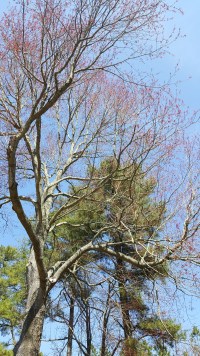
Even though things are starting to bloom, we still have cool days or periods of rain (when the bees cannot forage). This is a time of population explosion in the hive as the bees get ready for nectar flow–maximize the workforce. Rearing brood and drawing comb is energy intensive and though there is honey still in the hive, I’ve added some “feed”–aka granulated sugar–to help them over periods when foraging is impossible. The maple trees are breaking into bloom and the bees bring pollen from them back to the hive, but they are not a major nectar source. Bees are not like the postal service–some things do prevent going out to forage, hence the sugar that I put into the hive this morning. If the bees are getting plenty of nectar and pollen, they will ignore that stack of sugar and go out and bring back the good stuff.


Ò¿Ó

,

Consider the dandelion

It seems that spring may finally be here. Looking out my kitchen window I see that the maple (which I think is Acer saccharum) is budding. The honey bees are bringing different colors of pollens to the hive. I thought I had always been oriented to seasons–but it seems my observations were mostly related to what to eat that was in season. In other words, what to feed me. Now that I have honey bees I find that my awareness of seasons has broadened to include what is blooming that is providing food for my bees. We beekeepers have an orientation to flowering plants that is a bit different from the person interested in that velvet expanse of lawn, or the picture perfect flower garden: plants that are weeds to some are nectar and pollen for our bees.

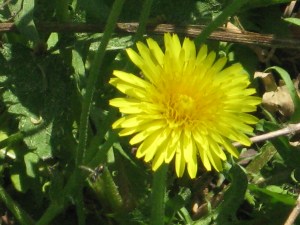
IMG_0875Consider the dandelion. It is the bane of many lawns–and people go to great lengths to get rid of it. From having grown up on a farm where part of our food was obtained from foraging (wild asparagus, lambs quarter, et cetera), I already had an appreciation of the dandelion. The brilliant yellow flowers and green leaves that appear early in the spring (or even when it warms up just briefly in late winter) signaled fresh greens on the table–a reprieve from canned food. While “harvesting” those precious greens we would find the bees sharing our interest–busily mining those bright yellow flowers for nectar and pollen.

There are many plants that are weeds if they appear in the lawn, or in the flower bed; that should be more attention as food plants, for us and the bees. Some plants found in the flower beds can also be eaten. Dandelions have become “gourmet” now. They’ve appeared in the produce case, the farmers’ market, and should you want to grow your own you can buy the seeds from Johnny’s Selected Seeds.  Young leaves can be used as salad greens, perhaps with a hot bacon dressing. Older leaves can be braised as you would other hearty greens. Older greens do have a bitter flavor, which I don’t find objectionable; however, some people have a genetically determined distaste for bitterness. These are for everyone, but if you like arugula, escarole, or frisée you might want to try some dandelion greens.  Even if you don’t want to eat them, the honey bees find the flowers a source of nectar and pollen in the early spring. Please don’t kill the dandelions!


Hive inspection 29 Feb 2016

IMG_8958It’s a lovely, sunny (but slightly breezy) almost 70-degree day, fit for a hive inspection to do a recheck on the queen cells noted on the 21st and to go into the bottom body to assess brood. I was fortunate to have friends–aka “bee buddies” to lend extra hands and eyes. So there are a few pictures of the queen cells and (unfortunately) of the two varroa mites that we saw.

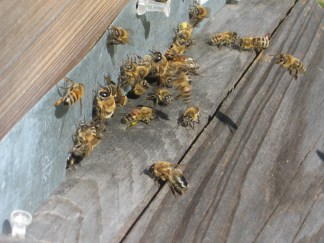
There is lots of activity in and out of the hive. It appears that the girls are finding pollen–a rainbow coming in ranging from cream, greenish-white, bright yellow, to deep golden yellow. The pollen baskets are better filled today. There were drones out and about today too.

Happily, the queen cells are still open and without egg or larvae–which makes me a happy beekeeper. Although there was some capped brood in the lower body, there is not enough capped brood to do a split, but lots of nectar and pollen stored.  I have to wonder if they were not slightly honey bound.

I did place a new super with wax foundation for the girls to expand into so that the queen has more room to lay–so that I can get enough brood to do a split in a month or so. It’s a relief to find those queen cells still vacant today.  I’ll be hoping that they are still vacant in a week because we have some more cold weather forecast.

The girls have demolished five pounds of fondant in the past week, and given the forecast, I guess I’ll need to supply more food for that period, but since we still have some nighttime temperatures hovering close to, or slightly below, freezing it seems a little premature to start syrup yet. Now the question is do I buy more fondant or do I try one of the techniques for feeding granulated sugar.

I got my first look at varroa mites–two of them–on one bee today. Even with the video of last week’s inspection and looking at lots more bees today we saw only two. It’s time for me to get out the sticky board and also to do a sugar roll to get a better idea of the mite population.


Beekeeper Happiness

This was taken from the video that friends did while I was doing my inspection yesterday. It was wonderful to have the extra hands, as well as video–as well as good company. I think this is about as close to picture of happiness for a beekeeper as you can get.

RG Queen bee

(I haven’t seen the whole video yet–but I’m excited–and I gathered from comments of the videographer that you can also see eggs in the open cells around where the queen is. Nothing like finding that you’ve got a queen-right colony!

Hive inspection 21 Feb 2016

The temperature was in the upper 60s today so even though it was cloudy with a light breeze I opened the hive to see what my colony was actually doing. OMG–do I ever have lots of bees.

IMG_8956Yesterday and today there was a lot of activity in and out of the hive. Some of the bees seemed to be just flying around the hive. I wondered if this was orientation flights for “new” bees.

Friends, also beekeepers, came to help with the inspection and videoed the frames as I pulled them out for inspection. None of us could guess what we were likely to see when we opened the hive. Other beekeepers have reported colony loss and/or low populations coming out of winter, so I wasn’t expecting so many bees. My hive is set up with three medium bodies for brood and honey.

Since this is my first winter as a beekeeper, I wasn’t sure what to expect. From my las inspection, I knew that the girls and continued to draw comb all winter and to build some
20160116_135200

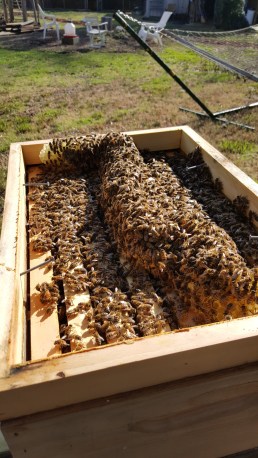
burr comb

impressive burr comb in a strip on the frames of the upper body in the space where the candy board was–before they ate it all. After removing the quilt box and the frame that used to have candy in it, the first task was to remove that burr comb. There was some capped brood and honey in this, but I removed it anyway. I was expecting the girls to get a bit testy when I did that but they didn’t.(I can still say that I have a very gentle colony.  I was able to do the entire inspection without gloves.)  ithWe did use the smoker more liberally than usual for me, simply because there were so many bees that I had to have them move down onto the frames before each was pulled out to look at the brood pattern, honey stores, pollen, and search for the queen.


We did use the smoker more liberally than usual for me, simply because there were so many bees that I had to have them move down onto the frames before each was pulled out to look at the brood pattern, honey stores, pollen, and search for the queen.

The bees have drawn more frames since my last inspection–even the outside frames in the second and third frames were being drawn out though in the second body they were not filled with honey. We were able to see brood in all stages of development. The queen was in the middle body–just trucking around doing her thing. The capped brood pattern looked good. There were capped drone cells, and drone pupae in the burr comb. We saw drones moving about on some of the frames–but probably not an excessive number given the overall population of the colony. I’ve seen drones flying, and the girls seeming to show some reluctance to let them return to the hive. Since it’s spring, they are raising drones so that they can go to drone congregation areas and mate with virgin queens.

As we pulled the frames from the middle body, I could look down onto the frames in the lower body–and I could see LOTS of bees there too. It seems that I have wall-to-wall bees in the hive. We found one queen cell, still open, at the bottom of one frame.

The hive is crowded so I anticipate making a split soon to prevent (I hope) swarming. I didn’t do that today as starting tomorrow the temperatures are supposed to drop back into the lower 50s (except for Wednesday when 65 °F is predicted. I didn’t think that there was enough stored honey to do a split today–though there are certainly enough bees.  Now it’s decision time–and time to consult an experienced beekeeper! Do I do a split, or do I add a super to this hive. (Thankfully, tomorrow is bee school so I have an opportunity to talk to experienced beekeepers.)

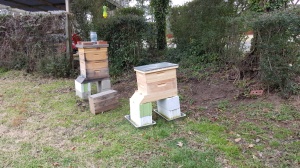
I’m sure I need to do something to provide more room for the colony or they will likely swarm. I set up another hive just on the basis of how many bees I saw last inspection and the amount of activity at the hive, but I was NOT expecting such a large population at this time of year.  But there is now a second hive waiting for occupancy!

20160202_134754

Ò¿Ô

This time, as I set up the hive I’m putting in ant defense–water trays around the concrete blocks.  I didn’t think to do that with the first hive so resorted to ground cinnamon sprinkled around the hive and cinnamon sticks tucked around the blocks. Next time I have the first hive down to the bottom board, I’ll put trays under those blocks as well.  Experience is a good teacher!

Now since I’ve graduated to two hives, I think I need to name them (#1 and #2 just don’t seem quite fitting for all those busy little creatures.) and I want need to be able to keep track of my queens (again, 2015 and 2016 just don’t seem appropriate either) so I’m contemplating names. I’ve had some possible suggestions from my FB posts (including Gryffindor and Slytherin) which dos suggests possibilities for naming queens as well.

Ò¿Ó
From hive to apiary?

hive added The bees are sending signals–they think it’s spring, no matter what the calendar says, or what the infamous groundhog says. (Happy groundhog day, all.) In reading about beekeeping you often find mentions of the varied opinions of different beekeepers–as 5 beekeepers and you will get at least 5 opinions. Well, in describing my hive situation to three master beekeepers I’ve gotten only one opinion: prepare for swarming.
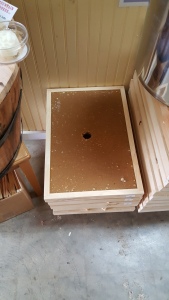
Not being one to ignore what seems good advice, especially with the consensus.  I’ve set up another hive in preparation for  (but hoping to prevent)  the swarming. One hive is soon going to become two.  The bees may dictate that I’m going to do this split sooner rather than later! I won’t know until it’s warm enough to get a good look inside the hive to see if there are swarm cells, or not.

Right now I don’t know if there is another queen in the making in the main hive (I guess that’s hive #1–but I need to think of something more poetic). From some quick searching on the internet, it looks as if I may have not choice but to allow the girls to “make” their own queen for those that stay behind in the main hive.

Ò¿Ó

I keep mentioning candyboard (or candy board) but I don’t think I ever explained what it is and why I put one on the hive for winter.

sugar in mould for bees

candyboard

Bee candy is just about what you would make for yourself–sugar and water–cooked to a hardball stage then poured into a mould that fits on top of the hive so the bees can get to it for emergency food in cold weather. The bee candy likely has some additions that you’d not like–essentially vitamins, and pollen or pollen substitutes. The is a picture of a candyboard taken in Bailey Bee Supply store while I was there purchasing hive components for the second hive. This is hard candy.  (There’s a photograph of the candyboard that I put on my have after the bees had worked eaten some of it.)  They ate the whole thing! Much sooner than I expected. Now depending on the weather the bees will need more “emergency” food.

Another option for feeding during times when there is not an adequate nectar flow is fondant (soft candy). Since I’ve displayed absolutely no talent for making candy–ever–I chose to buy both the hard and the soft from bee suppliers. I’m going to try the fondant for feeding now until the nectar flow starts. I’ll have to make some other decisions about feeding when the split is made–all rather weather dependent, and bee dictated.

It is possible to feed bees table sugar in other ways. In warm weather, a 1:1 sugar and water syrup works well, or dry sugar in an emergency. (There’s more about my adventures with that in other posts.)

Now, off to the books to learn more about doing splits! These girls obviously didn’t read the book or look at the weather forecast.

Ô¿Ô

.

Hive check 01 Feb 2016

IMG_8902Feb hiveThe uncertainties of the new beekeeper. . . .
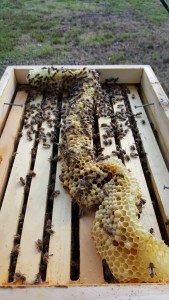
Since it’s warm, sunny today, I went out to check the hive. Bees are buzzing–including drones. There is pollen somewhere that the girls are bringing in. After seeing the traffic in and out of the hive, I decided to attack the burr comb problem after the temperature went up a bit more.

While waiting for the temperature to rise, I went to Honey Bee Suite to read about a camouflage bee suit, and spent most of the time reading about the experiences (from all over the country) of  unexpectedly large bee populations in the hives, considering the time of the year. That’s what my hive looks like as well–wall to wall bees with no sign of a cluster. Watching the traffic in and out showed pollen coming in and drones flying today.

Checking NOAA and Weather.com seems to suggest cooler than average temperatures in the southeast this spring, and wetter than normal–that suggests some time when foraging might be late or be sporadic. As I 20160116_134032gathered from Honey Bee Suite, since the girls have already wiped out the candyboard, the question now is to feed more sugar, or not to feed and hope the honey supplies are adequate for the rest of the winter. (As a new beekeeper, I’m not great at judging honey supply just from lifting the boxes–experience should change that.)

If I’m going to feed, I have to open the hive and remove all that extra burr comb that the bees in the space where my candyboard was, so that I can put in some emergency sugar for the rest of this winter.

(I have a plastic queen excluder to put on the bottom of this candyboard frame so that I can add more sugar or fondant (over waxed paper) where the candyboard was before. Next year’s candyboard will have more support underneath–like the queen excluder–than this one did so that it won’t collapse onto the frames.)

Ò¿Ó

This afternoon after the temperature had gone up,  I thought I’d be able to open the hive and remove this big batch of burr comb; however, it is windy today. At my hive location, I estimated the wind at about 15 mph (local weather showed up to 18 mph). My thoughts on opening the hive in that much wind were first, there is brood in the frames just under this burr comb, and second, that there is too much wind to use the smoker effectively (have tried that).

I discovered with a quick peek at one corner of the quilt box that there are bees all over that burr comb. My bit of experience with the smoker tells me that there’s no way I’m going to be able to smoke them down into the hive with the wind. Even when trying to puff smoke when lifting the quilt box a bit wasn’t successful–it just blew away. Even though I don’t smoke heavily for my inspections, I don’t think I could remove that comb without smoking. (The girls that were flying were paying a lot more attention to me than they usually do on a beautiful calm day though they were not aggressive, but then I was just looking and not doing anything like taking the roof off of their home.) I’d suspect that scraping that much burr comb is likely to attract their attention.

From my last inspection, I know that there is brood on the frames just under that big batch of burr comb, so I am concerned about heat loss and chilling that brood.   I’m going to have to scrape away that comb–and that means having the hive open longer than I’d think would be good for brood right under it.

The bottom line is that I wussed out and did not open the hive today and as the temperature drops I’m wondering (regretfully) if I should have done that little chore anyway. I did another “lift” and the hive feels heavy enough so that I think there’s likely enough honey for this next cool spell that’s coming. This uncertainty does mean that I’m going to have to attend to this problem soon!

A closer look into the hive

Sunny, but only 57 degrees Fahrenheit today, but I decided that I had to get into the hive enough to see what food stores were like. So off came the quilt box and the frame where the candyboard USED to be. It’s completely gone just as I thought from my hasty 20160116_134032peek the other day. Since it was rather breezy, I pulled only a couple frames and didn’t open the bottom hive box, didn’t look for the queen (except on the top of the frames), didn’t look for queen cells, or anything like that.

What I did find when I removed the quilt box was an empty candyboard frame. Not a crumb left, and the bees were building comb in the space left when the candyboard was devoured. I certainly was not expecting to see that. Since it was cool and breezy, I decided not to attempt to clean away the burr comb (brace comb or bridge comb are apparently all the same thing) on the top bars–I just wussed out and put the candyboard frame back on. It looked as if there was brood, and capped honey in the burr comb on top.

There wasn’t a sign of clustering–bees were spread all over the middle and upper boxes just going about doing what bees do. I just wasn’t expecting to see them actively building 20160116_134426comb at this time of the year. The two outer frames in the upper box, and the middle box are being drawn too–even though bees seem reluctant to work on those–they like to go right up the middle.
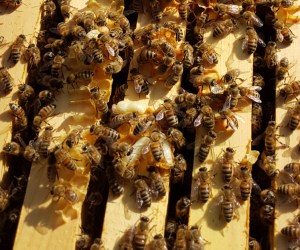
When I lifted the upper box, I found some more burr comb between those two boxes–and bees spread out doing their thing. (Not the best pictures, but I didn’t spend a lot of time taking them.) There were pupae in the brace comb between the boxes which was a surprise, but I still didn’t pull frames to locate the brood. Maybe I’m overly cautious as a “newbie”, but I didn’t want to chance chilling the brood that was on the frames.

I think the weather we’ve been having is confusing the girls–I know they are confusing me–and I’m glad that the “bee school” starts Monday so I can ask 20160116_pupae and burr comb_134800some questions of experienced beekeepers. It’s been a strange season so far.
Those “white bees” that you see where I’ve disrupted the burr comb are the pupae–they would have started to darken like the girls and would have chewed their way out of the comb soon.  I guess overall it looks as if I have a thriving hive here–and more bees on the way though the weather forecast is calling for cooler weather soon with daytime highs in the upper 30s and low 40s for the next week. Nighttime temperatures in the teens and twenties for about the next week.

After looking in the hive today, I think there is enough honey for the next bit, but I need advice from an experienced beekeeper on whether to feed–and how to do it in cold weather.

I was happy to see pollen being brought into the hive today though I don’t know where they are finding it–maybe on the Third Fork trail which is close. There was a fascinating array of colors–orange, reddish-orange, deep yellow, lighter yellow, greenish yellow, and some that could be called green or maybe chartreuse.

IMG_8874

Õ¿Õ

.


14 Jan 2016 hive report

Today is grey, drippy, damp, at the very least; otherwise it been pouring rain every time I’ve had to go out to run an errand.  On my trip to the hive today I saw a couple of the girls peeking out as if to check on the world without actually going out. I think it was the bee version of “yuck”.

Yesterday was sunny and warm so there bees flying and bringing in a bit of pollen.  I was at least able to lift the cover and get a glimpse of the inside of the hive. The first thing I noticed was that the girls have carefully applied propolis all around the edges of the quilt box so that it is difficult to lift the shavings and burlap to see down into the hive. The cedar shavings were wet on the top, but dry down next to the burlap despite all the rain and humidity.  That was good to see (and feel).

IMG_8826

candyboard 13 Dec 15

I was finally able to tug one corner of the burlap loose to peer down to the top bars of the upper  box. That immediately left me standing there with my mouth hanging open. The candyboard appears to be completely gone. Though I did not lift the quilt box off, I couldn’t see any candy left anywhere. There were bees on the top bars moving about and doing whatever it is that they do this time of year in this crazy weather, but certainly not clustered.

Looking back on my hive notes, I see that I put the candyboard on the hive on 11 November 2015. As you can see, there was a lot of it eaten by the 13th of December. (I can tell that I’m going to want next year’s candyboard to have some support in it, because I couldn’t lift this off the upper box to really look into it on that last inspection–not even a year yet and I’m developing some definite preferences for equipment.)

20151012_154335

04 Jan 2016

Looking at the seven-day forecast, it might be warm enough tomorrow, if it’s not raining or too windy to get a better look into the hive. If not tomorrow, it’s likely  to be a week (at least) before I can do an inspection.

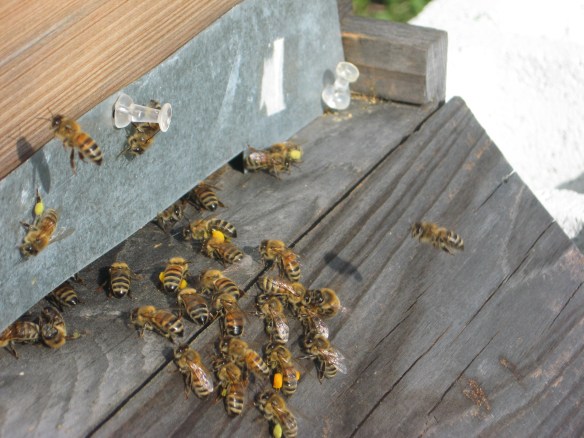
Keeping my fingers crossed and hoping that I’m just being a worrywart, novice beekeeper, but you can see that this pollen basket is not exactly stuffed–this was taken 04 January 2016–not exactly when you’d expect bees to be bringing in lots of pollen.


Ô¿Ó


Christmas day at the hive….

IMG_8850

I’ve just been out to take a look at the hive–I can’t help wondering if the girls boggled by the weather as I am. Sitting here working with the windows open is just not what you expect for the 25th of December.The bees are still foraging, but there is not a lot of pollen coming in, though there seems to be more today than a few days ago. Maybe more blossoms out there after the warm period we’ve had.

From the looks of the candyboard, there’s been a lot of noshing going on up there, as well as bring in what they can find. This yo-yo makes it really hard to figure out what to do with feeding. It’s been so warm that I’m now wishing that I had not placed the candyboard yet–I could still have been feeding syrup–but hindsight is so much better than foresight!

Now I’d best take a cue from these busy little creatures and get on with current indexing–do a little foraging myself for entries.

Merry Christmas, happy holidays to all!