Hive report (25 Sept 2015)

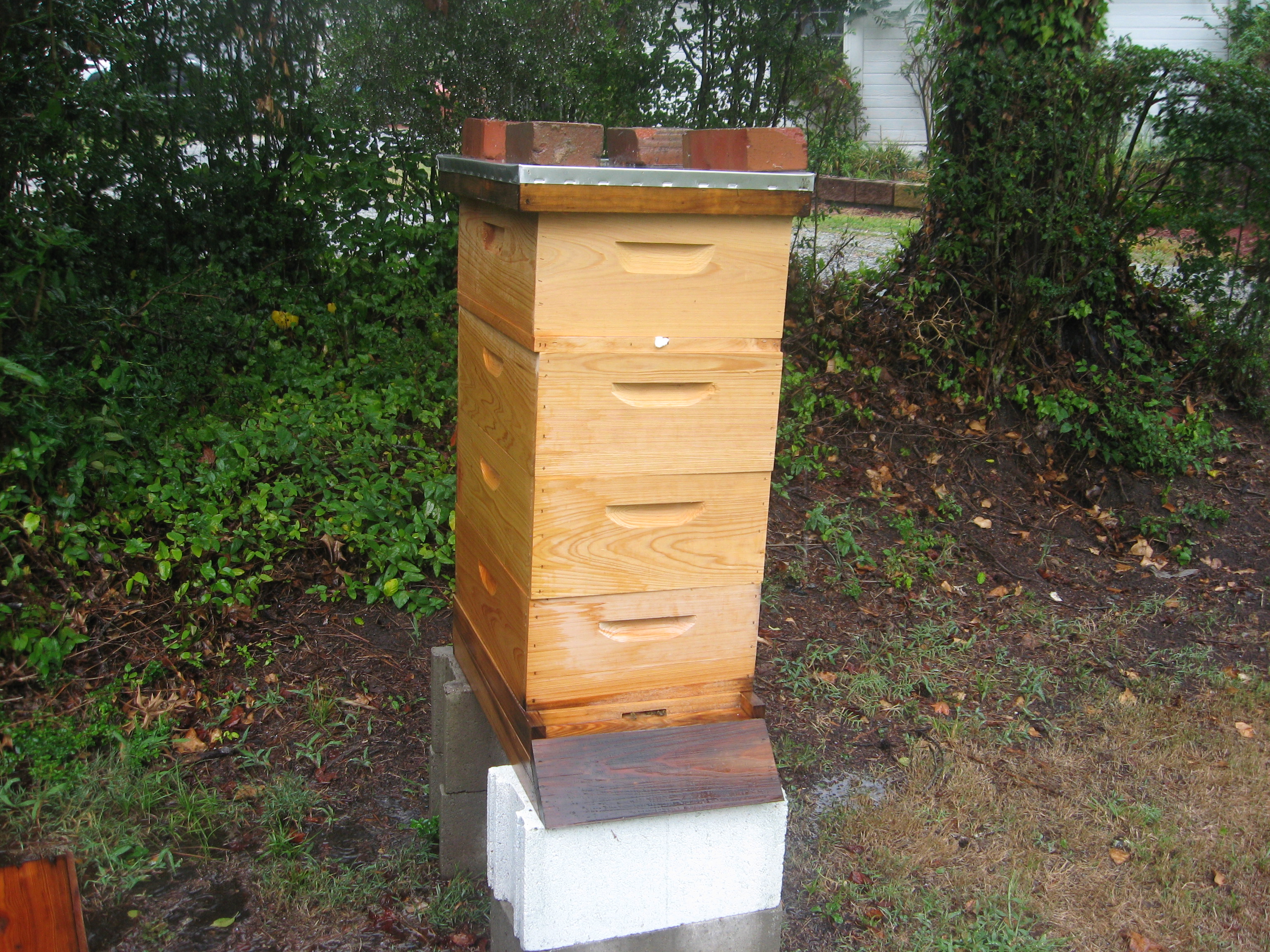
IMG_8472The hive was due for a routine inspection this weekend, but weather–cloudy, with rain–means it will have to wait until the next sunny day.  Check of the feeder shows that the girls are really slurping down the syrup.  No traffic today.

I’ll have to refill feeder in the morning–rain or shine.  Good thing about the feeder is that I don’t have to open the inner cover; just pull the quart mason jars and replace.

My curiosity is making me antsy–I want to know what’s going on in the upper super that was put on the hive  at last inspection. But that will wait–forecast sounds as if it’s going to rain all weekend so I have to wait until Monday or Tuesday to satisfy my curiosity.

Obviously, not a day to open up the hive–we need the rain so that’s good–but even the morning glories are showing the effects of the rain.

Ò¿Ó

Hive report (08 &10 September 2015)

traffic in and out of hive08 September 2015: Even though it’s a cloudy day there’s a good amount of traffic in and out of the hive–I’m glad I did give them a larger entrance to the hive when I had it open for the inspection.

I’ve looked at the flight path in and out of the hive and I think that they are heading for a local greenway/trail. Looking at Google Earth map, that is easily within a one-mile radius of the hive. I need to go hike the trail and see what is blooming now.  That’s one of the things you need to look at the blooming flowers from a bee’s point of view, and the quality of nectar produced by the flower. So much to learn….

Today I put the “stickyboard” in the screened bottom board to assess Varroa destructor (mites) in the colony to find out if I need to treat for them before winter. That has to stay under the hive for three days so I can get an idea of what’s going on with mites.

honey bees at hive carrying pollen10 September 2015:  The girls have been slurping down the sugar syrup (with Honey-B-Healthy), as well as bringing in pollen and nectar.  I gave them new syrup today as they had almost completely cleaned out the jars.

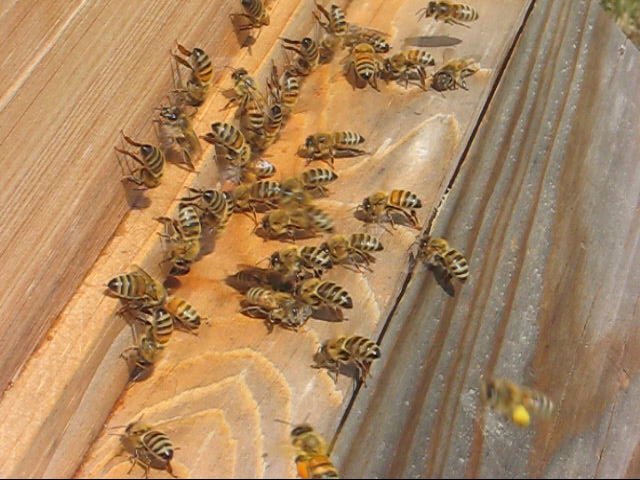
When I went out to the hive I got to see some different honey bee behavior:  I had bees washboarding on the front of the hive. No one seems to know what this behavior is, but it’s common, and it’s done by “adolescent” worker bees.

There was lots of traffic in and out–different colors of pollen being carried in–the bright yellow shows up most clearly, but I saw some orange, white, deeper yellow, and some very dark red while I was watching them come and go.

Tomorrow I’ll be able to pull the stickyboard and see what the Varroa population looks like.  Fingers crossed on that one since this is a new colony.  I’ve been reading about the various treatments, including some “natural” ones that use herbs, and other “harder” chemicals.

It will be another week before I can sneak another peek inside to see how much pollen, nectar, brood, and honey is there.  It’s  like wanting to peek into the oven to see if the soufflé is rising properly–not at all a good idea no matter how curious you are.

pollen colors

Hive Inspection (30 August ’15)

IMG_20150329_133928244_HDROMG–there are SO many bees in there. OK, I was expecting more bees given the traffic in and out of the hive looking like a really busy airport! (The RDU Apiport?  Sorry, just had to throw that in.)

Reality  hit when I lifted the inner cover. On my last inspection (15 August), the second medium box was only very sparsely populated-the girls were starting to draw comb on the foundation in it. There weren’t any full-depth cells, and no nectar or pollen then either.

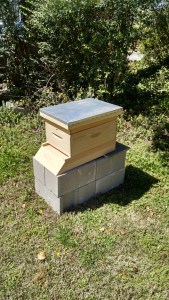
(We’ve progressed from the nucleus colony that had only five frames in one medium box (right), to needing three medium boxes now!  Happiness! I’m still learning what is supposed to be there, but the insides of the hive are beginning to look familiar.)

When I lifted off the upper box and set it aside so I could look at the frames in the lower box, I could tell that it was a lot heavier than on the last inspection. Good sign! Means the bees are stashing pollen and nectar.

When I looked in the lower box (where the nuc was installed) I could see empty cells, presumably where brood had hatched but had not yet been filled or reused. I didn’t find queen in the lower box, though everything looked good and hive_IMG_20150815_114521440_HDRthere were lots of bees down there.
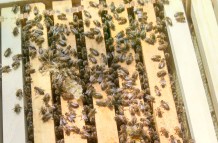
When I replaced the upper box and started inspecting those frames, I found the queen, and eggs. (It is really hard to see eggs. Now I know why the books say it’s good to have bright sunlight when you’re looking for them.) It was cloudy this afternoon and that made finding eggs really difficult. But there they were, and the queen was moseying around doing her thing with lots of workers . They had started to draw comb on all except the two outer-most frames of this box. I went to do this inspection expecting to add a third medium body to the hive–and I’m glad I did.  There was brood (capped and uncapped) in the upper box now, and queen (I think she needs a name!) was laying eggs up there. I knew that the population was increasing, but I didn’t really realize how much until today when I could look inside the hive. (I’ve been incredibly curious the last two weeks–it’s hard not to look every week, but not good for the bees. It’s disruptive when someone starts yanking you home apart.)

Ò¿Ó
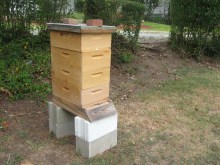
hiveI often go out  and watch them come and go–it’s hard to describe how relaxing it is to watch. Looking inside the hive is an awesome experience–realizing that each bee has a job, and all that activity is purposeful, not chaos. Working with the hive, with bees buzzing around you, maybe walking on your arms or hands, is like being off in another world.  Before my hands-on experience, I didn’t fully appreciate what other beekeepers were trying to describe about the experience of working a hive with bees all around you.

Ô¿Ô

 I have a feeder that uses four quart jars.  I wanted to be able to just switch out the nearly empty ones for filled ones, so I got quart four regular-mouth Ball/Mason jars.   I took new filled jars with me to do the inspection–after my experiences with spilled sugar syrup, there’s no way I’m going to work with it anywhere but over the kitchen sink.

When I put the hive back together, it turned out that those jars are just a tad taller than the jars that came with the feeder, so a medium super isn’t quite deep enough. Since the bees access the jars below and can’t get into the upper super, I just let the outer cover be a bit catawampus this evening.  First thing tomorrow morning I have to make a trip to Bailey Bee Supply tomorrow for a shim so that the cover will sit properly.

ÒυÓ
Friday hive news

honeybees at hive entranceAs you can see from the video FB post, there’s a lot of traffic in and out of the hive–fall nectar flow.  That kind of traffic makes for a happy beekeeper!  It’s so hard not to look into the hive more frequently than I should, but I’ll get to check what’s going on inside over the weekend.  Watching the activity from the outside makes me feel like I’m going to see that a lot of work has been done on the inside!  I hope that there’s enough pollen and nectar stored that I have to add another super so these girls will have lots of food for the winter.  Nectar must be good since they are not taking much of the sugar water–they know where the good stuff is.

Just a bit of frustration, though certainly not with the bees, but my telescoping cover seems a little cattywampus so I’ve got yellowjackets in the top super where the feeders are located.  BUT, they can neither get into the hive nor can the bees get into that super.  I need to find a solution to that.

(I also need to find a video converter so that I can post videos here–I’m so impressed with the traffic in and out–there’s no way to capture it on a still unless you’re very lucky.)

Ò¿Ó

At the hive. . . .

bees on upper super top framesMy last inspection was a little off my intended schedule–I didn’t want to open the hive with yellowjackets buzzing around. They were finally gone last week so I peeked into the hive to see what the “girls” were doing. (I have to keep reminding myself that the colony only arrived here on the 24th of July.)  Definitely more regular traffic in and out lately, carrying pollen in all colors different colors.

Goldenrod is starting to bloom here now–and I think I’ve seen ragweed.  I’m not yet used to looking at fall flowers for a bee’s point of view. From the meeting of the Durham Beekeepers association this week, it seems that I was correct about the goldenrod, and the asters will be later.  It’s a whole new perspective on looking at flowers when I consider the bees!

There is new comb in the upper super, but only very rare pollen or nectar, so I didn’t add an extra super this time. I’ll be checking again in about a week to see where we are. I’ve asked an experienced beekeeper to go through an inspection next weekend.  It will be good to have a “teaching” inspection since I wasn’t able to get into a class before my bees arrived.


Hive report

bee coming to hive with pollenThere is considerable relief in the last couple days as I watch the traffic in and out of the hive. There are no longer guard bees clustered on the landing board–they are able to do their job from inside the hive since the sticky mess of spilled syrup has mostly been removed by changing the cement blocks that were saturated with it, and there’s been some rain that apparently help wash away what was on the hive and the ground.

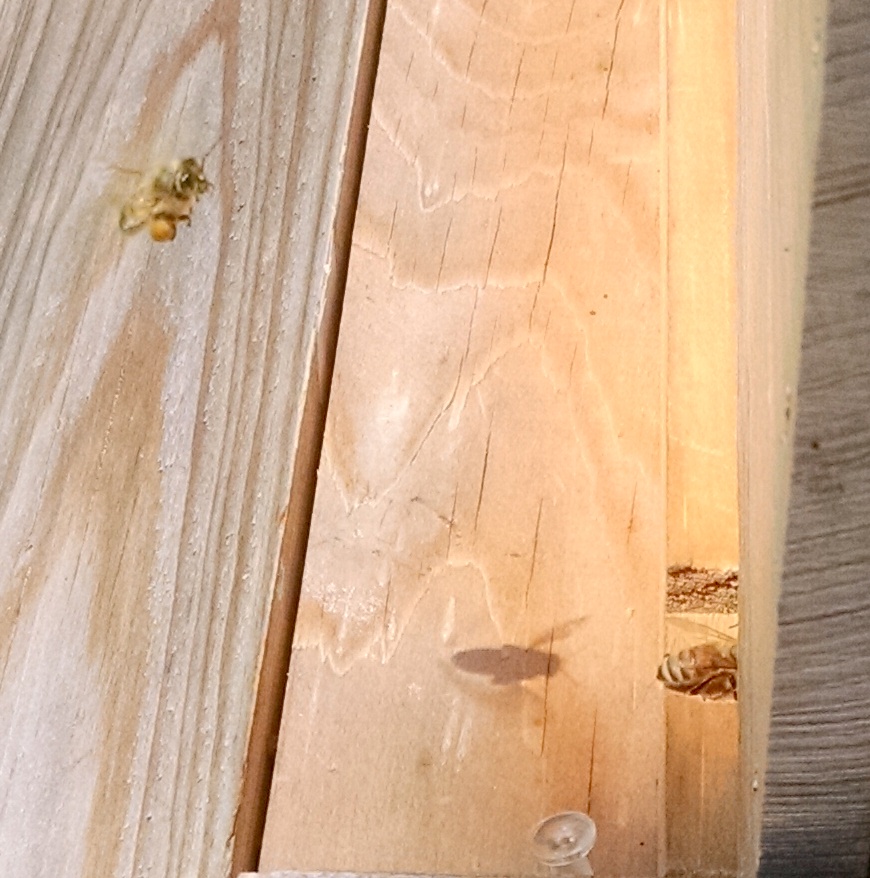
It’s very relaxing to watch the steady traffic of bees coming with pollen–white, yellow, orange, and some greenish in color.–and then heading back out for more.

Only the very occasional bald-faced hornet seen now and the yellowjackets seem to have either been trapped or decided that the sugar left around the hive is not worth fighting the guard bees for.

A pestilence of ants

Perhaps pestilence is a bit too strong a term, since I’m not literally dealing with plague, but I’m frustrated.

I’m not used to seeing insects strolling about my kitchen, but lately I keep seeing those little tiny brown or black ants that are called “sweet-eating” or “sugar” ants. I’ve had them invade before–you know, the moving black line, marching steadily toward something. . . .

But these aren’t in a column, a cluster, or even a group! If they were in a marching column, I could see where they are coming from, and where they were going. them. I could attack them effectively with traps or spray. If I knew where they were coming from, I’d sprinkle cinnamon or lay cinnamon sticks out.

Well, these aren’t marching purposefully toward anything. They aren’t even marching–they’re meandering. They aren’t obviously coming from anywhere. http://antark.net/They act as if they were on a Sunday afternoon stroll–not exactly wandering–each individual seems to know where it is going but with no particular destination all,  just one or two at a time, and in various directions, nothing consistent. The little b-….er, beasties are just there and they have been for weeks. Only a few at a time–just continually there.

If there were hordes, masses of them streaming across the counter, I wouldn’t really be surprised. Since the bees arrived,  I’ve been mixing sugar syrup to feed them.  I’ve had more sugar in my kitchen in the last three weeks than I’ve probably had in the whole rest of my life.  Until the bees arrived (and needed feeding  until the fall nectar flow really gets going), I bought sugar by the one-pound boxes since I couldn’t get anything smaller.  Now I’m bringing it in four-pound bags–several at a time, and mixing simple syrup by the gallon. So–I’d expect “sugar” ants. I could deal with the massive march that had an origin and a destination.

But that is not what seems to be happening here. They are not even walking purposefully–they’re just promenading ants!

Still Sticky, continued

We had some rain last night, but it seems that all it did was to make the spots where the sugar syrup spilled wet again, and get attention back to those.

Bald-faced hornets (BFH) and yellowjackets are still skulking around the hive.  I’ve put out traps–homemade ones–with soda for the yellowjackets and meat (tuna and chicken) for the BFHs.  At least this morning the BFHs were grabbing some of the yellowjackets and making off with them. There are lots of bees at the entrance apparently on guard duty.  Bees carrying in pollen are coming and going–though it seems their pollen baskets aren’t as stuffed as they were a few days ago and the pollen whitish-greenish!

A few yellowjackets have made it into my homemade traps, but so far no BFHs.

Still sticky

Perhaps this should be titled sequelae to stickiness sequelae. . . .and for all my friends who are grammarians, I used sequelae intentionally, to refer not to this sequela to the previous post, but to the myriad, multiple, bucketful, and gobs of effects stemming from that one event of a leaky syrup container.

 Ò¿Ó

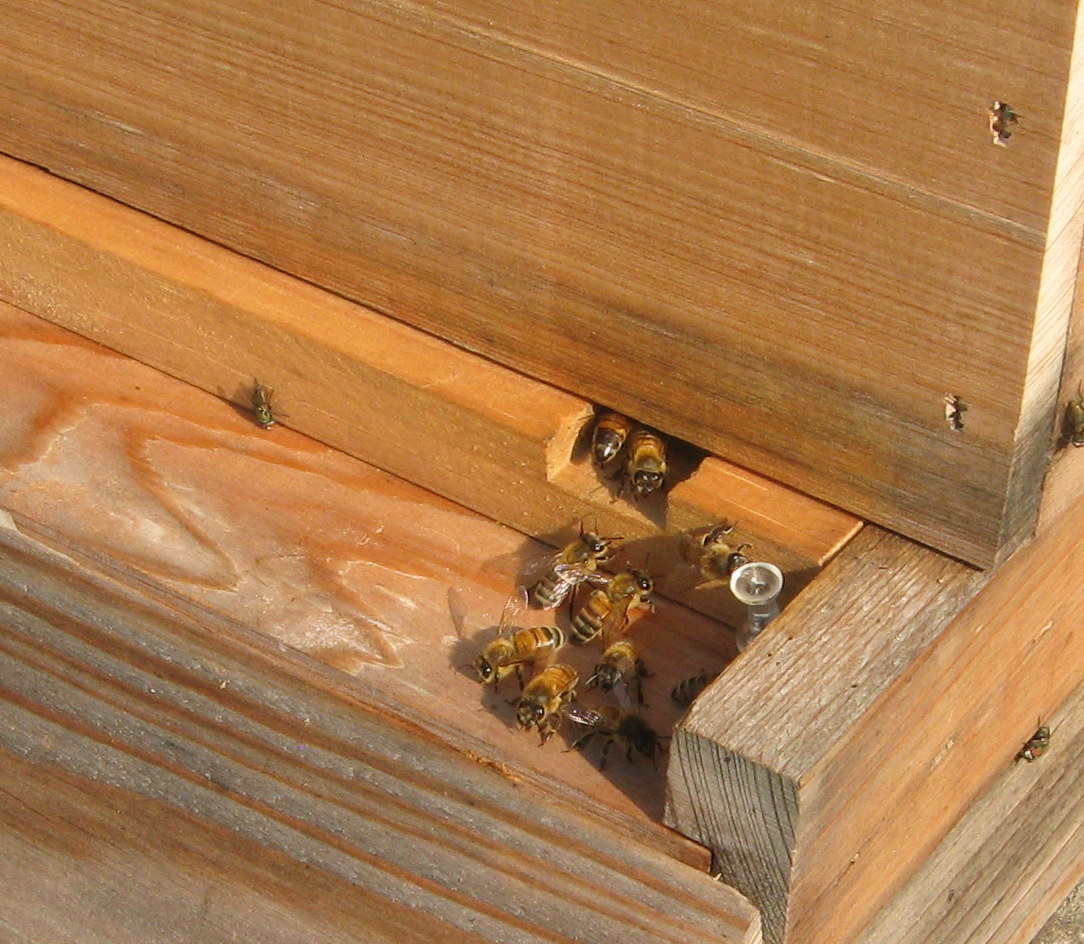
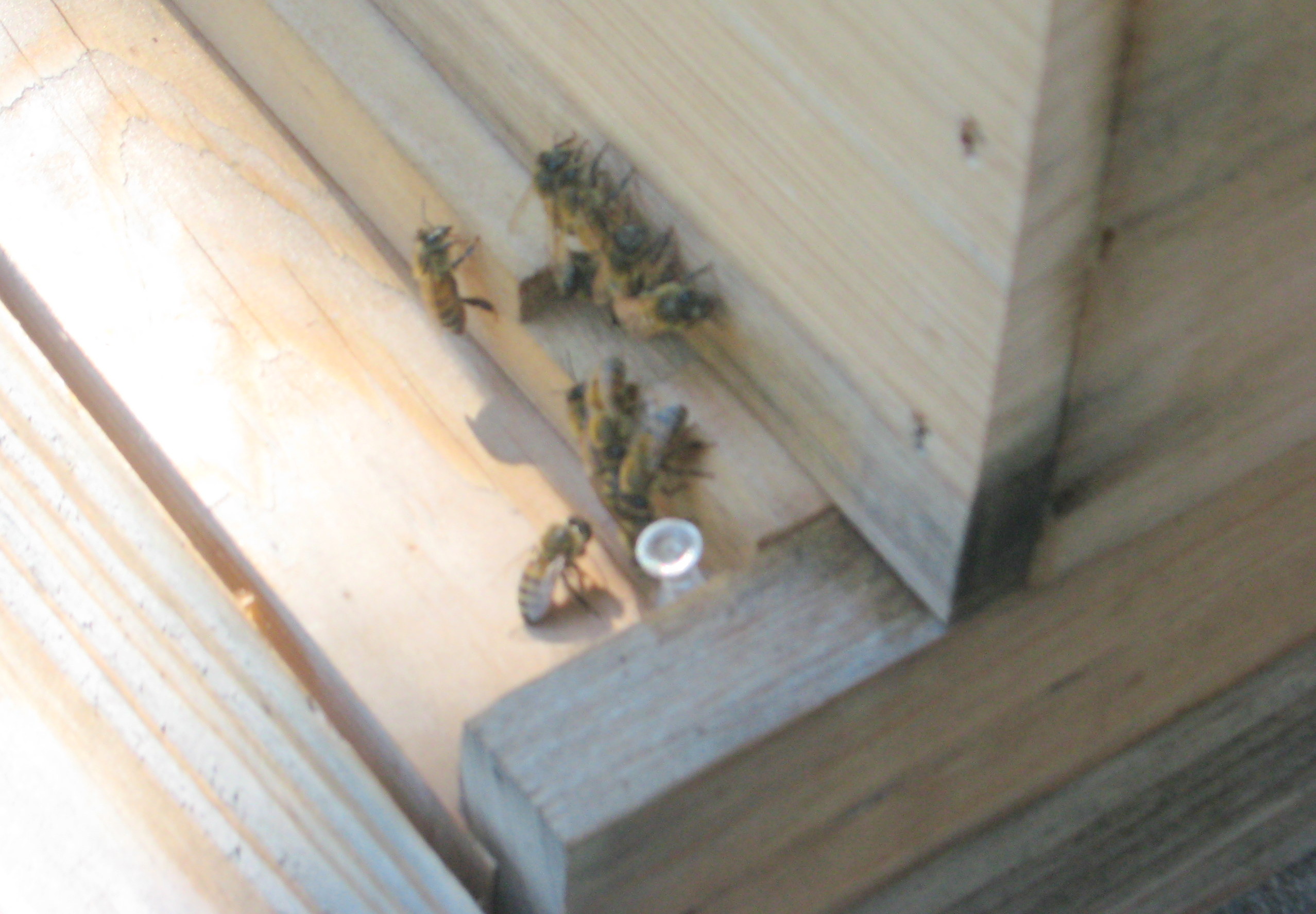
bees at hive entranceOn hive check this morning, it looks like normal activity at the entrance. No “invaders” hanging around the entrance for the time that I was watching–just “my girls” coming and going on the landing board.

I have traps out for yellowjackets and for bald-faced hornets.  Looks as if a few yellowjackets have been lured into the trap.

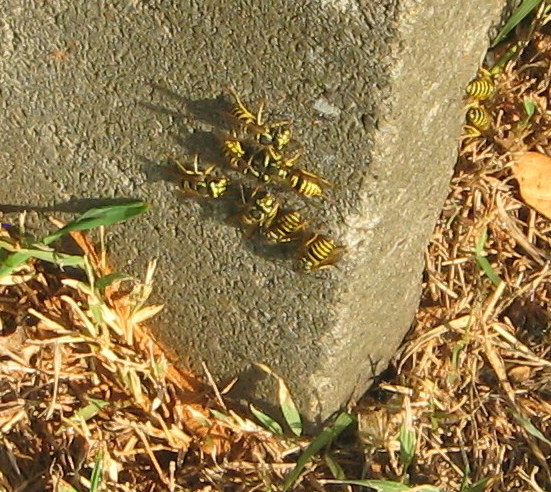
Unfortunately, there are still yellowjackets clustered on the lower right cement block that is supporting the hive.

I suspect that yellowjackets on cement blockwas were most of the sugar syrup flowed down.  That rather porous material is probably saturated with sweetness! They see to be preferring that to the trap with Coco-Cola in it. More concentrated sweetness (I hope). Maybe when that’s all been slurped out they will like the trap better.

I’m contemplating how to be sure that my pail feeders are not leaking, although when I check the inner cover and the empty super covering the feeders this morning there doesn’t seem to be wetness that would suggest feeder leak that would be dripping through the hive. I guess time will tell.

Stickiness sequelae

unknown bee-like visitorAnd in our continuing beekeeping saga is the sequel to stickiness. . . .still sticky!

The hive is fighting off invaders after the syrup spill.  I’d been hoping for rain, but that didn’t happen, so it was out there with the hose making like a rain goddess. All sorts of unfriendly creatures: bald-faced hornets and paper wasps I could identify without problems. Then there were (at least I hope I’ve gotten rid of some of them) others that are as yet unidentified (even with the Audubon guide). I’ve yet to do an internet search.

I think that others are yellow jackets–at least they were busy enough with the sugar syrup (dried on the hive) to mostly ignore me. The honey bees do have a fight on their hands right now, though it was looking much better after the second time I washed down the hive.   This is incredibly frustrating–I changed the style of feeder to avoid this exact thing, and then to have cropped invaders IMG_20150805_135640958even more syrup dumped onto the front of the hive and into the hive! (I’m not sure what I’ll do with the feeder that did the dump–maybe take it to the beekeepers meeting and see if anyone who already uses and likes it, wants it–I don’t think that I’ll try it again!

At left is one of my girls with one of the invaders. I really didn’t hang around to try to take pictures–I was busy with the hose. And some of the yellow jackets were just a bit PO’d about getting rained on.

These girls have really been slurping down the syrup, so I had to add more.  I went to the bee supply and got a second pail so that I didn’t have to keep the super where the feeder lives open long with all this activity of the invaders. I guess drawing all the comb and defending the hive takes a lot of energy. I’ve been reading some statistics on how far a honey bee will travel, and how many flowers she must visit to make a pound of honey, and how fast they can zip for flower to flower. Amazing creatures.

Ò¥Ó

I’ve just been out to the hive to take another look around. The girls are patrolling, but the entrance with the guards is quiet. Still a couple paper wasps around, but not on the hive or near the entrance. I really didn’t need this actual experience of  what a mess spilled syrup makes–I’m going to be taking a lot of precautions to see that it doesn’t happen again! I know it was stressful for the bees, but it was stressful, and distressing for me too!  I’ve noted that even with all this going on they were still quite gentle with me–I didn’t put on protective gear to work around the hive or to change the feeder. I think that they must have held their own pretty well since there were more of the opposition dead that my honey bees.

Since I put on the new box and frames last Friday, I may be looking in to see how things are going this coming Friday, depending on the weather.

And, to end–here is the nice quiet hive entrance after the washing down. That’s just normal coming and going.after washing progress IMG_8231