
There’s been a huge hiatus here–I don’t know why it is that no matter how well I think that I’ve prepared for the beginning of the Fall semester of teaching, it always seems to degenerate into a hectic time. I’m beginning to feel like I’ve got the semester organized now, so I’ll try to get back to more regular posts! Meanwhile, I’ve reblogged a couple of things that I thought were interesting.
Category Archives: Food for thought
Costco, even for one…
Great post! Even those of you cooking for one should take a look at this! I do use Costco–even for one!


Some people are surprised to hear we have a Costco membership when it’s just the two of us. I admit, paying to shop someplace is a hard sell for me, especially when we only go a few times a year. If you’ve never been to Costco before, only been a couple of times, or never really inspected the shelf prices, it’s easy to get carried away; not only can the selection and the store itself be kind of overwhelming, but the fact you’re paying for the privilege of shopping there makes it easy to assume everything you come across is going to be a great deal. Of course, this is not always the case, especially if you’re already making the effort to buy groceries in bulk and on sale. That said, the past few years have taught us a few things regarding what to buy (and what not to buy)…
View original post 1,151 more words
Green Salad with Watermelon, Feta, and Mint
I’ve mentioned this salad before, but it’s good for a last taste of summer before the best of the watermelons are gone. Enjoy!

A friend sent me an urgent email the other day.
“Make this salad,” he instructed. “I like that salad,” I told him. “But have you tried this one?”
He re-sent the original link. I saw his point, and went out to buy a watermelon.
View original post 210 more words
Baby vegetables?
One of the culinary “rages” a few years ago was micro-greens, and now it seems to be baby vegetables. Do you know what a baby vegetable is?
It’s not a very precise term in culinary lingo. If you’re interested in the culinary history of baby vegetables, take a look at “Eating Babies: A Study of Youth Horticulture” from Slate Magazine. We seem to have gone through a phase of the only-good-veggies-or-fruits-are-huge-ones. So we’ve selected for the “big” produce. (Think about storage onions, for example–how I would love to be able to buy small onions!) So now we’ve made small veggies (or fruits) a “gourmet” item–and created confusion with terms.
We really should not think of baby vegetables in the same way that we think of ourselves or even as we think of cows, or chickens, or hogs, as babies, adults, or the like. There have been so-called “baby carrots” in the supermarket for a long time–but those are NOT really “baby”–they are full-grown, mature (adult?) carrots that have been reshaped by some entrepreneur who had a surplus of gnarly, misshapen carrots that could not be sold any other way. Now, these “baby-cut” carrots are made from carrots bred for increased sugar, rather than the misfits. So those still should be called “baby-cut carrots”, not baby carrots.
Then consider cherry and grape tomatoes–are those “baby” vegetables? Well, yes–they are smaller versions of Solanum lycopersicum. Some are big like the Big Boy, or the Cherokee Purple. Others are smaller, or miniatures, like the Sungold, Sweet 100, or currant tomatoes, but we don’t call them baby tomatoes–but we could by the common usage of the term “baby” vegetable.
So is a baby vegetable just something that has been picked while still young and small? In many cases, that answer to that is a resounding no! Just like haricots verts are not pole beans or Kentucky Wonder beans picked immature or tiny–they are a different strain or cultivar of Phaseolus vulgaris.
So, are there really baby carrots? What about baby artichokes? Baby eggplant? Some carrots labeled “baby” are simply immature carrots that have been pulled because the carrot patch needed thinning, not because they were ready to eat. Frankly, most of that ilk of “baby” carrot is pretty tasteless–not really what I want when I want a carrot–but mature, small carrots I love! Yes–there are carrots that are bred to be small at maturity–and taste good too. (But then, neither do I want the 3-pound mega-carrot–I’ll use that for making stock.)
The term “baby” should be reserved for use with those things that have been bred to be small, grown to be mature, full-flavored, miniature, ripe produce, with essentially the same caloric value and nutritional value of the larger vegetable or fruit. According to the AgriLife Extension from Texas A&M System there are about 50 types of baby vegetables grown and marketed in the U.S. (This number may be low now as this material was in their archive, but it gives you some idea of the growth of the baby vegetable market.)
The term dwarf usually applies to plants–which may be small, but may grow full-sized fruits. To further complicate matters, plants respond to their environment, so some fruits and vegetables will be “dwarfed”–or grow smaller, if plant too thickly, or closer together–e.g. cabbage. Some smaller heads are simply standard cabbage that is planted close together–e.g. 8 inches instead of 18 inches in the garden.

baby vegetables
Obviously I feel that the “baby” vegetable is a misnomer–that should be the puréed stuff that Gerber puts out to be fed to small, immature humans, and we should use miniature to refer to small veggies and fruits!
(Yes, the image is from Gerber.com!)
New potatoes

newly dug
There are lots of benefits from growing your own food! You know how it was grown, when it was harvested, and that it’s going to taste better than supermarket produce. Aside from these obvious benefits, there is the very sensual, and sensuous, experience of harvesting your own food–tactile, olfactory as well as the anticipated gustatory experience.
I harvested my first potatoes today. The smell of the earth as you dig them–newly turned, feeling cool to the touch, and the smell of the potatoes (yes, you can smell them), and anticipation of the taste are things you’re not going to experience when you buy them in the grocery store–not to mention that you can’t get new potatoes unless you go to the farmers’ market. The other advantage of growing potatoes is that you can skulk out to the potato patch and gently unearth some of the marble-sized ones whenever you want–you can do that without uprooting the entire plant and treat yourself to something that you’re not even likely to find at the farmers’ market.
Now, I’m not advocating that you should try to grow enough potatoes–or any other vegetables–to meet all your needs since that’s not feasible for most of us urban gardeners; however, it’s worth growing a few just for the total experience of having new potatoes. I’m certainly not going to grow things that are readily available at the farmers’ market inexpensively–like summer squash, eggplants, or other basics. I’m going to reserve my gardening efforts for the special treats–like a hill of potatoes, or radishes, or haricots verts.
I recently purchased The food lover’s garden: amazing edibles you will love to grow and eat by Mark Diacono (See Bibliography). It’s worth a trip to the library to check this one out and read it–especially if you’re contemplating a foray into gardening. It will make you think about what you really want to expend time and effort on for your garden. The philosophy is that of a true food lover! It’s full of information on somewhat esoteric veggies that you’re certainly NOT going to find in the supermarket, and may not even find at your local farmers’ market. The philosophy is that you should grow the things that YOU really love to eat. There are a lot of really wonderful vegetables and fruits that aren’t readily available–salsify, scorzonera, kohlrabi and the like, as well as some that are just much better harvested as you’re ready to use them (brussels sprouts, broccoli for example) that will make you feel like it’s a different vegetable than what you brought home from the supermarket! These are the ones that deserve space in a small garden, and the time and effort required to grow them.
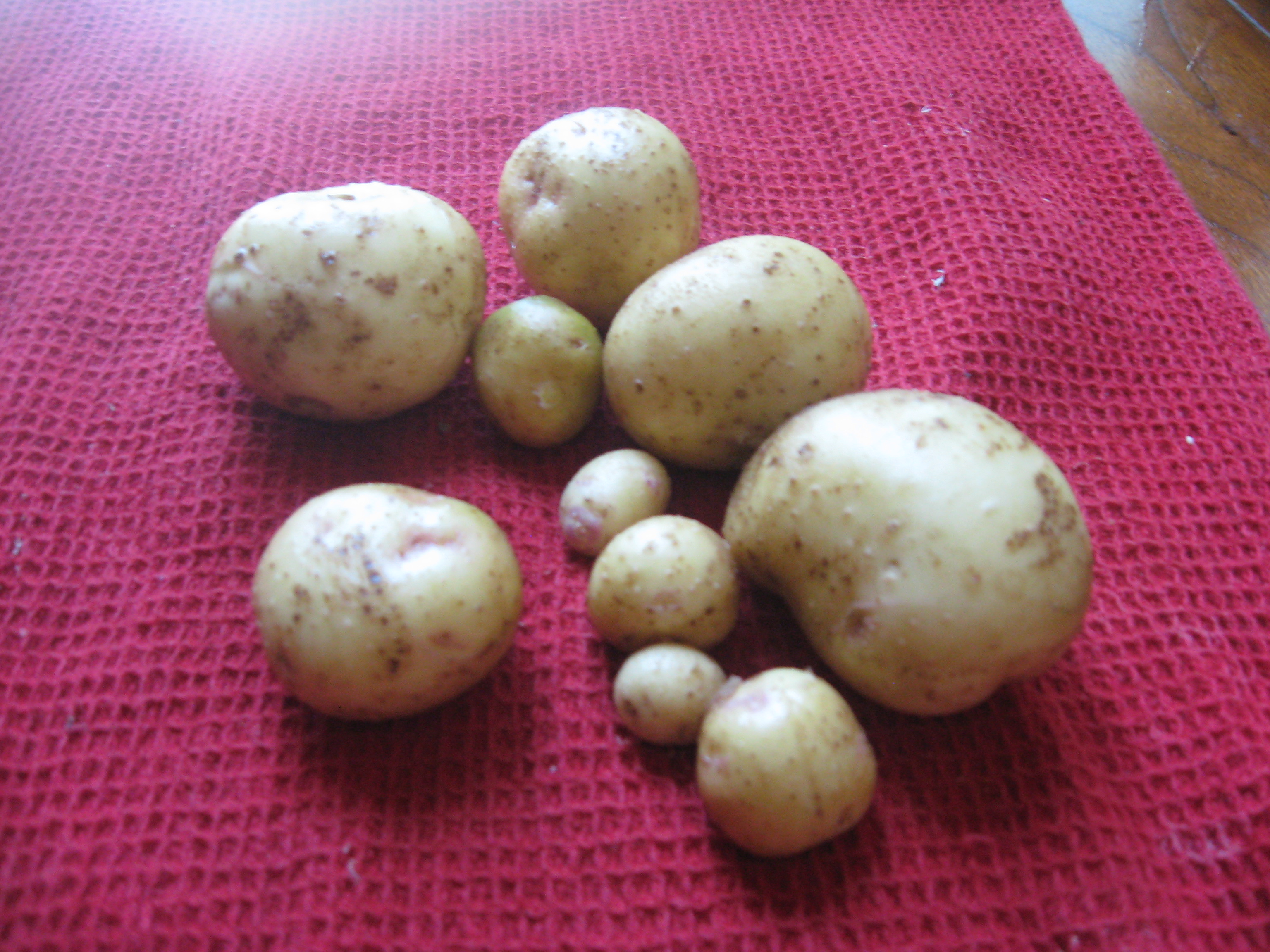
washed and ready to cook
In my case that includes at least a hill or two of potatoes (you can grow the in a large container) so that I can have the total experience–from planting, sneaking a few very small potatoes early to go with the fresh garden (English) peas in a luscious cream sauce, or larger new potatoes in some other simple fashion. That means that I’m going to continue buying my yellow storage/cooking onions from other people–though I do have my little clump of “walking” onions, and some tiny carrots to give me a special treat when I want carrots featured; but the carrots for sofrito or mirepoix will continue to come from other people’s efforts. The baking potatoes that I use will also come from somewhere other than my garden–they’re basic, inexpensive, and readily available at the farmers’ market or supermarket with the organic produce. I will grow some that are unavailable commercially because they’re something I love to eat.

mashed new potatoes
Something as unusual as new potatoes doesn’t need fancy preparation. Steamed, boiled (in their skins), or even cooked in the microwave oven, need only a tiny bit of good butter (preferably unsalted, sweet butter) or fruity extra virgin olive oil, some sea salt and fresh-ground black pepper for a luscious meal. Since these were quite variable in size, I cut them into chunks that would cook quickly and evenly, and nuked them, then added a pat of butter, and roughly mashed them with a fork, added sea salt and fresh-ground black pepper–there’s the main course. (The potatoes were accompanied by a slice of garden-fresh, vine-ripened tomato, and some haricots verts–also from the garden.)
A son goût!
GMO or not?
I’ve seen posts on Facebook saying that the PLU codes indicate whether produce is genetically modified or not–wanting more information I did a little searching, including reading some FB posts. I thought I’d share this commentary on the PLU codes from Snopes.com and the Huffington Post. It would be nice if it were as simple as looking the PLU code for reliable information!
Buying avocados
Just a quick note on a blog post that I read today.
I love avocados, but how many times have I gotten home and found the inside gross, icky brown, and had to pitch the avocado? Well, too many.
I was interested to see this post on Northwest Edible Life (via Facebook): Never buy a rotten avocado again. This is a method of checking out the interior of an avocado in the store–I’ve not heard it before, so I’m anxious to try it out.
Another thing to try with beets….
Since I’ve written about beets, I thought I’d share this link to a recipe for a pâté. I came across this while perusing the food blogs that I try to follow.
I’ve not made it (yet), but in my mental image and tasting, this is an appealing combination that I’d like to try.
Quinoa pudding
I’m happily not intolerant/or sensitive to lactose or gluten, but this summer pudding looks like a must-try to me, since I really like quinoa!

 Sweet, cool, soothing, filling, and easy to make—this is a pudding that’s just right for hot summer days. This dish is also a new version of a versatile favourite. (Earlier warm pudding versions used dried cranberries and puréed pumpkin or squash.)
I keep finding myself coming back to this pudding recipe whenever a possible ingredient makes itself known: in this case, aging bananas crying out to be puréed. But bananas are calorie-expensive, my rational mind argued. But they’d be delicious in this pudding, my stomach-inclined mind replied. Think of something!
That something was to tweak the original recipe by using liquid egg substitute instead of whole eggs and almond milk instead of soy milk. That didn’t make a significant change in taste but it did lower the Weight Watcher points and, hence, calories. My stomach-inclined mind immediately thought of adding chocolate or coconut, but I ignored it as best I could!
View original post 181 more words
More herbs and a few leeks….
Sunday, as the day after the farmers’ market (when I have to get up at 4 a.m.) is usually a pretty lazy day for me, but I did do a little planting today: some quinoa–mostly just to see what it’s like when I’m not getting it in a box. I curious to see if the leaves can really be used like spinach.
My biggest task was planting some leeks. I love them, but I’ve not ever tried to grow them so this will be fun too. I know I was amazed the first time I tasted REALLY fresh broccoli–you know, the home-grown, just-picked kind. I hope there will be a similar experience with the leeks, too.
I’ve added a couple more herbs–Spanish tarragon (a.k.a. Tagetes lucida) which did not do well for me last year); papalo (a first time one for me) since I’m always looking for potential substitutes for cilantro; epazote (again–more since it did overwinter), Thai basil, cinnamon basil, lime basil, and lemon basil. The burnet is back and looking healthy as is the Greek oregano, the marjoram. The Syrian oregano didn’t come back so that needs to be replaced. I’m most pleased that the French, or summer, thyme is back and looking great; I’ve added some English thyme, too.
My mint is looking really scruffy–unknown kind that I got from a friend and keep for the awesome flavor. I’ll need to see what I can do to help it along. Might be time to repot it. The lemon grass and the fern-leaf dill are looking good too.
Even though I’m always looking for stand-ins for cilantro, I’ve given up on culantro–flavor is okay, but the leaves are very tough, and I seem to have no “luck” at growing it–so on to something else. I do want to add Vietnamese coriander to the collection too.
Even though it’s not an herb, I’m most happy to see my planter of alpine strawberries is doing well again this year–I may not get lots of berries, but the flavor is so great. They never really make it into the kitchen–just get eaten out of hand as I pick them.
Ready for some spring and summer flavors–updates to follow as things grow.
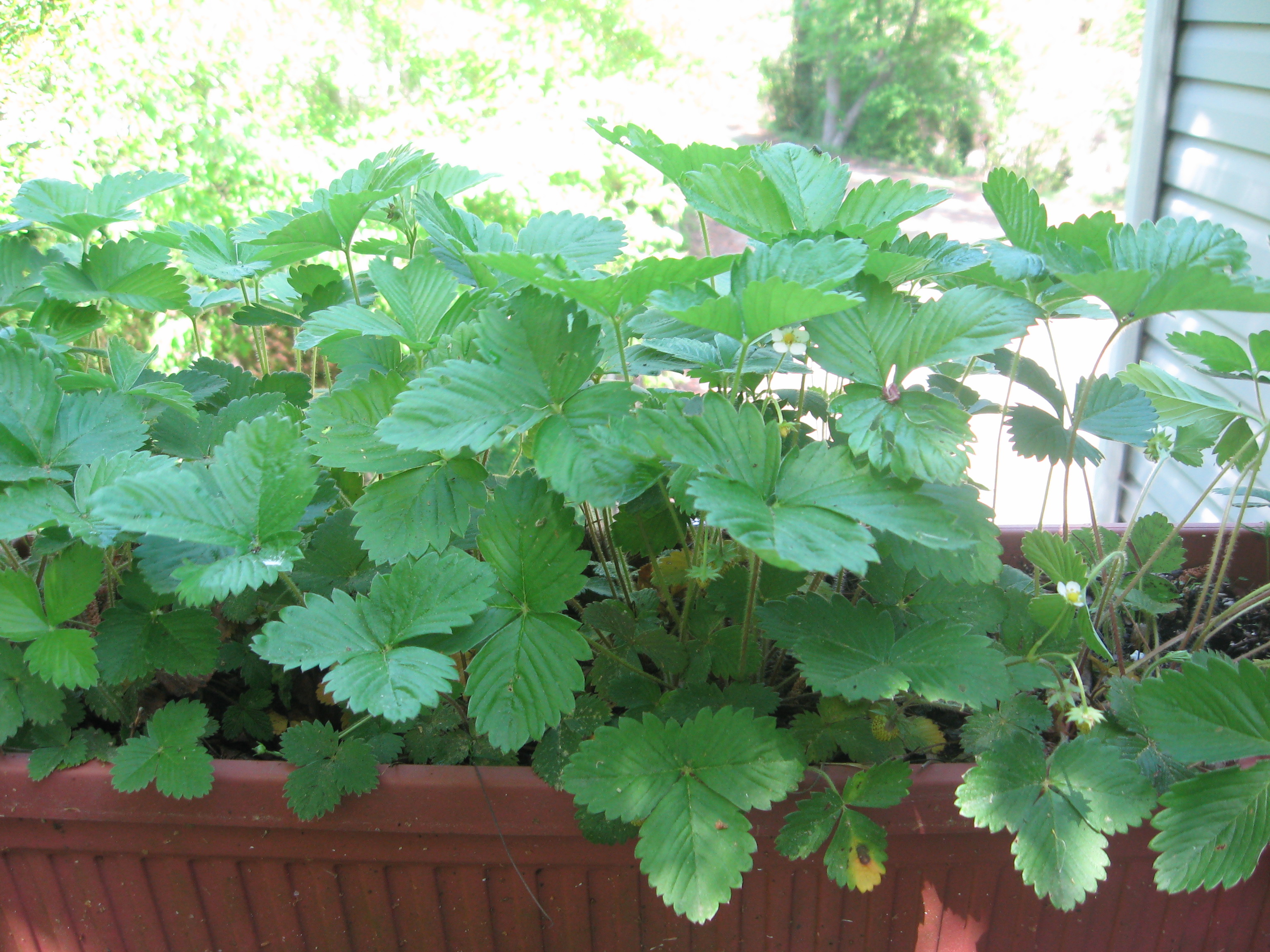
alpine strawberries
 a-single-serving.com