Hive report: waiting–not patiently!

Somehow work seems to get in the way of hobbies and sometimes even cooking–to a frustrating extent (you’ve noticed no recent posts, huh?). But one must work in order to cook, eat, and in order to support the creatures of the hive.

Although I did see bees on the quick January check when we had few rather unseasonably warm days in February and I saw bees flying in and out of the hive I was really, really happy. Both hives!

Now we have gone back to more seasonable weather for March but I’ve noticed despite rather cool (temperature currently 50°F), breezy (sometimes very windy) weather that the girls are in and out bearing a little pale greenish-white pollen–though their corbiculi are certainly not overflowing–in fact, they are downright skimpy. But there is traffic in and out despite the cool weather.

I’m a bit twitchy about what is really going on inside the hives since a friend has already had a swarm from one of his hives on the 6th of March–despite the cool weather.  I’ve had that very early swarm experience before and I don’t want to have it again so I need to prepare some woodenware to set up a new hive in case I need to do an urgent split, instead of having my bees wander off into the wild blue yonder!

Another thing that adds to my frustration of not knowing exactly what the girls are up to is that I’m in the midst of doing some equipment switches to change how I manage brood in my hives. As a “new-bee” I started with all medium eight-frame equipment. Last spring I switched to single deeps for my brood boxes since I just didn’t like how the medium frames split up the brood pattern.

All winter I’ve been debating whether I want to manage my colonies with one or two deep boxes for brood. After reading and talking to other beekeepers I have decided (almost) that I want two deeps for brood in my colonies. Now I’m trying to plan how that switch is going to take place. I somehow think that the girls are not going to make this a simple case of just putting another deep in place on the hive. I think planning a strategy would be a lot easier were I privy to what the girls are actually doing inside the hive.

But I’m a coward so I won’t open a hive in 50°F weather other than for just a quick peek to see if there still candy board for them to nosh on during our still-chilly and rainy weather.  I don’t want to take the chance of chilling brood. I only hope that they are not busily preparing to swarm since I saw a lot of bees in January.  So, I remain in ignorance, looking at a weather forecast that’s not going to let me find out much more for at least another week–highs in the 40s and rain at times.

—Ô¿Ô—

Hive report: catching up

If you are wondering, the bees seem to be doing well. It’s not that they have been neglected–it’s just that work has kept me from writing about the bees–or much of anything for that matter–as you’ve noticed.

As I watch the snow blowing around in our recent unusual cold snap (which it seemed as if it would never end) I’ve been reviewing my notes in the Hive Tracks software that I use for record-keeping the successes and failures, and ideas for next year. I keep thinking of what’s going on in the hives at this time of the year and I \need to do my monthly readings from the hive scales to upload for the Bee Care hive studies. I have “candy boards” on both hives to supplement the honey stores from the summer if the bees need more food.

It was a relief to see bees flying from both hives yesterday and even a few toting some pollen–not much though.  Since the temperature was in the upper 60s I did have a quick peek into the upper super of honey and there were lots of bees. As we get ready for the next wave of cold weather to move through I’m glad to have supplemental food available and the quilt boxes on to help control moisture in the hive.

Ò¿Ó

A question often asked (especially in wintertime and especially when we have weather extremes (at least for here) like this is about what is happening with the bees: do you start again next spring, do the bees hibernate or die?

20160628_101041One of the specializations of honeybees is that they are driven to store honey–that’s not true of many native bees, and it is something that has lead to “beekeeping. Some keep bees for honey production, some for pollination, and some of likely just because they are such fascinating creatures but no matter why this involves doing things to keep the bees healthy and well fed.

As beekeepers, we hope that we will be able to see the colonies successfully over the winter so that we won’t have to start again in the spring. That’s the hope of the beekeeper: we hope that there has been honey and pollen stored by the bees to use in the cold weather and if not, then we will supplement what the colony has been able to store as needed, mostly with granulated sugar (sucrose). Thus, keeping records of the weight of the hive and judging how much honey remains for consumption when there is no nectar brought into the hive is necessary.

The “work” for the bees in the winter time is taking care of the queen and a small amount of brood (developing bees)–in cold weather, that means keeping the hive warm. To accomplish this the worker bees (remember, all girls) “cluster” or “huddle” over the comb surrounding the queen. The honey in the comb is eaten to provide energy to “shiver” the wing muscles (without moving the membranous wings) to generate heat to keep the hive warm (around 93 to 95°F).

The queen stays in the center of this winter cluster–being fed and kept warm. The workers that surround her move from the outer edges of the cluster inward, and back again so that everyone stays warm enough to survive. (Think about the male Emporer penguins in “March of the Penguins.”)  The more active inner bees move outward and push colder bees that cannot move well inwards to warm up and eat.

sugar in mould for bees

candyboard

As winter approaches, the bees do a number of things to get ready for winter, in addition to storing honey: metabolism changes and the winter bees (that live longer than summer working bees) store food reserves to become “fat winter” bees. Vitellogenin is stored in fat bodies in the abdomen of winter bees—and is triggered by the decline in available “brood food”–as winter comes on. This provides the protein necessary to start spring brood rearing as the days get longer. Our winter bee care means that we must see that there is enough food (honey) since the bees are active all winter within the hive.

We also try to make it easier for the bees to keep hive temperatures up by making sure ventilation is adequate, that moisture from the respiratory activity of the bees does not collect and drip back down on the cluster. (Think about having cold water splashed on you when you’re trying to keep warm.)  One of the things I use to stop excess moisture dripping onto the bees is a “quilt box”–a layer of cedar shaving that will catch the moisture that drips from the hive top. When it’s very humid, I have to check and sometimes replace shavings if they are really wet.

Because the bees do such a good job of keeping the hive warm, it also becomes a very cozy place for other critters (e.g. mice) to spend the winter. As beekeepers we take physical measures to make that impossible–make the entrances to the hives small– to keep pests out.

With those preparations done, we beekeepers overwinter ourselves by thinking about plans for the spring, fretting about the bees and trying to stay warm when the weather is extreme, enjoying some of the honey from our hives, and (like gardeners) anticipating the first bloom that will start our colonies growing again.

Ò¿Ó

.


Hive report: bee attitude!

I’m willing to admit that all us females have a potential for bitchiness–expressed in various different ways. My girls in the hive seem to have a very explicit way of expressing theirs–and, no, I’m not talking about stinging. That’s a total last resort only when threatened and/or injured.  That’s defense, not attitude.

This is much more subtle. Despite my careful monitoring of the feeding jars, I let them get empty–completely empty–while on the hives. The bees are sucking down syrup at a great rate which does say something about nectar dearth. But they have registered their disapproval of my behavior.

When I removed the jars–quart jars with a lid that has small holes punched in them so that syrup is under a vacuum when the jars are turned upside down–I find that the girls had filled each and every one of the tiny holes in the lids with propolis. Every single little, tiny hole–completely shut!

Propolis has its uses–it’s antimicrobial, and bees seal small cracks in the hive with it and cover things that need to be “sealed”–like a mouse that is too big for them to carry out of the hive if the beekeeper, perhaps, forgot to put the mouse guard on the hive in the fall.

Getting propolis off of anything is not easy–it is very sticky so that dissolving it is really the only option. Rubbing alcohol is the best thing I’ve found–and the 91% rubbing alcohol (isopropyl) is much better than the usual 70% stuff, but it still required an awl to open each little hole individually and then a second scrub with alcohol.

I understood the message while I was out of town for the indexing convention–the jars were probably empty for several days, so I get the propolis. But this time they were only empty for a few hours–I get this message too, but I think I detect a faint bit of attitude here as well, but then I guess I could be feeling that way because I have been getting attitude from the cat as well today.

Anthropomorphize? Who, me?

Õ¡Ö

. . .

Hive report: 30 July 2017

The weather was lovely today–low humidity, sunny, not terribly hot–a mere 81°F with a nice breeze–so I took advantage of it to do hive inspections when the conditions were good for me and for the girls. They were pretty cooperative today though just a bit tetchy when I first opened the hive but that’s not unexpected at this time of the year when nectar is a bit scarce.

The girls in both hives seem to really like applying propolis to anything that doesn’t move–especially between the inner cover and the top of the frames. Prying the tops of the frames away from the inner cover was when the bees in the upper box got just a bit irked with me and switched from humming to buzzing–including a few that got in my face about it–that’s why we wear bee jackets or at least veils. Once I had the inner cover off the hive the bees did settle down and let me do my thing.

Both colonies are looking good–a reasonable population of bees, good brood pattern, honey and pollen storage although there were enough varroa mites present on the sugar shake that I started treatment today on both colonies with ApiVar (Amitraz) strips since we still have some hot weather coming. That’s part of getting ready over-wintering.

Ò¿Ó


More ways to use honey.

Now that the bees are here, thoughts turn to honey–even though it’s unlikely that I’ll be able to harvest from the hive started from the package of bees that I got on 14 April 2017–the bees must have a winter supply so that has priority over satisfying my desire for honey.

I found an interesting series of articles from Kitchn on honey and its use in cooking or just eating:


There are additional links within these articles to recipes using honey, and to a series on migratory beekeeping and production of varietal honey.

Varietals are so much fun. Even the seasonal variations on wildflower honey are special. Raw honey is much like wine–its goût de terroir–a reflection of the total environment where the bees forage.

A son gôut!

Ò¿Ó

Beekeeping: oops–keeper oversight!

We  had a few days of delightful (read low humidity) weather here. I’m a fresh air freak. If at all possible (even with spring pollen), I’ll have doors and windows open while I work in my office, or even while sleeping (well only the door to the second floor back porch open). Last night I went to sleep while reading–not unusual but that meant that my reading lamp didn’t get turned off. Usually, no big thing but this turned into a really BIG, HUGE thing.

I was awakened a few hour later by an infestation of moths bumbling into me, and by Frankie (the cat) tearing around the room and tromping all over me and over furniture.  I don’t mean one or two moths had managed to sneak in from the screened back porch as expected in North Carolina in the summer. This was a major invasion, and being attracted to the reading lamp, the were bumping into me. Frankie

This was a major invasion–I quit counting when I got to 13 of them. Besides, it’s difficult to count moths that are practically zooming around the room. Frankie was obviously having a lot of fun. For me, I was not in the least amused.

brown moth

Lesser wax moth from BAMOA

These were not the really neat ones that you love to see like a Luna moth or a Sphinx moth–these were rather plain looking brown ones–a bit smaller than the ones that usually wander in to visit. These were very active, smaller and, as it turned out very hard to kill. Everywhere I looked there were brown moths practically buzzing around. Believe me, these guys do not flutter pleasantly as most usual brown moths do.

Now I’m pretty tolerant of insects. My first response is not “kill”; it’s usually catch-and-put-outside, but there were just too many in my bedroom; I opted for kill mode.  I will admit to keeping insecticide at home for occasional use but not often since I do share the house with Frankie.

So I got the spray can and went to work. Weird thing, the insecticide that I usually use (that has usually worked on anything I needed it for) didn’t kill them–it seemed to only make them agitated and flying around faster and more furiously. That kill option failing, I opted for my other kill option–an old fashioned fly swatter, with a chair and step ladder strategically placed for hopping up and down. (These seem to be one of the few things that I found that Frankie, the cat, really got off on chasing and playing with although he wouldn’t kill them.)

That kill option failing, I went to something more direct–an old fashioned fly swatter, with a chair and step ladder strategically placed so that I could hop up and down to reach the ones on the ceiling. (While I’m doing my up, swat, down, up, swat, Frankie really got off on chasing and playing with them although he wouldn’t kill them.) In retrospect, I suspect this might have been a candidate for one of those “funniest video” programs.

As I got more awake, I had a horrible thought.

I had been sorting some frames from my hives that I lost late last fall. The frames had been stored with paradichlorobenzene (PDB) for to protect the drawn comb but I had frames stacked all over the place in the process of evaluating the foundation. But I’d put all those away again, carefully protected with the PDB.  Hadn’t I?

Extermination in the bedroom finished, I went back to sleep.

On exploration of the porch next morning  I discovered that I had, indeed, overlooked some frames that still had some foundation in them–they’d just gotten pushed to the side a bit, out of sight, and left in our lovely summer weather. It was now very obvious where all of the moths in my bedroom had come from. Not a pretty sight!

There were more of them, many more of the, on the porch, clustered around the ceiling–a veritable plague of the critters. The fly swatter was not an option for dealing with this. So, to the grocery store for the most potent insect spray I could find–after sufficient label reading to really confuse me I just opted for the Black Flag for murdering these flying insects since that was the most lethal sounding product there. Even with that, it seemed that they didn’t succumb as rapidly as most six-legged wildlife.

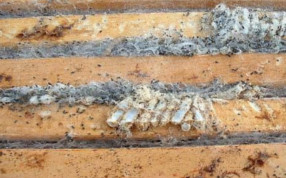
I’ve since found instructions for a trap for wax moths (on Bee Works). This was to bewax_moth_pupae hung around the hives to catch them outdoors rather than letting them go into the hives although a good strong colony will control them– they can quickly become a problem if the colony is weak. I have seen how quickly they can take over when a hive is failing.

Several days later, I seem to have successfully wiped out the population of wax moths on my porch and in the house. Frankie seems to miss them as entertainment, but I’ve now had all the experience with wax moths that I want–either in the hive or especially in the house.


Hive report: a real quickie….


Washboarding_20170711_152821

Washboarding bees

I’m such an awful wimp when it comes to heat and humidity. I was planning to inspect both hives today since I would be replacing the empty feeding buckets with full ones. I put additional supers on both hives but I thought I should see how much comb had been drawn in them.


With a heat index of 102°F (even with the humidity relatively low–well actually low for here) I didn’t last long in the bee suit. It’s really frustrating trying to see the world with sweat drops on the bee veil (yes, I was wearing a headband to try and sop it up).

Instead of the more detailed inspection that I had planned, I opted to simply remove the inner cover and see how many frames had been drawn in each one. The Durham bees (the ones from here in town) had drawn comb on almost every frame in the super. The Georgia bees (the package) had drawn enough comb in the super that I decided both hives needed to have a super added before I put the feeders back on.

I still need to do a full inspection before long to check for mites and all that good stuff, but for now, I think I have two healthy hives that are doing what bees do.

Ò¿Ó

The bees are displaying an interesting bit of honey bee behavior: both hives are washboarding. It’s something honey bees do (apparently adolescents), but no one knows what they are really doing, or why. I found a reference that said the do it more on surfaces with more texture, but nothing to say what they are really doing. They just spread out on the hive (usually the front, though the bees from one hive are spreading over onto the sides as well) and are rocking back and forth, doing something with their mouthparts and front legs.

Is it just the adolescents out for a disco day?


Ò¿Ó

The honey bee calendar: seasonal honey.

The bees’ calendar and the beekeeper’s calendar are not the same as the one in Outlook or Google that displays all the holidays for you and the “year” by which we proceed through our daily routines. They are more responsive to temperatures, and hours of daylight–what’s really going on in nature.  They are awaiting the spring nectar flow to increase the population of the hive and to store honey.  Or the fall nectar flow to store food for the winter months.

In summer when we are enjoying a surfeit of fruits and vegetables (because of the bees’ pollen and nectar gathering in the spring) we have to realize that about that time there is a declining flow of nectar–fewer things are blooming. Life can be hard for bees in July. A nectar dearth means less food for them, so depending on forage region, we may be feeding bees while enjoying plenty of fruits and vegetables.  The bees will be waiting for the fall nectar flow–in my forage region (Appalachian-Ozark Upland) that’s primarily asters and goldenrod.

This seasonal variation is one of the delights of honey and beekeeping. The photograph at the top of the page shows the difference between spring/summer honey (left) and autumn honey (right). It’s seasonal flavor when honey is not blended. In this forage region, as an urban beekeeper, I have “wildflower” honey since my bees don’t have access to a large monofloral flow. I can’t produce varietal honey such as sourwood or alfalfa honey, or even clover honey, but I do have seasonal honey.

Ò¿Ó

Hive report: an interim update

brood box of hiveThe bees have been getting attention–I’ve just not had time to tend bees and to write given work and travel.

I thoroughly enjoyed my almost-a-week stay in Portland ME.  I wish I could have brought the weather back with me, or figured out a way to get the bees and Frankie (the cat) to Maine. Since neither was feasible, I’m back home, tending the bees.

On 11 June 2017, I installed a nuc (small colony with laying queen) in my second hive. These are truly local honey bees–from an established beekeeper right here in town. It looks as if they have taken well to their new home. The “package” bees that I installed in the other hive on 14 April 2017 (from Georgia) seem to be doing well, too.

On 24 June 2017, I add a “super” to each hive–expecting it to be brood and honey. With a very quick look under the inner cover while I was putting my bucket feeders on this morning, I saw that there were bees working on all the frames on the super. This means that I need to plan a serious look into the hive when the weather is suitable in the next week to see if I need to add another super.

Ò¿Ó

What “raw” honey means…

…or doesn’t mean.

In many places, the spring nectar flow is over and some beekeepers may be harvesting honey. When you look at the label you may see “raw” honey. Here is a good discussion of that may mean from HoneybeeSuite. 

It’s a lot like the word “natural” used on labels. Your best bet is to ask the beekeeper who is selling the honey. They will be glad to explain the harvesting and extraction process to you so you know exactly what you’re getting.