Caramelized apple pie

What a lovely dessert–and not difficult, really. I’m not wild about just apple pie, but the caramelization and the wine combination. I just had to share this one even though you don’t see many desserts posted here.

s_marchiori's avatarthewinelifestyle

Dear readers,

Today I tought about the caramelized apple pie recipe, really tasty and quite simple to prepare: your weekend will be much sweeter!

Let’s go step by step to prepare the recipe and you will see it will be less difficult than expected.

Ingredients (12 slices):

2 egg yolks
2 entire eggs
200 gr of flour (7 oz)
200 gr of sugar (7 oz)
50 gr of melted butter for the mixture (1.8 oz)
60 gr butter to melt in the pan for the “caramelized” process (2.1 oz)
80 gr of sugar to caramelize the apples (2.8 oz)
Juice of half a lemon
250 gr of thinly sliced ​​apples (moisten with a few drops of lemon juice to prevent them discoloring) (8.8 oz)

Preparation

Beat and mix the two egg yolks in a bowl, the two whole eggs and 200 grams of sugar.
Melt the 50 gr of butter for a minute…

View original post 398 more words

Blood oranges….

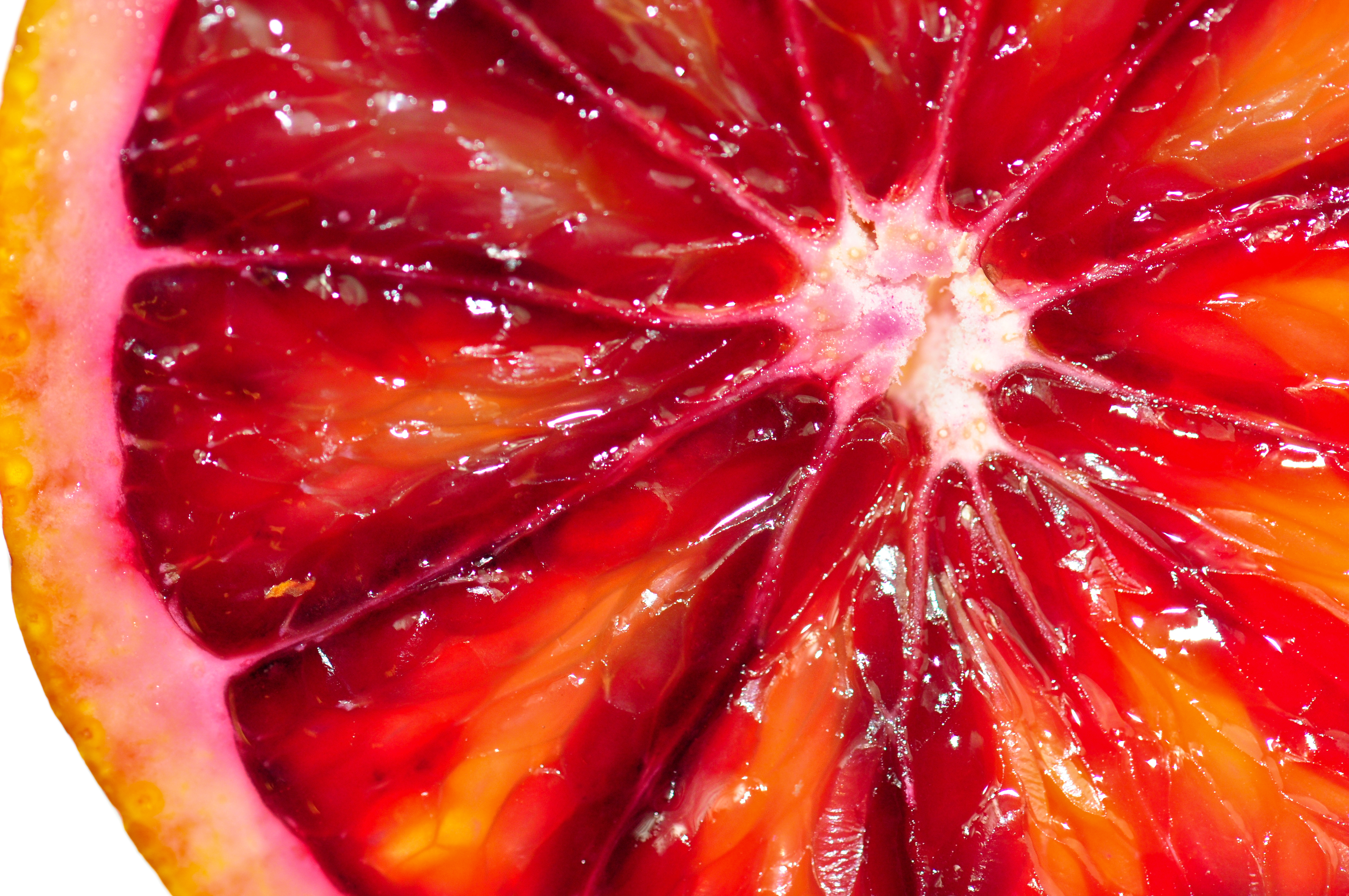
blood orange slice

blood orange

I have to say that for the most part, I hate shopping–except food-related shopping. When I do food-related shopping, I almost always come home with something that was not on the shopping list (Yes, I do make shopping lists, but I don’t really do meal planning.)  do sometimes venture in to the food store without a list, though I do try not to go food shopping when I’m hungry. Sometimes I go to the grocery store impulsively and spontaneously–triggered by some extraneous event.

My last such foray was triggered by sitting at the counter of Hope Valley Diner discussing food with another regular lunch customer–also a foodie.  What sent me to the grocery store was his mention of a chocolate cake from Fresh Market: namely chocolate ganache cake.That definitely got my chocolate imagination going–after all ganache is basically chocolate and cream, maybe some butter–but it’s really serious chocolate–adult chocolate.

Being in need of a chocolate fix since I’d been indexing all morning, I detoured by the Fresh Market on my way home (it really wasn’t more than a half mile in the opposite direction) hoping that I would find chocolate ganache cake by the slice. So–my intent on entering the Fresh Market was to obtain a single slice of chocolate cake.

As I walked through the entrance into the vestibule I was immediately faced with packages of California-grown Moro blood oranges. I seem to be constitutionally incapable of walking away from blood oranges, so there was the first “additional” item, so I really did need to get a basket though I hadn’t thought I needed one.  Now the blood oranges were not individual–they came in a little easy to carry bag–meaning that I now had several blood oranges.

Continuing on my way to the bakery section, I detoured though the produce (around the edge of the store).  That took me past the Bolthouse juices. (Yes, I find daily grapefruit, orange, etc boring too many days in a row.) I noticed a couple that I’d not found at my Harris Teeter market, so those (Daily Golden Vedge and the Stone Fruit Smoothie–still haven’t found the Mango Ginger + carrot) )got popped into the basket.

I made it to the bakery counter after a brief detour around the cheese counter and the seafood salad bar. I first noticed a whole chocolate ganache cake–shiny top as you’d expect from ganache, very dark, with the sides of the cake covered with dark chocolate shavings or chopped. Thankfully, there was a single slice of this luscious looking cake in the case. That got put into the basket with a sigh of relief–after all, THAT was what I came for! I made it back past the chocolate bars and other candy without adding anything more to the basket, checked out, and headed for home.

Blood Orange and Sage Sparkling SodaOnce home I had a blood orange–and realized that I was going to be eating or juicing blood oranges for a bit. Though straight blood orange juice is certainly not a hardship, serendipity has a way of intervening. While I was perusing my favorite blogs, what should I find but a gorgeous photograph and a recipe for blood orange and sage sparkling soda.

The image at the left is from Snixy Kitchen blog–just too gorgeous not to “plagiarize” with attribution, and share. I’d not thought of the combination of sage and orange, but with the “imagery” of the blood orange I’d just eaten, and a brush of the sage wintering on my deck, I knew I had to try it. This as a beverage is definitely a keeper–I’m sure that I’ll be making sage simple syrup again, and I have to think this would make a great sorbet as well as something to put in a glass and drink.  This combination of orange and sage also has me thinking about veal, pork, maybe chicken….Thank you, Snixy Kitchen for a great combination!

ÒΔÓ

Now if you’re wondering about the chocolate ganache cake?  Well, I ate it before it even occurred to me to take a picture, and I haven’t found a chocolate cake image that even comes close–so I’ll have to go with words: very, very dark, moist, with ganache between the layers and as icing, not too thick.  Dark chocolate chips/shaving on the sides, not too sweet, but sweet enough–adult chocolate–absolutely luscious.  That’s probably where I’ll go look for my next chocolate fix.

Fig and fennel caponata!

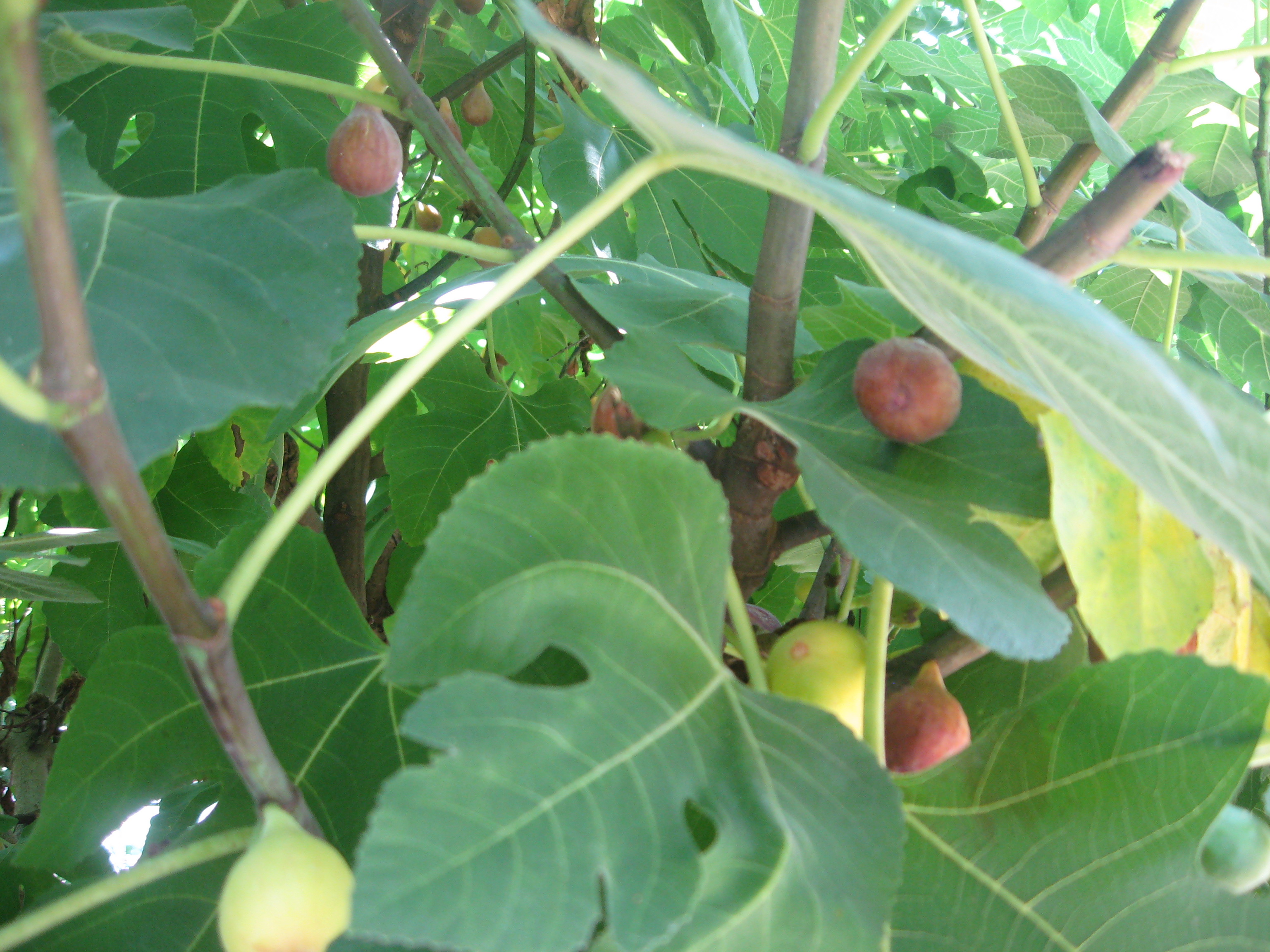
figs on tree

ripe and unripe figs on tree

My kitchen smells SO good right now–fennel, oranges, garlic…tartness of balsamic vinegar….

I’ve finished the most recent BIG indexing project, and I’m supposed to be deep in course preparation for my medical terminology courses that start a bit after mid-August.

I’m playing hooky from that for a bit.  I found a recipe for fig and fennel caponata that wouldn’t wait.  You’ll find the recipe at jjbegonia.com.

Caponata of any sort is one of my favorite summer things, no matter how served, and this was a combination I just had to try. Though mostly we think of caponata as a dish made with eggplant, tomatoes, etc., it is really a cooked vegetable salad–and as much as I love fennel and figs, I just had to try this one NOW.

I took a few liberties with the recipe, but I think that I kept to the spirit–the flavor was certainly good.  The only real modification I made was to substitute diced (drained) fire-roasted tomatoes for the crushed in purée since that’s what I had in the pantry, and after tasting, I added more figs. Whether my figs were less sweet, or my balsamic was more acidic, I’m not sure, but it seemed to need a bit more of the figgy-ness.  I held back most of the parsley since I’m not serving immediately.

Despite my liberties, it’s a fantastic recipe–obviously great on toasted bread just as a nibble (maybe with a glass of cava or prosecco), but I’m looking forward to it as a side for a grilled lamb (shoulder or leg) chop, though I’ll have some left to try on sandwiches as well, and maybe with pasta…and probably to share with neighbors and friends.

(Given that both the recipe from jjbegonia.com and mine were changes from the Barefoot Contessa, here is the link to that recipe for fig and fennel caponata as well. I’ll probably try this when fresh figs are not available, but I do like the freshness of this recipe.)

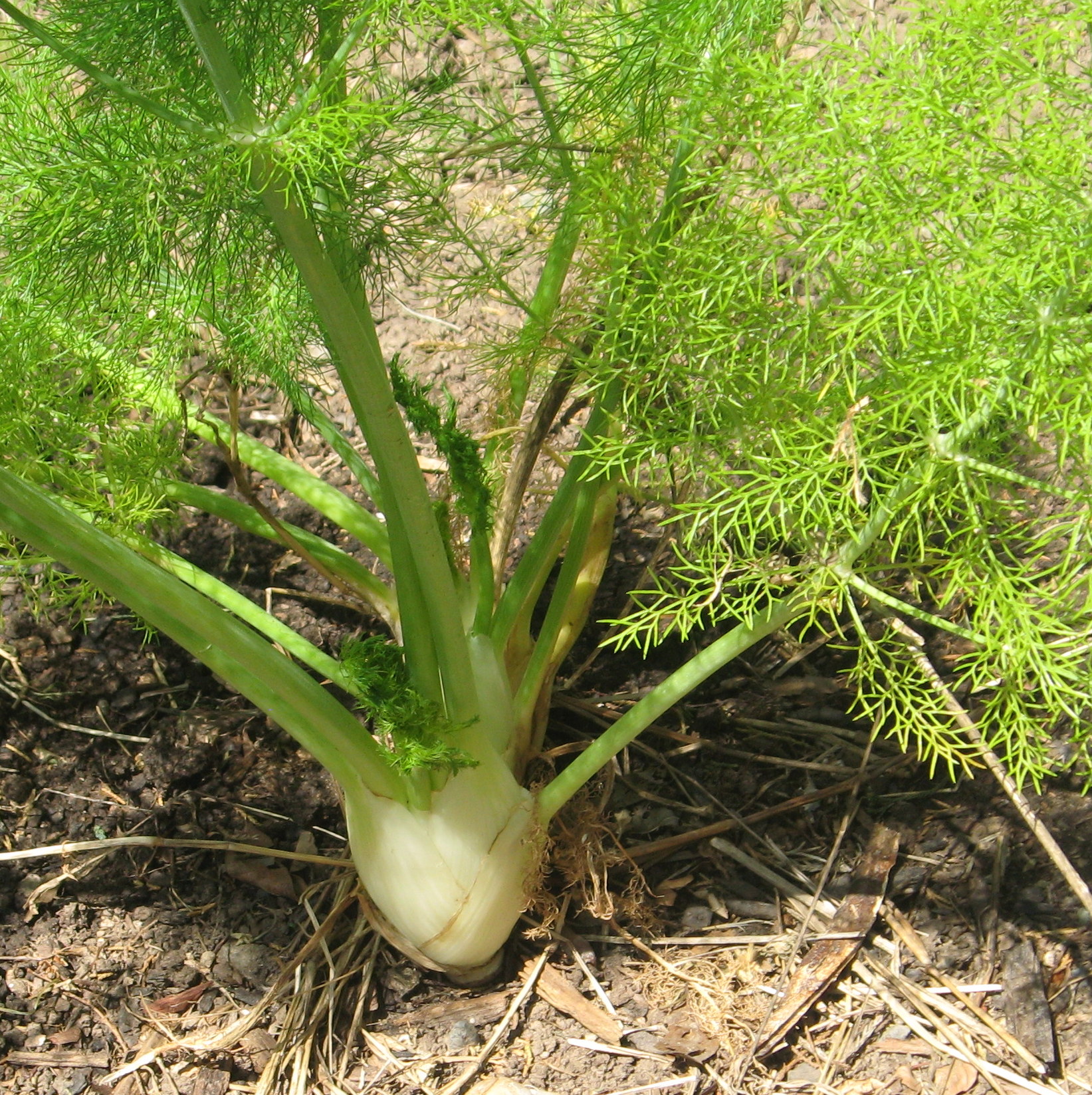
fennel (Foeniculum vulgare)

Foeniculum vulgare

Flamusse aux Pommes (Burgundian Apple Flan)

Looks awesome! Burgundian food and wine are some of my favorites!

StefanGourmet's avatarStefan's Gourmet Blog

For the Burgundian evening there also had to be a traditional dessert from Burgundy. I decided to prepare flamusse, an apple flan that is similar to clafoutis (made with cherries). This is a very an quick simple cake/dessert to make, but really tasty. The important thing is to use only a bit of batter and not to beat too much air into it, otherwise the flan will rise too much and although it will still taste good, it will look quite messy.

View original post 248 more words

Ushering in Strawberry Season

Luscious!

Rufus' Food and Spirits Guide's avatarRufus' Food and Spirits Guide

We’ve had a weird spring, which makes us even more giddy to see strawberries at the farmers market. It’s hard to feel springy when you’re using your fireplace to stay warm on May 4. The temperature dropped from the 80s to the mid 40s that week. But berries always let us know summer is just around the corner.

We’ll be featuring strawberry recipes all week — salads, booze, desserts! — and highlighting a few of our old favorites. Here’s a look back at some of our favorites:

Strawberry Cobblers for Two

Strawberry Rhubarb Pie

Spiced Strawberry Shortcakes

Strawberry Balsamic Granita

Strawberries Romanoff

View original post

Ripe fruit

mangoes

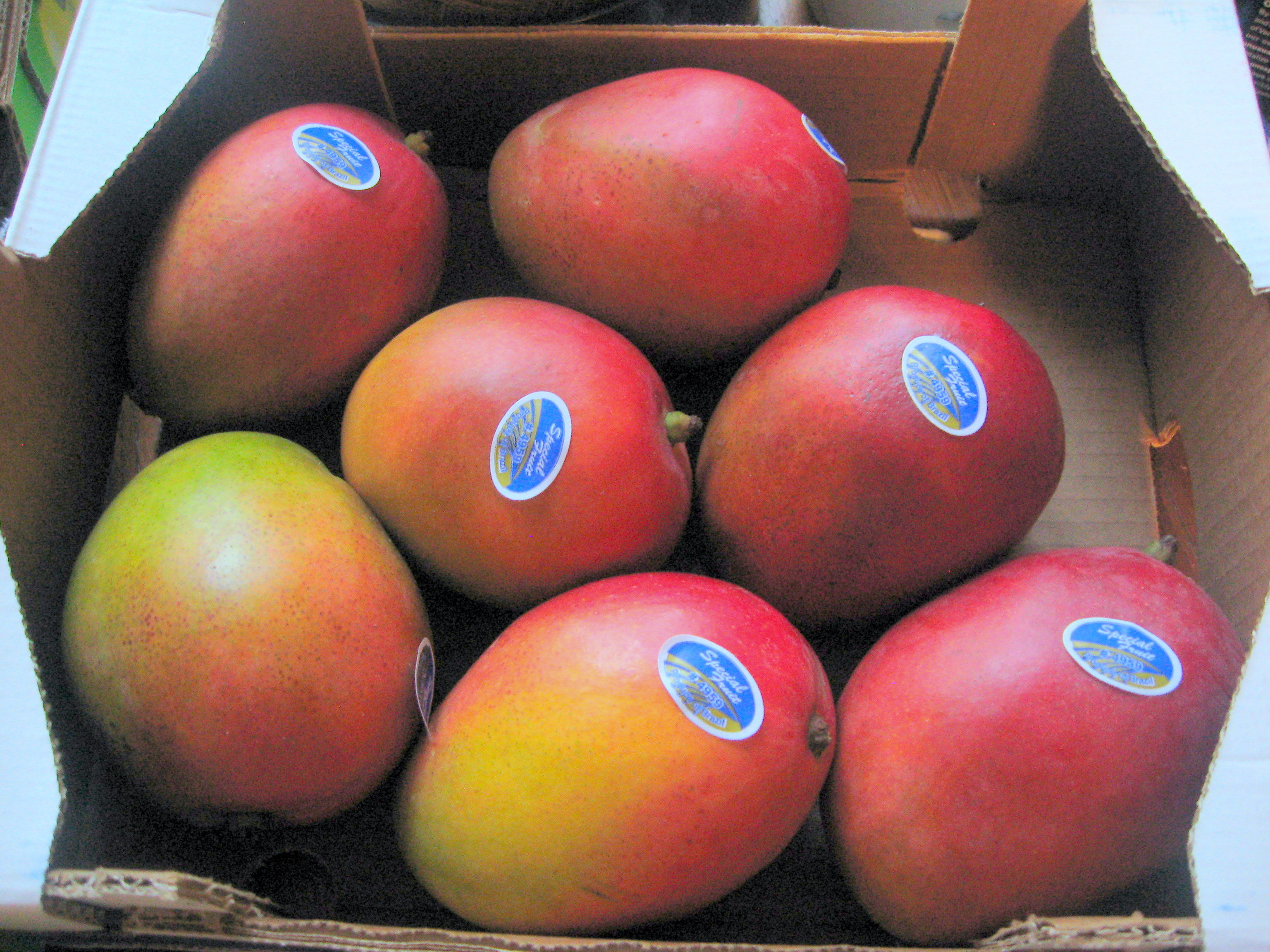
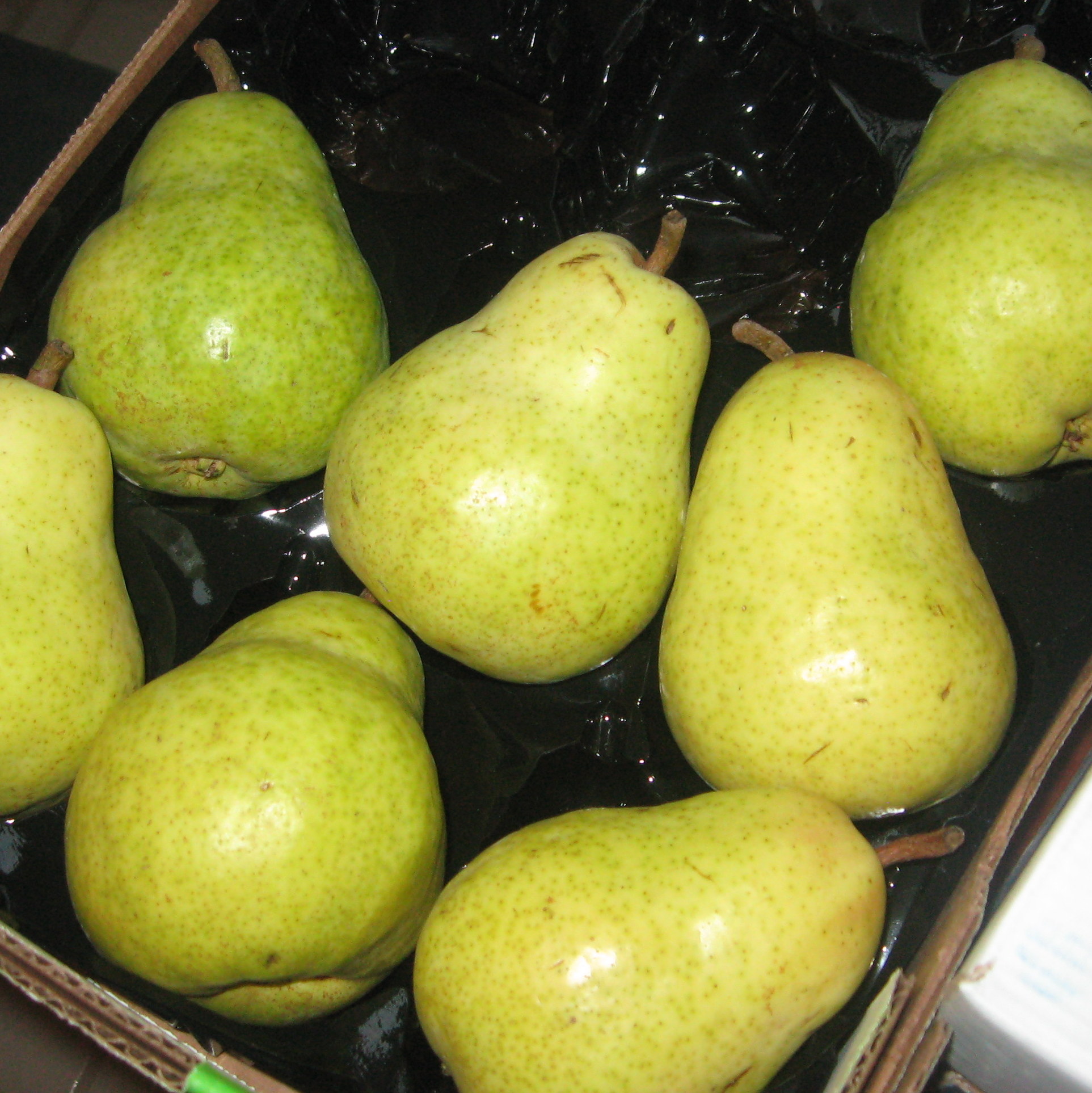
After my last excursion to Costco, when I came home with LOTS of fruit (eight mangoes and a dozen Bartlett pears), which were all absolutely scrumptious, I got to thinking about buying fruit in the supermarket: how do you choose? (Even friends that I shared this abundance of fruit with commented on how good those pears and the mangoes were–that meant that every one of the pears and mangoes was good!

If you’ve ever been tempted by those luscious looking fruit displays in the market, succumbed, and then gotten that fruit home, let it “ripen”, and found out that it has all the flavor of sawdust or cardboard, you’re probably more inclined to pass it by and get something like an apple that you think is safe. Been there, done that, passed on the T-shirt, but decided that I needed to know more about how fruits develop and ripen. Looks alone aren’t really the basis on which to buy your fruit.
bartlett pears in case (from costco)

Bartlett pears

This quest started while shopping at Costco.  While I have always been pleased with fruit (including berries) bought there, I wasn’t specifically there for fruit–I was there for cat food and laundry detergent.  As I walked past the produce (not in the cool room) I was distracted by the lovely smell of pears.  The case contained a dozen lovely Bartlett pears–rosy cheeks, plump, and unblemished, nestled in their individual slots in the case.  Well, I popped those into the cart, and then encountered the mangoes–not as aromatic as the pears, but lovely.  (Both were much less expensive than in the supermarket–so much so that I could eat my fill and share some too.) With lots of fruit in my cart, I was further lured (but resisted) by the fragrance of peaches!  Mostly I don’t think that you usually smell peaches–they are not usually that ripe.  I had a long debate about pears or peaches, or mangoes, or not.  I left the peaches because I’ve so often gotten peaches or nectarines (even from the farmers’ market) that may smell good if you pick them up and sniff, but which have never made to luscious…they’ve stayed mealy.  So–here is the result of my exploration to see what I could learn any predictable way to ensure ripe, yummy fruit in my shopping bag.

With that goal in mind, I got out my Kindle and went to my favorite cooking and food science reference: Harold McGee, On Food and Cooking: The Science and Lore of the Kitchen  in search of more information on fruits (and vegetables–like tomatoes– that are really fruits). To save you a trip to the library (though this book is worth reading for lots of reasons) I’m going to summarize what I learned about fruit growth and ripening of fruits:

  • First, a definition of fruit:  the female tissue (ovary) of the flower–mostly the thickened wall of the ovary which will have three layers.  The peel (outermost), a thin membrane surrounding the central seed or mass of seeds, and that luscious, flavorful between those two thin layers.
  • To get this sweet, desirable flesh, fruits go through several stages–usually fertilization (by the male pollen), proliferation of the cells in the ovary wall, expansion of storage cells where sugar is stored, and maturation of the seeds and preparation for eating (ripening)!

Ripening is really leading to changes meant to attract beasties (animals, birds, and even people) to eat the fruit so that the seeds (now mature) can be carried away from the plant, and spread to other locations.  In order to be ready (and desirable) to eat, softening of the flesh, and sweetening needs to occur.  Unripe fruits are not desirable chow for man nor beast–there are defensive compounds, the meat/flesh is hard and not sweet and juicy–things that keep the fruit on the plant until appropriately mature and desirable as a food source.

Okay–that seems simple, huh? Unfortunately, there seems to be a lot of conflicting information on ripening of fruit.  The given is that fruits must reach a stage of appropriate maturity before they are harvested.  Ripening is a complex process involving enzymes and molecular changes–details best left to food scientists and biochemists, other than the fact that ripening can be triggered in some after harvest.  We don’t need the technical details in order to shop successfully for fruit: we only need to know that there are two ways in which fruit ripens once it is mature: on the plant or off the plant.  The ripening style determines how the fruits in our stores are handled. (Sorry, now we have to introduce a little technical terminology here just to make referring to the ripening styles a bit easier and less wordy.)

  • Climacteric: This is the form of ripening, triggered by ethylene gas (the paper bag trick?), which stimulates the fruit to begin to use oxygen and to produce carbon dioxide (respiration) at a much greater rate than pre-ripening. When this happens the flavor and texture of the fruit changes rapidly, and then declines equally rapidly. Stored starch is converted into sugar–the yum factor here.
  • Nonclimacteric: These are fruits that don’t store starch so there’s nothing to convert to sugar for ripening–they cannot improve after harvesting–they need to ripen “on the vine” (or the tree, or whatever) so that they can continue to produce sugars.  They need to be mature enough that the changes that result in sweetening and softening have started.  You cannot “artifically” trigger this process away from the plant. This means that these must be picked and shipped as close to ripe as possible–which means that they are more likely to be bruised in handling. Obviously, the distinction between climacteric and nonclimacteric is not black and white–it seems to me that there is a lot of grey here!

The reason I’m telling you this?  Well, knowing the ripening style is key to knowing how the fruit is going to respond once you’ve paid for it, toted in home in your grocery sack, and parked in on the kitchen counter, in the fruit bowl (or maybe the fridge).  You’re going to have to do a little memorization here to get an idea of which fruits are which and learn some general categories of fruits, other than apples and oranges.

Ripening in fruit involves changes in the respiration (yep, oxygen and carbon dioxide use and production). Climacteric ripeners are fruits like bananas, avocados, pears, and tomatoes (yes, tomatoes are a fruit even though we treat them as a vegetable) to give you a few with which you’re likely already familiar. They can be harvested hard (or firm) and green (but mature), and the ripening process initiated “artificially” in controlled environments.  They will  will continue to improve in flavor and texture, softening and sweetening.  Nonclimacteric ripening fruits (include pineapples, citrus fruits, most berries, and some melons)  will not ripen if picked hard and green–the ripening respiratory changes need to be initiated while on the plant, though it can continue after harvest to some degree.

Now to consider some of the fruits that we find in the market.

Pome fruits (Apples, pears):  These pome fruits are climacteric–the conversion of stored starch to sugar can be initiated after harvesting.

  • Apples are generally sold ripe and should be immediately wrapped and refrigerated–otherwise the “death” process continues and they will not be good to eat.  The ripening process has been started after harvesting mature, but still unripe, and later exposing them to ethylene in controlled conditions.
  • Pears are generally sold unripe; they should be ripened at relatively cool room temperatures, then refrigerated, without close wrapping. They have a higher rate of using oxygen and producing carbon dioxide than apples, so they will not store as well as apples.
  • Quinces (related to apples and pears) are not eaten out of hand–they must be cooked–even when ripe, but they have a wonderful floral aroma and flavor.  (But an extra one to just leave lying on the counter to perfume the room.)  When cooked they turn a translucent deep pink to red.  If you can find them in the fall it’s worth the effort to find some recipes and cook some.

Stone fruits (Peaches, plums, cherries, apricots for example):  These fruits (relatives of the pome fruits) are named “stone” fruits because of the large, hard seed that surrounds the seed in the center.

  • Apricots can be found in the market–but are often a waste of money–since they are really delicate, and all to often lack any real flavor and aroma. They do some ripening after harvest, but must be that lovely yellow-orange color, signifying that they are appropriately mature.  They need to be ripened at room temperature; recommendations seem to be to refrigerate them unripe and then ripen as needed.
  • Cherries, also stone fruits, can be either sweet or tart (outright sour if you will)–which is a tip-off that they differ in–you guessed it–sugar content. They do not improve after harvest, so that means that they are picked ripe, and fragile, and are going to be expensive because of the special handling that they need.
  • Peaches and nectarines (yellow or white, with a large seed) begin ripening on the tree and “are said to continue their flavor development even after harvest” (McGee, location 9749 of 27510, Kindle, third generation).  The “said to” suggests buyer beware to me.  When I see statements like the ripening of peaches is controlled by “endogeneous and exogeneous factors” I begin to think that this somewhere between!
  • Being tasteless is only one of the problems facing the purchase of peaches–if they’ve been in cold storage (perishable, remember?) the flesh can be mealy and they will not soften to the lush, juicy fruit we want, even if they smell good.  This has something to do with the pectin in the flesh; they should not be stored below about 45° F.
  • Mangeos are stone fruit that will ripen after harvest and do produce ethylene during ripening.  (Green mangoes are not simply unripe mangos–they are immature mangos and will not ripen.)
  • Plums (climacteric ripeners) will ripen after harvest–and can be stored cold and then allowed to ripen slowly at about 55° F.

Berries (grapes, kiwi fruit too):  We’re going to ignore the precise, strict botanical definition of a berry, and just go with the term berry as we are accustomed to it in everyday English.  These must ripen on the bush, or the cane, as the case may be and shipped ripe, so they are prone to damage from handling and spoilage–like mold.  I’m sure that you already know that they are fragile, perishable, and don’t keep well.  We’ll not go through each berry type–I’m sure you’re familiar with the common ones.  Once you take them home, it’s best to use them immediately–rinse thoroughly in a colander and   then you can spin them gently in a salad spinner lined with paper towels to dry (from Cook’s Illustrated website, “Caring for Berries”).  For longer storage, see Storing Stuff. (Yes, this really does work, and it doesn’t leave your berries tasting like vinegar.)

Melons:  Melons are related to cucumbers, but unlike the cucumber, are not good when “unripe”.  The melons that we are best acquainted with can be classified as “summer” or “winter” melons, depending on the kind of rind that they have.  While we can say that some are climacteric and some nonclimacteric, they do not store starch so they need to ripen on the vine.

  • Summer melons are the very aromatic, fragrant, sweet ones that need to ripen on the vine–that’s to say that they are climacteric -they don’t improve after harvest.  They will separate from the stem when ripe.  Summer melons would generally include Charentais/Cavaillon; muskmelons (cantaloupe is a misnomer), Galia (also known as Ha Ogen) to give you some of the more commonly available ones.
  • Winter melons are more like cucumbers and squashes–less sweet and aromatic than summer melons–and generally nonclimacteric.  Examples of these wold be honeydew melons, Casaba, Santa Claus, Canary melons.

Citrus fruits do not ripen after picking.

Other fruits you might want to eat: 

  • Figs are sort of climacteric–they will ripen some after harvest, but they must be harvested at an appropriate degree of maturity–I think that this means that the ripening process must have been initiated, or very close, on the tree.
  • Papayas are
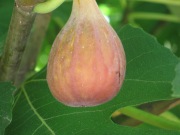
fig on tree

Brown turkey fig

As a last attempt to make some generalizations about fruit types, I wondered if the starch content of the mature, but unripe, fruit would give some cohesion to how to select fruits.  What I found was not much information at all on starch content of mature but not ripe fruits.  There were studies of the changes in starch content of fruits at various stages of growth and maturation, but nothing that allows any easy to follow rules for predicting how a fruit ripens.

<><><>

This all started off seemingly nice and categorized, but–we are dealing with living tissues that don’t fit nicely into categories.  Other confounding issues are simple semantics–when articles say “maturity” are we talking physiological maturity or “commercial” maturity?  So it’s been interesting researching this–but have I come up with any hard and fast answers?  Well…maybe?

  • Knowing the predominant ripening style of a fruit will help you in  handling the fruit to get the most bang for your buck–the best taste and texture.
  • We cannot really make any general statements about specific categories of fruits–except possibly berries.
  • Climacteric or not, immature fruit will not ever ripen to that lush, sweet treat that we’re hoping for.  I would add a caveat about getting good fruit–no matter which style of ripening, the best fruits will be those that have spent more  time ripening while attached to the plant!
  • Use all your senses in fruit selection: if it does not smell good, it very likely will not taste good. When you’re testing for softness or give of the flesh–do it carefully.  Testing for softness doesn’t mean to poke a finger or thumb into that piece of produce–even fairly firm produce can bruise if squeezed hard enough. Learn the visual appearance of ripe fruits–color and shape.
  • Look for heavy fruit for its size–this is an indication of maturity at least, and maybe juiciness (e.g. in citrus).

<><><>

  1. Food and Agriculture Organization of the United Nations  Document for Production and Sale of Fruits and Vegetables.
  2. List of  Culinary Fruits (Wikipedia)
  3. Papaya selection and ripening, Hawaii Papaya Association
  4. Choosing ripe fruit, Fine Cooking. Includes a chart of which fruits ripen after harvest.

Sugar plums

I think that these are a special holiday treat. Too bad that we don’t see more of them.

Rufus' Food and Spirits Guide's avatarRufus' Food and Spirits Guide

Despite the title, these little treats are quite dense and spicy, but not overly sweet. Feel free to alter the fruit mix. A number of recipes only used dates and apricots. Most recipes we saw called for using a food processor, but we don’t have one and were worried the blender would gum up on the first pulse. If you have the same dilemma just remember to chop the fruit very fine.

Sugar Plums

  • 1/2 cup pecans, chopped very fine
  • 2/3 cup honey
  • 1 tsp ground cinnamon
  • 1/4 tsp ground allspice
  • 1/2 cup finely chopped dried apricots
  • 1/2 cup finely chopped pitted dates
  • 1/4 cup finely chopped dried plums
  • 1/4 cup finely chopped dried cherries
  • 1/2 cup powdered sugar (aka confectioners’ or icing sugar)

Combine nuts, fruits and spice in a large bowl. Using a wooden spoon or rubber spatula, mix in honey stirring to coat evenly. Pinch off teaspoon-sized…

View original post 19 more words

Cucumber mango salad

Photograph of 7 mangoes in case with PLU stickers

mangoes

Yesterday I had a minor food crisis–fruit overload.  I went to Costco (for cat food and laundry detergent) but while walking past the huge stacks of produce I smelled first peaches, and then pears–and then there were the mangoes. The difficult decision was pears or peaches, and/or mangoes.  The pears won over peaches though the peaches smelled as good as the pears, but the price was such that I brought both mangoes and pears home with me. Both were much more reasonably priced than in the supermarket. So it was a no-brainer–I eat all the pears and mangoes that I want and share some with friends and I’m still ahead on the cost. (The pears were absolutely luscious–every bit as good as they actually smelled!)

bartlett pears in case (from costco)

Bartlett pears

That quantity of fruit does have you looking for some things to do other than just eat it out-of-hand.  I had some mangoes that needed to be used; I had eaten lots and shared some, but I needed to eat some more! (Not that eating big, juicy, ripe mangoes is really any hardship.) Saved by inspiration that struck when I started smelling my supper cooking.

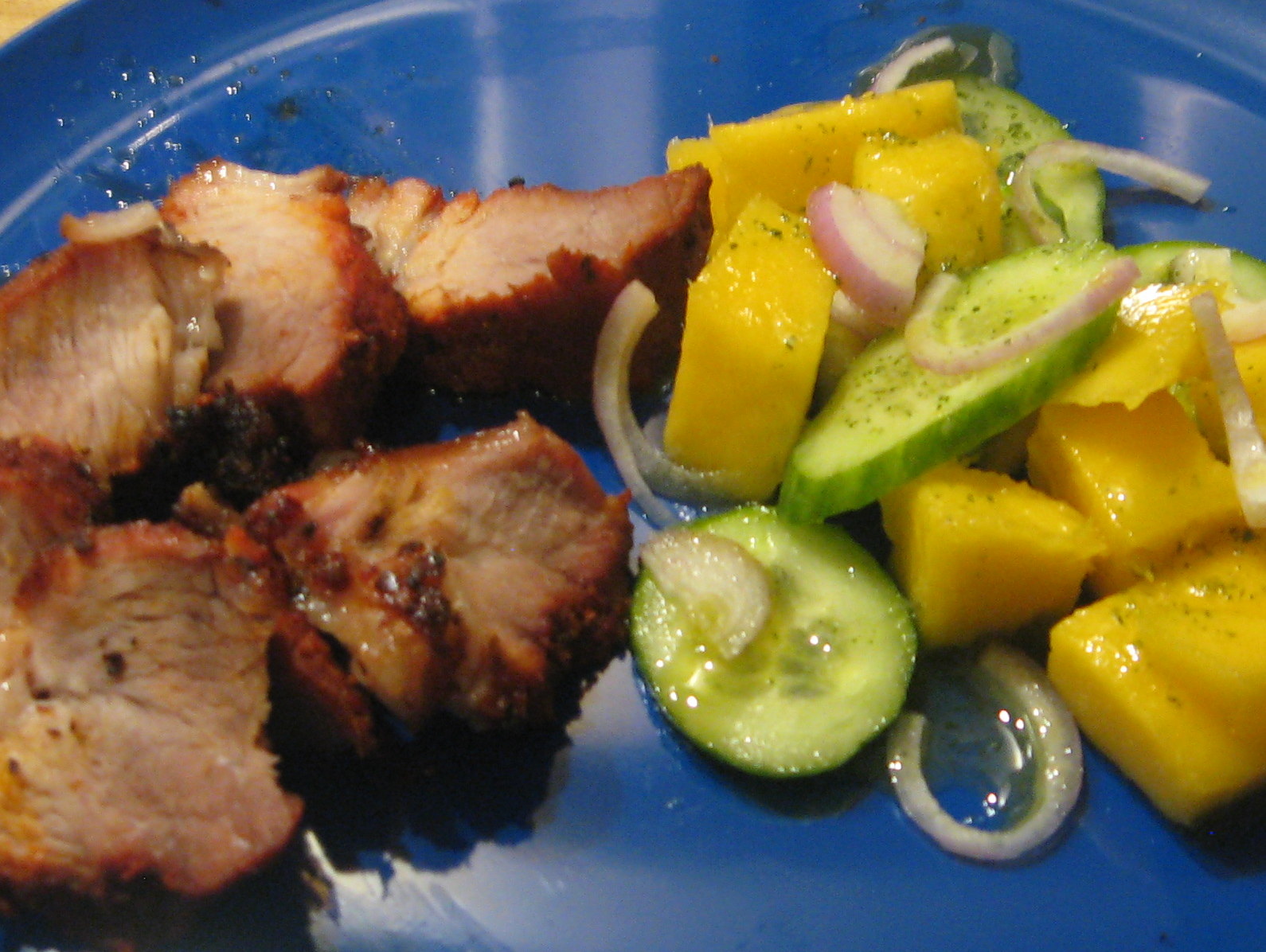
I was roasting some pork (on which I’d used a dry adobo seasoning rub given to me by a friend as a birthday present)–just a single big meaty spare rib for supper. This was one that was extra from making the chili con carne--simply would not fit in the pot so it became a small pork roast for one with just a tad left over.

I couldn’t think what to have with it until I smelled the roasting pork with the spicy adobo seasoning, something said “sweet and cool”–I thought of mangoes and cucumbers (which were sitting right there in the refrigerator just waiting to be used).

Not being particularly inspired about what to do with these two things, I headed for my laptop and Google!  As I was entering the “cucumber and ma….” the instant search which I’ve enabled popped up “cucumber and mango salad”.  That sounded just right with spicy roast pork.

I perused a number of recipe sites and blogs and found several interesting ones for cucumber and mango salads (and somehow I thought I was being very original when I visualized that combination):

  • from Daily Bites blog mango and cucumber, lime, ginger, honey (or coconut nectar–something new to explore), and optional cilantro.
  • from Eating Well which added avocado, brown sugar, rice vinegar, canola oil, and fish sauce as well as red pepper flakes.
  • from Herbivoracious  using Thai sweet chili sauce, rice vinegar, mint and cilantro leaves, and toasted sesame seeds.
  • from My Recipes  the simplest of all–cucumber, mango, lime juice and ground red pepper.
  • from Rookie Cookie with the addition of jacima, red bell pepper, honey, rice vinegar, and chile powder.
  • from The Full Plate Blog those basics but with champagne vinegar in the dressing, and suggestions for optional pea shoots (yum!), and slivered almonds, with romaine lettuce.

Those certainly gave a place to start for concocting for what I needed that night’s supper.  Then I found recipes with suggestions for adding grilled shrimp…seems like these need to be explored  much more carefully next time I’m that flush with mangoes.

rosy-cheeked bartlet pear and mango on blue/purple print towel.

pear and mango

Since my adobo rub had given me quite a spicy seasoning for the pork, I decided that I did not want to add chile powder, or even ginger–anything at all spicy to the salad–I wanted something cool and contrasting with the spicy meat.

I opted for the bare basics: cucumbers (the little baby ones), mango, shallot (no red onion in the house),  and since I didn’t have fresh mint (I’ve now killed my second plant), I used frozen cilantro (from Dorot) in the dressing which was just a simple vinaigrette made with olive oil and sherry vinegar (drat–no lime or champagne vinegar) and I didn’t think that rice wine vinegar would stand up to the adobo seasoning of the pork).

Even one mango and cucumber gave me some extra, so I dressed only what I was going to eat right then.  (What was left became another salad, with very thinly sliced pork right in with the fruit, and I added some of those luscious Bartlett pears to it as well–threw that over some mixed greens and it made an awesome lunch. I dressed with a fig-infused white balsamic vinaigrette since I added the pear.

The combination of mango, or other sweet fruit, and cucumber is definitely one that I’ll be playing with in the future–probably with chicken, shrimp  or maybe even crab, or scallops to “bulk it up” a bit for a complete meal.

(I know, it’s not a beautiful plate, but I was too hungry to go outside in the dark to find garnish–I almost didn’t even take a picture.)

A son goût!

pork, cucumber-mango salad

supper

A cucumber is a cucumber is a….

Another summer delight is the cucumber.  I know–they’re available year-round in the supermarket, but my favorites seldom show up in good condition in the market except at the farmers’ market during the summer, because I can get something besides the “slicing” cucumber (though that will do in a pinch).

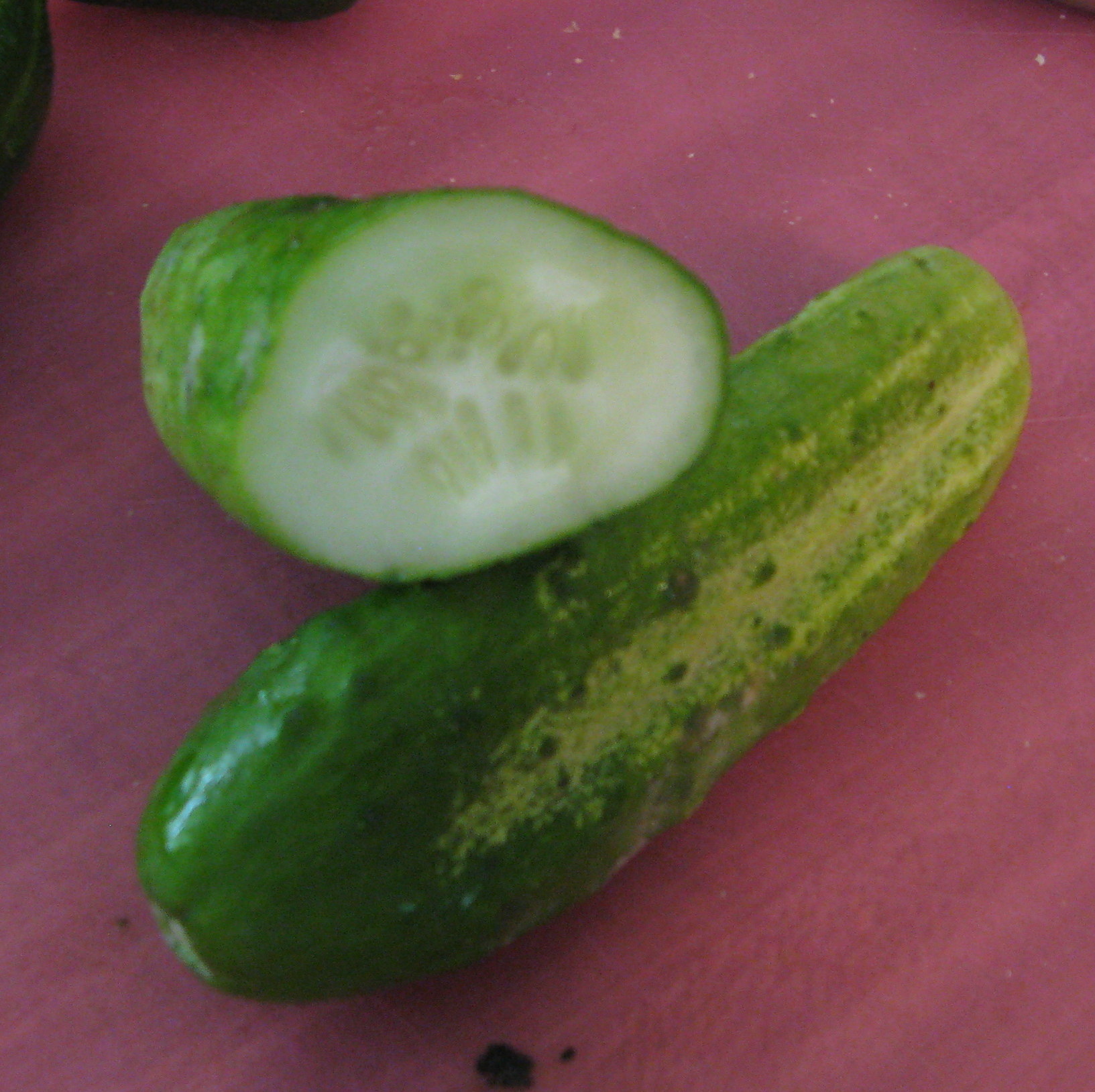
short chubby pickling cucumber with typical coloration

pickling cucumber

I like my cukes to be drier and without pronounced seeds, so I use pickling cucumbers to eat instead of the “slicing” or “field” cucumber.   During the winter, I’ll use the English (the big long ones in the plastic wrap) or the “baby” cucumbers since they have less developed seeds–and I can’t see having to scrape out that much of my cucumber.  A less watery cucumber (than the slicer) is desirable since I like to put them into cucumber and tomato salads, white bean salads, macaroni salads and all sorts of things like that–they are so cool and crunchy. I really don’t want to scrape out the seeds and salt to remove water!

.

cut Amira cucumber with small seed cavity and seeds

the Amira cucumber

Until recently, I’d been using pickling cucumbers, but a friend has introduced me to the Amira cucumber which she has grown in her garden regularly for some years; it’s now become my new favorite cucumber! Long, slender, with a deep green, thin skin, and seeds that are not very pronounced at all, and it is without the one downside of the pickling cucumber–a tendency to bitterness, especially in hot, dry weather. I’ll be planting some of these next summer, to take the place of the Diva (a slicer that does not need more than one plant to set fruit) cucumbers that I have been planting for the last few years.

.

Cucumbers are a member of the gourd family (Cucurbitaceae)which also includes squash, gourds, and melons. Cucumbers come in three main types: commonly called field or “slicers”, pickling, and “hothouse” or English cucumbers.

  • The American slicing (also garden, salad,  or field cucumbers) have a thicker skin and are usually waxed (for the supermarket) to prevent dehydration.  Since the skin is thicker, I prefer these peeled and because of the larger seeds which may be bitter and tough, and likely will need to be scraped out. These are a “wetter” cucumber and need to be salted to draw out excess moisture before use in salads. (Sorry, no pictures since I don’t have any of those around the house!) In the supermarket, these are the loose ones, with the waxed skin.
  • The pickling cucumber is noticeably different from the slicing or salad cucumber–there are gradations of color, and the skin is bumpy. These are usually shorter and chunkier than slicing or salad cucumbers, but they are perfectly good to use in place of slicing cucumbers.  (These will include gherkin and cornichon types which are smaller than other varieties of pickling cucumbers.)  When these are found in the supermarket, they usually seem to be dehydrated, since they are not waxed.
  • The English, Japanese, or “hothouse” cucumbers, which are longer and skinnier, and have small seed cavity and small seeds that don’t need to be scraped out. These are sometimes called “burpless” since they do not contain some of the compounds in the skin which can cause digestive distress to some people. These are found wrapped in plastic instead of waxed; the skin is thin so they don’t need to be peeled.

Favorite things to do with summer cucumbers include cucumber sandwiches, tomato and cucumber salad (with onion and herbs) as a side dish, or add cheese (maybe feta or ricotta salata) for a light meal (especially with fresh bread to soak up the juice), and I like to add them to other summer salads like white bean salad or pasta salad.  Slices are great as a crudity with hummus or other dip (baba ganoush). Then there’s that dish of cucumbers and onions, thinly sliced with a bit of sugar and vinegar and marinated.  Or combine them with yoghurt or sour cream, or even make a cold cucumber soup that’s easy and refreshing.

Recipes for cucumber salads or soups can be found on the web or in most cookbooks, but I’d especially recommend one of the vegetable cookbooks listed in the bibliography–Marian Morash’s The Victory Garden Cookbook, pages 92-101 for cucumber basics and some more novel uses such as sautéed  cucumber, and even baked stuffed cucumbers.

pickling and Amira cucumbers side by side

Amira and pickling cucumbers

Choicest summer fruit–figs!

figs on tree

ripe and unripe figs on tree

One of the high points of summer for me is when figs are ripe–eat them fresh, ripe from the tree early in the morning while they are still cool from nighttime, or in the heat of the afternoon when they are fragrant and warm from the afternoon sunshine.  Absolutely luscious!  They never even make it into the house.  Should the crop be so plentiful that they do make it into the house, then get out the prosciutto–fresh figs are even better than melon with that lovely ham! Or, some good cheese–goat cheese, or Gorgonzola, or other  blue, or a sheep’s milk cheese like Etorki or aged Manchego They are never better than when you can pick them truly tree-ripened.

Too many times, figs are sold unripe, mostly because they are very perishable and delicate when at peak ripeness.  Another reason figs are frequently picked before peak ripeness is the competition: birds, squirrels, bees, wasps, and ants–all those critters have an eye for the perfectly ripe fig!  If you want to eat them ripe from the tree you have to be willing to share because unfortunately, figs do not ripen after they are picked–pick a green fig and you’ll always have a tasteless fruit that will leave you wondering why anyone would want to eat them, much less get excited about them.

It’s really hard to describe the taste of a fresh, ripe fig–it’s certainly much different  from dried ones, and a world away from Fig Newtons.  I think that a ripe, fresh fig has some peach and berry flavors–it will vary somewhat with the variety of fig, but still—it’s not likely to be what you’d expect from eating dried ones.

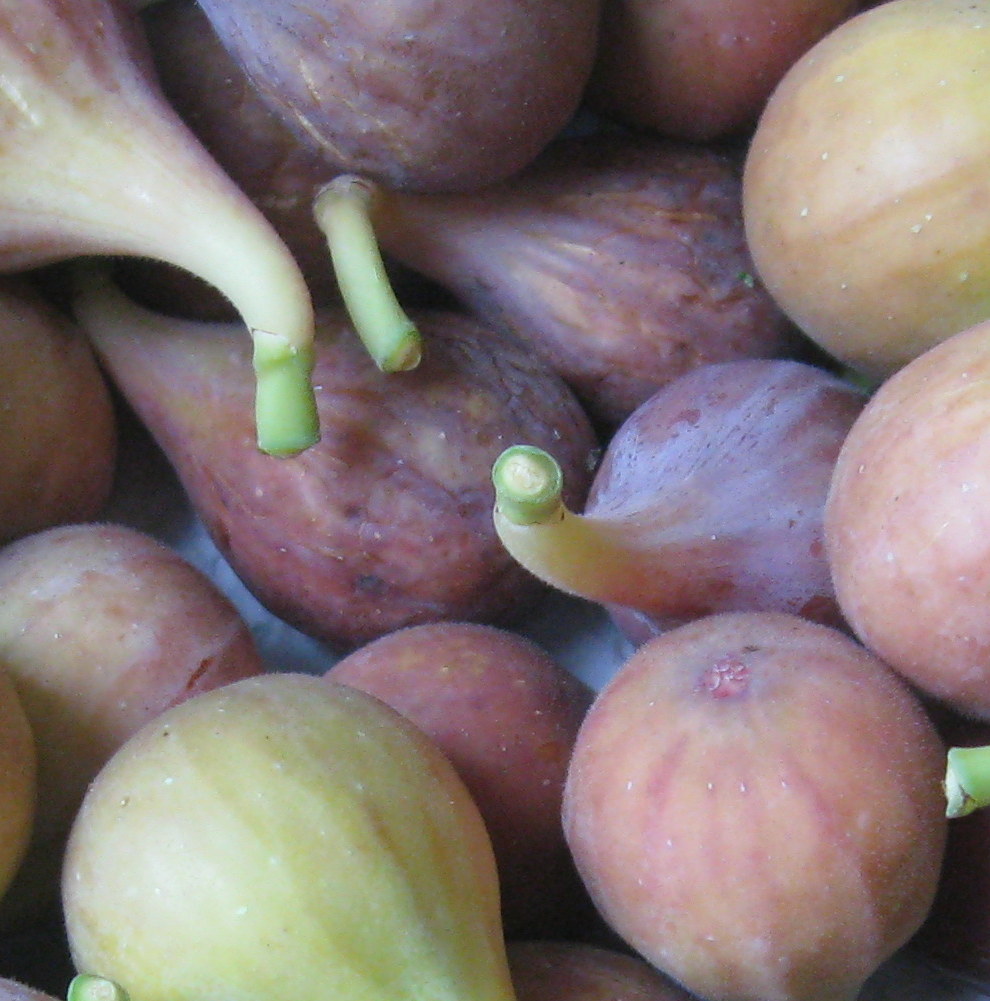
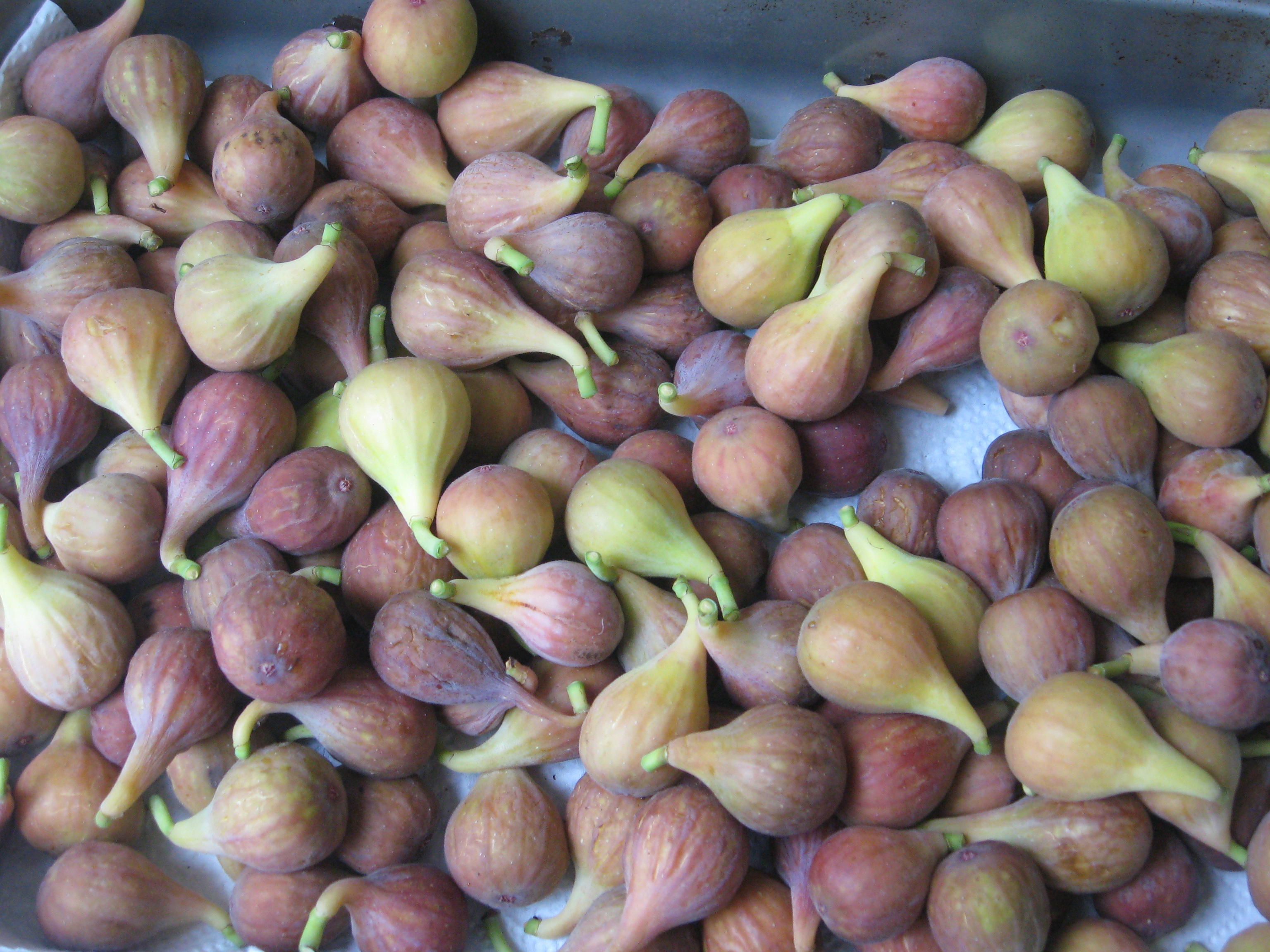
So how do you tell if a fig is ripe? They should be soft–but please be gentle when you press on them. Really, you can tell if they are going to be soft by looking at the color (you do need to know the color of the variety when ripe). The Brown Turkey figs first turn yellowish-green–they will likely be just starting to soften then, but still do not have much flavor yet.  As they ripen more they begin to turn a lovely rosy brown–but wait!  They’re not ready to eat yet.

Figs hang in a drooping way from the tree (you can see how the stem ends are curved in the photograph above).  When ripe they should separate easily from the tree when you lift them up against that curve. If they don’t they are not ripe!

For best flavor, they should begin to show some tiny surface fissures in the skin (not deep cracks) almost like crazing on pottery glaze, and the small round area at the blossom end should have started to  open or to show a split. On some figs you may actually see a drop of clear liquid there.

To find ripe figs if you don’t have your own tree, you need to head to the farmers’ market. The common fig here is the Brown Turkey which is in season approximately from July to September. I’ve just harvested several pounds of figs–but the tree still has lots of small green figs that should ripen in a second flush in a few weeks.

Should you have an excess of fresh figs, you should use some with duck–the recipe is complicated, but the result is unforgettable–worth the effort.  What else can you do with fresh figs?  Fig ice cream, poach some and serve with pound cake or vanilla ice cream, fresh fruit tart….but best of all, just eat them unadorned.

If you find you have some that are not quite what you’d like to eat out-of-hand, then you can make a lovely dessert by poaching them in Campari.  This is a recipe that I found in Jacques Pepin’s The Shortcut Cook (page 248) for which I’ll give you the basics here:

Poached Fresh Figs with Campari

Ingredients

  • 1 cup fruity white wine
  • 1/4 cup sugar
  • 1/4 cup lime juice
  • about 20 small, ripe figs
  • 2 teaspoons cornstarch dissolved in 2 tablespoons water
  • 2 tablespoons Campari

Preparation

  • Combine wine, sugar and lime juice and bring to a boil.
  • Add figs, cover, and simmer for about 4 to 5 minutes. Figs should be tender when tested with the tip of a knife, but should not burst open.
  • Transfer to a bowl with slotted spoon.
  • Reduce the liquid in the saucepan to 1 cup if there is more than this.
  • Add cornstarch slurry and bring to a boil to thicken.
  • Cool sauce to room temperature then stir in the Campari and pour over figs.

These are delightful served over pound cake with a dollop of sour cream or crème fraîche, or spooned over good vanilla ice cream.  (I like to add just a hint of cardamom to this poaching liquid.)

brown turkey figs picked ripe

ripe Brown Turkey figs