
I wasn’t surprised to find differences in how meat cooks with sous vide and pressure cooking. I want to know more about the best way to cook other things that I use frequently: beans, cabbage, rice, etc. so I decided to do another comparison. Lentils are something that I do use quite often so I thought that a pressure cooker/sous vide test was in order here too.
I was inspired to try cooking lentils with the Joule app on my smartphone. There was a section on “batch cooking.” Normally, since I’m always trying to do single-serving cooking and don’t do well with leftovers, I’d blow right by a suggestion like that, but I noticed that those batch-cooked lentils could be stored in the refrigerator for 7 to 10 days. That made sense since they would essentially be pasteurized. An interesting possibility for something that I use in as many ways as lentils!
Lentils are so quick to cook on the stovetop that you might wonder why you should use a pressure cooker or sous vide (particularly with the time required). One reason is hands-off. In the pressure cooker, it’s set-and-forget until done. The same is true of sous vide; for me, that can be an advantage when I’m engrossed in writing and indexing. So, here is a comparison of the two methods.
Another thing that made me curious about cooking lentils this way was that they were cooked in pint jars. With the brown lentils I had in the house at 185°F for the recommended 90 minutes, plus the additional recommended 30 minutes I still didn’t have cooked lentils. But I thought this deserved further investigation, so I searched for other recipes with suggestions for time and temperature.
My first task was to look at American’s Test Kitchen’s Pressure Cooker Perfection to see how to cook lentils in the pressure cooker other than just pushing the “beans/chili” button on the Instant Pot (IP). Much to my surprise, lentils weren’t listed as an ingredient. So, I went to other reliable sources for cooking time suggestions: From the Forks over Knives website, 20 minutes; from Kitchn, 15 minutes. Both recipes call for natural pressure release.
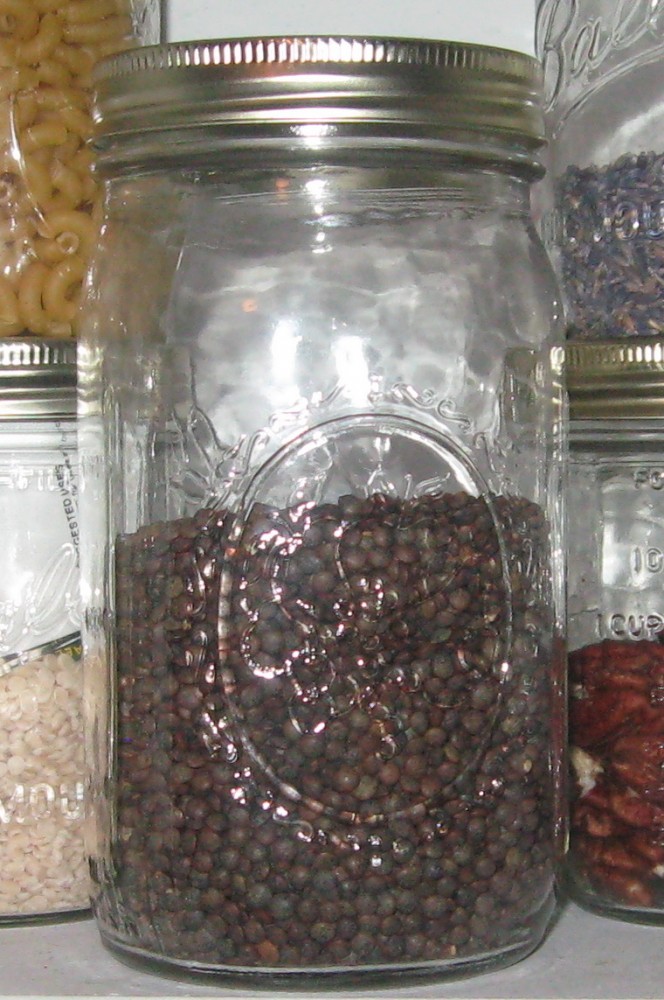
For sous vide (precision cooking), I did find lentils as an ingredient and, thus, instructions for cooking in Sous Vide for Everybody (location 3646). The recipe called for black lentils (sometimes called beluga lentils). Most often, I use French green lentils (lentilles du Puy), but I occasionally use brown lentils, so I opted to use those. At least I felt I was comparing apples to apples regarding cooking times and temperature since both were for black lentils.
The experiment
I had already tried using Mason jars in the water bath and in the IP, so I decided to use a pint Mason for both cooking methods. Although I believe that Ziploc freezer bags are probably safe, I think about using as little plastic as possible for environmental reasons if I can use recyclable containers like the Mason jars.


As with the meat, I decided to season both batches the same so that the only difference was the cooking method so the lentils were cooked with only salt as seasoning; it’s the texture I wanted to know about. From reviewing recipes from several sources for both electric pressure cooker and sous vide I prepared two pint jars each with 4 3/4 ounces of brown lentils, salt and 8 3/8 ounces of water–one for the pressure cooker and one for the sous vide water bath. The pressure cooker was set for 15 minutes, normal pressure release, and the sous vide for 194°F and 3 hours (range 3-5 hours). Then, the wait began.
The jar from the pressure cooker was cooled (it was sealed) and refrigerated until the sous vide lentils were cooked. That jar was also cooled (it was also sealed) and refrigerated.
The results:
For the taste and texture tests, both jars were removed from the refrigerator and unsealed to look at the lentils before reheating. The cold jars were placed in a cold water bath to reheat to 145°F (1 hour and 30 minutes).
Just looking at the two, there was an obvious difference in how some of the lentils cooked in the IP were “blown out”–i.e., exploded, burst open, etc.- not great for use in a salad. This is no surprise, given what I’ve read about the differences in other legumes cooked in either of these ways.


When tasted before reheating (cold), lentils cooked in the IP were much softer, almost mushy. This was OK in soup, especially if you wanted to puree some to thicken it a bit. The sous vide lentils were firm but tender—just what I’d like for a salad or a side. After reheating, there were still the same differences.
The flavor? I’m struggling to describe the differences in flavour–there definitely was a difference. I think part of it was that the IP lentils you started tasting immediately when they hit you mouth; with the sous vide lentils you didn’t really taste them until you start chewing them. Then, this burst of flavour seemed to me to be more intense than with the IP lentils. I found it very difficult to separate flavour from the “mouth feel” of the two batches–I think the texture differences affected my reactions.
After this experiment, I think I’ll be cooking a lot of lentils with the sous vide method. If I want lentil soup, I’ll turn to the IP. I’ll also add more salt to both.
Some interesting things to explore! A son gôut!
—Ô¿Ô—
…
 a-single-serving.com