Unknown's avatar

About sa.fifer

Lover of good, wholesome food and wine. Cooks for one and the cat. Likes to paint-- a frustrated botanical illustrator and amateur (photographer) and fledgling birdwatcher, beekeeper, and Kindle addict. Works as a freelance indexer.

Thyme and Black Pepper Crackers

These sound just incredible–and easy!

Chelsea's avatar"blackberry-eating in late September"

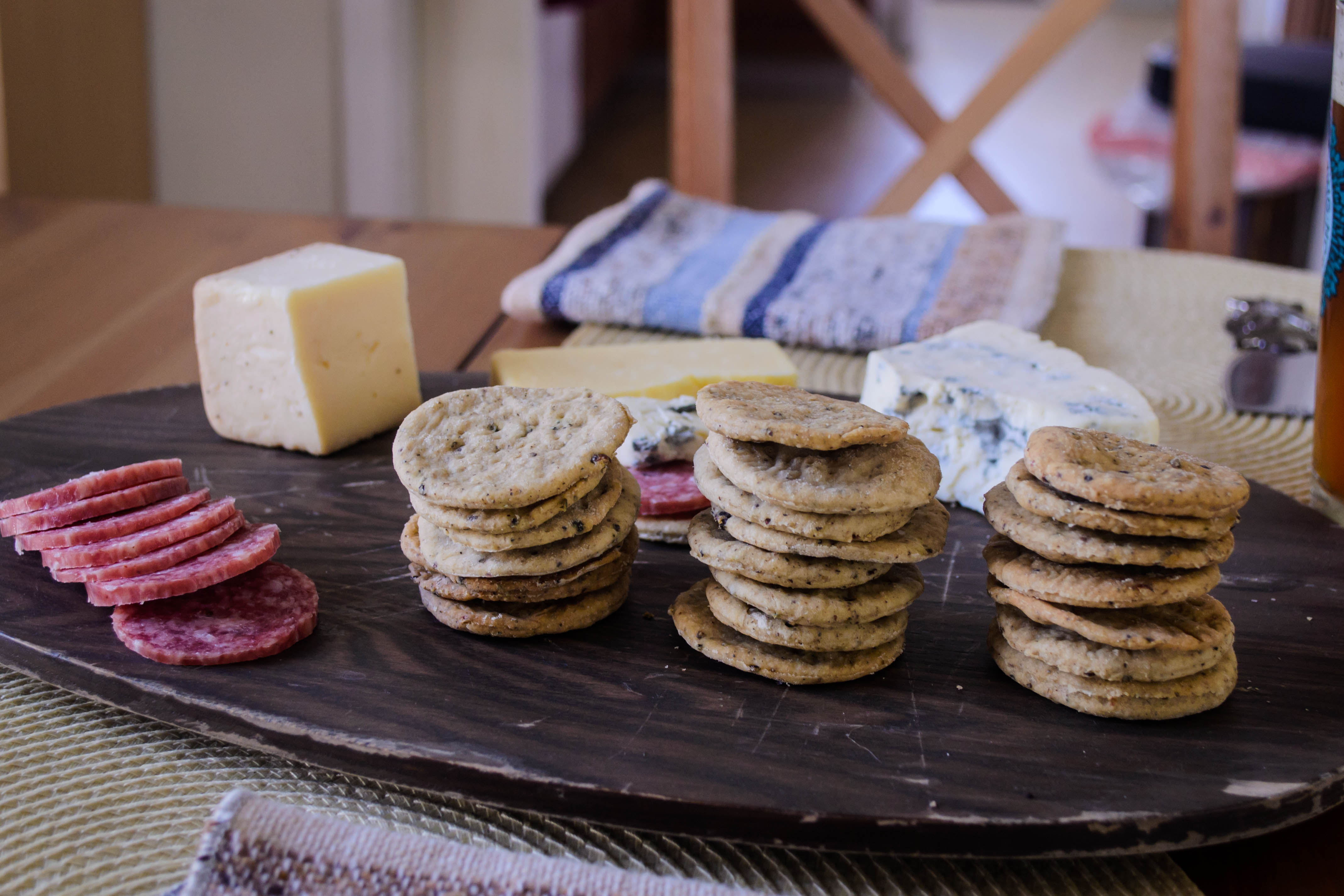
2015 Blog September-0498Over the past few years, N. and I have made it our business to conclude the week with a happy hour – we load some cheeses and crackers on a plate, sometimes some sliced cured meat, sometimes a few dried figs – and pour something cold and alcoholic into a frosty glass. Through this process, I’ve learned that N. loves black pepper. We bought a wedge of cheese crusted in black pepper once as an experiment, and I think since then it has been on every shopping list, every week, for about the last two years. More recently, we started picking up variety packs of crackers – the crushed wheat rounds, the chalky water crackers, the rectangles spiked with vegetable bits – and in one variety-pack, a black pepper water cracker. This sleeve always, always disappears first. N. doubles up on the pepper – peppered cheese on peppered cracker. And…

View original post 1,021 more words

Spice is a state of mind: cabbage thoran

Good information for all of us who cook using spices.

Aneela Mirchandani's avatarThe Odd Pantry

Cabbage thoran Cabbage thoran

Sometimes spice is just a state of mind. Plants don’t come with Dymo-printed labels that say ‘Spice use recommended’.

Now you might think I’m making an issue out of nothing. Obviously, plants that produce a strong appetizing smell can be used as spices, and others not, right? No mind tricks necessary.

But consider what happens during the process of blooming spices, otherwise known as tempering, or tadka. A sequence of spices are thrown into hot oil. They may be seeds — like cumin or black mustard, dry leaves like the bay, or even bits of bark — like cinnamon.

If the temperature is too low, nothing particular happens, while if the temperature is too high, the spice burns. But if the temperature is just right, two things happen. One, the outer surface of the spice browns. This browning, known as the Maillard reaction, is the perfect state of cooked food…

View original post 396 more words

Vacuum pack it!

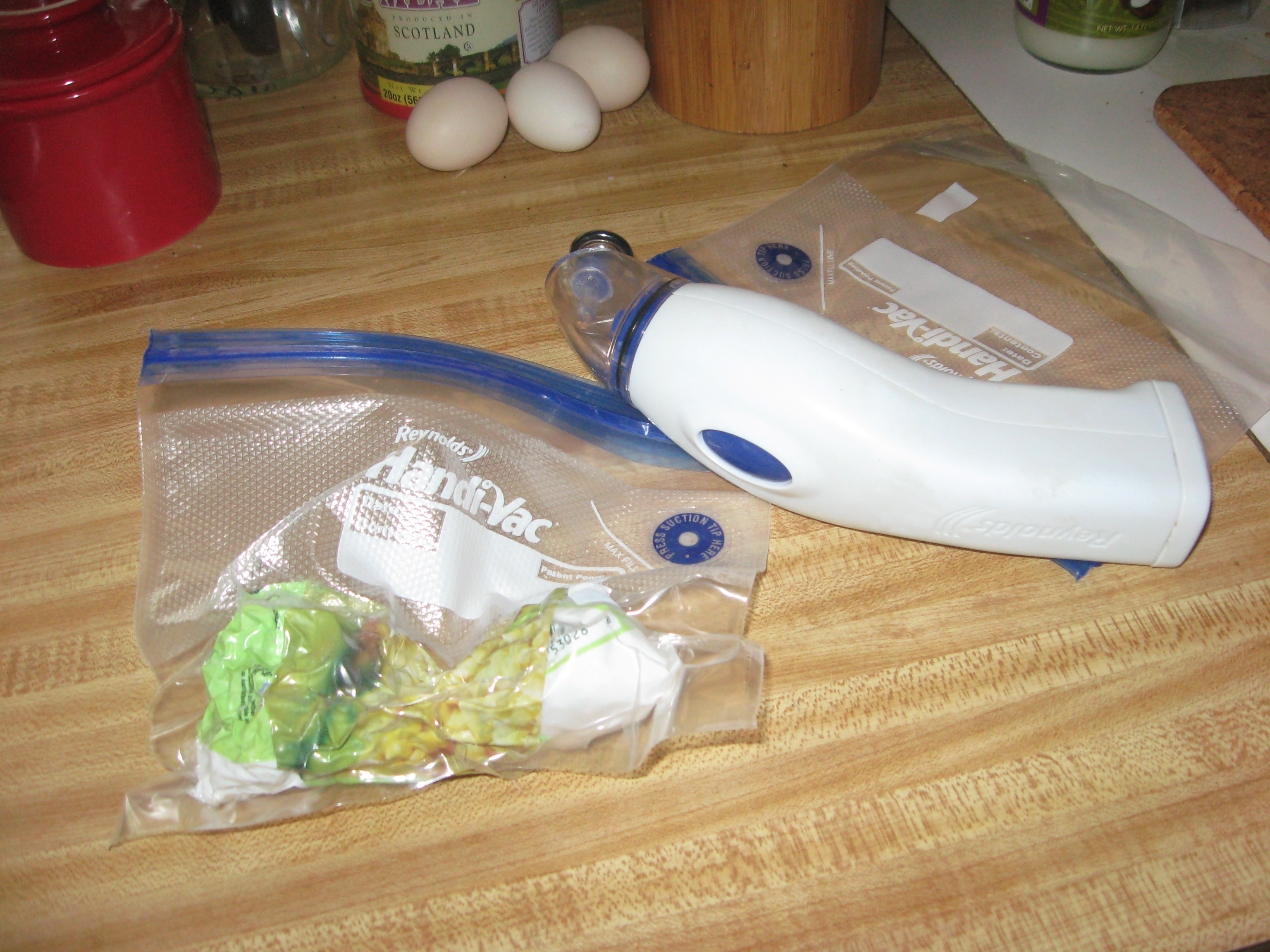
Reynolds Handi-Vac and bagWe all know about “freezer burn” that can happen when you put opened bags of stuff back into the freezer.  I’ve found something that ameliorates that. We’ve all observed that products that are vacuum-packed hold much better than those that are not. So–when I put opened bags vegetables back into the freezer, I use a clever gadget from Reynolds®.  Lest you cringe thinking expense–I’m not talking about the “big” vacuum sealing system.  I’m talking about the little hand-held pump and bags with a valve on them.

This is the Reynolds® Handi-Vac® system (reported to be discontinued, but still available from eBay and Amazon). It operates on AA batteries. For storing opened frozen products, I put the original bag, folded and air squeezed out into the vacuum bag, and vacuum! This is not as “hard” a vacuum as achieved with the counter-top vacuum sealing products, but it hides in a drawer and is inexpensive–no lost counter space which can be important.
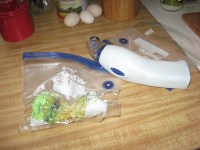
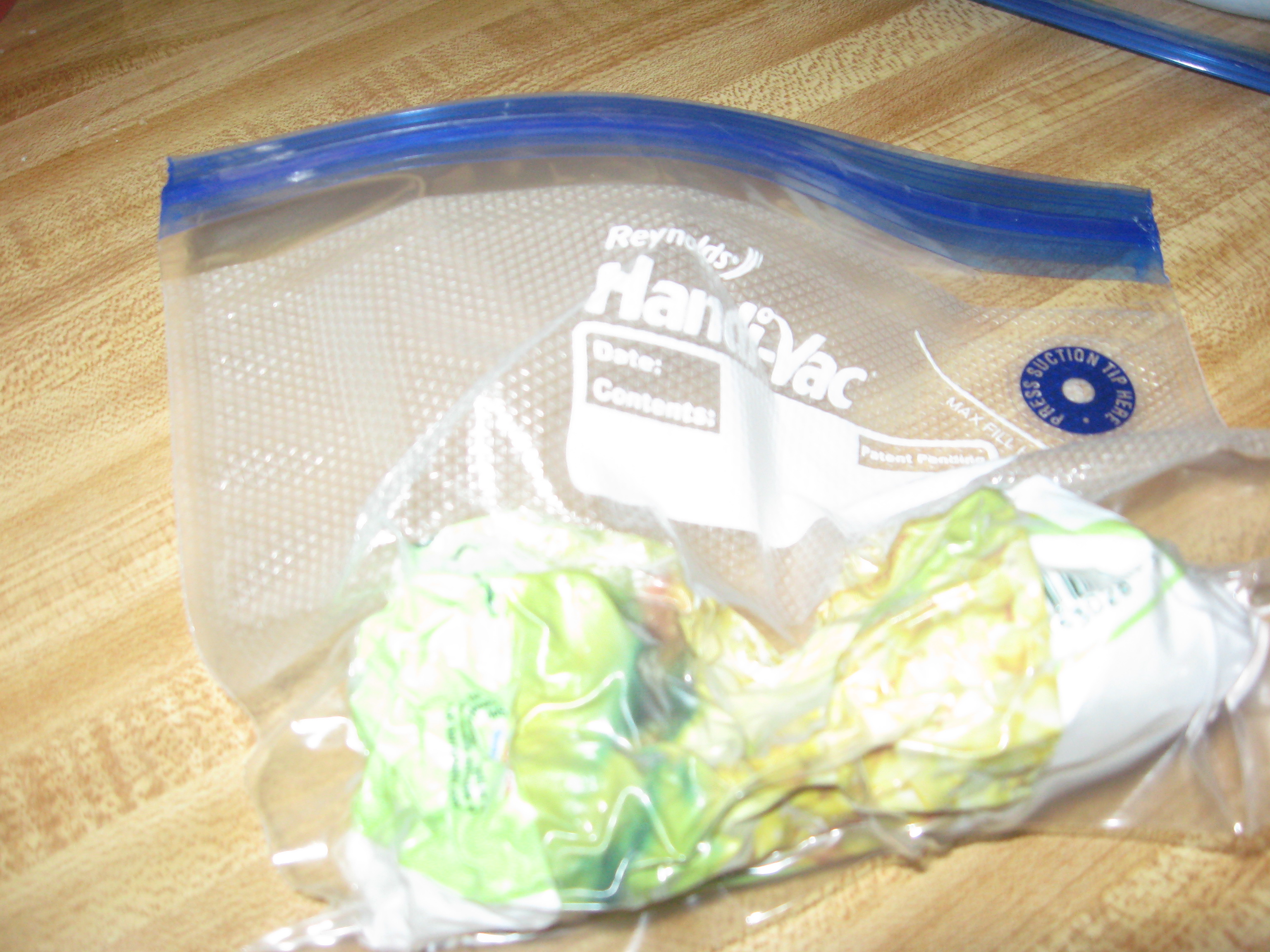
vacuum sealed cornIt does help extend the freezer-life of opened packages of frozen products. If it’s something I use a lot of (e.g the petits pois, or “baby” peas that only come frozen–we’re ignoring canned), then I may buy the family size package and portion and vacuum those in serving size.  For the most part, I leave the veggies in the original bag–this way I can reuse the vacuum bags. For meats or seafood, I generally don’t reuse the bags. I just don’t feel I can be sure that they are sufficiently clean.

Here is a partial bag of frozen corn (another thing I like to buy in bigger packages). I confess that I’ve not done any scientific studies here, but using this seems to have decreased the number of times I dump a partial bag because of the freezer burn.

I’ve also discovered that using this really helps with the celery dilemma common to single-serving cooking: wash and cut celery into length that fit into these bags (you can also get bigger bags), wrap in a damp paper towel, and vacuum seal. It’s’ amazing how long it lasts that way. When you wish to freeze servings of big-batch cooking you can use these if there is not much liquid, but it can be tricky. What I usually do for those is to put the food into a “light” storage zipper-lock bag, squeezing out most of the air, and then into one of these.  Again, I can reuse the bags; they seem to stand up to reuse quite well.

corn in vacuum sealed bagMy only experience has been with the Reynolds® Handi-Vac® though I’ve noted that Ziploc® and FoodSsaver® both now have hand-held systems (as well as the counter-top). Just from trawling the internet, I can’t tell if the Handi-Vac can be used with the Ziploc® or the FoodSsaver® bags; there’s contradictory information (what a big surprise).  Of note, the Ziploc® pump is manual rather than battery operated, and I would suspect that it will create a less strong vacuum than battery-operated pumps.

There’s an advertisement for an adapter for the Handi-Vac® pump to be used on Ziploc® bags. It’s called the “ReynLock Adapter™”; I’m NOT including a link because of the contradictory information I’ve found, and the price of the gizmo, and I’ve not used it so I don’t know anything other than the advertisement. (See My Opinion page, please).

Updates when I have more information because I will be looking for another product to do this.  Maybe I’ll be lucky and the Ziploc® bags will work!

Hive 01 Oct. 2015

pollen-carrying bees

Go girls!

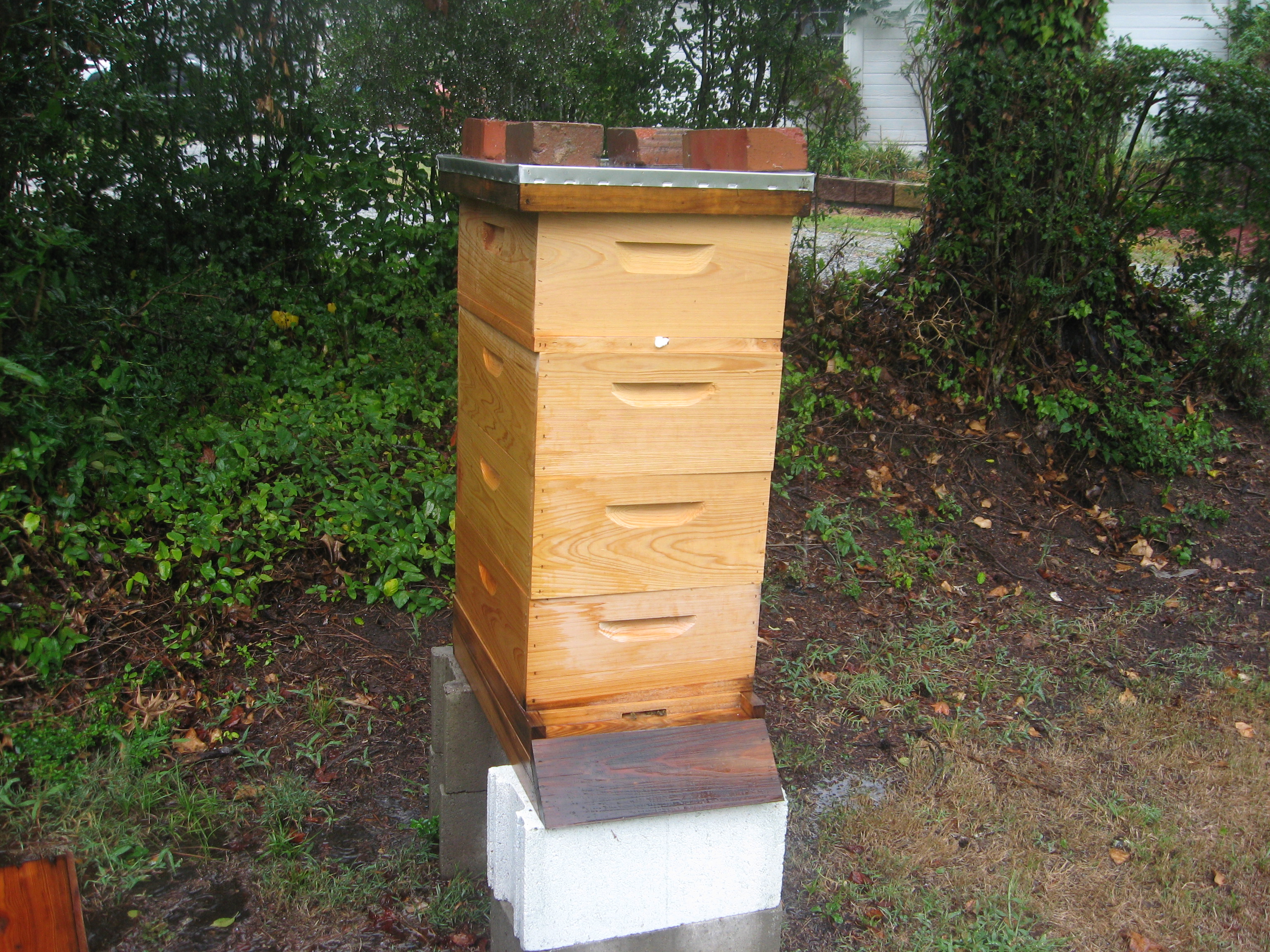
Frustration here–weather has kept me from opening the hive to see what’s happening in the upper medium box that I put on a few weeks ago.  Normally, I’d have done a routine inspection last weekend but opening hive in the rain is definitely a no-no–truly ticks off the girls.  Again today, too windy and chilly.  Given our weather forecast looks like I won’t be opening the hive until sometime next week. I’ll be out there checking on the first sunny day. My curiosity must wait a bit longer.

Switching to winter feeding with 2:1 sugar to water ratio. Looking ahead to colder weather getting some fondant to provide some food if needed in the colder weather, and adding a bit of insulation and moisture protection to the hive. Time to place a mouse guard, too.

I’ve done an assessment for Varroa destructor (mites) about 2 weeks ago with a stickyboard. There didn’t seem to be many mites. I’ll repeat that in the next few days to be sure that I don’t need to treat before winter.

Too much convenience?

Mueller's Pot-Sized PastaI was striding purposefully down the aisle of my local Harris Teeter when a package caught my eye–and brought me to a screeching halt–pot-sized spaghetti? This is something that you buy?  You don’t just take the regular spaghetti and break it, assuming that you’re not going to just put it into the water slowly, letting it soften until it’s all in the water?

Pot-sized angel hair?

Pot-sized thin spaghetti?

Pot-sized linguine?  Really? I was amazed, or maybe stupefied, or maybe the only thing that really covers my reaction was what I understand the British expression–gobsmacked–to mean!  Are we so far from “home cooking” that we can’t even deal with pasta unless it’s pot-sized. As you can tell this catapulted me right onto my soapbox, or maybe even onto my high horse (which every you prefer). Has having pot-sized pasta brought down the price of my plain spaghetti that’s too long to fit in the pot unless I stand there and lower it slowly into the water? Not being a marketer, or an economist, merely a consumer, I really doubt that  it has. (Besides, I think this would be too short to twirl effectively to wrap it around my fork.) Not something I’m likely to buy (even though I do sometimes buy other Mueller’s pastas.

jar of mixed rice and grainsI went past the pasta display because I was on my way to something of a convenience nature for me: one of the packages of grain mixes. Those don’t leave me gaping.  They are very useful for single-serving cooking.  My latest is an HT Traders mix of basmati brown rice, red rice, with barley and rye berries. That’s my idea of convenience–I don’t have to buy the standard package of each of those grains: that would be about 1-3/4 pounds of basmati rice, and who knows how much red rice and rye berries. I most likely would not use that mix if I had to buy each of those separately–unless I could buy each from bulk supplies.

That kind of convenience I can get my mind around. I do have packages of barley, oats, but even the dried things don’t have unlimited shelf-life. They don’t  spoil–in other words they are not perishable. If you store them carefully in glass jars with good seals, they should not get buggy, but keep them long enough and they won’t hydrate as well, taking longer to cook. For some dried goods like beans, you may get to the point where they will never soften appropriately.

Of course, there’s also the issue of storage space–for those of us without the luxury of a large pantry with miles of shelf space, but who do like variety this is a great alternative. It has another benefit: it’s compatible with the rice cooker.  I’m happy to more of the “esoteric” grains show up in my local supermarket–they are cheaper than if I were to go to a specialty shop, not to mention just closer to home.

mixed grains

Slow-roasted pork

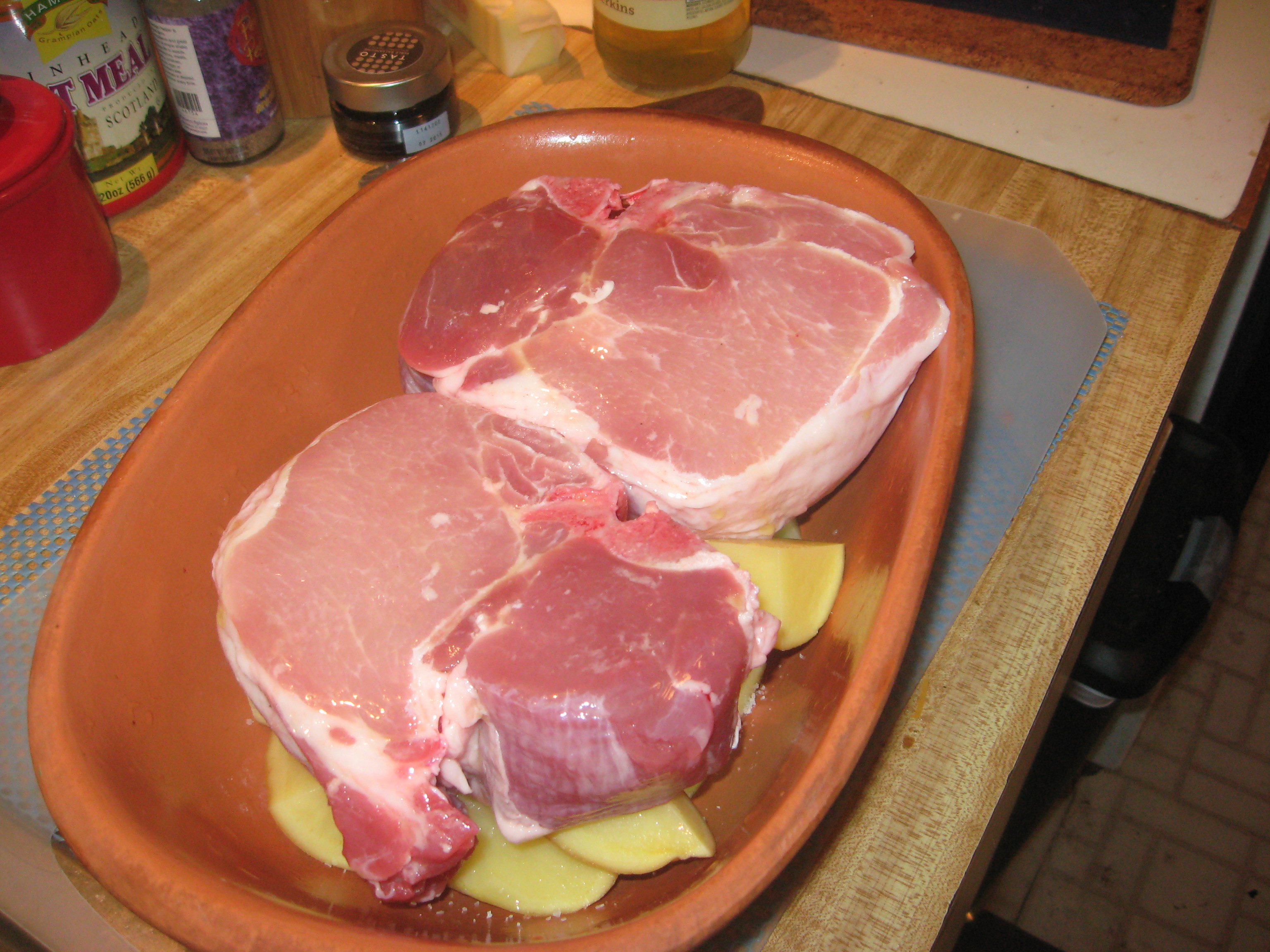
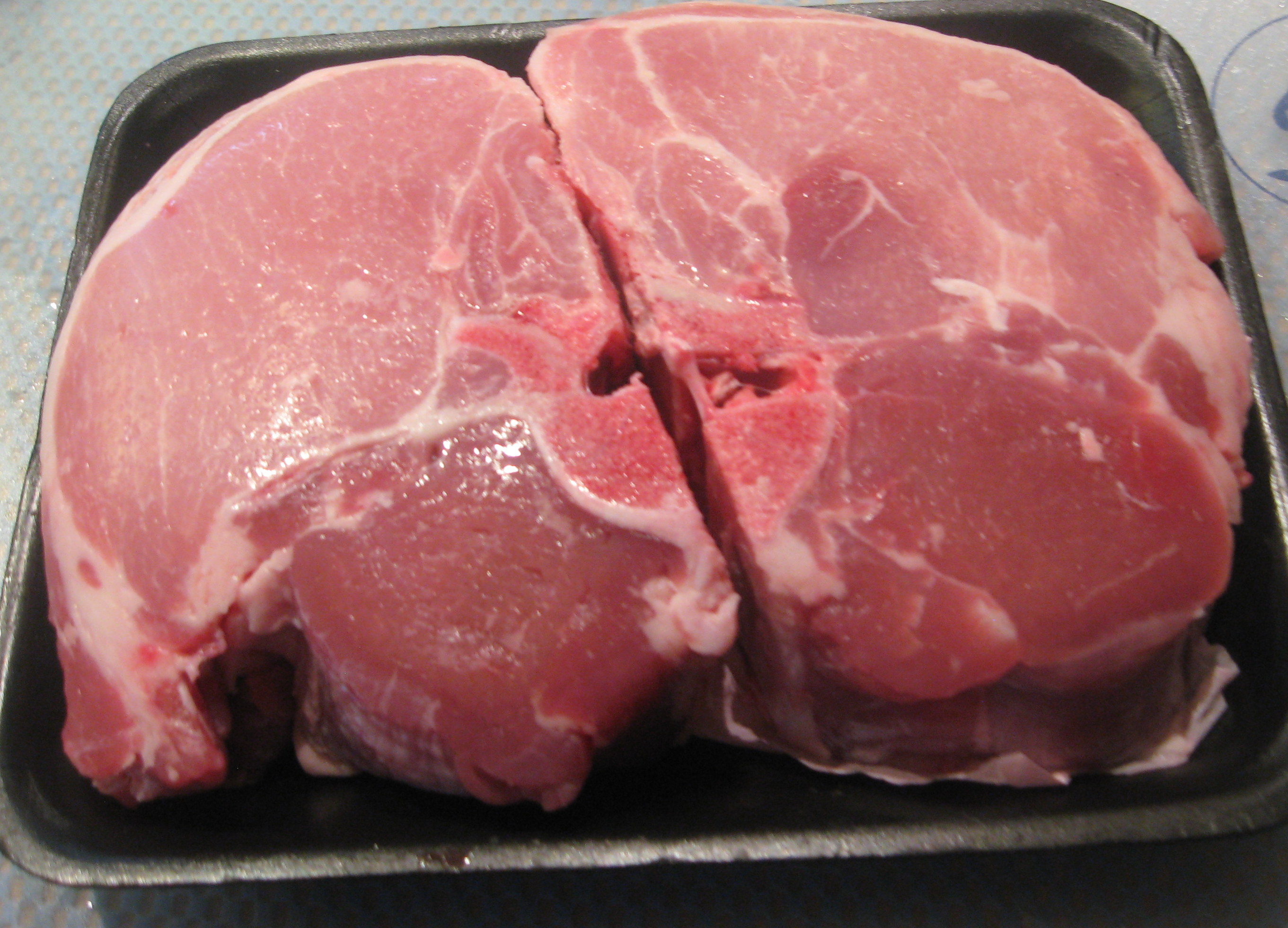
It’s a day that shouts that fall is finally, really here–steady, gentle rain, cool breeze, a bit dreary–the kind of day that says cook something savory and warming.  As the weather has been getting cooler, I’ve been anticipating this kind of day, so on yesterday’s trip to the market, I had the butcher cut me two extra-thick, bone-in, loin end pork chops.  When I got home, I “prepped” them for roasting–a generous sprinkle of salt (for a dry brine) and let them stand overnight in the fridge. Though it’s not cool enough to turn on the heat, just what I get from the oven while these roast will be cozy, and the smell of roasting pork….almost as good a baking bread.

I’ve gotten two chops because I actually want to have extra meat. Leftovers in this case are welcome (which is, admittedly, unusual for me).  This kind of weather brings out a desire for soup-making and other hearty fare, and roasted meat is a good starter!

Slow-roasted loin-end pork chops

Note: The pork was roasted in the clay cooker–with very simple seasoning. I just wanted some big roasted pork flavor. I used loin-end chops here, but thick-cut shoulder chops, or country-style spare ribs will also work. I love the Schlemmertopf/Romertopf for cooking, but you can do this in a Dutch oven if you don’t have a clay cooker.  It will still taste good!

loin end pork chopIngredients

  • 1 or 2 extra thick (1-1/2 to 2 inches) loin-end pork chops
  • a generous tablespoon kosher salt (for the two chops)
  • 2 large Yukon Gold potatoes scrubbed, cut into large chunks (eighths)

pork chops and potatoesPreparation

  • Pat chops dry and sprinkle kosher salt evenly over the chops.
  • Refrigerate overnight or for about 8 hours (up to 24)
  • Soak clay cooker for at least 20 minutes, add chops and place in cold oven set for 295 °F until easily shredded with a fork (about 3 hours).
  • Serve with roasting juices from cooker.

Ò¿Ó

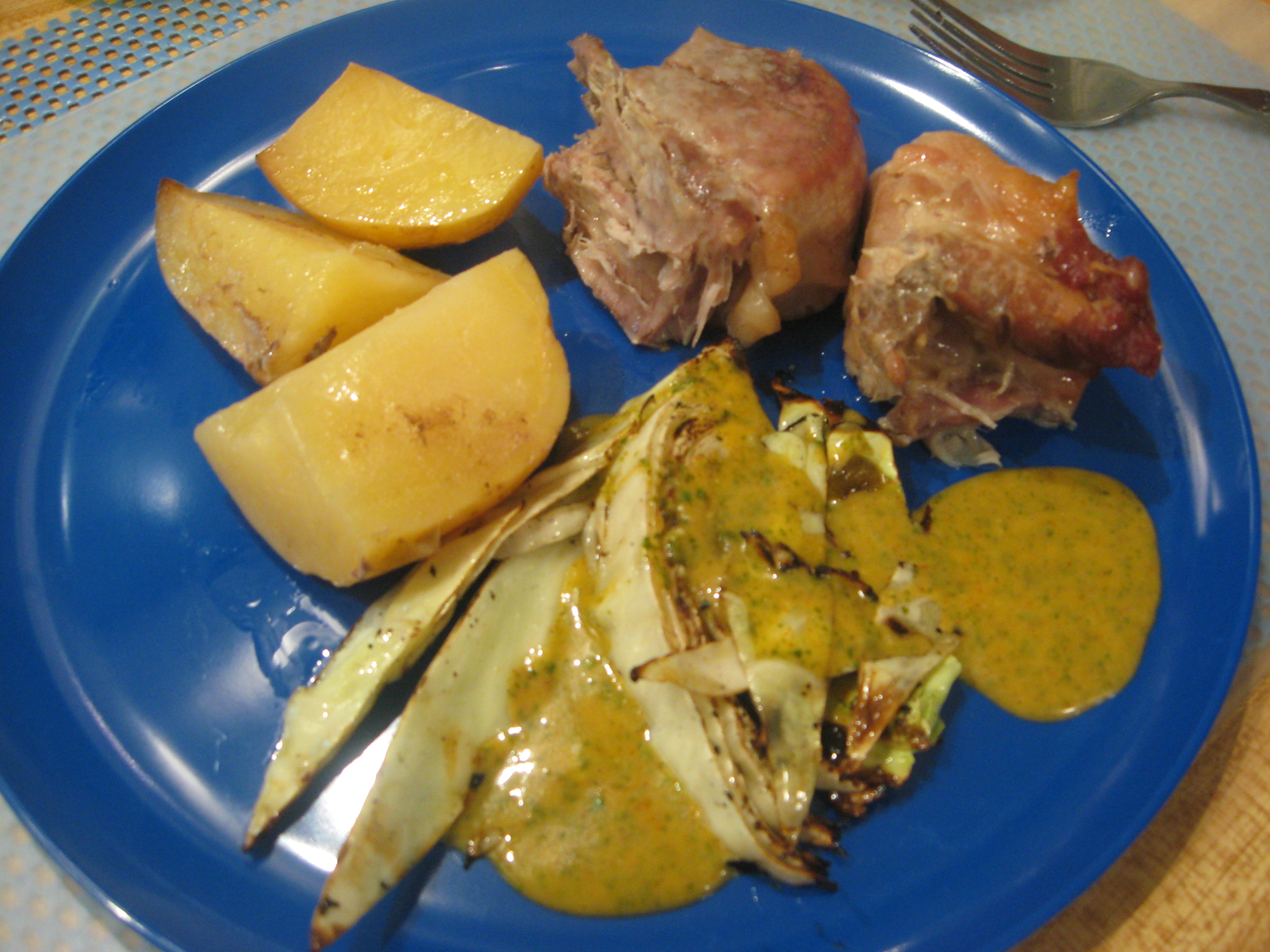
roasted pork and potatoesI made the spicy grilled cabbage from The Kitchn, to go with this. The weather didn’t permit grilling (and lack of planning the oven, therefore the broiler, was in use) so I did a thinner wedge on a smoking hot cast-iron griddle. It was fantastic–no doubt this would be even better on the grill. The spicy lime sauce is yummy (and the bit that found it’s way onto the pork was good there, too).

I did make a couple changes to the sauce: since I was lacking the “smoky” grill, I added chipotle chili powder as well as the cayenne, and I used honey instead of sugar. (I would love to try this sauce with buckwheat honey in it, but none in the house today.)  Definitely a keeper of a sauce!

Ò¿Ó

There are leftovers–but I’ve planned how to use them. The pork is seasoned only with salt at this point–deliberately so that I have lots of flexibility in using the rest of it.  I want to try a pasta dish with the “pulled” pork, sage and brown butter sauce. There are roasting juices that will contribute to some good soup–maybe hot and sour soup, or maybe something with hominy and sort of southwestern flavor. I suspect that a serving of basic roast pork is headed to the freezer for a quick comfort-food meal in colder weather.

pork, potatoes, cabbageA son goût!

Hive report (25 Sept 2015)

IMG_8472The hive was due for a routine inspection this weekend, but weather–cloudy, with rain–means it will have to wait until the next sunny day.  Check of the feeder shows that the girls are really slurping down the syrup.  No traffic today.

I’ll have to refill feeder in the morning–rain or shine.  Good thing about the feeder is that I don’t have to open the inner cover; just pull the quart mason jars and replace.

My curiosity is making me antsy–I want to know what’s going on in the upper super that was put on the hive  at last inspection. But that will wait–forecast sounds as if it’s going to rain all weekend so I have to wait until Monday or Tuesday to satisfy my curiosity.

Obviously, not a day to open up the hive–we need the rain so that’s good–but even the morning glories are showing the effects of the rain.

Ò¿Ó

Moroccan-Style Quinoa with Chickpeas and Kale redux

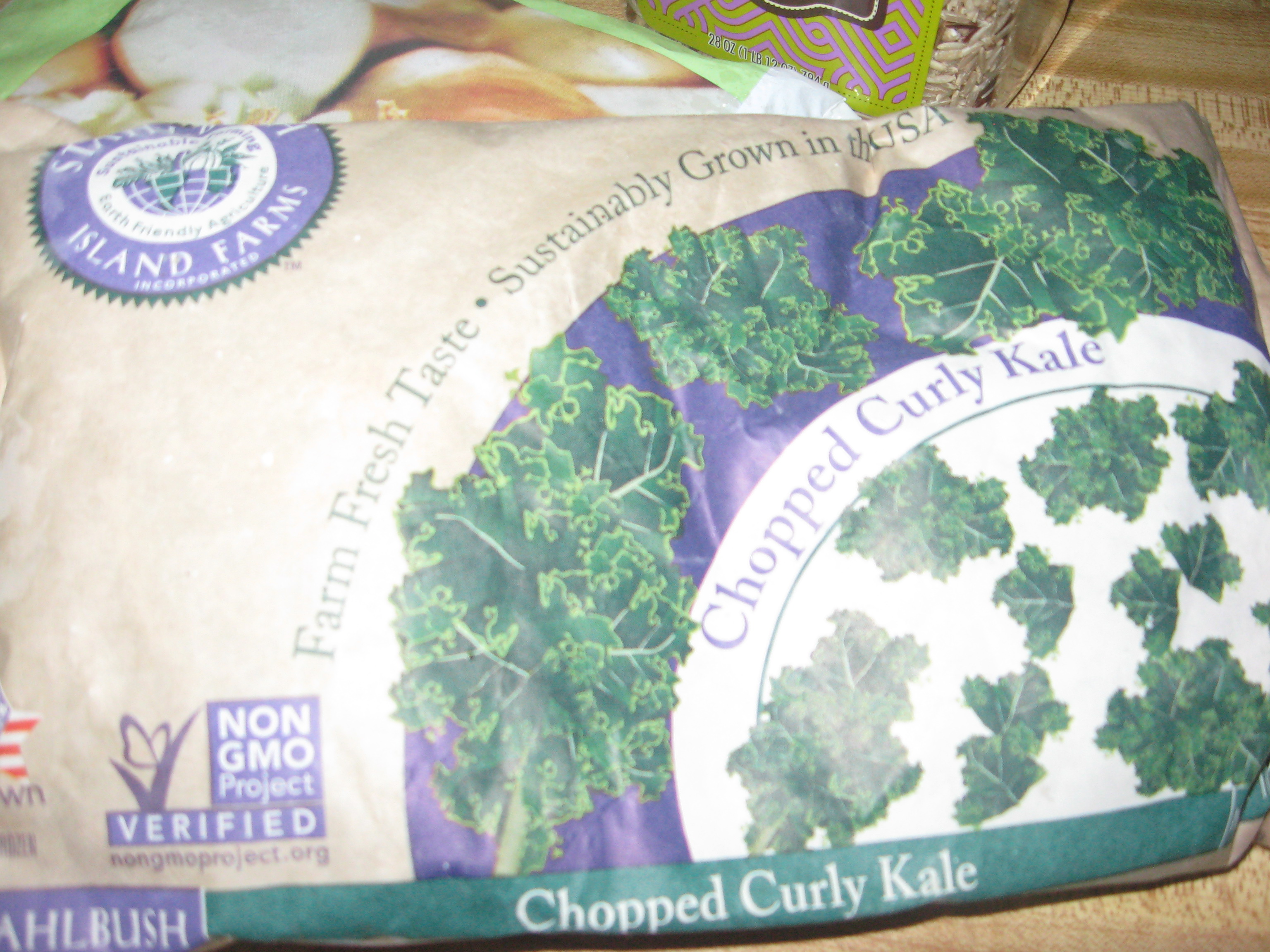
Frozen kaleIn my post about trying a recipe from an America’s Test Kitchen (ATK) I expressed my dissatisfaction with the balance between the kale and the rest of the ingredients.  I think I may have stumbled on a partial solution.

I’m admitting that in single-serving cooking I use frozen vegetables. One reason is that I can put the “leftovers” back into the freezer and not be pressured to use the rest of it right away–I’ll also admit to being a picky eater, par excellence as you’ve probably figured out.  Note my comments on meal planning.

Another is the nutritional value and quality of GOOD frozen products–we’re not talking “heat-‘n’-eat” here.  We’re talking fruits, vegetables, perhaps fish, etc. I don’t mean that I don’t buy fresh from local suppliers, but probably frozen is better than not bringing home fresh kale because it’s packaged (even at the Farmers’ Market) in a huge bunch that just doesn’t work for me.  (Cat just doesn’t eat enough vegetables for that to work, just like he doesn’t help with dust-bunny control).

I made this again, adjusting the seasoning–mostly just adding more of what was called for–but using the frozen kale from Stahlbush Island Farms and it was not overwhelmed by the kale. (Their website says it’s curly kale, but it must be younger leaves that what I had before.)  There will definitely be more of their kale in my freezer and I’ll make this again with these adjustments.


Hive report (08 &10 September 2015)

traffic in and out of hive08 September 2015: Even though it’s a cloudy day there’s a good amount of traffic in and out of the hive–I’m glad I did give them a larger entrance to the hive when I had it open for the inspection.

I’ve looked at the flight path in and out of the hive and I think that they are heading for a local greenway/trail. Looking at Google Earth map, that is easily within a one-mile radius of the hive. I need to go hike the trail and see what is blooming now.  That’s one of the things you need to look at the blooming flowers from a bee’s point of view, and the quality of nectar produced by the flower. So much to learn….

Today I put the “stickyboard” in the screened bottom board to assess Varroa destructor (mites) in the colony to find out if I need to treat for them before winter. That has to stay under the hive for three days so I can get an idea of what’s going on with mites.

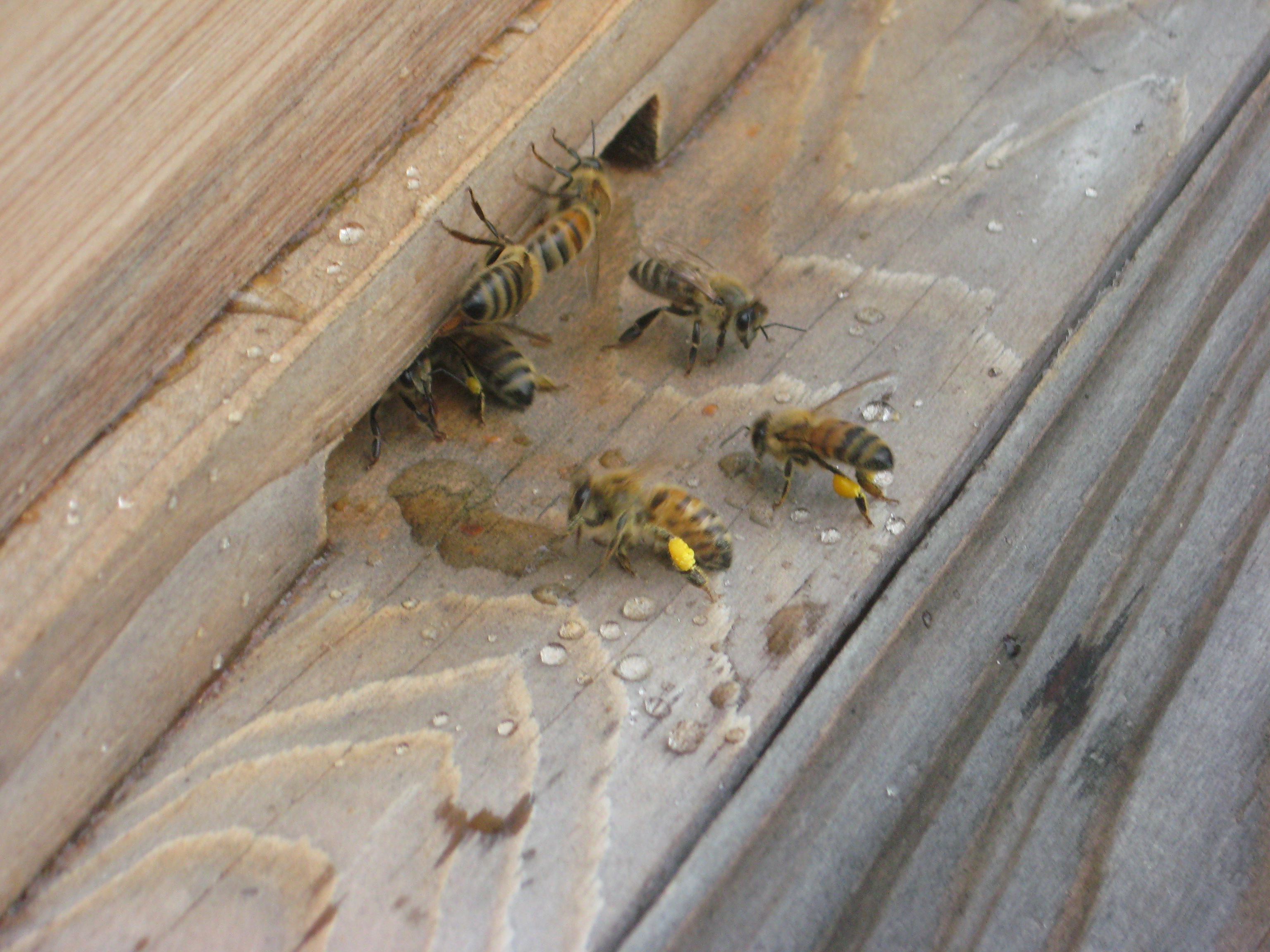
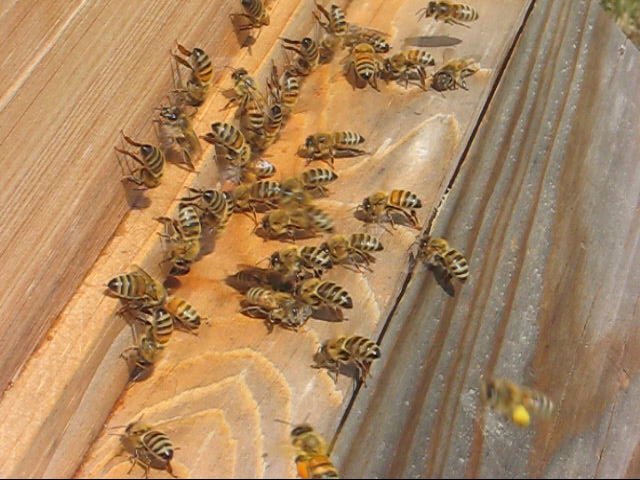
honey bees at hive carrying pollen10 September 2015:  The girls have been slurping down the sugar syrup (with Honey-B-Healthy), as well as bringing in pollen and nectar.  I gave them new syrup today as they had almost completely cleaned out the jars.

When I went out to the hive I got to see some different honey bee behavior:  I had bees washboarding on the front of the hive. No one seems to know what this behavior is, but it’s common, and it’s done by “adolescent” worker bees.

There was lots of traffic in and out–different colors of pollen being carried in–the bright yellow shows up most clearly, but I saw some orange, white, deeper yellow, and some very dark red while I was watching them come and go.

Tomorrow I’ll be able to pull the stickyboard and see what the Varroa population looks like.  Fingers crossed on that one since this is a new colony.  I’ve been reading about the various treatments, including some “natural” ones that use herbs, and other “harder” chemicals.

It will be another week before I can sneak another peek inside to see how much pollen, nectar, brood, and honey is there.  It’s  like wanting to peek into the oven to see if the soufflé is rising properly–not at all a good idea no matter how curious you are.

pollen colors