Hive report: 30 July 2017

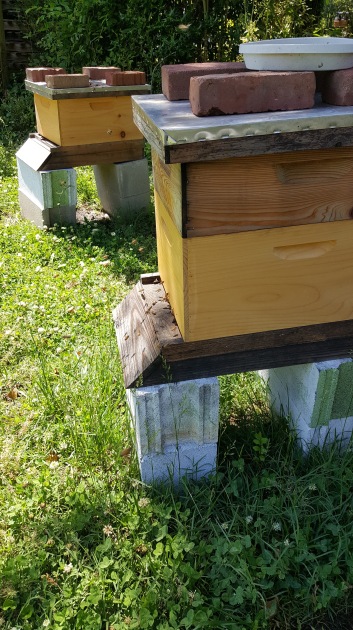
The weather was lovely today–low humidity, sunny, not terribly hot–a mere 81°F with a nice breeze–so I took advantage of it to do hive inspections when the conditions were good for me and for the girls. They were pretty cooperative today though just a bit tetchy when I first opened the hive but that’s not unexpected at this time of the year when nectar is a bit scarce.

The girls in both hives seem to really like applying propolis to anything that doesn’t move–especially between the inner cover and the top of the frames. Prying the tops of the frames away from the inner cover was when the bees in the upper box got just a bit irked with me and switched from humming to buzzing–including a few that got in my face about it–that’s why we wear bee jackets or at least veils. Once I had the inner cover off the hive the bees did settle down and let me do my thing.

Both colonies are looking good–a reasonable population of bees, good brood pattern, honey and pollen storage although there were enough varroa mites present on the sugar shake that I started treatment today on both colonies with ApiVar (Amitraz) strips since we still have some hot weather coming. That’s part of getting ready over-wintering.

Ò¿Ó


Hive report: a real quickie….


Washboarding_20170711_152821

Washboarding bees

I’m such an awful wimp when it comes to heat and humidity. I was planning to inspect both hives today since I would be replacing the empty feeding buckets with full ones. I put additional supers on both hives but I thought I should see how much comb had been drawn in them.


With a heat index of 102°F (even with the humidity relatively low–well actually low for here) I didn’t last long in the bee suit. It’s really frustrating trying to see the world with sweat drops on the bee veil (yes, I was wearing a headband to try and sop it up).

Instead of the more detailed inspection that I had planned, I opted to simply remove the inner cover and see how many frames had been drawn in each one. The Durham bees (the ones from here in town) had drawn comb on almost every frame in the super. The Georgia bees (the package) had drawn enough comb in the super that I decided both hives needed to have a super added before I put the feeders back on.

I still need to do a full inspection before long to check for mites and all that good stuff, but for now, I think I have two healthy hives that are doing what bees do.

Ò¿Ó

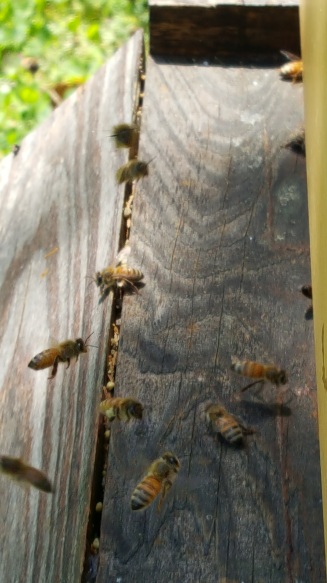
The bees are displaying an interesting bit of honey bee behavior: both hives are washboarding. It’s something honey bees do (apparently adolescents), but no one knows what they are really doing, or why. I found a reference that said the do it more on surfaces with more texture, but nothing to say what they are really doing. They just spread out on the hive (usually the front, though the bees from one hive are spreading over onto the sides as well) and are rocking back and forth, doing something with their mouthparts and front legs.

Is it just the adolescents out for a disco day?


Ò¿Ó

The honey bee calendar: seasonal honey.

The bees’ calendar and the beekeeper’s calendar are not the same as the one in Outlook or Google that displays all the holidays for you and the “year” by which we proceed through our daily routines. They are more responsive to temperatures, and hours of daylight–what’s really going on in nature.  They are awaiting the spring nectar flow to increase the population of the hive and to store honey.  Or the fall nectar flow to store food for the winter months.

In summer when we are enjoying a surfeit of fruits and vegetables (because of the bees’ pollen and nectar gathering in the spring) we have to realize that about that time there is a declining flow of nectar–fewer things are blooming. Life can be hard for bees in July. A nectar dearth means less food for them, so depending on forage region, we may be feeding bees while enjoying plenty of fruits and vegetables.  The bees will be waiting for the fall nectar flow–in my forage region (Appalachian-Ozark Upland) that’s primarily asters and goldenrod.

This seasonal variation is one of the delights of honey and beekeeping. The photograph at the top of the page shows the difference between spring/summer honey (left) and autumn honey (right). It’s seasonal flavor when honey is not blended. In this forage region, as an urban beekeeper, I have “wildflower” honey since my bees don’t have access to a large monofloral flow. I can’t produce varietal honey such as sourwood or alfalfa honey, or even clover honey, but I do have seasonal honey.

Ò¿Ó

Hive report: an interim update

brood box of hiveThe bees have been getting attention–I’ve just not had time to tend bees and to write given work and travel.

I thoroughly enjoyed my almost-a-week stay in Portland ME.  I wish I could have brought the weather back with me, or figured out a way to get the bees and Frankie (the cat) to Maine. Since neither was feasible, I’m back home, tending the bees.

On 11 June 2017, I installed a nuc (small colony with laying queen) in my second hive. These are truly local honey bees–from an established beekeeper right here in town. It looks as if they have taken well to their new home. The “package” bees that I installed in the other hive on 14 April 2017 (from Georgia) seem to be doing well, too.

On 24 June 2017, I add a “super” to each hive–expecting it to be brood and honey. With a very quick look under the inner cover while I was putting my bucket feeders on this morning, I saw that there were bees working on all the frames on the super. This means that I need to plan a serious look into the hive when the weather is suitable in the next week to see if I need to add another super.

Ò¿Ó

Water source for the honey bees

Every since I started the first colony I’ve been trying hard to see that the bees have a constant supply of water when needed. I’ve put water at numerous locations around the hives but never seen any bees using any of them. I know that with the heat here they must be getting water somewhere–and I’d much prefer that it NOT be someplace where it inconveniences neighbors who might just view them as stinging insects.

Yesterday as I was going through the procedure of lighting my smoker (on my deck) to do my inspection of the hives I noticed bees coming and going right on the deck. There was rainwater standing on the lid of a five-gallon bucket and the bees were getting water from that. It was water that certainly didn’t look potable to me–leaves, and other funky stuff, but there were  lots of them drinking.

I’d read about providing water sources for my bees in a number of places but, apparently, I missed the post from Honey Bee Suite on bees and dirty water. All the water sources that I’ve put out have had gravel or marbles for lots of edges for bees to land on so that they don’t get into deep water and drown–nothing much more depressing to me (well, maybe the RNC) than seeing drowned bees. In spite of my efforts, I’ve not seen bees coming to any of those locations.

I did notice some aggression going on several times while the bees were drinking even though this was a fair distance from the hive. I did note that my ladies of the hive were a bit testier than usual when I did my hive inspection on 19 July 2016, but I was surprised to see it here at the watering hole.

From reading through other posts on Honey Bee Suite, it seems that “dirty” might not be the operative thing here since there are reports of bees frequenting clean water sources but mention was made of bees liking salt pools. Since they were coming to that location I’ve put an additional watering place there as well and added just a bit of salt to see if that pleases them.

I’m not sure what the ladies are telling me–they don’t like city water,  they like rainwater better than city water, or that they like this particular location or something else that I’ve not figured out yet. Although we’re apparently going to have slightly cooler weather (merely in the low 90s) for a few days I’ll be watching as the temperature climbs into the upper 90s to see if the ladies use this water source.


Hive report: 14 May 2017

Honey B HealthyFinally! A warm, sunny day when I can open up the hive and see what’s going on inside. The bees have been in their new home for a month now. The weather has, overall, been more like March than May lately so I’ve not been able to check inside the hive, and I’ve had to give them sugar syrup with Honey B Healthy  (that’s the bee version of a one-a-day vitamin) and feeding stimulant since they don’t forage in cloudy weather or chilly, rainy, or very windy weather.

These girls went into a completely new hive on 14 April 2017 so I was really anxious to see how they are settling in. There was no comb already drawn for them to start storing honey–lots of work for them to do before storing nectar and pollen.

Go girls!

On inspection today I found that they have drawn (built) comb on almost all the frames (only one with no comb on either side, and another comb only on one side) in the brood box–so they have built comb on 6-1/2 frames of the eight so it looks like they are off to a good start. The queen has been doing her queenly stuff–there was lots of brood in the hive.

Since the weather forecast is looking much more like May for the next ten days, I didn’t replace the feeder after the inspection since there should be nectar available now that the weather has improved and they girls can go out to forage instead of staying home and slurping up sugar syrup. (When there is nectar available the bees don’t take sugar syrup even with the Honey B Healthy in it). They like the real stuff when they can get it.

About two hours after I finished the inspection I noticed that there was a lot of activity outside the hive: bees flying around the hive, but not going very away. I suspect I was seeing “new” foragers or field bees coming out for a first flight and getting oriented to hive location

When I finished the inspection–laid eyes on the queen–I added a medium super to give the girls room to start stashing honey and pollen. It looked as if the bees thought they were getting a bit crowded as they were putting pollen into some of the brood areas and building lots of burr comb. Now they don’t have to do that. I’ve given them more room for storing nectar and pollen.

First honey super of the season on the hive!

Ò¿Ó

Hive report: 27 April 2017

It was clear and sunny this morning with only a bit of steady breeze, so I lit the smoker and invaded the girls’ living quarters to see how they are settling in.

The colony seems to be doing well–given that I only installed the package on 14 April in an almost-brand-new hive with no drawn combs in the brood box. Added to that we’ve had a series of chilly, rainy days when there could be no foraging.

When I opened the hive today I was happy to see that four of the eight frames have comb either drawn or being drawn on them, and one side of the fifth frame was being drawn. On inspection, I saw eggs, larvae in various stages, and capped brood–all looking like a good laying pattern from this queen. Two of the frames were quite heavy with brood, pollen, and honey. There was a little capped honey, too.

I found the queen on one frame in from the outside on the right.  Some frames on the left of the brood chamber were completely undrawn, so I shifted everything toward the left, and put two of the empty frames on the right so that the brood is now more central in the chamber–I didn’t change the order of any frames with brood on them though–just shifted them toward the left. I sure hope that was an appropriate thing to do. (I suspect that this right sided distribution of drawn frames and brood has something to do with how I replaced frames after removing the shipping box from the hive–I should have split the empty frames–shifting the frame with the queen more toward the center of the hive. But that’s what keeps beekeeping interesting–always learning.

The colony seems quite calm–even while I was removing burr comb that they had constructed between the frame tops and the inner cover (and had filled with “nectar”–I couldn’t help wondering if that “nectar” was the sugar syrup from the bucket feeder that was on the hive. After inspection, I put the bucket feeder back on but if the weather holds, I’ll not refill it–letting the girls get on with foraging for nectar and pollen–or remove it in a couple days if it looks as if they are no longer taking the syrup.

Because I put these girls onto undrawn (but wax coated) frames, I had an entrance excluder in place so that the queen couldn’t get out of the hive–trying to be sure that the new package and queen didn’t abscond. Now that they have brood, I’ll remove that, but I think I’ll leave the entrance reduced for a bit longer until there are more bees in the colony (which shouldn’t be long given the amount of capped brood that I saw today).

For now, all seems well. Long live the (unnamed) queen in hive 2017A!

Ò¿Ó


Reading about bees…

On a chilly, grey, drizzly day, what could be better than a good book, a cat, and maybe a big mug of hot cocoa?

If you’d like a glimpse into the bee hive, I’d recommend “Bees Make the Best Pets” for an hour or so of delightful reading. It’s also available for Kindle.  Jack Mingo has a delightful way of describing the events of the hive.

Ò¿Ó

Please note: I do not have affiliate links with either Amazon or The Regulator Bookshop; I provide the latter as my favorite independent store with excellent customer service for special orders.

.

Happiness is…

.an empty queen cage and busy bees!

Since I installed the package of new bees on Friday, I’ve mostly left them alone other than placing, and replacing feeders. The girls seem to really be slurping up the sugar syrup, and drawing out comb.

I did only enough inspection to see that the queen was out, remove the cage, and watch the queen moving around on the frame.

I’ll open the hive again on Saturday or Sunday to see if I can find eggs on the frames. So far, it looks as if the new colony is off to a good start.

 ______Ò¿Ó______

..

The bees are home!

20170414_101643Lots of beekeepers converging on Bailey Bee Supply this morning at the opening time to pick up packages of bees. This was my first time picking up and installing a package–last time around I started with a nuc–so, a new experience for me this year.

I spent yesterday evening reviewing videos and blog posts about how to install a package in the hive. After looking at all the “traditional” methods, I went back to some posts on one of my favorite beekeeping blogs, Honey Bee Suite, about an easier way to do a package install: set the shipping box into the deep from which several frames have been removed and let the bees wander out instead of doing the “shake” method.  Since I’ve switched to deep boxes for my brood chamber, I decided to do the “overnight” installation.

The most difficult part of this was getting the package open–some very serious staples in the cover and the strips that held the boxes together for handling. The real hitch came 20170414_101724when every rubber band that I had in my pocket broke before fitting around the frame. I had to leave the queen cage, briefly, lying on the top of the box, and go get new rubber bands.

Trying to inspect the queen in her cage was interesting. First I shook most of the bees that were clustered on it when I pulled it out of the shipping box and started trying to see the queen. I had just long enough to see a healthy looking bee zipping around in the cage when I had a “glove” (on my ungloved hand) that completely covered the cage as well as my hand. I was looking for marking of yellow, but a friend noted “orange” in a FaceBook post for his package, so I suspect that I just didn’t see the marking on her thorax through all the bees clustering on my hand and the cage.

The queen in her little cage is now rubber-banded to one of the frames, and from the activity,  obviously anxious to get out.  Even though she traveled from Georgia with this little group of bees, it’s still not the time to let her out: the bees will do that by eating through the plug of “candy” at the end of her cage when they both had a little time to settle in.

Several hours later, it looks as if the bees who got out and were flying around the hive are making their way back inside, though they are still exploring.  Because I was putting the girls (and the queen) in a completely, brand new hive, I put an entrance guard on the hive so that the queen cannot leave when she leaves the cage–they girls need to stick around and make this home.

With luck, they will move out of the shipping box this afternoon and tonight. I’ll leave them alone until tomorrow when I’ll remove the shipping box from the hive and put the rest of the frames back in.

 ………..Ò¿Ó………

I got so entranced in working with these little creatures that I didn’t realize until writing this that I did that whole procedure without putting on my bee jacket and veil. I think I’ll try to remember that when I go back to check the hive in the morning! I guess maybe the girls are going to be friendly.

Ò¿Ó

.