Hive check 01 Feb 2016

IMG_8902Feb hiveThe uncertainties of the new beekeeper. . . .

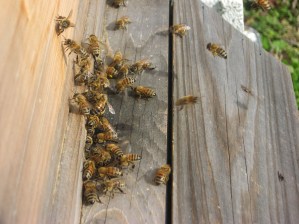
Since it’s warm, sunny today, I went out to check the hive. Bees are buzzing–including drones. There is pollen somewhere that the girls are bringing in. After seeing the traffic in and out of the hive, I decided to attack the burr comb problem after the temperature went up a bit more.

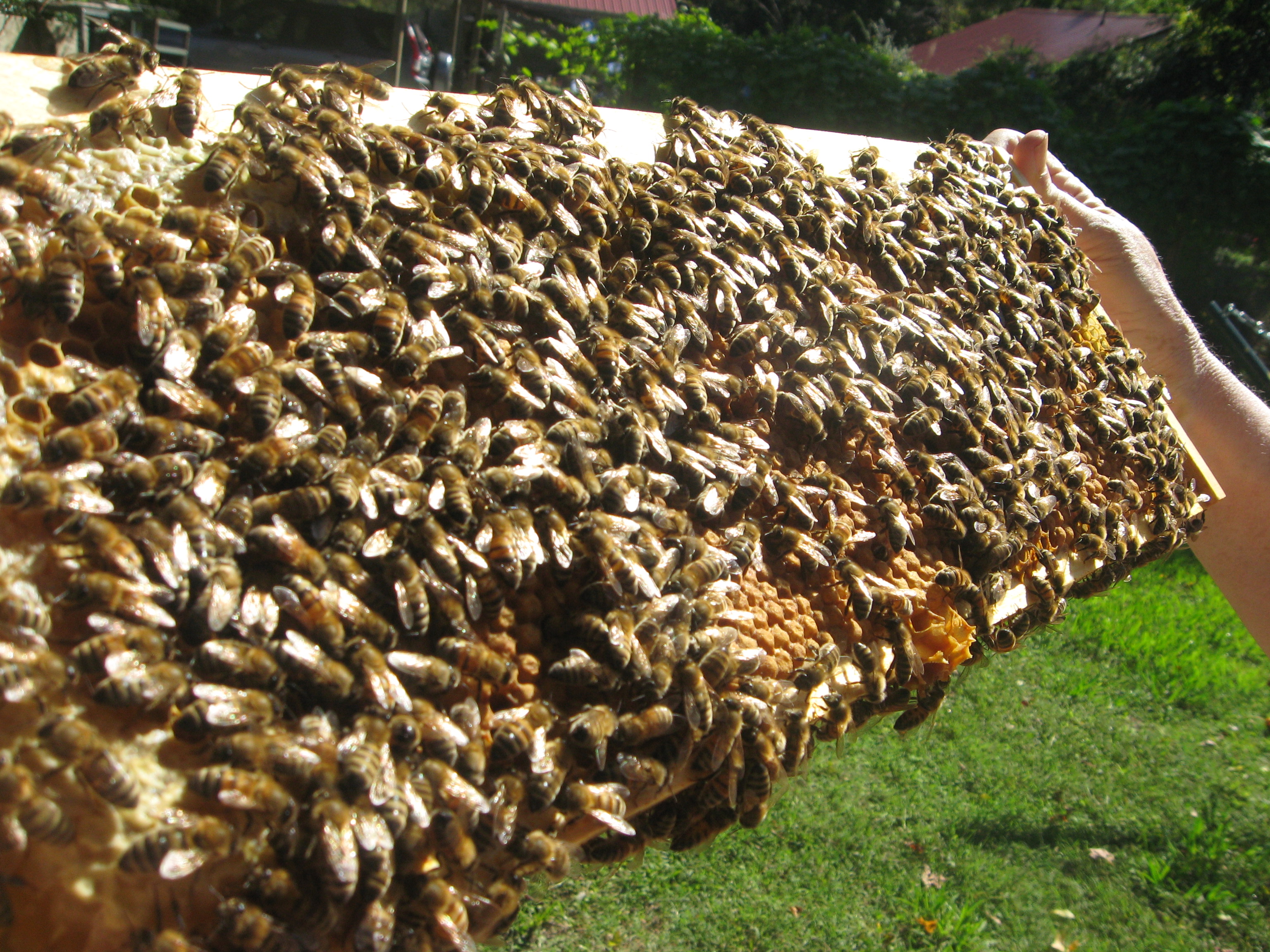
While waiting for the temperature to rise, I went to Honey Bee Suite to read about a camouflage bee suit, and spent most of the time reading about the experiences (from all over the country) of  unexpectedly large bee populations in the hives, considering the time of the year. That’s what my hive looks like as well–wall to wall bees with no sign of a cluster. Watching the traffic in and out showed pollen coming in and drones flying today.

Checking NOAA and Weather.com seems to suggest cooler than average temperatures in the southeast this spring, and wetter than normal–that suggests some time when foraging might be late or be sporadic. As I 20160116_134032gathered from Honey Bee Suite, since the girls have already wiped out the candyboard, the question now is to feed more sugar, or not to feed and hope the honey supplies are adequate for the rest of the winter. (As a new beekeeper, I’m not great at judging honey supply just from lifting the boxes–experience should change that.)
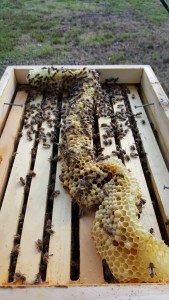
If I’m going to feed, I have to open the hive and remove all that extra burr comb that the bees in the space where my candyboard was, so that I can put in some emergency sugar for the rest of this winter.

(I have a plastic queen excluder to put on the bottom of this candyboard frame so that I can add more sugar or fondant (over waxed paper) where the candyboard was before. Next year’s candyboard will have more support underneath–like the queen excluder–than this one did so that it won’t collapse onto the frames.)

Ò¿Ó

This afternoon after the temperature had gone up,  I thought I’d be able to open the hive and remove this big batch of burr comb; however, it is windy today. At my hive location, I estimated the wind at about 15 mph (local weather showed up to 18 mph). My thoughts on opening the hive in that much wind were first, there is brood in the frames just under this burr comb, and second, that there is too much wind to use the smoker effectively (have tried that).

I discovered with a quick peek at one corner of the quilt box that there are bees all over that burr comb. My bit of experience with the smoker tells me that there’s no way I’m going to be able to smoke them down into the hive with the wind. Even when trying to puff smoke when lifting the quilt box a bit wasn’t successful–it just blew away. Even though I don’t smoke heavily for my inspections, I don’t think I could remove that comb without smoking. (The girls that were flying were paying a lot more attention to me than they usually do on a beautiful calm day though they were not aggressive, but then I was just looking and not doing anything like taking the roof off of their home.) I’d suspect that scraping that much burr comb is likely to attract their attention.

From my last inspection, I know that there is brood on the frames just under that big batch of burr comb, so I am concerned about heat loss and chilling that brood.   I’m going to have to scrape away that comb–and that means having the hive open longer than I’d think would be good for brood right under it.

The bottom line is that I wussed out and did not open the hive today and as the temperature drops I’m wondering (regretfully) if I should have done that little chore anyway. I did another “lift” and the hive feels heavy enough so that I think there’s likely enough honey for this next cool spell that’s coming. This uncertainty does mean that I’m going to have to attend to this problem soon!

Crystallized Honey

Since I’ve been posting about my bees, I want to share/reblog this post for all the honey fans out there.

zeebeeman's avatarZeebeeman's Blog

2 Honey

My friend Jannine brought me a jar of her crystallized honey for the holidays. It is so good!  It got me to do a bit of research on why some honey crystallizes and some doesn’t.  First of all, it does not mean that it has “gone bad”. Honey has a very low moisture content which deters bacteria and yeast, so it rarely if ever spoils. It turns out that the main reason honey will crystallize is due to the proportion of fructose and glucose, the two main sugars in honey. And this comes from the source of the honey. Honey that is high in glucose  ( and lower in fructose ) will have a tendency to crystallize sooner than the honey that is lower in glucose ( and higher in fructose).  Honey that comes from nectar from apple, goldenrod, sunflower, alfalfa, dandelion, mesquite and chamisa is high in glucose and will…

View original post 100 more words

A closer look into the hive

Sunny, but only 57 degrees Fahrenheit today, but I decided that I had to get into the hive enough to see what food stores were like. So off came the quilt box and the frame where the candyboard USED to be. It’s completely gone just as I thought from my hasty 20160116_134032peek the other day. Since it was rather breezy, I pulled only a couple frames and didn’t open the bottom hive box, didn’t look for the queen (except on the top of the frames), didn’t look for queen cells, or anything like that.

What I did find when I removed the quilt box was an empty candyboard frame. Not a crumb left, and the bees were building comb in the space left when the candyboard was devoured. I certainly was not expecting to see that. Since it was cool and breezy, I decided not to attempt to clean away the burr comb (brace comb or bridge comb are apparently all the same thing) on the top bars–I just wussed out and put the candyboard frame back on. It looked as if there was brood, and capped honey in the burr comb on top.

There wasn’t a sign of clustering–bees were spread all over the middle and upper boxes just going about doing what bees do. I just wasn’t expecting to see them actively building 20160116_134426comb at this time of the year. The two outer frames in the upper box, and the middle box are being drawn too–even though bees seem reluctant to work on those–they like to go right up the middle.
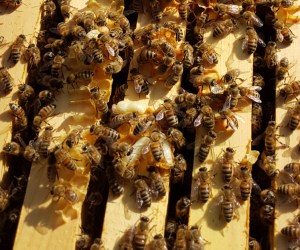
When I lifted the upper box, I found some more burr comb between those two boxes–and bees spread out doing their thing. (Not the best pictures, but I didn’t spend a lot of time taking them.) There were pupae in the brace comb between the boxes which was a surprise, but I still didn’t pull frames to locate the brood. Maybe I’m overly cautious as a “newbie”, but I didn’t want to chance chilling the brood that was on the frames.

I think the weather we’ve been having is confusing the girls–I know they are confusing me–and I’m glad that the “bee school” starts Monday so I can ask 20160116_pupae and burr comb_134800some questions of experienced beekeepers. It’s been a strange season so far.
Those “white bees” that you see where I’ve disrupted the burr comb are the pupae–they would have started to darken like the girls and would have chewed their way out of the comb soon.  I guess overall it looks as if I have a thriving hive here–and more bees on the way though the weather forecast is calling for cooler weather soon with daytime highs in the upper 30s and low 40s for the next week. Nighttime temperatures in the teens and twenties for about the next week.

After looking in the hive today, I think there is enough honey for the next bit, but I need advice from an experienced beekeeper on whether to feed–and how to do it in cold weather.

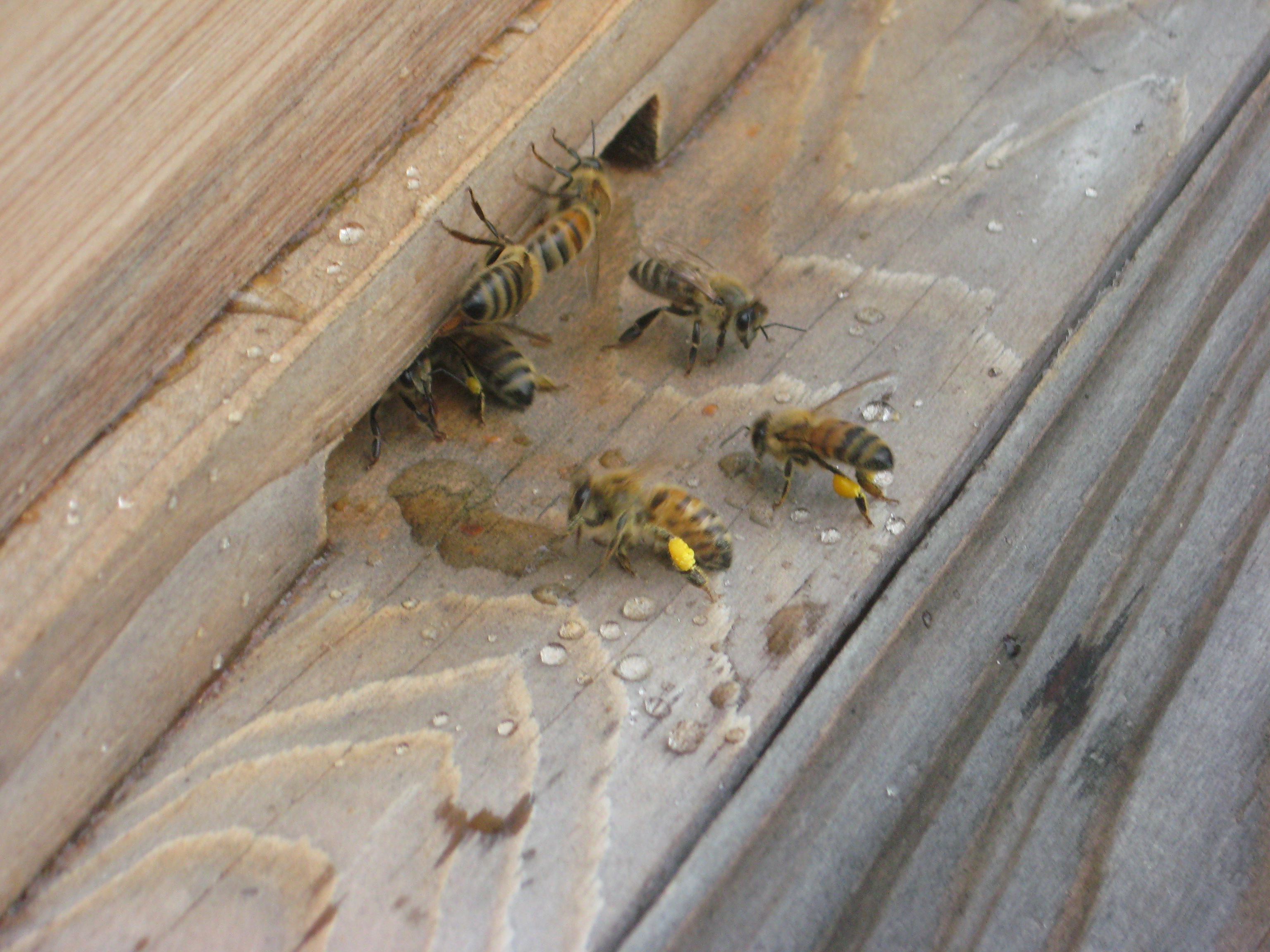
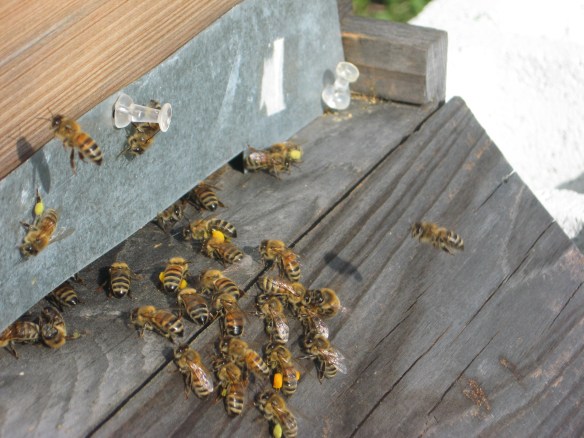
I was happy to see pollen being brought into the hive today though I don’t know where they are finding it–maybe on the Third Fork trail which is close. There was a fascinating array of colors–orange, reddish-orange, deep yellow, lighter yellow, greenish yellow, and some that could be called green or maybe chartreuse.

IMG_8874

Õ¿Õ

.


14 Jan 2016 hive report

Today is grey, drippy, damp, at the very least; otherwise it been pouring rain every time I’ve had to go out to run an errand.  On my trip to the hive today I saw a couple of the girls peeking out as if to check on the world without actually going out. I think it was the bee version of “yuck”.

Yesterday was sunny and warm so there bees flying and bringing in a bit of pollen.  I was at least able to lift the cover and get a glimpse of the inside of the hive. The first thing I noticed was that the girls have carefully applied propolis all around the edges of the quilt box so that it is difficult to lift the shavings and burlap to see down into the hive. The cedar shavings were wet on the top, but dry down next to the burlap despite all the rain and humidity.  That was good to see (and feel).

IMG_8826

candyboard 13 Dec 15

I was finally able to tug one corner of the burlap loose to peer down to the top bars of the upper  box. That immediately left me standing there with my mouth hanging open. The candyboard appears to be completely gone. Though I did not lift the quilt box off, I couldn’t see any candy left anywhere. There were bees on the top bars moving about and doing whatever it is that they do this time of year in this crazy weather, but certainly not clustered.

Looking back on my hive notes, I see that I put the candyboard on the hive on 11 November 2015. As you can see, there was a lot of it eaten by the 13th of December. (I can tell that I’m going to want next year’s candyboard to have some support in it, because I couldn’t lift this off the upper box to really look into it on that last inspection–not even a year yet and I’m developing some definite preferences for equipment.)

20151012_154335

04 Jan 2016

Looking at the seven-day forecast, it might be warm enough tomorrow, if it’s not raining or too windy to get a better look into the hive. If not tomorrow, it’s likely  to be a week (at least) before I can do an inspection.

Keeping my fingers crossed and hoping that I’m just being a worrywart, novice beekeeper, but you can see that this pollen basket is not exactly stuffed–this was taken 04 January 2016–not exactly when you’d expect bees to be bringing in lots of pollen.


Ô¿Ó


Christmas day at the hive….

IMG_8850

I’ve just been out to take a look at the hive–I can’t help wondering if the girls boggled by the weather as I am. Sitting here working with the windows open is just not what you expect for the 25th of December.The bees are still foraging, but there is not a lot of pollen coming in, though there seems to be more today than a few days ago. Maybe more blossoms out there after the warm period we’ve had.

From the looks of the candyboard, there’s been a lot of noshing going on up there, as well as bring in what they can find. This yo-yo makes it really hard to figure out what to do with feeding. It’s been so warm that I’m now wishing that I had not placed the candyboard yet–I could still have been feeding syrup–but hindsight is so much better than foresight!

Now I’d best take a cue from these busy little creatures and get on with current indexing–do a little foraging myself for entries.

Merry Christmas, happy holidays to all!

Hive Report (13 Dec 2015)

IMG_8824Warm enough today to I could open the hive and remove the strips I’d placed for Varroa mite treatment. There was a lot of activity at the front of the hive.

I didn’t do a full frame-by-frame inspection but removed all the boxes to get at the mite strips and remove the wooden entrance reducer and place a metal mouse guard for the winter.

IMG_8826Seems that the girls have been noshing on the candyboard already–in retrospect I probably should have waited until December to put it on, and just continued with the syrup feedings until then. But hindsight is  always better than foresight.

When I lifted the two upper boxes they were heavy–so they must be full of honey. Just looking down between the frames it looked as if there was a good supply of capped honey. The bees weren’t clustered–they were busy throughout all the boxes.

The bottom box was lighter–probably because some honey has been used from there already since there’s not much for them to forage on at this time of the year even though I’m seeing a little pollen being toted into the hive.

I didn’t try to find the queen this time–with all the activity and loads of bees I assume she is in there doing her thing–and it’s too late in the season to really do anything if not.  Keeping fingers crossed.

I’ll take a peek later when there’s a warmer day just to see how much of the candyboard has been devoured, and add sugar if necessary.

 Ò¿Ó

.

Hive report 11 Nov 2015

IMG_8695_11_11_trafficFinally a let up in rain and warm enough for me to play at the hive.  There’s still traffic in and out of the hive, but less than during warmer weather when there was nectar and pollen in more plentiful supply.  I didn’t see much pollen coming in at all.  When I removed the syrup feeders, there were lots of the girls up there slurping up syrup.

After I removed the syrup feeders I removed the inner cover–which were firmly glued in place with propolis.  The girls now have a candy-board and a quilt box to see them through the winter.  I wanted to place a mouse guard today, but wasn’t successful since the girls have done such a good job of gluing it in place with propolis that I’m going to have to actually lift the bottom brood box in order to get it out.  That means removing the other brood box and the super.  I didn’t do that this afternoon. Other beekeepers in this area have told me that they do not use metal mouse guards–just the wooden entrance reducer. I would really prefer to put metal mouse guard on, but there was enough traffic and enough guard bees out that I didn’t attempt that today. I do have a metal shield that will fit over my entrance reducer so I’ll place that instead, entrance reducer opening at upper edgeonce I get it cut down to 8-frame size.

I’ve heard different opinions for beekeepers on how the opening in the entrance reducer should be oriented–up or down. Mine is down now.  I wasn’t concerned about this as there was an upper entrance in the inner cover. I heard that for winter, the opening of the entrance reducer should be on top if there is winter-die off: if it’s down it could be blocked with dead bees. Now that I’ve removed the inner cover to place the candy-board and quilt box, I no longer have and upper entrance or ventilation.  One certainly hope that there’s not  going to be winter-die off, but I know some bees will die during the winter. (I’m learning how thoroughly things can be glued in with propolis.)

entrance reducer opening at lower edgeSo–do I place an Imrie shim to keep an upper entrance? Or am I going to have to lift the bottom box and change the orientation of the entrance reducer, or just substitute the mouse guard.  I miss having the class before the bees arrived; however from the looks of the colony, they are training me pretty well.  From Bee Journal, the inventor of the Imrie shim has written about it’s appropriate use–and providing upper entrance in fall and winter is not an intended use–it fact it’s an explicit no-no. Since he’s a successful beekeeper, and inventor of the shim, I think I may heed his advice.  But then there is the advice to provide an upper entrance. . . .

Now I’m left with the quandary of the orientation of the opening in the entrance reducer! Multiple opinions. (I’m beginning to suspect that if you ask 10 beekeepers about this you’ll get 12 different answers. I can see the logic of having the opening at the upper edge of the reducer, especially for winter–especially if that is the only entrance. The solution is probably to get the entrance reducer out and place the mouse guard.  No matter what it looks as if I’m going to have to lift that bottom box–which is pretty well filled with brood and honey, and the two above are now well filled with brood, and the upper with honey.  (This all makes me contemplate the virtues of the long (horizontal) Langstroth hive–which is not the same as a top-bar hive.

All my questions aside, it was good to see so many bees working in the honey super and  drawing and filling even the outermost frames. They’ve obviously been busy since my last inspection.  That should give them a good honey supply for the winter.  Being the “newbee” that I am, I am glad that the candy-board is on the hive.  Much better safe than sorry come spring.

Ever since the nuc arrived here I’ve been used to going out almost every day–even in the rain sometimes–to see what’s going on at the hive. I’m sure that during the winter when I can’t see any traffic I’ll still be going out to look at the hive and wondering how things are inside.  It’s rather amazing how attached you can get to a batch of insects! I’m sure it’s going to seem like a long winter, with rampant curiosity on my part. I do have to hope for another warm day so that I can remove the treatment I placed for varroa mites, but that’s going to be a very quick in-and-out for that purpose only unless it’s an unseasonably warm day.

(I’m pleased with how much honey is in the hive–I hope the candy-board is totally superfluous. I’m happier now that there is candy-board and quilt box on the hive.)

Ò¿Ó


D-day at the hive.

With a lull in the rain, I went out to see what the girls were up to.  Not expecting a lot of activity with the cloudy day and the rain, but I was greeted with activity–just looking it certainly was not the usual in and out traffic. It looked a lot like utter pandemonium and chaos, but with closer observation I did  figure out what was happening.

Thanks to a video posted just yesterday on Bee Sweet Bee Farm I realized that I was seeing drones being ejected from the hive.  I think it’s considered house cleaning for the winter. On closer look at the landing board, there were a number of drones, lots of scuffling, and kicking butt–and the drones were not winners.  It was rather awesome to watch. Certainly makes you aware of ruthless side of survival!

Ò¿Ó

.

Hive report 14 Oct. 2015

beekeeper holding Langstroth frameThis is late for my routine inspection–but with all the cloudy, windy, grey, chilly days it hasn’t been appropriate for me to be ripping the roof of the girls’ home. Then when the weather improved and the sun came out, we still had some days that were too windy for me to want to open the hive. Something about the girls clinging madly to the landing board in the gusts that suggested maybe not good time either. Then we finally had days that were not too windy and sere sunny, so I thought I’d do the inspection.

When I got to the hive, there were bees flying everywhere, circling the hive, and for the first time meeting me on the way to the hive. I wasn’t sure what was up with the ladies, but something said it might not be a good time to stick my nose into the hive.  The day following, same thing, except that I think I picked up what was causing the problem–lots of banging, thumping, nose, and some unusual traffic by the hive brought them out again; so another deferred inspection.

Langstroth fram with honey and beesToday, it all fell into place–sunny, warm, and the traffic to and from the hive was as usual.  No sign of alert bees buzzing all around the hive.

I had three boxes to inspect this time–and I came away glad that I decided to do all 8-frame mediums. Two of the boxes were heavy!  That’s not a complaint, just an observation; heavy is good. It means honey for the winter.  I didn’t have another OMG-so-many-bees reaction this time–I was expecting lots of bees.  That is what I found–but even more bees than I expected. Again, happiness.

Despite the time and manipulation it takes to check each frame in three boxes/bodies, the girls handled it well–there were more Langstroth frame with capped honey and beesthan usual flying around us by the time I was putting the last frame back in the bottom box, but I call them alert, not aggressive. This time I had an extra set of hands so I got some pictures of some of the frames as I pulled them–I was hoping to see more detail on the frames.  Guess I need to work on another way to get pictures.

I’m pleased with how the hive looks (to my inexperienced eye); bees were working in the upper body–mostly drawing comb, but starting to see a little nectar and pollen there too; no brood.  I found brood in both the middle and the lower body.  I did place strips to treat for mites (Varroa destructor).  When I go back to take that out, I think I’m going to need to re-arrange some of the frames to consolidate the brood.  This inspection raised a lot of what-do-I-need-to-do-now questions.  I’m middle outerglad there’s a meeting of the Durham County Beekeepers Association soon–I should find some answers there.

I do hope that these ladies are doing as well as I think they are–It should be interesting to take the beekeeping course after a season (well, part of a season) with already having hands on experience. The online materials (e.g. Brushy Mountain Bee Farms webinars and videos) and blogs (Scientific Beekeeping.com, Tales from the Bee Hive, Bee Sweet Bee Farm, My Latin Notebook, and many more) have provided good information.  Conversations with Facebook friends and beekeeping groups have also helped through difficulties like the sugar syrup spill bringing hornets and yellowjackets, and found me a feeder that works so well!

5th middle outerÔ¿Ô

Today I got my first sting–even though for everything except installing the nuc, I’ve worked only wearing a veil. I know it would happen sooner or later…and it finally did. No big deal.

Hive 01 Oct. 2015

pollen-carrying bees

Go girls!

Frustration here–weather has kept me from opening the hive to see what’s happening in the upper medium box that I put on a few weeks ago.  Normally, I’d have done a routine inspection last weekend but opening hive in the rain is definitely a no-no–truly ticks off the girls.  Again today, too windy and chilly.  Given our weather forecast looks like I won’t be opening the hive until sometime next week. I’ll be out there checking on the first sunny day. My curiosity must wait a bit longer.

Switching to winter feeding with 2:1 sugar to water ratio. Looking ahead to colder weather getting some fondant to provide some food if needed in the colder weather, and adding a bit of insulation and moisture protection to the hive. Time to place a mouse guard, too.

I’ve done an assessment for Varroa destructor (mites) about 2 weeks ago with a stickyboard. There didn’t seem to be many mites. I’ll repeat that in the next few days to be sure that I don’t need to treat before winter.