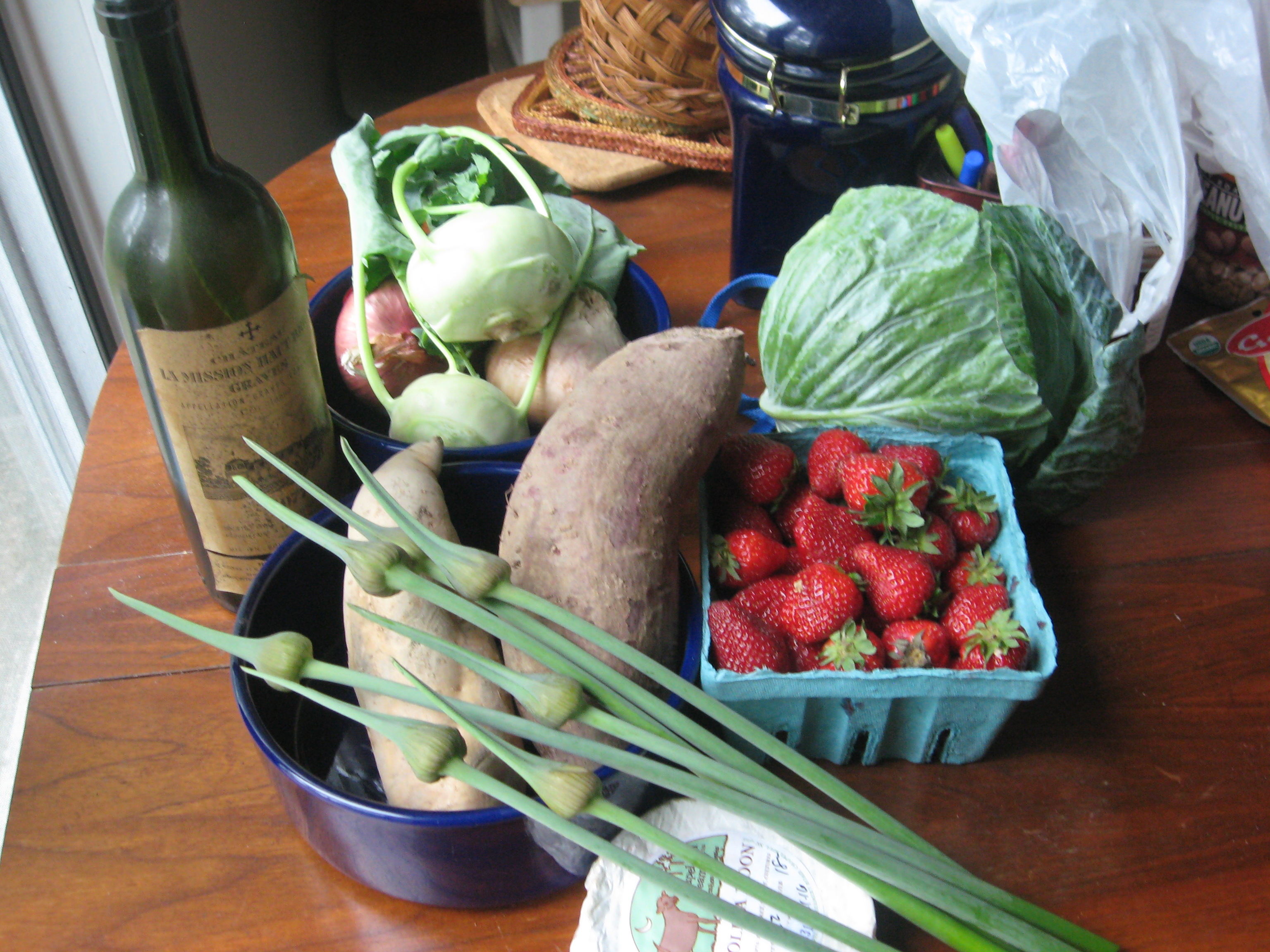
Some good eating ahead…

I’m back from the farmers’ market ready to settle in for the afternoon with some hot chocolate, book, and cat.  It was a chilly market this morning with the wind blowing a lot of the time–it was more than just breezy–so it feels so good to be indoors.

brought home from the farmers' market.

treasures from the farmers' market

I came home with lots of “finds” from the market:  strawberries, kohlrabi, both white and blue sweet potatoes, cabbage, garlic scapes, and one of my favorite cheeses (Carolina Moon) from Chapel Hill Creamery.  Now for some meal planning!

The weather is still cool enough that I think that the cabbage is going to be joined by some country-style pork ribs in one of my favorite “comfort foods”–braised pork and cabbage. A fair number of the strawberries have already disappeared while I was at the market–breakfast.  I’m still contemplating the fate of the garlic scapes, the sweet potatoes, and the kohlrabi, though some of the kohlrabi may just be eaten as a salad, just dressed with a vinaigrette.  Perhaps the other will find its way into the sauté pan.

I’m still contemplating the garlic scapes–a quick search has turned up a number of possibilities from blogs that I like to read.

I was so pleased to see white sweet potatoes at the market–they’re not as moist as the yellow/orange ones–that’s likely to end up as a baked potato.  I’ve read about blue ones, but this is my first time to try one, so that will be an experiment.  The grower tells me that the blue keeps it color when cooked and that the texture is similar to the white–but that may call for some research and recipe hunting although I might just roast a mix of the white and the blue so that I can taste them  side by side.

The cheese?  Well, that’s likely to be paired with some good bread and a nice robust red wine as my evening snack!

Creme Fraiche Panna Cotta with Strawberry Mousse and Puree

I love panna cotta–I’m going to be waiting for some really good strawberries to try this one. My mouth is watering in anticipation just reading this post!

AvocadoPesto's avatarAvocado - Pesto

I don’t care much for sweets but I do thoroughly enjoy a good panna cotta, creme brulee and cheesecake every so often. Notice a pattern here? Maybe it’s just the silky velvety consistency that I’m drawn too. It really doesn’t get smoother than panna cotta. Traditionally made with cream, milk, sugar and gelatin this time I went for panna cotta with a twist – the twist being creme fraiche (which I recently discovered when making a Valentine’s Day creme fraiche cheesecake). The result – a denser richer panna cotta than the standard but one that pairs perfectly with an airy strawberry mousse and strawberry puree. I’ve made panna cotta dozens of time since Daring Bakers first introduced me to it and I’ve noticed that going lighter on the gelatin and omitting honey produces the wibbly wobbly delicate panna cotta, whereas honey in place of almost all the sugar yields…

View original post 350 more words

Quinoa with Artichokes, Asparagus and Kale

This looks like a great way to get quinoa into my diet!

AvocadoPesto's avatarAvocado - Pesto

I tried quinoa once a while ago and wasn’t that impressed with it – it was kind of dry and flavorless and just sort of turned into mush in your mouth. But after seeing numerous quinoa recipes online and reading about all the various health benefits (high in protein, plant derived calcium, iron, and fiber, with magnesium to regulate blood pressure and relax muscles and manganese and copper to work as antioxidants)  – I knew it deserved another chance. I figured even if I didn’t like it that much the second time around, consuming such a superfood would still be worth it. But let me tell you – I LOVED it. I must have completely over cooked it the first time because with this recipe it was delicious. I couldn’t stop  myself from getting seconds, and then thirds – it was that good. The combination of textures and flavors is…

View original post 310 more words

Smoked Salmon

Definitely need to try this during the summer. The smoked lamb shanks worked so well.

Rufus' Food and Spirits Guide's avatarRufus' Food and Spirits Guide

There is nothing better than smoked salmon when it comes to fish sandwiches. Of course smoked salmon is one of those foods that can probably be added to anything to make it taste better.

This is a great way to practice how to smoke food since it takes only a couple hours and is easily done on a home barbecue. For basic steps on how to smoke go here. When smoking salmon, or any fish, I like to make a large foil tray to hold the meat. This keeps the fish from breaking apart and makes it very easy to remove from the grill. Just fold a couple of sheets of tin foil together slightly longer than the fish fillet and then fold up the sides about an inch to create the tray. Then with a fork punch a bunch of small holes in the bottom to allow air…

View original post 135 more words

Colcannon

Here’s another that is really good!

Rufus' Food and Spirits Guide's avatarRufus' Food and Spirits Guide

Nothing goes together like potatoes and cabbage.

Colcannon

  • 1 small head cabbage quartered and cored
  • 6-8 medium boiling potatoes peeled
  • 2 slices bacon, chopped fine
  • 6 green onions, white and green parts chopped fine and separated
  • Milk
  • Butter
  • Salt/pepper

In a large pot, salt and boil enough water to cover cabbage. Add cabbage and parboil until almost cooked. It should have a bit of bite. Strain, reserving water, and slice cabbage into quarter-inch strips once cool. Bring strained water back to a boil and cook potatoes until tender, adding more water if needed, about 45 minutes. Meanwhile render fat from bacon and set browned bacon bits aside. Mash potatoes with milk, butter, to desired consistency. Add green onion parts, bacon, salt and pepper. Reheat bacon fat and saute white parts of green onion. Add sliced cabbage and cook until softened stirring often.  Mix cooked cabbage with mashed potatoes and serve…

View original post 1 more word

Mashed Potatoes with Gruyere and Olive Oil

This sounds great–I have done mashed potatoes with olive oil but I like the sound of the additions here.

Rufus' Food and Spirits Guide's avatarRufus' Food and Spirits Guide

Yes, we really like messing with this classic dish. Leave the skins on. The tang from the Greek yogurt will make you feel like you’re eating a really creamy, loaded baked potato.

Mashed potatoes with Gruyere and Olive Oil

  • 3 lbs potatoes, boiled until tender with skins on (Russet or red will work)
  • 1 cup shredded Gruyere
  • 2 tbsp butter
  • 3/4 cup Greek yogurt
  • 1/2-3/4 cup milk
  • salt/pepper to taste
  • 1 tbsp extra virgin olive oil (plus more to taste)

Drain and mash potatoes with butter and cheese. Stir in yogurt and enough milk to reach your desired consistency. Add olive oil and taste. Add salt, pepper and, if desired, more olive oil to taste. Serve hot.


View original post

Lunches to go–or to eat at home.

Just a quick note to share this link:  Solo Lunches.  It’s one of the budget conscious, health-oriented things we can do.  Just because it’s a brown bag, that does not mean it has to be boring!  Check this out–I think that there are some good suggestions here. I am certainly going to be trying some of them even at home.

About lentils

lentils in Mason/Ball jar on pantry shelf.

lentils

Lentils (Lens culinaris), closely related to beans and peas, are dried after harvesting; you’ll find them on the shelves of your supermarket, gourmet stores, and online. They have been a staple food in many areas for over 8000 years, likely originating while in Turkey.  They are a staple food for many south Asian cultures, Middle Eastern, and Mediterranean countries.  The Latin word for lentils, lens, was used in the 17th century to describe eye glasses because of the similarity in shape

Like other legumes, lentils are low in fat and high in protein and fiber, but they have the added advantage of cooking quickly.  Lentils have a mild, often earthy flavor, which lets them pair well as side dishes, in salads, and soups.  Lentils have traditionally been used as a meat substitute.  Like other pulses, when paired with grains they offer excellent quality protein in our diet.

Before cooking, always rinse lentils and pick out stones and other debris–usually they are quite free of debris, but it’s always good to check them before cooking.  Unlike dried beans and peas, there’s no need to soak them. Lentils cook more slowly if they’re combined with salt or acidic ingredients, so add these last.  Bigger or older lentils take longer to cook.  Store dried lentils for up to a year in a cool, dry place. Substitutes: dal OR split peas OR black-eyed peas  More varieties are appearing even on the supermarket shelves, but specialty sources offer a wide variety with which to experiment.

The quick cooking and nutritious nature of lentils make them an obvious choice for winter soups. They are also good cooked and chilled for salads or mixed with bread crumbs to stuff vegetables. Blend lentils with middle eastern couscous and use as a bed for seafood and poultry.  Use them instead of beans  for summer salads with fresh tomatoes and other veggies.

Here is a little information about the various kinds of lentils.  More synonyms and alternative names can be found in the Cook’s Thesaurus.

  • Brown Lentils:  The average grocery store lentil is the brown lentil. You’ll likely find these on the shelves with the dried beans.  They tend to get mushy if overcooked.  If you want them to be firm, add oil to the cooking water and cook the lentils just a short while, say 15 minutes.
  • Black beluga lentils are a very popular legume in South Asia, they are used to make a beautiful black lentil soup. Some of the names that they my go by are Beluga lentil = black beluga lentil = beluga black lentil = petite beluga lentil. When they’re cooked, especially in salads with a tiny bit of oil, they glisten so that akes them look like beluga caviar.
  • Petite crimson lentils are “crimson” in color, which is a deep orange-red. These lentils tend to lose their shape when they are cooked and are an excellent choice for thickening soup.
  • Petite golden lentils are a small firm, golden lentil that is rounder in shape than many other  lentils; one of the reasons that this lentils holds its shape so well when cooked.  They have a soft texture.
  • Ivory white lentils are a creamy white colored small lentil that is really a peeled black lentils, known in India as urid dal.
  • French green lentils: (also called French green lentils, du Puy lentils,  lentilles du Puy, lentilles vertes du Puy.)  By many chefs, these are considered the “best”, most delicate lentils.  They have the typical earthy flavor, but also  are a bit “peppery”. These hold their shape well better than many other lentils,  but take longer to cook, but still do not need presoaking. While I love all lentils, and typically have several kinds in the pantry, these are the ones that I would not want to be without!)
  • Red lentils are the common seen in the supermarket.  It’s a lovely salmon pink in the dried form, but it turns golden when cooked.  These lentils cook faster than others.  They’re best in  purées or soups.
  • Spanish pardina lentils (also known as Spanish brown lentils or Continental lentils) are smaller the brown or red lentil–about the same size as a petite green or black lentil.  They have a particularly nutty flavor, and they hold their plump, round shape when cooked. This makes them a particular favorite with e for use in summer vegetable/lentil salads.
  • Dal is the Indian term for peas, beans, or lentils that have been split and often skinned, but the name is sometimes used for all lentils, peas, or beans, or to cooked dishes made with them. Split lentils don’t hold their shape well, so they’re often cooked into soups or purées.

Most of these can be interchanged in recipes as long as you take into account how quickly they cook and the final textures–some are softer than others. Generally the split ones tend to lose shape faster, so don’t do well for salads, or side dishes where you want them to keep their shape, but will be fine in soups–especially if you’d like your soup to be a little thicker.  Any of these would work in the lentil soup recipe that I gave earlier–though I usually use the lentils du Puy even for that.

Aside from using them instead of beans in summer salads, I think that lentils make an awesome side dish to go with grilled salmon–there’s something about the earthy flavor that combines SO well.  If you have “leftover” grilled salmon, try using it with some lentils to make a cool, but hearty summer salad with some tomatoes and cucumber to it.  Combined with a grain, this can be a very nutritious vegetarian dish–or not.

Here is a link to a lentil salad that makes me drool on my keyboard just looking at the recipe:  Warm Salad of Lentils with Duck Fat from the Hudson Valley.  Love’s description of the lentilles du Puy is marvelous.  (Each time I cook duck, I carefully keep some of the fat, sealed and refrigerated to use for things like this.)  Add some greens, and this is a one-dish meal that’s in my group of comfort foods.  Lentils will also work in the sausage, beans and greens one-dish meal.

Lots of uses, quick-cooking, nutritious, tasty, inexpensive…what more could you want?  Try some!

More tomatoes….

I’m back from the farm–LONG day, but I planted lots of tomato seeds (about 560) since we’ll sell some and plant about 450 in the field.  I’ve lots of new and interesting varieties that we’re trying that I’ll let you know about soon.

Transplanted and planted lots of herbs today as well: epazote, shiso, chervil, lime basil, papalo, Greek oregano, zaatar (Syrian oregano), fern leaf dill, some very potent sage that I love, to mention just a few.  Transplanted lemon grass, sweet  basil…. I’m disappointed that I’ve not gotten seeds for French thyme yet.

And then we moved on to the flowers……