What to do with all that butternut squash….

I love butternut squash, but there’s the usual problem–it’s a lot of squash when you’re cooking for one. This recipe looks like a keeper to me. I’ll be sure to make this with part of the butternut squash that is sitting on my kitchen counter!

AvocadoPesto's avatarAvocado - Pesto

I had to do something with the leftover butternut squash from the root vegetables I made last week. This butternut squash was huge and could easily be the star of two main dishes. Not wanting to just roast it again I decided to make a gratin. I found some recipes online and adapted them to include the ingredients I had on hand. The final result – delicious. Butternut squash, caramelized onions, mushrooms and melted gruyere. A great vegetarian side or main dish served with a leafy green salad.

Butternut Squash Gratin

Serves: 6

Start to Finish: 60-70 minutes

Ingredients:

1/2-1 butternut squash, peeled, halved, seeds scooped out, and chopped

1 onion, halved and thinly sliced

1 1/2 teaspoons brown sugar

1 tablespoon balsamic vinegar

5-10 button mushrooms, sliced into thick pieces

6 ounces Gruyere, shredded

salt and pepper, to taste

basil, slivered

Directions:

1. Preheat oven to 425 degrees F…

View original post 127 more words

Anticipation of things to come

Beginning planting

the almost bare greenhouse

I have lived where seasons are not markedly different–and I much prefer life where there is a distinct  seasonal change.  It’s partly the anticipation of the new and different things that come with each season.  Anticipation adds a lot to my life.  Living where flowers were almost year-round left me taking them for granted. Winter for me is a period of rest, rejuvenation, regeneration–and anticipation.

Anticipation contributes to enjoying so many things–that special bottle of wine and good food, or just a new season. Planning a special meal to go with a special wine…or those winter dreams of fresh produce while you dwell on the pages of the seed catalogs, knowing that the time will come when you’ll have seeds in your hand, and that those seeds will give you food.  That’s anticipation. Winter is passing into spring….

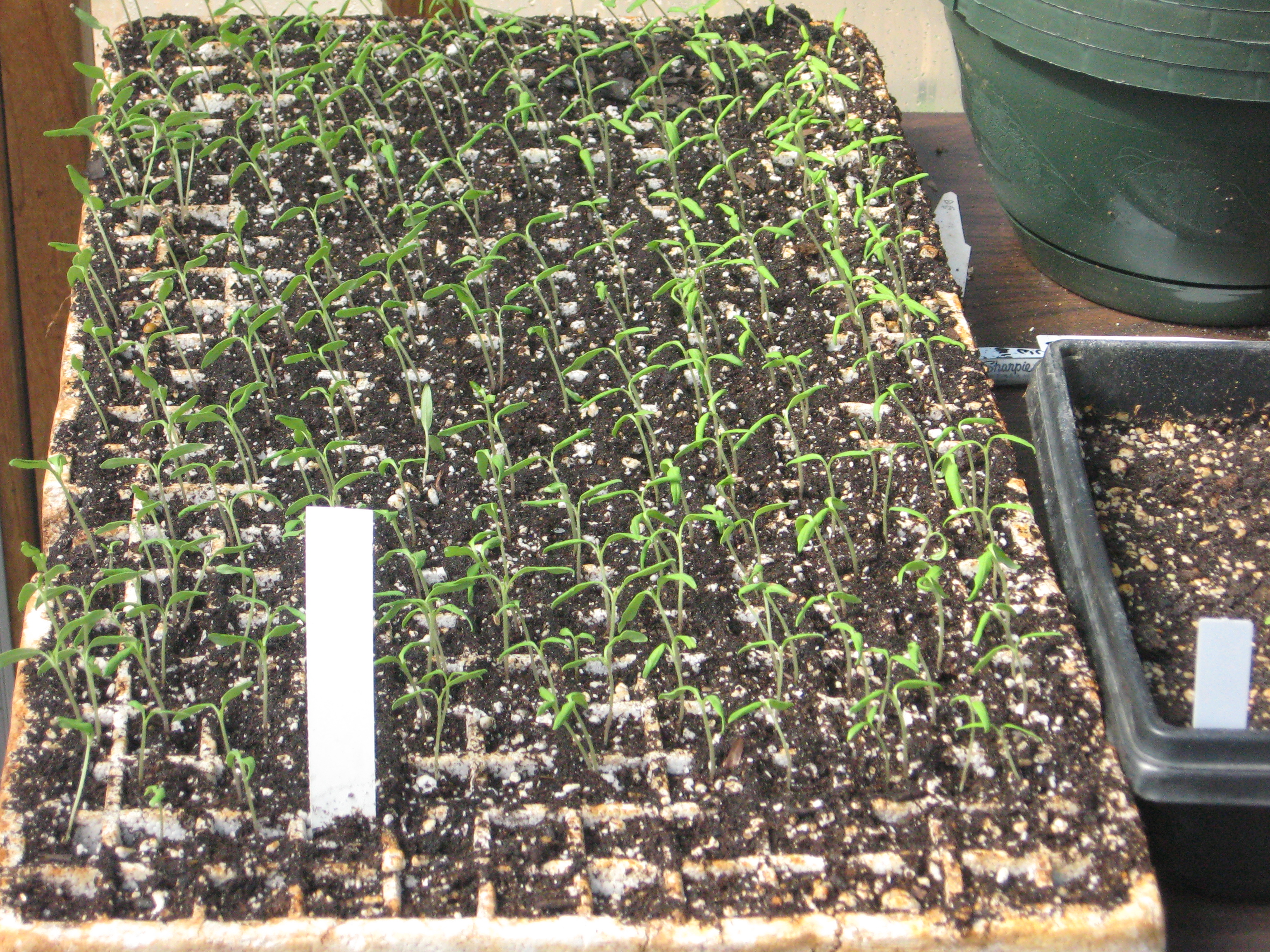
Plug tray of tomato plants

plug tray of tomato plants

Today I worked with a friend, as I do every spring and summer, getting a start on the luscious things that come from the field and garden.   I got my hands into the dirt and transplanted about 300 tomato plants from the itty-bitty plug trays into the three-packs that we’ll use to sell them at the farmers’ market.

We started with an almost bare greenhouse–just a few things that needed some protection to winter over, but were hardy without needing to heat the greenhouse all winter.

Small tomato plants in flats

transplanted tomato plants

The tomato seeds were planted just about ten days ago–in the house, because it was really too soon to get the green house up and going.  We planted the seeds in “plug” trays–each tray has lots of little “wells” just a bit bigger than my thumb (288 of them, I think).  Once they have germinated and have the first set of true leaves (even though they are very tiny they really do look like leaves on a tomato plant) then it’s time to give them more room to grow.  That was today’s work.  Tedious, yes!

Sungold cherry tomatoes on the vine

anticipation of what is to come

But, oh, the anticipation of what is to come from those tiny plants.  These are Sungold cherry tomatoes from last season–they’re summer candy.  Those tiny plants will  grow and bear tomatoes during the summer.  Today I did transplant some Sungolds, but there were Fried Green, Cabernet, Big Boy, Better Boy, Italian Tree, and Abe Lincoln tomato plants too.  Some of these are new for us–we’re trying them out to see how they taste and, of course, how that fare in the North Caroling summers.  So we’re anticipating….we’ll have more varieties like John Baer, Valley Girl, Champion, Brandy Boy…and maybe others.  It partly depends on how well the seeds germinate.  There be more transplanting going on shortly.  Then we can anticipate the sore knees, aching backs that comes from planting in the fields.  But that will pass, and we’ll be anticipating the sun-warmed, juicy fruit than came from that tiny seed.

Eating for one….

I think that an increasing number of use are eating alone, at least part of the time…that’s not a bad thing, even though there are some problems with it.  I’m always on the lookout for suggestions for cooking and eating for one.

I thought I’d pass along this link to The Kitchn where you’ll find some comments on single-serving cooking and eating.

Another use for Ball/Mason jars…..

This was just on my Facebook news feed from Savory Simple.  I have never found a travel mug that cleaned up easily…and they are not cheap!  Since I use wide-mouth canning jars for so much of my storage, I have them around in various sizes.   Definitely have to have one of these gadgets!

Link

I’ve just spent some time browsing the web while cleaning out my email inbox.  One of those was from Epicurious–a website that I use for features like The Food Dictionary and recipes from some cooking magazines to which I like to have access, but to which I don’t want to subscribe or have hard copy (e.g. recipes from Gourmet, Bon Appétit, Self, and other sources) since many of the recipes don’t fit my cooking style.

The most recent email was about eCookbooks–whole cookbooks available for purchase online.  Being a cookbook addict, and short of space for another bookcase, I’ve looked at Kindle editions of some books (Mark Bittman’s Salted and Food Matters Cookbook) and I find this an appealing option.

In checking out relative prices, I used Salted since I have the Kindle edition of that.  The Kindle price was $18.99; the hardcover edition, $23.10 plus shipping; and $18.99 from the eCookbook service at Epicurious.com, so price is moot on Kindle or eCookbooks.

The preview on eCookbooks does not let you access the index to see how that functionality compares with what’s available on the Kindle edition. Obviously I’m not about to buy a second copy of something that I already have, but I’m seriously considering trying this service, especially to see if the indexes really work and are in a format that can be easily used.

As I am already a subscriber to Eat Your Books, I’ll be interested to see if the page references from that service can be “translated” to the eCookbook as well.   I’m sure I’ll have more information for you on the service shortly!

Last-minute gift ideas for the cook

Knives are such an important and often used part of kitchen equipment!  Many times when you’re cooking for only one or two it’s much faster and easier to chop thing with a knife rather than use a food processor.   At least that’s true if your knives are in good condition–that is sharp–and sharp knives are much safer, and easier to use than dull ones.

Most knife sets come with a steel–but the purpose of a steel is NOT sharpening truly dull knives.  The steel is intended to even and straighten an edge–in other words,  to keep a knife sharp.

Even knives that have been well cared for eventually need sharpening.  It’s possible to sharpen with a stone–but most of us don’t truly have the necessary skill to do this–it’s time-consuming, tedious, and we likely won’t get the best results.  So, you might want to have your knives professionally sharpened.

However, there are some alternatives to professional sharpening or using a stone; there are now very good manual and electric sharpeners that can be used successfully by anyone.  That’s one possibility for a gift for the cook in your life, or for yourself. Cook’s Illustrated has tested both manual and electric sharpeners.

Anolon manual knife sharpener

For manual sharpeners, the AccuSharp knife and tool sharpener (model AccuSharp 001) is an inexpensive, easy to use possibility.  The Anolon Universal Knife Sharpener 3-Stage  Whetstone (model number 52255) are possible options.  I prefer the three-stage style.  Chef’s Choice also has manual knife sharpeners which have had generally good reviews as well, and are reasonably priced.

—<>—

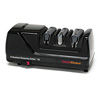
Electric knife sharpner image from Chef's Choice catalog

Electric sharpeners are predictably more expensive, but somewhat easier to use.  It’s a good investment for keeping knives  in good repair, and it’s something that might not buy for herself, and that makes it an especially appreciated gift. The Chef’s Choice electric sharpening products seem to generally have good reviews.

—<>—

steel for knives

A steel would also make a great gift for the cook–used every time you pick up a knife to cut, it evens and aligns the cutting edge.  It won’t replace a sharpener, but will help keep knives in good condition at each use between sharpening.

—<>—

To help those knives keep that sharp edge, some other kitchen accessories that your cook might welcome might be a knife block  or perhaps a magnetic strip which affixes to the wall. If knives are kept in a drawer, knife protectors might be welcome, or in-the-drawer

       —<>—

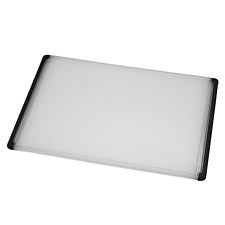
from OXO websiteAnother important way of keeping your knives in good condition is to use an appropriate cutting board–one that is “soft”.  Glass or ceramic boards will dull the knife edge so get plastic or wood/bamboo.  This need not be expensive–The OXO Good Grips cutting and carving board is an excellent choice.  The no-slip strips are great.  If the cutting board does not have these, you can always put a damp kitchen towel under it to keep it from sliding.

—<>—

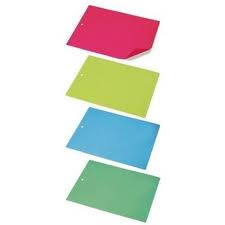
Four color-coded flexible cutting mats

For safe food preparation, flexible plastic cutting mats or chopping mats are also great to have in the kitchen (and they are inexpensive, too).  Some come in different colors to make it easy to keep those used for meats, poultry, seafood/fish, and veggies to avoid bacterial cross-contamination.  Another nice thing about these is that they can be easily used to transfer chopped ingredients to pan or bowl.  Recommended by Cook’s Country is the set of four chopping mats by Progressive International Food Safety Chopping Mat set of four for around $10, but you don’t need to find that specific brand.

Both the cutting board and the chopping mats will eventually show wear and tear and will need to be replaced, but it’s a small investment to keep your costly knives sharp so that cooking is easier and more enjoyable.


More potato basics

For those of you wanting more information on potato varieties,  you might also want to check the article on “Potato Varieties”  from Cook’s Illustrated.

Potato basics

Potatoes Solanum tuberosum) come in a myriad shapes, sizes and colors, with different starch and moisture content that makes different kinds suitable for different cooking methods.  There are red potatoes, white potatoes, purple potatoes, yellow potatoes, fingerling potatoes…. (I’ve put in the botanical name because these are different from sweet potatoes (even though we call both potatoes).

They are a wonderful vegetable–nutritious with lots of minerals and vitamins.  I think  they sometimes get a bad rap for all of the things we pile on–for example–a baked potato.  With “the works” added it’s certainly not low calorie…but we’re responsible for all that extra stuff that adds calories and “bad” fat.  There are lots of good things to do with potatoes that are quite healthy and then at times, potatoes turn into luxurious comfort food.

Potato blossom

potato blossom

All potatoes are created delicious, but not necessarily equal when it comes to performance.  You need to pick the right potato for what you want to do:  russet potatoes will be mushy in a potato salad.  Red potatoes (frequently called “new” potatoes–even though they are not) may not make the most luscious, decadent mashed potatoes.


rows of potato plants

potato plants

First, about what should and should not be called a “new potato“:  only a potato that is  harvested while immature is “new”–you can tell by looking at the skin.  On real “new” potatoes (all sizes) the skin is very thin and can be rubbed off the tuber;  you will likely see places where it has been abraded. Size does not tell you if a potato is new or not!  Even some very reputable and otherwise knowledgeable authors use “new potato” to mean red potatoes or boiling potatoes.  Newly harvested potatoes differ in moisture, starch and sugar content from potatoes that are fully mature.  They are wonderful in their own right if you can get them–it’s one of the joys of growing potatoes.  You can go out and get some really new potatoes.

—«°»—

Baking potato or russet potato

baking potato

The russet potato is the potato usually recommended for baking and for mashed potatoes.  They have lots of starch and less moisture than either red potatoes or Yukon gold potatoes.  They will make fluffier mashed potatoes and baked potatoes. They’re my preference for baked and mashed potatoes because I want “fluff” in my baked potato and I want to be able to add lots of butter and cream to my mashed potatoes.

—«°»—

Yukon gold potatoes

Yukon gold potatoes

The Yukon gold and Yellow Finn are rather middle-of-the-road potato, with medium starch and medium moisture.  If in doubt, and for an all purpose potato, these are my choice.  The flesh is pale yellow and I think a bit more “buttery” flavor than bakers or the red potato or even the round white potato (not pictured here).

—«°»—
red-skinned potatoes

red potatoes

The red-skinned, or red potato (sometimes called “new potatoes” or boiling potatoes) are usually described as “waxy”–that is low starch, higher moisture.  These, or round white potatoes,  would be my choice for potato salad, roasting, because they hold their shape well.


—«°»—
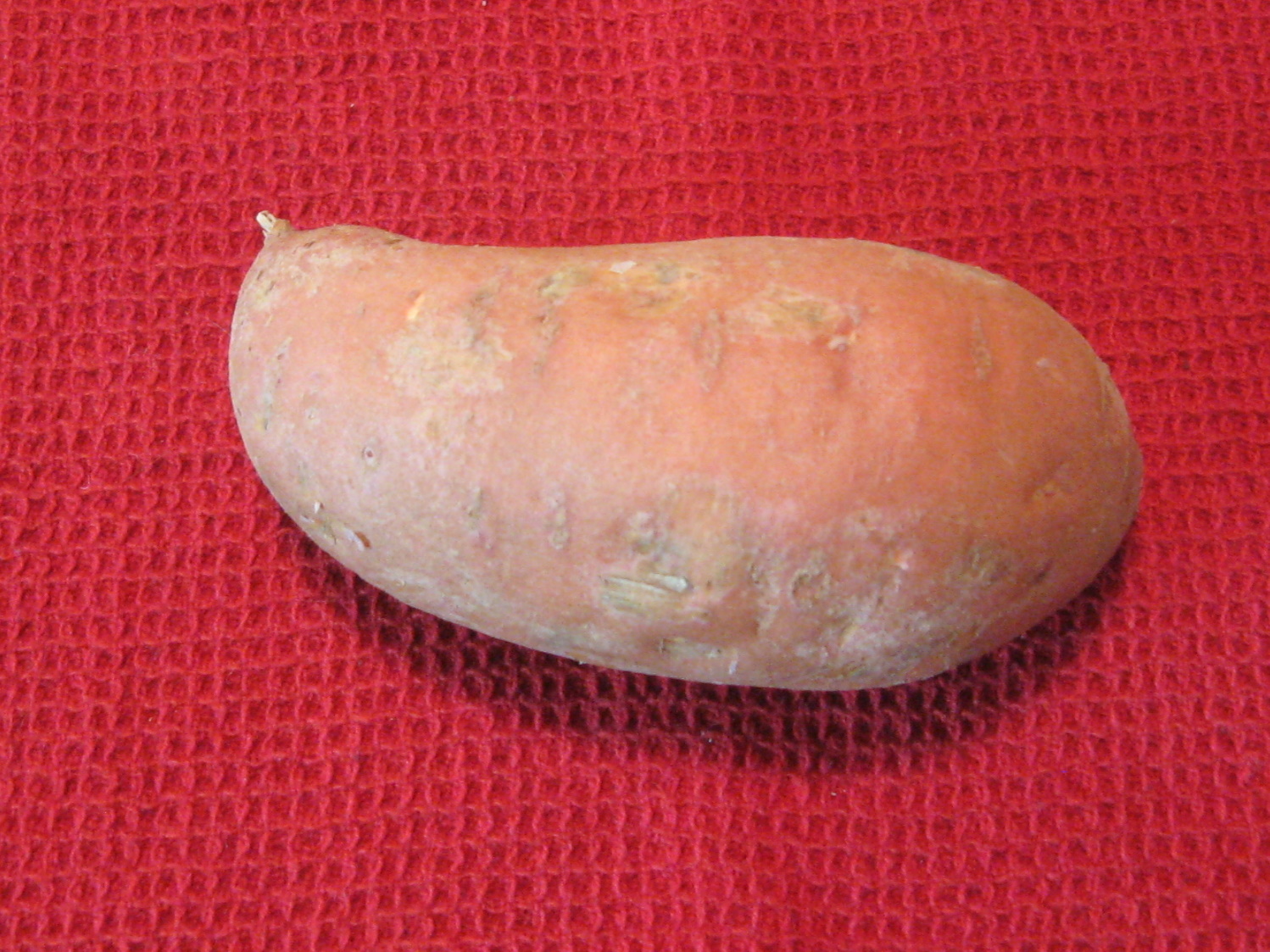
orange fleshed sweet potato

sweet potato

Then there are sweet potatoes (Ipomoea batatas),  which are commonly (and incorrectly) called yams.  Yams are a totally different biological entity.  These are only distantly related to the potatoes  discussed above.

Sweet potatoes likewise come in a variety of moisture content and colors.   The orange-fleshed ones are very moist, and as the name indicates, sweeter than the “real”  potatoes described above.  They are good baked and as french fries.  The white-fleshed ones are drier and those are my favorites for baking and making fries, but they are hard to find as a rule so when I see them, I bring some home.  There are purple sweet potatoes, too–again sometimes called yams, which they are not.  I’m going to be looking for these–I really like the purple potatoes, so I need to try these–they will certainly give a new look to sweet potato pie!

—«°»—

No matter what kind of potato you are buying, there should be not cuts, abrasions, or  soft spots.  For potatoes (Solanum tuberosum) you should check to see that there is no greenish discoloration.  This comes from exposure to light which produces solanine, a natural toxin.  The green is actually  chlorophyll, but it’s presence indicates the possible presence of a toxin, so green potatoes should be discarded.

When you get you potatoes home, they are best stored in a cool, dry, dark place.  Best is a temperature of about 40 to 50 ° F.   That’s certainly not the temperature of living quarters.  When stored at lower temperatures this can cause conversion of the starch in the potato to sugar and that will affect the flavor and cooking characteristics.  Lacking a suitably cool, dry and dark place I pass on the five-pound bag of bakers no matter how good the price, and bring home only what I’ll use in a short time (a week or ten days) and store them in the refrigerator (even though I keep my refrigerator really cold) otherwise they sprout before I use them all.

For lots more varieties and more suggestions for use see The Cook’s Thesaurus and the Potato and the sweet potato entries in Wikipedia for lots more great information on potatoes.

This is by no means a complete discussion of potatoes–I hope it gives you some basic information on  different characteristics of potatoes and which are most suitable for what use.   In the end, it’s your choice–want fluffy mashed potatoes, go russet; more rustic mashed potatoes–use red or try Yukon golds.  After all, you’re the one eating them  A son goût!

And here’s a bit of trivia for you for you next occasion for small talk:  2008 was the International Year of the Potato.  There is nutrition information and other fun stuff.

The Reliable Cheese Company–update

Unfortunately, the Reliable Cheese Company is no longer in business, but I’m leaving this because of the links to cheeses and charcuterie. Very sad to see this close; now for cheeses in this area, there is a Fresh Market, A Southern Season (which has an awesome selection of cheese and charcuterie). Wine Authorities carries some special cheeses, and the Durham Farmers’ Market has cheese vendors who come there.  Whole Foods also carries cheese. My local Harris Teeter  has a rather good selection of pre-cut cheeses–e.g. I can find Etorki there frequently.

After going to the Wine Authorities tasting on Saturday and coming home with raclette, I just had to go check out the Reliable Cheese Company this afternoon (not open on Mondays, but are on Sunday afternoons).  It’s not exactly on my way home, but I expect that I’ll be following that route more often in the future!

There were some great cheeses in the case–I could cheerfully do one of each.  There were other goodies like slab bacon,  bresaola, just to mention a few.  The Facebook page will keep you up to date on what’s happening at Reliable Cheese Company.

Came home with some lovely, luscious Taleggio cheese–just perfect texture. This is going to get a bottle of Gewürztraminer or Riesling opened to enjoy while nibbling on this cheese–It will need nothing more than some fresh bread and a bit of fruit to make supper.

Then I found the mortadella and had to bring home enough for one decent sandwich (that’s lunch tomorrow).

After perusing the sandwich menu, I could not walk out without my supper.  I came away  with the country ham, blue cheese, and fig jam  sandwich.