Growing & cooking with French tarragon

French tarragon

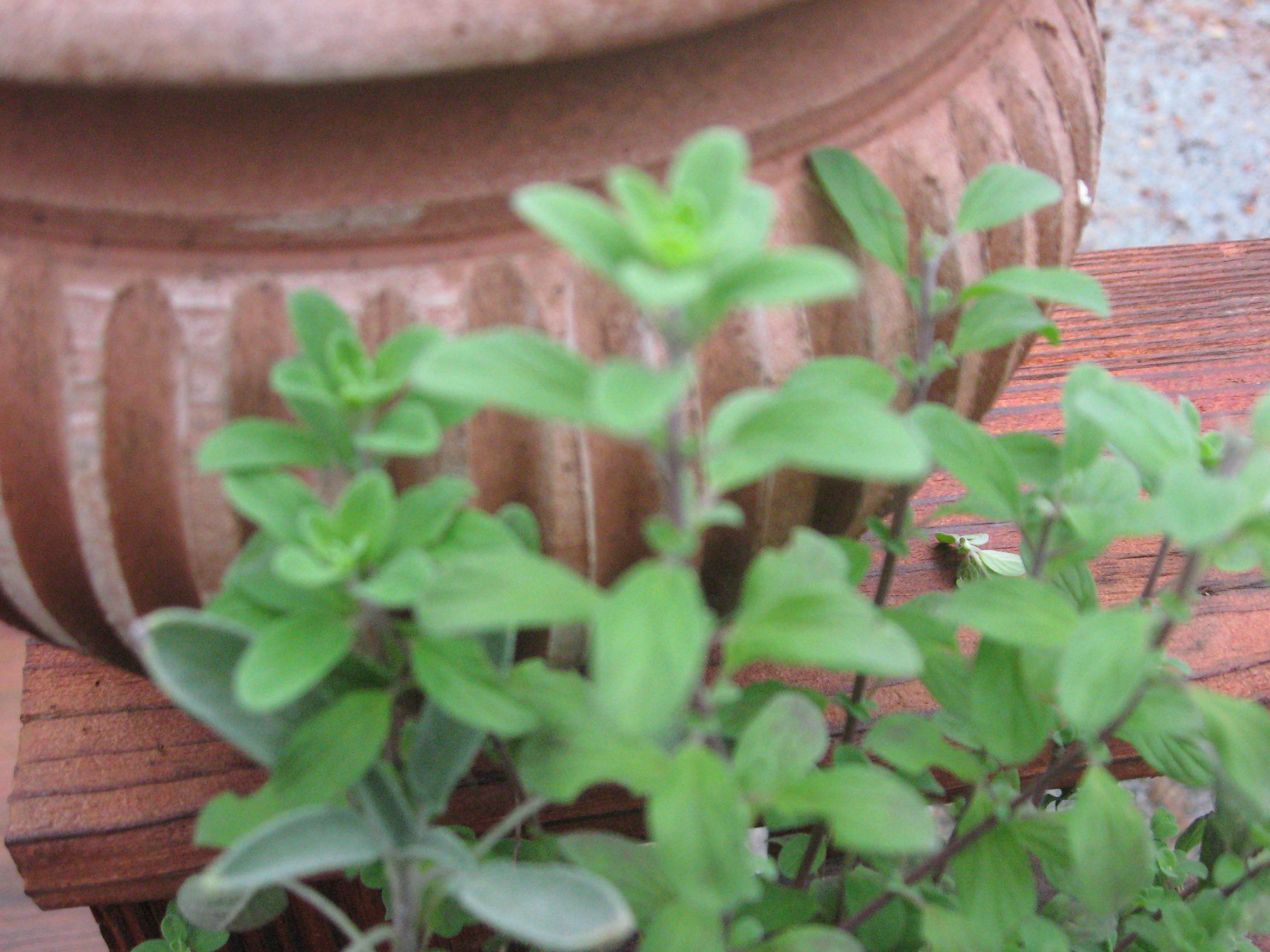
French tarragon (Artemisia dracunculus)

For me, another “must have” fresh herb is  French tarragon (Artemesia dracunculus var. sativa)–now.  Until I tasted the French variety fresh, I disliked it intensely.  I simply could not understand why people would rave about it as seasoning for anything.  Dried tarragon was what I tasted first–and threw it out: it was harsh and hay-like.

Then I decided to try the fresh herb–fresh is better, right?  I trundled off to a garden center and bought a “tarragon” plant.  Tarragon is tarragon, right?

That plant grew well, had nice tall, straight stems, but the taste did nothing for me; in fact I thought it was somewhat bitter.  I did realize that sometimes the flavor of herbs varies–just as anything live and growing varies from one to another.  So being somewhat stubborn, I went to a garden center with a larger selection of herbs and I bought another plant…this one labelled as French tarragon–the botanical name was shown on the tag.  (I almost didn’t buy it because while it was nice and green, it was rather straggly looking and it was expensive (compared to other herbs and the first tarragon plant I had bought).  But–I did buy it as it was the only tarragon  there; it grew slowly and was rather weedy looking–not a pretty plant.  When I was finally able to  pick some leaves to use,  that first taste made it obvious to me that this was something different.

I did some research and discovered that there are two kinds of tarragon:  Russian and French.  The Russian can be grown from seed, is a more robust looking plant, cheaper,  and is what you are likely to get if you buy a plant that just called tarragon.  On the other hand, the French tarragon will likely be more expensive, not as sturdy looking, must be started from cuttings or root divisions as it does not produce seeds; it’s also slower growing–but, the flavor is awesome!

The lessons from this?  Don’t bother to buy dried tarragon unless you like the flavor of hay, and don’t buy a tarragon plant unless it’s labelled French tarragon (Artemesia dracunculus var. sativa).

Once you get this treasure home, you’ll need to see that it has excellent drainage and lots of sun.  This particular herb has a few idiosyncrasies:   it likes a light, richer soil than other herbs such as  thyme, sage or oregano and while it is a hardy perennial, it actually needs (requires) a cold dormant period.  It will die back to the ground in the fall, but should survive the winter if it is in well-drained soil.

[Note:  If you live where you don’t get that kind of cold in the winter you may have trouble growing French tarragon as a perennial; instead of trying the Russian you might want to try Mexican tarragon (Tagetes lucida) also know as marigold mint.  The flavor of this is slightly sweeter and more licorice-like than French tarragon, but better than the Russian tarragon.]

It may be so slow to show in the spring that you’ll think that it’s not coming back–be patient.  In an extremely hot, humid climate, I’ve found that it does well with about six or eight hours of sunlight and then some shade during the hottest part of the day.  As it is rather slow growing, it may not need dividing for three or four years.

Now that you have this in your herb garden, what can you do with it?  To harvest it for use, you can cut almost anywhere, but don’t take more than half the plant at one time–it needs enough leaves left to have strength to grow back.  By pinching tips you can keep it a bit more bushy–but it’s always going to be a kind of weedy looking herb.

It’s best used as soon as it’s harvested, but it can be stored wrapped in a damp paper towel in a sealed zipperlock plastic bag in the refrigerator for three or four days, but one of the reasons for growing it is to use it at its peak flavor–right away.

The flavor of French tarragon is described as sweet and anise-like, with minty and peppery sensations–complex!  (It contains some of the same essential oil that is found in anise.)  It’s best to add it near the end of cooking because, like some other herbs (basil, for example), it loses some flavor with heating.

This is not an herb that you reach for as your basic “go to” like thyme or oregano but it’s a classic with chicken, mild seafood, and eggs.   A simple lemon/butter sauce is delightful on seafood with a bit of tarragon added.  The sweet, anise-like flavor is also good with root veggies like carrots, beets; fresh vegetables like peas, asparagus, green beans.   You can use tarragon with fruits as well as vegetables:  melon, peaches or stone fruits.  An intriguing suggestion  I’ve seen (but not yet tried) is with citrus sorbet such as grapefruit or lime; sounds like a great summer cooler–I also  wonder about adding it with grapefruit when making aqua fresca for hot weather drinks.

It’s part of some classic herb mixes such as the French mixture called fines herbs and herbes de Provence (actual herbs used and proportions will vary with the producer).  It’s also use in the classic Béarnaise sauce, frequently served with a good steak.

You’ll find your own uses for this herb if you have it readily available.  As always, smell and taste and see what clicks with you; even though there are classic combination, there are lots of other possibilities.

A son goût!  
Bay, basil & oregano

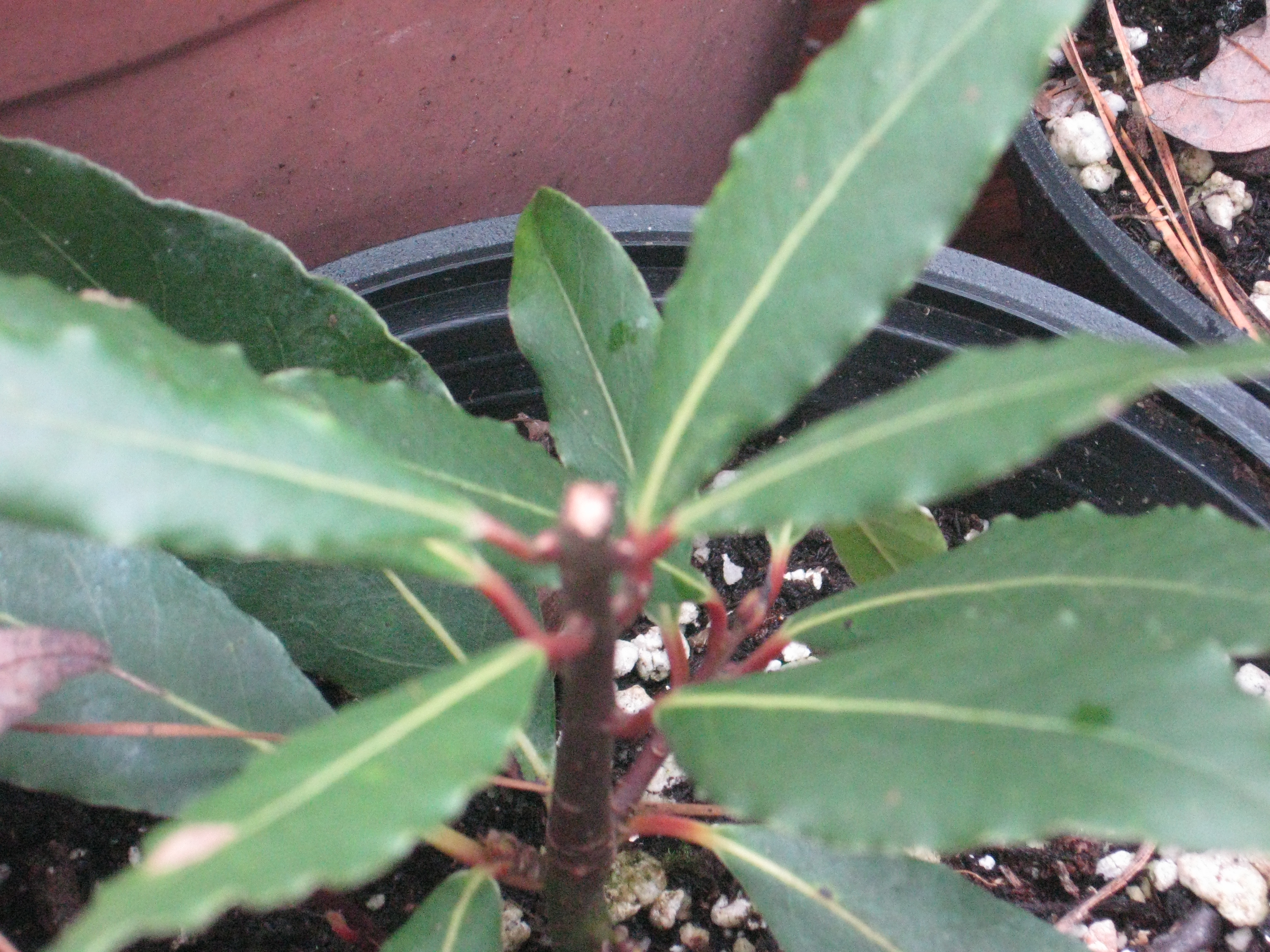
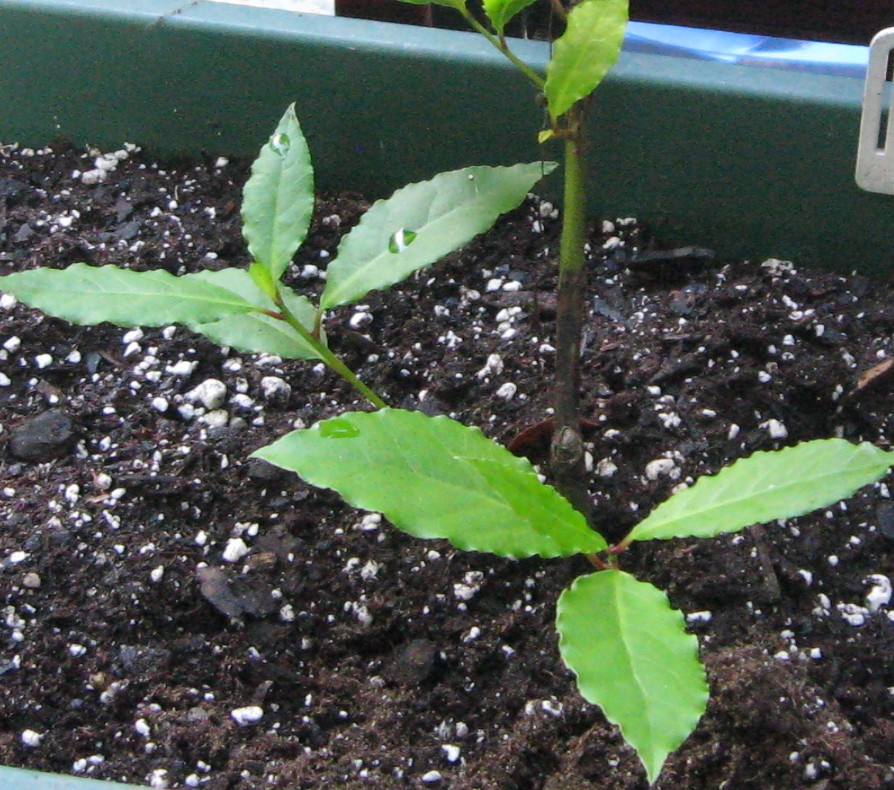
Turkish (sweet) bay (Laurus nobilis)

New leaves on Laurus nobilis plant

Bay (Laurus nobilis)

This may be an herb that is associated more with winter cuisine because it is so frequently used in soups, stews, and braises which are typical of cool weather cooking.  Once you have used the fresh rather than dried leaves, it will be an all-season herb.

Culinary bay (Laurus nobilis) is often called bay laurel, sweet bay or Turkish bay.  The botanical name is important for this herb as there is another, California bay (Umbellularia californica), that is often found as “bay”.   The flavor of the California bay is more medicinal with a strong camphor smell that is much different from the complex flavors of  true bay laurel.   There is a whole new experience waiting when you use fresh bay laurel leaves in cooking.

This herb is “picky” to grow, but well worth the effort.  To grow bay laurel, you will need to buy a plant from a reputable source so that you can be sure that you are getting Laurus nobilis since the California bay lacks the “sweetness” of true bay.  True bay  is more expensive than most herbs because it’s difficult to propagate and is slow-growing.  You’ll likely (depending on climate where you live) want to grow your bay in a container in order to move it inside in the wintertime, at least until it is about 24 inches tall when the stems will be somewhat woody and better able to withstand cold.

Bay needs sun, but too intense sunlight will burn the leaves–so having it in a pot will let you move it around and discover the best site for it.   It also needs fertile soil, evenly moist but well-drained.  It should never be allowed to dry out completely or it’s likely to die. This is an herb that will need a container all to itself.  If you need to bring it indoors to winter over, you’ll need to put it where there is plenty of light and where it is well ventilated–best in a cooler area.  While indoors bay is susceptible to some pests like mealy bugs, scale, and aphids so you must watch it closely.

Basil (Ocimum basilicum)

Sweet basil (Ocimum basilicum)

If there is a summer herb, as dried bay might be considered a winter herb,  it is most likely basil (Ocimum basilicum), especially the sweet, large-leaf, Italian basil.  Say tomato, and I’m sure a lot of  “foodies” would immediately say basil.  It is a tender annual that will not winter over–so it’s a spring event when you can plant basil and anxiously await that first harvest.   I suspect that basil would be at the top of a list of herbs grown by home gardeners–especially as it is so strongly associated with tomatoes.  There are many varieties of basil (purple, Thai, holy, cinnamon, lemon, and lime, globe for just a few) but we’ll start with the most common: sweet or Genovase basil.

To grow basil, you can start with seed or buy plants.  It is a heat-loving herb so you need to wait for warm weather to plant it outdoors (generally night-time temperatures need to stay above 50 ° F).  You can get a head start if you plant seeds indoors.  Once the weather is warm, you can gradually get your plants used to the outdoors, and finally plant them out. For your first time of growing basil, you should probably just buy plants.  Even so, if you plant your basil outdoors while the temperatures are too cool, you’re likely to have stunted plants that will never do really well.

Basil can be grown in the vegetable garden, herb garden, or in containers.  It needs average soil (so it will do well in that potting soil that you got from the garden center) but needs plenty of water (even moisture, not allowed to dry out between waterings) but must be well-drained.  It needs lots of  sun, but it does not like the drier, poorer soil conditions that some of the Mediterranean herbs will tolerate; however, basil will not do well in soil that is too rich either (don’t fertilize too much)–that will make it less fragrant since it will contain less of the essential oils.  This means that you should not plant basil in the same container as other Mediterranean herbs like sage.

As you start your basil plants, you want to pinch the growing tips so that the plants will branch sideways and be full and bushy.  Basil flowers readily, but after flowering the flavor declines so be rigorous in pinching the flowering tips.

There is one serious fungus disease (fusarium wilt) that can affect basil–it turns the leaves black and will kill plants in a short time.  This is a disease that is carried by seeds–so if you are starting your basil from seed, buy seeds that have been tested and are known to be disease free.  Should you get this disease in your plants, the only thing you can do is (literally) trash them–don’t throw the diseased plants in the compost or that will be contaminated too, and the disease can be transmitted to tomatoes and basil plants on which that compost is used.

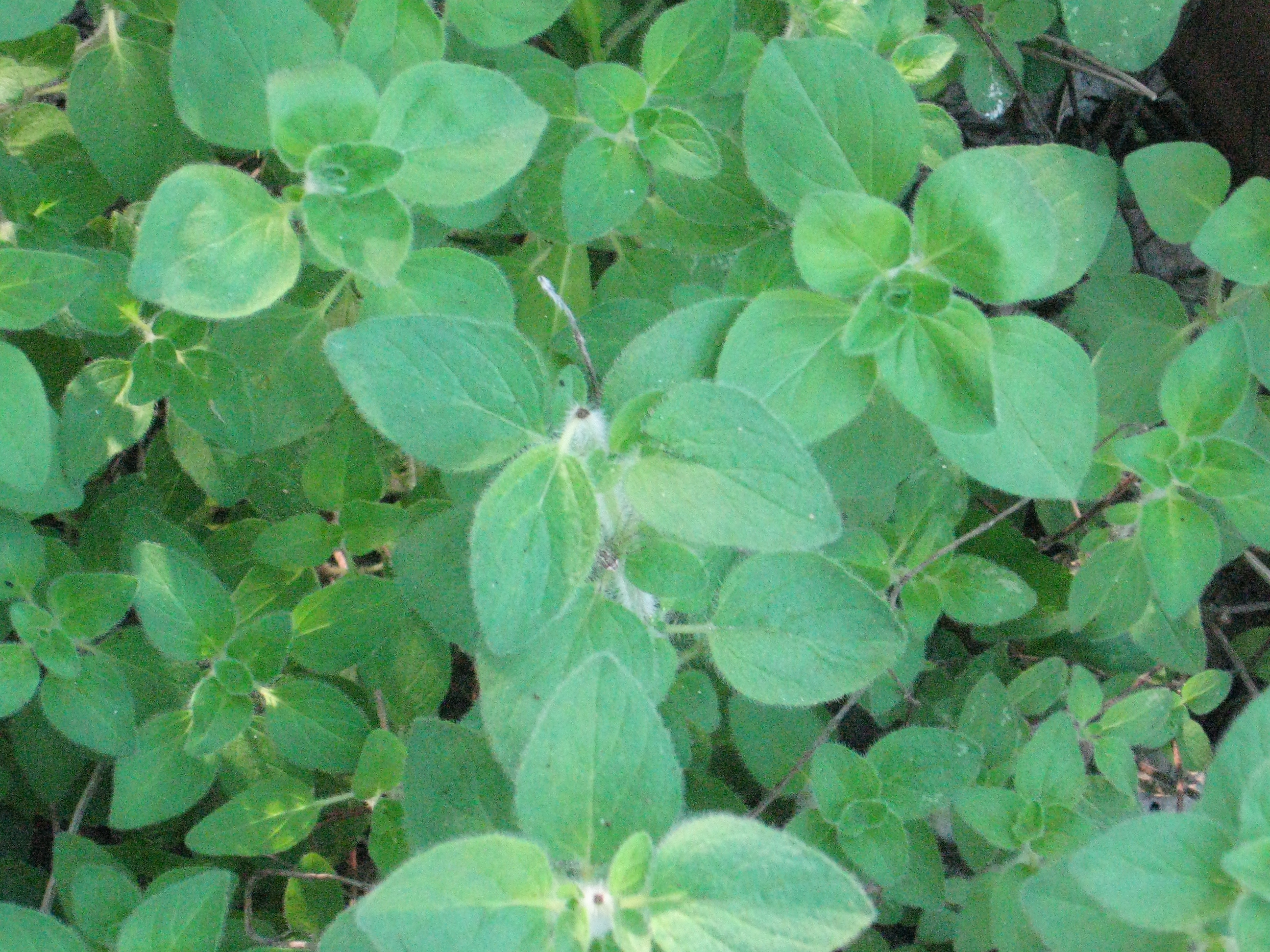
Oregano (Origanum vulgare subsp. hirtum

Greek oregano (Origanum vulgare, subsp. hirtum)

There are many types of oregano which vary markedly in the intensity of flavor.  Likely the one most commonly found in the supermarket or in the garden center is common or wild oregano (Origanum vulgare subsp. vulgare).  I like to grow the true Greek oregano (subspecies hirtum) for my use as it is very spicy and has an intense flavor.  It is a less vigorous growing plant than the common, but still easy to grow.   While you can start oregano from seed, it takes a long time to germinate and is slow-growing so unless you have lots of patience, buy a plant to start your herb garden.   The best way to tell what you’re getting it to smell and/or taste a leaf from the plant that you’re going to buy.  If you have never tasted Greek oregano, you are in for a wonderful treat–it’s much more flavorful and more peppery than the common oregano (which is what is most likely in those supermarket packs and in the garden center).

The two basics for growing oregano are sun and well-drained soil; given these it is a vigorous grower.  It is a perennial so once you get it started, it will stay with you for quite some time and generally be quite carefree to grow.   As with most herbs, it benefits from being used frequently or having the growing tips pinched occasionally to encourage it to branch and be a bushy, rather than a leggy, lanky plant.

A word of warning:  if you are also growing common oregano (see also Marjoram), don’t put it near your other species of oregano–it spreads by underground off-shoots (stolons) and by seeding itself, and it can (and likely will) replace your prized Greek (or other) oregano.   You might plant your Greek oregano in a container with sage, but not with other species of oregano or with marjoram.

◊ ♦ ◊

These three herbs would have to be part of absolute bare necessities, along with parsley, sage, thyme, and rosemary, for my cooking.  The longer I cook, the more herbs I want to have available for spontaneous use:  I’ve added tarragon, epazote and shiso (perilla), and lavender to what I’ve come to consider the “necessities”.  Every growing season is likely to find me adding another herb–this year it’s lime basil.  I’m waiting rather impatiently for the plant to be large enough to harvest some leaves and do something more than nibble on a leaf and contemplate where I’ll use it!

Parsley, sage, rosemary & thyme…

Those are some of the basics–but there are so many other herbs to use in seasoning your food.   For growing your own, start with the basics–don’t overwhelm yourself at your first attempt at growing.  Better to get a few going well and gradually add to them as you get more comfortable taking care of your growing collection.  Each cook will have favorite herbs (or blends) to add or to substitute to make up you kitchen basics, but I’m going to talk about growing some of the very common herbs first, and then we’ll go on to some less common, but delightful herbs.  Harvesting and cooking with these fresh herbs will come just a bit later.

I am going to include botanical names so that when (or if) you go looking through catalogs you will be able to relate to those.

Parsley (Petroselinum crispum)

Petroselinum crispum

is a member of the carrot family that we (all too frequently) think of as a garnish.  Parsley is grown as an herb, but also as a spice and a vegetable (root).  It’s native to the Mediterranean region–along with the sage, and thyme.  Here we’re considering the use as an herb.  (The vegetable part will come later; seeds are reputedly useful medicinally, but that is not considered here either).

It’s a wonderful herb in its own right–adding freshness and “green-ness” to lots of dishes.  There are two kinds of parsley: curly (Petroselinum crispum var. crispum) and “flat-leaf” or Italian parsley (P. crispum var. neapolitanum). There is a “gourmet” tendency toward the “flat-leaf” or Italian variety, but either can be used.  The essential oils that provide the herbal flavor are the same in either the curly or the flat-leaf; there is a bit of variation in when these flavors peak.   The flavor of parsley is usually described as “fresh”, “woody”, but there is also a flavor of anise (very common in herbs).  It is frequently use with other herbs to provide a rounded out background flavor.   Parsley can also be used as a “salad” green–e.g. tabbouleh.

Parsley is easy to grow–it likes basking in the sun, with evenly moist roots.  It’s a biennial plant so it will not “bolt” (go to seed) until the second year, but you’ll want to re-seed then to be sure that you have a constant crop.

Swallow-tail and Monarch butterflies love parsley (and other carrot-family herbs–so if the caterpillars descend on it, they can munch it down to  bare stems in a very short time.  If you note lots of swallowtail butterflies around, you might want to buy some extra parsley seed and throw it out in the hedgerows and edges of the garden for them–maybe they’ll leave your herbs alone.

Sage (Salvia officinalis)

Salvia officinalis var. Berggarten

Sage is the “poultry” herb to many people, but it has so many more uses than just poultry.  I think it has to be described as a rather “dry, austere” herb.  (If that sounds like wine-speak, it really is, but the terms lend themselves well to describing you basic culinary sage.   There are many varieties of sage available.  One of the chief differences between the culinary varieties is the ease with which they bloom, and to some degree, the concentration of essential oils which give the flavor to sage.

Plain Salvia officinalis (regular “garden sage”) will bloom quite readily bloom in the spring; other varieties such as the Berggarten or Extrakta tend to bloom less readily.  (While the blossoms of many herbs are beautiful, they will affect the lifespan and the flavor.)

Salvia officinalis (Extrakta)

 Personally I grow these two varieties as they do not bloom readily and are high in essential oils.  The Berggarten seems to be especially well suited to containers as it is less gangly, leggy or sprawling.  The flavor of both is excellent.  Both are usually hardy throughout cold winters.  You can see the difference in the openness of these two.   For your first attempt at growing sage, you certainly do not need to find anything exotic–just get plain “garden sage” which is what you’ll find in most garden centers.

Sage is one of the “Mediterranean herbs”–hot, dry, drought tolerant group.  So long as sage has lots of sun and well-drained soil, you should not have any problem growing it, and getting it to come back the following year.  If you have problems with it, most likely its feet are wet–and that makes the roots rot, and the plant dies.  Sage tolerates drought well, so don’t plant it in the same container with your basil (which likes more moisture).  You can see that I’ve planted these in larger individual pots.  While some sources say that sages may not survive the heat and the humidity of the Southeast United States, I have not had any problem keeping them going for several years.  These plants are both several years old.  In the heat (and humidity) of the North Carolina summer, I do not put these in all-day sun.  The sage gets put where it has afternoon sun.  Since the deck is mostly shaded, the sage pots are set along the stairs.

Rosemary (Rosmarinus officinalis)

Rosemary (Rosmarinus officinalis)

I’m sure this woody, evergreen (but tender) shrub well know to all  for its resinous, pine-y scent from stews and grilled foods.  It’s native to the Mediterranean coast and will not likely survive winters with sustained temperatures below about 10 ° F.  If you live where winters are moderate enough for it to survive, it can be a lovely shrub.  (With a little pruning and shaping I bring mine in briefly to use as a Christmas tree.)  If winters are very cold, it will need some protection in the wintertime–if it is in a container, put is indoors where it is partially protected; mulch it heavily, et cetera.  Mine (potted) has survived several winters of quite cold spells (short) with some protection like moving it to the back porch where it is warmer and protected from wind and frost (but not heated).

Rosemary is usually grown from cuttings rather than seed–we tried seeds last year on the farm, and the germination was very slow and very poor; you’ll be best off buying a plant that is already started.  One of the hardiest varieties is “Arp” which can withstand lower temperatures if  given some protection.   When buying your plant, crush a few leaves and smell it–if it does not have good strong scent, then try another plant.  The intensity of the flavor will vary rather markedly with the season (weaker in the winter; stronger in the summer).

This is another herb which does not like “wet feet”; it needs well-drained soil.  Potted it does best when slightly rootbound or potbound; keep the pot to a size that you can move into shelter in the winter–about 12 inches.   Rosemary also needs good air circulation around it, especially in the humid Southeastern United States.  I would not plant rosemary with other herbs because of this.   Harvesting and cooking with rosemary will follow shortly.

Thyme (Thymus vulgaris)

Winter thyme (Thymus vulgaris)

Thyme is another Mediterranean herb that loves well-drained soil, and lots of sun.  There are many varieties of thyme.  For now I’m excluding the “flavored” ones like lemon, or caraway.  The basic culinary thyme is Thymus vulgaris.  Look at an herb catalogue and you’ll find winter and summer thyme, French, German, and English thyme.

Most commonly the thyme found at your garden center is likely to be winter or English thyme.  This is called winter thyme because it is quite hardy and will very likely winter over without much fuss.  This is a woody herb so that you have to remove the tiny leaves from the stems, and it’s likely to get straggly and rather ratty looking despite trimming and pinching.

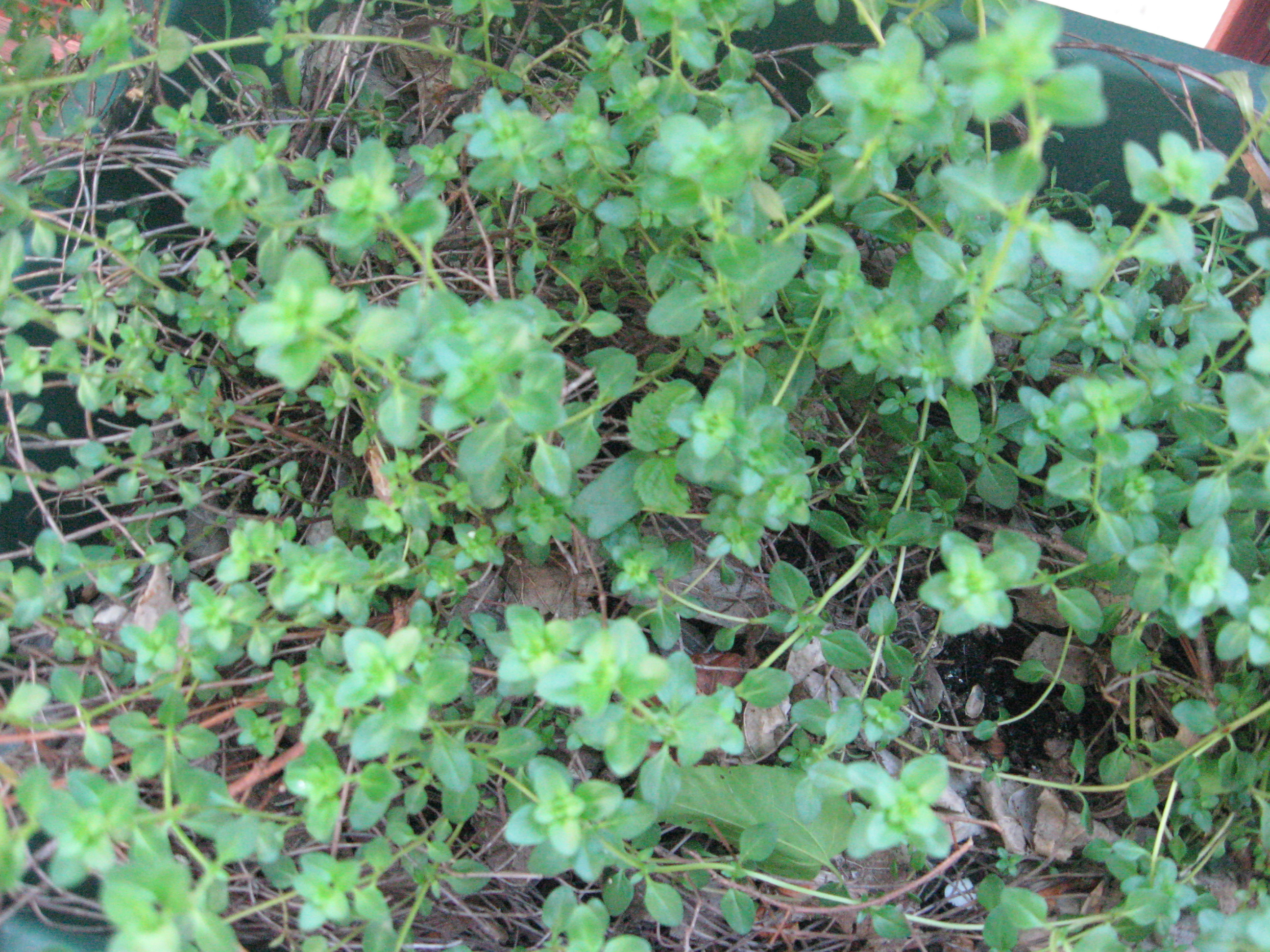
French (summer) thyme (Thymus vulgaris)

My particular favorite is “summer” or French thyme since the stems are not nearly as woody.  The down side of the summer thyme is that it does not tolerate cold winters and may not winter over.  So far I’ve been lucky here in North Carolina; my French, summer thyme as wintered well without my doing more that putting the pot somewhere a bit sheltered (screened back porch).  It’s a pleasant surprise when it comes back in the spring.

Regardless of which variety you’re growing, keep in mind that it is another herb which needs well-drained soil and sun.  You may well want several plants in order to have a good supply as you need to strip the leaves, which are small, from the stems unless you are going to remove the stems after cooking.

If you look at the characteristics of the herbs discussed above, you see that they all need well-drained soil and sunshine to thrive.  With the exception of rosemary, it would be possible to do a container of sage and thyme together; they sage is a more upright plant while thyme is lower growing, and will hang over the edges of the pot.  We’ll discuss some other herbs  which might  go into a planter with the sage and the thyme.

Your own fresh herbs.

Yes, I digress from actual in-the-kitchen cooking, but it’s the time of the year when the seed catalogs have started to appear in my mailbox, and the birds are beginning to suggest springtime, too.  It’s time for wishful thinking–and ordering seeds and/or plants.  There are so many herbs available that you won’t necessarily find in your local garden center–they will have the basics, and probably lemon thyme, and other flavored thymes.  Fresh herbs are one of the easiest ways to keep your cooking (even if it’s for more than one) exciting and healthy.  I’m not going to suggest that you replace salt with herbs (more on salt a bit later)–just use it judiciously with the fresh herbs.

Even though I purchase fresh herbs from the market during the winter and use some dried herbs, there’s nothing like being able to walk into the garden our even just out onto the deck and snip what herbs you want right now.  You are not in the frustrating position of not having the herbs that you need whenever you want them.  Having them readily available frees you to experiment depending on your mood, or whims as you cook.  Sometimes I don’t know what I want to use until I’m actually smelling the herbs as I brush against the plants.

Herbs are easy and fun to grow.  If you don’t have garden space, you can grow them in containers.  One fairly large pot can be used to grow several herbs, and has the advantage that you need to water less often than if you put your herbs in smaller containers.   I like larger containers with several herbs grouped together for several reasons:  I need to water less often, and I don’t have to be so concerned about them blowing over.  When you plant herbs together, you  do need to consider the moisture and light requirements of the herbs planted together.  Basil and oregano are not likely to be happy pot-mates as they require different moisture levels to be happy.  Most herbs like lots of sun, but there are a few that you may need to have in partial shade or shade so you’ll need to consider that as well.

When I say a “fairly large” container I am think about a three- to five-gallon container.   Pot sizes are usually given as the diameter at the top–so a 4-inch pot would be that wide at the top, possibly tapering to smaller diameter at the bottom.  The larger the diameter of the pot, usually the deeper the pot, so by the time you have a wide surface, say 14 to 16 inches, at the top, you may have a pot that is deeper than you really need for herbs, so don’t waste the extra potting soil!  Use some inert filler in the bottom of that huge pot so that you are using only the amount of soil needed.  Many herbs really need only about  8 inches of depth.   The old Styrofoam peanuts, for example, can be used (newer ones are biodegradable and will not last in the pot).  In order to avoid having to collect them when I need to change soil, I put them into old panty-hose (which take years to break down).  You could also use soft-drink cans, turned on-end, and upside down in the bottom of the pot–just be sure not to interfere with the drainage of your pot.  Because my deck is elevated and I don’t want to have to worry about pots blowing around, I will sometimes use bricks or rock to fill the bottom–just making sure that I can move it if needed.

A good place to start your herb gardening (container or otherwise) is with the basics that you use most often.  For me that is rosemary,  marjoram, Greek oregano (Origanum vulgare hirtum), Syrian oregano (Origanum maru), sage (Salvia officinalis, ‘Extrakta’ or ‘Berggarten‘), French or summer thyme (Thymus vulgaris ‘narrow-leaf French”, summer savory, and French tarragon (Artemisa dracunculus sativa), Thai basil, globe basil, bay (Laurus nobilis), chives, flat-leaf parsley, mint, and cutting celery.   Since you want only one plant of each, it’s probably best to buy plants rather than start from seed.  You can find herb plants at your farmers’ market in the spring, or at the garden center.

I will admit to being a bit of a snob about my herbs–I do want to know exactly what I’m getting, as you can see from the botanical names included with the list above–at least for some herbs, really as many as possible, but especially for bay and for French tarragon.  I don’t plant lemon thyme, et cetera, because I feel that the “citrus” part of the thyme cooks off quickly, so I prefer to add the citrus by using juice or zest of the citrus.   I don’t want Russian tarragon because, to me, the flavor is harsh–just not what I want from tarragon.  The same principle holds with bay–the California bay (Umbellularia californica) is strongly flavored, but  lacks the complexity of the Lauris nobilis or true bay.

Tarragon is another herb were it pays to be particular–it must be from cuttings, as true French tarragon does not produce viable seeds.  The seed packets of “tarragon” are a relative, but lack the finesse of French tarragon.   Other herbs that I’ve listed I like because of particularly high essential oil content, so more flavor.   Once you’ve got the basics, you’ll probably find others that you want to try:  I’ve added shiso, epazote, Spanish tarragon (Tagetes lucida), and given a catalog, I’m sure I can find many others I would love to try.

I generally do NOT combine annuals and perennials–I don’t want to disturb well-established roots of the perennials to remove or add an annual.  one of my containers is likely to contain sage for a nice tall plant with lovely grey-green foliage, oregano, thyme, and perhaps some chives in a 12- to 14-inch pot.   Rosemary can become quite bushy and makes a good tall plant for another container.  My bay gets its own pot, as I want it to be large and tree-like.

Cutting celery is an herb of which I’ve grown particularly fond–it does not head, and yet can give me fresh celery flavor for salads, soups, and the stems even add a bit of crispness.  It can grow with dill, chives, Vietnamese coriander, or stevia, for example.  Parsley usually get a pot to itself.  Cilantro, which bolts easily, gets a 6-inch pot or an area in a planter which gets sequential plantings all summer.   Most dill is not suited to containers as it tends to get huge, and develop a tap root; however, there are a few “dwarf” varieties (Fernleaf being one of those) which can be grown in a container.

Mint must have more moisture than these other herbs, so it gets its own separate pot, perhaps sharing with lemon balm (Melissa officinalis) usually placed out of the blazing summer sun.  My wish list for this summer’s herbs is not complete yet…there are more seed catalogs to go through yet.

It does take a bit of effort to grow herbs: you’ll need to water them, and do some mid-season fertilizing, but it is well worth the effort.  The other thing that you need to do is to keep herbs pinched and trimmed in order to have them bushy and productive.  You’ll not want them to bloom as the flavor is not as good after blooming, so pinch and trim.  To a large extent that happens as you harvest for use.  There are times when I just go out and give them a “butch”.  That’s when you make an herb vinaigrette, share with friends or purée to use under the skin of a roast chicken!  You can also include the leaves in a salad of mesclun or your favorite greens.

Having your own herb garden keeps you supplied without the expense and (even as manyas I used) waste with the packaged supermarket herbs. It also provides a sensual pleasure just to smell them as you walk by, or to deliberately brush through them, just for the heavenly aromas they give off.  Nothing is much more exciting than seeing those first leaves as they come back in the spring, announcing a whole season of wonderful tastes and smells–time to have things just a son goût even if it is single-serving cooking for one.

Chicken braised in milk.

Always on the lookout for a new taste experience, while checking out favorite blogs and  websites, I found a recipe that I just had to try:  chicken braised in milk from Jamie Oliver’s website.  I’ve made pork braised in milk (a recipe from one of Marcella Hazan’s cookbooks) and it was scrumptious!  Reading the recipe for “Chicken in Milk” I was intrigued by the seasoning–sage, garlic, cinnamon, and lemon.  Not a combination that I had thought, but considering the source I thought it worth a try.  Not wanting a whole chicken, I decided to try it with my favorite chicken parts–thighs.  It seemed like another great dish to test out the petit brasier.  I even found a friend willing to test the results with me.

Since I had about half the weight in thighs of the chicken called for in the recipe, I went halves on the seasonings as well.  What I learned was that chicken parts were okay, but maybe not the way to go with this recipe, and that halves on the seasoning was too big a cut.  The flavor combination was a success–it was somewhat earthy, and “round” and balanced, but I think I need to try it again with more than half the amounts of seasoning. We both felt that it could have been more highly seasoned, but it was a recipe that definitely goes into my “keepers” file.  Work on modifying it as a one-person meal is going to continue.

This was one of the times that I broke a rule that I usually follow:  make the recipe just “as is” before you try modifying it; so it’s back to the kitchen with this one–probably going to have to invite friends and do a whole chicken before I try cutting it down again;  I need  to know  what it would be like as intended so that I know how to modify the seasoning.  It’s not always easy to modify a recipe for single-serving cooking, but it’s a worthwhile endeavor.

Now that the holidays are past and things are settling down a bit, I think I’ll give it another try–my friends are used to me having a “food crisis”–and usually willing to participate.  I think it would be a good time to check out a bottle of good white Burgundy wine as well.    Since I’ve been considering this, I nabbed a couple of Cornish game hens on one of my trips through the grocery store, thinking that this might work as a single serving adaptation.  You can expect updates on this to follow–the full recipe and adaptations for one or two servings. If you need (or want) to serve four, it’s a recipe worth making!