
Anticipation of things to come

Beginning planting

the almost bare greenhouse

I have lived where seasons are not markedly different–and I much prefer life where there is a distinct  seasonal change.  It’s partly the anticipation of the new and different things that come with each season.  Anticipation adds a lot to my life.  Living where flowers were almost year-round left me taking them for granted. Winter for me is a period of rest, rejuvenation, regeneration–and anticipation.

Anticipation contributes to enjoying so many things–that special bottle of wine and good food, or just a new season. Planning a special meal to go with a special wine…or those winter dreams of fresh produce while you dwell on the pages of the seed catalogs, knowing that the time will come when you’ll have seeds in your hand, and that those seeds will give you food.  That’s anticipation. Winter is passing into spring….
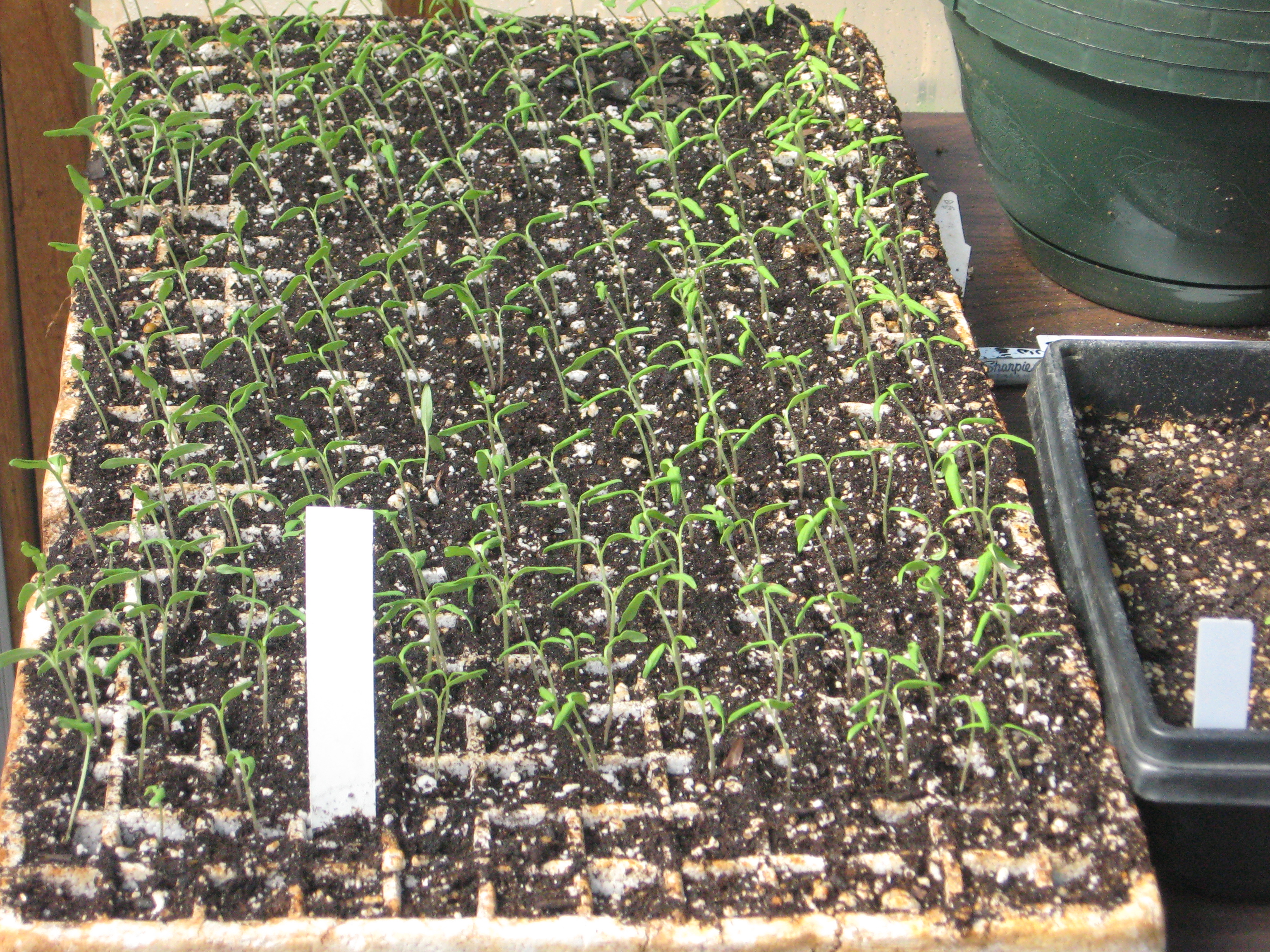
Plug tray of tomato plants

plug tray of tomato plants

Today I worked with a friend, as I do every spring and summer, getting a start on the luscious things that come from the field and garden.   I got my hands into the dirt and transplanted about 300 tomato plants from the itty-bitty plug trays into the three-packs that we’ll use to sell them at the farmers’ market.

We started with an almost bare greenhouse–just a few things that needed some protection to winter over, but were hardy without needing to heat the greenhouse all winter.

Small tomato plants in flats

transplanted tomato plants

The tomato seeds were planted just about ten days ago–in the house, because it was really too soon to get the green house up and going.  We planted the seeds in “plug” trays–each tray has lots of little “wells” just a bit bigger than my thumb (288 of them, I think).  Once they have germinated and have the first set of true leaves (even though they are very tiny they really do look like leaves on a tomato plant) then it’s time to give them more room to grow.  That was today’s work.  Tedious, yes!

Sungold cherry tomatoes on the vine

anticipation of what is to come

But, oh, the anticipation of what is to come from those tiny plants.  These are Sungold cherry tomatoes from last season–they’re summer candy.  Those tiny plants will  grow and bear tomatoes during the summer.  Today I did transplant some Sungolds, but there were Fried Green, Cabernet, Big Boy, Better Boy, Italian Tree, and Abe Lincoln tomato plants too.  Some of these are new for us–we’re trying them out to see how they taste and, of course, how that fare in the North Caroling summers.  So we’re anticipating….we’ll have more varieties like John Baer, Valley Girl, Champion, Brandy Boy…and maybe others.  It partly depends on how well the seeds germinate.  There be more transplanting going on shortly.  Then we can anticipate the sore knees, aching backs that comes from planting in the fields.  But that will pass, and we’ll be anticipating the sun-warmed, juicy fruit than came from that tiny seed.

Caponata!

The first time I tasted “caponata” it was mostly eggplant, and it was absolutely buried in tomato sauce.  I liked the concept, but it had kind of languished until I was looking around the kitchen at the tomatoes and eggplants that I had there.  This has been such hot, humid, torrid weather that I’m turning into a very picky eater…must be flavorful, room temperature or cold.  Needless to say I’ve eaten a lot of melons and fruits…and raw tomatoes in caprese salad, but I really needed to do something with the tomatoes and eggplants.

I decided to go looking for a recipe for caponata that looked like something I want to eat with grilled or griddled king klip since that was on special in the market today.  I started by going to EatYourBooks.com to search for caponata recipes among the books that I own (that I’ve put on my bookshelf there).  I found that I had 6 recipes for caponata.  I don’t know if it’s the weather, or what, but none looked like something I wanted to tackle this afternoon.  So I went searching online in the blogs that I like to check on.

On All Things Sicilian and more, I found a recipe that “felt” like something to do this afternoon, and it seemed loose enough that I could do it with what I had–oriental-type eggplants and little grape tomatoes.  It involves several steps, but it’s seemed approachable. A slight variation put a little garlic and some red pepper flakes into the mix as the olives that I had were marinated in those things.   Admittedly I did take a few liberties with the recipe but I think it worked well.  I did not improvise with the agro dolce–I kept those proportions.

My only real variation (other than the tomatoes) was that I treated the eggplant as described in my post on how to cook eggplant (as suggested by Cook’s Illustrated: salted very lightly, microwaved it, pressed it) and I was able to sauté all the eggplant in about a tablespoon of olive oil.

Here is the recipe from All Things Sicilian blog–the best I’ve ever tasted.  (You should go to this blog and read for more information about caponata.)

Ingredients

  • extra virgin olive oil, 1½ cups (more or less – depending how much the vegetables will absorb)
  • eggplants, 1-2  large, dark skinned variety,
  • peppers, 3, preferably 1 green, 1 red, 1 yellow (variation of colour is mainly for appearance, but the red and yellow ones taste sweeter)
  • onion, 1, large, sliced thinly
  • red tomatoes, 2 medium size, peeled and chopped, or 2 tablespoons of tomato paste and a little water
  • capers, ½ cup, salted or in brine
  • green olives, ¾ cup, stoned, chopped
  • celery, 2-3 tender stalks and the pale green leaves (both from the centre of the celery)
  • white, wine vinegar, ½ cup
  • sugar, 2 tablespoons
  • salt and freshly ground pepper 

Preparation

For caponata vegetables

  1. Cut the eggplant into cubes (approx 30mm) – do not peel. Place the cubes into abundant water with about 1 tablespoon of salt. Leave for about 30 minutes – this will keep the flesh white and the eggplant is said to absorb less oil if soaked previously.
  2. Prepare the capers – if they are the salted variety, ensure they have been rinsed thoroughly and then soaked for about 30 minutes before use, and then rinsed again.
  3. Cut the peppers into slices (approx 20mm) or into rectangular shapes.
  4. Slice the onion.
  5. Slice the celery sticks and the green leaves finely.
  6. Peel, and coarsely chop the tomatoes (or use tomato paste).
  7. Drain the eggplants and squeeze them to remove as much water as possible – I use a clean tea towel.
  8. Heat a large frypan over medium heat with ¾ cup of the extra virgin olive oil.
  9. Add eggplant cubes and sauté until soft and golden (about 10-12 minutes). Place the drained eggplants into a large bowl and set aside (all of the vegetables will be added to this same bowl). If you want to, drain the oil from the eggplants back into the same frypan and re-use this oil to fry the next ingredients – the peppers.
  10. Add new oil (to the left-over eggplant oil) plus a little salt and sauté the peppers,until wilted and beginning to turn brown (about 10-12 minutes). Remove the peppers from the pan and drain the oil from the peppers back into the same frypan. Place the peppers in the bowl with the eggplants.
  11. Add a little more oil to the pan and sauté the celery gently for 5-7 minutes, so that it retains some of its crispness (in more traditional recipes, the celery is always boiled until soft before being sautéed). Sprinkle the celery with a little salt while it is cooking.
  12. Remove the celery from the pan and add it to the eggplants and peppers.
  13. Sauté the onion having added a little more oil to the frypan. Add a little salt and cook until translucent.
  14. Empty the contents of the frypan into the bowl with the other cooked vegetables.

For the agro dolce sauce

  1. Add the sugar to the frypan (already coated with the caramelised flavours from the vegetables).
  2. Heat it very gently until it begins to melt and bubble. Add the vinegar and evaporate.
  3. Incorporate the cooked vegetables into the frypan with the agro dolce sauce.
  4. Add ground pepper, check for salt and add more if necessary. Gently toss all of the ingredients over low heat for 2-3 minutes to blend the flavours.
  5. Remove the caponata from the pan and cool before placing it into one or more containers.

Ò¿Ó
It should hold well in the refrigerator–and I know it will be even better tomorrow when the flavors have melded  more.  I’m looking forward to this with some griddled king klip tomorrow.

Insalata caprese

One of my favorite things during tomato season is caprese salad.  It’s satisfying and easy to do.  I didn’t do mozzarella di bufala, but I did have fresh mozzarella from the Durham Farmers’ Market (Chapel Hill Creamery) and that was splendid.  Sometimes I get a little over-exuberant and I have leftovers from this.  Next day it’s not quite what I’d want just as is.  (There really can be too much of a good thing at times.)  I’d seen a post on Closet Cooking suggesting a caprese sandwich on ciabatta; that looked really sumptuous, but mine was a leftover.  Standing there staring into the refrigerator, I realized that though I did not have ciabatta, I had some good, homemade olive oil bread–how about turning this into a grilled cheese and tomato sandwich?  Lay the slices of seasoned tomato and mozzarella on my hearty bread, brush the outsides lightly with olive oil, and pop it on the cast-iron griddle that lives on top of my gas stove.  Wonderful way to use a leftover thanks to the inspiration of the post on Closet Cooking.

This is not the first time that I’ve gotten carried away with insalata caprese–I’ve also used the leftovers as a filling for an omelette.  I’m sure there must be other ways to use leftovers and I’m always looking for them especially in the summer time because, if not this summer, I’ll need them next summer, or the one after that.