Hive report 11 Nov 2015

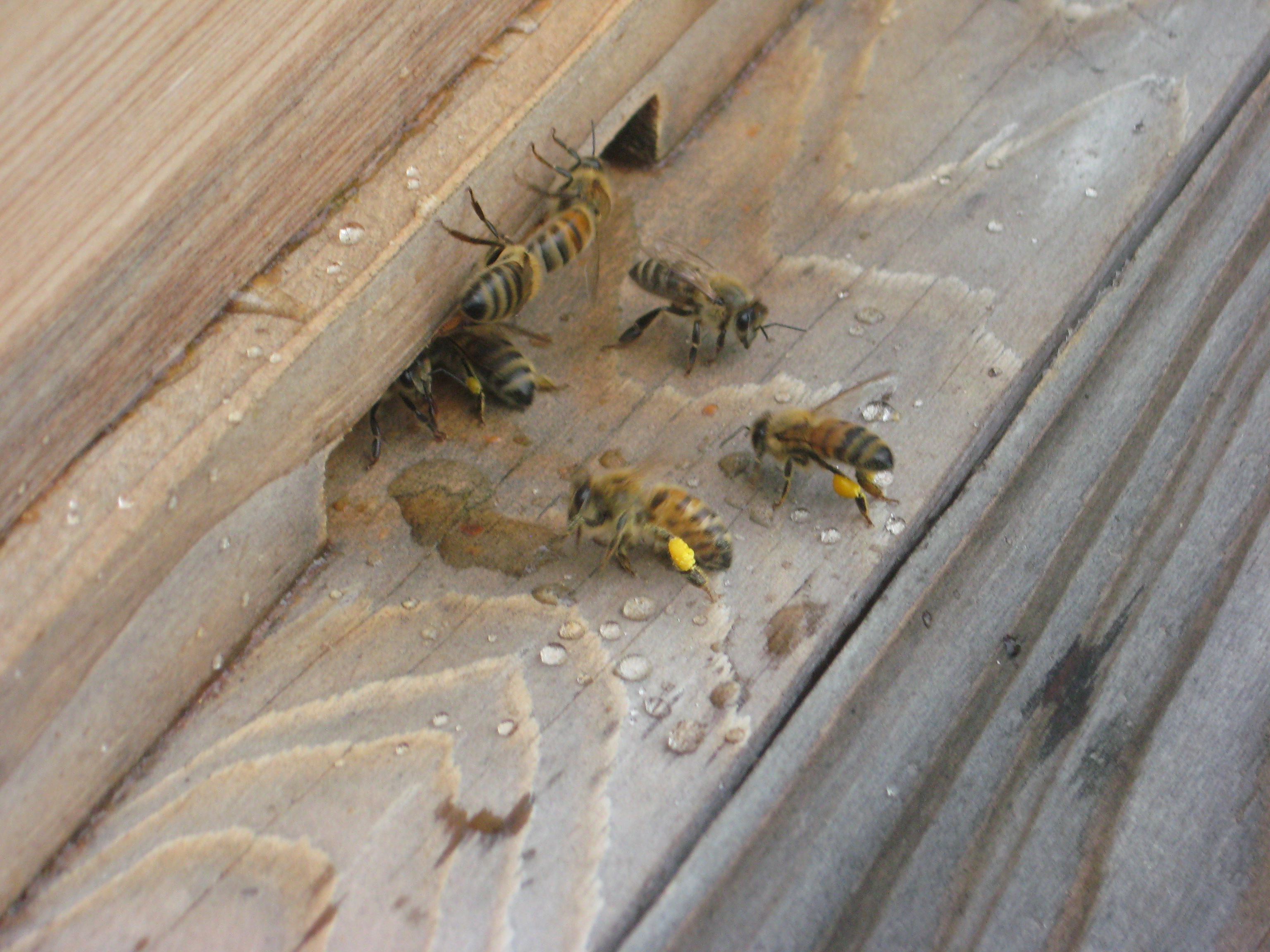
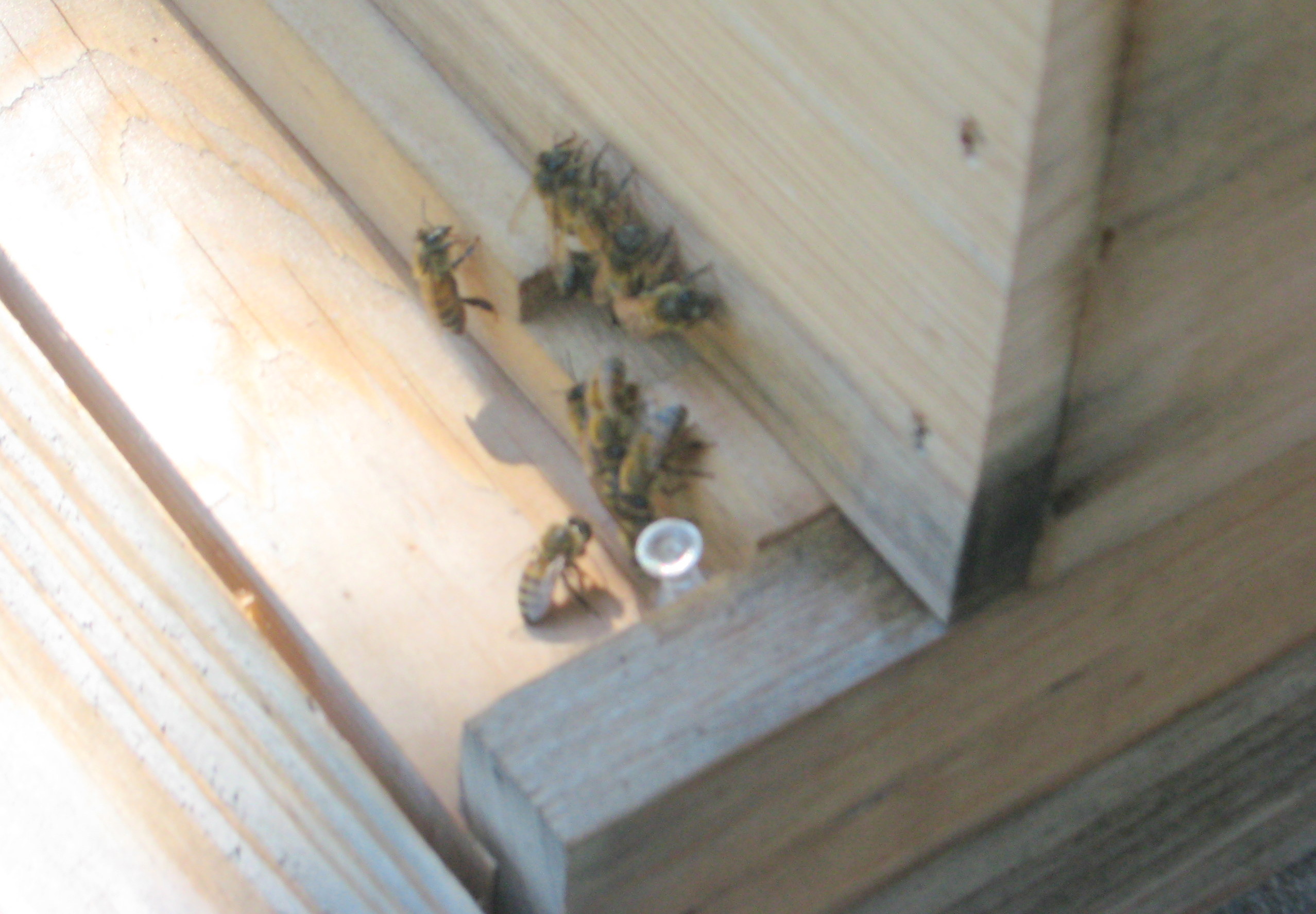
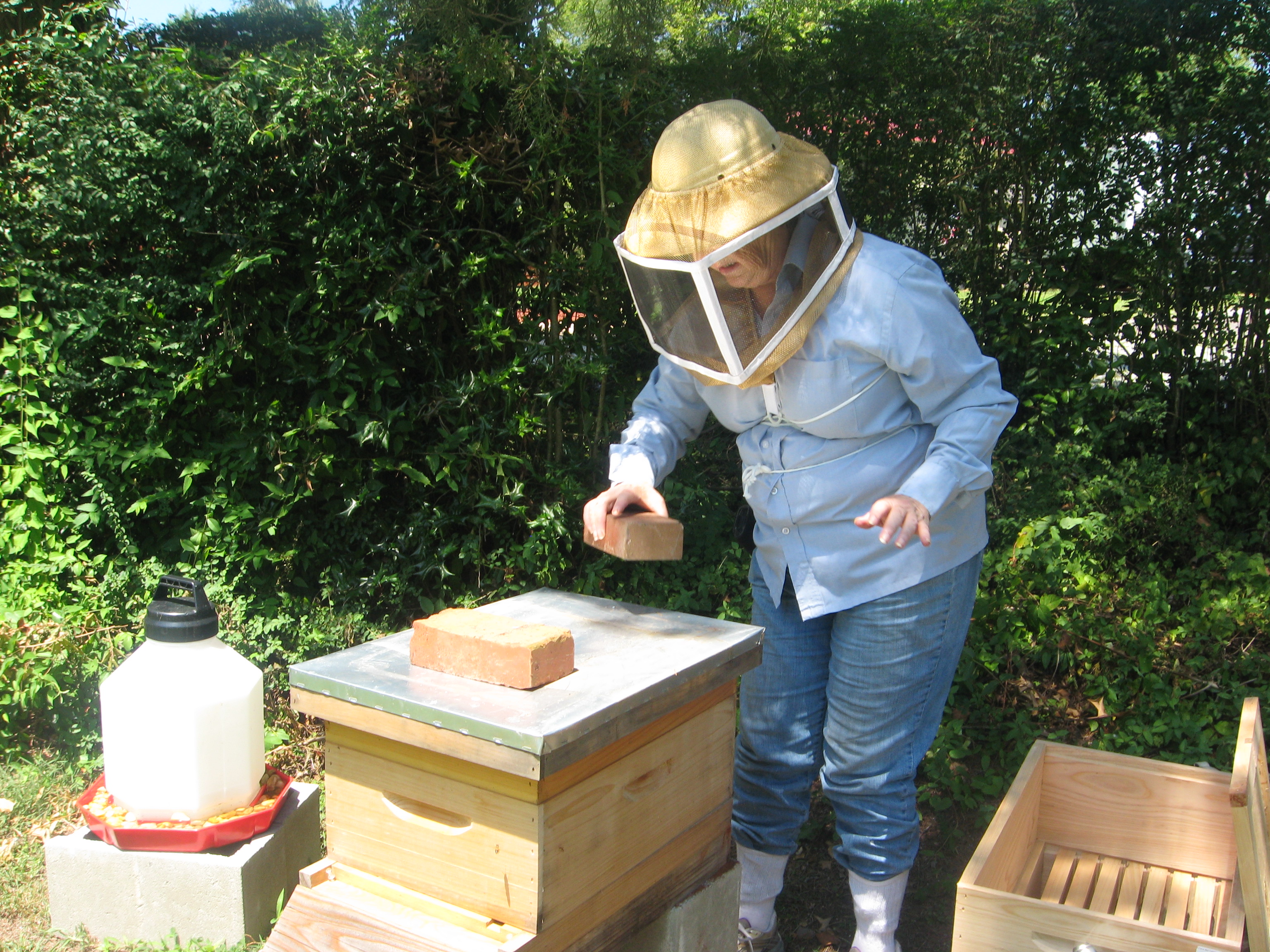
IMG_8695_11_11_trafficFinally a let up in rain and warm enough for me to play at the hive.  There’s still traffic in and out of the hive, but less than during warmer weather when there was nectar and pollen in more plentiful supply.  I didn’t see much pollen coming in at all.  When I removed the syrup feeders, there were lots of the girls up there slurping up syrup.

After I removed the syrup feeders I removed the inner cover–which were firmly glued in place with propolis.  The girls now have a candy-board and a quilt box to see them through the winter.  I wanted to place a mouse guard today, but wasn’t successful since the girls have done such a good job of gluing it in place with propolis that I’m going to have to actually lift the bottom brood box in order to get it out.  That means removing the other brood box and the super.  I didn’t do that this afternoon. Other beekeepers in this area have told me that they do not use metal mouse guards–just the wooden entrance reducer. I would really prefer to put metal mouse guard on, but there was enough traffic and enough guard bees out that I didn’t attempt that today. I do have a metal shield that will fit over my entrance reducer so I’ll place that instead, entrance reducer opening at upper edgeonce I get it cut down to 8-frame size.

I’ve heard different opinions for beekeepers on how the opening in the entrance reducer should be oriented–up or down. Mine is down now.  I wasn’t concerned about this as there was an upper entrance in the inner cover. I heard that for winter, the opening of the entrance reducer should be on top if there is winter-die off: if it’s down it could be blocked with dead bees. Now that I’ve removed the inner cover to place the candy-board and quilt box, I no longer have and upper entrance or ventilation.  One certainly hope that there’s not  going to be winter-die off, but I know some bees will die during the winter. (I’m learning how thoroughly things can be glued in with propolis.)

entrance reducer opening at lower edgeSo–do I place an Imrie shim to keep an upper entrance? Or am I going to have to lift the bottom box and change the orientation of the entrance reducer, or just substitute the mouse guard.  I miss having the class before the bees arrived; however from the looks of the colony, they are training me pretty well.  From Bee Journal, the inventor of the Imrie shim has written about it’s appropriate use–and providing upper entrance in fall and winter is not an intended use–it fact it’s an explicit no-no. Since he’s a successful beekeeper, and inventor of the shim, I think I may heed his advice.  But then there is the advice to provide an upper entrance. . . .

Now I’m left with the quandary of the orientation of the opening in the entrance reducer! Multiple opinions. (I’m beginning to suspect that if you ask 10 beekeepers about this you’ll get 12 different answers. I can see the logic of having the opening at the upper edge of the reducer, especially for winter–especially if that is the only entrance. The solution is probably to get the entrance reducer out and place the mouse guard.  No matter what it looks as if I’m going to have to lift that bottom box–which is pretty well filled with brood and honey, and the two above are now well filled with brood, and the upper with honey.  (This all makes me contemplate the virtues of the long (horizontal) Langstroth hive–which is not the same as a top-bar hive.

All my questions aside, it was good to see so many bees working in the honey super and  drawing and filling even the outermost frames. They’ve obviously been busy since my last inspection.  That should give them a good honey supply for the winter.  Being the “newbee” that I am, I am glad that the candy-board is on the hive.  Much better safe than sorry come spring.

Ever since the nuc arrived here I’ve been used to going out almost every day–even in the rain sometimes–to see what’s going on at the hive. I’m sure that during the winter when I can’t see any traffic I’ll still be going out to look at the hive and wondering how things are inside.  It’s rather amazing how attached you can get to a batch of insects! I’m sure it’s going to seem like a long winter, with rampant curiosity on my part. I do have to hope for another warm day so that I can remove the treatment I placed for varroa mites, but that’s going to be a very quick in-and-out for that purpose only unless it’s an unseasonably warm day.

(I’m pleased with how much honey is in the hive–I hope the candy-board is totally superfluous. I’m happier now that there is candy-board and quilt box on the hive.)

Ò¿Ó


Hive report 14 Oct. 2015

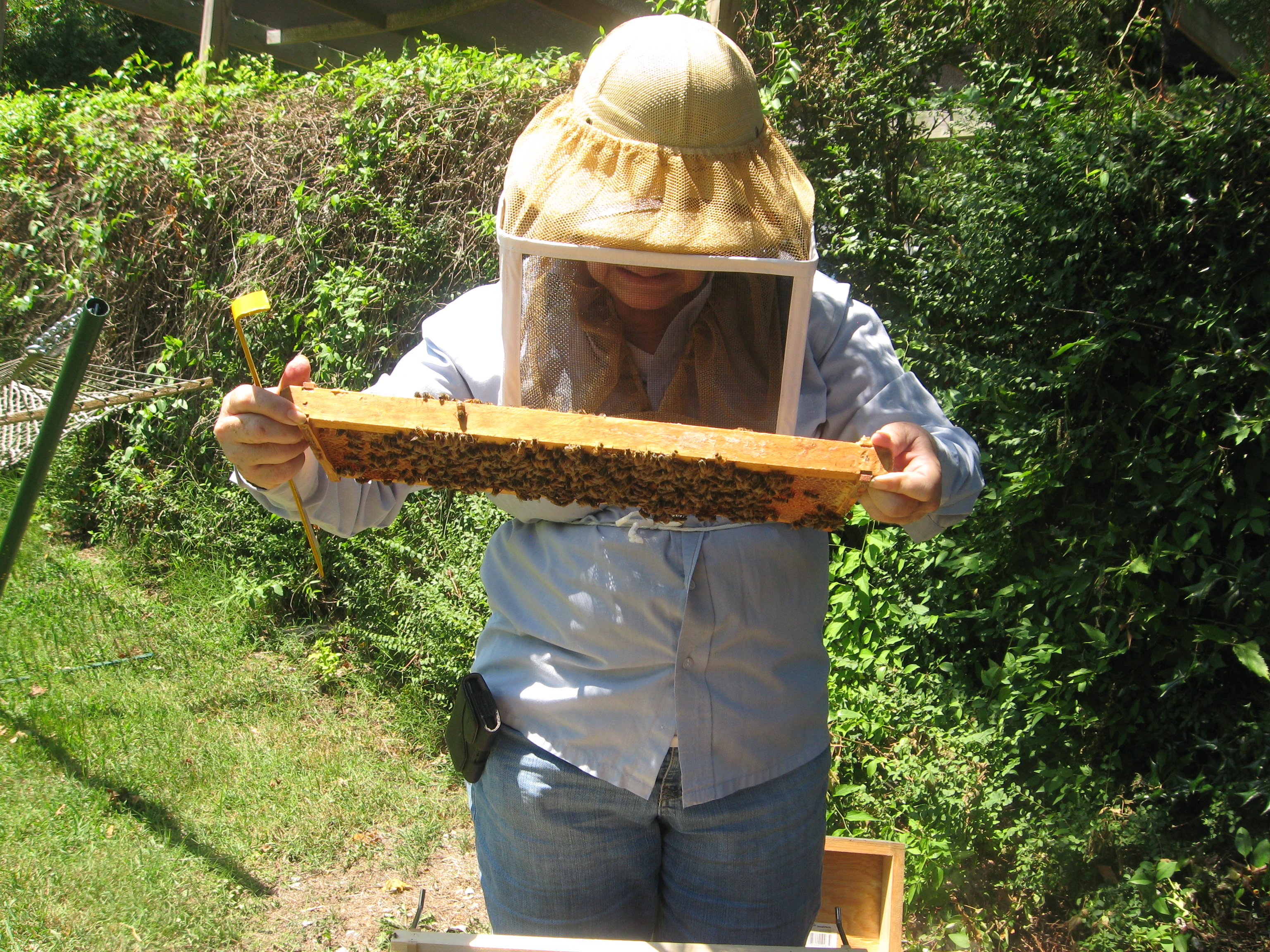
beekeeper holding Langstroth frameThis is late for my routine inspection–but with all the cloudy, windy, grey, chilly days it hasn’t been appropriate for me to be ripping the roof of the girls’ home. Then when the weather improved and the sun came out, we still had some days that were too windy for me to want to open the hive. Something about the girls clinging madly to the landing board in the gusts that suggested maybe not good time either. Then we finally had days that were not too windy and sere sunny, so I thought I’d do the inspection.

When I got to the hive, there were bees flying everywhere, circling the hive, and for the first time meeting me on the way to the hive. I wasn’t sure what was up with the ladies, but something said it might not be a good time to stick my nose into the hive.  The day following, same thing, except that I think I picked up what was causing the problem–lots of banging, thumping, nose, and some unusual traffic by the hive brought them out again; so another deferred inspection.

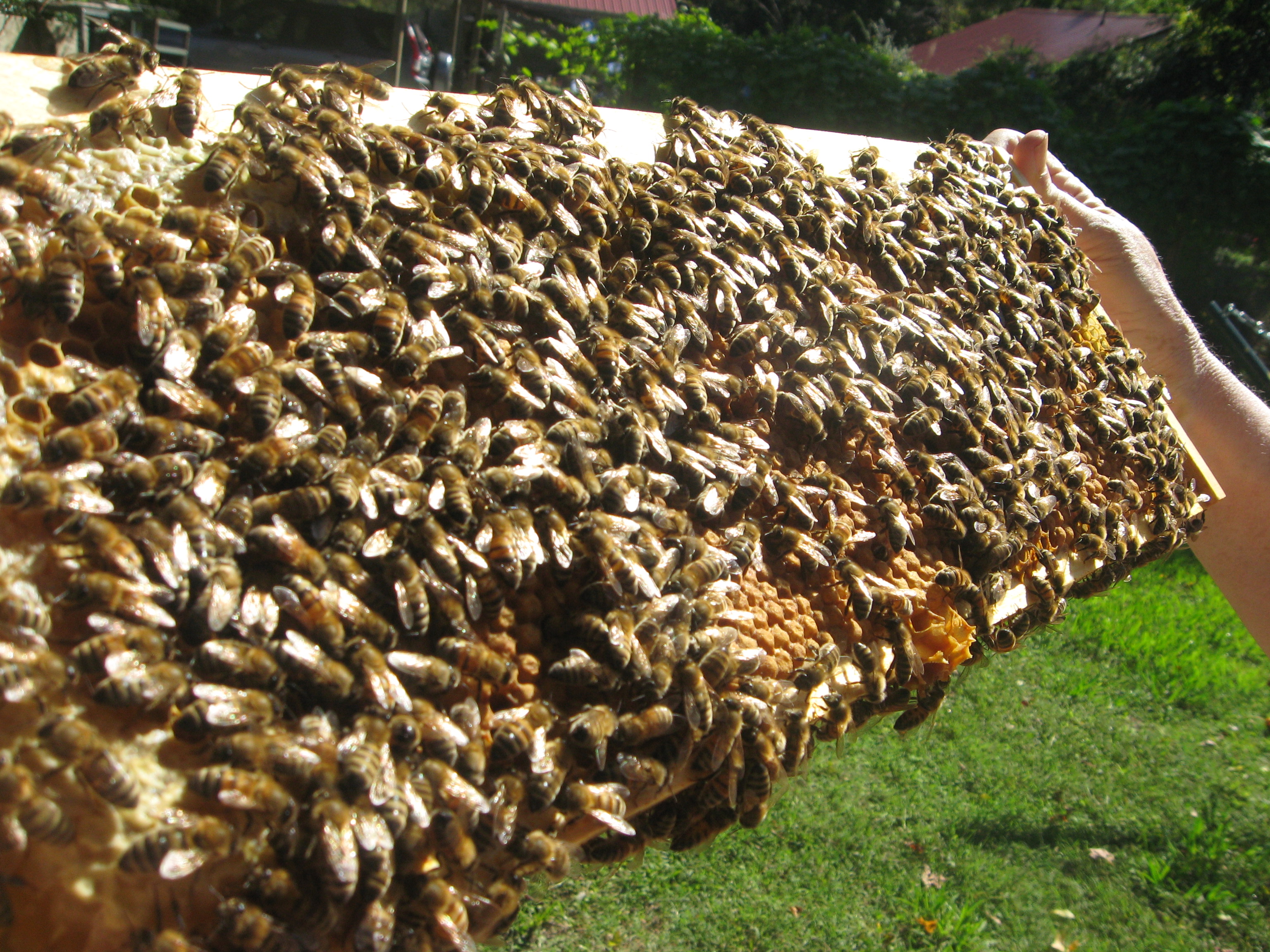
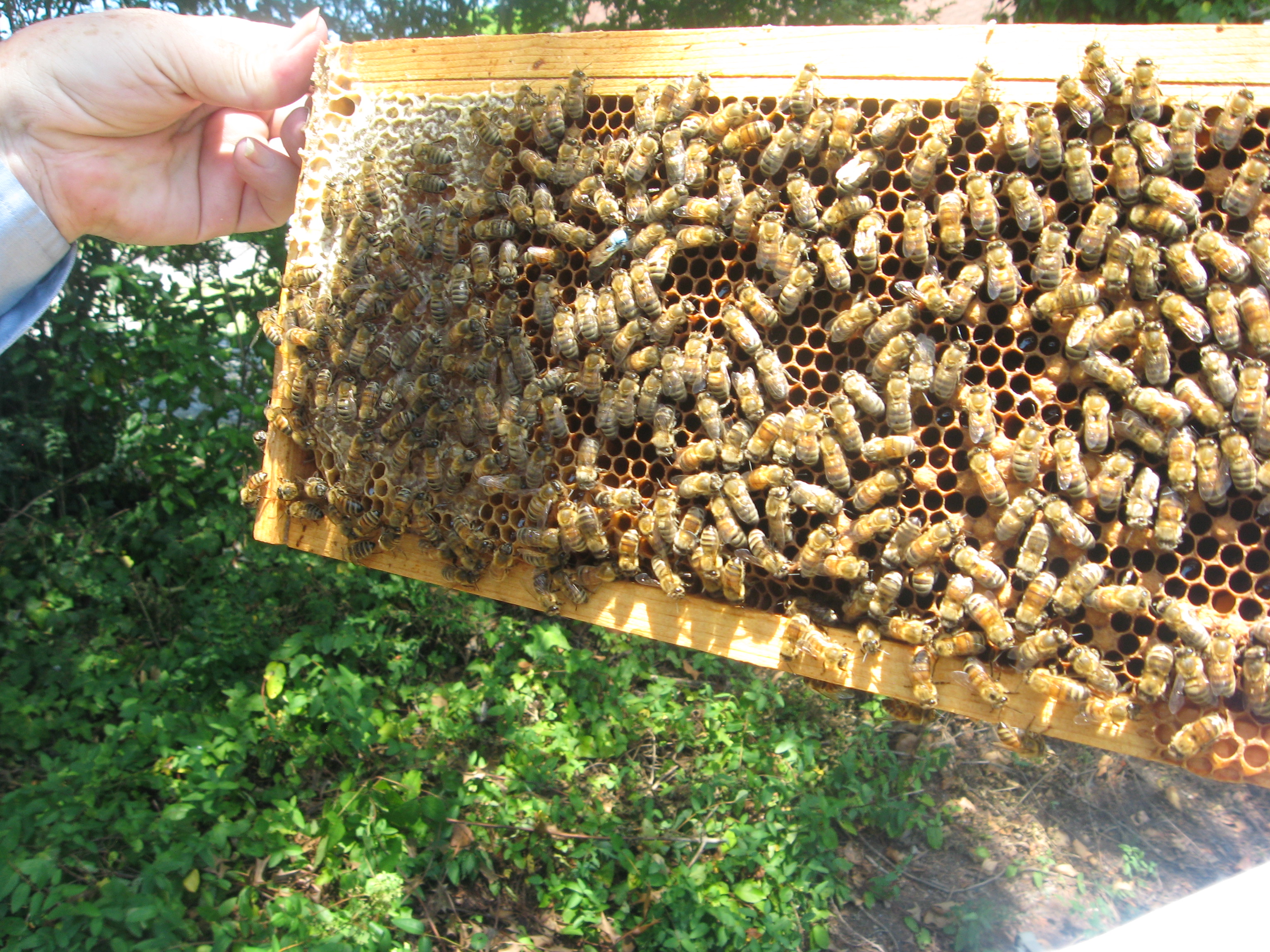
Langstroth fram with honey and beesToday, it all fell into place–sunny, warm, and the traffic to and from the hive was as usual.  No sign of alert bees buzzing all around the hive.

I had three boxes to inspect this time–and I came away glad that I decided to do all 8-frame mediums. Two of the boxes were heavy!  That’s not a complaint, just an observation; heavy is good. It means honey for the winter.  I didn’t have another OMG-so-many-bees reaction this time–I was expecting lots of bees.  That is what I found–but even more bees than I expected. Again, happiness.

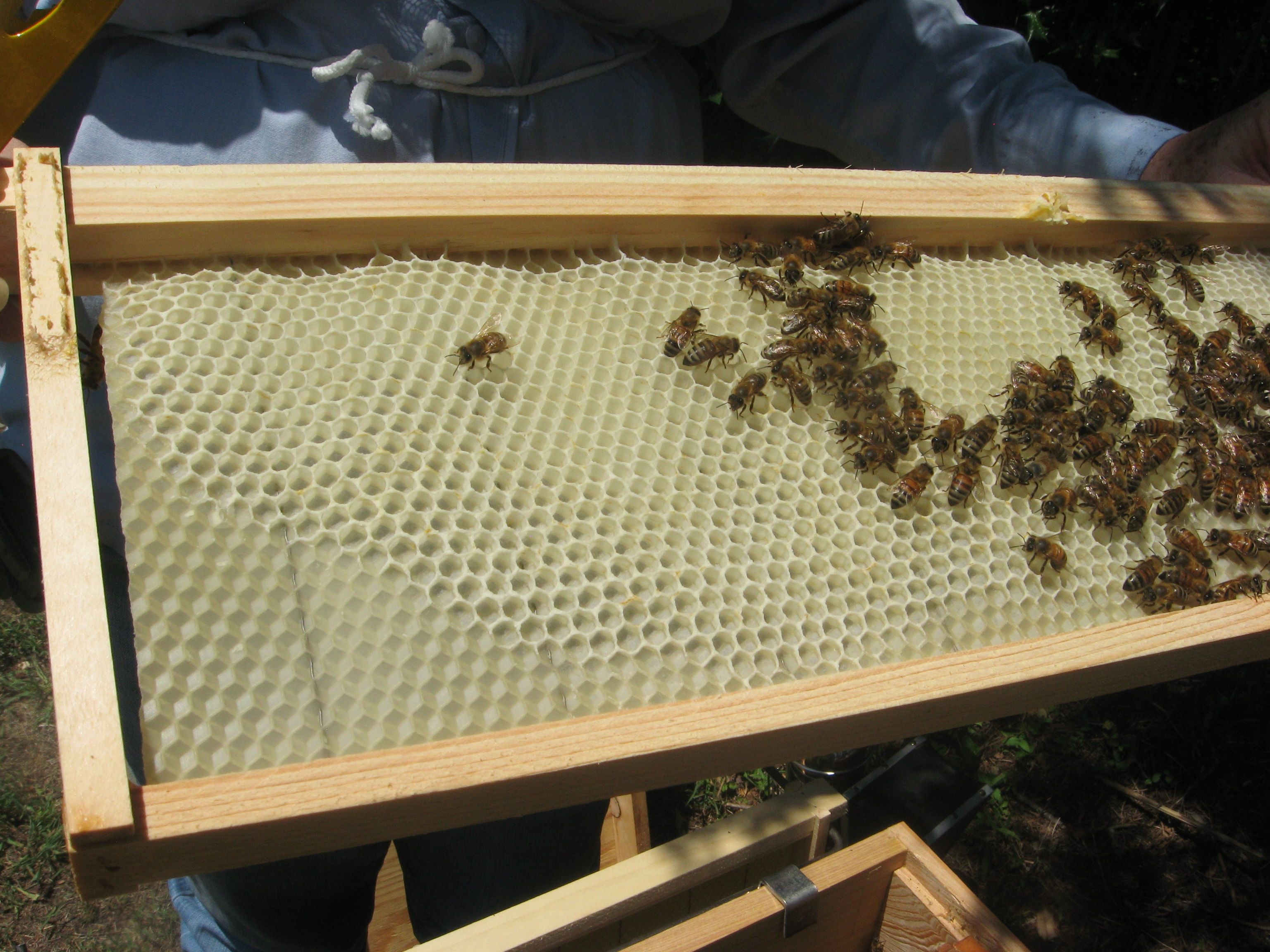
Despite the time and manipulation it takes to check each frame in three boxes/bodies, the girls handled it well–there were more Langstroth frame with capped honey and beesthan usual flying around us by the time I was putting the last frame back in the bottom box, but I call them alert, not aggressive. This time I had an extra set of hands so I got some pictures of some of the frames as I pulled them–I was hoping to see more detail on the frames.  Guess I need to work on another way to get pictures.

I’m pleased with how the hive looks (to my inexperienced eye); bees were working in the upper body–mostly drawing comb, but starting to see a little nectar and pollen there too; no brood.  I found brood in both the middle and the lower body.  I did place strips to treat for mites (Varroa destructor).  When I go back to take that out, I think I’m going to need to re-arrange some of the frames to consolidate the brood.  This inspection raised a lot of what-do-I-need-to-do-now questions.  I’m middle outerglad there’s a meeting of the Durham County Beekeepers Association soon–I should find some answers there.

I do hope that these ladies are doing as well as I think they are–It should be interesting to take the beekeeping course after a season (well, part of a season) with already having hands on experience. The online materials (e.g. Brushy Mountain Bee Farms webinars and videos) and blogs (Scientific Beekeeping.com, Tales from the Bee Hive, Bee Sweet Bee Farm, My Latin Notebook, and many more) have provided good information.  Conversations with Facebook friends and beekeeping groups have also helped through difficulties like the sugar syrup spill bringing hornets and yellowjackets, and found me a feeder that works so well!

5th middle outerÔ¿Ô

Today I got my first sting–even though for everything except installing the nuc, I’ve worked only wearing a veil. I know it would happen sooner or later…and it finally did. No big deal.

Hive 01 Oct. 2015

pollen-carrying bees

Go girls!

Frustration here–weather has kept me from opening the hive to see what’s happening in the upper medium box that I put on a few weeks ago.  Normally, I’d have done a routine inspection last weekend but opening hive in the rain is definitely a no-no–truly ticks off the girls.  Again today, too windy and chilly.  Given our weather forecast looks like I won’t be opening the hive until sometime next week. I’ll be out there checking on the first sunny day. My curiosity must wait a bit longer.

Switching to winter feeding with 2:1 sugar to water ratio. Looking ahead to colder weather getting some fondant to provide some food if needed in the colder weather, and adding a bit of insulation and moisture protection to the hive. Time to place a mouse guard, too.

I’ve done an assessment for Varroa destructor (mites) about 2 weeks ago with a stickyboard. There didn’t seem to be many mites. I’ll repeat that in the next few days to be sure that I don’t need to treat before winter.

Hive Inspection (30 August ’15)

IMG_20150329_133928244_HDROMG–there are SO many bees in there. OK, I was expecting more bees given the traffic in and out of the hive looking like a really busy airport! (The RDU Apiport?  Sorry, just had to throw that in.)

Reality  hit when I lifted the inner cover. On my last inspection (15 August), the second medium box was only very sparsely populated-the girls were starting to draw comb on the foundation in it. There weren’t any full-depth cells, and no nectar or pollen then either.

(We’ve progressed from the nucleus colony that had only five frames in one medium box (right), to needing three medium boxes now!  Happiness! I’m still learning what is supposed to be there, but the insides of the hive are beginning to look familiar.)

When I lifted off the upper box and set it aside so I could look at the frames in the lower box, I could tell that it was a lot heavier than on the last inspection. Good sign! Means the bees are stashing pollen and nectar.

When I looked in the lower box (where the nuc was installed) I could see empty cells, presumably where brood had hatched but had not yet been filled or reused. I didn’t find queen in the lower box, though everything looked good and hive_IMG_20150815_114521440_HDRthere were lots of bees down there.

When I replaced the upper box and started inspecting those frames, I found the queen, and eggs. (It is really hard to see eggs. Now I know why the books say it’s good to have bright sunlight when you’re looking for them.) It was cloudy this afternoon and that made finding eggs really difficult. But there they were, and the queen was moseying around doing her thing with lots of workers . They had started to draw comb on all except the two outer-most frames of this box. I went to do this inspection expecting to add a third medium body to the hive–and I’m glad I did.  There was brood (capped and uncapped) in the upper box now, and queen (I think she needs a name!) was laying eggs up there. I knew that the population was increasing, but I didn’t really realize how much until today when I could look inside the hive. (I’ve been incredibly curious the last two weeks–it’s hard not to look every week, but not good for the bees. It’s disruptive when someone starts yanking you home apart.)

Ò¿Ó

hiveI often go out  and watch them come and go–it’s hard to describe how relaxing it is to watch. Looking inside the hive is an awesome experience–realizing that each bee has a job, and all that activity is purposeful, not chaos. Working with the hive, with bees buzzing around you, maybe walking on your arms or hands, is like being off in another world.  Before my hands-on experience, I didn’t fully appreciate what other beekeepers were trying to describe about the experience of working a hive with bees all around you.

Ô¿Ô

 I have a feeder that uses four quart jars.  I wanted to be able to just switch out the nearly empty ones for filled ones, so I got quart four regular-mouth Ball/Mason jars.   I took new filled jars with me to do the inspection–after my experiences with spilled sugar syrup, there’s no way I’m going to work with it anywhere but over the kitchen sink.

When I put the hive back together, it turned out that those jars are just a tad taller than the jars that came with the feeder, so a medium super isn’t quite deep enough. Since the bees access the jars below and can’t get into the upper super, I just let the outer cover be a bit catawampus this evening.  First thing tomorrow morning I have to make a trip to Bailey Bee Supply tomorrow for a shim so that the cover will sit properly.

ÒυÓ

Friday hive news

honeybees at hive entranceAs you can see from the video FB post, there’s a lot of traffic in and out of the hive–fall nectar flow.  That kind of traffic makes for a happy beekeeper!  It’s so hard not to look into the hive more frequently than I should, but I’ll get to check what’s going on inside over the weekend.  Watching the activity from the outside makes me feel like I’m going to see that a lot of work has been done on the inside!  I hope that there’s enough pollen and nectar stored that I have to add another super so these girls will have lots of food for the winter.  Nectar must be good since they are not taking much of the sugar water–they know where the good stuff is.

Just a bit of frustration, though certainly not with the bees, but my telescoping cover seems a little cattywampus so I’ve got yellowjackets in the top super where the feeders are located.  BUT, they can neither get into the hive nor can the bees get into that super.  I need to find a solution to that.

(I also need to find a video converter so that I can post videos here–I’m so impressed with the traffic in and out–there’s no way to capture it on a still unless you’re very lucky.)

Ò¿Ó

Still Sticky, continued

We had some rain last night, but it seems that all it did was to make the spots where the sugar syrup spilled wet again, and get attention back to those.

Bald-faced hornets (BFH) and yellowjackets are still skulking around the hive.  I’ve put out traps–homemade ones–with soda for the yellowjackets and meat (tuna and chicken) for the BFHs.  At least this morning the BFHs were grabbing some of the yellowjackets and making off with them. There are lots of bees at the entrance apparently on guard duty.  Bees carrying in pollen are coming and going–though it seems their pollen baskets aren’t as stuffed as they were a few days ago and the pollen whitish-greenish!

A few yellowjackets have made it into my homemade traps, but so far no BFHs.

Stickiness sequelae

unknown bee-like visitorAnd in our continuing beekeeping saga is the sequel to stickiness. . . .still sticky!

The hive is fighting off invaders after the syrup spill.  I’d been hoping for rain, but that didn’t happen, so it was out there with the hose making like a rain goddess. All sorts of unfriendly creatures: bald-faced hornets and paper wasps I could identify without problems. Then there were (at least I hope I’ve gotten rid of some of them) others that are as yet unidentified (even with the Audubon guide). I’ve yet to do an internet search.

I think that others are yellow jackets–at least they were busy enough with the sugar syrup (dried on the hive) to mostly ignore me. The honey bees do have a fight on their hands right now, though it was looking much better after the second time I washed down the hive.   This is incredibly frustrating–I changed the style of feeder to avoid this exact thing, and then to have cropped invaders IMG_20150805_135640958even more syrup dumped onto the front of the hive and into the hive! (I’m not sure what I’ll do with the feeder that did the dump–maybe take it to the beekeepers meeting and see if anyone who already uses and likes it, wants it–I don’t think that I’ll try it again!

At left is one of my girls with one of the invaders. I really didn’t hang around to try to take pictures–I was busy with the hose. And some of the yellow jackets were just a bit PO’d about getting rained on.

These girls have really been slurping down the syrup, so I had to add more.  I went to the bee supply and got a second pail so that I didn’t have to keep the super where the feeder lives open long with all this activity of the invaders. I guess drawing all the comb and defending the hive takes a lot of energy. I’ve been reading some statistics on how far a honey bee will travel, and how many flowers she must visit to make a pound of honey, and how fast they can zip for flower to flower. Amazing creatures.

Ò¥Ó

I’ve just been out to the hive to take another look around. The girls are patrolling, but the entrance with the guards is quiet. Still a couple paper wasps around, but not on the hive or near the entrance. I really didn’t need this actual experience of  what a mess spilled syrup makes–I’m going to be taking a lot of precautions to see that it doesn’t happen again! I know it was stressful for the bees, but it was stressful, and distressing for me too!  I’ve noted that even with all this going on they were still quite gentle with me–I didn’t put on protective gear to work around the hive or to change the feeder. I think that they must have held their own pretty well since there were more of the opposition dead that my honey bees.

Since I put on the new box and frames last Friday, I may be looking in to see how things are going this coming Friday, depending on the weather.

And, to end–here is the nice quiet hive entrance after the washing down. That’s just normal coming and going.after washing progress IMG_8231

More–bees and me

beekeeper me

beekeeper me

An incredible experience today! All the beekeeping books I’ve read (a fair number by now) try to describe the experience of seeing a hive in action.  It’s likely to remain indescribable.  I certainly can’t begin to put it into words.

One week ago today I brought my nuc home and transferred the girls (probably a few guys as well) to their permanent home. It didn’t take long for me to discover that I needed to modify the protective clothing that I wore, so back to the bee store.

Today, I opened the hive to see what was happening inside. (Had friend to take some pictures, too.)  As you can see, I’ve opted for different attire–a much nicer experience for me. Still sweaty, but at least not dripping on my veil. The weather was cooperative–clear, sunny, low humidity (41% and 87 °F reported at the time I opened the hive).

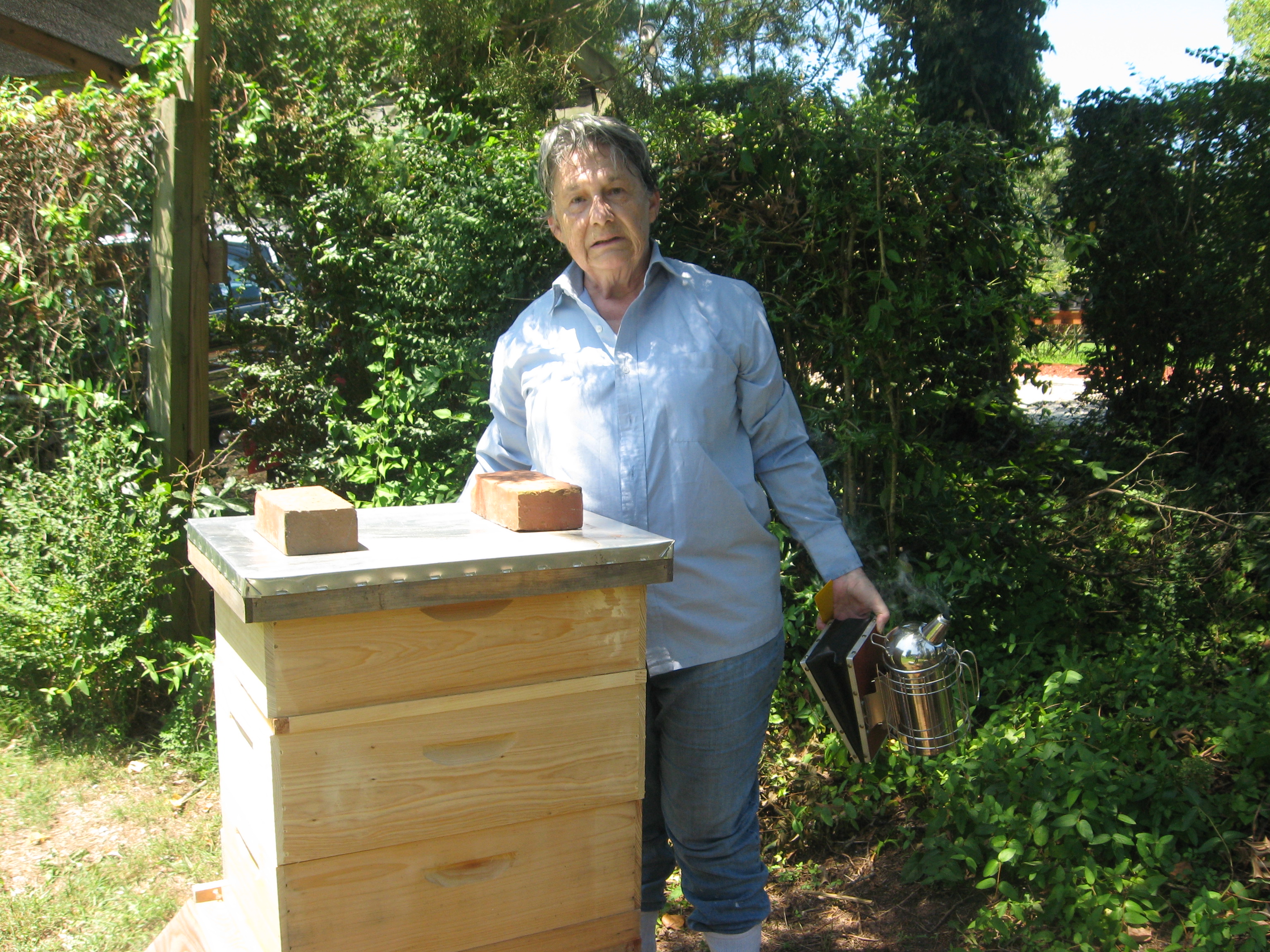
I did light a smoker and used it only for a couple of puffs to clear the Miller feeder before taking it off.  Last week I did the newspaper-pine needles-punk wood, routine.  This week I wussed out and simply used the cotton fiber fuel that you can by from the bee store–such a time-saver, and so much easier. This colony seems rather tolerant of me nosing around so I didn’t put on gloves. There was one point when I was just getting ready to start pulling the frames (after I had removed the first one) when there was an interesting line of bees, all side-by-side, wall-to-wall, in the cracks between the other frames–I definitely did feel I was being watched!  They got anther puff of smoke then–given that several of the books say that indicates need for a bit more smoke.  I really felt I needed them to move down so I could pull the frames without hurting anyone.

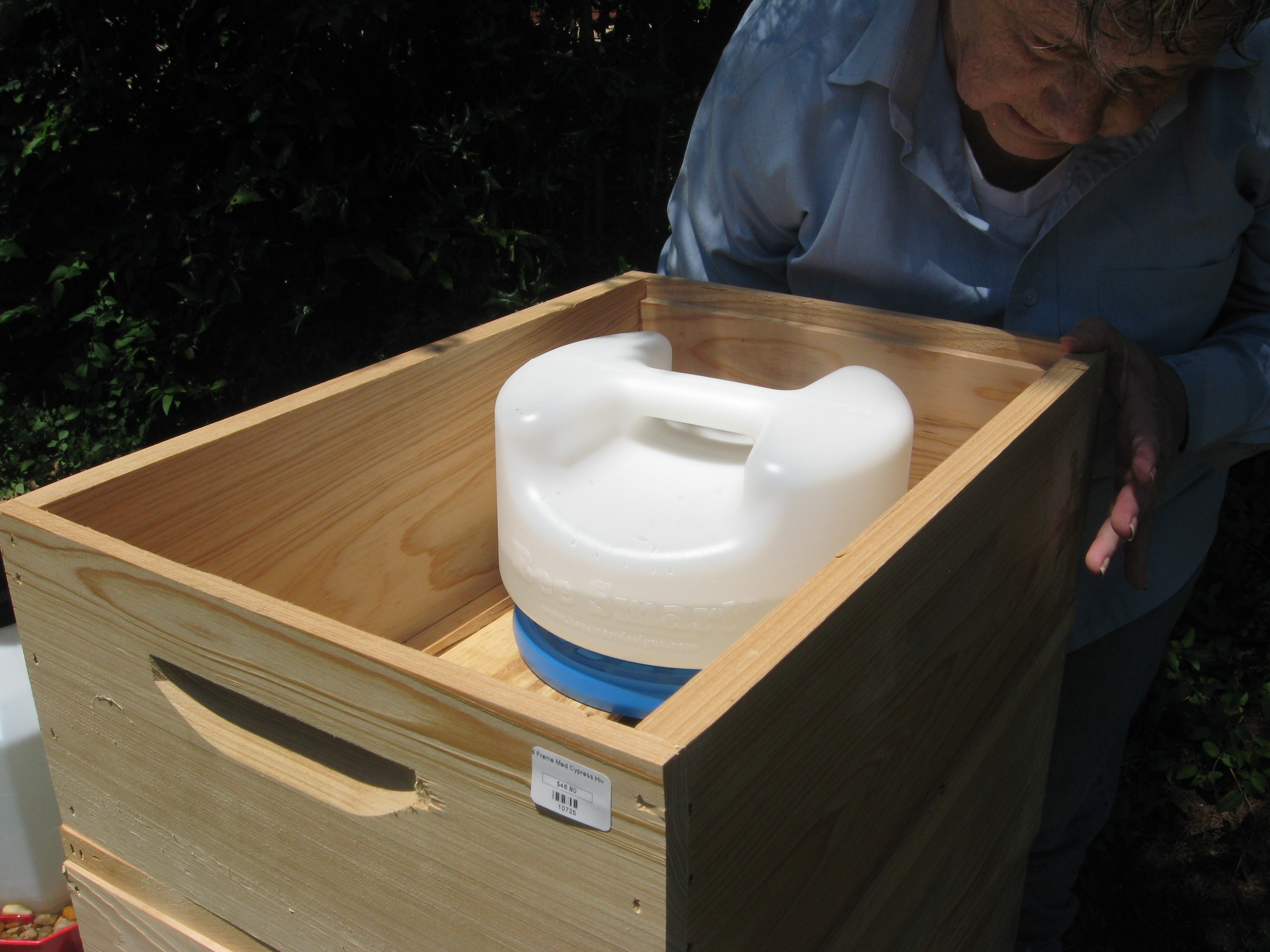
Because I’m going to be in and out of the hive about weekly with the new girls getting established and me learning, I switched from the Miller-type hive-top feeder to a Bee Smart feeder today. I tried out the Bee Smart in the kitchen sink before toting it out to the hive.  The  Bee Smart tray filled nicely and didn’t overflow.  Fingers crossed because that should be easier than moving the other one each time without slopping sugar water all over the place. After talking with other keepers, I did add Honey-B-Healthy to the feeder.

queen on frame

queen bee

To my very novice eye, things looked good in there. I did see eggs around where the queen was–they are really hard to see–I may add a magnifying lens to my “bee bag” with all the other goodies that accompany me to the hive.  I made sure that I did this inspection when the sun was out or I doubt I would have seen eggs. I didn’t see a lot of larvae though. Lots of capped cells. And bees crawling about everywhere….

On the left 1/3 of the frame, you see what looks like a white/light blue spot–that’s actually the queen bee (marked with the international standard color). She was moving around slowly on that frame.

Soooooo happy to see her in there doing her thing (yes, with effort I did see eggs) after my first adventure with her.  It seemed like every single cell was stuffed with nectar/sugar water/honey in all of the frames from the nuc. Surprised at how much heavier they were when I picked them up today, compared to what I remember from last week., (The hive was certainly heavier (after the feeder was off). With luck it will be heavier still next week.

newly drawn comb on new frame

newly drawn comb

They had started to draw the comb on the unused frames–so it seemed appropriate to add another box–certainly want them to have enough room to do their thing.

Now to wait another whole week to see what is happening in there–I really do want to peek sooner, but I’ll refrain, and just deal with the anticipation.

Since this was my first go at doing a frame inspection, I didn’t take my tablet or notebook computer out to use Hive Tracks live on the inspection, or for that matter even attempt to use my smart-telephone. That will be added next time. It was certainly wonderful to come in and have the weather entered at the time I started the inspection.  I liked the check-things-off approach.  I suspect that I got a more complete record than had I been handwriting or even making notes on the computer. Just reading over the inspection form before I actually even lit a smoker helped with organization–which I need badly as a brand new beekeeper!

holding frame

IMG_8204Ò¿Ó

OOPS!  Well, a bit of a mishap with the Bee Smart feeder–which may be with the beekeeper.  It’s good to read the instructions, but then you do have to follow them if you want something work as promised.  I put feeder in, but neglected to note that “the base can be rotated to adjust the syrup level; since most hives are not level make sure that the syrup stays. . . .”  So–some sugar water spilled onto the inner cover, and down the front of the hive. Didn’t run out all that much, and it did not douse the frames. But. . .it did not stop overflowing until I leveled it.  Slight movement while trying to adjust it lead to sloshing which lead to more syrup. After leveling it has (right now) quit overflowing.  There will be an early morning check on this for sure. Likely an internet search for an alternative just in case.  I’m looking for something that fits in a medium super rather than a deep (or two mediums). In my internet searching before I got the Bee Smart feeder, there did seem to be a split: love it or hate it.  I talked to users who loved it–I’ll have to wait and see.  I might want just a plain simple bucket feeder!

IMG_8203

For the bees (and me)

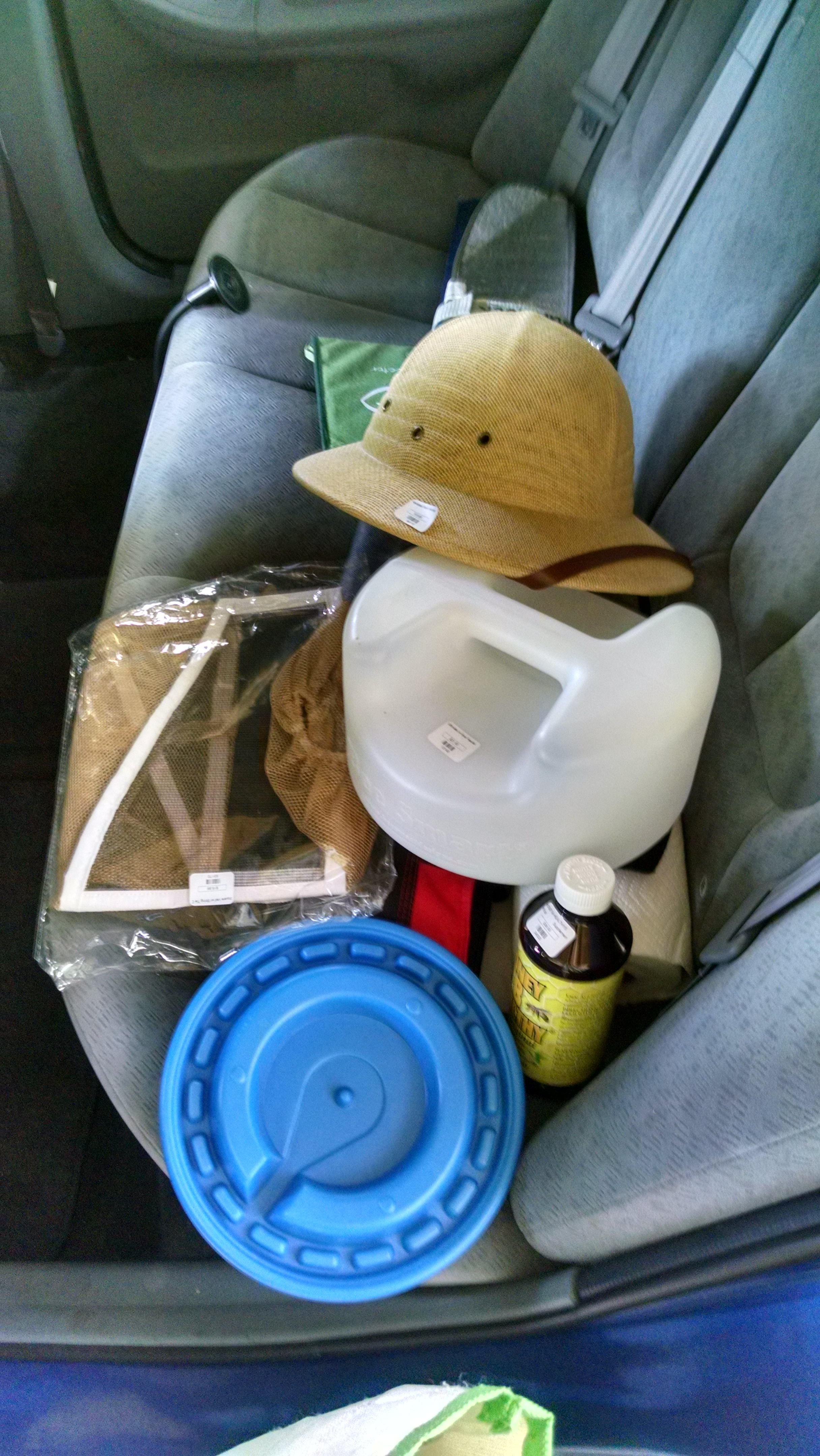
After my experience with the dome veil and jacket while I was putting the new bees into the hive, my mission for today was to get a veil that would allow a lot more ventilation. My last experience while in the jacket and veil was a bit like looking at the world through raindrops–not the best for clear vision, especially looking at little moving critters and trying to find one specific little moving critter that (thankfully) had a nice, bright blue dot on her thorax. So, off to Bailey Bee Supply this morning.

new equipment on car seat

new stuff

As is likely typical of most of us when we start a new project/hobby, gadgets and new equipment are totally fascinating and there is such a variety to check out. I suspect that beekeeping gadgets are going to be like kitchen gadgets and widgets–a lot of them better  in advertisement than in actual practice, but you never know, though chatting with other beekeepers certainly helps in choosing, or not. You find out all sorts of things that never appear in the “book learning” part of beekeeping.

For example, in discussions of hats and veils that I’ve read online and in books, nowhere did I find any mention of having a chin strap on the helmet. A friend mentioned, while chatting on FB, that she wished her helmet had a chin strap. I was about to settle for the basic plastic helmet, when my brain registered the fact that a helmet sitting right in front of me had a chin strap–quick change, and I have a helmet that is ventilated and has a chin strap to support a veil that will allow some air flow. That doesn’t mean I won’t drip while working outdoors, but it should help.

Obviously I came home from the bee store with more than just a helmet and veil–just like when I go skulk around the kitchen store.  I had a delightful chat with the lady in the bee store about pros and consult of various gadgetry and her experience–much greater than mine, gave me useful information and contributed to my purchases.

After opening the hive once, I discovered that the disadvantages frequently described for a this type of hive-top feeder  8 Frame Miller Top Feederwere very real. Biggest one for me right now is the difficulty in lifting it off the hive without slopping sugar syrup all over the place. Think about lifting a big, fairly shallow pan–like when you use a bain-marie in the oven–how the liquid shifts and threatens to slosh.  Well, slopping sugar syrup all over me, the bees, the hive, and surrounds is not something I want to deal with right now when I’m doing frequent inspections for my learning experience. SO, new feeder. (Given the good points of this style of hive-top feeder, I suspect that I’ll use it again when I’m not in and out of the hive so often because it’s large capacity is attractive–so it’s not a write-off.)

Despite reading some very contradictory reviews on forums–seemly a definite love-it or hate-it reactions–I got a Bee Smart in-hive feeder in-hive feeder. I’ve read the instructions, and  I’ve been checking it out over the kitchen sink with water. It seems a little touchy about getting the cover screwed back on, but as long as I pay attention to that (and I think my OCD-tendencies will kick in there), it seems to work. Since can go on the inner cover, it will certainly make opening the hive easier for me right now.

My only other purchase was some Honey-B-Healthy–an all-natural feeding stimulant for bees that is HONEY-B-HEALTHY® Supplement 16 ozreported to help with some of the problems that one encounters with bees–like  Nosema ceranae and some of the other really nasty things that can get your bees! It’s not advertised for that (I guess like off-label drug use in humans), but for those attempting to do without giving heavy-duty medications unless absolutely necessary, it has good reports from experienced beekeepers.  So, add a bottle of Honey-B-Healthy concentrate for the girls.
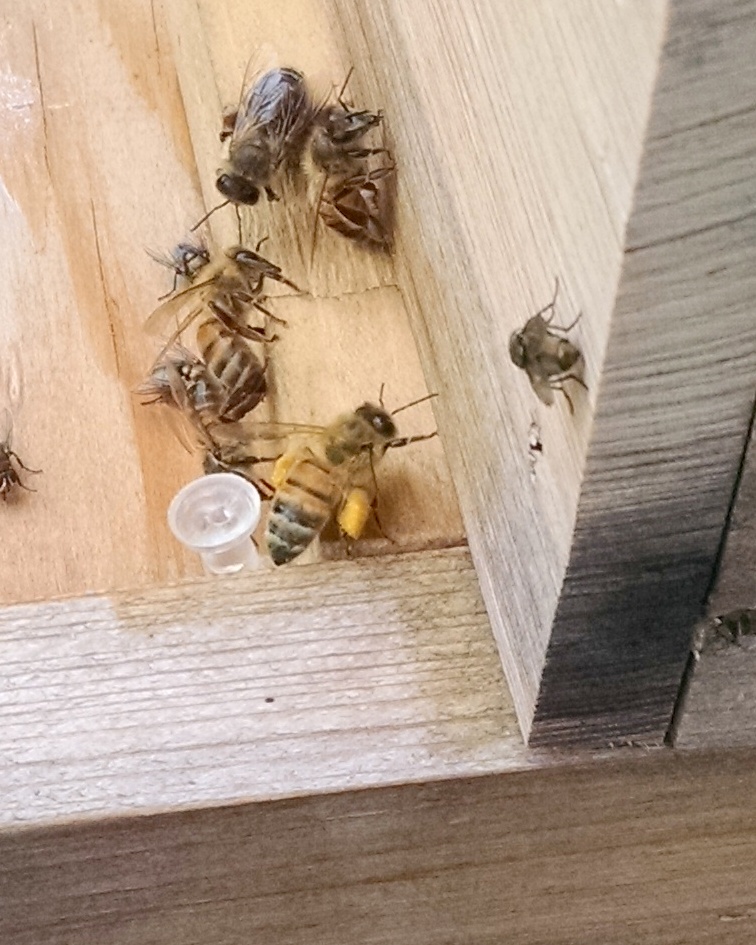
Now comes the sort of hard part–they are not due for a hive inspection until Friday–I have to content to watch them carrying pollen into the hive.

bee with full pollen baskets

pollen into the hive

pollen rainbow

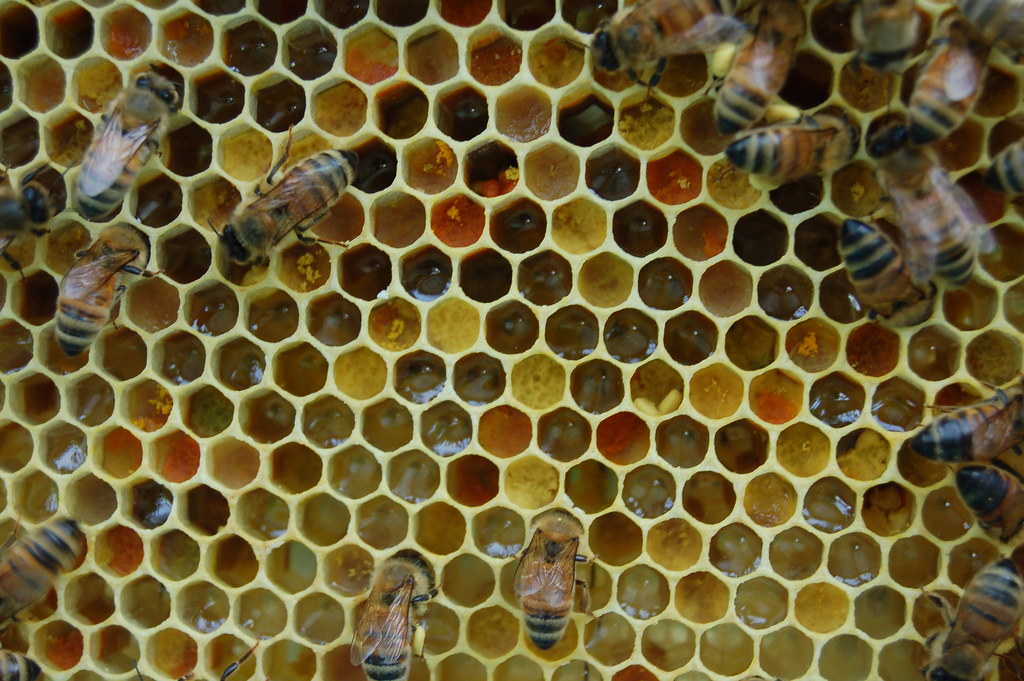
Watching the bees bring pollen into the hive, I saw mostly yellow but on looking at the frames I saw other colors–and so to Google–a veritable rainbow.

misterkrista's avatarkrista and jess

You really should click for a larger look.

And if you are a nerd (I know you are), click for the Wikipedia with a pollen color chart.

View original post