Hive inspection 29 Feb 2016

IMG_8958It’s a lovely, sunny (but slightly breezy) almost 70-degree day, fit for a hive inspection to do a recheck on the queen cells noted on the 21st and to go into the bottom body to assess brood. I was fortunate to have friends–aka “bee buddies” to lend extra hands and eyes. So there are a few pictures of the queen cells and (unfortunately) of the two varroa mites that we saw.

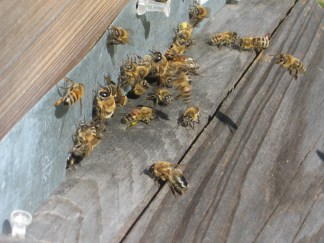
There is lots of activity in and out of the hive. It appears that the girls are finding pollen–a rainbow coming in ranging from cream, greenish-white, bright yellow, to deep golden yellow. The pollen baskets are better filled today. There were drones out and about today too.

Happily, the queen cells are still open and without egg or larvae–which makes me a happy beekeeper. Although there was some capped brood in the lower body, there is not enough capped brood to do a split, but lots of nectar and pollen stored.  I have to wonder if they were not slightly honey bound.

I did place a new super with wax foundation for the girls to expand into so that the queen has more room to lay–so that I can get enough brood to do a split in a month or so. It’s a relief to find those queen cells still vacant today.  I’ll be hoping that they are still vacant in a week because we have some more cold weather forecast.

The girls have demolished five pounds of fondant in the past week, and given the forecast, I guess I’ll need to supply more food for that period, but since we still have some nighttime temperatures hovering close to, or slightly below, freezing it seems a little premature to start syrup yet. Now the question is do I buy more fondant or do I try one of the techniques for feeding granulated sugar.

I got my first look at varroa mites–two of them–on one bee today. Even with the video of last week’s inspection and looking at lots more bees today we saw only two. It’s time for me to get out the sticky board and also to do a sugar roll to get a better idea of the mite population.


My fat cells and I

It’s amazing how easy it is to ignore what the scales, the mirror, the doctor, and clothes are telling you–until you get a look as others see you–a video of you going about your normal activity. As you watch, it’s more like watching another person, and you have a sudden OMG-it’s-really-true moment. You suddenly know that the time has come–that repeated New Year’s resolution that you’ve “renewed” umpteen times and not kept must finally be faced. (Hotel bathroom mirrors are almost as revealing–big, usually with door mirrors too so you get an all-around look in really bright light, too.)

You review all the experience that you’ve had with “diets”–the Atkins (worked like a charm but not sustainable because of the ban on fruit, beans, milk, and dairy products except cheese. The New Atkins–for the same reasons. You read the books evaluating low-carbohydrate and low-fat diets, high-protein, Mediterranean diet, and the French Paradox and feel like a real wuss because you’ve not been able to keep to the latest thing you’ve tried. You even check sites that have BMI computations available–everyone gives you the same answer: you’ve moved over from the overweight into the “obese” range. Then there’s the video–wonderful hive inspection but the beekeeper.

9781455533862I bought the latest diet book on the market–the day it was released–Always Hungry?.  I read it, and think about it, and then I saw myself in a video, And the jig is up! You know you’ve deluded yourself when looking in the mirror, looking at photographs, and feeling how your clothes fit.

So reread the book–really read the book (including the recipes and the meal plans). To add motivation, (since the book discusses movement) I’ve dug in the “junk” basket on the bookcase shelf, and in the drawer where stuff accumulates and, finally, found the pedometer. Now I have numbers to show how truly sedentary I truly am! Scary.

Back to this food plan. Refined sugars are a no=no, but that’s not a real problem because your sweet tooth is chocolate dependent. Soft drinks are not in the in this house fridge anyway. But there are pasta and beans on the pantry shelf. From experience I know I  like (maybe even love) complex carbohydrates, aka starches. Those and milk have been the stumbling blocks every time before–but this food plan allows legumes and milk even in the initial phase. There’s one ounce of dark chocolate allowed daily even in Phase 1. This “diet” for weight loss is a plan for moderation. Phases 2 and 3  (essential since you really, truly like food) allows judicious reintroduction of some of the things you most like (baked white potatoes), at least on an occasional basis and still maintain weight loss.

Since some basic sauces are essential for the food plan, I decided to start with some that would need routine weekly preparation and those that I thought I would like particularly well, to give me an idea of how things the recipes are seasoned.

After reviewing the list of permitted foods (again), this book moves to the kitchen. Trying some of the recipes since in the past food plans have always seemed too contrived. Well, the recipe for Blue Cheese Dressing (All Phases) on page 263 seems like a good place to start since it is a favorite. Can’t you eat the lettuce so you can have the blue cheese dressing? Recommended to make a wide-mouth mason jar (have) and immersion blender (have). The prep time estimate was accurate–really fast and easy.. (Since blue cheese is a strong flavor, I prefer more tartness, so I replaced the tablespoon of water with an additional tablespoon of lemon juice.  Tastes splendid so score one for the food plan Bring on the crudities. This sauce is a keeper even if it is on a food plan for weight loss!

So one tasty recipe doesn’t make it acceptable. I like (and make at home often) vinaigrettes and use oil and vinegar dressings. The Lemon Olive Oil Dressing (All Phases), page 269, is straightforward and a good balance of olive oil, lemon juice, salt, and pepper. If you make this in tandem with the blue cheese, you don’t have miscellaneous bits of leftover lemon.

[There’s a bonus to using mason jars–they have gradations on the sides so with just a bit of planning you won’t even have to wash a measuring cup. If you use a kitchen scale, you might not even need measuring spoons. (I’ve noted weights of things like 2 tablespoons of lemon juice with the recipes).]

Next  for testing,  I chose Creamy Dill Sauce (All Phases). This sauce is a bit more complicated than the first two but noted to keep for 1 to 2 weeks in the refrigerator. Again, using a mason jar and scales it was easy to put together.Knowing that I tend to find many recipes under-seasoned, and over-salted, I did use 2 small garlic cloves, substituted 1/4 teaspoon of smoked Spanish paprika for the “dash of paprika” called for in the recipe. I found it a bit lacking in the lemon flavor with only the lemon juice, so I added 1/2 teaspoon of lemon zest. After allowing it to stand for a few hours, I was pleased with the tart dill, lemon, and slightly smoky flavors. (This is easily modifiable without changing the balance of protein/fat–ancho chili or Aleppo pepper could be used.

The final sauce that I made to test was Lemon Tahini (All Phases), page 269. Taking my taste for garlic and tartness into account, I used a large clove of garlic, 2 tablespoons extra lemon juice, and 1 teaspoon of lemon zest.

My clean up after making these sauces (in very close to the prep time given in the book and with a little more experience and organization I’m sure I can decrease that):

  • one chef’s knife
  • one cutting board
  • one set of measuring spoons
  • one spatula for scraping down the side of jars
  • immersion blender
  • microplane grater (for lemon zest)
  • one citrus reamer

I can certainly deal with that. Leftover from this prep, one lemon minus zest (lack of organization on my part–next time I’ll just zest all the lemons before squeezing them)

I didn’t have to buy anything that wasn’t already in my pantry except dill and parsley, but since it’s winter, that’s not a negative thing. I’m certainly not going to have to rearrange my kitchen to accommodate, although the immersion blender will need to live somewhere slightly more accessible.

Sauces, as important as they are, don’t make a meal plan. The recipe for Broiled Fish with Garlic and Lemon (All Phases), page 232, looks like a good way to start testing the main dish recipes. It is simple, and besides, it’s very easy to cook fish, although I don’t use the broiler much–but this recipe works as well as those for the sauces. The serving of cod fillet that I cooked with this recipe was for one–so only about 6 ounces. In order not to overcook the fish, I seared on only one side and then finished under the broiler. . I broiled the fish for 8 minutes (the minimum time suggested in the recipe). Broiling it on the lemon slices with the olive oil and garlic worked: nicely garlicky and great lemon flavor. This is another keeper!

Three things that are called for frequently are mayonnaise and  Ranchero Sauce, page 272. I’m going to opt out of those since I can get a palatable mayonnaise made without sugar (that I usually buy anyway) and I have a favorite salsa that lacks sugar in the ingredient list.My local Harris Teeter grocery has a store brand hummus that is without sugar, so I’ll likely also opt to use that instead of making it at home.(There are resources on the  website  to facilitate the plan.)

Now that I have a feel for the seasoning used in these dishes I think I can use many of the recipes provided with the meal plan without having to alter my pantry much at all. After looking at other recipes, I find several that I am looking forward to trying: Ginger-Carrot Soup (All Phases), Red Lentil Soup (All Phases)Chocolate Sauce (All Phases), and Cabbage Casserole (All Phases). A lot of these recipes lend themselves easily to improvisation with herbs and spices, too–another plus for preventing boredom.

There’s only one “special” thing I have to buy–whey protein for the occasional Phase 1 Power Shake. Because of the stress on the balance of macronutrients emphasized in each phase, I will do that. (The thing sounds good when you consider what else is in it).

After rereading the permitted foods, I’ve decided I can do without pasta if I can have legumes and the prospect of adding some pasta and bread in later Phases 2 and 3. With my physician’s words bouncing around in my brain, and that horrible BMI, I CAN do this. It’s about moderation–and chocolate, whipped cream, and wine (after Phase 1) are allowed. It’s about moderation and balance of the amount and quality of protein, carbohydrate, and fats consumed. It’s also about not having to revamp my pantry or suffer deprivation.

This project has to involve getting off my butt and doing more walking and movement, too! That’s likely to take more effort than eating the right things, given how sedentary my work is. But, needs must!

Ò¿Ó

°

There is a lead-in phase where you get ready–for three of those days I’ll be on the road or at a convention, but once back home, this starts. No more procrastination!  After sampling the sauce recipes and the broiled fish, I certainly feel more positive about the meal plans that I ever have about any other weight-loss meal plan. (The blue cheese sauce added to egg salad is good–lots of room for improvisation with the recipes, still keeping the macronutrient balance.

I’ll admit to one slight frustration with this book: recipes are listed by name under an entry for “recipes”. Cabbage Casserole appears just where you’d expect it. Coleslaw you will find only if you look for “Tangy Coleslaw”. When trying to locate the recipe for the fish, I couldn’t remember the specific name–fortunately, broiled was in the title so it was close to the first of the list.

Though the main focus is not as a cookbook, but on nutrition and weight loss (index very useful for this), just a few simple entries throughout for main ingredients such as “cabbage”, “polenta”, or “shrimp” would be helpful. But, I shouldn’t complain–I know space considerations often dictate what can be included or what must be cut. I’d happily settle for smaller print in the index (even if it meant getting out my reading glasses) to have those extra entries.



Parmesan, Chive and Truffle Madeleines and a Paris Snapshot

Despite Paris being so close to London – three hours on the Eurostar – we had never been with big A and little Z. Mr B and I had been on numerous occasions in the past both for work and…

Source: Parmesan, Chive and Truffle Madeleines and a Paris Snapshot

Beekeeper Happiness

This was taken from the video that friends did while I was doing my inspection yesterday. It was wonderful to have the extra hands, as well as video–as well as good company. I think this is about as close to picture of happiness for a beekeeper as you can get.

RG Queen bee

(I haven’t seen the whole video yet–but I’m excited–and I gathered from comments of the videographer that you can also see eggs in the open cells around where the queen is. Nothing like finding that you’ve got a queen-right colony!

Hive inspection 21 Feb 2016

The temperature was in the upper 60s today so even though it was cloudy with a light breeze I opened the hive to see what my colony was actually doing. OMG–do I ever have lots of bees.

IMG_8956Yesterday and today there was a lot of activity in and out of the hive. Some of the bees seemed to be just flying around the hive. I wondered if this was orientation flights for “new” bees.
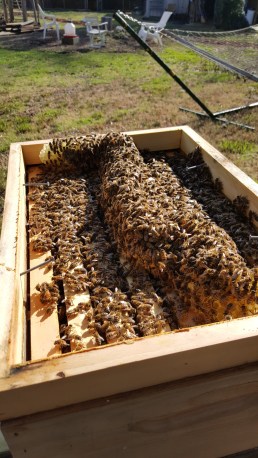
Friends, also beekeepers, came to help with the inspection and videoed the frames as I pulled them out for inspection. None of us could guess what we were likely to see when we opened the hive. Other beekeepers have reported colony loss and/or low populations coming out of winter, so I wasn’t expecting so many bees. My hive is set up with three medium bodies for brood and honey.

Since this is my first winter as a beekeeper, I wasn’t sure what to expect. From my las inspection, I knew that the girls and continued to draw comb all winter and to build some

20160116_135200

burr comb

impressive burr comb in a strip on the frames of the upper body in the space where the candy board was–before they ate it all. After removing the quilt box and the frame that used to have candy in it, the first task was to remove that burr comb. There was some capped brood and honey in this, but I removed it anyway. I was expecting the girls to get a bit testy when I did that but they didn’t.(I can still say that I have a very gentle colony.  I was able to do the entire inspection without gloves.)  ithWe did use the smoker more liberally than usual for me, simply because there were so many bees that I had to have them move down onto the frames before each was pulled out to look at the brood pattern, honey stores, pollen, and search for the queen.


We did use the smoker more liberally than usual for me, simply because there were so many bees that I had to have them move down onto the frames before each was pulled out to look at the brood pattern, honey stores, pollen, and search for the queen.

The bees have drawn more frames since my last inspection–even the outside frames in the second and third frames were being drawn out though in the second body they were not filled with honey. We were able to see brood in all stages of development. The queen was in the middle body–just trucking around doing her thing. The capped brood pattern looked good. There were capped drone cells, and drone pupae in the burr comb. We saw drones moving about on some of the frames–but probably not an excessive number given the overall population of the colony. I’ve seen drones flying, and the girls seeming to show some reluctance to let them return to the hive. Since it’s spring, they are raising drones so that they can go to drone congregation areas and mate with virgin queens.

As we pulled the frames from the middle body, I could look down onto the frames in the lower body–and I could see LOTS of bees there too. It seems that I have wall-to-wall bees in the hive. We found one queen cell, still open, at the bottom of one frame.

The hive is crowded so I anticipate making a split soon to prevent (I hope) swarming. I didn’t do that today as starting tomorrow the temperatures are supposed to drop back into the lower 50s (except for Wednesday when 65 °F is predicted. I didn’t think that there was enough stored honey to do a split today–though there are certainly enough bees.  Now it’s decision time–and time to consult an experienced beekeeper! Do I do a split, or do I add a super to this hive. (Thankfully, tomorrow is bee school so I have an opportunity to talk to experienced beekeepers.)

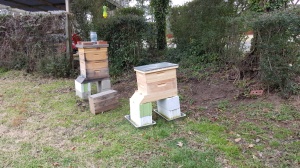
I’m sure I need to do something to provide more room for the colony or they will likely swarm. I set up another hive just on the basis of how many bees I saw last inspection and the amount of activity at the hive, but I was NOT expecting such a large population at this time of year.  But there is now a second hive waiting for occupancy!

20160202_134754

Ò¿Ô

This time, as I set up the hive I’m putting in ant defense–water trays around the concrete blocks.  I didn’t think to do that with the first hive so resorted to ground cinnamon sprinkled around the hive and cinnamon sticks tucked around the blocks. Next time I have the first hive down to the bottom board, I’ll put trays under those blocks as well.  Experience is a good teacher!

Now since I’ve graduated to two hives, I think I need to name them (#1 and #2 just don’t seem quite fitting for all those busy little creatures.) and I want need to be able to keep track of my queens (again, 2015 and 2016 just don’t seem appropriate either) so I’m contemplating names. I’ve had some possible suggestions from my FB posts (including Gryffindor and Slytherin) which dos suggests possibilities for naming queens as well.

Ò¿Ó

Braised lamb shanks

Continuing my freezer clean-out, I discovered two lovely lamb shanks that I must admit, I had forgotten were in there.  The weather that we’re having now just begs for comfort food, so I decided to make braised lamb shanks and the shanks beg for white beans to accompany them.

Starting with a recipe for braised lamb shanks and white beans that I knew worked well I still perused recipes from some other reputable sources (Williams-Sonoma, Food and Wine, and The New York Times). My lazy side came to the front and I decided that I wanted to do this all in one pot–so I went with the New York Times recipe–except I used thyme instead of rosemary and scaled the recipe for two lamb shanks.

Then I decided to follow a favorite principle of mine in cooking: never do on the stovetop what you can do in the oven (extremely hot weather will modify this). After bringing the pot to a simmer on the stovetop, I popped the pot into a 275°F oven for a few hours–low and slow since this is supper for tomorrow, likely with a grilled (well, broiled given the weather) cabbage wedge for a side.

Even for two shanks, this comes out to be a lot of food, so I’m looking forward to putting some into the freezer for another rainy day meal when I’m feeling indolent.

From hive to apiary?

hive added The bees are sending signals–they think it’s spring, no matter what the calendar says, or what the infamous groundhog says. (Happy groundhog day, all.) In reading about beekeeping you often find mentions of the varied opinions of different beekeepers–as 5 beekeepers and you will get at least 5 opinions. Well, in describing my hive situation to three master beekeepers I’ve gotten only one opinion: prepare for swarming.
Not being one to ignore what seems good advice, especially with the consensus.  I’ve set up another hive in preparation for  (but hoping to prevent)  the swarming. One hive is soon going to become two.  The bees may dictate that I’m going to do this split sooner rather than later! I won’t know until it’s warm enough to get a good look inside the hive to see if there are swarm cells, or not.

Right now I don’t know if there is another queen in the making in the main hive (I guess that’s hive #1–but I need to think of something more poetic). From some quick searching on the internet, it looks as if I may have not choice but to allow the girls to “make” their own queen for those that stay behind in the main hive.

Ò¿Ó

I keep mentioning candyboard (or candy board) but I don’t think I ever explained what it is and why I put one on the hive for winter.

sugar in mould for bees

candyboard

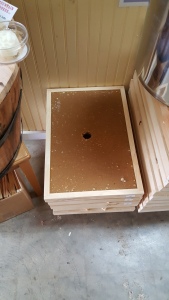
Bee candy is just about what you would make for yourself–sugar and water–cooked to a hardball stage then poured into a mould that fits on top of the hive so the bees can get to it for emergency food in cold weather. The bee candy likely has some additions that you’d not like–essentially vitamins, and pollen or pollen substitutes. The is a picture of a candyboard taken in Bailey Bee Supply store while I was there purchasing hive components for the second hive. This is hard candy.  (There’s a photograph of the candyboard that I put on my have after the bees had worked eaten some of it.)  They ate the whole thing! Much sooner than I expected. Now depending on the weather the bees will need more “emergency” food.

Another option for feeding during times when there is not an adequate nectar flow is fondant (soft candy). Since I’ve displayed absolutely no talent for making candy–ever–I chose to buy both the hard and the soft from bee suppliers. I’m going to try the fondant for feeding now until the nectar flow starts. I’ll have to make some other decisions about feeding when the split is made–all rather weather dependent, and bee dictated.

It is possible to feed bees table sugar in other ways. In warm weather, a 1:1 sugar and water syrup works well, or dry sugar in an emergency. (There’s more about my adventures with that in other posts.)

Now, off to the books to learn more about doing splits! These girls obviously didn’t read the book or look at the weather forecast.

Ô¿Ô

.

Zaphod

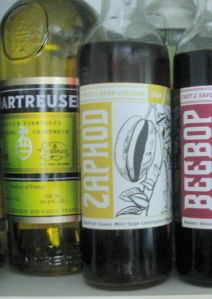
First, let me tell you that I’m not generally a fan of liqueurs, especially to be sipped on their own because most are syrupy and my first impression is simply of sweet. Now let me tell you that I’ve found some exceptions, starting with Krupnikas and then Zaphod liqueur bottleBeatnik–it really amazes I’ve now found five that I truly like on their own. Even sweetened with raw cane sugar, my first gustatory experience is not of sweet.

From the Brothers Vilgalys another great liqueur: Zaphod.  It’s a light liqueur (for sipping even in the summer) that is very complex–but not overwhelmingly any particular spice or botanical.  One of the things that I love about Krupnikas and these liqueurs is the complexity and the blending of all the flavors.

Sniffing the Zaphod suggests something clean, and bright. Taking a sip and holding it in your mouth the flavors begin to unfold. There is the brightness of lemon (lemon grass), the coolness of mint and sweetness of fruit. As the liqueur warms in your mouth you begin to sense the earthiness of sage, and finally a spicy, peppery feel.

The balance of Krupnikas and each of these liqueurs is impressive: they give a whole sequence of tastes–and have a very long finish. I can see this one with soda (seltzer water) or a very light sparkling wine for a summer beverage.  Another awesome liqueur.


Ò¿Ó

Because the scale never lies: Farro and Legumes Soup

I share those after-holiday feelings. I only discovered farro but considering how much I love legumes this looks just wonderful.

Francesca's avatarFlora's Table

Farro and legume soup Farro and legume soup

4 Servings

Hello everyone!

The Holiday season is behind us but our Christmas tree is still up and some of Santa’s presents (unwrapped) are still laying under the tree – mostly because they are so ugly I’m not quite sure what to do with them! 😜

Anyway, this year Santa decided to surprise me with something totally unexpected. Something you cannot really unwrap but you can see, feel and touch, something that makes your clothes feel tighter and tighter as the day goes by.

A magical gift? Not really! I’m rather talking about 5 pounds of sneaky and vicious fat spread out all over my body!

With my parents over for Christmas, I wholeheartedly embraced the holiday spirit by practically eating non-stop and using any excuse that came to mind to ask Stefano to pop a bottle of bubbly. Considering that my body is not exactly in its twenties and my metabolism gets slower as we speak…

View original post 838 more words

Hive check 01 Feb 2016

IMG_8902Feb hiveThe uncertainties of the new beekeeper. . . .
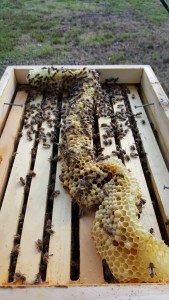
Since it’s warm, sunny today, I went out to check the hive. Bees are buzzing–including drones. There is pollen somewhere that the girls are bringing in. After seeing the traffic in and out of the hive, I decided to attack the burr comb problem after the temperature went up a bit more.

While waiting for the temperature to rise, I went to Honey Bee Suite to read about a camouflage bee suit, and spent most of the time reading about the experiences (from all over the country) of  unexpectedly large bee populations in the hives, considering the time of the year. That’s what my hive looks like as well–wall to wall bees with no sign of a cluster. Watching the traffic in and out showed pollen coming in and drones flying today.

Checking NOAA and Weather.com seems to suggest cooler than average temperatures in the southeast this spring, and wetter than normal–that suggests some time when foraging might be late or be sporadic. As I 20160116_134032gathered from Honey Bee Suite, since the girls have already wiped out the candyboard, the question now is to feed more sugar, or not to feed and hope the honey supplies are adequate for the rest of the winter. (As a new beekeeper, I’m not great at judging honey supply just from lifting the boxes–experience should change that.)

If I’m going to feed, I have to open the hive and remove all that extra burr comb that the bees in the space where my candyboard was, so that I can put in some emergency sugar for the rest of this winter.

(I have a plastic queen excluder to put on the bottom of this candyboard frame so that I can add more sugar or fondant (over waxed paper) where the candyboard was before. Next year’s candyboard will have more support underneath–like the queen excluder–than this one did so that it won’t collapse onto the frames.)

Ò¿Ó

This afternoon after the temperature had gone up,  I thought I’d be able to open the hive and remove this big batch of burr comb; however, it is windy today. At my hive location, I estimated the wind at about 15 mph (local weather showed up to 18 mph). My thoughts on opening the hive in that much wind were first, there is brood in the frames just under this burr comb, and second, that there is too much wind to use the smoker effectively (have tried that).

I discovered with a quick peek at one corner of the quilt box that there are bees all over that burr comb. My bit of experience with the smoker tells me that there’s no way I’m going to be able to smoke them down into the hive with the wind. Even when trying to puff smoke when lifting the quilt box a bit wasn’t successful–it just blew away. Even though I don’t smoke heavily for my inspections, I don’t think I could remove that comb without smoking. (The girls that were flying were paying a lot more attention to me than they usually do on a beautiful calm day though they were not aggressive, but then I was just looking and not doing anything like taking the roof off of their home.) I’d suspect that scraping that much burr comb is likely to attract their attention.

From my last inspection, I know that there is brood on the frames just under that big batch of burr comb, so I am concerned about heat loss and chilling that brood.   I’m going to have to scrape away that comb–and that means having the hive open longer than I’d think would be good for brood right under it.

The bottom line is that I wussed out and did not open the hive today and as the temperature drops I’m wondering (regretfully) if I should have done that little chore anyway. I did another “lift” and the hive feels heavy enough so that I think there’s likely enough honey for this next cool spell that’s coming. This uncertainty does mean that I’m going to have to attend to this problem soon!