
Another lamb and garbanzo bean stew

Yesterday was the day for a trip to the supermarket–as usual dictated not by coupons but by me being low enough on milk that I was not going to be able to make enough caffè latte to get me awake and doing what I needed to do today. As usual, I didn’t go with preconceived notions of what I might bring home to cook.

I got my milk and eggs–just not possible to be out of eggs, but I was–and did my usual troll past the butcher counter. I found a manager’s special that was simply too good to pass up: lamb stew meat at a great price. Since my agenda today was mostly minor chores I thought I’d have time to cook, so I came home with lamb stew meat and actually remembered to soak (in brine) the garbanzo beans last night. You’re probably thinking so what?

Well, it’s fall and that makes me want to cook hearty stuff and lamb stew just seemed to be a really good idea: economical, tasty, some to go in the freezer for quick meals, and some to eat now. Unfortunately, the weather is not really cooperating–my thermometer is showing 82ºF right now–but at least it’s cooler in the evenings now so stew is not completely amiss. Still, so what?  Right?

Well, as I started my morning caffeination by browsing Facebook I was informed that I had memories from two years ago. Now I’m still not convinced the FB really cares about my memories, but the top item on the list was my post about making–yep!–lamb and garbanzo bean stew in the oven. Well, same today: it’s unseasonably warm again, but not too humid, and it’s sunny and breezy today so it’s oven rather than slow-cooker version this time. Since I did forget to soak the Romertopf  ahead of time, I just pulled out the Dutch oven instead.

I did look for recipes last night but didn’t really find anything inspiring, so today’s lamb stew was a “kitchen happening”–let’s just see what turns out. That two-year-ago lamb stew was an oven version of a slow cooker recipe. This year, given the weather I decided that I’d (again) do oven braising. (The slow-cooker version was good, but no way as good as the one done in the oven.)  I haven’t looked back to see what went with that version–all I really remember is that I used canned beans that time.

Oven-braised lamb and garbanzo stew (2016)

Ingredients

(I’m not giving much in the way of measurements here since this was a “kitchen happening”)

  • Lamb stew meat (about 3 pounds with some bones included)
  • Garbanzo beans (brined over-night)
  • Lots of onions (cheated and used frozen chopped ones)
  • Bay leaves–2 large
  • Salt about 1-1/2 teaspoons, give or take–will taste later
  • French thyme (dried)
  • Marjoram (dried)
  • Garlic powder (Oops–not a single head of garlic in the house!)
  • One 14-ounce can of diced tomatoes–drat, out of fire-roasted ones.
  • Smoked Spanish paprika
  • Olive oil as needed for browning lamb

Preparation

  • Brown stew meat (bones included; they will make good stock as the beans and lamb cook ).The bones are big enough to get out easily when the stew is done. Add to Dutch oven.
  • Saute onions until just golden, and add to Dutch oven with meat, beans, and tomatoes
  • Deglaze skillet with water and add to braising pot
  • Add  salt, herbs, and spices.
  • Bring to a simmer on the stove-top
  • Place in a 185ºF oven  and cook until beans and meat are tender–about 3 hours.

Ò¿Ó

Here I was, again, making this lovely stew in unseasonably warm weather but still cool enough to use the oven rather than the slow-cooker. Cooking my own garbanzo beans was well worth the thought and bit of effort that it took to soak them. Brining them seems to make them cook much more quickly. Leaving the bones in with the meat really gave a lot of lamb flavor–worth the effort of taking them out after the meat was done.

I love this combination of lamb and garbanzo beans–it seems that I’ve used different seasonings almost every time this “happens” in my kitchen, but it’s good every time! No recipe needed just season as you like…a son gôut!


Hive report: Taking down a hive

20161017_124359Taking down a hive in the midst of robbing is not fun! I finally got everything except one hive body and two frames in and stored before I became a total wimp. The more I took away, the more the bees buzzed (definitely buzz, not hum) aggressively around what was left there–and the farther they followed me with my load of supers and frames. The followed me all the way back to the screened door of my deck even with the frames shaken and brushed before they were put into a closed plastic bin–The one you see in the photograph.
Despite vigorous shaking, thumping, and brushing I still got a few bees onto the back porch where I was bagging the supers and frames so the doors are closed (and Frankie can’t go out so he is having a bad hair day).

When I finally wussed out about those last frames, no amount of shaking, bumping, or brushing was getting them remotely clear of bees–being the wimp that I am I gave up on that and decided that those could simply stay outside until the bees had cleaned all the honey from them because when I got to the screen door to go inside I realized that I had a LOT of bees on me. Despite all the bees following me, I had to take off the bee suit outside. I did that quickly and dashed inside and closed the screen door on  them.

As I started to write I heard least one honey bee that has been carried into the house buzzing frantically at the office window. (I actually found two.) The old cup-and-paper trick works pretty well. If you’re really persistent you can get more than one bee in the cup at a time. There are still a bunch on the back porch–too many for that trick.

All the supers and frames are now sealed up so that honey bees can’t get to them. so they are congregating in the sunshine on the screen, trying to get out. I’m not quite sure how I’m going to address this issue–except sweep up the dead bees tomorrow–or whenever–since these are not going to be house pets and there are too many to catch and put back outside. There are also honey bees outside the screened back porch trying to get in. I hope those ladies will depart and not come back tomorrow.

 Õ¿Õ

My big mistake on this whole process was sleeping through my alarm–this would have been much easier much earlier while it was cooler very early in the morning. Since I wussed out on those last frames and body, I guess I’ll make sure I don’t oversleep in the morning and finish the job.

There didn’t seem to be much robbing going on at Salvia yet. I have to wonder if those “foreign” bees will switch their attention to Salvia when there is less for them to attend to at what was Rosmarinus. There was no way to get a robbing screen on this morning after my sleep-in–that was another thing I had intended to do. I’ve got the entrance reduced and it is still a strong colony. Fingers crossed–and up much earlier tomorrow morning!


Hive report: Happiness is…

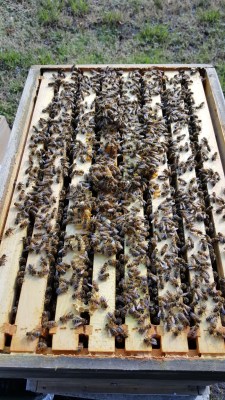
20160116_134424I just finished inspecting hive Salvia with a fellow beekeeper; it looks as if the re-queening was successful. Though we didn’t actually lay eyes on the queen–and we both have trouble seeing eggs–we did see larvae this morning.

Depending on the weather, I may peek into the hive again in ten days or so to see how the ladies are doing, but for now I just happy to have seen little shiny white larvae in the hive. Right we both think that there are good honey and pollen stores for the winter in Salvia.

First on the agenda for tomorrow is to dismantle hive Rosmarinus to see if there is honey that can be salvaged. But for today, a very happy beekeeper!


Hive report: Requiem for a colony

IMG_8426As I approached the hives today to check on the release of the queens, it was obvious even to a novice like me that all was not well with Rosmarinus–bees all around the hive at every crack or join between the supers and under the screened bottom board as well. It looked like robbing going on but without any defense at the hive entrance. Ominous!

When I opened the hive there were very few bees that appeared to be doing the normal bee things that you would expect of the ladies in residence and some webby stuff right under the inner cover. Very few bees doing normal things. As I looked deeper into the hive I saw that the queen had not been released–was dead with attendants in the shipping cage.

There was an obvious problem–slimy looking stuff on the surface of the comb, more of the web-like stuff between frames. Small hive beetles had taken over quickly as the colony weakened even as I attempted to re-queen it.

In retrospect, it’s obvious that I should have put beetle traps in this hive when I first saw that the population was down. Lesson learned–hindsight is so good!  It’s amazing how fast SHB can take over once the population is declining (a lesson I’d really rather have done without–but definitely a learning experience).  This hive was opened twice since queen installation on 06 October 2016–and today–disaster. I would guess that an experienced beekeeper would have seen signs that I missed.

My mission today was to see if the queens had been released so, although with some reservations about the (probable) robbing activity going on from Rosmarinus, I started to open the Salvia colony. No sooner had I removed the telescoping cover and popped the inner cover than I had bees moving from around Rosmarinus to Salvia with fighting taking place on the inner cover. Discretion took over–I smoked and brushed the bees from the inner cover and immediately replaced the outer cover. With foreign bees around the hive I IMG_20150329_133928244_HDRstarted seeing some fighting on the landing board as well, so I put in an entrance reducer. The population of Salvia is good so I think (hope) they can defend the hive now.
I don’t know if that queen has been released–I thought it best not to continue to open the hive with the robbing activity. I’ll try again tomorrow and hope I find better results in this hive.


Hive report: new queen bees

With Matthew approaching NC–or not so much–I’m still relieved to have the new queens tucked into the hives. This was not an experience that I really, really wanted right queens_frankie_20161006_124957now, but it was just thrust upon me.

As noted on my inspection on the 3rd of the month, I found both hives to be queenless–for unknown reasons. I suppose it was a little consolation to know that a couple other beekeepers in the area had found the same thing. The big question for me was what to do. While some beekeepers seem to swear by re-queening hives in the fall I thought this was a bit late to be a really good time to put in new queens. But not to do that was to condemn both hives. Not what a beekeeper likes to do.

After deliberation and contemplation, I called my local bee store (Bailey Bee Supply) to see if they still had queens. No such luck although I wasn’t surprised–as I said I don’t think beekeepers are doing much “re-queening” at this time of year unless it’s a necessity. Without local queens, I ordered two new queens from Rossman Apiaries (recommended by my local bee store).

The day started cool and sunny and my box of bees arrived late morning. So far so good. I lit the smoker (and it actually did stay lit for even longer than necessary) and headed for the hives with my little white box.

The ladies of the hive Rosmarinus were not particularly pleased to have me tearing off the roof, ripping up the ceiling, and generally messing about especially as this entailed as much shifting of brood boxes and supers to be sure I put the new queen in the optimal locations. While I was moving everything about I did all the shuffling necessary for preparing the hives for winter. (Note optimism here–I’m hoping this is successful and I’ll have this hive next spring.)  The new queen in her little cage with attendants was inserted between two frames in what I hope will be a brood box.

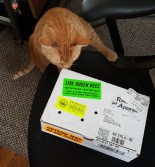
20161006_125908If you’re wondering–the queen bees are put into the hive in the cage to protect her until the workers of the hive accept her as the queen. Bees are not necessarily kind so the queen and the colony need to get used to each other–you can’t just pop a new queen into a colony of thousands of worker bees or she is likely to be killed. The white that you see at one of the queen cages is candy (sugar). Yep, sweet stuff that bees will eat. The worker bees of the hive will gradually eat away the candy  to expose an opening through which the queen can emerge into the hive and (I hope) do her thing! That whole process will take several days and during that time she will be secreting “queen pheromone” and (with luck) the hive will adopt her and take good care of her–and continue getting ready for winter.

This same process was repeated with hive Salvia–but by this time it was overcast, breezier–not prime time to skulk amongst the ladies.  These ladies were just a tad bit testier than usual but their hive is now also shuffled for winter as well as having a new queen “installed”. Makes her sound a bit like software, doesn’t it?

Now my anxious waiting starts–to see if the ladies of the hive and the new queens accept each other.  The waiting is not going to be easy–I’m anxious and curious because this will make the difference in having bees and not having bees.

Now battening down the hatches and hives. Although it looks as if Matthew may miss us it still looks as if we are in for rain for the next several days. I’m much relieved that the new queen bees are in the hives–those little travel cages were not meant for long-term residence.


Pork confit


Cool weather inspires cooking! Something warm and cozy–confit as a “pantry” staple for a starting point for multiple dishes. With the weather a bit up in the air I decided to make something that would give me lots of possibilities even if Matthew decides to visit.

Confit was originally made as a method of preserving meat–often duck or goose, but it’s a method that can be applied to other meats, fish, and seafood–e.g. tuna which I love for summer salads and cold meals but it’s a great starting place for cool-weather meals too. The traditional method is to poach meat in fat (oil) at low temperatures which yields meat that is intense in flavor, and absolutely luscious in texture. If you’re wondering, it’s NOT greasy! The Science of Cooking addresses many of the questions often asked about confit.

With cool weather here I decided to opt for my favorite meat–pork–and to try a slightly different method of achieving the end results. This inspiration sprang from finding country-style spare ribs on special at my local Harris Teeter market. Since the weather wasn’t quite cool enough for me to want to have the oven on for hours, I decided to use the my multi-function pot in slow-cooking mode to make pork confit.

packaged pork from the meat counter in the supermarket

Since country-style spare ribs have a lot of fat on them I decided that I didn’t need to submerge them in oil–the fat would render from them as they cooked in the slow-cooker. From experiments when I was trying to do monk fish sous vide, I knew that the slow-cooker mode would keep the temperature at 185ºF. Most confit recipes suggest temperatures between about 190ºF and 200ºF. I thought 185ºF would be workable (especially since the confit will be refrigerated after cooking) but will be covered with the rendered pork fat.

I took my country-style spare ribs and salted them liberally over night–e.g. “dry brine”, then rinsed, and patted them dry. Because of the fattiness of this cut, I added only a couple s tablespoons of olive oil in the bottom of the cooker and packed in the meat. I didn’t add seasoning other than the previous salting so I have a flavorful (but kind of “blank” canvas) to build other dishes. I set the cooker for eight hours and went on to do other things–like hive inspections.

The liquid which (intensely flavored broth/gelatin) was separated from the fat that was rendered and will ultimately make its way into soup or as “au jus” with the confit. The meat is now tucked away in the fridge sealed in the fat. Since this was originally a method of preserving meat, now with the addition of refrigeration, there is a long shelf-life if you separate the broth/gelatin liquid from the fat and then “seal” the meat in the fat. Old method, but useful in modern cooking.

This cooking method works with any meat–a favorite in this household is confit made with chicken (especially leg quarters or thighs). I think that this fall as “turkey” season rolls around I will try to find thighs to cook this way. It might improve my attitude toward turkey given the flavor and texture changes that result from the confit process.

The result? Absolutely as good as if I had done it in the oven though requiring less added fat than I would have added for that method.  Enough fat rendered to submerge the meat about three-quarters of the way up the sides. Even without additional seasonings the meat is luscious immediately after cooking–pure unadulterated pork flavor.

What’s on the menu for supper? Well, I’m thinking cabbage steak (done under the broiler) with pork confit that has been quickly reheated and browned (also under the broiler) but with the tahini sauce replaced with the juice from the confit process.

Ô¿Ô

Krups rice cooker IMG_3796

.


Hive inspection: 03 October 2016

Lovely fall day, a mere 79 degrees–until you put on the bee jacket. Then I start dripping. Sweat drops on a bee veil make it really interesting to work. I did have on a sweat band, but…!

Not a happy inspection this afternoon. Hive Rosmarinus is queenless–no brood period. Nada, zip, zilch, nothing. No eggs, no larvae, no capped brood. Likewise, no dead bees, or beetles, and only two queen cups. Population about 50% of expected.

On opening hive Salvia, at least I found a lot of bees. All very busy, and signs of pollen and honey stores. But not good here either–very spotty capped brood, but no larvae, or eggs. Salvia has (or perhaps I should say had) a marked queen (second year for her) but I could not find that lovely blue spot. Given that there is only spotty capped brood I suspect that Salvia is queenless too. Not a happy thing to find at this time of the year.

I guess it’s time to talk to some beekeepers more experienced than I am–and maybe a trip to the bee store for two new queens!