Unknown's avatar

About sa.fifer

Lover of good, wholesome food and wine. Cooks for one and the cat. Likes to paint-- a frustrated botanical illustrator and amateur (photographer) and fledgling birdwatcher, beekeeper, and Kindle addict. Works as a freelance indexer.

A strange coincidence this afternoon

I truly love technology, especially when it lets me find marvelous things. If you’ve been here before, you’ll note the change of format. Well, it’s entailed a LOT of editing, link checking, replacing photographs that somehow disappeared in the switch.  So, I’m likely a little squirrely side. (Frankie would probably flat-out bitchy since the last time he walked across the keyboard.) I was just editing a blog post on Roast Duck with Fresh Fig Sauce, thinking that since it’s summertime, there will be figs. . . .

My email popped up notification of a  “like”  from a blog that I just discovered and started following.   From Alfred’s with Love.  WordPress put this one up on my list of recommended blogs yesterday, and I went to check it out.  I liked, I followed.Thank you, WordPress!

I’m seriously addicted to good writing about food, eating, dining, or even just the occasional graze, or an excellent sandwich (See Bibliography page).  As usual, the WordPress email included some links–Sea Bass and eat it caught my eye, and I was just roaming around. Perhaps because I had just been looking at duck on my blog I pulled down the recipe index and clicked on duck.

What I found first was Duck à l’epoisses. Epoisses is one of my two favorite cheeses (the other being Brin d’Amour or Fleur de Maquis).  I’d never thought of combining it with duck until I saw this recipe, and it’s left me drooling on my keyboard, even if it is so hot right now that I’d not want duck for dinner. This is a keeper of a recipe–come some cooler days and I’ll be looking for Epoisses cheese to try this (unfortunately it’s not one that I can just walk into the cheese shop and get here in Durham).

You’ve got the links here; you really should go check out this blog because there delightful reading, and some great anticipation with the recipes.

Stickiness

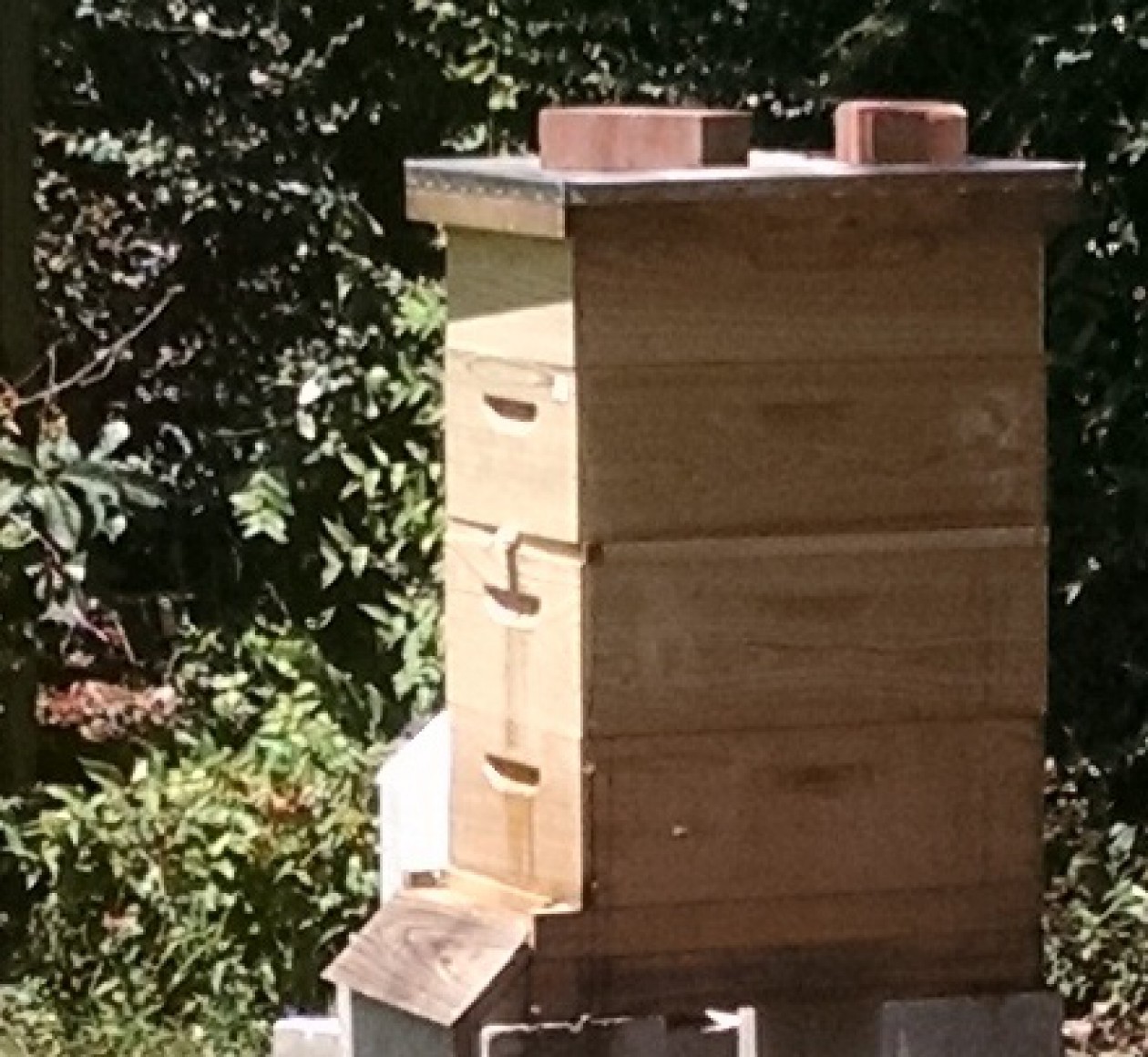
cropped-crop_img_20150801_130019171.jpgI told you in an earlier post that I changed to a different type of feeder when I inspected the colony yesterday.  Well, I’ve now changed feeders again as of this morning. It’s turning into a  “feeder saga”.      I started with a Miller hive top feeder–from reading that seemed like it would be what I wanted. My only objection to it is that as a learning beekeeper with a new colony, I have to do almost-weekly inspections to make sure things are going well in the hive. The issue is that at times I can be a veritable Klutz (the capitalization is intentional–I can take klutziness to a special level without even trying just in the kitchen with a bain-marie)–the good side of that is that at least the sugar syrup (1:1 sugar to water) is not hot. All the good and bad things I’ve read about this style of feeder seem to be true, so obviously I’m not having a novel experience here, and I suspect that I’ll return to this style of feeder once this colony is established and I’m more familiar with beekeeping.

However, I did decide to try to make my life a little easier (so I thought) by changing to a feeder that would be easier to put on and take off for inspections. I went to Bailey Bee Supply, my local bee store, intending to purchase a simple pail feeder.  What I discovered was that the pail was too tall to fit into an empty medium super. Since I didn’t have a deep (and truly didn’t want one since all my equipment was medium 8-frame) I decided to try a different style of in-hive feeder.

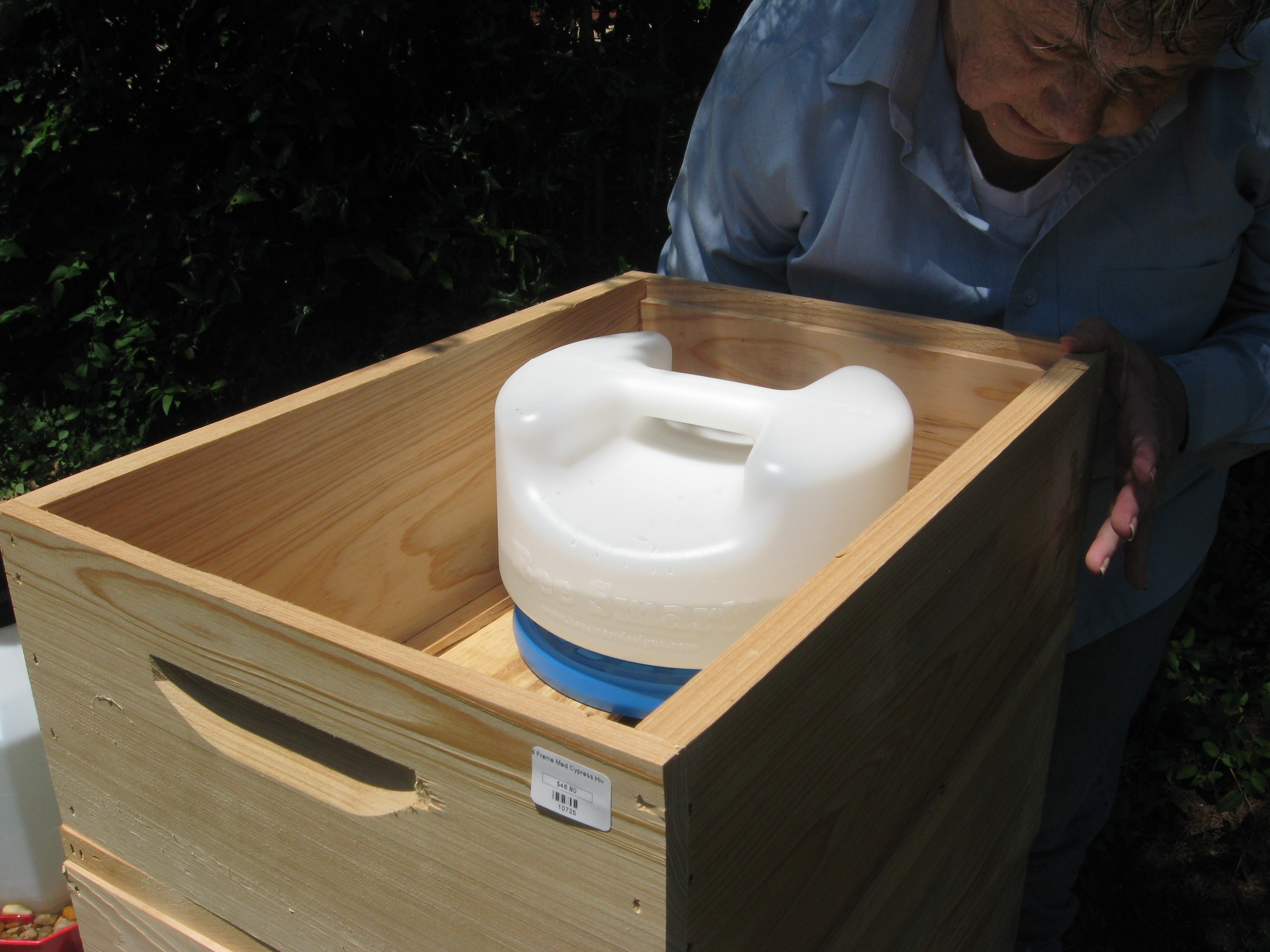
Bee smart feederAfter the inspection yesterday, I put the new feeder into the empty medium super.  There was a minor mishap–which I thought was beekeeper, not feeder.   About an hour later I went back to check and there was syrup running down the front of the hive. This is not a good thing, since it attracts other nectar-drinking insects as well as MY Apis mellifera.

I got in there and made some adjustments and finally managed to get the syrup to stop overflowing by leveling the feeder and tray; closed things back up and went about my evening’s activities. (I did get the Miller feeder off yesterday without sloshing syrup everywhere so the wetness on the front of the hive here is not a result of my klutziness. No matter why its there its not a good thing to see.)

This morning I checked on the food–the feeder was empty–meaning that one-half gallon of sugar syrup had been “dumped” during the night.,  This was not a happy thought but all was quiet around the hive.  I took the empty feeder away and made a bee-line (sorry–that pun is unintentional, but I’m leaving it there) for the bee store again.

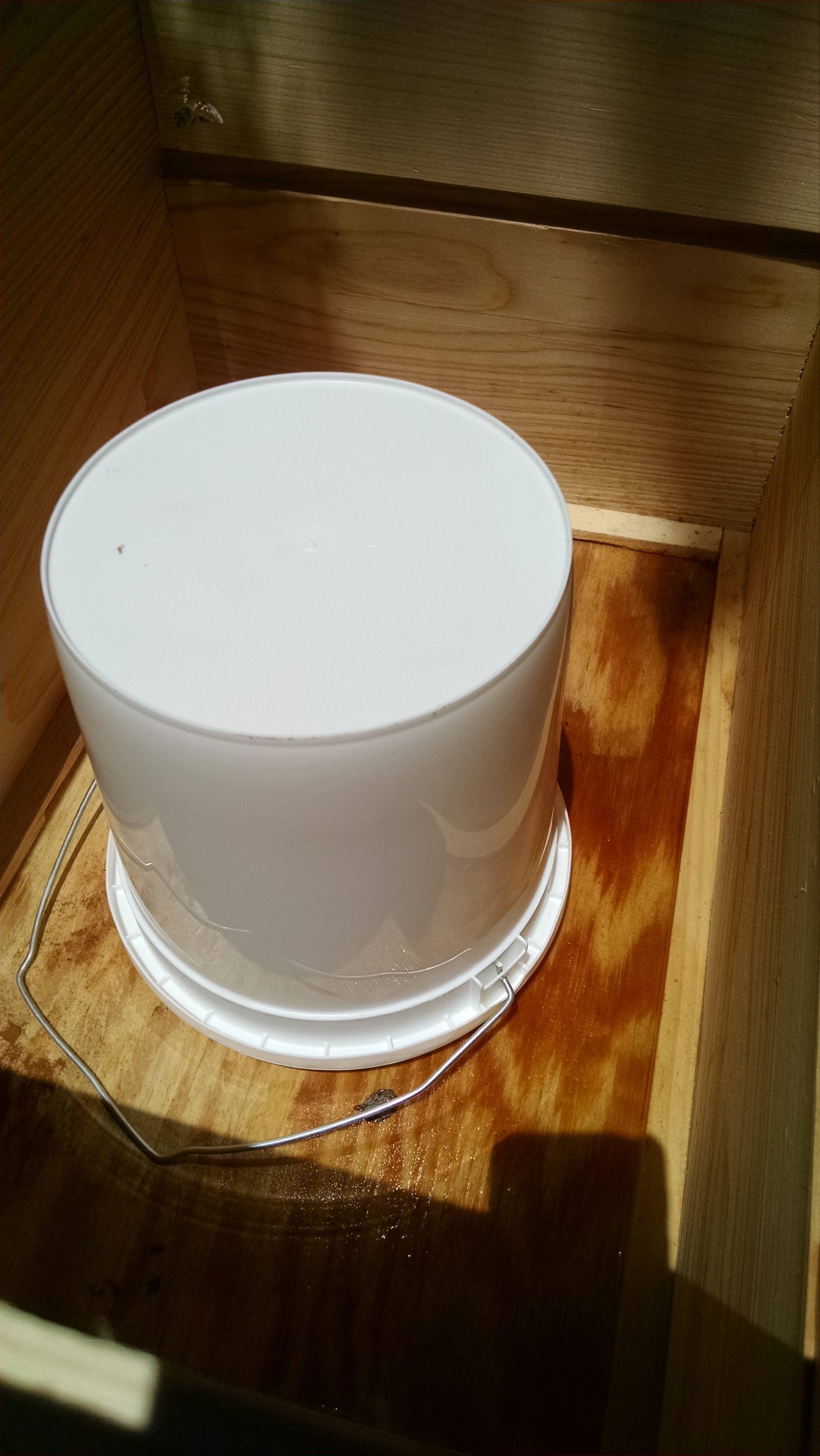
white pail in medium superI bought an extra medium hive body and a pail feeder (pail is just barely too tall for the medium) so that it would be covered.  Home–install new feeder. Amazingly, everything around the hive was very quiet–I had expected to see all sorts of insects attracted by sugar water spread around on the ground and the front of the hive.

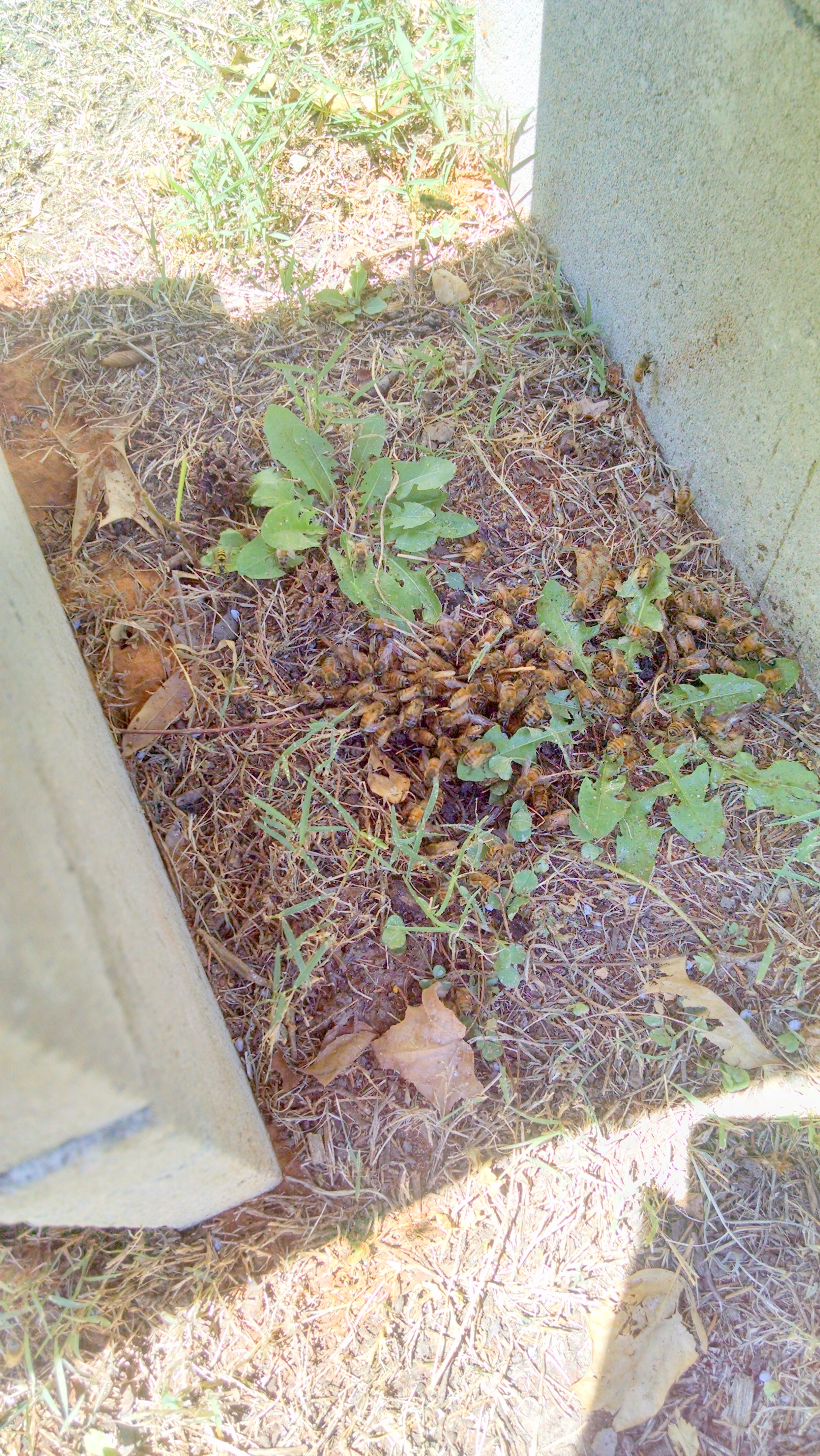
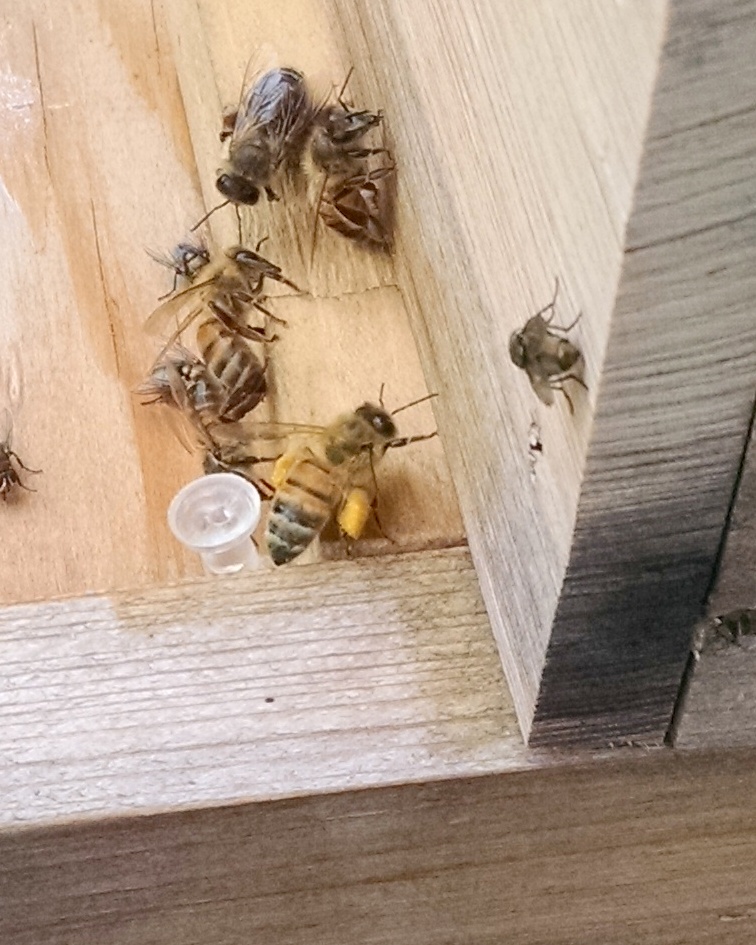
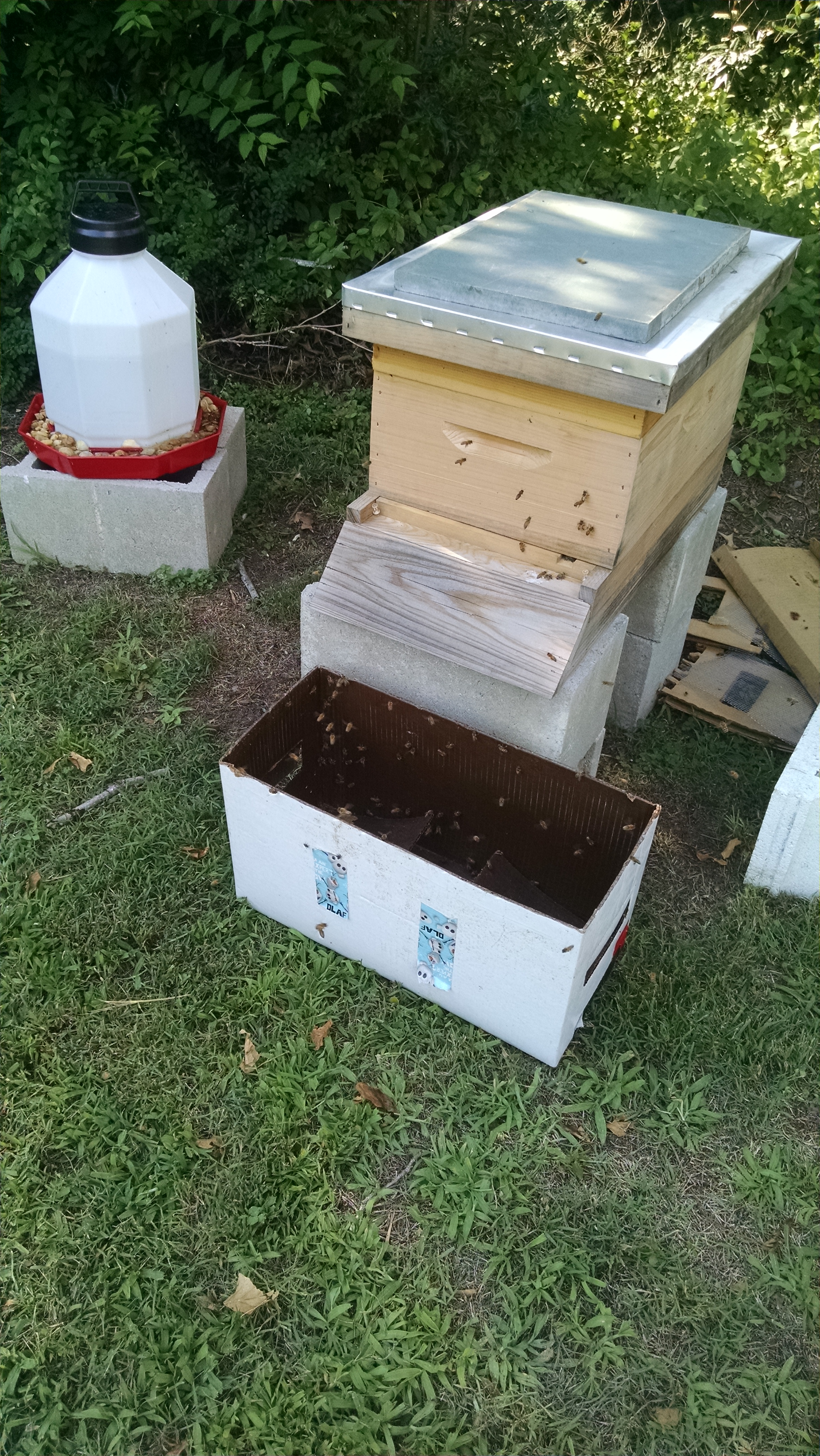
Now, a couple hours later–back to check and there are bees flying everywhere–not aggressive though. I think it’s bees from my hive reclaiming their syrup.  At least I hope it is. There are a few other wasp-like critters, but they are not making any effort to get into the hive. Thankfully, no hornets either.  I think maybe a rain dance this evening with hopes of a good hard rain to wash away the syrup. What I saw under the hive (I have a screened bottom board, and no sticky board in place yet) was not what you want to see around your hive.

group of bees under hiveThe only thing for me to be thankful for is that there were only a few other insects buzzing around–I just hope that lasts. Interestingly enough, I did not see any ants around–but perhaps they were all in my kitchen slurping up the syrup from where I carried the other feeder back in to clean it out. I wonder if that is a commentary on how ants feel about cinnamon–because there’s certainly a lot of it sprinkled around the hive.

Turns out that the ants were not in my kitchen–the cinnamon sticks that I had lying around on the counter must be doing a job. But, now I’m wandering around the house with a damp cloth trying to get sugar syrup wiped off of everything I touched–outside door handle, inside door handle, cell telephone (have no idea how that got there), the faucet in the bathroom sink. . . .probably other places that I didn’t realize.  I’ll find them later when I least expect it.

I never realized that “simple syrup” could be SO sticky!

Recipe: Apothic Dark Red Wine Cake

I like this wine–just for drinking, and can imagine that this will be awesome.

winebyari's avatarWine by Ari

Apothic-Cake-2-3-620x775


I came across this amazing recipe for Apothic Dark Red Wine Cake from Chasing Delicious.

Apothic Dark Red Wine Cake

Ingredients

  • 6 ounces flour
  • 2 ounces cocoa powder
  • 1 teaspoon baking soda
  • ½ teaspoon salt
  • 8 ounces unsalted butter, at room temperature
  • 14 ounces vanilla sugar (or granulated sugar)
  • 2 eggs
  • 1 teaspoon vanilla extract
  • 1⅓ cup sweet red wine (try Apothic Dark)
  • 1 cup cinnamon red wine sauce, recipe below

Instructions

  1. Preheat an oven to 350°F.
  2. Butter and flour or grease a bundt pan. Set aside.
  3. Mix together the flour, cocoa powder, baking soda and salt in a large bowl. Set aside.
  4. Beat the sugar and vanilla together until light and fluffy, about 5 minutes.
  5. Add the eggs, 1 at a time, and then the vanilla, mixing well after each addition.
  6. Add half of the dry mixture and mix in well. Pour in the wine and mix…

View original post 207 more words

More–bees and me

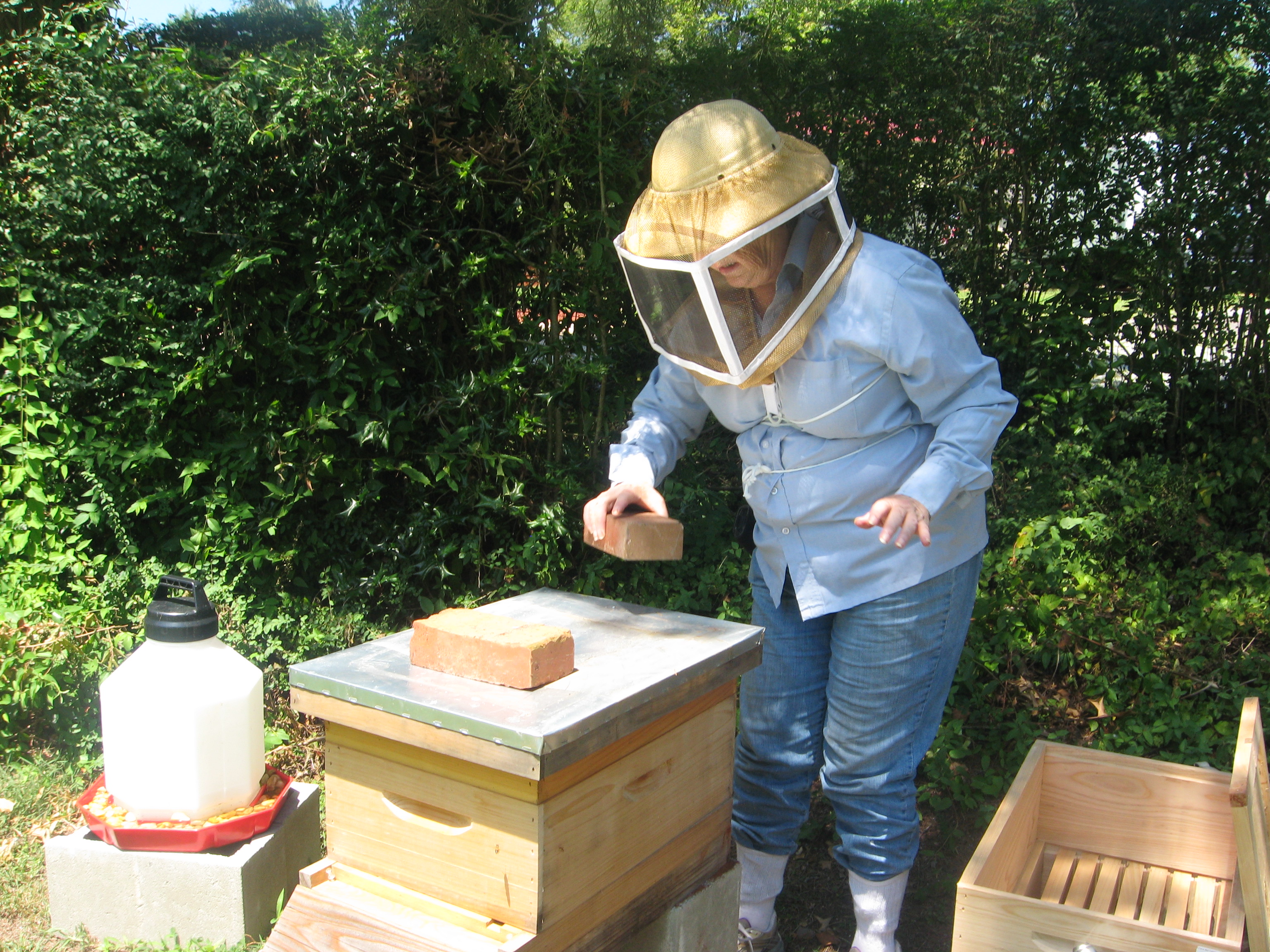
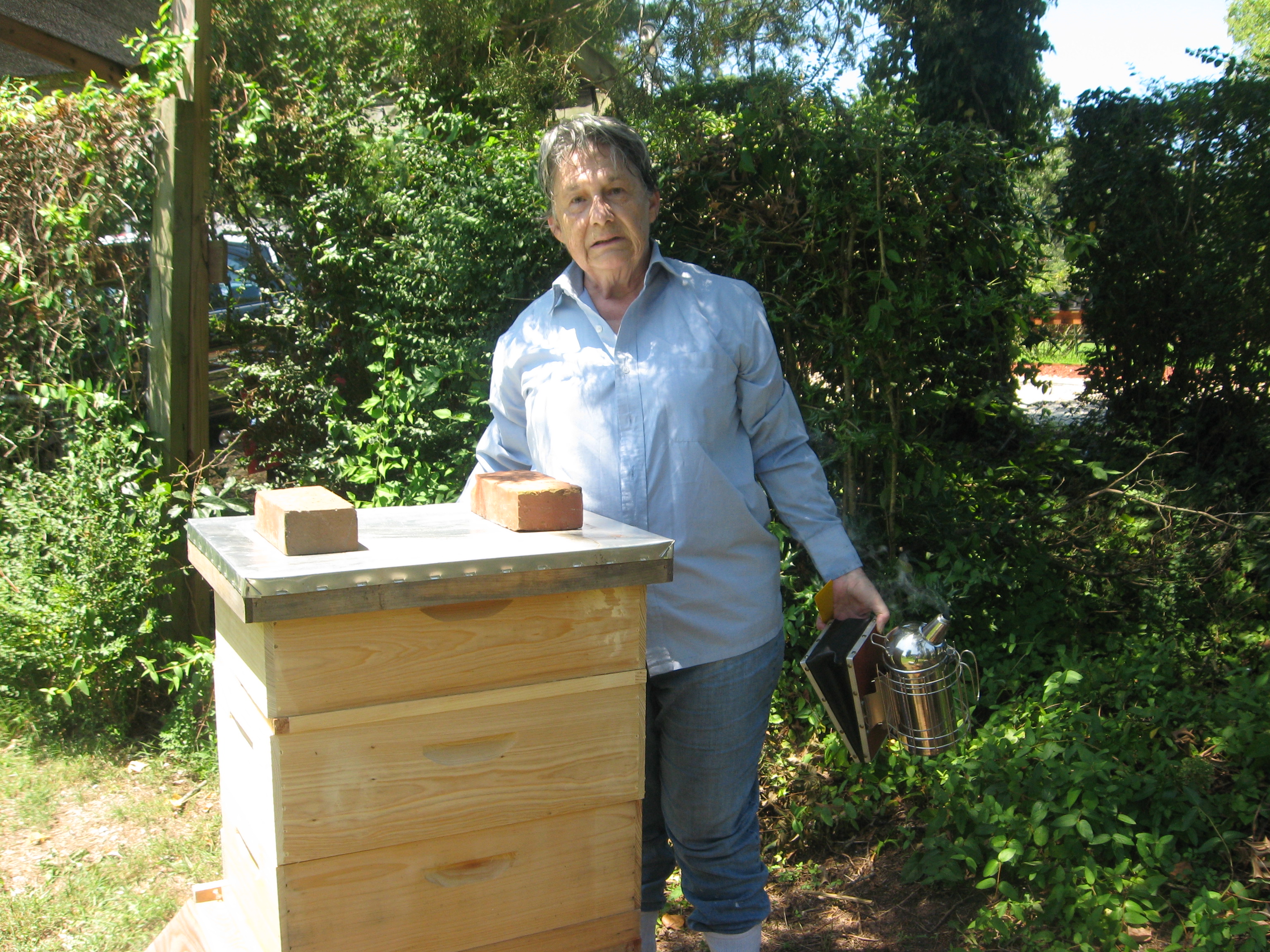
beekeeper me

beekeeper me

An incredible experience today! All the beekeeping books I’ve read (a fair number by now) try to describe the experience of seeing a hive in action.  It’s likely to remain indescribable.  I certainly can’t begin to put it into words.

One week ago today I brought my nuc home and transferred the girls (probably a few guys as well) to their permanent home. It didn’t take long for me to discover that I needed to modify the protective clothing that I wore, so back to the bee store.

Today, I opened the hive to see what was happening inside. (Had friend to take some pictures, too.)  As you can see, I’ve opted for different attire–a much nicer experience for me. Still sweaty, but at least not dripping on my veil. The weather was cooperative–clear, sunny, low humidity (41% and 87 °F reported at the time I opened the hive).

I did light a smoker and used it only for a couple of puffs to clear the Miller feeder before taking it off.  Last week I did the newspaper-pine needles-punk wood, routine.  This week I wussed out and simply used the cotton fiber fuel that you can by from the bee store–such a time-saver, and so much easier. This colony seems rather tolerant of me nosing around so I didn’t put on gloves. There was one point when I was just getting ready to start pulling the frames (after I had removed the first one) when there was an interesting line of bees, all side-by-side, wall-to-wall, in the cracks between the other frames–I definitely did feel I was being watched!  They got anther puff of smoke then–given that several of the books say that indicates need for a bit more smoke.  I really felt I needed them to move down so I could pull the frames without hurting anyone.

Because I’m going to be in and out of the hive about weekly with the new girls getting established and me learning, I switched from the Miller-type hive-top feeder to a Bee Smart feeder today. I tried out the Bee Smart in the kitchen sink before toting it out to the hive.  The  Bee Smart tray filled nicely and didn’t overflow.  Fingers crossed because that should be easier than moving the other one each time without slopping sugar water all over the place. After talking with other keepers, I did add Honey-B-Healthy to the feeder.

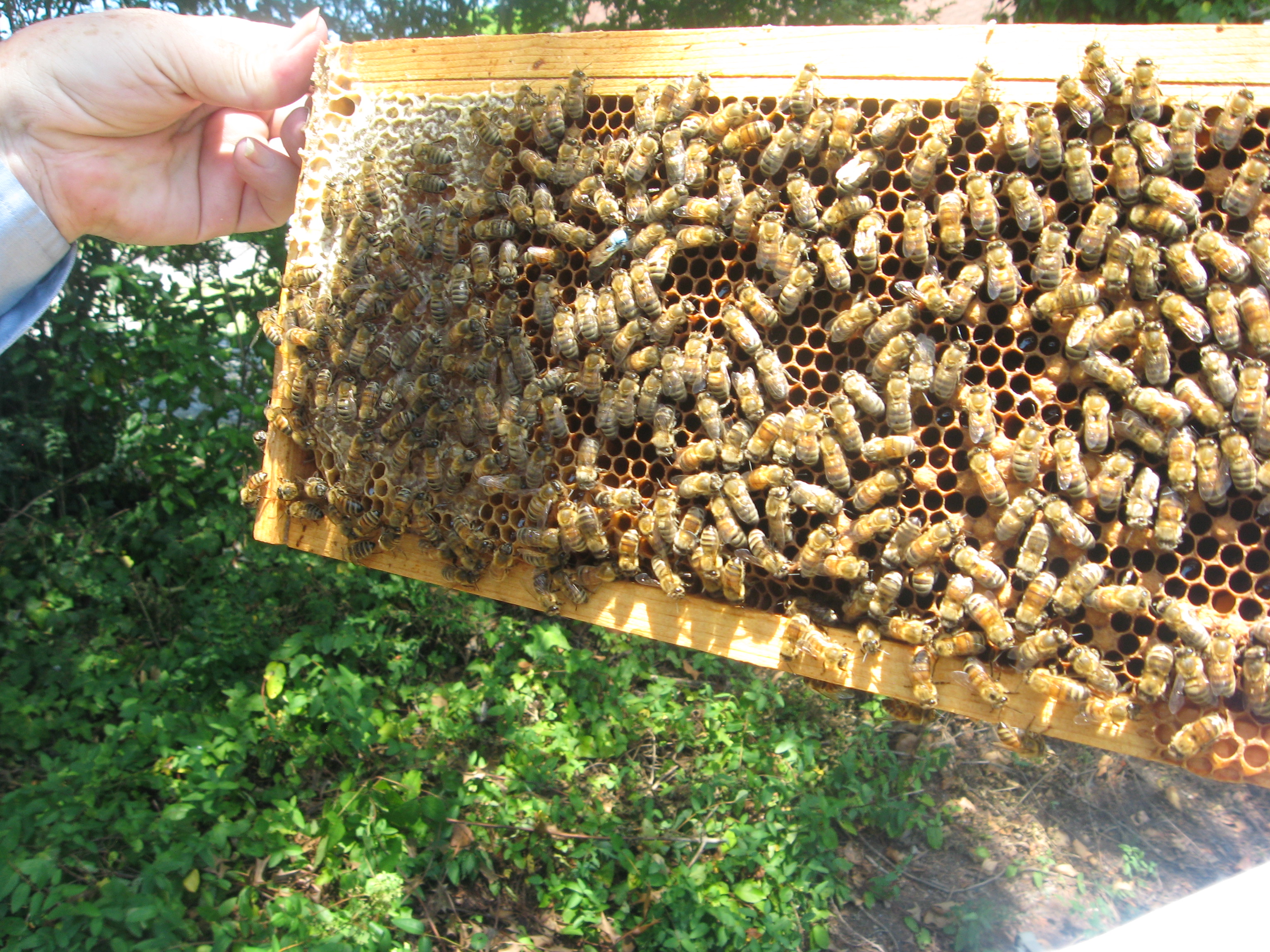
queen on frame

queen bee

To my very novice eye, things looked good in there. I did see eggs around where the queen was–they are really hard to see–I may add a magnifying lens to my “bee bag” with all the other goodies that accompany me to the hive.  I made sure that I did this inspection when the sun was out or I doubt I would have seen eggs. I didn’t see a lot of larvae though. Lots of capped cells. And bees crawling about everywhere….

On the left 1/3 of the frame, you see what looks like a white/light blue spot–that’s actually the queen bee (marked with the international standard color). She was moving around slowly on that frame.

Soooooo happy to see her in there doing her thing (yes, with effort I did see eggs) after my first adventure with her.  It seemed like every single cell was stuffed with nectar/sugar water/honey in all of the frames from the nuc. Surprised at how much heavier they were when I picked them up today, compared to what I remember from last week., (The hive was certainly heavier (after the feeder was off). With luck it will be heavier still next week.

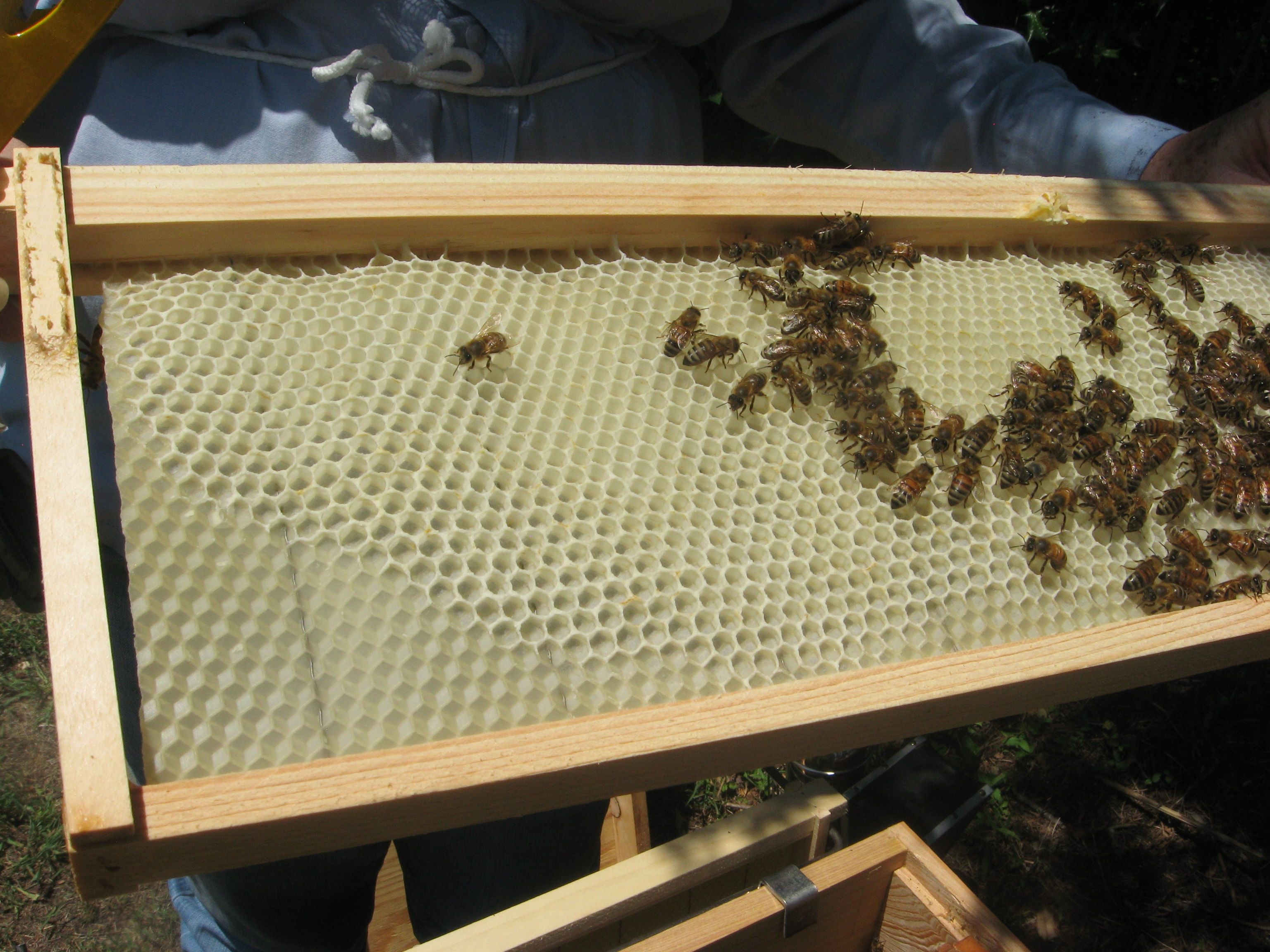
newly drawn comb on new frame

newly drawn comb

They had started to draw the comb on the unused frames–so it seemed appropriate to add another box–certainly want them to have enough room to do their thing.

Now to wait another whole week to see what is happening in there–I really do want to peek sooner, but I’ll refrain, and just deal with the anticipation.

Since this was my first go at doing a frame inspection, I didn’t take my tablet or notebook computer out to use Hive Tracks live on the inspection, or for that matter even attempt to use my smart-telephone. That will be added next time. It was certainly wonderful to come in and have the weather entered at the time I started the inspection.  I liked the check-things-off approach.  I suspect that I got a more complete record than had I been handwriting or even making notes on the computer. Just reading over the inspection form before I actually even lit a smoker helped with organization–which I need badly as a brand new beekeeper!

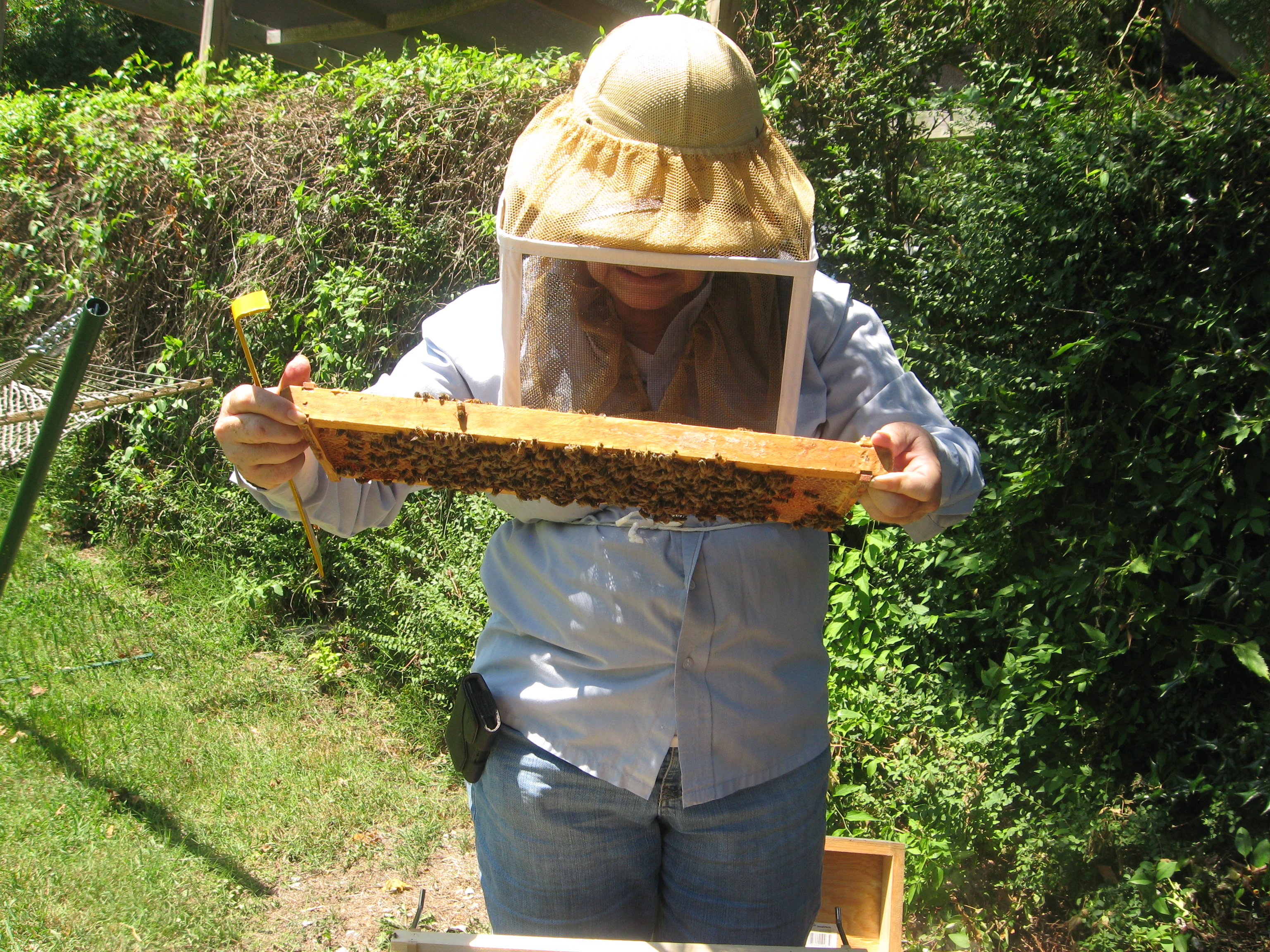
holding frame

IMG_8204Ò¿Ó

OOPS!  Well, a bit of a mishap with the Bee Smart feeder–which may be with the beekeeper.  It’s good to read the instructions, but then you do have to follow them if you want something work as promised.  I put feeder in, but neglected to note that “the base can be rotated to adjust the syrup level; since most hives are not level make sure that the syrup stays. . . .”  So–some sugar water spilled onto the inner cover, and down the front of the hive. Didn’t run out all that much, and it did not douse the frames. But. . .it did not stop overflowing until I leveled it.  Slight movement while trying to adjust it lead to sloshing which lead to more syrup. After leveling it has (right now) quit overflowing.  There will be an early morning check on this for sure. Likely an internet search for an alternative just in case.  I’m looking for something that fits in a medium super rather than a deep (or two mediums). In my internet searching before I got the Bee Smart feeder, there did seem to be a split: love it or hate it.  I talked to users who loved it–I’ll have to wait and see.  I might want just a plain simple bucket feeder!

IMG_8203

Beets in a surprising place

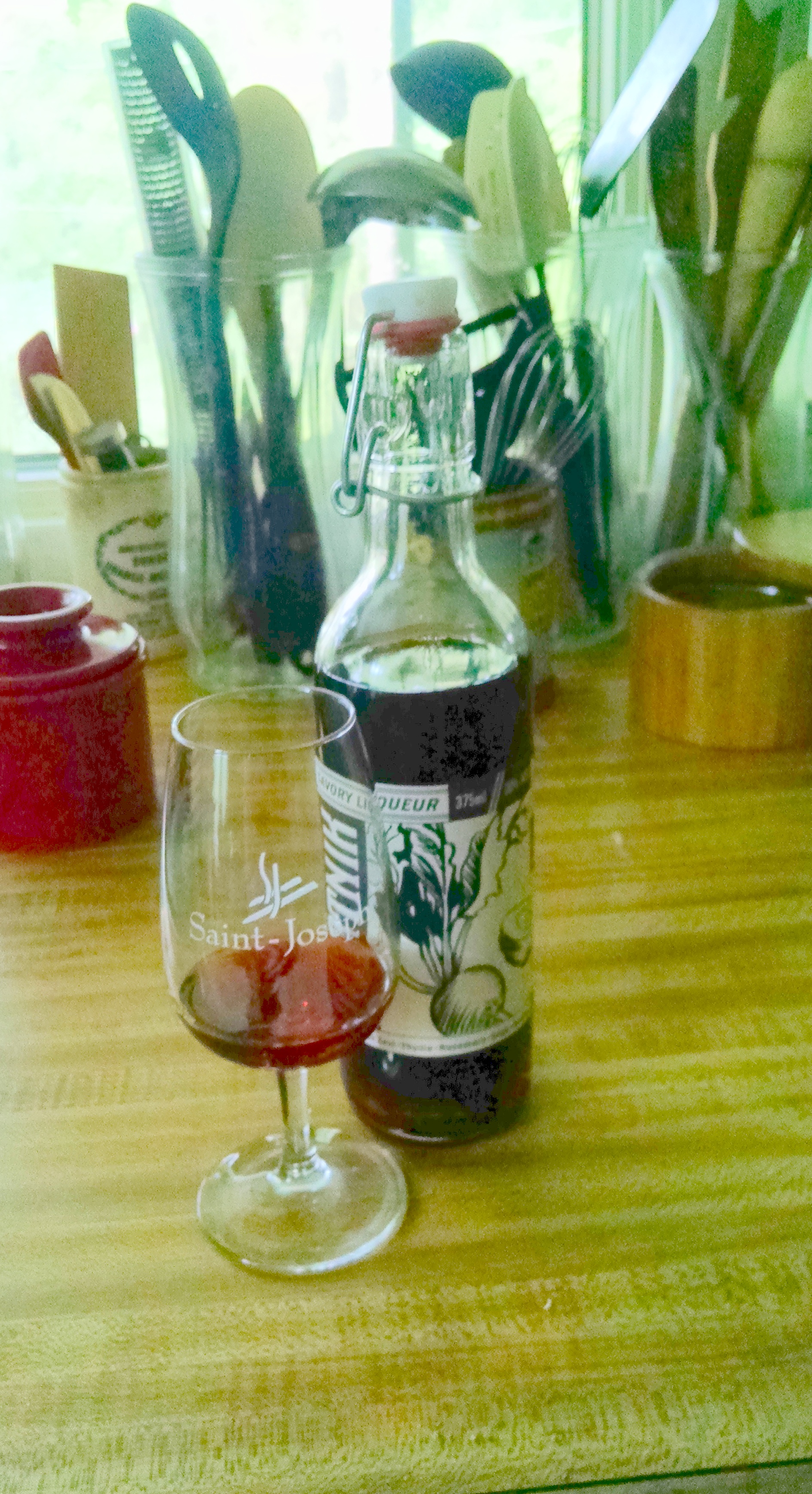
bottle and glass of Beatnik

Beatnik liqueur

If you’re any sort of a “regular” here I’m sure that you are aware that I think beets are under-appreciated vegetables. I’ve posted a number of beet recipes that I’ve found on other blogs and that I like. Last week I got an unusual (I mean they don’t bombard you with emails) from the Brothers Vilgalys who produced the Krupnikas about which I posted.  Well the email introduced some new liqueurs. (Note that this is a liqueur; it is not a cocktail called beatnik.)

The first that I’m sampling is the Beatnik. I don’t know what that conjures up for you, but it is a fantastic taste.  (You aren’t surprised, are you? Not given my fondness for beets!)

I suppose that the last place you’d expect beets to show up would be in a liqueur.  I was surprised when I read the description, but I just had to try it.

So, here is a liqueur with beets in it, described in the email as “An unusual liqueur made with Beets & Savory Herbs. Draws a bit of inspiration from an old Estonian liqueur I read about. Goes great with Gin drinks.”

I can tell you it is awesome! The beets are tempered/seasoned with orange zest, rosemary, thyme, sage, and fennel. I doubt that you could pick each one out as they blend so smoothly.  I’m sampling it “straight” this evening, but I’m going to try a splash of seltzer, as I’ve found that the Krupnikas (for warm weather) does nicely with that.

There are three others. I had a telephone call from the Woodcroft ABC store this afternoon to let me know that these had arrived. The Beebop was missing (that one has rhubarb and other goodies), but Jabberwock (coffee, chickory and some spicy things) and Zaphod (which is a fruity, minty one) were available.  I’ll be reporting on those in the fairly near future.

I’m just entranced by the nose of the Beatnik. The beets are certainly not obscured by the herbs and the orange zest–it all just blends together into a lovely earthy, beety, resiny, woodsy flavor.  In a word, awesome.

It gives me some ideas for seasoning beets as a vegetable too.

For the bees (and me)

After my experience with the dome veil and jacket while I was putting the new bees into the hive, my mission for today was to get a veil that would allow a lot more ventilation. My last experience while in the jacket and veil was a bit like looking at the world through raindrops–not the best for clear vision, especially looking at little moving critters and trying to find one specific little moving critter that (thankfully) had a nice, bright blue dot on her thorax. So, off to Bailey Bee Supply this morning.

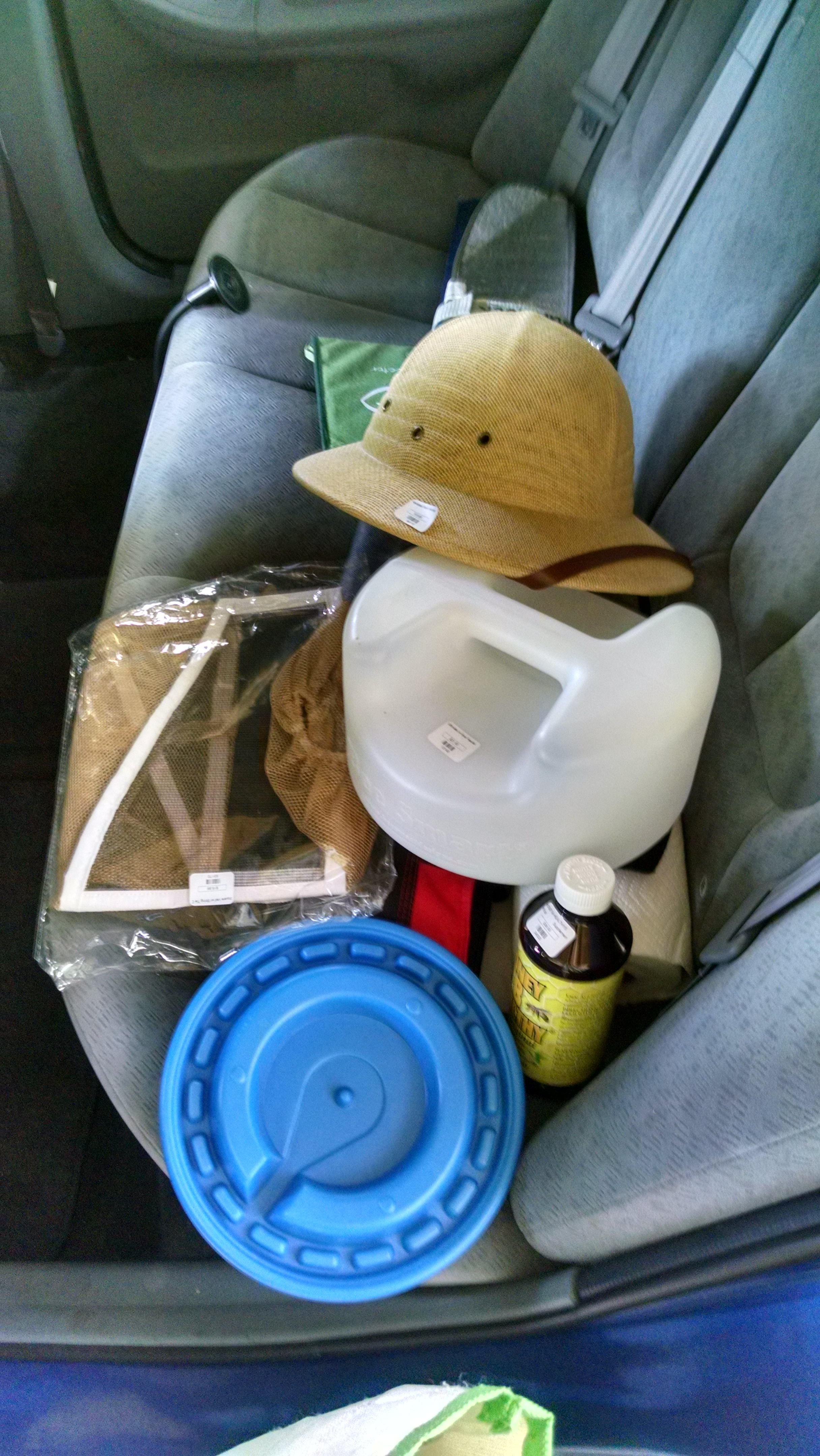
new equipment on car seat

new stuff

As is likely typical of most of us when we start a new project/hobby, gadgets and new equipment are totally fascinating and there is such a variety to check out. I suspect that beekeeping gadgets are going to be like kitchen gadgets and widgets–a lot of them better  in advertisement than in actual practice, but you never know, though chatting with other beekeepers certainly helps in choosing, or not. You find out all sorts of things that never appear in the “book learning” part of beekeeping.

For example, in discussions of hats and veils that I’ve read online and in books, nowhere did I find any mention of having a chin strap on the helmet. A friend mentioned, while chatting on FB, that she wished her helmet had a chin strap. I was about to settle for the basic plastic helmet, when my brain registered the fact that a helmet sitting right in front of me had a chin strap–quick change, and I have a helmet that is ventilated and has a chin strap to support a veil that will allow some air flow. That doesn’t mean I won’t drip while working outdoors, but it should help.

Obviously I came home from the bee store with more than just a helmet and veil–just like when I go skulk around the kitchen store.  I had a delightful chat with the lady in the bee store about pros and consult of various gadgetry and her experience–much greater than mine, gave me useful information and contributed to my purchases.

After opening the hive once, I discovered that the disadvantages frequently described for a this type of hive-top feeder  8 Frame Miller Top Feederwere very real. Biggest one for me right now is the difficulty in lifting it off the hive without slopping sugar syrup all over the place. Think about lifting a big, fairly shallow pan–like when you use a bain-marie in the oven–how the liquid shifts and threatens to slosh.  Well, slopping sugar syrup all over me, the bees, the hive, and surrounds is not something I want to deal with right now when I’m doing frequent inspections for my learning experience. SO, new feeder. (Given the good points of this style of hive-top feeder, I suspect that I’ll use it again when I’m not in and out of the hive so often because it’s large capacity is attractive–so it’s not a write-off.)

Despite reading some very contradictory reviews on forums–seemly a definite love-it or hate-it reactions–I got a Bee Smart in-hive feeder in-hive feeder. I’ve read the instructions, and  I’ve been checking it out over the kitchen sink with water. It seems a little touchy about getting the cover screwed back on, but as long as I pay attention to that (and I think my OCD-tendencies will kick in there), it seems to work. Since can go on the inner cover, it will certainly make opening the hive easier for me right now.

My only other purchase was some Honey-B-Healthy–an all-natural feeding stimulant for bees that is HONEY-B-HEALTHY® Supplement 16 ozreported to help with some of the problems that one encounters with bees–like  Nosema ceranae and some of the other really nasty things that can get your bees! It’s not advertised for that (I guess like off-label drug use in humans), but for those attempting to do without giving heavy-duty medications unless absolutely necessary, it has good reports from experienced beekeepers.  So, add a bottle of Honey-B-Healthy concentrate for the girls.

Now comes the sort of hard part–they are not due for a hive inspection until Friday–I have to content to watch them carrying pollen into the hive.

bee with full pollen baskets

pollen into the hive

pollen rainbow

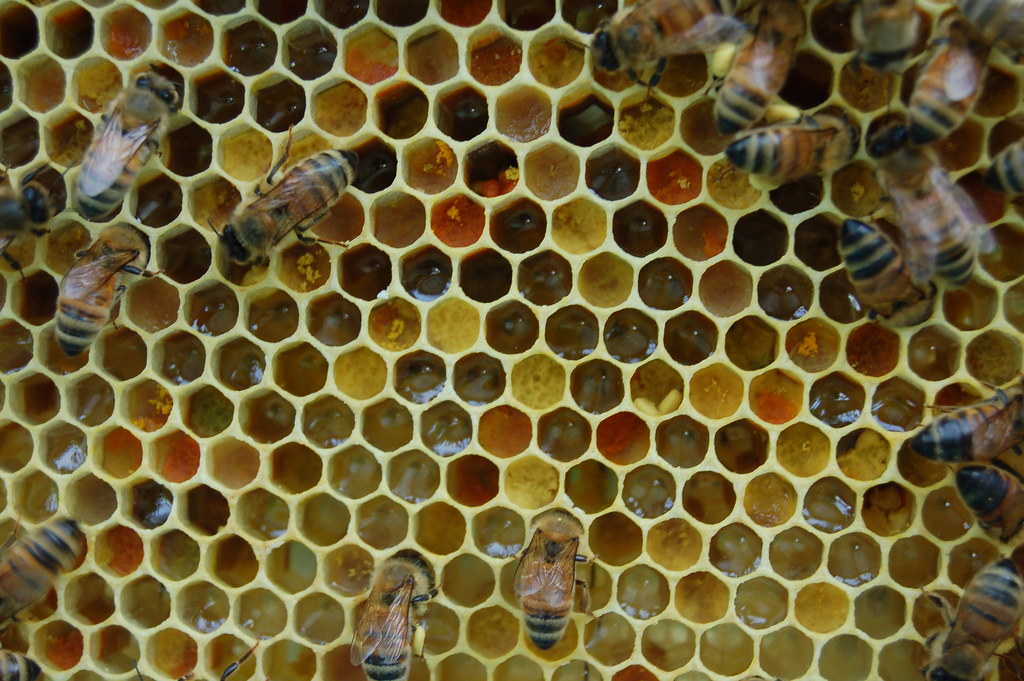
Watching the bees bring pollen into the hive, I saw mostly yellow but on looking at the frames I saw other colors–and so to Google–a veritable rainbow.

misterkrista's avatarkrista and jess

You really should click for a larger look.

And if you are a nerd (I know you are), click for the Wikipedia with a pollen color chart.

View original post

Honey bees are here. . . .

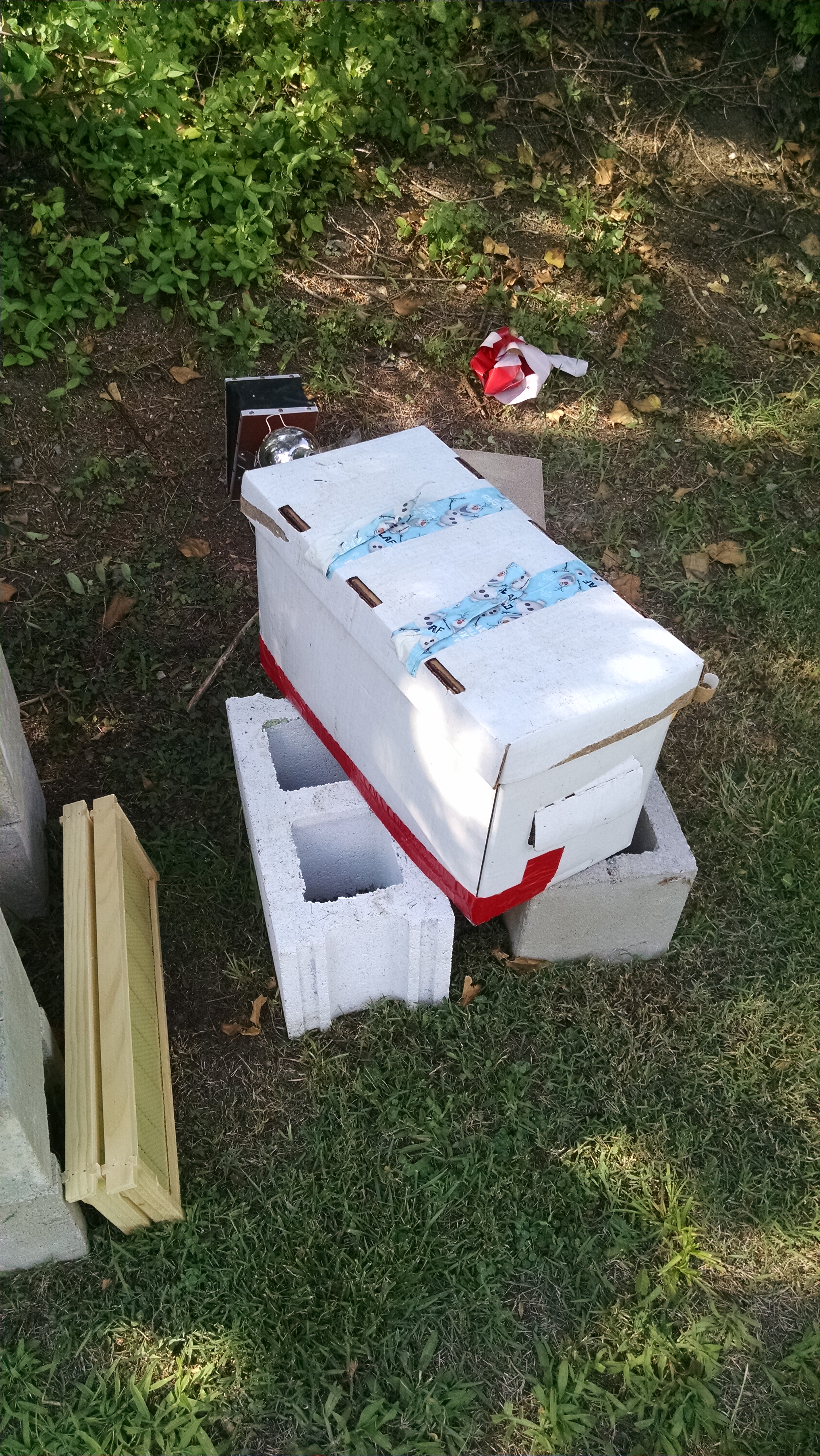
nuc box

box of bees

This might seem like a digression–but not really, since it eventually relates to honey, which is edible (so deemed appropriate by me, at least) though there won’t be even a single serving until next year.

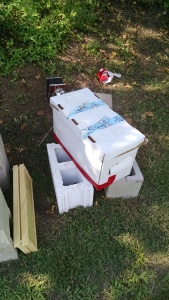
Yesterday afternoon I went to Hillsborough NC and came home with a large box of bees:  brood in all stages, workers, queen, and even honey; all in a nucleus colony from Bailey Bee Supply.  The bees in that box had to be transferred into their permanent hive. I was a little uncertain about what their disposition might be after being carted around hither and thither–from apiary to supplier to home.  As you can see by comparing it to the cement blocks, it was a rather large box.  A buzzing box.  When I picked it up to take it out of the car I could feel vibrations. An adventure waiting for me when opening that box.

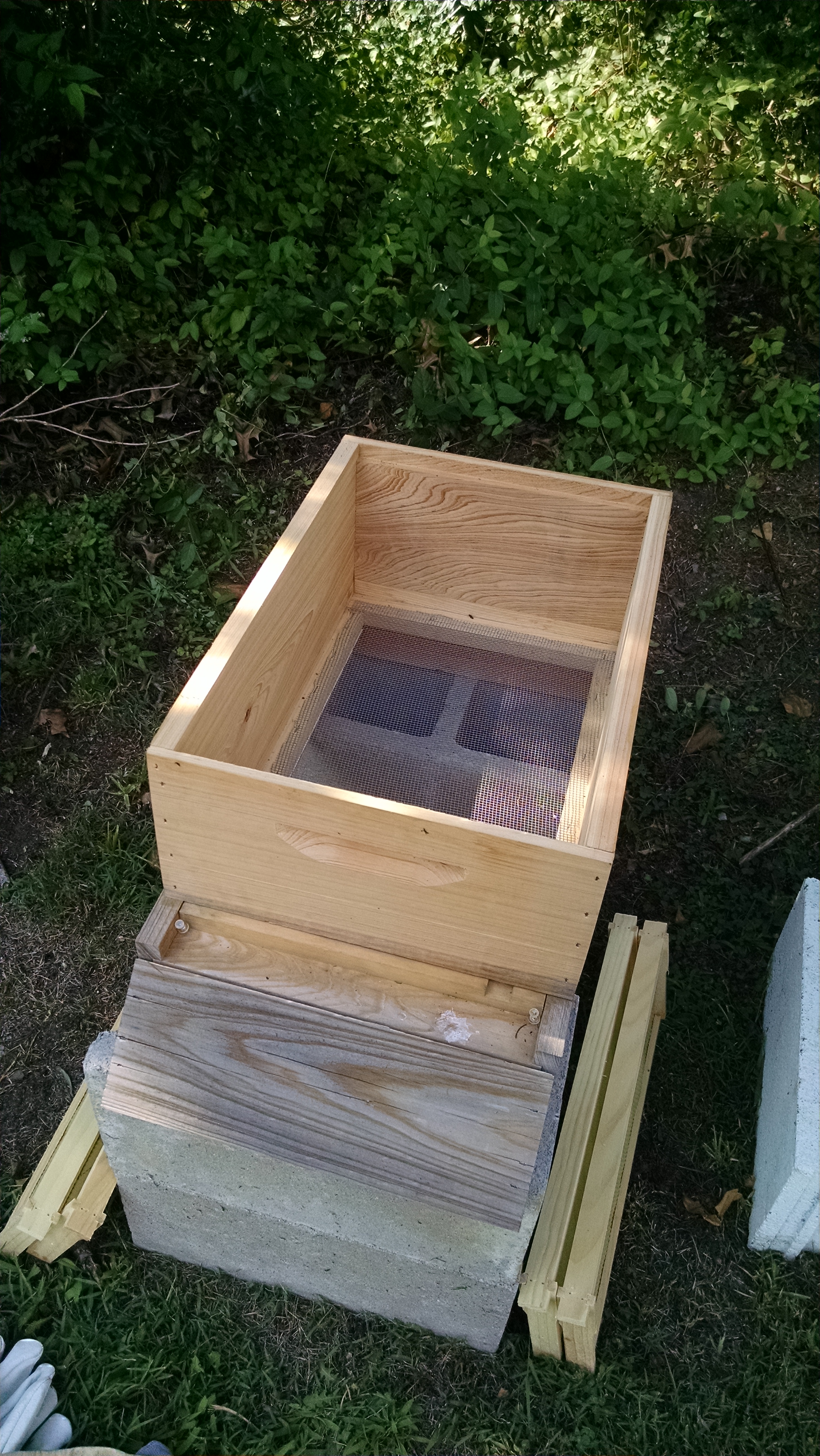
The bees from that box needed to be transferred to the hive body (below) that was to become their permanent home.  The nuc contained 5 frames–a miniature colony. Their permanent home will have 8 frames in each of the boxes.  Right now, only the one, but I C:UsersBailey Bee SupplyPicturesVent Jacket w Hood Veil 3.JPGhope I’ll be adding another super and frames in a week.
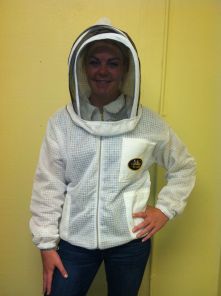
 

Before opening this box of bees, who might just be a bit PO’d after all the travel, I got the smoker going, and then I donned the “typical” beekeepers jacket and the veil despite the heat.of the afternoon. The jacket pictured here is a special ventilated one–you can see through to tell color of clothing underneath.  Mine is NOT ventilated–it’s heavy cotton–and HOT. I didn’t put it on until I had the smoker going, and was right ready to take the lid off the box. Even the ventilated one like that would not have been much help because there really wasn’t any breeze.
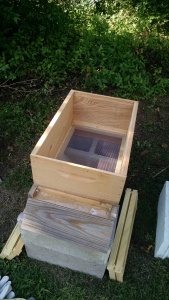
empty hive box

empty hive body

I started untaping the box after giving them just a bit of smoke through the vents on the ends of the box, and then a little more before I lifted the lid completely off–and a little more before I removed the inner cover. And there they were –a busy, bustling, buzzing mass of bees. . . .

By the time I picked up the first of the five frames to move it into the hive body, I was absolutely dripping sweat which plopped onto the veil in front of my face when I bent over to pick up a frame. I did even use a headband, too, but that didn’t stop the drips or sweat getting in my eyes. Drops of sweat clung onto the veil–not going right through, so I’m looking at a mass of moving bees with drops of sweat in front of my face. Now, being the truly quick learner here, I made a real effort NOT to bend over so far again. (At least I’d had the sense to put the nuc box on blocks rather than on the ground.)

I inspected each of the five frames–looking for the queen, and saw her on the last one, of course–at the bottom of one side of the frame.  I turned the frame to inspect the other side–probably not really necessary since I already spotted the queen–but I did it anyway and then put that last frame into the hive body, put the three additional empty frames in, picked up the box and tapped all the lingering bees down into one corner as much as possible, dumped them on top of the frames, put the hive-feeder on top and then the outside cover. Done! There were still some bees clinging in the box so I put it on the ground in front of the hive so those could climb up to the entrance. There were some bees buzzing around outside the hive, but all seemed good.

No problems, right? So I thought.

Being a bit like a new parent, first thing this morning before even first coffee, I went to take a look. What I saw, even from a distance and UN-coffee-d, evoked a fervent, emphatic (and unprintable) epithet!  Too many bees flying around and around the hive–not coming in and out, but flying around the hive. Dashing over to the hive, I found a fist-sized cluster of bees in the corner of the nuc box. That was NOT good–that’s when I realized that I must have dropped the queen when I rotated the frame (which fortunately I did over the box) rather than over the grass.  Too bad I didn’t do it over the hive–duh!  I guess that’s what you call a learning experience. I prefer that phrasing to either dumb, or stupid thing to do.

After taking off the cover and removing the feeder I did another dump of bees onto the top of the frames–queen still didn’t go in so I gently nudged her out of the box into the hive with my fingers–and closed the hive again.

Back for another look after about 30 minutes and all appeared much more normal–bees doing straight-line in and out, without all the flying around the hive.  Huge sigh of relief here, though the real relief will come only when I open the hive in a week  for an inspection and find things normal.

. . . .and I think this may to be a pretty friendly colony. I didn’t even think about getting out the smoker or putting on the jacket and veil. Here’s me in shorts and T-shirt opening the hive and popping the queen inside without all the paraphernalia. I had a few bees crawling on my hands and arms while nudged the queen out of the box, but not a single sting. Admittedly, I wasn’t pulling frames out of the body (in other words threatening their honey or brood).  I will wear a veil so that I don’t have bees crawling over my face, but I doubt I’ll put that heavy jacket on again.

So ends the first adventure of beekeeping.
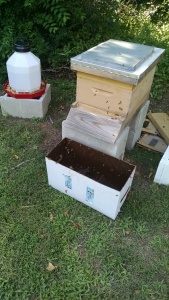
closed hive and nuc box

home, sweet home

Thought for food. . . .

I am enjoying a bit of leisure time since I just finished the last indexing project. It’s quite welcome as I had (unintentionally) overlapping indexes.  When the last went off to the editor, the first thing I did was to hang and out-of-order sign on me and elect to have quality time with the cat and Kindle.

As someone with a confirmed interest in food, a lover of good food, I’m not sure I want to be called a “foodie”.  In some ways that has the connotation of interest in the latest food fads. What I’m interested in is good food. I do think food is a multi-sensory File:Fugu sashimi.jpgexperience. Presentation as the visual part of that experience has it’s place–there’s nothing quite so impressive as the  presentation of fugu sashimi, or the aromas of cooking, or the temperature contrasts of a hot fudge sundae. But then there’s nothing wrong with the presentation of a plate of braised greens and sausages, either.  I guess I want to be able to recognize my food (which leaves me somewhat ambiguous toward some of the molecular gastronomy presentations.

Molecular gastronomy eggs benedict

Eggs Benedict

The presentation to the right (from Wikipedia) doesn’t make me want to sit down and eat, even though I love eggs Benedict. Perhaps it’s my age showing, but I’m interested in good food and I like it to look like food. I suppose part of this is that I have food memories stashed away within my brain, and these are visual as well as olfactory, tactile, and gustatory.

I’ll admit that the plate of sashimi does not look like a fugu (it’s not at all a pretty fish), but because of experience and knowledge of sashimi, it looks pleasing, and eminently edible (and tasty). Almost all cookbooks come with photographs these days (I have some oldies that don’t have any) so even as we start to prepare a dish, which have some visual imagery.  We may be frustrated when we finish because ours doesn’t look like the styled one with the recipe, but there still a resemblance. A little at least?

poached egg on spinach/toast with hollandiaise

Eggs Florentine

There is a certain dissonance for me when I read a recipe that sounds wonderful, and then I look at the photograph, and I cannot recognize the food in the presentation–totally plated, stacked, towering, more like architecture than something I’m going to eat. Having worked in a kitchen, I know when my food looks as if it’s had someone’s hands all over it, and that’s fine to a degree.

When I’m not cooking, indexing, writing, or attending to the cat, I like to read about food so that’s what I’ve been doing for my leisure and relaxation. I’ve posted some of my favorite books about food and eating in the bibliography. The Art of Eating by M.F. K. Fisher is one that I pick up and read–well, I guess reread is more appropriate–often. There are also two collections by Roy Andries de Groot (In Search of the Perfect Meal) which are wonderful, also often reread.  Then there’s the collection Elizabeth David’s writing: Is There A Nutmeg in the House. Or Richard Olney’s Reflections.

I’ve added a new one to that shelf food books (figuratively since it’s on Kindle) by Mimi Sheraton, called 1,000 Foods to Eat Before You Die. It is a virtual travel-log, complete with telephone numbers, and links to places that sell, make, or provide food. Her descriptions are delightfully evocative, though admittedly lacking the first-had olfactory and gustatory stimuli.

If you really like food, and if you live to eat, rather than just eat to live, then I would recommend a trip to the library, or bookstore–even if it’s digital.

Apricot and Ginger Tarte Tatin

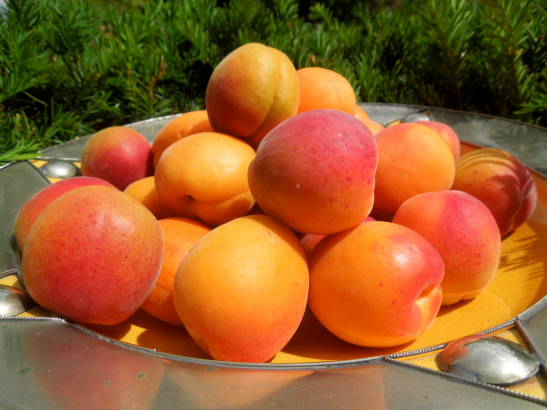
I’d love to get my hands on some really good apricots! The ginger with this sounds yummy!

Linda Duffin's avatarMrs Portly's Kitchen

Image of Howard's apricot bushes

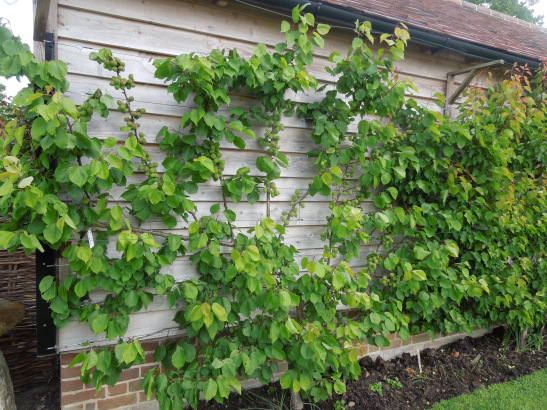
I experienced serious fruit tree envy recently when visiting Kenton Hall in Suffolk, home of the McVeigh family and their longhorn cattle. It’s also home to Aunt Paddy and Uncle Howard, possessors of a lovingly-tended kitchen garden and crucially, of three or four espaliered apricots. Howard is rightly proud of them and says they produce a good crop of fine-flavoured fruit.

We have apples and pears, plums and gages, quince and cherries, blueberries, strawberries, raspberries, tayberries, gooseberries, red-, white- and blackcurrants and something Dutch I can never remember the name of. What we don’t have are any apricots, so I was well jell, as my nieces and nephews probably wouldn’t be caught dead saying. I did, however, manage to source a few punnets in our local Co-op.

Image of bowlful of apricots

Usually I make apricots into a conserve, which is without a doubt the most popular jam in the Portly preserve cupboard. This time…

View original post 72 more words