
Looking through the WordPress blog reader, I found a lovely picture–it was a beet pizza post on Dinner for (N)one. Looks really good, given how much I like beets. I wanted to re-blog it because it looked so great, but somehow the electronic world of cyberspace is being obstreperous this afternoon. So, I’m just posting the link without the gorgeous pictures.
Author Archives: sa.fifer

Make ratios work for you
It’s unfortunate that we’ve learned to view recipes as something to be followed rather slavishly. That’s not the way cooking works since there are so many variables in ingredients available. If we can get out of that habit, then we’ve made a huge stride in cooking for one.
I’ve talked about Pam Andersen’s How to Cook without a Book-–which is based on using ratios in recipes. Even more liberating from the slavish following of recipes are a number of books which really don’t give specific quantities at all or just suggest approximations of ingredients. These can be easily adjusted if you pay attention to the proportions of the main ingredients or the ratios.
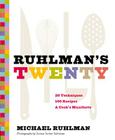 I just purchased Michael Ruhlman‘s Twenty. I found it a fascinating approach to cooking–it introduces you to the really important ingredients that you work with so often that you almost do not think about them–you take them for granted: like salt, eggs, water (yes, water!) and onions, to mention a few. He presents recipes that will make you aware of how these ingredients actually work in the process of cooking–to help you understand them so that you can improvise!
Another great thing about this book is that even though the recipes may be for more servings than you want, ratios are given for important ingredients. For example, in a recipe for “Traditional French Onion Soup”, he give a and “onion-to-liquid” ratio that he prefers for the main ingredients–7 or 8 pounds onions (which really cook down) to 6 cups of water. That gives you the information you need to downsize the recipe. Other ingredients are mostly “to taste” although quantities are suggested in the base recipe. It’s wonderful when the recipes give you this kind of information; however, you can always look at the major ingredients in a recipe and come up with your own ratio.
This book stresses “thinking about food”–and that does not mean looking at the recipe that has 20 ingredients, and dreaming about how nice it would be to make that, but it serves 16, and…. Techniques that are basic to many recipes are presented–some of them are basic ingredients–to help you understand the why and the wherefore of the ingredients. That is the key to improvising. The other important thing stressed: think! Once you understand ingredients, you can adjust the recipe, you can improvise.
This is a book that I’d recommend highly–at least check it out of the library and read it–it just might give some food for though, and open some doors to make single-serving cooking easier for you. I’d also suggest checking out Michael Ruhlman’s website for other good information for the home cook.
Herb-infused oils and vinegars
I’m always glad to see spring and summer (despite hating hot and humid weather) because of the fresh herbs. Maintaining the herbs on my deck involves keeping them cut back so that they do not bloom–I want peak flavor all summer. That involves taking the scissors to them and cutting off about one-third of the plant, so that they will stay nice and bushy.
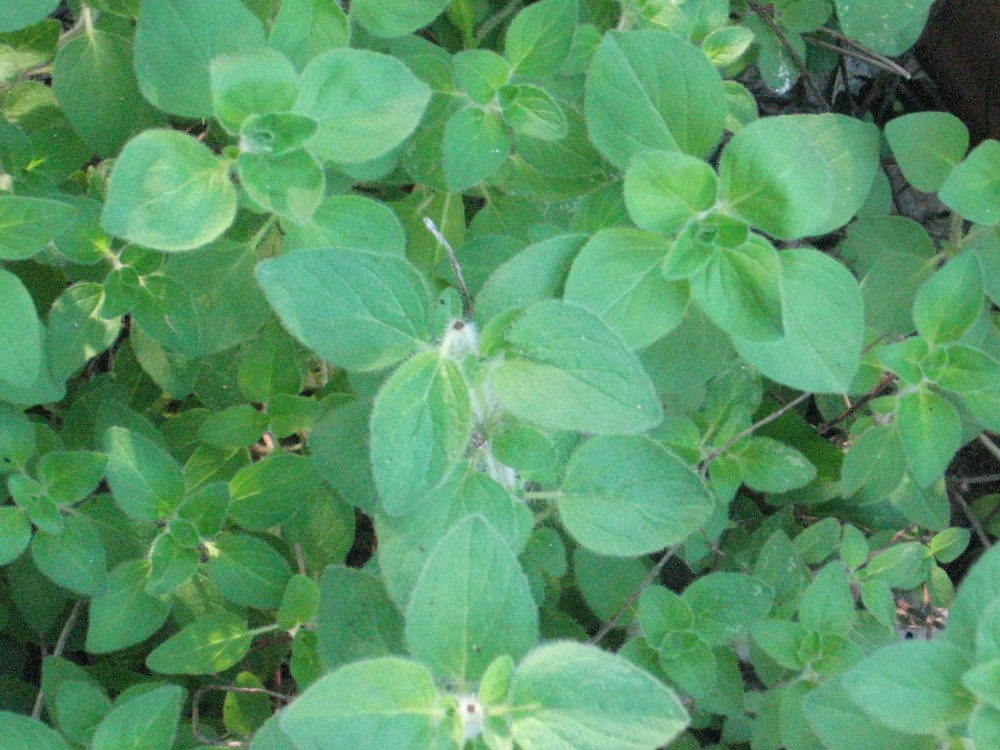
Greek oregano (Origanum vulgare, subsp. hirtum)
Even though it’s good maintenance, I just hate to throw away all those fresh herbs, so I often make flavored oils or vinegars with the trimmings. I love having a supply on hand for salad dressings, dipping, or whatever.
When I make infused oils I want strong flavor that I can use in many ways. I use plain vegetable oil and extract my herbs in heated oil at about 180° to 200° Fahrenheit, checked with an instant-read thermometer. I either use my tiny “baby” slow cooker and let the oil infuse in that for several hours or use the microwave oven on low or defrost, then strain. This gives me very strongly flavored oils that I dilute with other oil depending on how I plant to use them. Once strained, I store in the refrigerator or freezer.
I’ve made infused oil from a lot of different herbs–oregano, marjoram, thyme, rosemary, sage, even epazote–or mixed herbs. I haven’t tried cilantro, but after reading the post on Chef Mimi Blog I want to give that a try as well.
This hot weather reminds me that it’s time to make lemon oil again. I do this in the summer, removing the zest for the oil, then using the lemons to make a big pitcher of lemonade and sip that on the deck while the oil infuses in the slow cooker.
With oils made from fresh herbs, we need to be aware of the potential for botulism since Clostridium botulinum can thrive in oils like this. Any fresh herb or vegetable has the potential of carrying C. botulinum, and it requires high temperatures to kill the spores or to destroy the toxin so we need to be particularly careful about keeping them refrigerated. Tips for prevention are given here and here.
Beet salad with feta
 I’m in a work rush with a close deadline on a book that I’m indexing and that means that any heavy duty cooking (anything that requires turning on the stove, or pushing a button on the microwave) is out for the next few days. In need of lunch, I perused the fridge contents.
There was a package of Melissa’s Produce steamed, peeled, baby beets that I brought home from the supermarket produce section; toted home and put in the vegetable bin (sometime ago, and not yet used) so I made the easy beet salad from Chef Mimi’s blog this afternoon. This was a great light, quick, warm-day lunch.
The beets are vacuum sealed in heavy plastic. The texture is perfect–just like I’d steamed and peeled them myself–and they have a long shelf-life so I can always have them around without feeling that I absolutely HAVE to have beets today, or even tomorrow.
It’s not that cooking beets is difficult, but when there’s a really pressing deadline and I need lots of work time, I go for convenience and speed but I don’t want to sacrifice taste. That usually rules out canned vegetables (except for beans and tomatoes) though I admit to not have checked out canned beets in ages because I really never liked the taste; I can see that I need to revisit the canned ones again, too.
These vacuum packed ones just moved beets right up with canned beans as a convenience item in my pantry.
(Let me be clear about my comments on any products mentioned in my posts: I have no connection (except as a consumer) with Melissa’s Produce, nor with Stahlbush Island Farms (mentioned below. I get no remuneration for comments or use of these products.)
Now, I tasted the beets straight from the package and then made my salad. I didn’t spiralize them, so my salad wasn’t as pretty as that pictured on Cher Mimi’s blog, but it was tasty. I doubt that I could tell those vacuum-sealed, pre-cooked beets from ones that I had steamed and peeled myself (unless I looked at the color of my hands). You could put those in a bowl and serve as a vegetable without anything except warming them and adding seasoning of your choice.
I have one more “convenience” product that I want to check out: Stahlbush Island Farms sliced frozen beets that I found in the frozen food section at my local Harris Teeter. I didn’t go to the frozen foods section expecting beets (probably the farthermost thing from my mind just then–I was looking for chopped kale) but right next to the Stahlbush Island Farms chopped curly kale, were sliced beets. As  you’ve probably gathered, I’m incapable of leaving something like that in the store. So, I have those in the freezer to try next.
One of my other summer favorites is beet soup. I can certainly speed up making that if I use one of these products! I can replace the beet greens with Swiss chard–maybe even find it frozen as well.
One of the appealing things about the frozen beets is that I can use some and put the remaining ones back in the freezer without having leftover veggies. Since they are sliced, but uncooked, I have more flexibility. With the vacuum packed ones or a can, you have to do something with the rest of the beets so that they don’t linger too long in the fridge and grow interesting colors of mold, and eventually find the way to the garbage.
My only “regret” with the Melissa’s beets was that I really like beets roasted instead of steamed. The first way I’ll try the frozen ones is roasted as suggested on the website.
ÒΔÓ
Until I found these products in the frozen food section, I’d never heard of Stahlbush Island Farms, but after looking at the website and the products, I’ll certainly follow up to check out some of the grains and legumes that are frozen, as well as fruits. (Again, no connection, except as a consumer, and picky at that.)
I noticed black raspberries on the product list. I’m a fanatic about black raspberries–there’s a big difference in flavor from the red ones that we see in the stores, not that those aren’t good, but black raspberries are what I grew up with, and thus my idea of what raspberries should be.
Easy Beet Salad
Gallery
This gallery contains 7 photos.
For some reason, I’ve always avoided canned beets–This inspires me to try them since I feel they are under-appreciated vegetable. I’ve very recently found beets in the freezer case at my local Harris Teeter, and cooked in the produce (unrefrigerated). … Continue reading
The less common parts of the beast
As you’ve seen in my posts on offal before, there are edible parts of the animal that you won’t find in the supermarket–Americans seem to focus on only the really choice (not referring to USDA grading here) parts of the animal–like steaks and roasts. We relegate some really tasty parts to pet food (not that I don’t love the cat–I’ll share).
 If you want to sample some of these tasty bits, you’ll need a local supplier who butchers their own animals or you can likely find some of these other edible parts in an Hispanic or Asian market, though I’ve noticed that pork belly has been showing up in the meat case at my local Harris Teeter recently.
For cooking instruction for the odd bits, some of my favorite cookbooks for this “nose-to-tail” or “everything but the oink” eating are by Fergus Henderson and Jennifer McLagen. See Bibliography page.
This really isn’t offal–it’s not an internal organ, but it is part of the beast that we don’t usually cook (except as bacon), kind of like jowels or cheeks. For some really luscious pork, you should try pork belly. This is going to be more like what you’d get if you attend a “pig pickin'”, rather than the usual pork roast that shows up on the dinner table. If these pictures from Eat the Earth don’t have you drooling on your keyboard, I can’t imagine what will.
The method used there was from Jamie Oliver.com; here is a recipe for roast pork belly. This is serious comfort food–and it’s good to be able to get this without having to wait for an occasion where the whole pig has been cooked. Now that you’re acquainted with “less common” parts of the beast you should check out true offal: heart, liver, lungs, kidneys, and even the stomach and intestines. (Frankly, I have cooked and eaten tripe (stomach) and chitterlings (intestines), and probably will not ever cook those two bit of offal again–unless it’s the intestines as the casing of sausages. That’s a whole different thing. I’ll happily have a go at most of the other organs.
Since I’ve an easy supply of offal from Rose’s Meat and Sweet Market and a large Li Ming’s Global Mart (Asian) I’ve no problem getting the odd bits–like duck gizzards–so there will be more about offal as we go along.
Offal–the other tasty bits
 When I look at the meat counter in the supermarket I always wonder why we use so few of the parts of the animals that we raise and slaughter for food. It seems wasteful and disrespectful of life, and we’re missing a lot of good eating that way. Obviously, I favor of using all of the beast if you’re going to slaughter it to have a steak or a roast (the skeletal muscle, in other words).
Maybe part of the reluctance to use organ meats is that many cooks don’t know how to prepare these other bits–they can be a bit more complicated to cook than a steak. Certainly many popular cookbooks don’t include recipes for them. It might also be because we are told that these are not good for us–that they are high in fats, and in cholesterol–which is supposed to be so terribly, horribly unhealthy for us. Maybe it’s also related to controversy about whether or not fat, and animal fat in particular, is actually bad for you–government and medical recommendations on what we should–or should not–eat.
There does seem to be increasing interest in “variety meats” as something other than pet food. (Yes, I will share the giblets with the cat when we’re cooking chicken or turkey but I will not give them all away.) There are some excellent cookbooks available now. I’ve added some of my favorites to the bibliography. Whatever the reasons, I’m glad to see it (and you can expect more of my opinions on the high-carb, low-fat controversy about how to get rid of the excess weight we tote around with us).
But to get to the thing that got me started on this particular topic. One of my favorite bits of offal is tongue and I found this delightful post on Fae’s Twist & Tango with a recipe for cooking tongue that is a good addition to my collection recipes for that particular bit of the beast.
(It’s really unfortunate that “offal” is pronounced like “awful” so that enunciating that word leaves a lot of people thinking that you’ve said “awful”–which is what many think of organ or “variety” meats. I’m sure there are people who love foie gras and caviar, and maybe even shad roe, who would not consider other organ meat from a cow, or a pig, or a chicken. But offal is not awful–it’s good stuff.)
Easy Foolproof Béarnaise Sauce
Béarnaise sauce is great. It can be made without a lot of fuss as you see here.

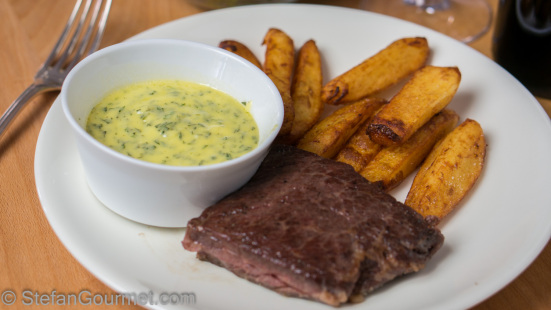
Béarnaise is one of the classic sauces from French cuisine and it is great with steak. The traditional way of preparing it au bain marie requires quite a bit of skill, as the sauces curdles easily. It also requires you to make clarified butter first. And even though you should make clarified butter to cook the steak anyway, using a slightly different technique you can make sauce béarnaise easily with minimal risk of curdling.
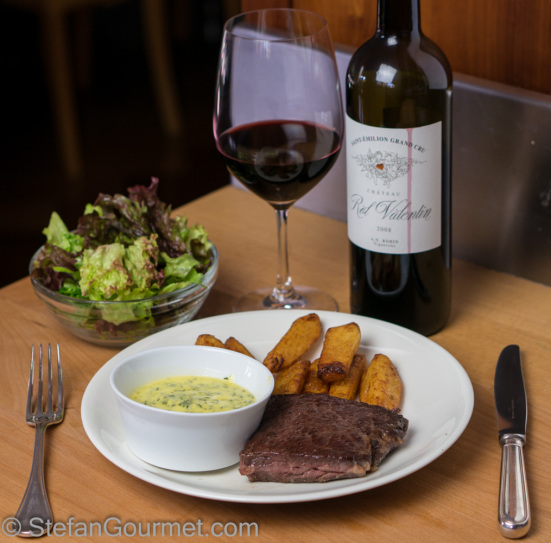
Last night’s dinner: a nice juicy steak cooked sous-vide and then seared quickly in very hot clarified butter, hand cut fries, sauce béarnaise, a green salad, and a nice glass of Saint-Émilion Grand Cru.
There are some variation on the recipe, but the basic idea of béarnaise is a hollandaise with tarragon. Some recipes also add parsley and chervil. Some recipes use tarragon vinegar, but instead you can just as easily use the stems of the…
View original post 376 more words
Radishes: Easter Egg vs. French Breakfast
Radishes are a sure sign of spring to me. The ones you grow yourself will be quite different from the one you get in the plastic bags at the supermarket.
Radish sandwiches are awesome–with a little salt and European-style butter on pumpernickel (especially freshly baked) accompanied by a glass of champagne.
We don’t usually think of radishes being treated as a vegetable. Here are some other things to do with them, e.g. radish soup.

I grow a lot of radishes. My husband, who’s not keen on too many vegetables, loves them. As does his father, who regularly sits down to an entire bowl, which he eats plain except for a sprinkling of salt. So every spring I make sure to put in a healthy radish patch, just to make sure I have some left for me!
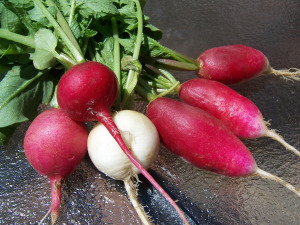 L: Easter Egg, R: French Breakfast
The two varieties I’ve been regularly growing for the past few years are Easter Egg and French Breakfast. Easter Egg is actually a mixture of varieties, which is one of its primary advantages. Radishes grow very quickly (mine mature anywhere from 4-6 weeks from sowing, depending on the weather), and they also quickly pass their prime. Sowing a mixture of varieties helps space out the harvest a bit, and with Easter Egg, you have that variation built in.
French Breakfast radishes mature slightly earlier than…
View original post 331 more words
Addendum to “Hard copy or Digital”
Aside
Addendum to Hard-copy or Digital?
I’ve admitted being an addict, so I do buy lots of cookbooks. It’s lovely to have the books where you can pull them out anytime and fondle them, but don’t forget about your public library.
I have an OverDrive app installed on all my electronic stuff so that I can check eBooks out of the library! It’s a great way to explore lots of book without needing extra shelf space, or spending money!
 a-single-serving.com