Spanish potato omelette (Tortilla Española)

Another favorite egg dish (though I don’t make this as often as the basic omelette) is tortilla Española or Spanish potato omelette–this takes a bit more time than basic omelette, but it is serious comfort food.  Though most recipes that I’ve seen recommend serving it at room temperature (and I love it that way too), I like the first serving still warm.  I don’t mind having some of this around to eat as recommended, at room temperature, especially in hot weather.  I usually make the entire 4 servings of this.

This recipe is adapted from The food of Spain and Portugal: The Complete Iberian Cuisine by Elisabeth Lambert Ortiz (p. 231) and allioli (p. 239).

Tortilla Española

Ingredients

  • 500 gm/1 pound potatoes, peeled and diced or thinly sliced (preferably waxy potato–red or Yukon gold).
  • 250 gm/8 ounces (about 3 medium) onions, finely chopped or sliced thin
  • salt and fresh-ground black pepper
  • 250 ml/8 fluid ounces (1 cup) olive oil
  • 5 large eggs, lightly beaten

Preparation

  • season the potatoes and onions with salt and pepper.
  • heat the oil in a large, heavy frying pan (skillet), preferably nonstick.
  • cook the potatoes and onions covered over low heat until soft, but not browned; stir gently from time to time.
  • drain the potatoes and onions through a sieve, reserving the oil.
  • stir the eggs with a little salt and pepper
  • add the potato and onion mixture, mix gently and allow to stand for 10 to 15 minutes.
  • wipe out the frying pan/skillet and add 4 tablespoons of the oil, and heat
  • add the egg, potato, and onion mixture and spread it evenly
  • cook over moderate heat shaking the pan occasionally to keep it from sticking.
  • when the omelette begins to brown underneath, put a plate over the skillet and invert the pan and slide the omelette onto the plate.
  • heat a little more oil and return the omelette to the pan with the browned side up.
  • cook it just long enough to brown the underside.
  • transfer to a warmed plate and serve hot or at room temperature.
As a garlic lover, I love to accompany the with allioli (garlic mayonnaise) so here is a recipe for that accompaniment:   
 

Allioli à la Catalana  (Garlic mayonnaise, Catalan-style)

Ingredients

Makes about 1 cup; will keep in the fridge for several days.  This is for serious garlic lovers–there is a less potent variation given in the book, as well as variations using egg yolks.

  • 1/2 large head of garlic, peeled and crushed.
  • 1 teaspoon (5 mL) lemon juice (or white wine vinegar)
  • 250 ml (1 cup) olive oil at room temperature
  • 1/2 teaspoon salt.

Preparation

  • put the crushed garlic into a small bowl (or a large mortar).
  • add the lemon juice or vinegar
  • stir to mix
  • gradually add the oil, stirring in the same direction until the oil is absorbed and the mixture has a mayonnaise-like consistency.
  • stir in salt to taste.

You don’t need to use expensive oil–the garlic flavor is very strong.  This can be made in a food processor or blender, but I think that it’s more trouble to clean either of those than to make it by hand.

If you don’t care to make the allioli from scratch, you can add crushed garlic to a good commercial mayonnaise, and adjust seasoning to taste with lemon juice (or vinegar).  When I do it this way I use Hellmann’s® mayonnaise–it is quicker, but not quite as good as making it from scratch.
Fast food: basic omelette

Whether you choose to spell it omelette or omelet, it’s still a god-send when cooking for one,  when you need fast food (even for several), or when you just want to make a meal without going to the grocery store.

Omelettes come in several styles–thin and rolled or folded, or thick and puffy; usually with filling or other added ingredients.  It’s the filling/topping possibilities that make this a meal in itself–these can range from a simple cheese filling to mixtures of vegetables, and even jam or jelly for a sweet treat.

My favorite style is the thin, folded (not puffy) with a filling of some sort–even “leftover” caprese salad in the summer time, or cheese, mushrooms, onions, and spinach–there are lots of “classic” fillings for omelettes that you see on restaurant menus–Denver, Spanish, Mexican, Greek, et cetera but there are virtually endless possibilities.

First, choose the appropriately sized pan:  I use an 6- to 8-inch skillet (All-Clad) when cooking a 2- or 3-egg omelette just for me (and the cat).  Too small and All-Clad stainless steel skilletthe omelette will be too thick to fold and too large, the omelette is too thin.  Just like other cooking for one, the size of the pan is important.

An omelette is most easily made in a skillet or frying pan because the slanted sides allow you to roll or fold the omelette easily.  You may see ads for “omelette pans” but the plain skillet or frying pan is the only thing that you need so long as it is of good quality and heat is conducted evenly.  Nonstick is not necessary–any good skillet, if preheated and oil added appropriately works fine.

If your filling needs cooking, e.g. mushrooms, onions, peppers, or the like, prepare that by sautéing the ingredients and setting them aside. You should allow about 1/4 to 1/3 cup of filling for each two eggs.  Your imagination and your taste are the only limitations on what can be used as a filling for your omelette.  Cheese of your choice is always good–add a salad and you’ve a meal right there.  Fresh herbs with tender greens such as spinach can be quickly sautéed with a little butter and/or olive oil and used as a filling.  In the summer, tomatoes, summer squash are possibilities.  Leftover boiled or roasted potatoes or roasted root veggies–certainly.  Even “tough” greens such as kale or chard can be used if precooked. Leftover fish or smoked salmon works well.  Even creamed spinach from the freezer, or just some of the salsa from a jar.  Recycle some of the sausage-potato casserole as omelette filling….

For a flat, folded (or rolled) omelette, I start with two large eggs, add a splash of milk or cream, a pinch of salt, and beat the eggs until yolks and whites are well blended.  I like to beat them with chopsticks or a fork since I don’t want the omelette to puff.

From Cook's Illustrated

French omelette

Using a whisk will incorporate air and those bubbles will expand and give you a somewhat puffy omelette, which I don’t like as well as the thinner, folded or rolled style.  I also prefer not to have my omelettes browned–I want that nice cooked, but still moist style.

For an evenly cooked omelette without spotty browning, you need to preheat your pan thoroughly (5 or 6 minutes) before adding the eggs so that they will cook evenly.

Over medium-high heat, add some butter (about 1-1/2 teaspoons).  When the foam subsides, pour in the beaten eggs, and pull the edges as they set toward the center of the pan, allowing unset egg to run to the edge–maybe 30 rule out 45 seconds.

Spread your filling over the surface of the omelette, cover (foil or a plate if you don’t have a lid that fits your frying pan) and remove from the heat for about 60 to 90 seconds to allow the residual heat to finish setting the eggs on the top of the omelette; it should appear moist, but not runny.  If it’s not set enough, return to the heat briefly with the cover still in place.

When cooked to your taste, use the chopsticks or fork to roll or fold the omelette.  I usually simply fold it into thirds, or even in half, rather than rolling it up. Turn out on a plate, and it’s ready to eat.

—<§>—

Omelettes are ubiquitous…for an interesting survey of variations (including some seen on restaurant menus) see the Wikipedia article on omelettes.  Your taste is your guide to making this a quick, delectable meal.

A son goût!  

Comfort food: baked potatoes

It’s another chilly day here, but at least the rain has stopped and the sun is out off and on now, but the thermometer is still reading only 51 ° F .  Despite the chill, a neighbor and I ventured out to go to the wine tasting at the Wine Authorities.  as well as the usual great wines, there was cheese from the Reliable Cheese Company (with samples).  The Tomme de Savoie was very tempting, but when I saw the raclette, I passed on the Tomme since it’s only for me (and the cat). I got the raclette instead so that I could  make one of my favorite special comfort foods:  baked potato with raclette cheese melted over it.

Just plain baked potatoes are one of my favorite comfort foods!  I don’t mean anything fancy like “twice-baked” potatoes  (love those too)—just a really good baked potato that has seen neither the inside of a microwave oven, nor the inside of a foil package.

Russet (baking potato)

a baking potato

When you select your potato for baking, you want one that is as evenly shaped as possible, in addition to being a good potato in general.  (See potatoes.)

Here are three basic recipes for baked potatoes (adapted from Cook’s Illustrated).  Easy…and worth the time.  Cheaper than eating out too–you’d have to go to a really expensive restaurant to get as good a baked potato as any of these recipes will give you.

Basic oven-baked potato

This method will give you a baked potato with a really great  skin to munch on along with that lovely interior.

  • Preheat oven to 350 ° F
  • Scrub a russet potato thoroughly and dry well.
  • Place potato in the middle rack of the oven and bake for 1 hour and 15 minutes.
  • Remove and open immediately (to let steam escape) and serve.

Salt-baked potato

This method can give the potato a flavor boost, especially if you include herbs and/or garlic in the covered dish while the potato is baking.  It will give you the fluffiest inside and a tender but lightly crisped skin on the top.

  • Preheat oven to 450 ° F
  • Scrub a russet potato thoroughly and dry well.
  • In a small baking dish, place a layer of kosher salt about 1/2-inch thick (about 1 cup for this particular dish).
  • Place the potato on the salt, broad side down.
  • Cover with foil or place in a covered baking dish and bake in the middle position of oven for 1 hour and 15 minutes
  • Remove foil, brush the potato with 1 teaspoon olive oil and return to the oven until tender when pierced with the tip of a paring knife.
  • Remove, brush off excess salt, open immediately, and serve.

Oven-baked sweet potato

This is for the orange-fleshed, wetter varieties.  If you have a white sweet potato (yum) it has much drier flesh, and I typically treat it as a russet potato.

  •  Scrub thoroughly. Prick lightly with a fork in three places, or multiple times with the tip of a paring knife.
  • Preheat oven to 400 ° F
  • Rub the potato with olive oil and place on a foil-covered pan, on the middle rack of the oven.
  • Bake 40 to 50 minutes until it’s tender when pierced with the tip of a knife.
  • Open immediately, season to taste, and serve.
«◊♦◊»
Wedge of raclette cheese

Raclette cheese

When you want to be a little extra special with even the most comfy of foods–just add more comfort food.  One of my favorite extra comfy foods is baked potato with cheese; and my all time favorite for baked potato with cheese is baked potato with raclette.  Never mind the butter, sour cream and all that stuff (admittedly wonderful), but in this case it’s totally unnecessary.

Raclette is a semi-hard cow’s milk cheese that is mellow, nutty and earthy.  A dish by that name is typically served with the cheese melted over potatoes (usually

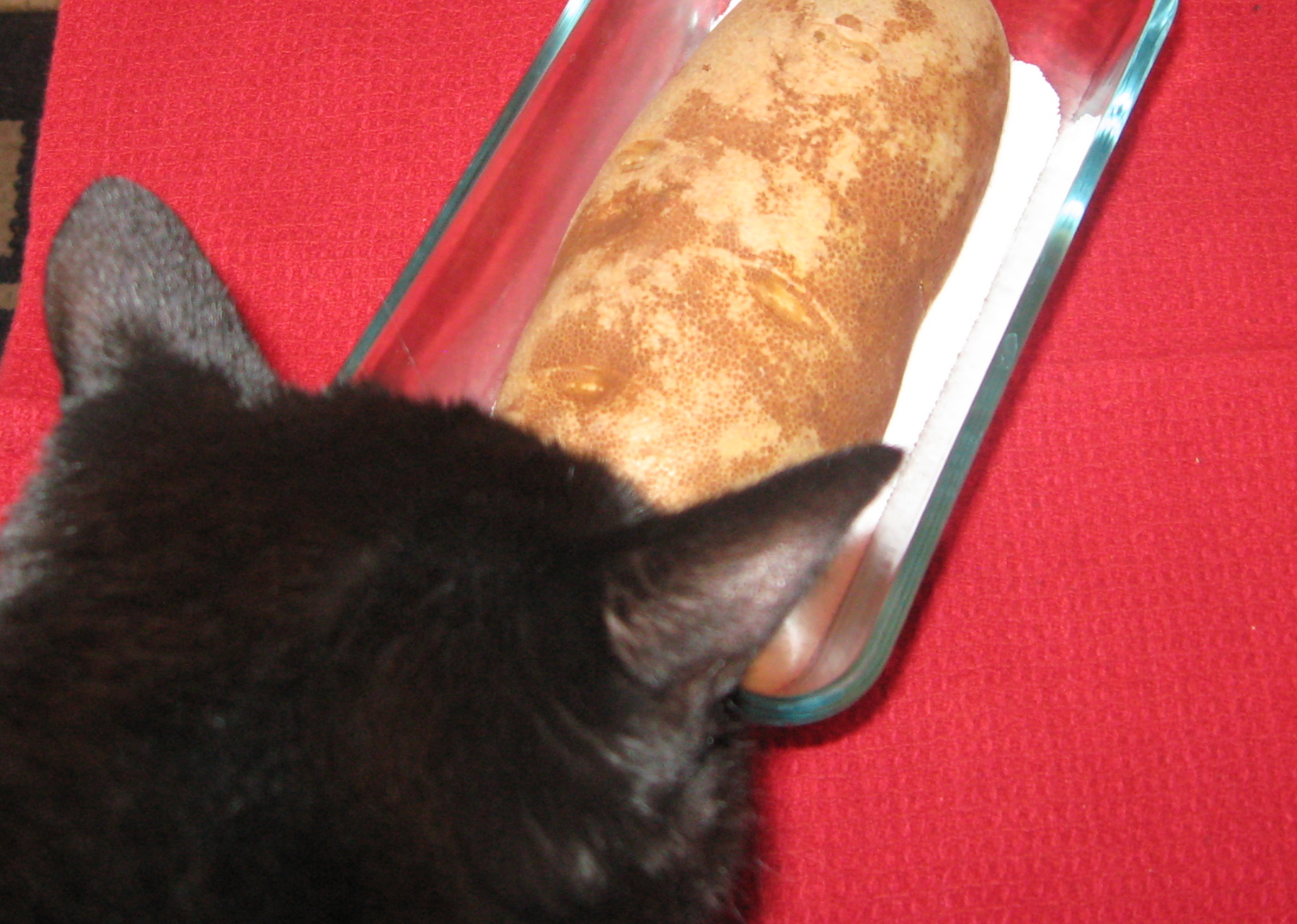
black cat looking at potato

Is it mine?

boiled) and gherkins (pickles made from specially grown small cucumbers). While what I’m having here is not traditional raclette, it is a real treat.  (All cooking and recipes are tested and approved (or not) by Keiko, the cat.)

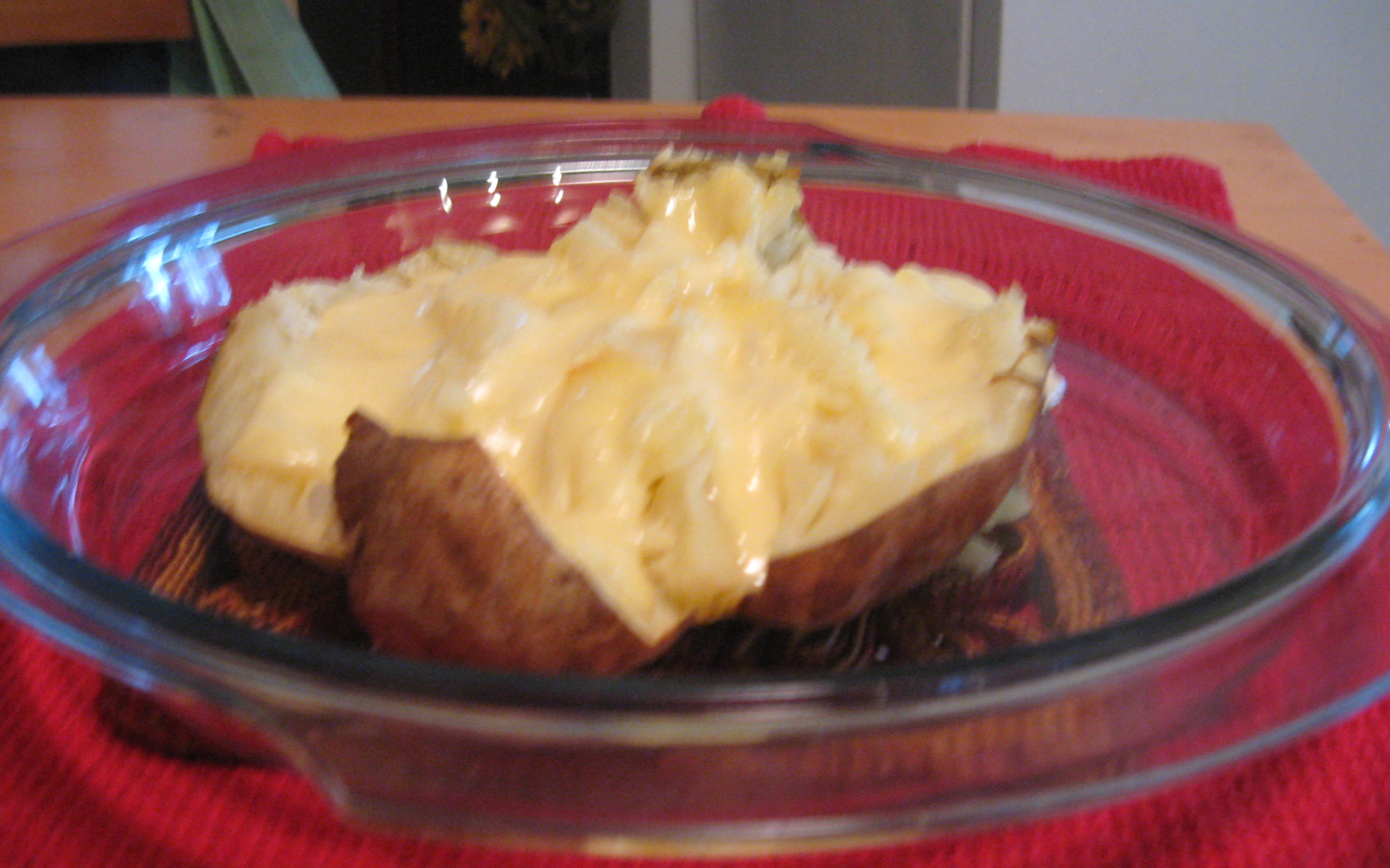
I made a salt-baked potato and finished it as directed in the recipe, and after opening it, laid slices of raclette over the top, and put it back into the oven to let the cheese melt (not under the broiler).

baked potato topped with raclette cheese

Comfort food for supper

The  main course was just that big baked potato and cheese, with a glass of champagne (no cornichons though)!  I had really intended to have a first course of roasted baby carrots and baby zucchini with vinaigrette dressing….but that was not just BIG potato–it was a HUGE potato, so it was my evening to have just that–I had fruits and veggies for breakfast and lunch anyway.)

 −«◊»–

The Reliable Cheese Company–update

Unfortunately, the Reliable Cheese Company is no longer in business, but I’m leaving this because of the links to cheeses and charcuterie. Very sad to see this close; now for cheeses in this area, there is a Fresh Market, A Southern Season (which has an awesome selection of cheese and charcuterie). Wine Authorities carries some special cheeses, and the Durham Farmers’ Market has cheese vendors who come there.  Whole Foods also carries cheese. My local Harris Teeter  has a rather good selection of pre-cut cheeses–e.g. I can find Etorki there frequently.

After going to the Wine Authorities tasting on Saturday and coming home with raclette, I just had to go check out the Reliable Cheese Company this afternoon (not open on Mondays, but are on Sunday afternoons).  It’s not exactly on my way home, but I expect that I’ll be following that route more often in the future!

There were some great cheeses in the case–I could cheerfully do one of each.  There were other goodies like slab bacon,  bresaola, just to mention a few.  The Facebook page will keep you up to date on what’s happening at Reliable Cheese Company.

Came home with some lovely, luscious Taleggio cheese–just perfect texture. This is going to get a bottle of Gewürztraminer or Riesling opened to enjoy while nibbling on this cheese–It will need nothing more than some fresh bread and a bit of fruit to make supper.

Then I found the mortadella and had to bring home enough for one decent sandwich (that’s lunch tomorrow).

After perusing the sandwich menu, I could not walk out without my supper.  I came away  with the country ham, blue cheese, and fig jam  sandwich.

Egg basics

In my kitchen, being out of eggs is right up there with being out of onions, garlic, and chocolate!

The egg is packaged by nature to have a long shelf-life–as long as they are treated properly between hen and home.  I want the hen to be treated properly as well so I buy my eggs from the farmers’ market where I know the farmers.  That gives me better eggs–yellower yolks and more omega-3 fatty acids nutritionally, and better flavor.  (Cook’s Illustrated had a blind tasting of eggs with differing levels of omega-3 fatty acids and guess who won?  High omega-e fatty acids did give yolks a richer taste.) Color of the shell has nothing to do with quality of the egg–that has to do with the breed of chicken and how its diet.

The down side of eggs?  Well, there’s Salmonella but a little care is purchasing, storage, and cooking really takes care of that–buying fresh eggs from someone you know is a good start.  Your vendor should have the eggs refrigerated and you should keep them cool until you get to your refrigerator.

Once home, store eggs in the refrigerator, either in the carton or in a closed container.  If your refrigerator has those little plastic dents on the door to hold a dozen eggs, ignore it.  That’s not the place to store eggs for several reasons: it’s not cold and there are frequent temperature changes as you open the door.  Eggs need some protection to avoid moisture loss, and agitation of opening and closing the door can affect texture/consistency of the whites particularly.  You can also store eggs in a closed container to further retard moisture loss, but can accentuate

The expected “shelf-life” of eggs is really several weeks past the sell-by date (for supermarket eggs).  Eggs seldom spoil, although  some moisture loss will occur, nutritional value remains good for a long time–after all, think of the purpose of the egg.  Eggs can pick up odors in the refrigerator since the shells are porous.

Because of the potential for Salmonella food poisoning, eggs do need to be cooked carefully, but from one or two eggs anyone with a normal immune system is very unlikely to get Salmonella enteritis from a sunny-side, over-easy or soft-cooked egg if handled properly.  For one thing, egg dishes should be served promptly and not left sitting out.

For soft-cooked eggs, it is possible to “pasteurize” them by holding them at a temperature of 140 ° F for 30 minutes–this is a temperature that does not continue to harden the yolks, but will kill bacteria.  Eggs which reach a cooking temperature of 160 ° F are safe.

Sometimes you need to know egg sizes since they are not interchangeable. Harold McGee, in Keys to Good Cooking gives the following weights for egg sizes:

  • jumbo = 2.5 ounces or 70 grams
  • extra-large = 2.25 ounces or 63 grams
  • large = 2 ounces or 56 grams
  • medium = 1.75 ounces or 49 grams
These equivalents will let you correct for the size eggs that you have and what is called for in a recipe, since eggs purchased at the farmers’ market are not likely to be of uniform sizes.
For more detailed discussion of eggs, see Keys to Good Cooking and Kitchen Science by Harold McGee. There are also lots of fun and useful egg facts in these two books.

Cool pink things for summer

After the wonderful strawberry ice cream yesterday afternoon, I more “cool pink” for supper: watermelon with feta cheese and mint.

It’s right up there with beet soup for a refreshing summer meal or side dish.  I probably should not even call it a salad:  no dressing or anything except the natural juices.  I’ve seen suggestions for dressings such as buttermilk/lime, but I’ve not tried that–have some buttermilk in the fridge so maybe I’ll taste it with that  when I make more this afternoon.

There really is no recipe for this:

  •  watermelon, cut into pieces or cut with  melon-baller.  Use however much you think you might eat–I usually add some extra  because I will usually eat more.
  • mint–preferably spearmint  (Kentucky Colonel is especially good), chopped medium or cut into chiffonade–several sprigs
  • feta cheese–your favorite feta cheese, cut into small cubes or crumbled.
Toss the watermelon and the mint and let this chill in the refrigerator for about an hour.  You want the mint and melon to “meld”–if you don’t do this, you get separate flavors of mint and melon (which is not bad either) instead of something like mintmelonmint.  After this melding, add the feta cheese, and eat!
If the melon stands with the feta cheese, the texture of the melon becomes a bit soggy, presumable from the salt in the feta cheese,  so it’s best made freshly.  You can let the mint/melon mix stand in the fridge longer, though.
I suspect that other salty cheese could be substituted for the feta–e.g. pecorino or some of the Greek cheeses.

Cannellini & Italian sausage supper

One Italian sausage provides seasoning and a bit of meat for two meals.  The starting point gives enough for two servings.  When I’m using the Italian sausage for two separate meals like this, I usually buy sweet instead of hot, since I can readily add the heat I’d like with crushed red pepper flakes at the time I’m preparing the meal.

  • 1 medium onion, halved lengthwise and thinly sliced
  • 1 sweet Italian sausage, meat removed from the casing and crumbled
  • 4 cloves garlic, minced
  • 1 tablespoon olive oil
  • 2 cups cooked, drained white beans (cannellini or great northern) or 15-ounce can rinsed and drained
  • 2 tablespoon water

In a 12 inch skillet with a tight-fitting cover, add the olive oil; when the skillet is heated add the sliced onion, and cook until it is beginning to brown. Add the sausage and brown.  Add minced garlic and cook about 2 minutes.  Add the rinsed beans, and cook covered about 5 minutes.

Remove half the bean/onion/sausage mixture to be used for a second meal.  Cool and refrigerate.

Meal 1:

  • Half the bean/onion/sausage mixture
  • about 15 grape/cherry tomatoes, halved
  • 1/4 cup antipasto salad mix (pitted olives, peppers, carrots) from the salad bar, chopped finely.
  • several sprinkles of crushed red pepper flakes
  • 2-3 teaspoons chopped fresh sweet marjoram or Turkish/Greek oregano, or 1/2 teaspoon dried herbs.
  • a single-serving size handful of haricots verts
  • 1 teaspoon water
  • salt and fresh-ground black pepper to taste (the antipasto salad is salty so taste before you add additional salt.

Add the herbs, the chopped antipasto salad, crushed red pepper flakes and mix well.  Over medium low heat, add the tomatoes, lay the haricots verts on top of the cannellini beans, add the water, cover tightly and continue to cook until  the haricots verts are tender.  Serve with shavings of Pecorino Romano over the canellinni beans, and the haricots verts on the side, drizzled with a few drops of extra-virgin olive oil.

Meal 2:

  • the reserved cannellini bean/onion/sausage mixture
  • about 15 grape/cherry tomatoes, halved
  • 3 generous handfuls baby spinach
  • 1 tablespoon water
  • salt and fresh-ground black pepper to taste

Place the cannellini bean/onion/sausage in sauté pan, add the water, halved tomatoes, and cover.  Heat gently for about 5 minutes (until starts to steam).  Add the spinach, cover, and allow spinach to wilt.  Toss to combine with the bean mixture.

I had this with some steam-sautéed carrots as an additional vegetable.  Add a glass of good friendly red wine and its a very satisfying meal that’s easy and economical.

Insalata caprese

One of my favorite things during tomato season is caprese salad.  It’s satisfying and easy to do.  I didn’t do mozzarella di bufala, but I did have fresh mozzarella from the Durham Farmers’ Market (Chapel Hill Creamery) and that was splendid.  Sometimes I get a little over-exuberant and I have leftovers from this.  Next day it’s not quite what I’d want just as is.  (There really can be too much of a good thing at times.)  I’d seen a post on Closet Cooking suggesting a caprese sandwich on ciabatta; that looked really sumptuous, but mine was a leftover.  Standing there staring into the refrigerator, I realized that though I did not have ciabatta, I had some good, homemade olive oil bread–how about turning this into a grilled cheese and tomato sandwich?  Lay the slices of seasoned tomato and mozzarella on my hearty bread, brush the outsides lightly with olive oil, and pop it on the cast-iron griddle that lives on top of my gas stove.  Wonderful way to use a leftover thanks to the inspiration of the post on Closet Cooking.

This is not the first time that I’ve gotten carried away with insalata caprese–I’ve also used the leftovers as a filling for an omelette.  I’m sure there must be other ways to use leftovers and I’m always looking for them especially in the summer time because, if not this summer, I’ll need them next summer, or the one after that.