Winter sunrise

winter sunrise

My kitchen window is really the first thing that I actually attend to each day. It may well set the tone of my day–at least for what I want to eat.

It’s the view I have while getting enough caffeine into my system to become a functional person. Sitting at the kitchen table, with a café latte in hand, watching a winter sunrise is a good start for the day.

.

Ò¿Ó


Holiday time again….

Like it or not the holiday season approaches. I’ve one Christmas gift to order yet, but then I’m through. I thought I’d pass on a few suggestions for gifts for those of you who still have a cooking person on your list to shop for:

  • Volrath French carbon steel skillet: probably my most-used, it has the advantages of cast iron, without the weight.
  • Romertopf clay cooker: a go-to especially for one-dish meals in cold weather.
  • Home espresso machine: Can’t start the morning without my jolt of caffeine either straight espresso or café latte.
  • Clever Coffee Dripper: If I’m not wanting quite the jolt of espresso this gets something more like French press, with the benefit of a filter to eliminate the sediment.
  • Kunh Rincon garlic press: If garlic is a cooking necessity, a garlic press can be a time-saver, or it can be a total nuisance when you have to clean it, so you don’t use it. This is a good one, recommended by Cook’s Illustrated after testing lots of them.*
  • Max Burton Portable Induction cook unit: Live where it’s hot and humid in the summer? You just hate to turn on the stove? Induction cooking is much cooler–though it does require cookware that is either stainless steel or iron.  If a magnet won’t stick on your cookware, then you need the Hob Heat Diffuser that will allow you to use other cookware with the induction unit.
  • Pressure cooker: The Fissler FSSFIS5859 Vitaquick Pressure Cooker was the winner of the Cook’s Illustrated testing* and is pricey.  The runner-up was the Fagor Duo line, less pricey, highly recommended and noted as “best buy”. (This is the one I’ve used.) This cooker does work with induction cook units–a real plus in hot, humid weather when you still want those dried beans cooked.
  • Fasta Pasta Microwave pasta cooker: This is a real gem to have in the kitchen! So much easier than boiling that big pot of water–again great in hot, humid weather, but once you start using it, you’re hooked. Again this is a kitchen “gadget” that was tested by Cook’s Illustrated.*
  • If the cook you’re shopping for is just getting a kitchen set up, there’s always some of the essentials for good cooking: Penzeys herbs and spices, either basic, for bakers or for the cook starting to branch out, a do-it-yourself box of specialty herbs and spices.  If you have someone on your list who has to watch sodium intake, there are lots of salt-free blends. If you buying for a cook pressed for time, seasoning blends can be real time-savers–in my kitchen I don’t want to be without herbes de Provence for that time when I’m just too rushed to think blending my own.
  • For relaxation and enjoyment,  either alone or with company, a selection off teas to have on a leisurely morning, or relaxing afternoon break.  Harney & Sons Master Tea Blenders have a fantastic selection–black, green, herbal, flavored, and all the accessories necessary to make a special occasion. Teas can be ordered individually, or there are collections ready made.  If you’re unsure what tea would please your “giftee” most, then send a selection of samples–for a modest $2 you can send enough to brew a decent pot of many teas. Some very expensive ones–e.g. Black King which rings up at $240.00/pound–the sample may run $5. What a great way to let someone explore fine teas–treat yourself.
  • Like a liqueur to sip while relaxing? If you’re in North Carolina, there are some lovely liqueurs made in Durham by the Brothers Vilgalys: Krupnikas, a spice honey liqueur would be a real treat, or look at the unusual liqueurs they make: Beatmik, Beebop, Zaphod, and Jabberwok.  All are great in cocktails, for just sipping straight, added to hot chocolate or hot cocoa.  If you’re not in North Carolina you may still be able to get these delightful liqueurs through other distributors.

Wishing you and your favorite cook very happy holidays–lots of good food, friends, conversations, as well as wines and spirits!

__________________________________________________________

*Cook’s Illustrated equipment testing is done without manufacturers knowledge until after publication, and products tested are chosen for consumer benefit. They do not accept requests for testing from manufacturers.

.

Ò¿Ó

.

Hot Cocoa

It’s been a chilly, damp, drippy Monday–the kind of day that takes an inordinate amount of caffeine to achieve a minimally functional state. The day’s to-do list included taking the cat to the vet. Of course it was raining  when I toted Frankie out to the car, and it was raining when we came out of the veterinarian’s office. Frankie was lucky–he was in the carrier and dry (not that he was at all appreciative of that).  Now we’re back indoors.  It’s still chilly, damp, drippy Monday–but now dark.  It’s time for a warm beverage that must have chocolate in some form in it–but there must be lots of if.  That means hot coca!

The hot chocolate is sipping chocolate–thick, rich, creamy–for when you feel truly decadent and in need of something sensuous as well as chocolate. There are times when chocolate is required–after a long walk in the snow, or after you’ve finished all the errands that made you go out on a cold, damp, grey, and miserable day. Those are the times when I want hot cocoa–a lighter beverage that comes in a BIG mug (and maybe even whipped cream) to warm me up. It has to be lighter than drinking chocolate because I want to drink more just because. I don’t want the stuff from the grocery store shelves that is supposedly “hot cocoa” but is usually too sweet and lacking in cocoa/chocolate flavor (e.g. Swiss Miss or Nestle’s).

Some chocolatiers have cocoa or drinking-chocolate prepared mixes that are very good–Chuao chocolate Spicy Mayan (expensive and really drinking chocolate), Starbucks, Ghiradelli, to mention a few of the up-scale ones. Even with these, I feel that the cocoa flavor is a bit lacking–I end up using more than suggested on the package,  and they are often sweeter than I like–I’m paying for lots of sugar and powdered milk. For a review of a hot cocoa mixes see Serious Eats.

Scharffen Berger does have sweetened cocoa powder–though more flexible, you’re paying for sugar (that you can get at the grocers inexpensively and you probably already have it in the kitchen).  So, how do I get my great big, steaming, warming mug of hot cocoa?

I’ll start with a premium cocoa: Valrhona is a favorite, Ghiradelli but  you can use the cocoa powder of your choice. The basic recipe for hot cocoa for one is from Epicurious. (On particularly miserable days, I recommend doubling the recipe even if it is just for one.)

Simple Hot Cocoa for One

Ingredients

  • 2 tablespoons unsweetened cocoa powder
  • 1 to 2 tablespoons sugar (depending on how sweet you like it
  • Pinch of salt
  • 1 cup milk or any combination of milk, half-and-half, or cream
  • 1/4 teaspoon vanilla extract

Preparation

  • Whisk together the cocoa, sugar, salt, and about 2 tablespoons milk in a small saucepan over medium-low heat until cocoa and sugar are dissolved.
  • Whisk in the rest of the milk and heat it over medium heat, whisking occasionally, until it is hot.
  • Stir in the vanilla and serve.
  • If you like it frothy, blend it in the blender
  • This recipe multiplies easily. When you get up to a quart of milk, use 1/4 teaspoon salt

For a bit more oomph, you can use both chocolate and cocoa together–and if you don’t want to do more that heat milk to get you cocoa and chocolate fix, here is a recipe for The Best Hot Chocolate Mix from Cook’s Illustrated, November/December 2014, page 23 that makes enough mix for 12 one-cup servings. Frankly, I get less than 12 since I usually use a big mug.

The Best Hot Chocolate Mix

Ingredients

  • 1 cup (7 ounces) sugar
  • 6 ounces unsweetened chocolate, chopped fine
  • 1 cup (3 ounces) unsweetened cocoa powder
  • 1/2 cup (1-1/2 ounces) nonfat dry milk powder
  • 5 teaspoons cornstarch
  • 1 teaspoon vanilla extract
  • 3/4 teaspoon kosher salt

Preparation

  • Process all the ingredients in food processor until ground to powder (30 to 60 seconds, or as needed)
  • Store in airtight container at room temperature for up to 2 months.

Making hot chocolate

For 1 serving:

  • Heat one cup milk (whole, 2%, or 1% low fat) over medium heat until steaming and bubbles appear around the edge of the pan.
  • Add 1/4 cup (4 tablespoons) hot chocolate mix
  • Continue to heat, whisking constantly, until simmering (another 2-3 minutes)
  • Pour into a heated mug and serve

Ò¿Ó

Hot chocolate or hot coca sometimes begs to be dressed up with some additions like Krupnikas or perhaps Jabberwok. If you’re going to add a sweetened liquor like Krupnikas, you may not want to use a mix (as above) that contains sugar. You can only tell by tasting.

Other liqueurs that to dress up hot chocolate or cocoa beverages:

Ò¿Ó

It’s always fun to dress up your hot cocoa–but for me, forget the marshmallows (unless they are homemade), and the whipped cream (unnecessary when you use at least part half-and-half), but adding some spices or other flavors can be fun. Sometimes I make hot chocolate with favorite chocolate bars:  Chuao Spicy Mayan bars, and I sometimes use that to make hot chocolate. My local Harris Teeter has a “house” dark chocolate with orange that makes a great cup of hot chocolate, and the pear and dark chocolate is a way to get a boost if your bar doesn’t include the liqueurs.

Ò¿Ó

Fall frustration

I love fall. One of my favorite things is the flaming color of the sugar maple leaves. My kitchen window looks out into a sugar maple tree–and it’s usually gorgeous.  This year, with all the rain, it’s not developed that flaming red that I love so much.  It’s been more yellow and transitioning to brown–but still lovely, but not flamboyant as usual.

yellow leaves through window


Ò¿Ó

.

Breakfast

Nutritional information—or what passes for it—abounds on the internet and in books that you can check out from the library, or find as you pass through the checkout line at the grocery store, but it’s frustrating. It’s constantly changing. Many—really most of us—don’t have the background in physiology, medicine, or the time to do our own detailed research to assess it. You can read the books, e.g. Good Calories, Bad Calories ( (Taubes, Good Calories, Bad Calories 2007), Why We Get Fat ( (Taubes, Why We Get Fat: And What to Do About It 2010), or The Big Fat Surprise (Teicholz 2015) which are extensively researched and well documented. But it still can be confusing, especially if you want more specific information. There’s the Paleo diet, the Atkins diet, the Mediterranean diet….and even The New Atkins for a New You (Westerman and Phinney 2010). So much information, so much controversy. . .

Then there are the things that our grandmothers told us—eat your veggies, and your fruits—but the one that I remember most is that breakfast is a must-have meal. That seems to be one of the less controversial bits of advice out there. There’s only one problem—breakfast is supposed to happen when you wake up. Now, according to the Merriam-Webster Unabridged Dictionary, wake up, awake or awaken, means to “stop sleeping”. The problem is that for some of us awakening is not the same as achieving a state of functioning (“performing a group of related acts and process” according to the dictionary). We awaken, and the functioning state is bestowed later–sometimes much later and only with an appropriate amount of caffeine.

Every time I have to say whether I’m a “morning person” I face a quandary—I love early mornings—the cool part of the day, with the inspiration of the sunrise. So in that sense, I’m a morning person. Add functionality to that and there is a problem. Until I’ve had my morning cafè latte or espresso function is simply out of the question. Making breakfast requires functioning—albeit minimal. I can manage the kind of functioning required to get the espresso machine to spit out the liquid caffeine portion of my latte. Actual breakfast is another issue.

Another issue for me is that first thing in the morning, even as much as I love breakfast food, I don’t want to eat. Food? Yuck! So I have my two café lattes, and by then I should be at my computer working on the current index—breakfast gets another miss.

Every New Year (and probably again this coming one) my resolutions include eating more healthily. That would include giving my body morning fuel. Every year it goes by the wayside because of non-functioning in the morning. So I’m attuned to things that will get me food with least effort in the morning. I’m willing to admit that cooking eggs seems pretty simple, but diet-wise I doubt the nutritional wisdom of bacon and eggs daily partly from the caloric point of view.

In the winter (especially if the view from the kitchen window reveals a cold, grey, damp, day) a breakfast favorite is oatmeal (don’t DO cold cereals on a taste or nutritional basis). Specifically, I want oatmeal with some tooth to it—which really eliminates the quick stuff. I want the steel-cut, slow-cooking stuff. It’s the slow-cooking part that hurts. So I’m constantly on the lookout for things that might help me keep that New Year’s resolution—and maybe even contribute to more healthy eating (and weight loss.

If you search the web, you can find numerous suggestion on how to cook steel-cut oats—some reducing the cooking time to 30 minutes. Even with that, it’s still not in my range of morning functionality—I won’t enumerate the number of ways is possible to screw up when your functioning is barely above brain-dead.

In my recent perusal of the blogs that I follow I was delighted to see a post entitled How To Make Oatmeal in Jars: One Week of Breakfast in 5 Minutes. First of all, it promised make-ahead, and then you’ve probably gathered that I’m a fan of Ball/Mason jars so I have lots of those around.

The prep is simple (see full post for discussion and details)

  • Combine 1-2/3 cups steel-cut oats with 4 cups water, ¼ teaspoon salt.
  • Bring to boil and cook for 3 minutes.
  • Put it into jars, and when it reaches room temperature, cap and refrigerate.
  • To eat, microwave 2 to 3 minutes, add whatever you wish and eat.

My only change to this is something I’ve done for a long time when I’m cooking oatmeal—substitute milk or oat milk for 3 cups of the water and divide into 7 servings since I just don’t eat that much in the morning. The three-minute boil gives chewy kernels; I actually prefer just a bit less chew, so I boil for 5 minutes.

I like to use 1/2-pint jars for this as they will sit in a coffee mug so I don’t have to handle the hot jar or put it into something else to eat–admittedly I do at times end up taking my breakfast on my “commute” into the office and eating at my desk. (I know–not a good thing to do, but it happens when deadlines are close.) Filled only to about 2/3 there’s still room to add things on top–then this recipe works for about 7 days.

Another alternative to “quicken” up the steel-cut oats is to do an overnight soak at room temperature; Maria Speck, in her book on ancient grains, suggests that this will reduce cooking time to about 7 minutes.  My issues with this are that it requires planning ahead. Once the oats are soaked, they need to be cooked. I am, admittedly, a very temperamental, picky eater: I might wake up not wanting to eat oats for breakfast. By precooking and refrigerating, I do give myself a little leeway to be picky without throwing something out.

On more relaxed mornings, I’ll make other versions of steel-cut oats. A favorite is from Alton Brown via the Food Network. Love the toasting before adding liquid. Adding the milk and buttermilk adds richness and tanginess. His point here about stirring in the dairy does make a difference. I’ll admit to not being the owner of a true Scottish-style spurtle but a Holland-style spoodle to be a bit gentler with my steel-cut oats.

Now, for breakfast. . . a drizzle of some luscious varietal honey like French lavender, tupelo, sourwood, or maybe leatherwood, or thyme, or just wildflower or clover, or orange blossom, or maybe just some butter, or possibly milk, or…it may well depend on what I see from my kitchen window!

Ò¿Ó

Risotto for one

A traditional risotto, scaled for one.

Christina Hernandez Sherwood's avatarSpaghetti & Meatballs

It’s no secret that I love risotto (Exhibit A, Exhibit B). It can be a time-intensive dish, so my tendency has always been to make risotto in bulk.

But after a few delicious risotto meals recently, I realized I didn’t have enough ingredients left to make any of my favorite risotto recipes without buying more supplies. The idea of risotto for one was born.

I scoured several risotto recipes for larger groups and tweaked them to fit my ingredient supply. This risotto is deliciously simple and just the right size for one. Enjoy!

Ingredients:

  • 1 tablespoon butter
  • A few tablespoons chopped onion
  • 1/4 cup dry white wine
  • 1 1/2 cups chicken or vegetable stock
  • 1/2 cup Arborio rice
  • A few tablespoons grated Parmesan or Romano cheese
  • Salt and pepper
  • Olive oil
Directions:
  • Warm the stock in a pot over medium heat.
  • In a separate pot, melt the butter. Cook…

View original post 175 more words

Sunday with simple pleasures. . .

Not doing much at all today–just enjoying the October weather, fall and the color that’s starting to show.

I’ve been out to the hive to see what’s happening–so relaxing to sit there watching, with the bees buzzing by (and around me).  They are carrying in pollen and nectar at a great rate–they’ve not taken much of the sugar syrup from the feeder.  They know where the good stuff is. IMG_7250

Made a comfort food lunch: grilled cheese sandwich and tomato soup.  But–not the American processed cheese and Campbell’s Cream of Tomato soup.  I still like the combination, but I’ve kicked it up a notch.  Today the grilled cheese was Vermont extra sharp cheddar and pumpernickel bread.  The soup?  No, I didn’t make it myself. My local Harris Teeter had a BOGO on their “chef’s recipe” soups so I indulged.  Their tomato basil is a favorite: it’s not overwhelmed with basil, it’s not too salty, and it has chunks of tomato in it. (It’s not cheap, but reasonable at BOGO, and it can be frozen! It’s good, and easy.  Sometimes easy is necessary–but can’t give up good for easy!

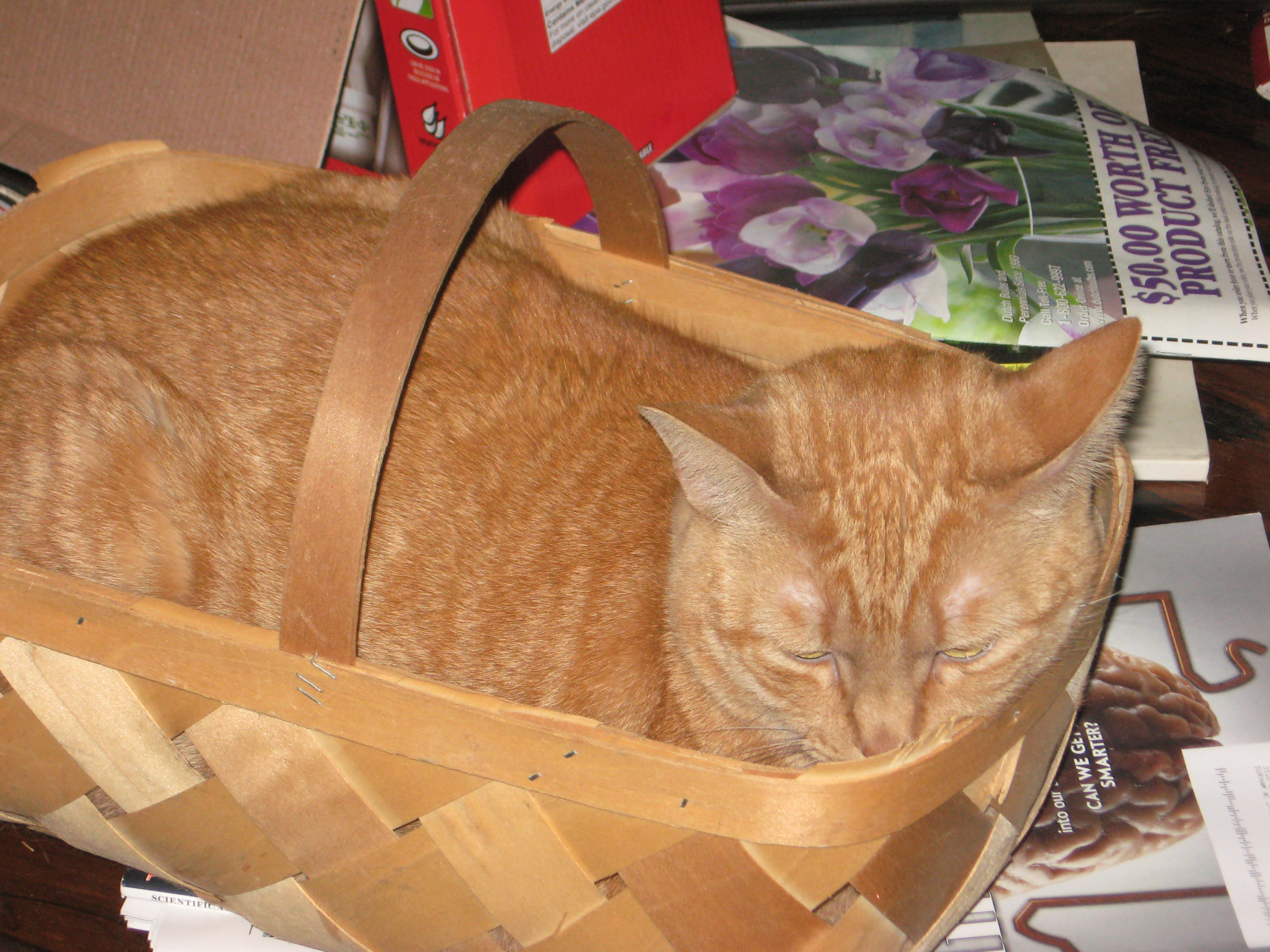
Nice comfort lunch, lazy day…the cat approves!

Ö¿Ô

What I learned in the kitchen

Source: What I learned in the kitchen

I found this while perusing the blogs that I follow (Cooking without Limits). If we were to follow these in the kitchen, cooking might cease to be frustrating, and something that we don’t want to do.


Too much convenience?

Mueller's Pot-Sized PastaI was striding purposefully down the aisle of my local Harris Teeter when a package caught my eye–and brought me to a screeching halt–pot-sized spaghetti? This is something that you buy?  You don’t just take the regular spaghetti and break it, assuming that you’re not going to just put it into the water slowly, letting it soften until it’s all in the water?

Pot-sized angel hair?

Pot-sized thin spaghetti?

Pot-sized linguine?  Really? I was amazed, or maybe stupefied, or maybe the only thing that really covers my reaction was what I understand the British expression–gobsmacked–to mean!  Are we so far from “home cooking” that we can’t even deal with pasta unless it’s pot-sized. As you can tell this catapulted me right onto my soapbox, or maybe even onto my high horse (which every you prefer). Has having pot-sized pasta brought down the price of my plain spaghetti that’s too long to fit in the pot unless I stand there and lower it slowly into the water? Not being a marketer, or an economist, merely a consumer, I really doubt that  it has. (Besides, I think this would be too short to twirl effectively to wrap it around my fork.) Not something I’m likely to buy (even though I do sometimes buy other Mueller’s pastas.

jar of mixed rice and grainsI went past the pasta display because I was on my way to something of a convenience nature for me: one of the packages of grain mixes. Those don’t leave me gaping.  They are very useful for single-serving cooking.  My latest is an HT Traders mix of basmati brown rice, red rice, with barley and rye berries. That’s my idea of convenience–I don’t have to buy the standard package of each of those grains: that would be about 1-3/4 pounds of basmati rice, and who knows how much red rice and rye berries. I most likely would not use that mix if I had to buy each of those separately–unless I could buy each from bulk supplies.

That kind of convenience I can get my mind around. I do have packages of barley, oats, but even the dried things don’t have unlimited shelf-life. They don’t  spoil–in other words they are not perishable. If you store them carefully in glass jars with good seals, they should not get buggy, but keep them long enough and they won’t hydrate as well, taking longer to cook. For some dried goods like beans, you may get to the point where they will never soften appropriately.

Of course, there’s also the issue of storage space–for those of us without the luxury of a large pantry with miles of shelf space, but who do like variety this is a great alternative. It has another benefit: it’s compatible with the rice cooker.  I’m happy to more of the “esoteric” grains show up in my local supermarket–they are cheaper than if I were to go to a specialty shop, not to mention just closer to home.

mixed grains

Thought for food. . . .

I am enjoying a bit of leisure time since I just finished the last indexing project. It’s quite welcome as I had (unintentionally) overlapping indexes.  When the last went off to the editor, the first thing I did was to hang and out-of-order sign on me and elect to have quality time with the cat and Kindle.

As someone with a confirmed interest in food, a lover of good food, I’m not sure I want to be called a “foodie”.  In some ways that has the connotation of interest in the latest food fads. What I’m interested in is good food. I do think food is a multi-sensory File:Fugu sashimi.jpgexperience. Presentation as the visual part of that experience has it’s place–there’s nothing quite so impressive as the  presentation of fugu sashimi, or the aromas of cooking, or the temperature contrasts of a hot fudge sundae. But then there’s nothing wrong with the presentation of a plate of braised greens and sausages, either.  I guess I want to be able to recognize my food (which leaves me somewhat ambiguous toward some of the molecular gastronomy presentations.

Molecular gastronomy eggs benedict

Eggs Benedict

The presentation to the right (from Wikipedia) doesn’t make me want to sit down and eat, even though I love eggs Benedict. Perhaps it’s my age showing, but I’m interested in good food and I like it to look like food. I suppose part of this is that I have food memories stashed away within my brain, and these are visual as well as olfactory, tactile, and gustatory.

I’ll admit that the plate of sashimi does not look like a fugu (it’s not at all a pretty fish), but because of experience and knowledge of sashimi, it looks pleasing, and eminently edible (and tasty). Almost all cookbooks come with photographs these days (I have some oldies that don’t have any) so even as we start to prepare a dish, which have some visual imagery.  We may be frustrated when we finish because ours doesn’t look like the styled one with the recipe, but there still a resemblance. A little at least?

poached egg on spinach/toast with hollandiaise

Eggs Florentine

There is a certain dissonance for me when I read a recipe that sounds wonderful, and then I look at the photograph, and I cannot recognize the food in the presentation–totally plated, stacked, towering, more like architecture than something I’m going to eat. Having worked in a kitchen, I know when my food looks as if it’s had someone’s hands all over it, and that’s fine to a degree.

When I’m not cooking, indexing, writing, or attending to the cat, I like to read about food so that’s what I’ve been doing for my leisure and relaxation. I’ve posted some of my favorite books about food and eating in the bibliography. The Art of Eating by M.F. K. Fisher is one that I pick up and read–well, I guess reread is more appropriate–often. There are also two collections by Roy Andries de Groot (In Search of the Perfect Meal) which are wonderful, also often reread.  Then there’s the collection Elizabeth David’s writing: Is There A Nutmeg in the House. Or Richard Olney’s Reflections.

I’ve added a new one to that shelf food books (figuratively since it’s on Kindle) by Mimi Sheraton, called 1,000 Foods to Eat Before You Die. It is a virtual travel-log, complete with telephone numbers, and links to places that sell, make, or provide food. Her descriptions are delightfully evocative, though admittedly lacking the first-had olfactory and gustatory stimuli.

If you really like food, and if you live to eat, rather than just eat to live, then I would recommend a trip to the library, or bookstore–even if it’s digital.