A mortar and pestle

I  have a dedicated spice grinder (one of those little “coffee grinders” that doesn’t work on coffee,) but I’ve decided that I need a good mortar and pestle.  I gave away the wooden ones and the porcelain ones that just don’t work either.

Why do I want a mortar and pestle? Well, the spice grinder does not work well for small quantities like I often used when doing single-serving cooking–I do mean literally single-serving cooking. When all I want to grind is six allspice berries and 1/8 teaspoon of cumin seeds–the grinder is overkill, and they really just bounce around in there, so it’s not really efficient and then add cleaning time and effort. (This is kind of like my feeling about food processors versus my chef’s knife–give me simple and effective, along with easy clean-up for small quantities of stuff!)

That doesn’t mean I’m giving up my spice grinder–it’s great when I’m making a huge pot of chili con carne and need to grind larger quantities. But when all I want is a few spices to put into two servings of mujadara I’ll opt for manual labor. Not giving up the food processor either–love it for making large quantities of mirepoix for the freezer.

Given how unhappy I’ve been with all the previous mortars and pestles I’ve had, I went in search of a review of them. From Fine Cooking I found “Equipment Review: Mortars and Pestles” with a discussion of materials, pros, and cons, and even some specific recommendations.

The top rated one was made of granite with granite pestle from ImportFoods.com was one tested. Part of the utility of a mortar is how rough or smooth the inside is. I don’t want to buy one sight unseen from “that place” because I won’t be able to look inside it and feel the interior.

–Ò¿Ó–

Rotisserie chicken

Yes, I do mean exactly what you think I mean: one that I tote home from my local Harris Teeter supermarket, not one that I’ve cooked at home.  On Sundays, the rotisserie chickens are on special–$4.99. I can’t buy a whole chicken for that price so I’ve learned the times when the freshly roasted ones come out, and I go pick up one that hasn’t been sitting on the heated carousel for hours. That’s one thing to check before you buy. I like to lurk while they are actually being put out.

Even getting one that is freshly packed still has its problems–chickens have both dark and white meat. Unfortunately, the two don’t cook the same, but they are both on the same bird. The first serving of breast meat off that bird is okay–not really my favorite. The second is not so okay if you don’t particularly like white meat. But such a bargain!

I usually don’t buy whole chickens. I buy leg quarters. Occasionally when I’m really busy and don’t want to cook I succumb to the lure of the whole rotisserie chicken. My quandary is always how to make use of the second serving of white meat. Reheated it’s dry and tastes reheated. Made into soup, it is still dry and even less flavorful that it was on the fresh bird.

Inspiration struck the other evening when I was making mujadara in the Instant Pot. When I pulled the bowl out it was steaming hot. I was planning it as a side to the chicken. Instead, I sliced the breast into bite-size pieces and stirred it into the mujadara. That was enough to warm the chicken but not enough heat to overcook it. That turned out to be the best second serving of white meat that I’ve had in a long time.

I’m sure I can do that same thing with other dishes–or with soup–just add right before eating instead of cooking it more.


Mujadara

One of my favorite things is a combination of rice and beans–or lentils. The top of my list of comfort food (even higher than mac ‘n’ cheese) is mujadara–rice and lentils, and onions. (I discovered that if you want to find this in a Lebanese cookbook you should look for m’jadara, but then, I was not even sure what the dish was called so I didn’t even get close.) Now that I know what I’m looking for, it’s much easier to look in the index!

I’ve found lots of recipes online:

I’m sure that this is one of the dishes that every cook has their own recipe, so I was looking at how it was seasoned. There was an amazing range: from salt, pepper, and onions to versions including cumin, allspice, coriander, cinnamon, and cayenne. Some included lemon juice or zest.

Since I’ve become the proud owner of an Instant Pot (IP for short), I have been experimenting with things like dried beans, rice, and all sorts of meat dishes. I’m convinced that the IP is going to be a good replacement for my Krups multifunction pot.

I had been exposed to pressure cooking ages ago, and by a cooking style that produced everything drab olive green, and by first-generation pressure cookers. So I never really bothered. Now I’m convinced that I have been missing a good thing. So, enter the IP.

I started with the simplest version of mujadara that I could find. My perusal of recipes led me to the conclusion that rice and lentils were used in almost equal quantities. Since I’m a single-serving cook, I want smaller quantities than any recipe that I’ve seen.

For my first test, I didn’t do the crispy onions–I just put some chopped onions in with the rice and lentils. Since I’ve been reading The Essential Instant Pot Cookbook by Coco Morante, and everything I’ve followed her instructions for has worked so well, I decided to follow my “gut” about how much water to use to cook this in the IP, and knowing that onions would release a bunch of water, I used just slightly less than the volume of the rice and the lentils.

My Mujadara

For two servings:

Ingredients

  • 1/4 cup brown basmati rice
  • 1/4 cup lentils de Puy
  • a good three-fingered pinch of kosher (Morten) salt.
  • black pepper
  • a dash of red pepper flakes
  • 1 medium yellow onion, chopped
  • scant 1/2 cup water

Preparation

  • All ingredients into the Instant Pot
  • Add water
  • Multigrain setting

Yes, all of it all at once into the IP, without rinsing the rice, in a 7-cup Pyrex bowl for the pot-in-pot cooking method.

I should have reduced the time just a bit to leave a bit more “tooth” to the rice and to the lentils–I suspect 30 minutes will work fine. Even though all the recipes I’ve found say NOT to use the French lentils, I like them–and they were what I have in the house for general use. So, that’s my version.

For a first run, I’m was a happy camper. The second time around, the multigrain time set for  30 minutes.   I added the seasonings in from the Cook’s Illustrated recipe, except that I was out of coriander. To try to pick up something of the same flavor, I added sumac. However, without any extra seasonings, it was a good side to go with my rotisserie chicken (brought home from the grocery store because I’m eyeball-deep in indexing) and not spending a lot of time cooking.

The second batch, with shorter cook time and more seasonings, was better consistency, but I really like the very plain dish for flavor although I’m sure it will depend on what’s being served with it.

A son gôut!

 Ò¿Ó

Salt is salt?…Not!

Salt seems to be an ingredient we take for granted. What kind of salt do you have in your kitchen? A lot of us have forsaken “table” salt for other kinds of salt. A frequent response from cooks is “kosher”.  But what brand?

Most of us probably know that table salt and kosher salt, while both sodium chloride, cannot be interchanged when salt is measured by volume. But what about kosher salt?

This article, “The Kosher Salt Question” is a good discussion of the two major brands of kosher salt. Read it before you use a volume measure to salt a recipe.

A son gôut!

Cutting boards….

It’s one of the things that I couldn’t do without in my kitchen. There are lots of options out there, but only a few really good ones. From Bon Appetit–some thoughts on cutting boards, with some good links to discussions of what’s best and why.

More ways to use honey.

Now that the bees are here, thoughts turn to honey–even though it’s unlikely that I’ll be able to harvest from the hive started from the package of bees that I got on 14 April 2017–the bees must have a winter supply so that has priority over satisfying my desire for honey.

I found an interesting series of articles from Kitchn on honey and its use in cooking or just eating:


There are additional links within these articles to recipes using honey, and to a series on migratory beekeeping and production of varietal honey.

Varietals are so much fun. Even the seasonal variations on wildflower honey are special. Raw honey is much like wine–its goût de terroir–a reflection of the total environment where the bees forage.

A son gôut!

Ò¿Ó

Refurbished kitchen appliances….

This article from Bon Appétit  might just be useful if you’ve been eyeing a new kitchen appliance: Where to Buy Refurbished Kitchen Appliances You Can Trust Online.

My Kitchen Aid mixer was bought refurbished and it’s been fine. I’d do that again for another appliance that I’ve been coveting, given the savings. I’m glad to know about the other possible sources here.

Swedish cabbage pudding

From The New York Times cooking section by Sam Sifton:

Good morning. I dropped by a friend’s house the other day and found her cooking a Swedish kalpudding, a kind of cabbage meatloaf: layers of butter-sautéed cabbage and ground beef cut through with bread crumbs and cream. It smelled fantastic. I couldn’t stop thinking about it. I wanted to make it right away.

Now I have, and now I think you should, too, an early-week no-recipe recipe that you could knock down on a Monday night with ease.

You’ll need: a small green cabbage and a big knob of unsalted butter. Also: a pound of ground pork or a mixture of ground beef and pork; a small onion, peeled and diced; a cup of cream; a few tablespoons of bread crumbs; and (two cool additions I picked up from reading the chef Magnus Nilsson’s version of the dish in “The Nordic Cook Book“) a healthy pour of golden syrup and a splash of soy sauce.

Shred the cabbage and caramelize it in a pan with the butter and the golden syrup (use a mixture of molasses and light corn syrup if you can’t find golden, or a spray of brown sugar, or just omit because we shouldn’t be eating so much sugar, anyway). Let it get really tantalizingly close to burned. Then mix about a third of that with the meat, onion, cream, bread crumbs and soy sauce, along with some salt and pepper, and mold it all into a buttered loaf pan. Top with the remaining caramelized cabbage, and bake in a 350-degree oven for about 45 minutes.

Serve with boiled potatoes and some lingonberry jam. If you don’t like it, I’ll fashion a hat out of beef liver and eat it with onions.

Beekeeping: oops–keeper oversight!

We  had a few days of delightful (read low humidity) weather here. I’m a fresh air freak. If at all possible (even with spring pollen), I’ll have doors and windows open while I work in my office, or even while sleeping (well only the door to the second floor back porch open). Last night I went to sleep while reading–not unusual but that meant that my reading lamp didn’t get turned off. Usually, no big thing but this turned into a really BIG, HUGE thing.

I was awakened a few hour later by an infestation of moths bumbling into me, and by Frankie (the cat) tearing around the room and tromping all over me and over furniture.  I don’t mean one or two moths had managed to sneak in from the screened back porch as expected in North Carolina in the summer. This was a major invasion, and being attracted to the reading lamp, the were bumping into me. Frankie

This was a major invasion–I quit counting when I got to 13 of them. Besides, it’s difficult to count moths that are practically zooming around the room. Frankie was obviously having a lot of fun. For me, I was not in the least amused.

brown moth

Lesser wax moth from BAMOA

These were not the really neat ones that you love to see like a Luna moth or a Sphinx moth–these were rather plain looking brown ones–a bit smaller than the ones that usually wander in to visit. These were very active, smaller and, as it turned out very hard to kill. Everywhere I looked there were brown moths practically buzzing around. Believe me, these guys do not flutter pleasantly as most usual brown moths do.

Now I’m pretty tolerant of insects. My first response is not “kill”; it’s usually catch-and-put-outside, but there were just too many in my bedroom; I opted for kill mode.  I will admit to keeping insecticide at home for occasional use but not often since I do share the house with Frankie.

So I got the spray can and went to work. Weird thing, the insecticide that I usually use (that has usually worked on anything I needed it for) didn’t kill them–it seemed to only make them agitated and flying around faster and more furiously. That kill option failing, I opted for my other kill option–an old fashioned fly swatter, with a chair and step ladder strategically placed for hopping up and down. (These seem to be one of the few things that I found that Frankie, the cat, really got off on chasing and playing with although he wouldn’t kill them.)

That kill option failing, I went to something more direct–an old fashioned fly swatter, with a chair and step ladder strategically placed so that I could hop up and down to reach the ones on the ceiling. (While I’m doing my up, swat, down, up, swat, Frankie really got off on chasing and playing with them although he wouldn’t kill them.) In retrospect, I suspect this might have been a candidate for one of those “funniest video” programs.

As I got more awake, I had a horrible thought.

I had been sorting some frames from my hives that I lost late last fall. The frames had been stored with paradichlorobenzene (PDB) for to protect the drawn comb but I had frames stacked all over the place in the process of evaluating the foundation. But I’d put all those away again, carefully protected with the PDB.  Hadn’t I?

Extermination in the bedroom finished, I went back to sleep.

On exploration of the porch next morning  I discovered that I had, indeed, overlooked some frames that still had some foundation in them–they’d just gotten pushed to the side a bit, out of sight, and left in our lovely summer weather. It was now very obvious where all of the moths in my bedroom had come from. Not a pretty sight!

There were more of them, many more of the, on the porch, clustered around the ceiling–a veritable plague of the critters. The fly swatter was not an option for dealing with this. So, to the grocery store for the most potent insect spray I could find–after sufficient label reading to really confuse me I just opted for the Black Flag for murdering these flying insects since that was the most lethal sounding product there. Even with that, it seemed that they didn’t succumb as rapidly as most six-legged wildlife.

I’ve since found instructions for a trap for wax moths (on Bee Works). This was to bewax_moth_pupae hung around the hives to catch them outdoors rather than letting them go into the hives although a good strong colony will control them– they can quickly become a problem if the colony is weak. I have seen how quickly they can take over when a hive is failing.
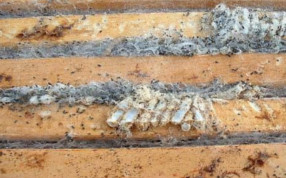
Several days later, I seem to have successfully wiped out the population of wax moths on my porch and in the house. Frankie seems to miss them as entertainment, but I’ve now had all the experience with wax moths that I want–either in the hive or especially in the house.