Griddled dinner, addendum

End of the work week for me; I’m home from teaching my last class (ended at 4 o’clock).  I made a stop at the local Harris Teeter store to try to find some “Opal” apples without success, and came home with only some milk and chocolate  (Chuao with chile pepper and some other spices).

I think that I probably set a record for the least time to get a meal for myself (and a good one, at that)–short of just dipping into the peanut butter jar.  Of course, it helps to start with great ingredients that really don’t need much done to them.

I got some beautiful wild-caught Alaskan salmon yesterday, so that was dinner this
evening, from the griddle.  The filet was beautiful–skin on,  not a single bone that I had to pluck out with tweezers, and it was cut to just the size that I needed for a single serving.  It was griddle-ready.

I heated the griddle so that I had a good “spit” when I flicked a drop of water on it.  I rubbed a bit of olive oil on both sides, sprinkled a little salt, put the salmon on the griddle skin-side up to start.  At the same time I tossed a handful of partially cooked haricots verts on with it.  It took about five minutes for it to brown nicely.  I flipped it over, skin-side down,  turned the heat down on that end of the griddle, and finished cooking it until there was just a nice darker streak  visible on the ends and took it off the griddle to rest for a few minutes, flipped the beans, and topped the salmon with some sorrel butter.  Great meal in about 15 minutes, start to sit-down.   Definitely minimal ingredients, but not minimal flavor–and it was a healthy dinner too. (Keiko preferred it without the sorrel butter, though.)

I wish there had been enough sorrel to make a sauce, but as it’s just coming up, I could not pick many leaves; what I could pick were minced and mixed with room-temperature butter (unsalted) to be plopped on top of the salmon.  The sorrel butter added a little richness, with some tartness that went well with the salmon.  Fast, easy, and a great way to cook for one person.

Aguas Frescas

I just wanted to add this link for some refreshing summer drinks.  I know the heat is coming, and as I mentioned in and earlier summer-time post, I always in search of healthy, refreshing drinks that are really thirst quenching.  I came across this post of Aguas Frescas this evening and thought that, despite the chilly weather outside tonight, I’d pass it along as some of you might enjoy some of the ones given here.  I know I plan to try some of them during the hot weather.

Evolution of comfort food.

A few days ago it was gray, rainy, chilly and no matter what there thermostat said, I could not feel warm.   Peering into the refrigerator, I could not find anything that I wanted to eat and I did not want to cook.  Comfort food was in order, something basic: grilled cheese and tomato soup.

That got me thinking about why grilled cheese and tomato soup was so appealing.  I realized that it was likely because that was comfort food when I was a child–home from school with a cold, or sometimes, just a treat.

I did fix myself a grilled cheese sandwich and tomato soup, and it was wonderful–just what I needed.  Munching away, I started considering, even though this was grilled cheese and tomato soup (our of a can), how different it was from what I had as a child.

Growing up on a farm in the country we were pretty self-sufficient: raised and butchered our own meat, curing our own ham and bacon, canning vegetables, raising chickens for our own eggs, and milking cows so that we had our own butter, milk and cream.  I grew up with home-made bread, cakes, pies as a routine thing.   From that vantage point, “store-boughten” was a treat.

One of those treats was a grilled cheese sandwich made with American cheese and something like Wonder bread–so it all squished down flat under the bacon press.  Heaven was to have that accompanied by a can of Campbell’s cream of tomato soup–yes, the condensed stuff.

Given the home-cured country ham, bacon, and good meats (beef, pork, and maybe even lamb, with some rabbit and maybe venison) a treat was a bologna sandwich!  Extra special if fried.  Probably almost anything that came out of a tin can that required a can opener, and did not come out of a Ball/Mason jar would have been considered a real treat.

The things that came out of the Ball/Mason jars were luscious halves of peaches, whole tomatoes,  pears, apple butter…and I did not appreciate them then–they were just food, nothing special.  Well, how things do change.

Now, even though I admit to really liking mortadella, and having just had a grilled cheese sandwich with cream of tomato soup for comfort food–my idea of quality of comfort food has changed a lot.

My grilled cheese sandwich was made with excellent imported, firm, nutty Swiss cheese, with bread sliced from a whole loaf of Italian bread.   That bread was lightly brushed with extra-virgin olive oil, almost like was done in my childhood, put onto a cast iron griddle and carefully browned on both sides.  Lovely, crunchy on the outside, melted cheese oozing with every bit, and delicious.

My tomato soup, admittedly, did come from a can but what a difference from condensed soup.  It was Progresso chunky tomato with basil, not cream of tomato, but really pretty good for soup out of a can.  I did, however, want cream of tomato soup.  I put half the soup into the refrigerator to be used another time, and after heating the other half in the microwave, I added two teaspoons of heavy cream, and some fresh (frozen) basil to it.

I was quite happy with my comfort food–but I did have to reflect on how my taste has evolved.  The original American-cheese, Wonder-bread sandwich never even occurred to me; no did Campbell’s condensed cream of tomato soup–yet my choice was cream of tomato soup and a grilled cheese sandwich, but such a difference now.

This made me think of other differences then and now.  When I first left the farm and went to the city, I was amazed at “city” or deli ham…thought I liked  that better than “country ham”.  Living alone and cooking for one, I even used mac ‘n’ cheese from a box–very different from what I had grown up with.  I was so thankful to be away from the farm, to not have to milk cows, churn butter, and make cheese.  Now, I seem to  have come back to where I started–I want to grow things, buy from the farmers’ market, and will search out those things that I took so much for granted as a child.

Griddled dinner

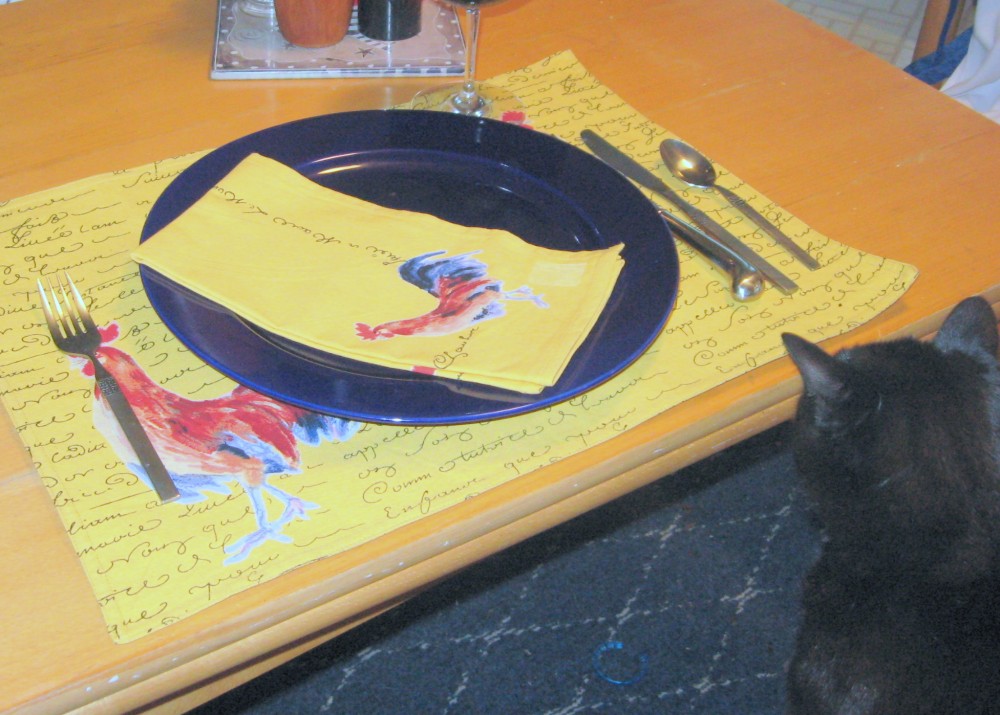
I was recently scanning through my e-mail update from CliffordAWright.com and I saw “Griddled Broccoli”.  It was one of those keep-scanning moments, and then (when the brain caught up with the eyes)–back up and look again, and read carefully.  This looked like something that would be great for single-serving cooking .  I set out to cook my whole meal as a griddled dinner.  The house supervisor was on duty, approved  and was waiting anxiously to see how this was going to turn out.

A favorite cooking tool in my kitchen is my cast iron griddle which goes across two burners of my gas stove.  It’s not a pre-seasoned one–but that’s really easy to do.  I got it from mycast -iron griddle
local garden store which also carries Lodge cast iron.  Sometimes I contemplate getting a grill-pan, but I, despite needing two burners, I really like the flexibility of being able to have the grill/griddle combination.  It’s certainly not a glamorous piece of cookware, but it’s functional and not all that expensive either.

I have found that trying to use it with only one burner lit really does not let it heat well.  It does not have a non-stick finish since I’m concerned about the effects of high heat on that, but it’s well seasoned and non-stick in effect.  Besides I also has doubled as a broiler pan too, and I certainly could not do that with non-stick coatings.

I’ve got a lovely rib-eye steak for a red-meat splurge.  I could do on my Weber Kettle Grill, but given the uncertainty of the weather now and finding the griddled broccoli recipe, I decided I’d try my whole meal on the griddle.

The griddled broccoli recipe calls for parboiling the broccoli for a few minutes before the actual griddling, but that seems simple enough, even for a quick meal.   I want some other vegetables as well as the broccoli with my steak, so I though I’d add some mushrooms, some sweet potato slices, and maybe some red bell pepper to my griddling.

I started by salting the steak as recommended in Cook’s Illustrated; it’s really worth the time to do this.  While the steak was Rib-eye steakresting with the salt, I prepared broccoli almost according to Wright’s instructions,  sliced the mushrooms, part of  a yellow bell pepper (the red ones at the market just didn’t look or feel really good), peeled and sliced the sweet potato into 1/2-inch thick cross-sections.  Because I wanted a variety of vegetables, with two of them that needed a bit of pre-cooking, I opted for steaming instead of blanching for the par-cooking. I steamed the broccoli for only about two minutes since it was cut in fairly small pieces.  I steamed the sweet potato slices for about three minutes and then set these aside for griddling a bit later.  Because I wanted to cook the whole sweet potato and the more of other vegetables for some planned leftovers, I started on the vegetable a bit before I put the steak on the griddle. I preheated the griddle until I got a good “bounce and sizzle” when a drop of water was flicked on the surface; we were good to go.

I thought that the mushroom and peppers could be easily reheated while my steak was resting and the broccoli was finishing, so I started with those and the sweet potato slices which were still firm.  I patted the sweet potatoes dry, since they had been put into cold water to stop the cooking after steaming.  I tossed the vegetables with a bit of  olive oil, and put them on the hot griddle.

Once the mushrooms and peppers were nice and brown, I removed them from the griddle, moved the sweet potatoes to the front since they would require more attention than the steak.

I patted the steak dry (a little moisture accumulates while it is stand with the salt, and I put the steak on the griddle to start cooking.  Since the broccoli has been steamed and put into cold water, I drained it and let it rest on paper towels to dry a bit.  While the steak was browning on the first side, I attended to the sweet potatoes and sliced some zucchini which I had decided to add as last-minute addition while looking in the refrigerator for something else.   After about  seven minutes, I peeked at the underside of the steak.  It was a lovely brown, so I turned it over and continued cooking it.  Since I like my steaks on the rare side of medium rare, I thought it would take about another five or six minutes, so I put the now-drained broccoli into a bowl and tossed it with a little olive oil.  I wanted the steak to rest for about five minutes after coming off the griddle to let all those lovely juices redistribute–evenchecking temperature that short of a rest does make a difference.

Now for the broccoli.  I put that on the griddle to finish the cooking, and I used an instant-read
thermometer to check the temperature of the steak since it was a very thick one.  It showed 115 ° F  on the thermometer, so I turned the heat down under the griddle and  put all the vegetables back on to rewarm.  I took the steak off and set it aside on my plate to rest.  After a five-minute rest the vegetables were reheated, and it was time to eat.

Even allowing for the salting time for the steak, I was sitting down to eat in about an hour and twenty minutes.  I spent some extra  time cooking veggies while the steak was “salting”, but I have plans for those–some can be reheated, and some can go into a salad for another meal.   And…yes, there is left-over steak–that thing was huge! That will be good in a sandwich for lunch with some horseradish, or perhaps in a salad; but I won’t try to reheat that.

Had I not wanted the extra vegetables for planned leftovers, all this could easily have been prepared on the griddle at the same time and easily tailored to provide even a mix of vegetables in a single-serving quantity.

The clean-up was really minimal–the steamer, two small bowls, and the plate!  The griddle, when cooled just needs a quick rinse under hot water, and drying over  flame for a few minutes.  It really is non-stick, and it’s easy to keep it properly cured.  It does get a lot of use: grilled cheese sandwiches, grilled chicken or pork chops.  The red meat aside (and that is a rare splurge) it was a pretty healthy meal: lots of veggies, and very little oil involved in the cooking…but it was really good.  I’m definitely a fan of griddled broccoli.

Empty plate

Your own fresh herbs.

Yes, I digress from actual in-the-kitchen cooking, but it’s the time of the year when the seed catalogs have started to appear in my mailbox, and the birds are beginning to suggest springtime, too.  It’s time for wishful thinking–and ordering seeds and/or plants.  There are so many herbs available that you won’t necessarily find in your local garden center–they will have the basics, and probably lemon thyme, and other flavored thymes.  Fresh herbs are one of the easiest ways to keep your cooking (even if it’s for more than one) exciting and healthy.  I’m not going to suggest that you replace salt with herbs (more on salt a bit later)–just use it judiciously with the fresh herbs.

Even though I purchase fresh herbs from the market during the winter and use some dried herbs, there’s nothing like being able to walk into the garden our even just out onto the deck and snip what herbs you want right now.  You are not in the frustrating position of not having the herbs that you need whenever you want them.  Having them readily available frees you to experiment depending on your mood, or whims as you cook.  Sometimes I don’t know what I want to use until I’m actually smelling the herbs as I brush against the plants.

Herbs are easy and fun to grow.  If you don’t have garden space, you can grow them in containers.  One fairly large pot can be used to grow several herbs, and has the advantage that you need to water less often than if you put your herbs in smaller containers.   I like larger containers with several herbs grouped together for several reasons:  I need to water less often, and I don’t have to be so concerned about them blowing over.  When you plant herbs together, you  do need to consider the moisture and light requirements of the herbs planted together.  Basil and oregano are not likely to be happy pot-mates as they require different moisture levels to be happy.  Most herbs like lots of sun, but there are a few that you may need to have in partial shade or shade so you’ll need to consider that as well.

When I say a “fairly large” container I am think about a three- to five-gallon container.   Pot sizes are usually given as the diameter at the top–so a 4-inch pot would be that wide at the top, possibly tapering to smaller diameter at the bottom.  The larger the diameter of the pot, usually the deeper the pot, so by the time you have a wide surface, say 14 to 16 inches, at the top, you may have a pot that is deeper than you really need for herbs, so don’t waste the extra potting soil!  Use some inert filler in the bottom of that huge pot so that you are using only the amount of soil needed.  Many herbs really need only about  8 inches of depth.   The old Styrofoam peanuts, for example, can be used (newer ones are biodegradable and will not last in the pot).  In order to avoid having to collect them when I need to change soil, I put them into old panty-hose (which take years to break down).  You could also use soft-drink cans, turned on-end, and upside down in the bottom of the pot–just be sure not to interfere with the drainage of your pot.  Because my deck is elevated and I don’t want to have to worry about pots blowing around, I will sometimes use bricks or rock to fill the bottom–just making sure that I can move it if needed.

A good place to start your herb gardening (container or otherwise) is with the basics that you use most often.  For me that is rosemary,  marjoram, Greek oregano (Origanum vulgare hirtum), Syrian oregano (Origanum maru), sage (Salvia officinalis, ‘Extrakta’ or ‘Berggarten‘), French or summer thyme (Thymus vulgaris ‘narrow-leaf French”, summer savory, and French tarragon (Artemisa dracunculus sativa), Thai basil, globe basil, bay (Laurus nobilis), chives, flat-leaf parsley, mint, and cutting celery.   Since you want only one plant of each, it’s probably best to buy plants rather than start from seed.  You can find herb plants at your farmers’ market in the spring, or at the garden center.

I will admit to being a bit of a snob about my herbs–I do want to know exactly what I’m getting, as you can see from the botanical names included with the list above–at least for some herbs, really as many as possible, but especially for bay and for French tarragon.  I don’t plant lemon thyme, et cetera, because I feel that the “citrus” part of the thyme cooks off quickly, so I prefer to add the citrus by using juice or zest of the citrus.   I don’t want Russian tarragon because, to me, the flavor is harsh–just not what I want from tarragon.  The same principle holds with bay–the California bay (Umbellularia californica) is strongly flavored, but  lacks the complexity of the Lauris nobilis or true bay.

Tarragon is another herb were it pays to be particular–it must be from cuttings, as true French tarragon does not produce viable seeds.  The seed packets of “tarragon” are a relative, but lack the finesse of French tarragon.   Other herbs that I’ve listed I like because of particularly high essential oil content, so more flavor.   Once you’ve got the basics, you’ll probably find others that you want to try:  I’ve added shiso, epazote, Spanish tarragon (Tagetes lucida), and given a catalog, I’m sure I can find many others I would love to try.
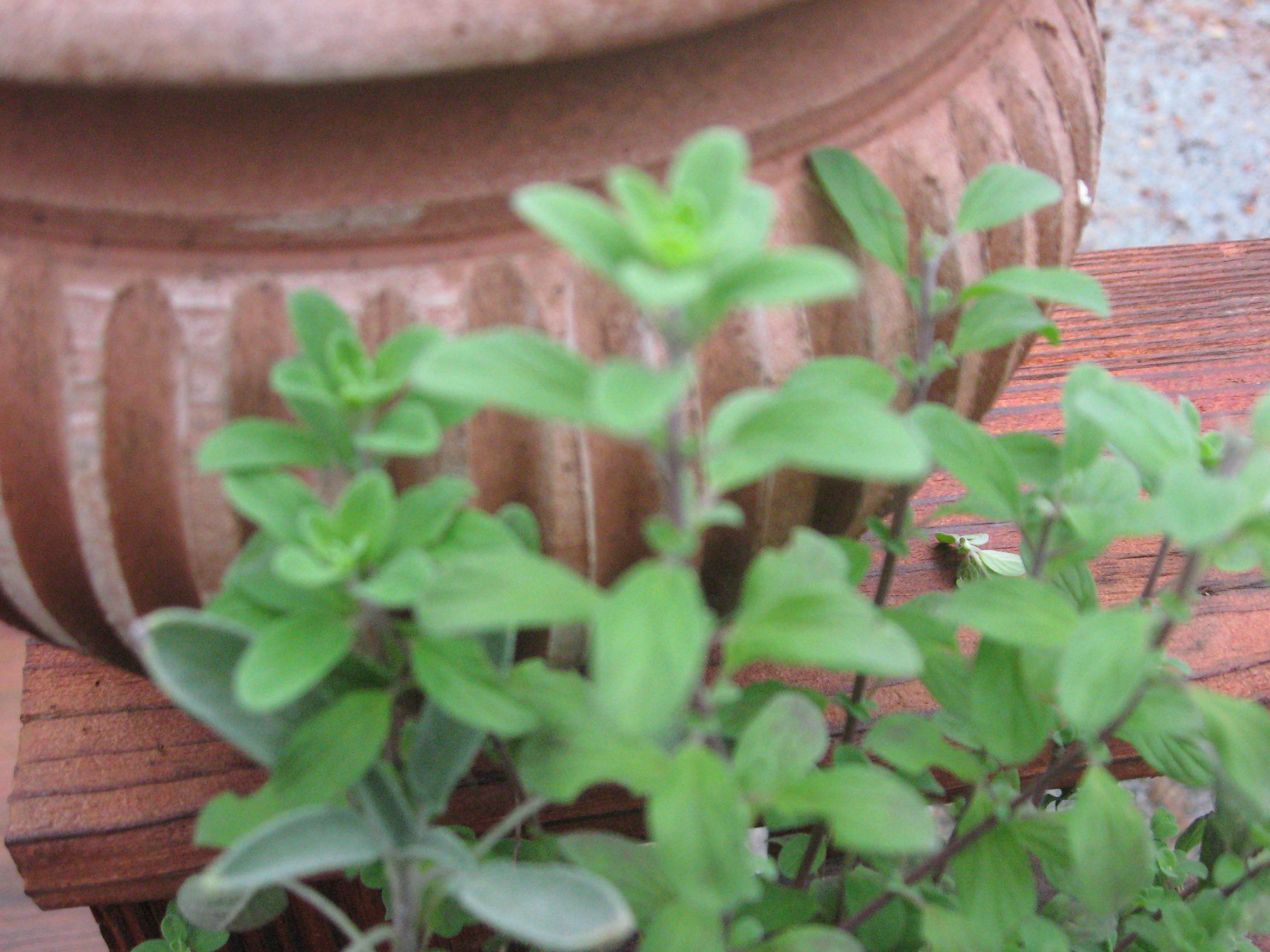
I generally do NOT combine annuals and perennials–I don’t want to disturb well-established roots of the perennials to remove or add an annual.  one of my containers is likely to contain sage for a nice tall plant with lovely grey-green foliage, oregano, thyme, and perhaps some chives in a 12- to 14-inch pot.   Rosemary can become quite bushy and makes a good tall plant for another container.  My bay gets its own pot, as I want it to be large and tree-like.

Cutting celery is an herb of which I’ve grown particularly fond–it does not head, and yet can give me fresh celery flavor for salads, soups, and the stems even add a bit of crispness.  It can grow with dill, chives, Vietnamese coriander, or stevia, for example.  Parsley usually get a pot to itself.  Cilantro, which bolts easily, gets a 6-inch pot or an area in a planter which gets sequential plantings all summer.   Most dill is not suited to containers as it tends to get huge, and develop a tap root; however, there are a few “dwarf” varieties (Fernleaf being one of those) which can be grown in a container.

Mint must have more moisture than these other herbs, so it gets its own separate pot, perhaps sharing with lemon balm (Melissa officinalis) usually placed out of the blazing summer sun.  My wish list for this summer’s herbs is not complete yet…there are more seed catalogs to go through yet.

It does take a bit of effort to grow herbs: you’ll need to water them, and do some mid-season fertilizing, but it is well worth the effort.  The other thing that you need to do is to keep herbs pinched and trimmed in order to have them bushy and productive.  You’ll not want them to bloom as the flavor is not as good after blooming, so pinch and trim.  To a large extent that happens as you harvest for use.  There are times when I just go out and give them a “butch”.  That’s when you make an herb vinaigrette, share with friends or purée to use under the skin of a roast chicken!  You can also include the leaves in a salad of mesclun or your favorite greens.

Having your own herb garden keeps you supplied without the expense and (even as manyas I used) waste with the packaged supermarket herbs. It also provides a sensual pleasure just to smell them as you walk by, or to deliberately brush through them, just for the heavenly aromas they give off.  Nothing is much more exciting than seeing those first leaves as they come back in the spring, announcing a whole season of wonderful tastes and smells–time to have things just a son goût even if it is single-serving cooking for one.

Chicken braised in milk.

Always on the lookout for a new taste experience, while checking out favorite blogs and  websites, I found a recipe that I just had to try:  chicken braised in milk from Jamie Oliver’s website.  I’ve made pork braised in milk (a recipe from one of Marcella Hazan’s cookbooks) and it was scrumptious!  Reading the recipe for “Chicken in Milk” I was intrigued by the seasoning–sage, garlic, cinnamon, and lemon.  Not a combination that I had thought, but considering the source I thought it worth a try.  Not wanting a whole chicken, I decided to try it with my favorite chicken parts–thighs.  It seemed like another great dish to test out the petit brasier.  I even found a friend willing to test the results with me.

Since I had about half the weight in thighs of the chicken called for in the recipe, I went halves on the seasonings as well.  What I learned was that chicken parts were okay, but maybe not the way to go with this recipe, and that halves on the seasoning was too big a cut.  The flavor combination was a success–it was somewhat earthy, and “round” and balanced, but I think I need to try it again with more than half the amounts of seasoning. We both felt that it could have been more highly seasoned, but it was a recipe that definitely goes into my “keepers” file.  Work on modifying it as a one-person meal is going to continue.

This was one of the times that I broke a rule that I usually follow:  make the recipe just “as is” before you try modifying it; so it’s back to the kitchen with this one–probably going to have to invite friends and do a whole chicken before I try cutting it down again;  I need  to know  what it would be like as intended so that I know how to modify the seasoning.  It’s not always easy to modify a recipe for single-serving cooking, but it’s a worthwhile endeavor.

Now that the holidays are past and things are settling down a bit, I think I’ll give it another try–my friends are used to me having a “food crisis”–and usually willing to participate.  I think it would be a good time to check out a bottle of good white Burgundy wine as well.    Since I’ve been considering this, I nabbed a couple of Cornish game hens on one of my trips through the grocery store, thinking that this might work as a single serving adaptation.  You can expect updates on this to follow–the full recipe and adaptations for one or two servings. If you need (or want) to serve four, it’s a recipe worth making!