
Since I have a dozen Bartlett pears (still firm, but very aromatic) I think I’ll try this recipe though the Bartlett pears may bake differently from the Bosc pears.
Author Archives: sa.fifer

Interesting recipes….
Some very good information here, and I’m sure there’s more to come!

Hello, friends! I’ve been kicking around a new idea, will you tell me what you think?
At this point there are so many recipes on this site that most of them are simply buried by time. (I need a recipe index, I know; the sidebar category search is rudimentary.) And although I’m posting new recipes daily here, I’m also always cooking my old favorites off-screen. I’m thinking that it might be fun to share more with you about my kitchen and what’s happening there from week to week.
Regular “What’s Cooking” dispatches would give me an opportunity to tell you what recipes I’m loving as the seasons go by, to tell you about delicious ideas that don’t rise to the level of being “recipes” themselves, and to show you how I fit these many individual recipes together as meals (and then repurpose the leftovers as more meals!). Hopefully this will…
View original post 761 more words
Fresh rhizomes!

I’ve had a lovely display of tropical green plants this summer–and the fun (and flavors) of harvesting my own rhizomes from the “garden” on my front deck. These two plants are worth having for the appearance, as well as the flavors from the leaves, stems, and rhizomes of both these plants.
As autumn progresses towards winter, these both will likely die back, but I can anticipate their reappearance in the spring. I doubt that I have enough light indoors (even with basic grow lights) to keep these plants alive, healthy, and flavorful, so I’ll just protect them from freezing, and wait as patiently as possible for spring! Neither of these seem difficult to grow here in NC: water, occasional fertilizer, and this is what I got to enjoy.

culinary ginger
The culinary ginger (Zingiber officinale) has been a pleasure all summer–the rhizome that is most often used in cooking is wonderful when it’s harvested young! It is not fibrous, and may not even need to be peeled; the flavor is milder than the mature rhizome that we usually retrieve from the market, and can be use fresh to add some spice (but not burn) to salads of both fruit and greens. Fortunately, the rhizome grows very near the surface so that it’s easy to harvest as needed and allow it to just keep right on growing. If you have well-established ginger, the young, tender stems are also edible, as well as the rhizome–and since I’m a ginger lover, I sometimes add them to salad greens.
The plants in this picture are from established rhizomes that wintered over undisturbed–I was very restrained in harvesting it last year. With protection from of the rhizomes from freezing, it came back this spring. It’s now on my list of “must have” herbs and spices. I’ll be moving this humongous pot indoors, but I’m afraid that I really can’t provide enough light to have it thrive during the winter indoors, so I’ll be anticipating the reappearance next spring.

The other addition this summer (also from second-year rhizomes) was turmeric (Curcuma longa) which I like to use fresh. (The rhizomes can sometimes be found fresh in Latino or Asian food stores.) This is also a tropical plant so I’ll try it indoors, but I doubt that I can give it enough light either–so I’ll have to wait for spring for more rhizomes. Turmeric is sometimes called “Indian saffron” because of its flavor and color–and I like to add it to rice just as I would saffron. (Warning: It will stain almost anything so handle with care.) The fresh root can be used in pickles, and I’m sure with some searching I’ll find more ways to use it. The young rhizomes, like those of ginger, and tender and not fibrous like the older, mature rhizomes. Though it seems to grow deeper I harvested it like the ginger, and it did not seem to harm the plants.
As well as the uses for the rhizome, the leaves can be used to wrap food for cooking, and possibly included in other Asian recipes for flavor–I’m looking forward to trying this before these lovely large green leaves are gone for the winter–possibly with some chicken thighs on the grill. I’ve even found references to use of turmeric leaves and roots in sweet dishes as well as savory ones. I’ve always kept turmeric powder on hand in the spice cabinet just as I do ginger root, but the fresh turmeric has now earned a place in my list of “usual” herbs and spices as well! Many new flavors to explore.
A son goût!
Eggplant recipe
Always looking for ways to use the inexpensive and healthful veggies that are so plentiful in the summer. I’ve not made this one yet, but it looks to me like a great summer recipe.
Homemade pita
Freshly made pita is wonderful–and easy and quick once you get the rolling-out part down. I use the doughs from “Artisan Bread in Five Minutes a Day” and “Healthy Bread in Five Minutes a Day” to make pita as well as loaves of bread; here’s an alternative recipe.

To be honest it is probably easier to buy pre-made pitas. Of course these taste much better once you perfect how to roll them.
Make the starter the night before. In a large bowl mix 1 1/4 tsp yeast with 2 1/2 cups warm water. Let yeast dissolve and begin to bubble. Add 2 1/2 cups unbleached white flour and mix well. The starter will be the consistency of thick batter. Cover with a wet towel and let ferment over night, or at least 5 hours.
Mix 3 cups flour and 1 1/2 tsp salt into starter and form a rough dough. Knead for 10 minutes adding more flour slowly until dough is smooth and still slightly tacky to the touch.
Heavily oil a bowl with olive oil and place dough in. Cover with a damp towel and let rise until doubled, about 1 1/2 hours.
Punch down dough and…
View original post 85 more words
The school term has started….
There’s been a huge hiatus here–I don’t know why it is that no matter how well I think that I’ve prepared for the beginning of the Fall semester of teaching, it always seems to degenerate into a hectic time. I’m beginning to feel like I’ve got the semester organized now, so I’ll try to get back to more regular posts! Meanwhile, I’ve reblogged a couple of things that I thought were interesting.
Costco, even for one…
Great post! Even those of you cooking for one should take a look at this! I do use Costco–even for one!


Some people are surprised to hear we have a Costco membership when it’s just the two of us. I admit, paying to shop someplace is a hard sell for me, especially when we only go a few times a year. If you’ve never been to Costco before, only been a couple of times, or never really inspected the shelf prices, it’s easy to get carried away; not only can the selection and the store itself be kind of overwhelming, but the fact you’re paying for the privilege of shopping there makes it easy to assume everything you come across is going to be a great deal. Of course, this is not always the case, especially if you’re already making the effort to buy groceries in bulk and on sale. That said, the past few years have taught us a few things regarding what to buy (and what not to buy)…
View original post 1,151 more words
Green Salad with Watermelon, Feta, and Mint
I’ve mentioned this salad before, but it’s good for a last taste of summer before the best of the watermelons are gone. Enjoy!
A friend sent me an urgent email the other day.
“Make this salad,” he instructed. “I like that salad,” I told him. “But have you tried this one?”
He re-sent the original link. I saw his point, and went out to buy a watermelon.
View original post 210 more words
How to plan a week of meals
A great article for some ideas on how to deal with “leftovers” and efficient cooking for one or two.

One of the main obstacles that I’ve heard about for why people don’t cook very often is that it’s hard to buy groceries without wasting a lot of food. If you are only cooking for one or two people, I can understand how this is challenging. What works for me is to plan a few meals before I go shopping, and to try to overlap some of the main ingredients. I’ve outlined a few examples below.
When you are shopping for the week, be realistic about how often you cook. If you know that you will probably go out to eat one or two nights of the week, don’t buy enough groceries to make five dinners. If possible, shop somewhere where you can buy custom-sized portions (i.e., somewhere with a butcher’s counter and that allows you to buy produce by weight).
Sample week 1:
Grilled Chicken with Caprese Topping
Clams…
View original post 149 more words
A cucumber is a cucumber is a….
Another summer delight is the cucumber. I know–they’re available year-round in the supermarket, but my favorites seldom show up in good condition in the market except at the farmers’ market during the summer, because I can get something besides the “slicing” cucumber (though that will do in a pinch).
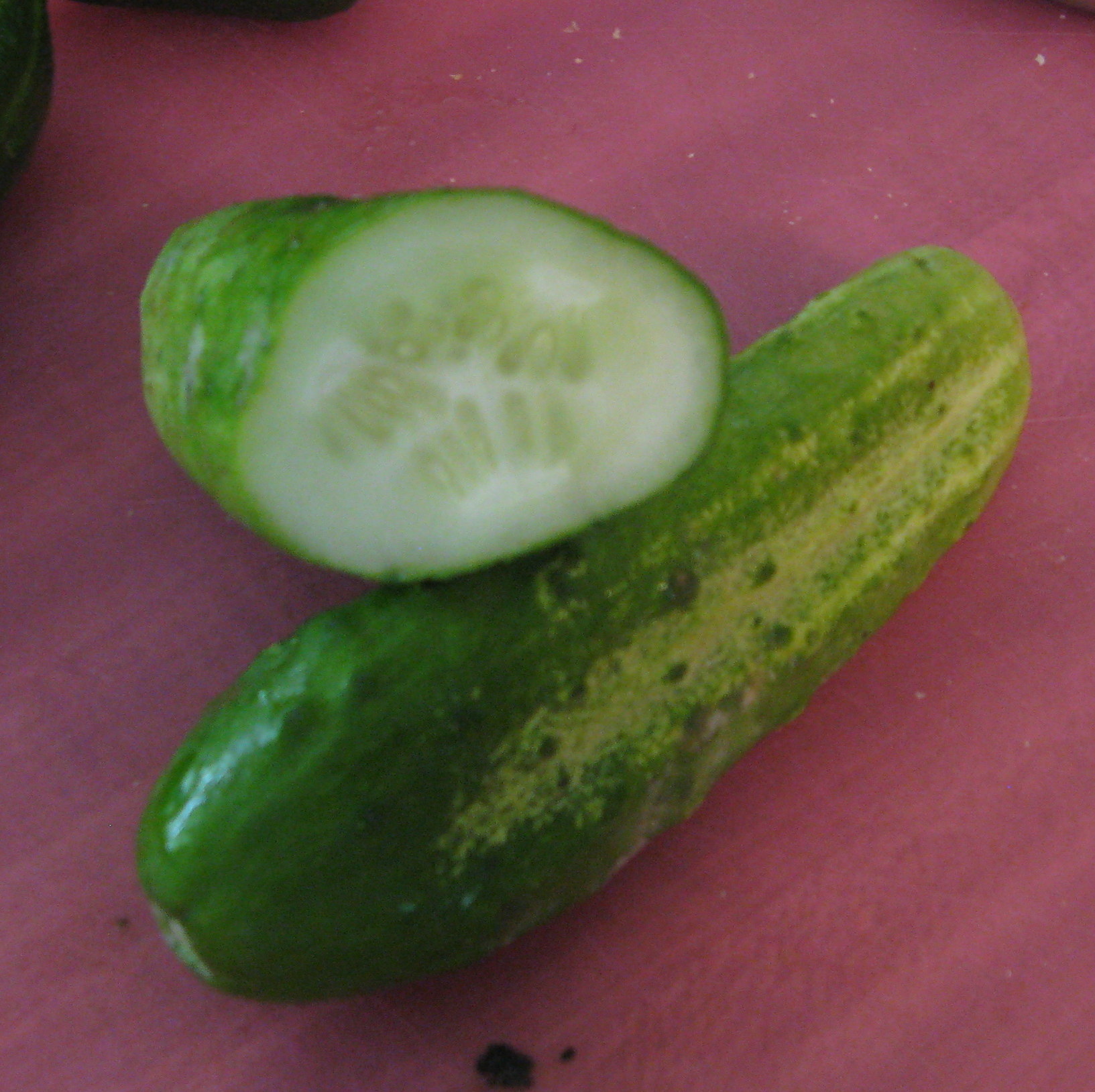
pickling cucumber
I like my cukes to be drier and without pronounced seeds, so I use pickling cucumbers to eat instead of the “slicing” or “field” cucumber. During the winter, I’ll use the English (the big long ones in the plastic wrap) or the “baby” cucumbers since they have less developed seeds–and I can’t see having to scrape out that much of my cucumber. A less watery cucumber (than the slicer) is desirable since I like to put them into cucumber and tomato salads, white bean salads, macaroni salads and all sorts of things like that–they are so cool and crunchy. I really don’t want to scrape out the seeds and salt to remove water!
.

the Amira cucumber
Until recently, I’d been using pickling cucumbers, but a friend has introduced me to the Amira cucumber which she has grown in her garden regularly for some years; it’s now become my new favorite cucumber! Long, slender, with a deep green, thin skin, and seeds that are not very pronounced at all, and it is without the one downside of the pickling cucumber–a tendency to bitterness, especially in hot, dry weather. I’ll be planting some of these next summer, to take the place of the Diva (a slicer that does not need more than one plant to set fruit) cucumbers that I have been planting for the last few years.
.
Cucumbers are a member of the gourd family (Cucurbitaceae), which also includes squash, gourds, and melons. Cucumbers come in three main types: commonly called field or “slicers”, pickling, and “hothouse” or English cucumbers.
- The American slicing (also garden, salad, or field cucumbers) have a thicker skin and are usually waxed (for the supermarket) to prevent dehydration. Since the skin is thicker, I prefer these peeled and because of the larger seeds which may be bitter and tough, and likely will need to be scraped out. These are a “wetter” cucumber and need to be salted to draw out excess moisture before use in salads. (Sorry, no pictures since I don’t have any of those around the house!) In the supermarket, these are the loose ones, with the waxed skin.
- The pickling cucumber is noticeably different from the slicing or salad cucumber–there are gradations of color, and the skin is bumpy. These are usually shorter and chunkier than slicing or salad cucumbers, but they are perfectly good to use in place of slicing cucumbers. (These will include gherkin and cornichon types which are smaller than other varieties of pickling cucumbers.) When these are found in the supermarket, they usually seem to be dehydrated, since they are not waxed.
- The English, Japanese, or “hothouse” cucumbers, which are longer and skinnier, and have small seed cavity and small seeds that don’t need to be scraped out. These are sometimes called “burpless” since they do not contain some of the compounds in the skin which can cause digestive distress to some people. These are found wrapped in plastic instead of waxed; the skin is thin so they don’t need to be peeled.
Favorite things to do with summer cucumbers include cucumber sandwiches, tomato and cucumber salad (with onion and herbs) as a side dish, or add cheese (maybe feta or ricotta salata) for a light meal (especially with fresh bread to soak up the juice), and I like to add them to other summer salads like white bean salad or pasta salad. Slices are great as a crudity with hummus or other dip (baba ganoush). Then there’s that dish of cucumbers and onions, thinly sliced with a bit of sugar and vinegar and marinated. Or combine them with yoghurt or sour cream, or even make a cold cucumber soup that’s easy and refreshing.
Recipes for cucumber salads or soups can be found on the web or in most cookbooks, but I’d especially recommend one of the vegetable cookbooks listed in the bibliography–Marian Morash’s The Victory Garden Cookbook, pages 92-101 for cucumber basics and some more novel uses such as sautéed cucumber, and even baked stuffed cucumbers.

Amira and pickling cucumbers
 a-single-serving.com