After-holiday sales…love ’em!

My favorite most-frequented supermarket is my local Harris Teeter, though I do occasionally wander into the Kroger. I’m a pretty frequent shopper since I don’t do well at meal planning.

Right after the holidays I always seem to find  some goodies in those end-of-holiday-season, reduced-price carts that I wouldn’t purchase otherwise.  Last year it was black truffle oil which has been put to good use this past year, and even recently when I was trying to do some wine-food pairing. (It’s been drizzled on baked potatoes too–my serious, decadent comfort food.)

A couple years ago, I was planning to do a roast goose (obviously requires friends in attendance).  When I got to the checkout, the price of the goose was SO low that I got a second one.  Good thing because we had snow and ice on the day I’d  planned the dinner.  You really can’t undo the thawed goose, so I toured the neighborhood within walking distance with impromptu invitations to eat goose–and found willing neighbors.  (These who missed that got to help eat the second goose when the weather permitted.) So the freezer case has become a place that I also skulk through at this time of the year as well as those “manager’s special” carts.

Two Whole Pheasants- Pheasant Meat

Dinner!

This year so far my “find” is pheasants on sale. I’m planning a pheasant dinner with friends shortly.

I get the pleasure of planning the meal, picking a wine, and then eating and drinking with good company. It’s in the planning stages now–braise or roast? Maybe the Romertopf since I do have a very large one?

Perusing recipes and thinking about wine is pleasurable activity. I’m leaning toward a bottle of the Ravenswood “Besieged”, but I might have to check with my favorite wine store before I make a final decision, and after I’ve decided what seasoning these birds will get.

Cornish hen braised in milk

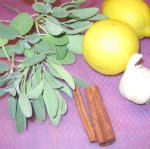
sage, cinnamon, garlic and lemon

I had an earlier post about braising chicken in milk, when I tried the recipe using chicken pieces since that gave me something more like a single serving.  Flavor was great, but I thought that for something a bit scaled down, but more in keeping with the original recipe, I would try this with a Cornish  hen and see how that worked. One of the advantages of these little birds is that they are more in keeping with  Jamie Oliver’s recipe, rather than the chicken parts that I tried originally. This might be a way to keep with the spirit of the original recipe, but scale it down to something closer to single-serving size.  While this is a recipe that might do well on second runs, I really don’t want as much as whole chicken would make.
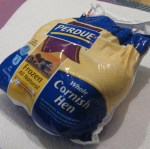
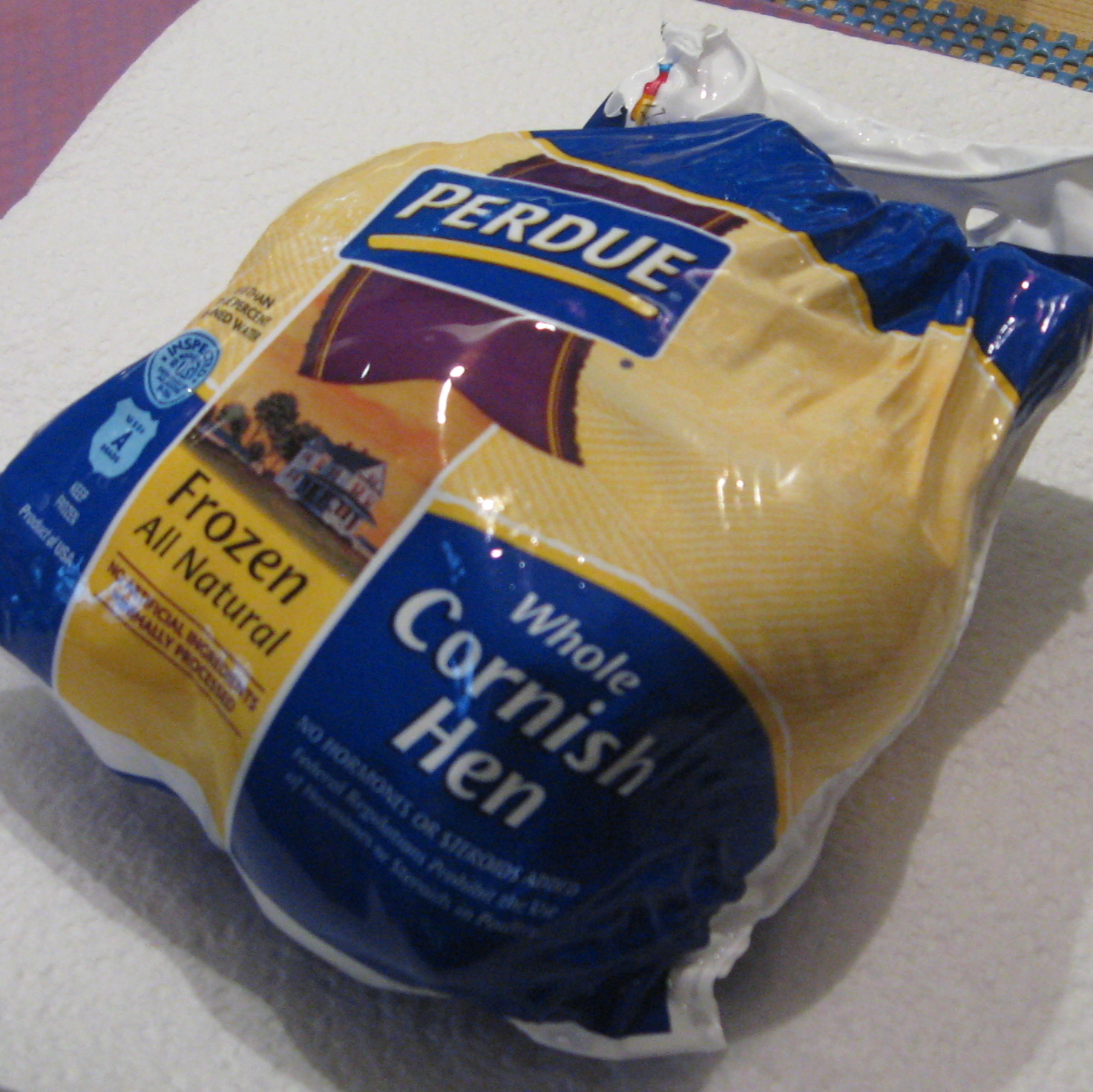
Well, the weather has turned to fall with blowing leaves, and chilly temperatures so this seems an excellent time to try this again…and my grocery shopping provided me with a lovely price on a pair of (frozen) Cornish hens–about 1 to 1-1/4 pounds each.

A Cornish hen–either male or female regardless of calling it a “hen”–is a special breed of chicken (in the USA sometimes also called a poussin, though that is really French for a very young, small chicken that is usually about a pound in weight).  Since my supermarket does not offer poussins, but does have the Cornish hen (which is a young, hybrid chicken–of Rock Cornish with some other breed–not over 2 pounds by USDA specifications) that’s what I’ll use; I was fortunate enough to find some hens that were just about a pound or a pound and a quarter each.

While browsing some of my favorite blogs, I found a discussion of Jamie Oliver’s recipe–where an oversight  of lid on instead of off for part of the time was compared to the bird braised in an open pot.  This made me think of the French chicken in a pot that I had cook recently–one of the things that was  impressive about that was how the flavors seemed to permeate the meat itself.  I decided to try this with the  lid on for part of the time just for that reason.  (I do have two Cornish hens–so maybe I need to do the same here–one each way!
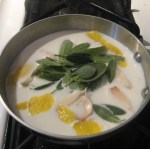
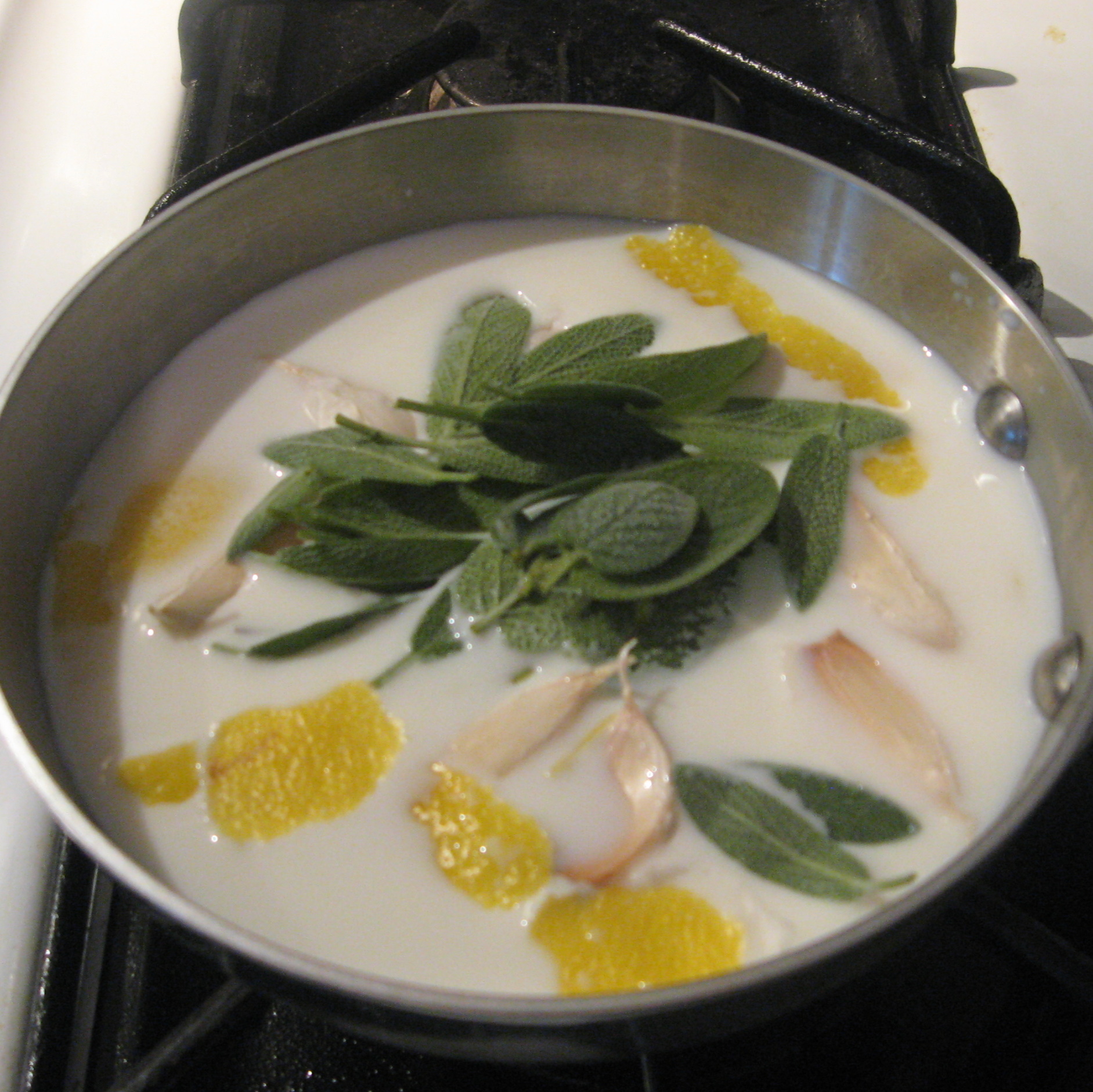
One of the things I discovered when doing the chicken parts was that just because you are using 1 pound of chicken instead of 4 pounds, you might not want to just take a quarter of the seasoning ingredients–the flavor was good, but perhaps a bit on the wimpy side; so I have to find a way to optimize that when cutting the recipe to single-serving size.  I decided that this time, I will make up the seasonings and milk as if I were doing the large chicken (in the 2 cups of milk).  I thought I’d simmer the seasonings in the milk and taste to see what that was like, cool it and add what seemed appropriate for the size of my bird and my pot.

The petit brasier was a no go–too big around–so I used my 4-quart All-Clad pot as being the closest thing to a “small” dutch oven.  The whole stick of butter was obviously not necessary so I used just enough (about 2 tablespoons) with the olive oil (about 2 tablespoons as well) to brown the hen.  (One thing I did discover is that the skin on a Cornish hen is much more fragile and has much less fat under it than does a more mature chicken.)  Just the smell of the hen browning in the butter and the olive oil is fabulous!

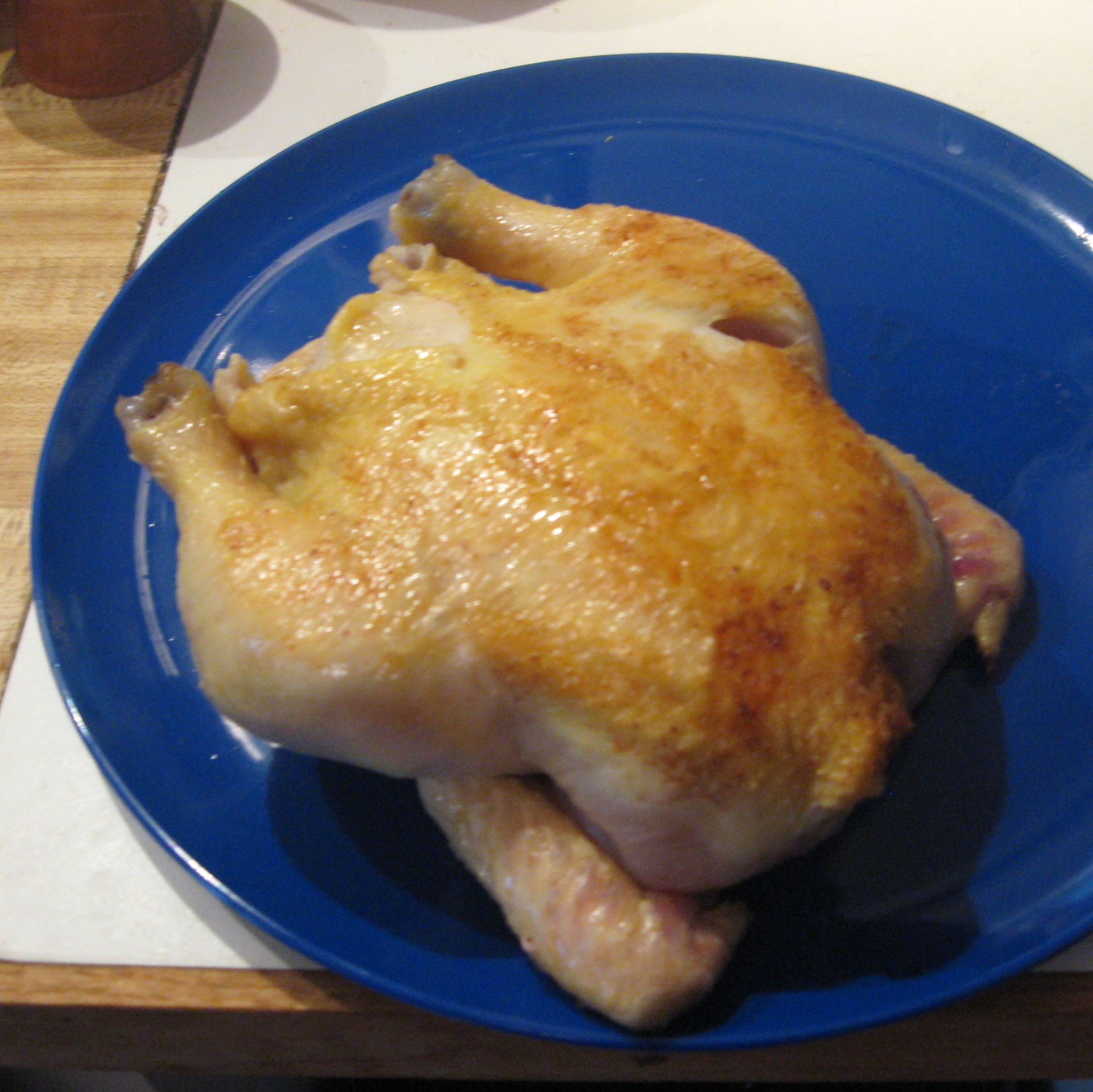
browned bird on plate

There was not much fat in the cavity either so I returned about half of the butter/olive oil mixture to the pot with the chicken.  Giblets were mostly not included–just the neck, but I browned that and included it in the braising pot for  extra flavor.

So here’s my bird, browned, and ready to go back into the pot to braise with the seasoned milk.  (Next time I’m doing a Cornish hen or poussin, I think that I’ll try using just half the milk with half to three-quarters of seasonings even though these birds are only about a quarter the weight of the chicken called for in the original recipe.)

browned bird in the pot with milk and seasonings

After steeping the other seasonings in the warm milk, and then letting it cool a bit, I tasted it–very lemony and sage-y, but not much garlic or cinnamon yet; (that came out later in the braising process).  I divided the milk and the other seasonings in about half since that looked like about the right amount of liquid (the eyeball test!!).  It took about 1 cup of milk (and I added half the solids) so the rest went into the freezer for a repeat, or perhaps just to braise some chicken thighs or poach some breasts. ( I did put the cinnamon into the braising pot with this bird).

braised Cornish hen

Since it was a smaller bird and the braising liquid was already warm, I reduced the oven temperature to 325 ° F since I wanted enough braising time to let the flavors actually get into the meat (as it did in the French chicken in a pot).  I decided to go with lid-on for about 30 or 35 minutes and see how it looked then, and finish the braising with the lid off so that the liquids reduced more.
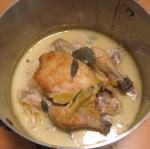
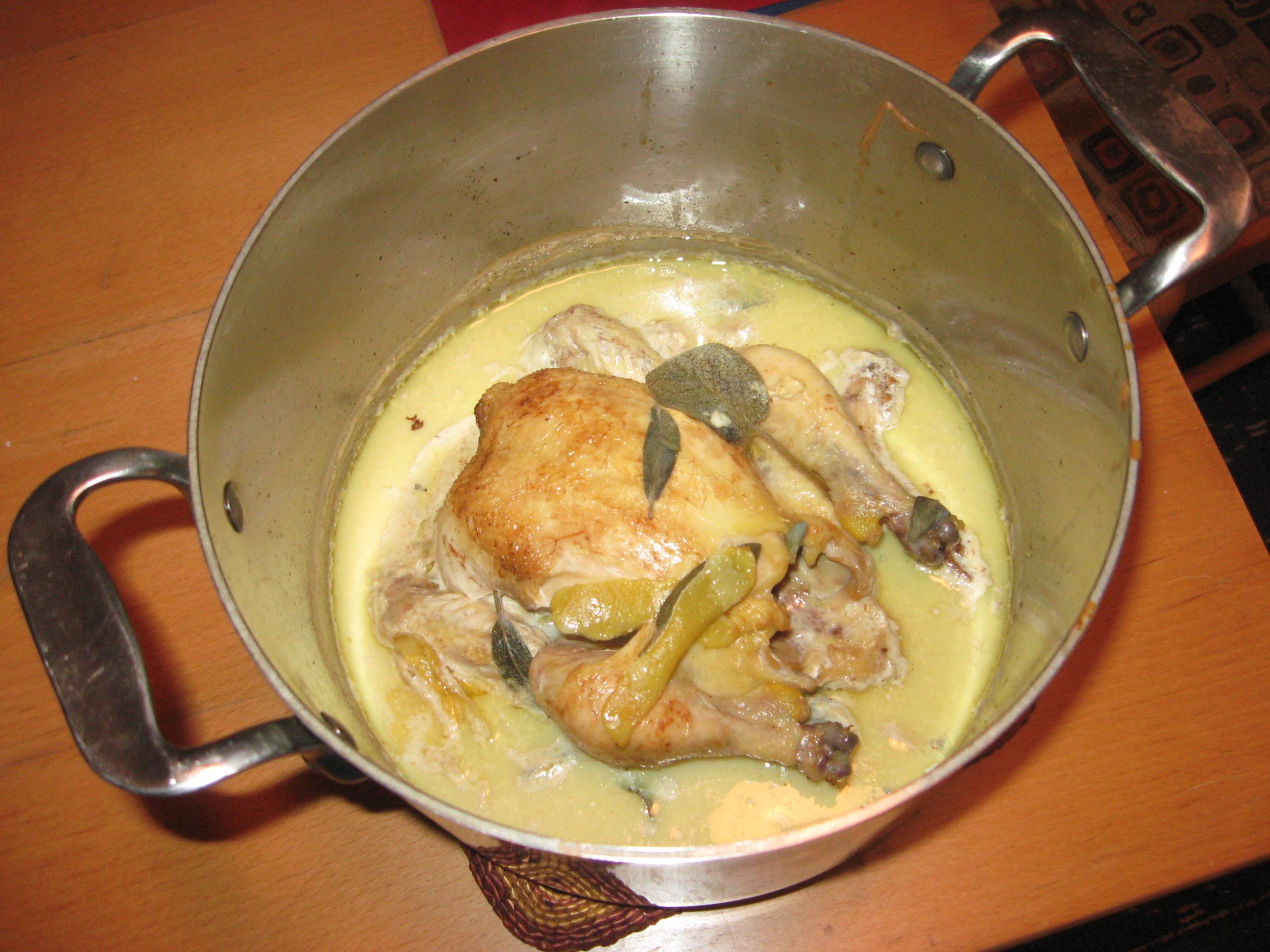
bird in pot after 30 minutes in the oven with lid off

lid off for about 30 minutes

After another 30 minutes in the oven with the lid off, the sauce has reduced some and it looks falling-off-the-bone tender.

Somewhere along the way, all those unlikely, highly individual, and potent seasonings have turned into a complex, earthy  taste and aroma.

I’m ready to eat!

Admittedly this does not look like it’s going to be a dish that lends itself to elegant presentation, but it’s certainly a keeper for comfort food.  Braised in a container that could go directly to the table it would make a nice casual presentation as the skin does brown more after the lid comes off.

•♦•«»•♦•

The  pot  that I used was just a bit deeper than I might have liked, but better too deep than too wide since that would need too much liquid to reduce by the time the hen was done.  Unfortunately, the bird was just a bit too tall to fit into my small chef’s pan–but this was close enough.  The sauce does look “curdled” but tastes wonderful!  Just the thing for a damp, drizzly, autumn or winter evening!

chocolate mug with sage-lemons IMG_4796The original recipe for a whole chicken would be great for causal company–this is definitely a keeper!   I had this with basmati rice, roasted baby carrots and baby zucchini.  Sautéed  spinach, or maybe broccoli raab would be good too.  I think that the slight bitterness of the broccoli raab would be a great contrast to the way that these seasonings meld into a very earthy background to the chicken.

A son goût!

Take four chicken thighs…

If you are going to cook for one, you need to get away from recipes that specify exact quantities–it’s a step toward learning to improvise as you cook.  I’d urge you to take a look at Kitchen Express by Mark Bittman–you don’t have to buy it, thought it’s a great book to have; go to the library and check it out. (It’s also available for Kindle, too)  Other simple, and simply good recipes can be found at The New York Times, and at Mark Bittman.com.  You will find recipes that are easy to do for one because they are “quantity-less” in the sense of the typical recipes.  They don’t call him “minimalist” without a reason–a very few ingredients can make some wonderful eating.

Now for those four chicken thighs, cooked as described in “The Microwave in my Kitchen”, here’s what has been done with some, and what is intended for that fourth one:

1.  Chicken salad for a sandwich, quickly made by adding some minced red onion, a bit of cutting celery (See Herbs page) leaves and stems, salt, fresh-ground black pepper, a squeeze of lime juice (or lemon juice), and a drizzle of extra-virgin olive oil.

2.  A warm meal of chicken with  part of a can of chickpeas left from a previous use.  Sautéed a handful of onion in olive oil until softened, added a big clove of garlic, the chicken cut into bite-sized pieces, added some halved grape tomatoes, about a tablespoon of chopped sun-dried tomatoes, a dash of Syrian oregano (still growing on my deck); finish with salt and fresh-ground black pepper to taste.   Add a  single-serving salad of mixed greens and had a quick, satisfying meal.

3.   The third piece went to make some quick chicken hash for Sunday breakfast as follows:  In a 12-inch nonstick skillet sauté a handful of diced onion  in olive oil until just starting to brown.  Add two minced garlic cloves (I like lots of garlic),  and cook for two or three minutes.   Meanwhile, open a can of diced potatoes (I told you this was quick–obviously you can start with raw potatoes and sauté them until tender) and brown them lightly. Rinse and drain the potatoes, add to the skillet and sauté until they start to brown.

Remove half the potato mixture–this is destined for another use.  Remove the meat from the chicken thigh if it was bone-in and dice the meat.  Add this to the potato mixture in the skillet, along with some (about 1/2 teaspoon) fresh thyme (again still growing on my deck) and continue to sauté.  When the potatoes and chicken are slightly browned, remove to a plate and keep warm.  Cook one egg (or two if you are really hungry) to medium, and serve over the chicken hash.

The portion of potatoes that you removed from the skillet can be used in different ways: the are likely to become a kind of quick version of a Spanish tortilla by just  warming and adding a couple of eggs and serving with a salad or vegetable.

4.  With the broth obtained from cooking the thighs in the microwave, I plan make a meaty chicken soup using that fourth chicken thigh, using that bit of  rice left  from another meal.  I’ll add more veggies, perhaps a bay leaf, and some of my “lazy” favorite (and only) herb mix, herbs de Provence. I’ll see when the time comes–since I don’t do leftovers, I probably shouldn’t do predictions either.

There will be a follow-up on that fourth piece of chicken to let you know where my improvisation lead me.  I’ll give you another example, using a recipe from Kitchen Express for a lentil soup that just blew my mind (See An Awesome Lentil Soup).  It was such an unexpected combination of flavors, and it is one that I keep using to improvise with other ingredients, as well as coming back to the original.  It’s a recipe where I could also make use of the last piece of chicken.

Roast duck with fresh fig sauce

No–it’s not a single serving, but it’s so good that you just have to make it when there are fresh figs available.  So invite friends and enjoy.

Adapted from In Search of the Perfect Meal, a collection of writing by Roy Andries de Groot, pp 148-150.

  • 2 Long Island ducks (one about 2-1/2 pounds, and one about 4-1/2 to 5 pounds).
  • 1 lemon cut in half
  • 1 medium yellow onion, peeled and chopped
  • 2 medium carrots, chopped
  • 2 ribs of celery, chopped with leaves
  • 3 springs of fresh parsley
  • kosher salt to taste
  • freshly ground white pepper to taste
  • 12 whole fresh figs (I like black mission, but any good ripe fresh fig will work)
  • 2 ounces French Orgeat, almond syrup
  • about 2 cups chicken bouillon
  • 1 cup white wine, preferably Sancerre
  • 2 tablespoons minced shallots
  • 2 tablespoons sweet butter

Ducks: Preheat the oven to 350 ° F.  Rub the ducks inside and outside with the lemon. Prick the underside skin to allow fat to run out.  Place the ducks on a rack in an open roasting pan and roast until the breasts are pink (usually no more than about 45 to 50 minutes).

Stock: While the ducks are roasting, put chopped onion, chopped carrots, chopped celery and parsley springs into  a 2-quart sauce pan. Pour a pint of cold water over these and bring rapidly to a boil.  Stir, and reduce heat to a simmer and continue simmering until the duck carcass is ready to go in.

Figs: Put figs in a 1-quart saucepan.  Dribble the Orgeat over them and pour enough of the chicken stock over them to cover. Heat this to a gentle simmer and continue simmering, covered, until the figs are warm and puffed up (usually 5 to 10 minutes).  The stock should be vaguely sweet with the fig juice.  Remove the figs (carefully) and keep warm in a covered container.

Now boil the fig-chicken stock hard to reduce to about half and concentrate its sweetness.  Hold covered until you need it later.

Back to the roasting ducks: When the breasts are pink, put the larger one in a covered casserole and let stand tightly covered over extremely low heat on top of the stove, gently ripening in its own juices for about an hour.

Carve off the breast, legs, thighs and wings of the smaller duck and put them into the covered casserole with the larger duck.

Chop the carcass of the smaller duck into pieces, about 8 pieces, and put them into the 2-quart saucepan with the vegetables; press the pieces down into the liquid fairly tightly. If necessary add more water to cover.  Continue simmering, covered, until the stock is needed later.

Skim off the fat from the pan in which the ducks were roasted and set the pan over a burner, and deglaze with the cup of white wine, scraping the bottom of the pan with a wooden spoon to loosen the fond.  Pour this deglazing mixture into the simmering duck bouillon.

Completion and assembly: Preheat grill.  Strain the duck bouillon, return to the saucepan and boiling it hard to reduce it and concentrate the flavor.  Reheat the fig bouillon to just bubbling.  While finishing the sauce here, you must taste continually the duck and the fig stocks to get them just right to combine.  If the sauce is too sweet it will overwhelm the duck–you want just a very delicate on sweetness in this sauce so that you still appreciate the “duckiness” of the meat. Defat the duck stock.  Pour the fig bouillon into the duck stock, add the 2 tablespoons of shallots, and continue boiling to further reduce the combined sauce.

Place the figs on a platter and quickly glaze them under the broiler–for just a minute or two.

Now, carve the duck (the whole bird) and the parts from the casserole. Set portions on warmed plates and garnish with the glazed figs.  When the sauce has just the right sweetness, turn the heat down to below simmer, add a fair amount of white pepper–enough to cut across the sweetness of the sauce, but not enough to “prick your throat”.  Do not let the sauce boil after adding the pepper or it will have a bitter taste.

When the sauce is just right, monter au beurre. (Melt the butter on the surface, a small piece at a time, stirring in.  This will give the sauce a luxurious, velvety mouth-feel.  Pour the sauce around (not over) the duck and figs on the plate.  Rush them to the table.

Wine: Because of the sweetness of the sauce, red wine is not  quite right with this dish.  The recommended wine (from the French restaurant where this dish is served) is a white burgundy.  I did this with a Meursault and it was luxurious.   For domestic wine, a California PinotChardonnay from the Alexander Valley was recommended.

Even though this is a fairly complicated preparation and definitely not a single serving it is an exquisite dish.  If you have duck at other times, by all means make stock from the carcasses and freeze it. If you have the stock, you can do this sauce at any time you have the fresh figs available and perhaps serve with pan-seared duck breast without roasting the whole bird.