Dandelion greens

I finished my teaching week this afternoon and found myself in need of an attitude adjustment.  It’s been a busy, hectic week but I still can’t figure out what I supposedly accomplished in all that business.  Still laundry to do and other household chores….

dandelion greens bunched in the Harris Teeter produce department

dandelion greens

In prowling through the grocery store (my local Harris Teeter) the other day I found absolutely lovely dandelion greens.  I haven’t had dandelion greens very often since I was a kid growing up on the farm.  Then they were a springtime treat–the young tender ones in a wilted salad with bacon dressing.  I thought that I’d try them in a one-dish meal based on a recipe from Jacques Pepin’s Shortcut Cook–quick, easy, and in the comfort-food category.  I decided that a good complement to the bitterness of the dandelion greens would be Siciliansausage which Harris Teeter makes in the meat department.  It’s a bit like Italian, but spicier and with much less fennel.

fresh store-made sausages

freshly made sausages

Remove sausage from casing, brown; add chopped onion and continue with the browning, then add a couple of garlic cloves, minced.  Add the chopped dandelion greens, stems about 10 minutes before the leafier parts (still wet from washing), cover and simmer. Depending on the spiciness of the sausage you might want some red pepper flakes. This particular sausage is strongly enough flavored that I did not add anything else.  When the greens are almost cooked, add some cooked pinto beans (in this case I’m resorting to canned ones). For a change from beans, add some diced potatoes to cook with the sausage and the greens.

Finish with a tiny drizzle of good fruity extra-virgin olive oil and it’s good to go, add some of my homemade oat bread, and ripe and fragrant Bartlett pears.

It’s certainly easy, reasonably quick–it takes about 15 to 20 minutes for the greens to cook, but it sure does contribute to attitude adjustment!  (Sorry, no pictures–it’s not photogenic.)  It’s good for single-serving cooking since I can buy the sausages individually, and if I’m using mustard, kale, I can buy those loose in the amount needed I don’t have leftovers.  If there is more than I’m going to use at once, I’ll take out some of the sausage and greens to be used later, perhaps as an omelette filling.

A son goût! 

A cucumber is a cucumber is a….

Another summer delight is the cucumber.  I know–they’re available year-round in the supermarket, but my favorites seldom show up in good condition in the market except at the farmers’ market during the summer, because I can get something besides the “slicing” cucumber (though that will do in a pinch).

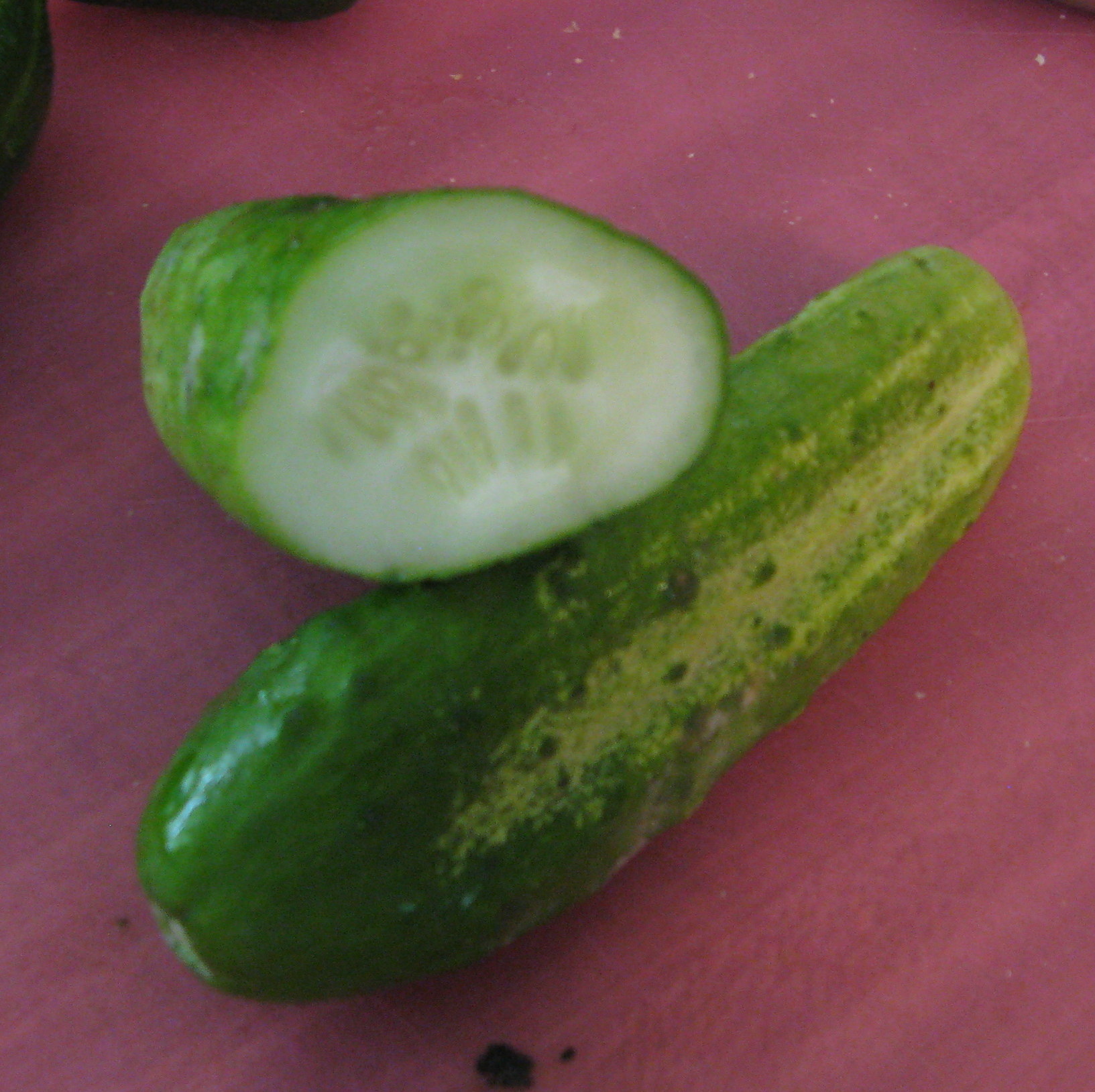
short chubby pickling cucumber with typical coloration

pickling cucumber

I like my cukes to be drier and without pronounced seeds, so I use pickling cucumbers to eat instead of the “slicing” or “field” cucumber.   During the winter, I’ll use the English (the big long ones in the plastic wrap) or the “baby” cucumbers since they have less developed seeds–and I can’t see having to scrape out that much of my cucumber.  A less watery cucumber (than the slicer) is desirable since I like to put them into cucumber and tomato salads, white bean salads, macaroni salads and all sorts of things like that–they are so cool and crunchy. I really don’t want to scrape out the seeds and salt to remove water!

.

cut Amira cucumber with small seed cavity and seeds

the Amira cucumber

Until recently, I’d been using pickling cucumbers, but a friend has introduced me to the Amira cucumber which she has grown in her garden regularly for some years; it’s now become my new favorite cucumber! Long, slender, with a deep green, thin skin, and seeds that are not very pronounced at all, and it is without the one downside of the pickling cucumber–a tendency to bitterness, especially in hot, dry weather. I’ll be planting some of these next summer, to take the place of the Diva (a slicer that does not need more than one plant to set fruit) cucumbers that I have been planting for the last few years.

.

Cucumbers are a member of the gourd family (Cucurbitaceae)which also includes squash, gourds, and melons. Cucumbers come in three main types: commonly called field or “slicers”, pickling, and “hothouse” or English cucumbers.

  • The American slicing (also garden, salad,  or field cucumbers) have a thicker skin and are usually waxed (for the supermarket) to prevent dehydration.  Since the skin is thicker, I prefer these peeled and because of the larger seeds which may be bitter and tough, and likely will need to be scraped out. These are a “wetter” cucumber and need to be salted to draw out excess moisture before use in salads. (Sorry, no pictures since I don’t have any of those around the house!) In the supermarket, these are the loose ones, with the waxed skin.
  • The pickling cucumber is noticeably different from the slicing or salad cucumber–there are gradations of color, and the skin is bumpy. These are usually shorter and chunkier than slicing or salad cucumbers, but they are perfectly good to use in place of slicing cucumbers.  (These will include gherkin and cornichon types which are smaller than other varieties of pickling cucumbers.)  When these are found in the supermarket, they usually seem to be dehydrated, since they are not waxed.
  • The English, Japanese, or “hothouse” cucumbers, which are longer and skinnier, and have small seed cavity and small seeds that don’t need to be scraped out. These are sometimes called “burpless” since they do not contain some of the compounds in the skin which can cause digestive distress to some people. These are found wrapped in plastic instead of waxed; the skin is thin so they don’t need to be peeled.

Favorite things to do with summer cucumbers include cucumber sandwiches, tomato and cucumber salad (with onion and herbs) as a side dish, or add cheese (maybe feta or ricotta salata) for a light meal (especially with fresh bread to soak up the juice), and I like to add them to other summer salads like white bean salad or pasta salad.  Slices are great as a crudity with hummus or other dip (baba ganoush). Then there’s that dish of cucumbers and onions, thinly sliced with a bit of sugar and vinegar and marinated.  Or combine them with yoghurt or sour cream, or even make a cold cucumber soup that’s easy and refreshing.

Recipes for cucumber salads or soups can be found on the web or in most cookbooks, but I’d especially recommend one of the vegetable cookbooks listed in the bibliography–Marian Morash’s The Victory Garden Cookbook, pages 92-101 for cucumber basics and some more novel uses such as sautéed  cucumber, and even baked stuffed cucumbers.

pickling and Amira cucumbers side by side

Amira and pickling cucumbers

Baby eggplant

Since eggplant are such a common, inexpensive, vegetable at all the summer farmers’ markets, I’m looking for ways to use more of them.  If you look at the nutritional value of this vegetable it looks like a worthy addition to my diet–vitamins, minerals, manganese, phosphorous, potassium, iron, and protein.  So what’s my problem? I think it’s one of the most beautiful vegetables in the market–right up there with ripe bell and chili peppers, and it’s not that I don’t like it–but I certainly don’t LOVE it like I so some other veggies.  Then there’s the size–I will eat veggies I don’t love, but I certainly DO NOT want leftovers lingering in the fridge.

baby eggplant in colander

baby eggplant

This summer I’m seeing baby eggplant at the markets–they are really cute and maybe more manageable in my diet. I have a lot of them now, so I’m looking for things to do with them. My usual “treatment” for eggplant is to brush it with some good, fruity olive oil and then grill it or put it on the griddle. Since I don’t have the grill fired up this evening, I think I’ll try simply roasting some of them as a first step in discovering things to do with baby eggplant.

For more ideas of things to do with this surfeit of this vegetable, I’ve been browsing the Internet. (If you simply google “baby eggplant recipes” you get 37,500,000 hits, so I though I do a little screening.)

I’ve found several recipes that look worthwhile–some more involved than others, but still looking appealing to me, since some of these bloggers were willing to confess to not loving eggplant, too.  So, I’ll share some of these “finds” with you.

halves of baby eggplant roasted

roasted baby eggplant

There are some starting points for this vegetable–for my first attempt, I simply halved them, popped them into the oven on a baking sheet after brushing them with a little olive oil; in about 10 or 15 minutes seemed soft, so I broiled them for just a few minutes to caramelize the tops at bit.  (I think next time I’ll put a little cheese–goat, feta, or maybe Parmigiano-Reggiano on top before the broiling.) Smelled wonderful with the carmelization.  Seasoning?  I had them with just a sprinkle of Fleur de Sel that neighbor gave me for doing cat care for her.  I’m likely going to try brushing them with some of the oregano oil that I made when I had to cut back by Greek oregano, or maybe some garlic oil….

I’m probably not yet ready to say that I LOVE eggplant, but these little bites certainly were good even with minimal adornment. Some of the ones left after this evening will probably find their way as a side for white bean, tomato, cucumber salad for lunch or a light supper tomorrow.

Baby vegetables?

One of the culinary “rages” a few years ago was micro-greens, and now it seems to be baby vegetables. Do you know what a baby vegetable is?

It’s not a very precise term in culinary lingo. If you’re interested in the culinary history of baby vegetables, take a look at “Eating Babies: A Study of Youth Horticulture” from Slate Magazine. We seem to have gone through a phase of the only-good-veggies-or-fruits-are-huge-ones. So we’ve selected for the “big” produce. (Think about storage onions, for example–how I would love to be able to buy small onions!) So now we’ve made small veggies (or fruits) a “gourmet” item–and created confusion with terms.

We really should not think of baby vegetables in the same way that we think of ourselves or even as we think of cows, or chickens, or hogs, as babies, adults, or the like.  There have been so-called “baby carrots” in the supermarket for a long time–but those are NOT really “baby”–they are full-grown, mature (adult?) carrots that have been reshaped by some entrepreneur who had a surplus of gnarly, misshapen carrots that could not be sold any other way. Now, these “baby-cut” carrots are made from carrots bred for increased sugar, rather than the misfits. So those still should be called “baby-cut carrots”, not baby carrots.

Then consider cherry and grape tomatoes–are those “baby” vegetables?  Well, yes–they are smaller versions of Solanum lycopersicum.  Some are big like the Big Boy, or the Cherokee Purple.  Others are smaller, or miniatures, like the Sungold, Sweet 100, or currant tomatoes, but we don’t call them baby tomatoes–but we could by the common usage of the term “baby” vegetable.

So is a baby vegetable just something that has been picked while still young and small? In many cases, that answer to that is a resounding no!  Just like haricots verts are not pole beans or Kentucky Wonder beans picked immature or tiny–they are a different strain or cultivar of Phaseolus vulgaris.

So, are there really baby carrots? What about baby artichokes? Baby eggplant?  Some carrots labeled “baby” are simply immature carrots that have been pulled because the carrot patch needed thinning, not because they were ready to eat. Frankly, most of that ilk of “baby” carrot is pretty tasteless–not really what I want when I want a carrot–but mature, small carrots I love! Yes–there are carrots that are bred to be small at maturity–and taste good too. (But then, neither do I want the 3-pound mega-carrot–I’ll use that for making stock.)

The term “baby” should be reserved for use with those things that have been bred to be small,  grown to be mature, full-flavored, miniature, ripe produce, with essentially the same caloric value and nutritional value of the larger vegetable or fruit. According to the AgriLife Extension from Texas A&M System there are about 50 types of baby vegetables grown and marketed in the U.S. (This number may be low now as this material was in their archive, but it gives you some idea of the growth of the baby vegetable market.)

The term dwarf usually applies to plants–which may be small, but may grow full-sized fruits. To further complicate matters, plants respond to their environment, so some fruits and vegetables will be “dwarfed”–or grow smaller, if plant too thickly, or closer together–e.g. cabbage.  Some smaller heads are simply standard cabbage that is planted close together–e.g. 8 inches instead of 18 inches in the garden.

jar of baby food from Gerber

baby vegetables

Obviously I feel that the “baby” vegetable is a misnomer–that should be the puréed stuff that Gerber puts out to be fed to small, immature humans, and we should use miniature to refer to small veggies and fruits!

(Yes, the image is from Gerber.com!)

Adding to panzanella….

dark purple eggplant

Black beauty eggplant fruits

You’ve probably noticed that I haven’t said much about one or two of the prominent summer vegetables–eggplant and summer squash. Well, here’s something that looks like it would be a good use of the ubiquitous eggplant that I’ve ignored except for baba ganoush and caponata. I no quarrel that eggplant nutritious, inexpensive, and the like.

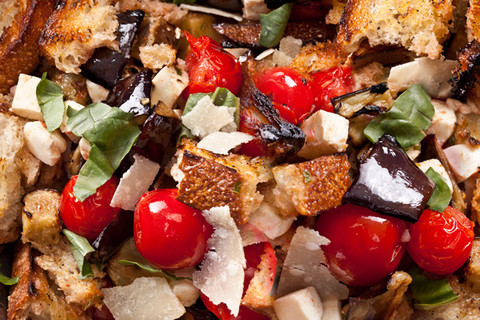
I’ve already posted about another summer favorite of mine–bread salad or panzanella so I was pleased to see this recipe for a bread salad using grilled eggplant.  This kind of salad is so easy to fix single-serving amounts that I wanted to pass this along as another way to make use of a summer vegetable.  The image below was included with the recipe on the website Chow.com.

bread salad with grilled eggplant closeup

Indigo Rose Tomatoes

When you’re just getting thoroughly tired of winter–about late November or  very early January–the seed catalogs start to appear in the mail box.  You spend hours happily looking through them and anticipating planting seed.  There are all those gorgeous pictures and the descriptions.  For me this is especially a problem with tomatoes.  So, every year I end up wanting something new–in addition to those heirlooms that I always want (Black Krim, Cherokee Purple). Last year my new addition was a Japanese Black Trifle.  It’s now become one of the regulars, and is close to replacing the Black Krim because it tastes wonderful and produces more tomatoes.

This past winter the tomato that aroused my curiosity most was an Indigo Rose, described in Johnny’s Select Seeds as a cocktail sized tomato, dark purple because of the anthocyanins (anti-oxidants) which develop in areas of the skin exposed to direct sunlight. To further titillate, it was described as ” good flavor with ‘plummy’ overtones. Developed by Jim Myers at Oregon State University using traditional plant breeding techniques. Moderately vigorous. Compact indeterminate. Organically grown.”  Now, who could possibly resist that in the midst of grey skies and cold rain?  Yes, I ordered some seeds.

Sprays of unripe Indigo Rose Tomatoes on the vine

unripe Indigo Rose tomatoes

Now we are harvesting them from the garden and fields–the acid test, so to speak.  I’ll concede that they are moderately vigorous, compact indeterminate, and very striking when you see them in the garden even when unripe the purple anthocyanin pigment is really obvious.

As they ripen to red (thus, the “Rose”, I guess) they really are lovely–impressive to be perfectly honest about it.

The very first ones that I tasted left me somewhat ambivalent about the taste–maybe I  tried them before that were appropriately ripe, or maybe I just like a different style of tomatoes–anyhow, there were different opinions.

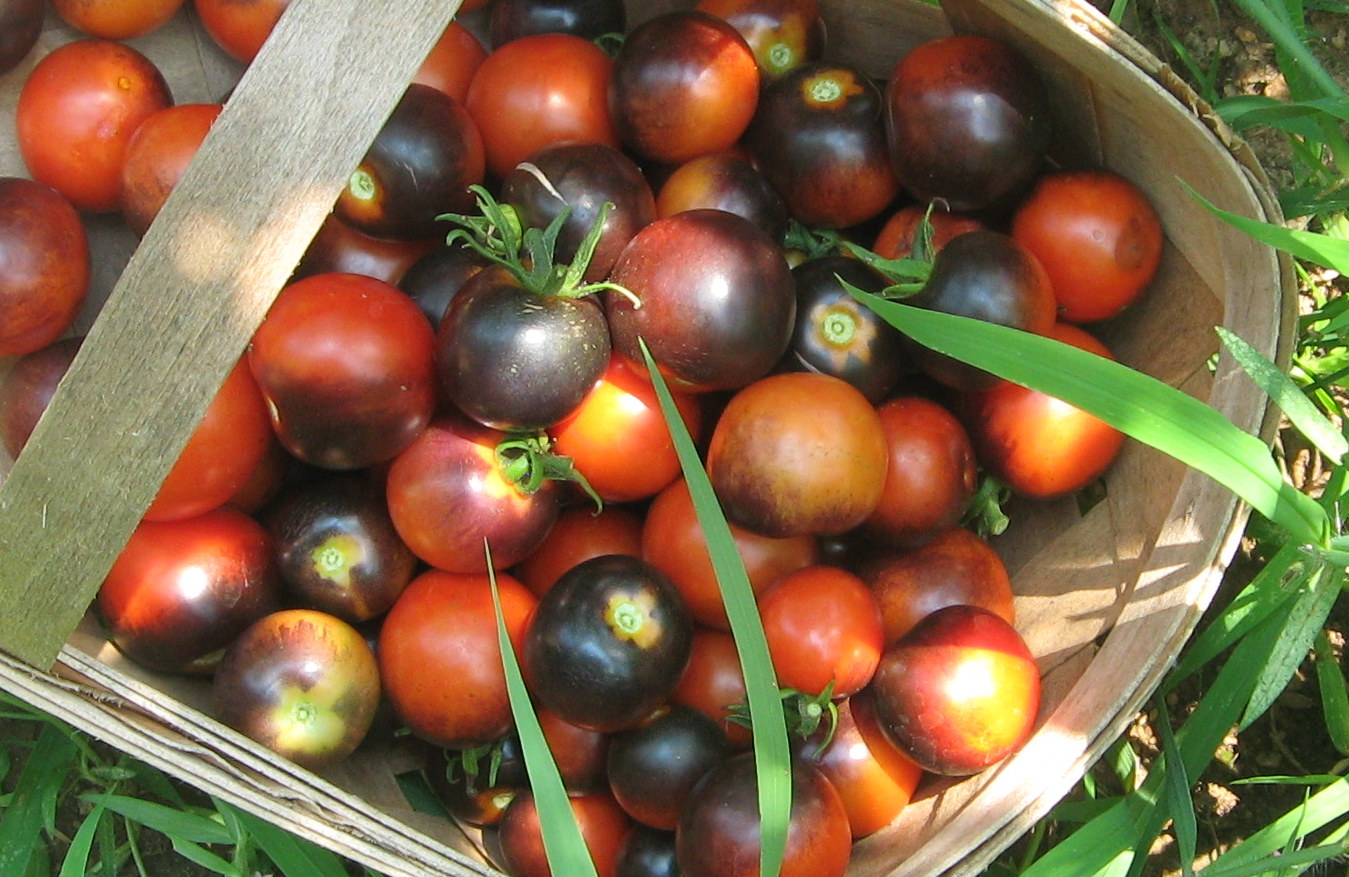
Ripe Indigo Rose tomatoes

ripe Indigo Rose on the vine

Now that I’ve tasted some that I’m sure are really ripe, and tried them in several different ways, other than just eaten out of hand, I’m more interested in exploring different things to do with them.

I have to say that they are not going to make it on to my bacon, lettuce, and tomato sandwich–not nearly tart enough to stand up to the really good dry cured kind of bacon that I like to put on my BLTs.  (I would put a Black Krim, or a Japanese Black Trifele, or a Brandy Boy on my BLT, though.) But–there are lots of tomatoes that I really like for different uses that don’t make it onto the BLT either–so no strike against the Indigo Rose for that reason.

My impression eating them out of hand is that they are a very low acid tomato.  Usually I prefer higher acid tomatoes–a balance of tomato-tart and tomato-sweet.  So this is not going to be my choice of tomato for my sloppy, eat-over-the-sink-with-mayo tomato sandwich (which needs to be on white bread, too, by the way!) either.

But–one of my other summer favorites is insalata Caprese.  One of the fun things to do when making this salad is to have different kinds of tomatoes–lots of visual appeal–like Green or Red Zebras, some pink, some purple–whatever!  I tried these with the fresh mozzarella and extra-virgin olive oil, and just a tiny drizzle of a good balsamic vinegar.  The sweet-tartness of the balsamic really showed the sweet tomato flavor of the Indigo Rose tomatoes.  I did not (I know Indigo rose tomatoes in basket after pickingit’s heresy, but I did not) put basil on this salad–I used Syrian oregano, and it was a lovely salad.

For more taste and visual contrast I might combine these with an orange or yellow (also lower acid) tomato, but not with high acid tomatoes–I think that would just make the Indigo Rose ones taste bland–but that’s the next experiment!  A reason to go tomato shopping at the Wake Forest Farmers’ market tomorrow.

Another way that I’d like to try them is slowly oven-roasted to concentrate the flavors–I think that will really bring out the sweet, plummy flavor–again another experiment.  They are a good size to use in green salads, but I’d want a pretty mellow vinaigrette with them–maybe just extra-virgin olive oil and balsamic vinegar.

Panzanella (Bread Salad)

lots of tomatoes laid out on table

tomatoes, tomatoes…

Tomatoes, tomatoes and more tomatoes! So many ways to eat tomatoes…caprese salad, good old-fashioned tomato sandwiches–good white bread, mayonnaise, and juicy tomatoes; a sandwich that has to be eaten over the kitchen sink.   Then there is the BLT!  All good, but what else can you do with the summer abundance of tomatoes? Obviously  you can freeze some, or make sauce to freeze for winter use,  but one of my summer favorites is panzanella, or bread salad.  Since stale bread is a fact of life, even when you bake your own pretty much “on demand”, here is one of my favorite ways to use it up and to enjoy summer tomatoes.

This is a summary and adaptation of  my “go-to” recipe from Marcella Hazan’s Essentials of Classic Italian Cooking (pp. 554-555):

Ingredients

  • 1/2 garlic clove, peeled
  • 2-3 flat anchovy fillets, chopped fine
  • 1 tablespoon capers, soaked and rinsed
  • 1/4 yellow bell pepper, ribs and seeds removed
  • 1/4 cup extra-virgin olive oil
  • 1 tablespoon good red wine vinegar
  • 2 cups firm bread (cut into 1/2-inch squared), trimmed of crust and toasted
  • 3 fresh, ripe, firm tomatoes
  • 1 cup cucumber cut into 1/4-inch dice
  • 1/2 medium sweet onion, diced
  • fresh-ground black pepper and salt to taste

Preparation

  • Mash the garlic, anchovies, and capers to a paste.
  • Toss  the pepper, garlic, anchovy, olive oil, and vinegar together in a bowl.
  • Put the toasted bread (and any crumbs) in a small bowl.
  • Purée one tomato in food mill; add to bread an allow it to steep for 15 minutes or longer.
  • Skin and seed the other 2 tomatoes and cut into 1/2-inch pieces (picking out some of the seeds if there are too many).
  • Add the cut tomatoes and the bread squares to the bowl with pepper, garlic, anchovy, oil and vinegar mix, and  add the cucumber and the onion; toss thoroughly.

While the recipe calls for peeling the tomatoes, I don’t usually do this unless the skins are very tough–I’ve no objection to the extra fiber, and some objection to the extra work that peeling them takes.  I don’t pick out seeds either–I think that the “jelly” surrounding the seeds adds extra flavor and an acidity that is lost by removing them–however, if you want a more refined version, by all means peel and remove seeds. (If you keep the “jelly” and seeds, it increases the tartness of the tomatoes, so you might want to decrease the wine vinegar–just taste it and season accordingly.) You can add fresh herbs of your choice–basil, marjoram, oregano, Syrian oregano (zaatar)–whatever strikes your fancy!

If this cookbook is not in your library, there is also a recipe for a simpler version of panzanella at Epicurious.com.

If you’d like to make this a meal in itself, add some good quality canned tuna or your homemade tuna confit to it. Cucumbers and onions are certainly optional.  Some fresh mozzarella would work here too.

The basic recipe above makes four to six servings, but it’s very easy to cut this down to make a single-serving quantity–just eyeball it!

I decided that this had potential for a bacon, lettuce and tomato salad so I did some modification: omitted the anchovies, capers, and the pepper.  I prepared the bread and the tomatoes as for the panzanella, and substituted balsamic (or rice wine) vinegar.  I kept the cucumber for it’s crunch and freshness and the sweet onion, even though they are not part of the BLT.  I added crumbled crisp bacon, and had this over romaine lettuce.

Since I did this improvisation  (it just wasn’t something that I needed a recipe for), I’ve googled “BLT salad” and found lots of variations on that theme, especially with the dressing.  Since I’m one who does like mayonnaise with my BLT, I’ve looked for dressings using it, but haven’t found anything I like better than the basic oil and vinegar, though I may be adventurous and try a creamy dressing with mayonnaise, thinned with buttermilk in the future.

A son goût!  

Beet Chips

An interesting option for beets when there are more than you can use fresh.

emmycooks's avatarEmmy Cooks

Welcome to Emmy Cooks!  You can see some of my favorite recent recipes by clicking the “My Favorite Recipes” category on the sidebar (here are April, May, and June).  If you like what you see here, you can sign up on the sidebar to receive a daily recipe by email and to follow Emmy Cooks on Facebook or Twitter.

During my first pregnancy, I had an occasional craving for citrus.  Grapefruit, oranges, pomelos, lemons, limes, anything.  During my second pregnancy, nothing.  And during my third pregnancy, I had no cravings, but one aversion: beets.

Other vegetables were okay: I would happily have eaten butternut squash tacos with chipotle and feta or a pound-of-greens frittata.  Those risotto-stuffed chard leaves were popular in my kitchen that year, and a simple arugula salad was just my speed (the arugula comes up in the garden by itself on years…

View original post 314 more words

Red, white, and blue roasted potatoes

Happy Fourth of July to all!
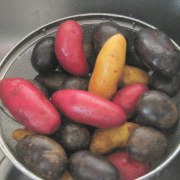
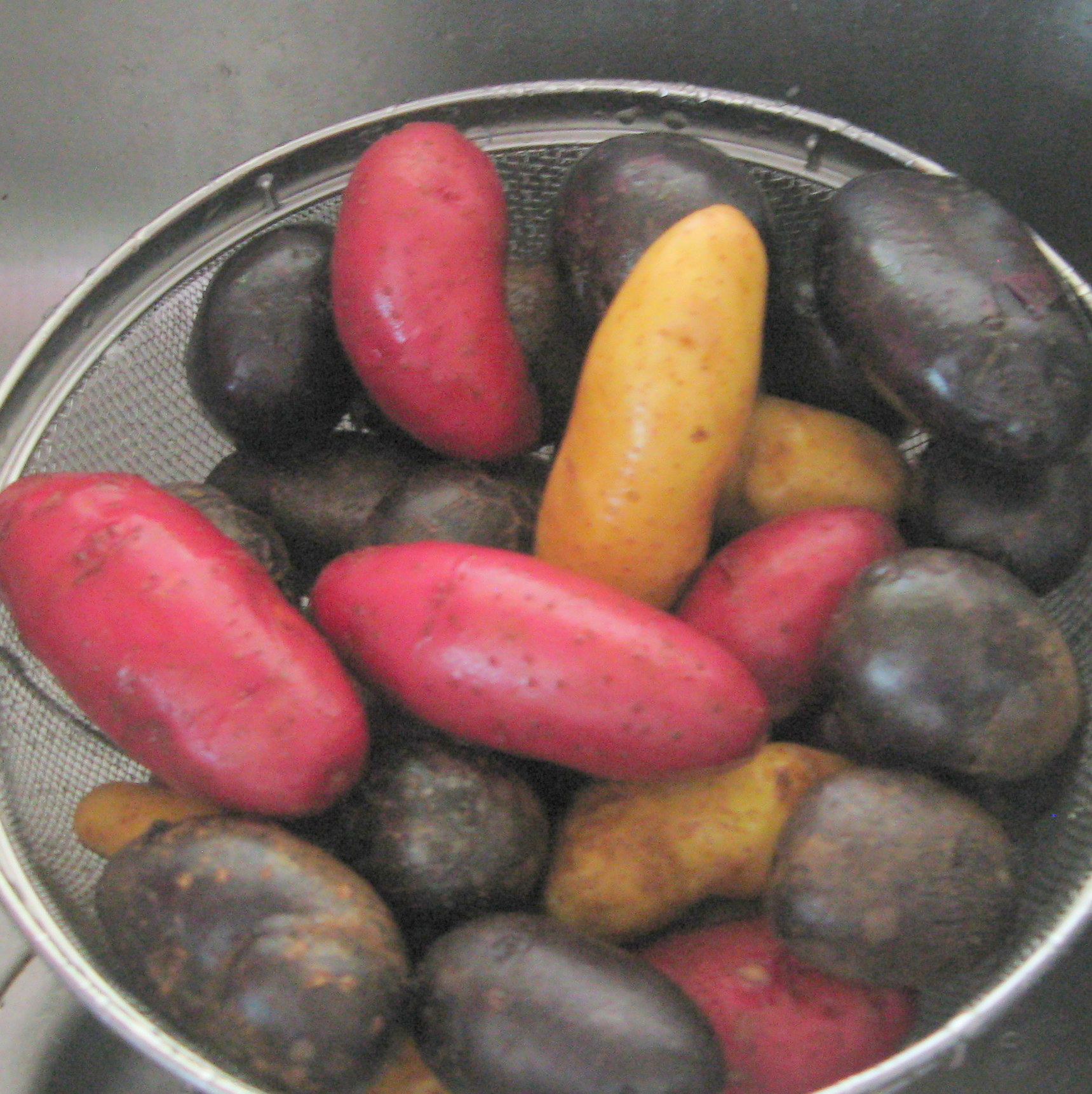
mixed color potatoes in colander

I really was planning to do something special today–more smoked lamb and goat shanks–but I admit to turning to a total wuss, wimping out…as I looked at the weather forecast for the week.  Even though those are easy, it still requires some minding of the grill, and I just could not face it.  I resolved to have a quiet, cool Fourth of July–just me and the cat–indoors with the air conditioning…and I woke up this morning wishing I’d not been such a wuss.

Saved by friends!  An impromptu invitation to join them for grilled chicken this evening.  So–I’m having my quiet Fourth, but with friends and neighbors.
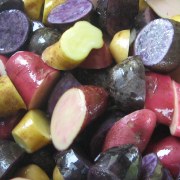
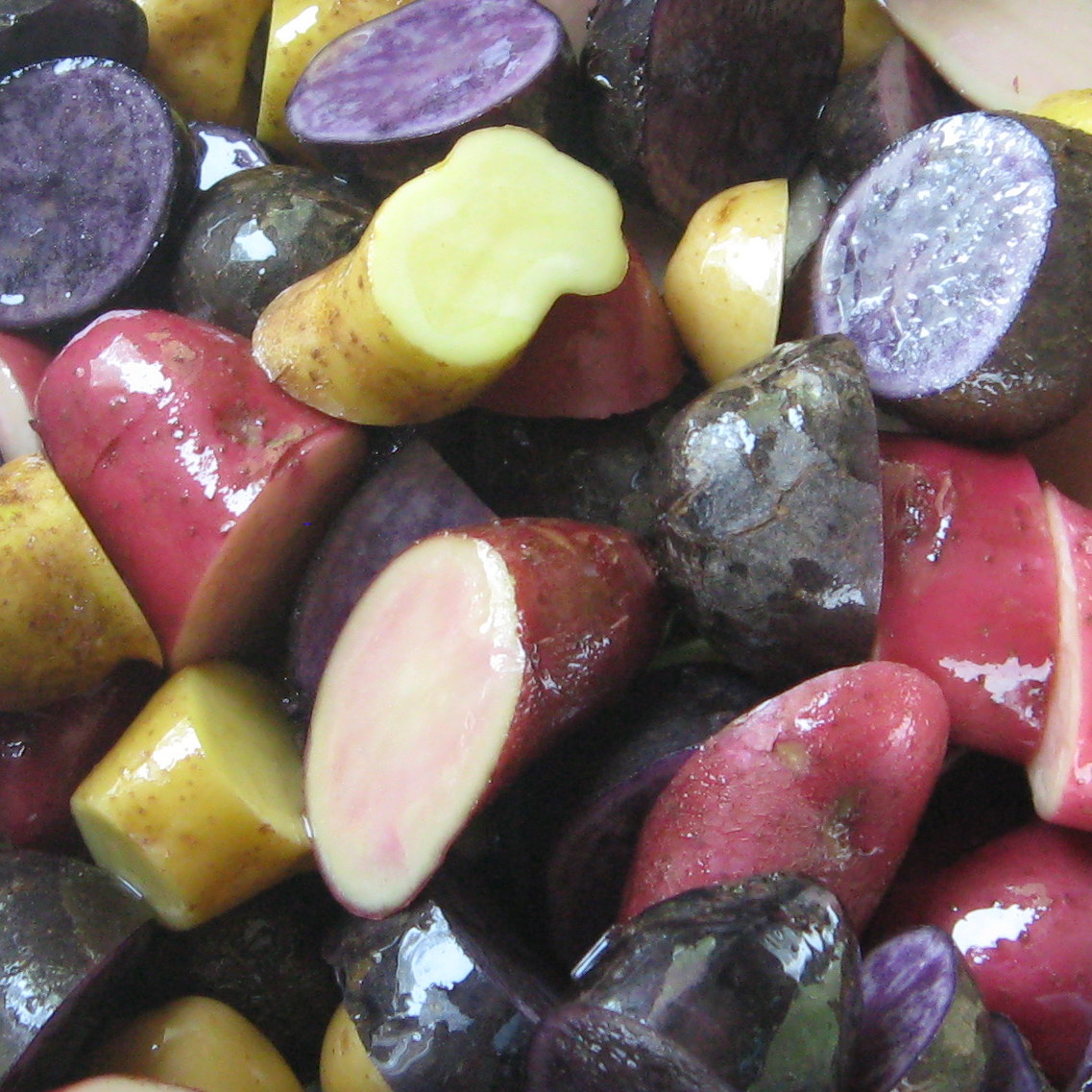
close-up of cut purple, pink/red, and yellow potatoes

Not to go empty-handed, I am making some patriotic roasted potatoes–red, white, and blue–Red Thumb, Russian Banana (okay, bit of fudging here), and Purple Majesty potatoes (new ones from the farm).  Since it’s HOT (my thermometer is reading 98°F now), I’ve decided that those roasted potatoes are going to turn into something that can be eaten at “room temperature”, that will be light and refreshing, and compliment the chicken.

I’m taking  newly dug tri-colored potatoes and scrubbing their delicate skins carefully, cutting as needed to have them equal sizes so that they cook at the same rate, tossing them with a little olive oil; then into a preheated pan and into a 350° F oven until they are tender.
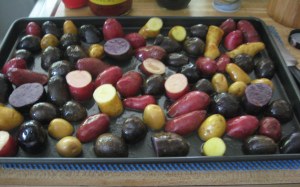
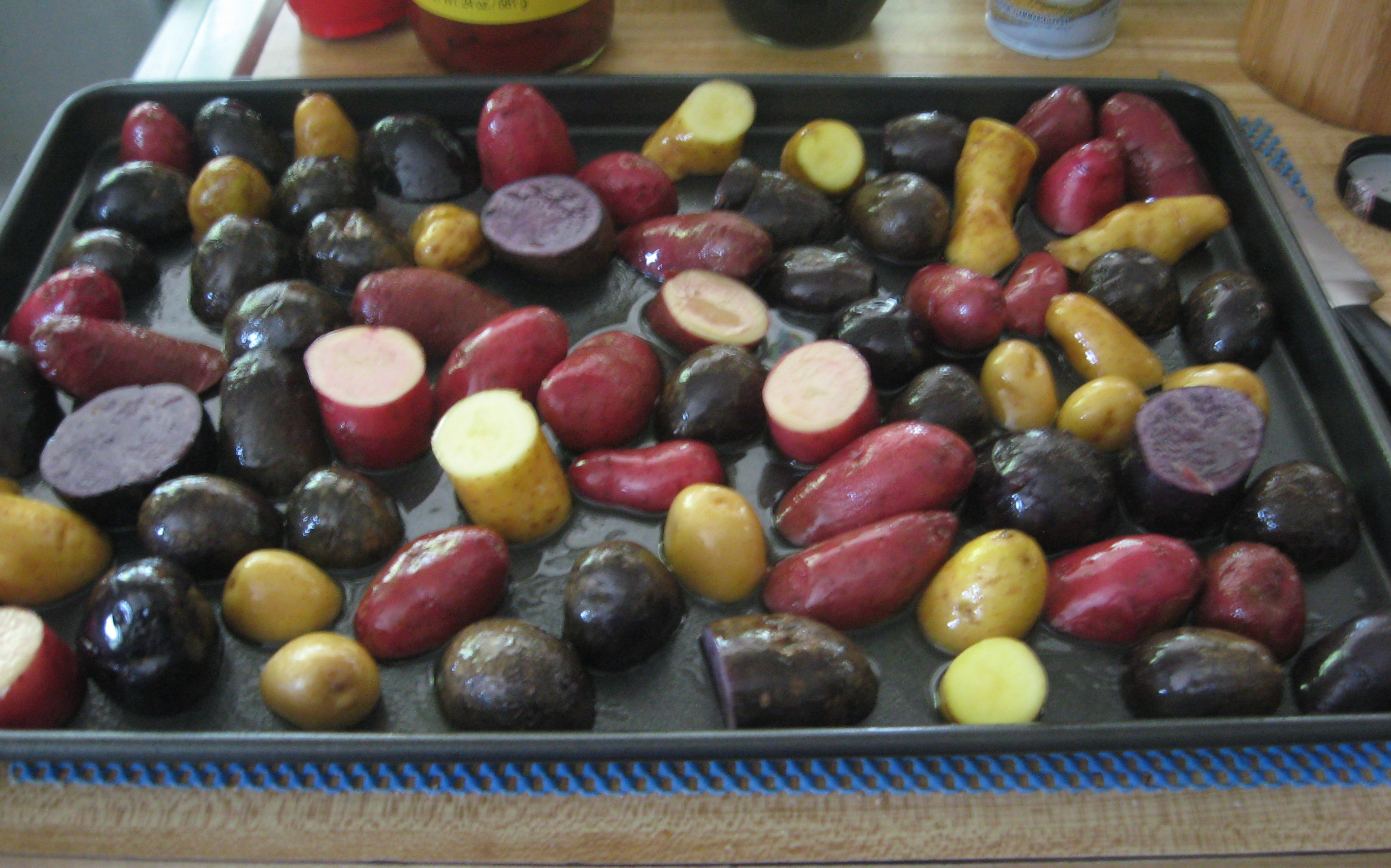
cut and oiled potatoes on baking sheet

I’ve done what America’s Test Kitchen recommends and placed cut sides in contact with the baking sheet so that at least some of the potatoes will brown to give roasted flavor. Now for some complimentary and contrasting flavors to finish these. Since all these do taste a bit different, and for me one of the fun things about this is to be able to taste the individual potatoes and to compare them–think about comparing wines–I want light seasoning–nothing to overwhelm the potatoes themselves. The only seasoning at this point is kosher salt.

Since it’s hot outside (my thermometer is now reading 99.7°F ), I’m thinking light and cool flavors.  I don’t want “potato salad”–so vinegar is out, but I do need something “bright”–and light, and something cool.  Time to check out the herbs on the deck, and the crisper drawer.
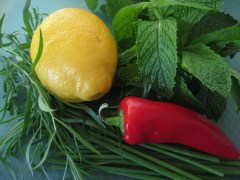
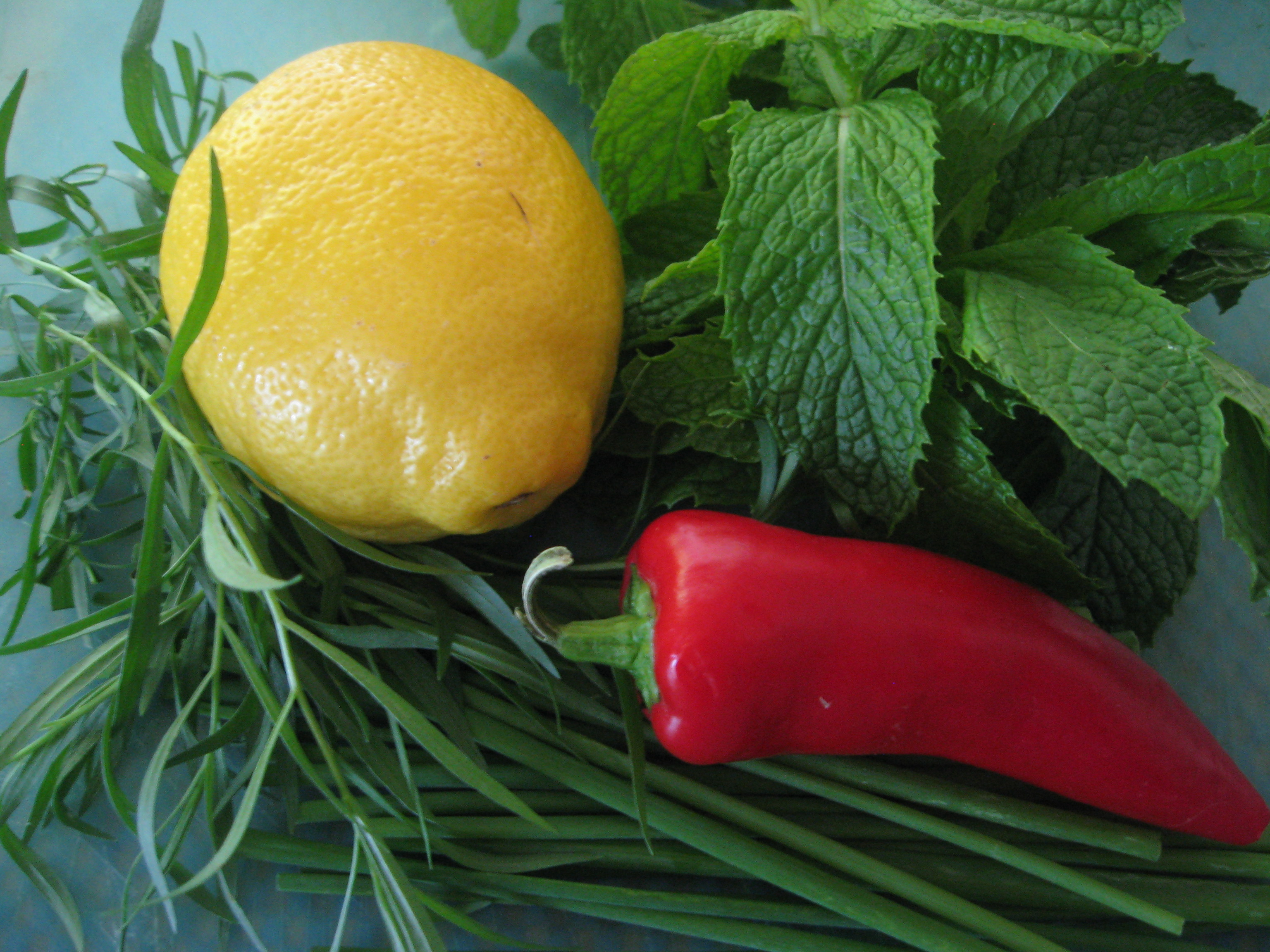
lemon, tarragon, chives, mint, and chili peppers.

Chicken makes me think tarragon.  Cool makes me thing mint–hmm.  Let me smush a couple of leaves together and see how that smells.  Tarragon–warm, mint–cool.  Need some brightness to set off the earthiness of the potatoes–lemon zest, and maybe just a bit of lemon juice over the potatoes while they are still warm.  Seems a good start–but not quite there yet.  Needs a little “spice”–some very finely minced red chili pepper might just do it.

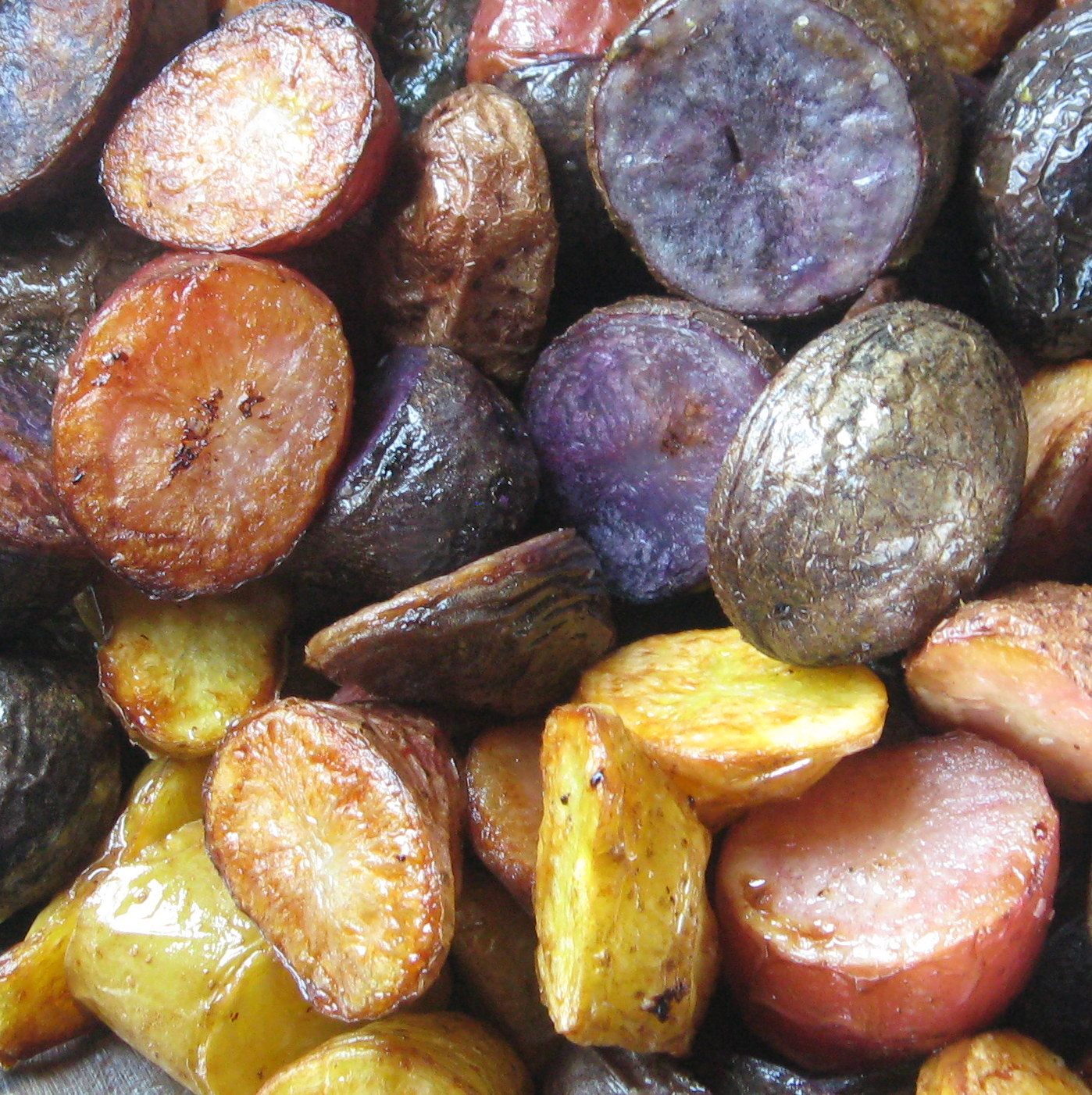
After the potatoes had been in the oven for 30 minutes, I used the tip of a paring knife to check doneness–not quite; and, not quite brown enough.  (I probably should have used the heavier half-pan baking sheet instead of this one–drat.) I kicked the oven temperature to 450°F for another 15 minutes and checked again.  Perfect!  Brown potatoes–so out of the oven, ready for the first seasoning.
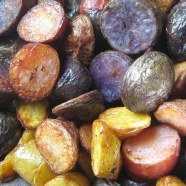
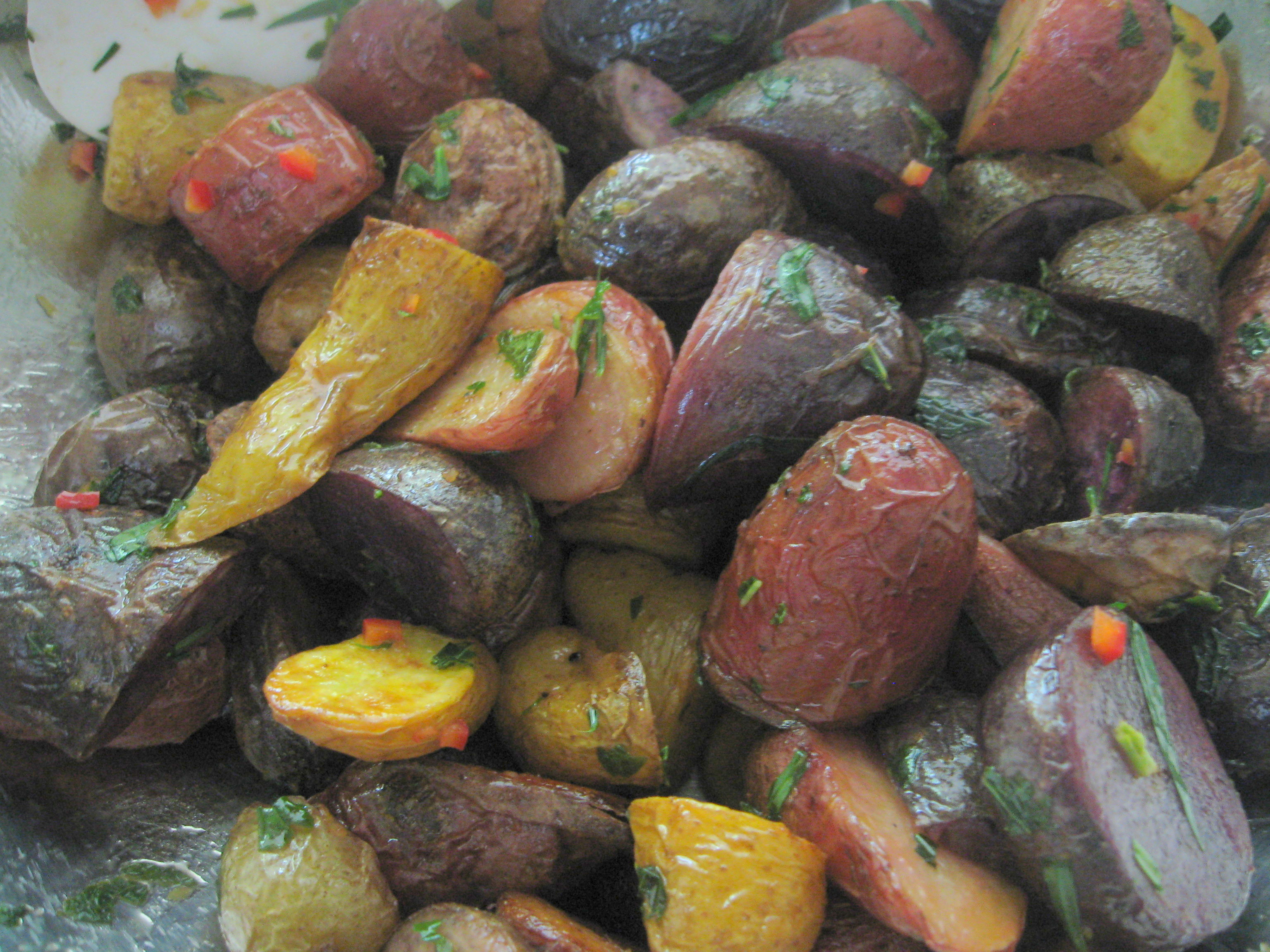
roasted potatoes--browned edges of the red, yellow and purple  ones.While still hot, I tossed them with the zest of one lemon and most of the juice of the lemon–nice bright flavor to contrast with the brown and earthy potatoes.  After cooling a bit, I tossed in about a tablespoon each pretty finely chopped French tarragon and mint. That got the first taste of cool mint, followed by the warm flavor of French tarragon.  So far so good.

I let them stand for a bit and tasted again–the lemon flavor is there but not overwhelming–the juice has added just a bit of tartness, but not enough to taste like a “potato salad”. Now, I’m debating chives and chili pepper.  I taste the chili pepper–it’s not screaming hot–and I think that just an occasional bit of heat as you eat the potatoes would be nice.  I seeded and removed the ribs, and finely minced about 1/5 of the pepper and tossed that with the potatoes. (Still debating about the chives–I really don’t want them to taste like ersatz baked potatoes.)
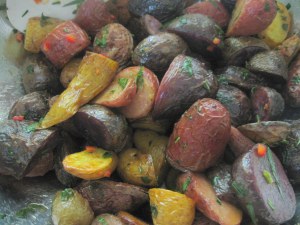
seasoned IMG_6935After standing for a bit longer, I tasted again, and decided that chives are not what is needed here–I probably should just leave them alone!

So the final seasonings are the zest of one lemon, lemon juice, mint, tarragon, and just a touch of  red Serrano chili pepper, and a very light sprinkle of a good fruity, extra-virgin olive oil.  I hope that after standing a bit more (not to be refrigerated before we eat the at ambient temperature–or maybe a little less–thermometer now at 100.6°F ) there will be flavors of warm and cool herbs, the brightness of lemon (juice and zest), and an occasional burst of heat from the chili pepper.

Using the baking sheet so that the potatoes are spread out and don’t steam, and preheated does really help get browned roasted potatoes.  If they are too crowded, they will only “steam” and not brown–not really roasted.  The browning is, after all, the whole purpose of turning on the oven!

It’s not smoked lamb shanks, but it’s going to be a pleasant evening with friends–and I do think that something similar will return to go with those lamb shanks when they happen later–when the temperature does not turn me into a total wimp!

…and yes, I’ve done that final taste–yum!  No chives though.
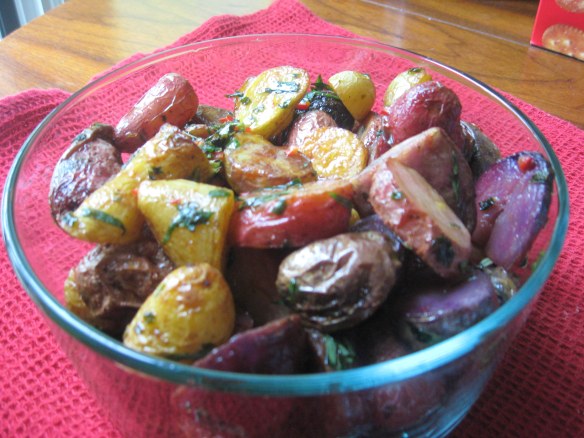
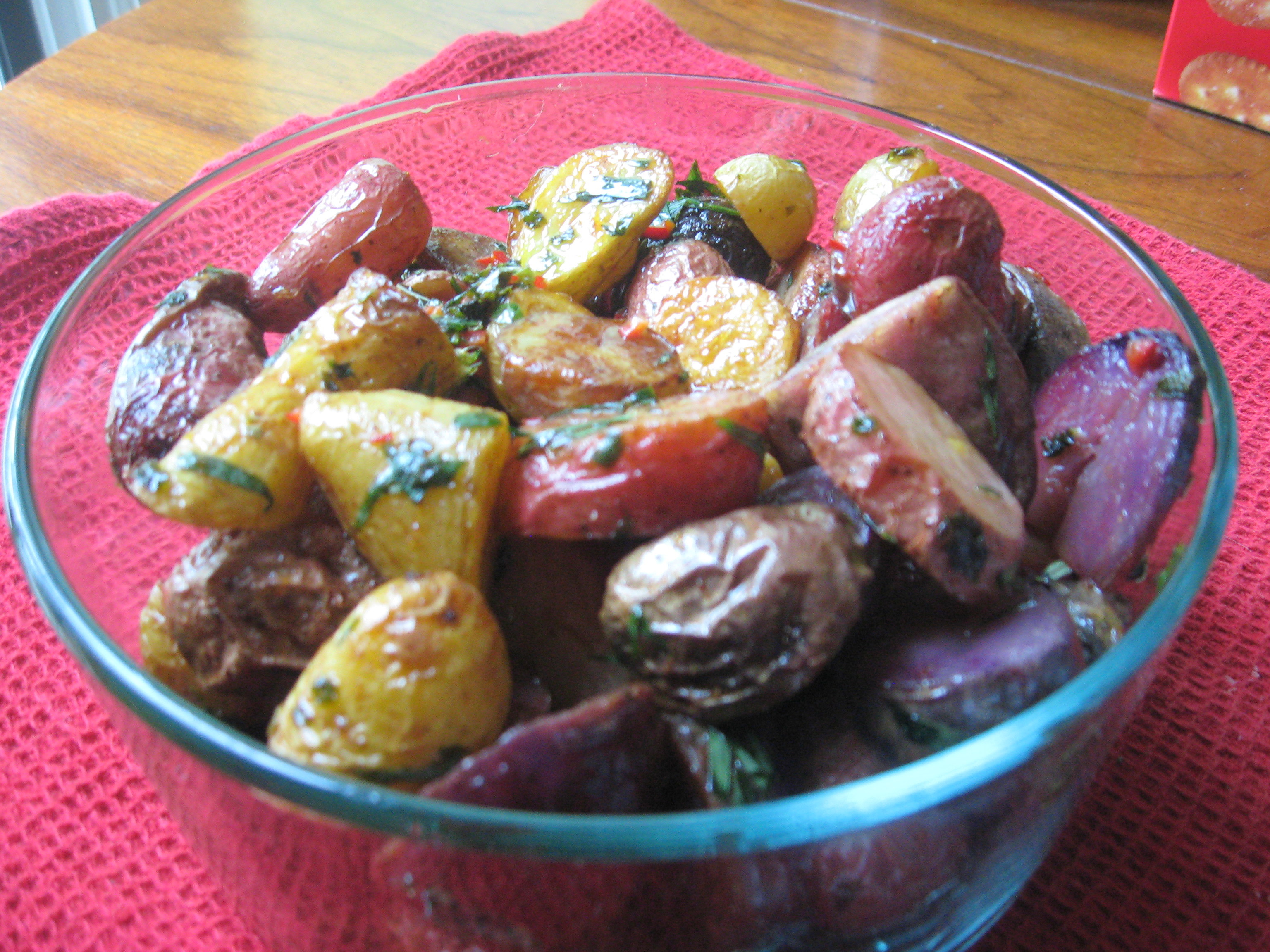
roasted potatoes, with herbs and chili peppers in serving dish.

Leftovers? Possibly–it is a big dish of potatoes for three, but leftovers here are desirable.  Tomorrow they can become a roasted potato salad–perhaps with just a splash of balsamic vinegar, adding some fresh tomato, and cucumber, and, perhaps, some celery, radishes, crisp sweet onion or some freshly snipped chives.

Happy Fourth of July!  A son goût!  

Haricots verts with herb-infused oil

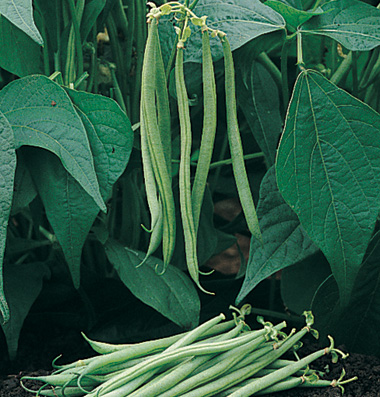
Taverna filet beans

haricots verts (Taverna)

Yes, it is French for green beans–and they are Phaseolus vulgaris, but they are special green beans–not like Kentucky Wonder, or some of the other rather common beans.  To find them in the seed catalogue you need to look for “filet” beans.  They are bush beans, but the pods are small and slender (when harvested appropriately). Not having a large garden, I don’t grow my entire supply of green beans–the usual pole beans or bush beans like Kentucky Wonder–I buy some from the farmers’ market and I even use frozen ones in the wintertime.

These little beans are something that does get space in my garden or in a container on my deck–with successive plantings throughout the summer so that I can dash out and pick a single-serving batch when I want them.

My favorite way to cook them is to steam them very briefly (about 5 minutes) until just tender, shock  them in ice water so that they stay brilliant green, and  toss them with some extra-virgin olive oil infused with fresh herbs, and served at room temperature.  A favorite of mine for those hot summer days when you’re being fussy about what you eat.

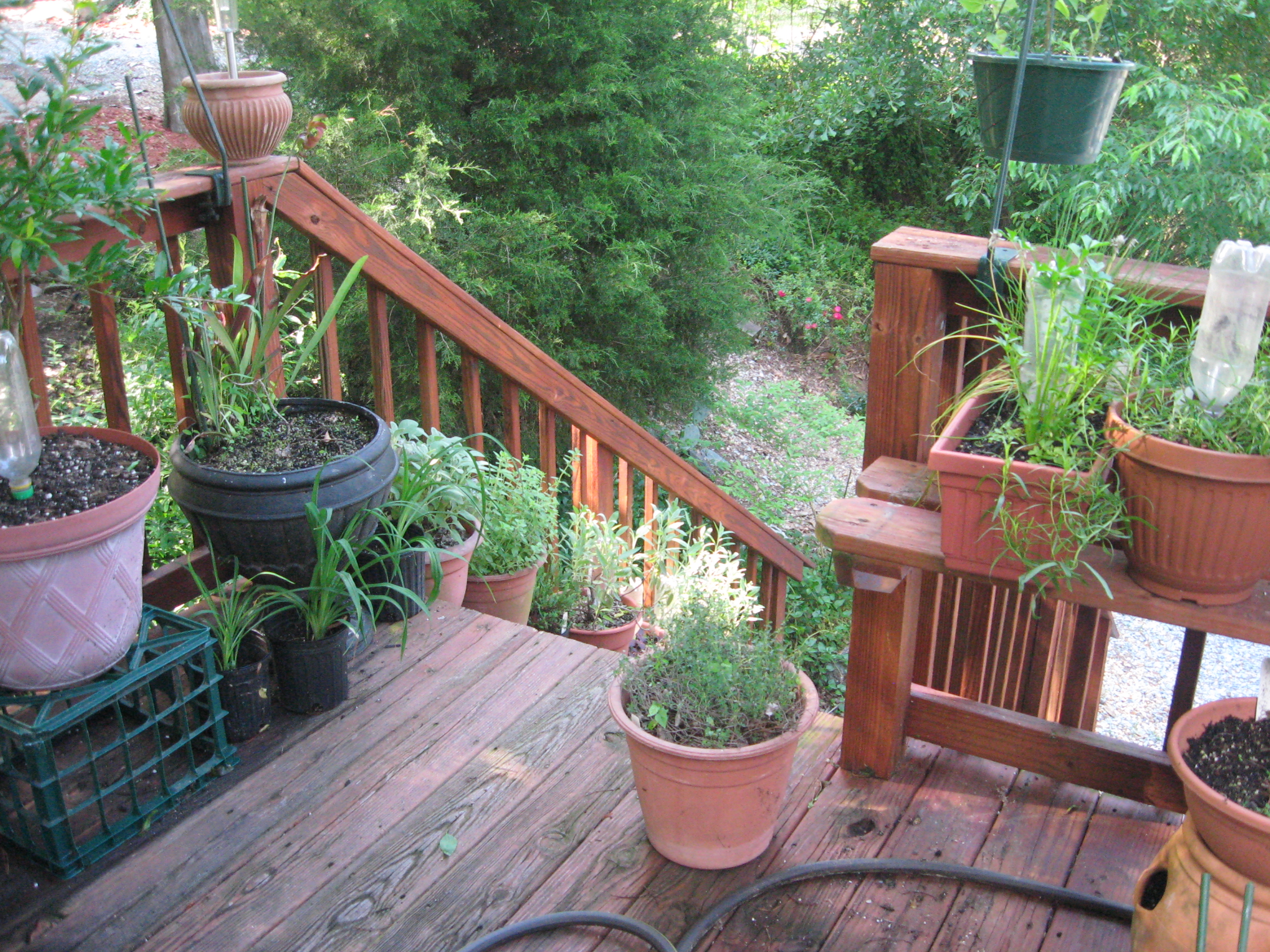
containers of herbs on deck and stairway

herbs

Since I do grow a lot of herbs on my deck with containers arranged on the stairway, and since I prefer not to let them bloom since that affects the flavor of the herb, I keep them cut back to prevent blooming–or grow varieties that do not bloom as readily as the common culinary herbs.  I find that I often need to give the marjoram and the oregano a “butch” cut.  This does not involve a neat trim–it’s taking the hedge shears with the long blades and lopping off the tips.  That leaves me with a handful of fresh herbs to share with my neighbors, or to use to make herb-infused oils to have on hand, and to use during the wintertime.

It’s simple to make herb-infused oils.  For immediate use, you can simply blanch the herbs, then “shock” in ice water, squeeze dry, and purée with enough oil to make a slurry, then add more oil.  Let stand, refrigerated, for 24 hours and strain through coffee filter.  These can keep for about a week, refrigerated.

For longer storage, I prefer to heat the herbs in oil to about 185 to 195° F and then strain.  At that temperature, you should be safe from any bacterial growth.  The last batch of oil that I prepared, I washed, blanched and dried the herbs; then chopped them and popped them into my very small slow cooker overnight, and then strained them.  This oil is probably not as bright green as it would be had I not heated it for that long, but the aroma is really great.

My favorites with the haricots verts is either sweet marjoram, or Syrian oregano (also sometimes known as zaatar).  Both of these herbs seem to intensify the sweetness and the “bean-ness” of the haricots.

Most herbs lend themselves well to making flavored oils:  sage, oregano, thyme–whatever is your favorite–try different ones with the beans, and vary it according to the flavors of other dishes served at the same time.

A son goût!