Ushering in Strawberry Season

Luscious!

Rufus' Food and Spirits Guide's avatarRufus' Food and Spirits Guide

We’ve had a weird spring, which makes us even more giddy to see strawberries at the farmers market. It’s hard to feel springy when you’re using your fireplace to stay warm on May 4. The temperature dropped from the 80s to the mid 40s that week. But berries always let us know summer is just around the corner.

We’ll be featuring strawberry recipes all week — salads, booze, desserts! — and highlighting a few of our old favorites. Here’s a look back at some of our favorites:

Strawberry Cobblers for Two

Strawberry Rhubarb Pie

Spiced Strawberry Shortcakes

Strawberry Balsamic Granita

Strawberries Romanoff

View original post

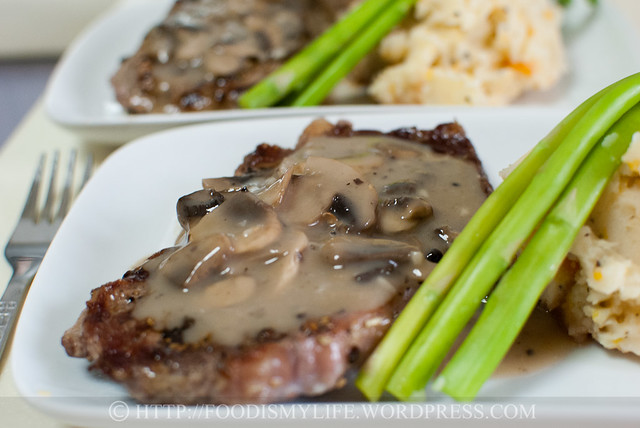
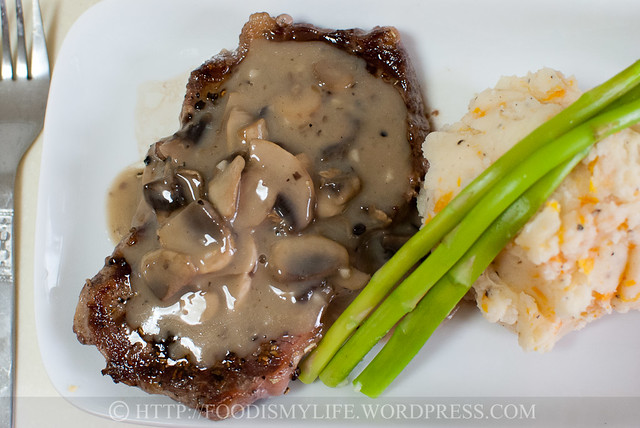
15-Minutes Mushroom Sauce (for Steaks and Mashed Potatoes)

Quick and easy!

Foodie Baker's avatarFood Is My Life

15-Minute Creamy Mushroom Sauce for Steaks

This very easy, very quick and very delicious mushroom sauce changed my life, completely.

Okay that’s a total exaggeration, but well, at least I no longer have to go and buy those pre-made sauces for steaks (God knows what’s in there). I can make this sauce myself, at the comfort of my own home, with pantry ingredients (okay you probably need to grab the mushrooms and milk/cream from the market, but yea you get the idea, right?) And the sauce tastes so good, so spoon-licking good that I can’t stop eating it right out from the pot (even before I started cooking my steaks).

So yea, in a way you can say that this sauce is revolutionary. 😉

15-Minute Creamy Mushroom Sauce for Steaks

View original post 442 more words

Cooking monkfish

TGIEOT—yes, that’s a bit more than TGIF!  It’s end-of-term.  The Spring term was the school term from hell, starting right at the end of Fall term!  Over the winter break I had unexpected course preparation to do for two online classes—switching from Blackboard to Sakai—for content management.  Top that off with an ongoing indexing project, and it’s—well, let’s just say it left very little time for cleaning, cooking, or writing!  Then, add to that a hard-drive failure for my computer….but it’s over now.

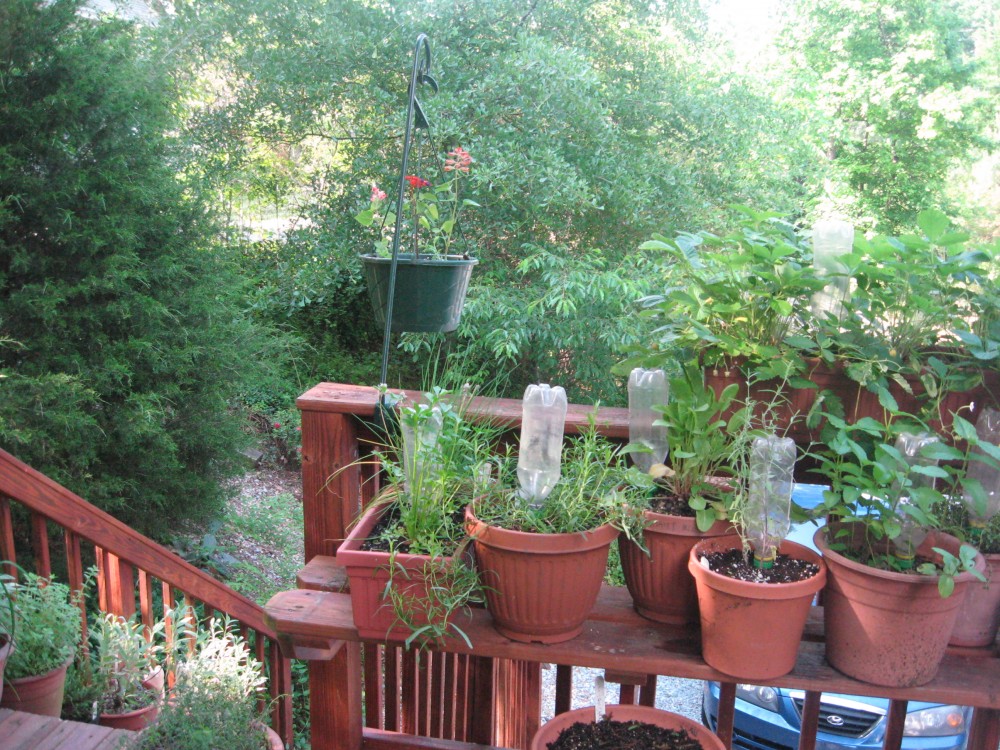
I’ve taken some time to work on revising the on-deck herb garden since I had plants that needed to go into their home pots, and a couple of days to do nothing but have quality time with the cat.  All that has left me yearning for some relaxation time and some really good food—cooked by me.

My day was absolutely made when I got my email delivery of the “Fresh Catch” specials from my local Harris Teeter this morning: they had monkfish! In terms of favorite fish, that’s right up there with Chilean sea bass for me.  Needless to say, I scarfed down my morning coffee and headed right off to HT.
fennel, leeks and garlic ready to roast

fennel, leeks and garlic

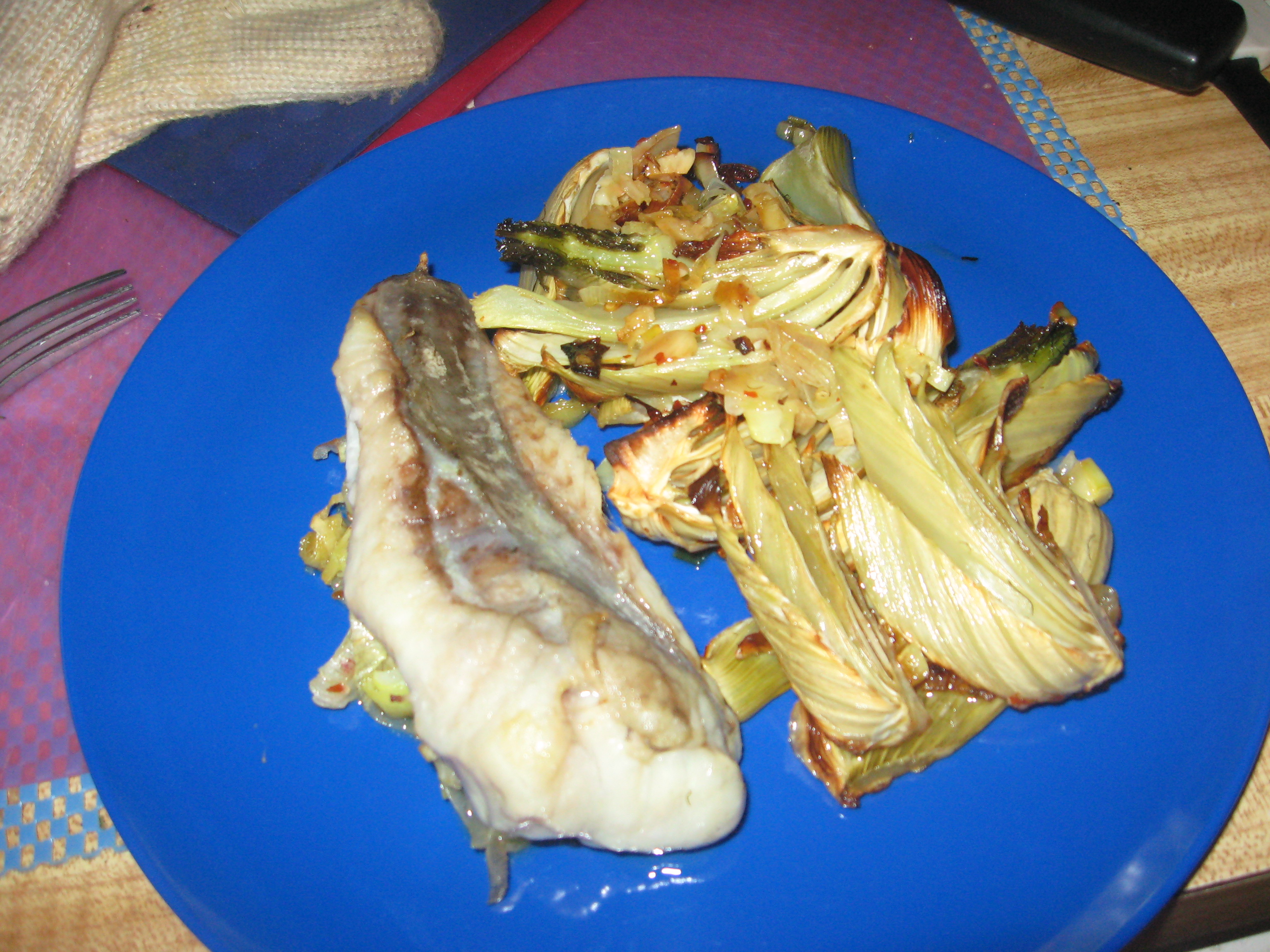
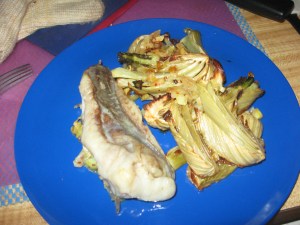
Supper this evening was roasted monkfish, with roasted fennel with leeks, garlic, and a dash of red pepper flakes, with a nice un-oaked chardonnay.  The fennel was an in-store, spur of the moment thing since it looked so gorgeous.

Even though it is warm this afternoon, I opted to cook in the oven because I wanted roasted fennel as well. I’ve done monkfish in hobo-pack style before but I thought I’d try roasting it this time and see if I couldn’t have a one-pot dinner.
monkfish

monkfish

I’d seen a post by Edward Schneider in Mark Bittman’s NY Times column (Diner’s Journal) about roasting monkfish, and the differences in monkfish on both sides of the Atlantic. After reading that I salted my monkfish for about an hour, and then roasted it.  I did manage to make a one-pan meal out of it. Since I had to allow about 40 minutes for the fennel to roast, I started that first.  After about 15 minutes, I laid the monkfish on top of the leeks, pushing the fennel wedges to the side, and popped it back into the oven for about 15 minutes.  I used very simple seasoning on the fish—olive oil and salt before going into the oven, and nothing for than fresh-ground black pepper and a pat of unsalted butter after it came out of the oven. So very simple—so very good, and even healthy.

(The only thing I wish I had done differently would have been to add some sweet red (or orange or yellow) bell pepper with the fennel. A glass of un-oaked chardonnay complemented the meal very nicely.)

IMG_7553

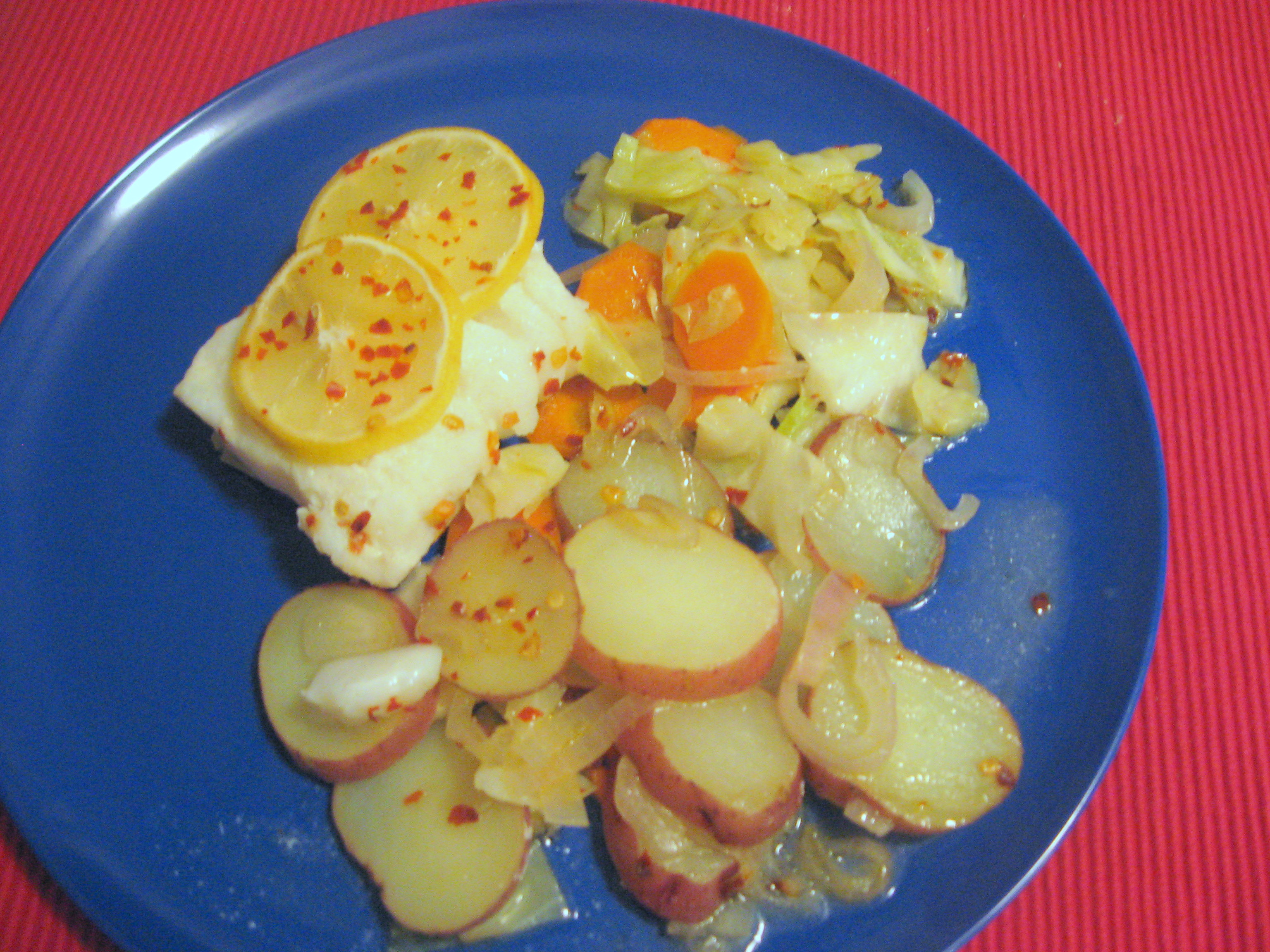
Baked cod fillet with vegetables

The “leftover” cod to which I alluded in a previous post was the result of beginning-of-term course preparation frenzy (always happens no matter how well I think that I’ve planned).  It was an OMG-I’m-starving-what-have-I-got-in-the-fridge, what-can-I-put-into-the-oven-so-I-don’t-have-to-watch-it, panic situation.

cod filet in a baking dish

cod & vegetables ready for oven

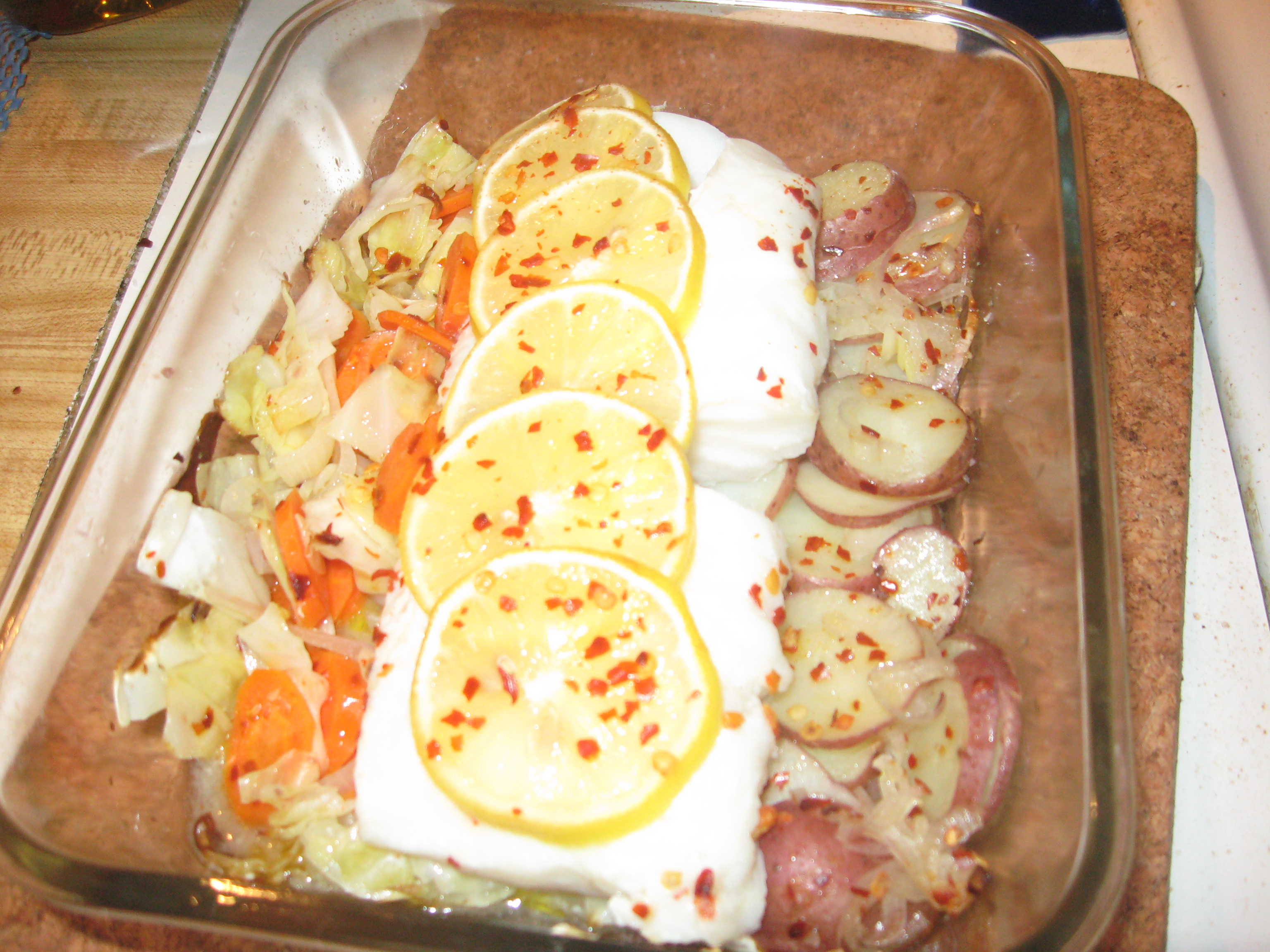
I had the cod fillet, but I was really pressed for time.  After madly rummaging in the vegetable crisper, and came up with cabbage, carrots, potatoes, lemons, and onions.  The cabbage got cut into bite-size pieces, the carrots and potatoes sliced into about 3 mm (1/8-inch) pieces.  I tossed the cabbage and very thinly sliced onions with some extra-virgin olive oil and a pinch of salt.  I gave the carrots and the potatoes the same treatment, threw in one of the few herb mixes that I keep on hand–herbes de Provence (my go-to in panic mode), some red pepper flakes put the fillet on top, plopped some lemon slices in, covered it, and stuck it in the partially preheated 325°F oven for about 45 minutes since it was a very thick cod fillet–and set a timer! (Since there were lemon slices, and the cabbage was still damp from rinsing, the cover for this baking dish fit very well, and I knew there would be a bit of liquid from the fish, I didn’t add any water.)

plated cod fillet with cabbage, carrots and potatoes

one-dish meal

When the timer went off I went back to see what I had–the thinly sliced carrots and small red potatoes were tender, the cabbage was tender but still slightly crisp, and the fish flaked nicely–success on the fly!  If you don’t like a little crunch with your cabbage, you might remove the heavier ribs.

Good results for minimal effort, and a really healthy meal.  The lemon and extra-virgin olive oil complemented all the veggies and the fish.  The red chili pepper flakes spiced things up just a little.  Yes, pretty simple, but tasty.  Good food doesn’t have to be complicated if you have good things to start with.

…and planting continues

I’ve been working on planting the herbs on my deck this weekend–though it’s been raining off an on so it’s not going as fast as I’d hoped. In the past I’ve tried filling in the bottoms of very deep pots to decrease the amount of potting mix needed, I’m not doing that this time around. Going to go with the advice posted by in “Growing Herbs in Containers.”

As usual, when I’m skulking among little plants at the nursery, I’ve come home with some unplanned ones:  Vietnamese coriander (Persicaria odorata) and Cuban oregano (Plectranthus amboinicus) for the herb garden–and they are looking good, but my summer savory crumped.  Guess I’ll have to get another one…which means I’ll probably come home with more than that….

Growing herbs in containers

From Gardener to Go (Sharyn Caudell) some pointers on growing herbs in containers.  For other gardening information you’ll find “Tip of the Month” at her website.

Herbs are wonderful addition to any garden.  They are beautiful plants and everyone knows that fresh herbs add so much to cooking.   Many of our herbs are Mediterranean in origin.  This means they grow in thin, often rocky soils in a hot summer climate with no rain in the summers.   Central North Carolina has the hot summers and one of the best ways to provide the other conditions is to grow them in containers.   Herbs will languish with ‘wet feet’ so good drainage is essential.

If you have sandy, well-drained soils in your garden, you can probably grow them directly in the ground.   For the rest of us, choose a large container. Some folks use flue tiles which are made of terra cotta. These are available from building supply stores.  Place the tiles upright on the ground and fill with a good soilless mix such as a high-quality potting mix. You want a potting soil that does not compress to a wet mix.   Several good brands are Fafard, MetroMix, Pro-Mix, Sunshine Mix and others (these are professional mixes).  If you can’t find those, look for a potting soil that does not contain moisture-retaining granules; this type is great for hanging baskets that you don’t want to water constantly but not herbs.  Try lifting the bag. It should feel light for its size.  Some potting soils are very heavy in the bag and will be too dense and wet for herbs.   You can mix perlite with the soil to improve the drainage. (Perlite improves aeration and drainage; vermiculite holds water so read the bags carefully!)   Do not add Styrofoam peanuts or pebbles or anything in the bottom of the pot to improve the drainage; it doesn’t work.  Soils drain by capillary action between the small pieces of the soil (think of a very thin straw).   Adding items in the bottom of the pot shortens the capillary ‘straw’ and holds more moisture in the pot.  To keep the soil from washing out of the pot, line with a sheet of newspaper, window screening, landscape fabric or several coffee filters. These will hold the soil in place while the roots form.   It is a good idea to mix in some dolomitic limestone with potting soil.

Herbs need 4 to 6 hours or more of sun per day.  Try to pick a spot that is easily accessible from the kitchen so you will use your herbs.   Herbs require moderate water so you don’t have to tend these daily.    Some good herbs to start with are parsley, chives, basil, thyme,  oregano, rosemary and sage.   Parsley is a biennial  plant—it sets seed its second year and then dies. Basil in an annual that needs replanted every year.   Chives, thyme, oregano and sage are perennials.   Rosemary is a shrub with lovely small blue flowers in the spring.  There are small varieties that will do better in a container.  Dill and cilantro will grow well in the spring and fall but will bolt, flower, set seed and die in our summer heat.   Pruning off the flowers or dead-heading will keep your herbs growing longer.   Herbs require little fertilizing.  It is better to be very sparing of fertilizer than to have lush growth that may be damaged in the winter.  You can always add a bit more fertilizer if you need it.   Most herbs will be fine with no fertilizer for the first year.

IMG_4073You can grow chives and parsley in a vegetable garden easily.    French tarragon is a wonderful herb that doesn’t do well in our summers.  You can substitute Mexican tarragon (Tagetes lucida) instead. This is actually a marigold that grows to 3-plus feet and has yellow flowers. Use the leaves as you would tarragon.   It is an annual.   There is a substitute for celery that is a perennial: cutting celery (Apium graveolens var. secalinum). It grows 12-15 inches and has a wonderful celery flavor but not the long stalks of regular celery.  It is an evergreen and will self seed.

In general, deer don’t like herbs because of their strong flavors or smells but a really hungry white-tail will eat almost anything.  Don’t use pesticides on your herbs.  The black and yellow caterpillars of the pipevine swallowtail butterfly will devour your parsley, dill and fennel plants but the leaves will grow back.

There are many other herbs that have been used medicinally or for dyes that are grown in our gardens for their beauty.   Browse the herb section at your garden center or find a book on the subject. You will enhance your garden and your table by growing herbs.

Renewing the herb garden

Even though perennials return year after year, they are not forever.  Eventually old age or inclement weather takes its toll.  It seems that my on-the-deck herb garden has reached it’s expiration date and is in serious need of refreshing. That’s my project for the weekend.

img_3910.jpgSome of the herbs that I’ve grown were plopped into pots in a rather topsy-turvy fashion.  With the summer heat here it takes a lot of watering keep the smaller pots going, and some things just didn’t make it, whether from erratic watering or just plain old age.  This year I’m going to try to be a bit more organized and make the herbs a little easier to care for.

I’m fortunate to have a good friend and neighbor who is a serious plant person, and gardener, with a garden consulting business–Sharyn Caudell at Gardener to Go.  She’ll look over your garden space and give planting advice, show you how to plant, make suggestions about what to plant and where to plant it.  I’m shamelessly taking advantage of her know-how to  improve my herb plantings on the deck.  In exchange for some help on one of her projects she’s made suggestions about how I can improve the container herb garden. She is going to do a post on growing herbs in containers for us.

First thing on the  list was bigger pots with several plants in each so that there will be less watering.  I’m sure that some of my herbs that were in smaller pots bit the dust because of erratic watering during the last summer.  Others were just old plants–even perennials don’t last forever.

For my plants, it’s a trip to Gunter’s Greenhouse and Garden Center since their plants are locally grown.  They will have big bags of soilless mix for potting too.  Then it’s time to get my hands in the dirt–well, the potting mix.

Love or Loathe

A great veggie–especially straight from the garden. If you can’t grow them check your farmer’s market.

Promenade Claire's avatarPromenade Plantings

I could be writing about the recent death of Margaret Thatcher couldn’t I? She has managed to divide opinion in life and in death. But this isn’t a political blog, life on the Promenade  is about gardening, growing and eating great food and here’s the parallel, my last post All about Brussels– not the sizeable Belgian City but the vegetable sprouting kind also polarised opinion. From reading the comments left here on the Promenade – you either love or loathe them.

It seems that many of us have suffered the long slow killing of Brussels Sprouts by interminable boiling. Boiling them to the point where they turned a greyish-green, soft and soggy, waterlogged and unpalatable, cooked to the point where they have given up on the will to live. I know my Granny cooked them like that and I bet there are a few of you who can relate to my memories. Why…

View original post 595 more words

Hot chocolate

As an avowed, fervent chocoholic, I have to share this link with you.  Hot chocolate has to be one of my favorite treats.  I’ve never tried adding butter.  If I’m feeling really decadent, I’ll use half and half to make it.  From Frugal Feeding a recipe for hot chocolate.

This looks and sounds delicious! After my contemplation of what to do with truffle oil, this looks like a place where a few drops added at the very end might just make this even more awesome.

GreedyFrog's avatarThe Greedy Frog

image

Winter is dragging on, my mood is as gloomy as the weather, and I feel like I am going to be cold forever.

I wish I could just burrow under the duvet and wait for the temperatures to start climbing again before venturing back out, but I can’t do that because I would most probably get sacked. Unfortunately, my job cannot be done from home, and it definitely cannot be done from under a duvet, so like most other people I have to suck it up, leave my bed and wrap up in a lot of layers in order to go to work. And it sucks.

Sadly, taking your duvet to work isn’t normally very practical either. So, what to do? What could make up for having to get out of bed?

In my opinion, the next best thing to a duvet is probably soup. It is warm, comforting and satisfying, and…

View original post 291 more words