One-pan cooking

It’s really no secret that I don’t like washing dishes–I know some people say that they do, but I simply don’t believe it (I can kind of understand liking ironing, but…). It’s not as wv5220xthough I’ve never mentioned “one-pot meals” here and it’s pretty obvious that I don’t feel a huge need for recipes, but sometimes some guidelines are nice.

In perusing the internet I see lots of recipes that can be done in one pot–or maybe a sheet pan. These are so easily adaptable for single-serving cooking, use things that come in “chunks”,  and that it’s possible to buy in appropriate quantities.  For winter cooking I’ve got no problems using the oven as it simply contributes to heating the house. I’ve bought a one-quarter (9 x 13 inch) sheet pan to prepare for winter meals.

Summer is another matter–no oven use for this person.  I don’t want to add any extra heat, but cooking on a single burner would be within my limits (maybe actually doing it on an induction unit, too.)  Today, I found an article in Bon Appetit Basically that provided some guidelines for building a one-skillet meal that seems very amenable to improvisation–in other words a how to approach.

I’d suggest you take a look at the full article, but in summary:

  1. Cook your protein first. For quick-cooking things like shrimp, etc be sure to undercook just a tad.
  2. Add aromatics of your choice.
  3. Deglaze with your choice of liquid.
  4. Add vegetables; quick-cooking ones are best but that leaves a lot of options.
  5. Add pre-cooked grains if you wish.
  6. Return to protein to the skillet, to reheat if necessary.
  7. Serve!

If you do this in a well-seasoned cast iron skillet the cleanup is going to be really simple. Even better, if the skillet can also go in the oven you’ve even more flexibility in finishing off you one-skillet meal. (Tonight, my skillet will contain some good onion sausage and kohlrabi leaves with a few aromatics–onions and garlic.)

A son gôut!

Chicken thighs

I cook a lot of chicken for myself–especially since I can buy chicken parts in quantities suitable for single-serving cooking. Don’t get me wrong, I love roasting a whole chicken–20161119_165833in fact to me that’s preferable to turkey (though I do use some turkey). I occasionally get leg quarters or breasts but my go-to is thighs (usually bone-in).

Obviously, I’m always looking for inspiration and this Bon Appetite article popped into my inbox some time ago, and I have finally gotten around to looking at it.  I view recipes as sources of inspiration so a collection of 39 different recipes is a great thing to find.

I’ll admit that I was never a real fan of Bon Appetite magazine (in hard copy form) until I discovered the online special sections like Healthish and Basics as sources of techniques and other information–even though I’m really past the “basics” stage of cooking. This collection of recipes for chicken thighs (my favorite part of the chicken) has some very interesting flavor combinations and additions for that basic chicken thigh–like cucumber-rhubarb salsa.

If you cook for one the skillet and/or sheet pan recipes are especially easy to adapt to single-serving (or maybe two) cooking. Sure, chicken parts are more expensive initially, than just getting a whole bird but not in the long run–when you consider the waste you’re likely to have with a whole bird for one person (especially if you’re one of those truly weird people who really doesn’t care for breasts.

—Ô¿Ô—


Super-foods & supplements

Okay–this is a rant (rather like my one on “baby” vegetables  so you might want to quit reading right here. Not a problem–you can have my share of the superfoods, too.)

mustard & kale IMG_6023

mustard greens, curly kale, and dandelion greens

I’m really tired of hearing about “superfoods”! I don’t care if it’s açaí berries, green tea, kale, turmeric–I don’t really think there is such a thing–It’s media hyperbole. I don’t mean that I don’t like some of the things that are called superfoods. Kale and acai berries are good, nutritious, and even tasty.

The term superfood somehow suggests that many of the fruits and vegetables we eat are not adequate nutrition. If a superfood is one which is supposed be rich in compounds good for health, it seems more of our fruits and vegetables should be on that list, for example, dandelion greens. (It’s not a new word–according to Merriam-Webster Unabridged Dictionary (online) it was first used in 1915. It’s true that fruits and vegetables do vary in nutritional value–iceberg lettuce and cucumbers are not exactly powerhouses of nutrition but they do have things like fiber that are good for us.

Kale is undoubtedly more nutritious than iceberg lettuce. I like kale, but the other day I wanted a takeaway from the grocery store–a vegetable salad (something other than mesclun, romaine, or other “lettuce”. I was really frustrated because almost everything had raw kale in it. Frankly, I don’t like raw kale even if it’s been massaged, and I’m sure none of this had been.  Raw kale of the kind that is so frequently used (the curly stuff) puts me into the existential world of a ruminant–and I’m lacking the extra stomach that they have for digesting completely uncooked greenery. So, I want my kale cooked and I want different varieties–e.g. Toscano or Russian which are more suited how I want to eat kale.  (I feel the same about completely raw broccoli; give it to me as a cruditè but lightly blanched, please,  and I love it.)

While skulking about the internet to learn more about the legislative process in the EU, I found the European Food Information Council and an article on The science behind superfoods: are they really super? that suggested we need to look carefully at the science behind these claims–with the bottom line being that we do need to eat more fruits and vegetables–and a variety of them. Just a variety of real foods and not look for “superfoods”.

Thinking about all the hype of super-foods lead me to think about all the supplements marketed and consumed in this country and the idea that “more is better” is applied to so many things. On my own recognizance and the recommendation of my physician I take a single multivitamin (age appropriate), and because of age, calcium and vitamin D supplements. That’s all! (As much dairy as I consume I sometimes wonder if the calcium supplement is really even necessary.) Then I think of some acquaintances who take supplements as if life depended on it–rather than focusing on good daily nutrition.

All this rumination leads me to thoughts about our more-is-better attitudes which gets me on my soapbox just about as much as superfood and baby vegetables. It seems bigger-is-better is the theme in the produce department. I don’t want huge apples; I want a serving-size apple so I don’t have “leftovers” when I eat apples. My produce does not need to be picture-perfect to taste good, either.

Give me variety, give me lots of veggies and fruits, give me “real” (unprocessed) food, but spare me the superfoods!

—Ô¿Ô—

What shall I eat?

9780465020416[1]I seem to be on a bit of a binge lately–not eating, but reading about real food, fake food and the quality of food and the effects on health.

This whole thing seems to have started with Richard Wrangham‘s Catching Fire: How Cooking Made Us Human which lead to questions about how we arrived at what we are currently eating–our trip from “traditional” foods to the current state where we seem to have given up the true pleasure of food–treating it almost as “medicine”. It must be low carb, or low fat, or…

I’ll be the last to disagree that our diet determines our health, but why have we given up the true hedonistic pleasures of eating good food to spending more time thinking of all the things our current “diet” doesn’t let us eat?

All these books were well worth reading if you like to eat. The bottom line of all this leaves me feeling that our food needs to include raw, cooked, vegetables, meats, dairy, eggs, and fish–all real foods–but not processed foods. Shop around the edges of the grocery store, except for the side excursions to find the grains, and legumes which are underused by most of us.

Real Food/Fake Food is enlightening in terms of how to shop for foods that are not adulterated–which is so common today. It’s unfortunate that we have to shop for our food using the caveat emptor mindset, but that’s what we have allowed to happen by not exercising selectivity in what we will purchase–in looking for “cheap” as opposed to high quality.  We need to not buy adulterated foods–it’s worth the bit of extra effort to find out what we are buying and find shops where we know that quality is foremost even if the price is just a bit higher.

—Ô¿Ô—


Hive report: 17 June 2018

This turned out to be a very quick peek into Hive A–the heat got to me.  I’m such a wuss when it comes to heat and humidity.  I’ve been trying so hard not to degenerate into complaining (no, actually make that bitching) about the weather but I give up.  When I went out to do this inspection the local weather conditions were reported as 90°F with a heat index of 102 °F: however, my thermometer read 94.9°F.  Inside my bee jacket (the common white one)–well, I don’t even want to think about that.  (More about the cool blue one later).

What I found when I opened the hive was brood all over the place–yes, I forgot to put on the queen excluder–so now I have brood right up to the topmost medium super.  Some of the foundationless frames that I had inserted are being drawn nicely though.

One frame on plasticell foundation had been drawn into space where the foundationless one was–the girls seemed to be ignoring that one so I had very deep comb on one side. You can see how I disrupted a lot of the comb, so I just pulled that frame out for harvest.  I replaced it with an undrawn frame . This one is going to get harvested in some variation of crush/strain method and I’ll hope that some of the foundationless ones can be harvested for cut comb.

Unfortunately, the heat got to me in a big way so I couldn’t stay out long enough to do a full, meticulous find-the-queen inspection–at least I know the queen is doing well.  I need to make some sort of plan to deal with what these girls are doing–probably going back in and consolidating brood, and putting on a queen excluder would be a good start. But to do that I have to find the queen and that’s not easy because the hive population is SO heavy. At least I know that the girls do have space to store more honey, but…

But I need to see what’s in the “brood box”–though the girls and I don’t seem to agree on where that right now. I also need to inspect the other three hives–but not today. My thermometer is now reading 95.8°F and I’m totally wilted. (Yes, I did start hydrating a couple hours before I got into the bee jacket, but that wasn’t enough.  More water, sooner next time–and start earlier.

I guess maybe the girls will get me appropriately trained sooner or later, maybe….


 —Ô¿Ô—

Culinary rhizomes: Ginger and turmeric

We’re all familiar with ginger root (from the grocery store or dried whole or powdered) and turmeric (commonly found in curry powder–the bright yellow-orange stuff), and galangal in Southeast Asian cooking, but you can add those to the things you can grow in your kitchen garden–even if it is a container garden.

The ginger family of plants (Zingiberaceae) provides us with a number of “spices” that we use frequently:  ginger (Zingiber officinale), turmeric(Curcuma longa), and galangal (Alpinia officinarum or “lesser galangal), and cardamom seeds (genera Elettaria–green cardamom-and Amomum–black cardamom).

Ginger, turmeric, and galangal are perennial herbaceous plants with specialized horizontal stems (rhizomes) that lie underground, but close to the surface.  While we are most likely to encounter these in the dried form or find the ginger rhizomes in the produce section of the grocery store, you can add the fresh forms of some of these to your culinary repertoire.

All these plants mentioned above have similar requirements for growing: even moisture, well-drained soil, partial to dappled shade, warm temperatures, and high humidity, and protection from cold.

Ginger (Zingiber officinale)

You can start your ginger by getting the “root stock” (an official technical term here) from the grocery store.   You want rhizomes that are plump, and fresh looking, and that have knobs or nubs growing off the main part of the root.  It’s likely that the ginger root you find in the grocery store will have been treated with something to retard growth/sprouting, so rinse it thoroughly before you plant it.

Bury it about one inch deep in well-drained soil and keep evenly moist.  If you’re planting it in a pot, you should use one that is of 12- to14-inch diameter and about same in depth, but does not need the full depth of most 14 inch pots.

It may take a few weeks before you see shoots appear.  You’ll not want to harvest your ginger heavily the first season, but you can harvest some after about 4 months.  Ginger will not need (or like) full sun–it would prefer part (dappled) shade.  In areas where you get hard freezes, you’ll need to overwinter indoors.  In areas where the winter is mild, it may die back to the ground with the onset of cool weather but should come up again in the spring.  (I’m partial to growing it in large pots).  During the summer it can be put outdoors and moved to shelter to prevent freezing in winter.  It should be fertilized with an all-purpose fertilizer about twice during the growing season.

You harvest by very gently uncovering part of the rhizome, or where it’s seen above the surface towards the edge of the pot–leaving the center portion undisturbed.

The ginger you harvest from your plant will be much less fibrous and less “hot” when compared to the large rhizomes that you purchase in the grocery store.  The leaves/stalks can also be used to brew tea (steep leaves in boiling water for 5 minutes) and you can add to stir-fries or other dishes if you slice the stalks/leaves thinly–it has a mild ginger flavor and maybe a hint of lemon or citrus.

Turmeric ( Curcuma domestica syn Curcuma longa)
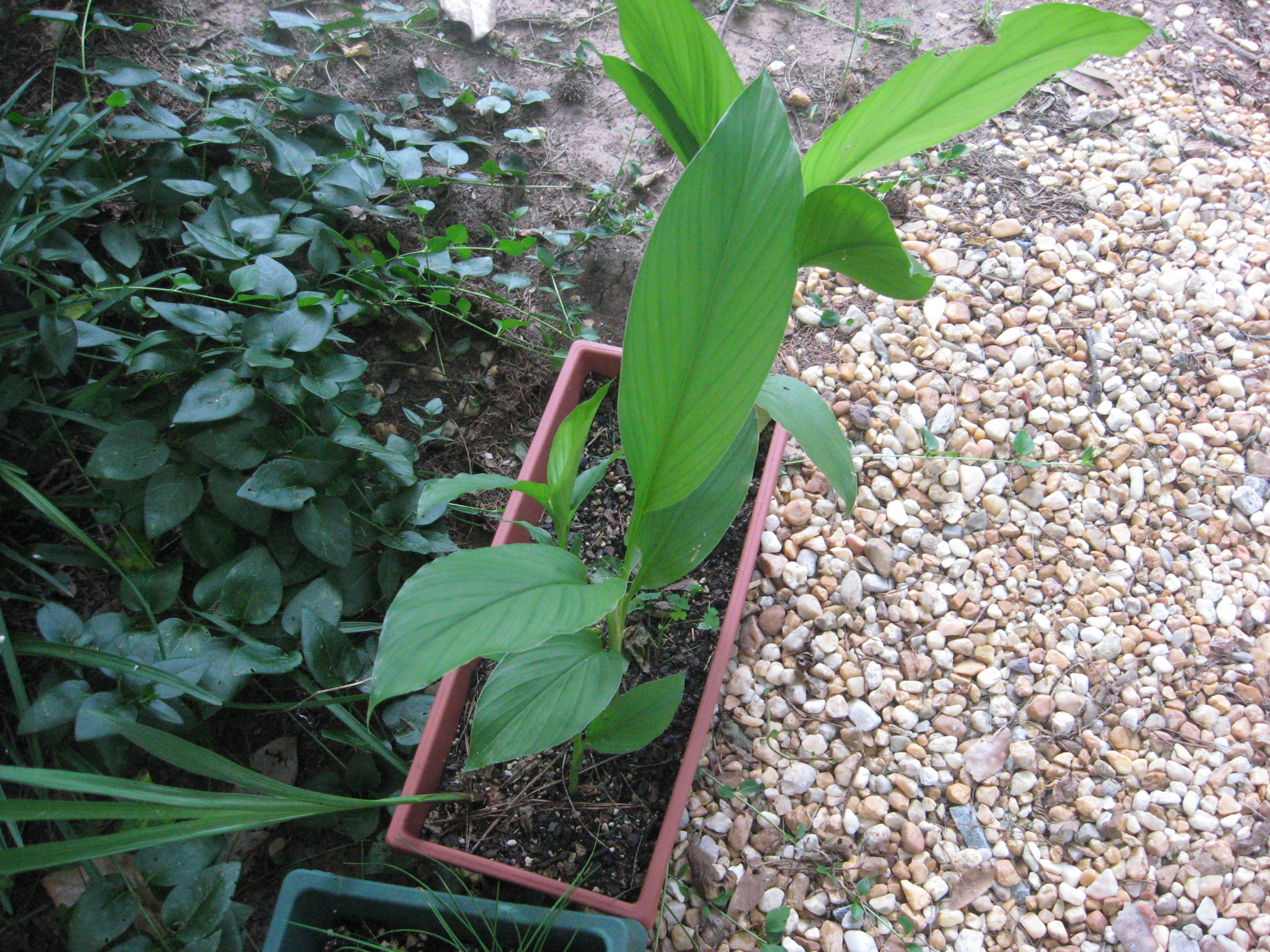
Turmeric is touted as an anti-inflammatory and an antioxidant–I’m not touching on those properties here, but rather the culinary uses.  It has been called “poor man’s saffron” and that’s one of my favorite things: add fresh turmeric to rice.  It’s very earthy and warm.  It’s not saffron, but it’s good.

To grow your own, you’ll need the fresh rhizomes–found in Asian, Indian or Latina groceries–probably located close to the ginger, (and maybe the galangal).  You’ll treat it almost as you would ginger:  plant about one to two inches deep in a 12- to 14-inch pot (about 12 inches in depth as well), keep evenly moist but well-drained, and give it part shade to dappled shade.  This is also a tropical perennial so it will need winter protection.  In cool weather, the leaves will die back, but if not frozen the rhizomes should sprout again in the spring.  (I tried keeping some, with the ginger, in the house to overwinter, but neither turmeric nor ginger survived as a plant; the rhizomes did put up shoots again in the spring.)

You can harvest as you would ginger–by carefully cutting off small pieces toward the edges of the pot.  You need to handle with care as it will stain hands and probably counters–it’s used as a dye, too.   Left undisturbed (except for harvesting from the edges) you may see blooms in the second year.

Turmeric is currently appearing in chocolate bars, and being touted as a “superfood”. I just like the earthy flavor, in many things where I would use saffron (but am too cheap to do that).

I hope to add galangal if I can find the fresh rhizome–there is an Asian food store that I keep watching. I suspect I’ll find it there sooner or later.

—Ô¿Ô—

..

More lentil soups

Most likely you’ve gathered that I’m a big fan of legumes–beans, peas, and lentils–as side dishes, in soups, comfort food, summer salads, and in one-pot meals. Winter weather (or even just a chilly, grey, damp, rainy day that kind of settles into your bones) beg for soup. Even chilly summer days are suitable for a good lentil soup–always quick since they don’t require soaking, and given the Instant Pot addition to my batterie de cuisine, well, almost “instant”.

pantry-de puy lentils cropped IMG_1115My idea of soup is a whole meal in a bowl–not quite a stew, but a whole meal that needs only the addition of some good bread. Wintertime means heartier soups, what Pam Anderson in How to Cook without a Book calls “supper soups.”  Tomato soup is often found on my table in the summer but for me, it is not a winter thing. Most of my winter soups will include legumes–frequently lentils. While the recipe that I posted for lentil soup is used year-round (it’s even suitable for a sunny-day soup), sometimes winter soups need to be more robust–more stick-to-the-ribs.

One of the great things about soups is that they don’t require recipes–improvisation works well here though I find it impossible to make a single-serving soup. (I don’t mind “leftovers” since having a serving of soup in the freezer good when you want a perfect duvet day.

If you’re looking for guidelines here is the suggestion from How to Cook without a Book (p. 35)–kind of a master recipe: Sauté an onion, then add vegetables, starch, and meat. Cook in a quart of broth for a meal that can’t be beat.

The basic formula for four servings is 1 pound of meat, 1 pound of vegetables, and a starch (potatoes, rice, pasta), 1 onion, 1 cup of tomatoes (if you wish), and herbs and spices to fit your culinary mood.

Another “without a recipe” lentil soup is from Food52

If you want more specific guidance Alton Brown’s lentil soup recipe is a good place to start. This one includes a rather esoteric spice–grains of paradise, here or here for a description of flavor, and here for substitution. (I’m always up for trying a new spice or herb though–even harder to find ones.)

Since I’m such a lentil soup fan, I’m always looking for variations, so I plugged lentil soup into Google just to see what I could find. Lots of “hits”–and many so similar that there’s no point in mentioning them but a few have been noteworthy:


Kitchen gloves

I hadn’t really thought much about “dish” gloves even though I don’t have a dishwasher until I saw this article from thekitchn.com on “5 Surprising Things I Learned from Using Dish Gloves”.  I do have gloves in my kitchen–True Blues. Since I’m washing dishes only for myself most of the time I don’t usually put them on–I either get my hands wet or use a brush: however, I do have some “rubber” (actually probably neoprene), lined, heavy gloves that offer heat protection and that I use in place of “hot pads” for a lot of things. They have textured “hands” so it’s easy to get a good grip. 71NNQBEEKxL._SL1500_[1]

These gloves are not really “dish” gloves–they are closer to safety gloves and were likely intended for a restaurant dishwasher. I can wash dishes in them, but they have a lot of other uses, too. They are great for handling very hot dishes or pans. Since I can put them on and wash them just like I would wash my hands before handling food, they are great for flipping that chicken or turkey easily or get hot dishes out of the Instant Pot.

These are kitchen gloves–though they would be suitable for cleaning anywhere and even with harsh chemicals,–these are cooking gloves. These are machine washable and heat safe up to 185°F.  You can get small, medium, or large–and they are latex free. Though not cheap–probably $12-$16, they are a bit like the energizer bunny.  Found in high-end kitchen stores like Williams-Sonoma or Vermont Country Store.

Perennial alliums

The “lilies of the kitchen”–yes, I borrowed the title from a book by Barbara Batcheller (See Bibliography–Vegetable Cookbooks)” are onions, leeks, garlic, shallots, and scallions!  They are often hidden away in the sofrito/soffrito or the mirepoix, but they can make fantastic dishes on their own.  I can’t imagine a kitchen without these “lilies”.  In my kitchen, being without onions and garlic is just about as big a catastrophe as being out of chocolate or coffee!

Can you really cook without all the Allium family? Caramelized onions, roasted garlic, scallions or green onions to add to salads and chives to top the baked potato.  Then there are leeks…another under-used, and perhaps, under-appreciated vegetable as an ingredient as a vegetable on their own.

While most of this family are now readily available in the supermarket, there are some that it’s worthwhile growing in your own garden.  Others, unless you have a huge garden and want to be self-sufficient, it’s much easier to buy.  The regular “yellow” or storage onions that we cook with–they’re inexpensive.  Most of us don’t have space or the humidity/temperatures required to store the quantity that we use in a season so buying those makes good sense.

Others like leeks, shallots, and garlic I use in such quantities that I don’t have space or time to tend. Since they are also readily available from the supermarket or the farmer’s market I’ll opt to buy as well. Some that we use “green”–like scallions might be worth growing but still demand space and time.

When we speak of “fresh” onions, we often use the terms green onion, scallion, and spring onion interchangeably but there really are some differences. The green onion and scallion differences are mostly marketing semantics. Spring onions are just regular onions (that would eventually form a bulb) harvested while immature–as when you have to thin the onion you planted too close together. Scallions, on the other hand, are species of allium that do not form a fully developed bulb. If you’re a huge fan of alliums of all sorts there are some perennial perennials that can be good substitutes for those fresh ones that we normally buy, and they can be grown in small spaces–or even large containers.

batun

A. fistulosum

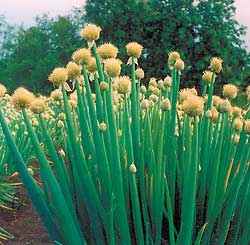
Allium fistulosumor bunching onion is a possible stand-in for those green onions from the grocery store if you want to grow your own. While the “Welsh” is a misnomer since these came from China originally, the taste is still “green onion”, sometimes grown as an ornamental. You can find bunching onions from Johnny’s Selected Seeds.


The Egyptian (this may also be a misnomer) –my favorite–is just plain fun with its unusual appearance that will definitely be a topic of conversation.

allium_fistulosum_bulbifera0

A. cepa x proliferu

Other common names include tree onion, top onion, walking onion, Canada onion, and Catawissa onion which may all refer to various cultivars. The Egyptian Walking Onion,  Egyption Onions , Biodiverseed and Mother Earth News websites provide some glimpses into the rather mysterious history of these (and other) onions.

Genetically it has been shown to be a cross between the common allium (Allium cepa) and the “Welsh” onion (above). Botanically speaking, it is Allium cepa x proliferum. These form bulbs, but also have top-sets which can be shared with friends. These plants multiply from the bulb in the ground as well as by producing top-sets, and sometimes topsets on topsets, rather than seeds. These onions are most often found from growers or seed catalogs specializing in heirloom vegetables such as Territorial Seeds, although a Google search shows them available from eBay and Amazon.

Potato onions (multiplier onions, shallots)  or Allium cepa var. aggregatum are also perennial alliums. These do not produce topsets, but rather “multiply” from bulbs left in the ground over the winter.

Multiplier (Allium porrum), perennial, multiplying or “Musselburgh” leeks (Allium ampeloprasum), though smaller than annuals,  can provide the taste of leeks without the amount of effort involved with annual leeks. These are also called garden leeks.

More information on sites like Edible Gardening, Hope Seeds, Southern Exposure Seed Exchange, FoodForestFarm.com , inhabitat.com, and icultivate.net.  Grow some “lilies of the kitchen” and don’t ignore others like chives. Then there’s garlic: for a method of growing without yearly planting check out The One Straw Revolution.

—Ô¿Ô—

_

Hive report: a beekeeper’s notebook

21 May 2018:  I’ve had a new beekeeping experience–dealing with a seriously angry bunch of bees. I do hope it will be a while before I have that experience again.

Yesterday  I planned to inspect Hive A (Dave’s Girls), but I didn’t take into account lawn mowing and trimming activities that had been going on around the hive. I had just removed the telescoping cover and the inner cover when I was in the midst of a serious attack–I now know what seriously PO’d bees sound like. After getting stung on my hands (only thin gloves on) I beat a very hasty retreat, but the girls were angry enough that they followed me–so I had to stand around in my bee jacket until they finally gave up and went home.

20180316_114851.jpg

22 May 2018:  This morning  I went back to do what needed to be done. Things were good when I opened the hive–bees all over all of the frames just doing their thing and they let me look around and do my part of the housekeeping.  I’ve put in foundationless frames to see if the girls will cooperate with me for some cut-comb honey this season. Fingers crossed and waiting.

26 May 2018:  There’s obviously been a bit of a hiatus here–the weather has been rather erratic–intermittently cloudy, windy, with less traffic in and out of the hive than usual. I’ve learned (the hard way) that the girls are quite testy (even bitchy, maybe?) when the weather is good.  Of course, that also means that lots of them are out at work so there are fewer to deal with during the inspections–and that is definitely an advantage with a large colony.

I made the mistake of putting work hours before bee time! Silly me.  By the time I was ready to do inspections, the weather wasn’t cooperating–intermittently cloudy with threatening clouds and a little drizzle. Then another bit of sunshine. Then clouds again.  I wussed out and decided to wait until tomorrow morning. I mean, in this area I should know that thunderstorms are likely in the afternoon.

27 May 2018:  This morning I had my priorities straight: to the hives just of soon as I had adequate Sunday morning caffeination.  I started with the Georgia Girls (Hive B) since that was the big job. They had been cooperative, actually doing what I wanted them to do–most of the brood was now in the deep so I could reverse the medium and be back to deep-on-the-bottom then the medium, still with some brood, above. They still had room to store honey above the queen excluder so I didn’t give them any foundationless frames.

Hives C and D each got a quick peek under the cover to see how things were. Both obviously had a queen doing her thing. Hive D (a split with a queen cell from Hive A) had brood in the medium (and the deep), but needed more room for honey.  Add queen excluder and a super for honey–done!  And–just in time for it to start getting a bit more overcast and breezy.

Happiness for a beekeeper is knowing what the girls are doing!

—Ô¿Ô—