
For those of you wanting more information on potato varieties, you might also want to check the article on “Potato Varieties” from Cook’s Illustrated.
Potato basics
 Potatoes ( Solanum tuberosum) come in a myriad shapes, sizes and colors, with different starch and moisture content that makes different kinds suitable for different cooking methods. There are red potatoes, white potatoes, purple potatoes, yellow potatoes, fingerling potatoes…. (I’ve put in the botanical name because these are different from sweet potatoes (even though we call both potatoes).
They are a wonderful vegetable–nutritious with lots of minerals and vitamins. I think they sometimes get a bad rap for all of the things we pile on–for example–a baked potato. With “the works” added it’s certainly not low calorie…but we’re responsible for all that extra stuff that adds calories and “bad” fat. There are lots of good things to do with potatoes that are quite healthy and then at times, potatoes turn into luxurious comfort food.

potato blossom
All potatoes are created delicious, but not necessarily equal when it comes to performance. You need to pick the right potato for what you want to do: russet potatoes will be mushy in a potato salad. Red potatoes (frequently called “new” potatoes–even though they are not) may not make the most luscious, decadent mashed potatoes.

potato plants
First, about what should and should not be called a “new potato“: only a potato that is harvested while immature is “new”–you can tell by looking at the skin. On real “new” potatoes (all sizes) the skin is very thin and can be rubbed off the tuber; you will likely see places where it has been abraded. Size does not tell you if a potato is new or not! Even some very reputable and otherwise knowledgeable authors use “new potato” to mean red potatoes or boiling potatoes. Newly harvested potatoes differ in moisture, starch and sugar content from potatoes that are fully mature. They are wonderful in their own right if you can get them–it’s one of the joys of growing potatoes. You can go out and get some really new potatoes.
—«°»—

baking potato
The russet potato is the potato usually recommended for baking and for mashed potatoes. They have lots of starch and less moisture than either red potatoes or Yukon gold potatoes. They will make fluffier mashed potatoes and baked potatoes. They’re my preference for baked and mashed potatoes because I want “fluff” in my baked potato and I want to be able to add lots of butter and cream to my mashed potatoes.
—«°»—

Yukon gold potatoes
The Yukon gold and Yellow Finn are rather middle-of-the-road potato, with medium starch and medium moisture. If in doubt, and for an all purpose potato, these are my choice. The flesh is pale yellow and I think a bit more “buttery” flavor than bakers or the red potato or even the round white potato (not pictured here).
—«°»—

red potatoes
The red-skinned, or red potato (sometimes called “new potatoes” or boiling potatoes) are usually described as “waxy”–that is low starch, higher moisture. These, or round white potatoes, would be my choice for potato salad, roasting, because they hold their shape well.
—«°»—
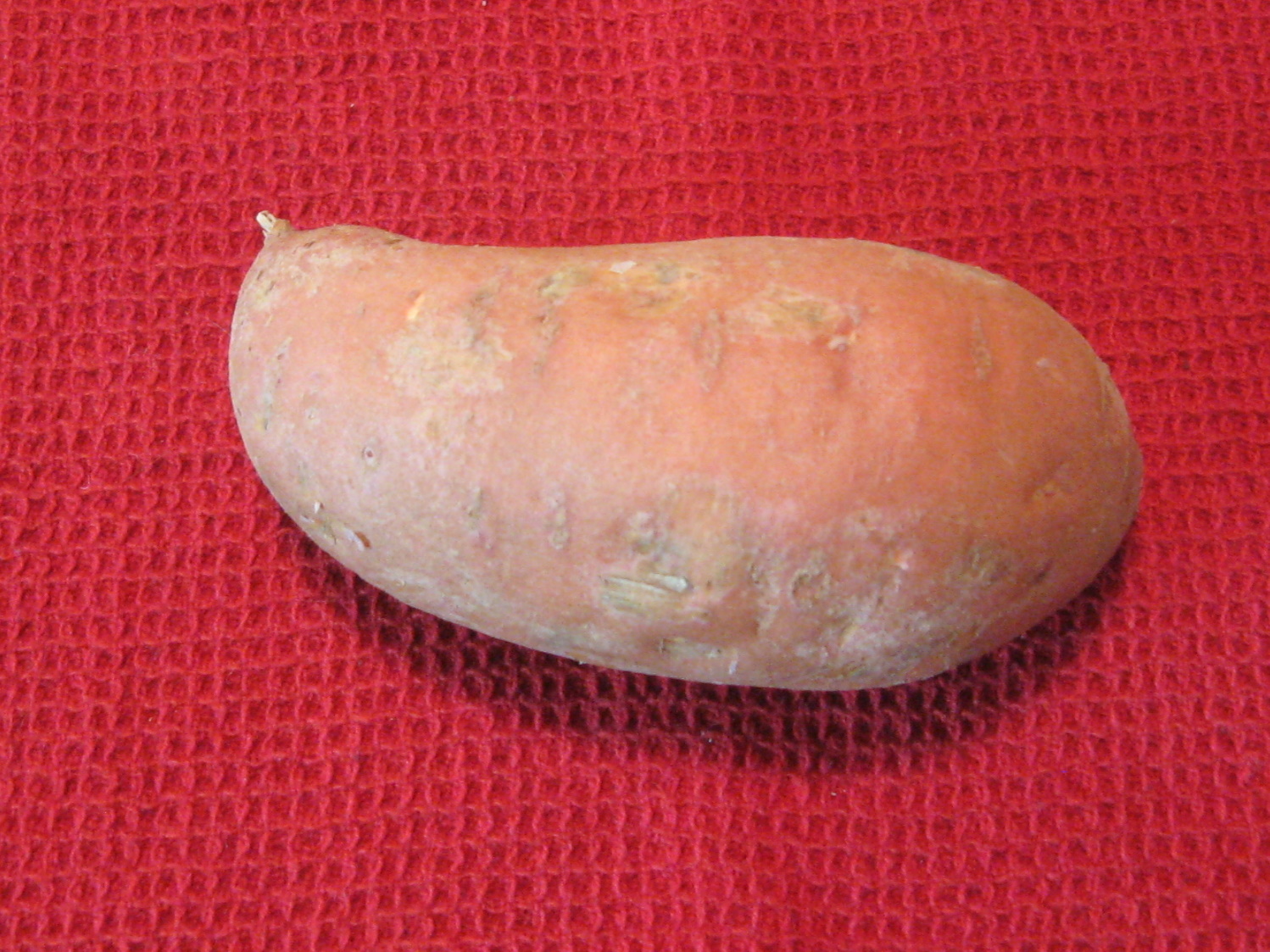
sweet potato
Then there are sweet potatoes (Ipomoea batatas), which are commonly (and incorrectly) called yams. Yams are a totally different biological entity. These are only distantly related to the potatoes discussed above.
Sweet potatoes likewise come in a variety of moisture content and colors. The orange-fleshed ones are very moist, and as the name indicates, sweeter than the “real” potatoes described above. They are good baked and as french fries. The white-fleshed ones are drier and those are my favorites for baking and making fries, but they are hard to find as a rule so when I see them, I bring some home. There are purple sweet potatoes, too–again sometimes called yams, which they are not. I’m going to be looking for these–I really like the purple potatoes, so I need to try these–they will certainly give a new look to sweet potato pie!
—«°»—
No matter what kind of potato you are buying, there should be not cuts, abrasions, or soft spots. For potatoes (Solanum tuberosum) you should check to see that there is no greenish discoloration. This comes from exposure to light which produces solanine, a natural toxin. The green is actually chlorophyll, but it’s presence indicates the possible presence of a toxin, so green potatoes should be discarded.
When you get you potatoes home, they are best stored in a cool, dry, dark place. Best is a temperature of about 40 to 50 ° F. That’s certainly not the temperature of living quarters. When stored at lower temperatures this can cause conversion of the starch in the potato to sugar and that will affect the flavor and cooking characteristics. Lacking a suitably cool, dry and dark place I pass on the five-pound bag of bakers no matter how good the price, and bring home only what I’ll use in a short time (a week or ten days) and store them in the refrigerator (even though I keep my refrigerator really cold) otherwise they sprout before I use them all.
For lots more varieties and more suggestions for use see The Cook’s Thesaurus and the Potato and the sweet potato entries in Wikipedia for lots more great information on potatoes.
This is by no means a complete discussion of potatoes–I hope it gives you some basic information on different characteristics of potatoes and which are most suitable for what use. In the end, it’s your choice–want fluffy mashed potatoes, go russet; more rustic mashed potatoes–use red or try Yukon golds. After all, you’re the one eating them A son goût!
And here’s a bit of trivia for you for you next occasion for small talk: 2008 was the International Year of the Potato. There is nutrition information and other fun stuff.
Comfort food: baked potatoes
It’s another chilly day here, but at least the rain has stopped and the sun is out off and on now, but the thermometer is still reading only 51 ° F . Despite the chill, a neighbor and I ventured out to go to the wine tasting at the Wine Authorities. as well as the usual great wines, there was cheese from the Reliable Cheese Company (with samples). The Tomme de Savoie was very tempting, but when I saw the raclette, I passed on the Tomme since it’s only for me (and the cat). I got the raclette instead so that I could make one of my favorite special comfort foods: baked potato with raclette cheese melted over it.
Just plain baked potatoes are one of my favorite comfort foods! I don’t mean anything fancy like “twice-baked” potatoes (love those too)—just a really good baked potato that has seen neither the inside of a microwave oven, nor the inside of a foil package.

a baking potato
When you select your potato for baking, you want one that is as evenly shaped as possible, in addition to being a good potato in general. (See potatoes.)
Here are three basic recipes for baked potatoes (adapted from Cook’s Illustrated). Easy…and worth the time. Cheaper than eating out too–you’d have to go to a really expensive restaurant to get as good a baked potato as any of these recipes will give you.
Basic oven-baked potato
This method will give you a baked potato with a really great skin to munch on along with that lovely interior.
- Preheat oven to 350 ° F
- Scrub a russet potato thoroughly and dry well.
- Place potato in the middle rack of the oven and bake for 1 hour and 15 minutes.
- Remove and open immediately (to let steam escape) and serve.
Salt-baked potato
This method can give the potato a flavor boost, especially if you include herbs and/or garlic in the covered dish while the potato is baking. It will give you the fluffiest inside and a tender but lightly crisped skin on the top.
- Preheat oven to 450 ° F
- Scrub a russet potato thoroughly and dry well.
- In a small baking dish, place a layer of kosher salt about 1/2-inch thick (about 1
 cup for this particular dish).
 - Place the potato on the salt, broad side down.
- Cover with foil or place in a covered baking dish and bake in the middle position of oven for 1 hour and 15 minutes
- Remove foil, brush the potato with 1 teaspoon olive oil and return to the oven until tender when pierced with the tip of a paring knife.
- Remove, brush off excess salt, open immediately, and serve.

Oven-baked sweet potato
This is for the orange-fleshed, wetter varieties. If you have a white sweet potato (yum) it has much drier flesh, and I typically treat it as a russet potato.
- Scrub thoroughly. Prick lightly with a fork in three places, or multiple times with the tip of a paring knife.
- Preheat oven to 400 ° F
- Rub the potato with olive oil and place on a foil-covered pan, on the middle rack of the oven.
- Bake 40 to 50 minutes until it’s tender when pierced with the tip of a knife.
- Open immediately, season to taste, and serve.
«◊♦◊»

Raclette cheese
When you want to be a little extra special with even the most comfy of foods–just add more comfort food. One of my favorite extra comfy foods is baked potato with cheese; and my all time favorite for baked potato with cheese is baked potato with raclette. Never mind the butter, sour cream and all that stuff (admittedly wonderful), but in this case it’s totally unnecessary.
Raclette is a semi-hard cow’s milk cheese that is mellow, nutty and earthy. A dish by that name is typically served with the cheese melted over potatoes (usually

Is it mine?
boiled) and gherkins (pickles made from specially grown small cucumbers). While what I’m having here is not traditional raclette, it is a real treat. (All cooking and recipes are tested and approved (or not) by Keiko, the cat.)
I made a salt-baked potato and finished it as directed in the recipe, and after opening it, laid slices of raclette over the top, and put it back into the oven to let the cheese melt (not under the broiler).
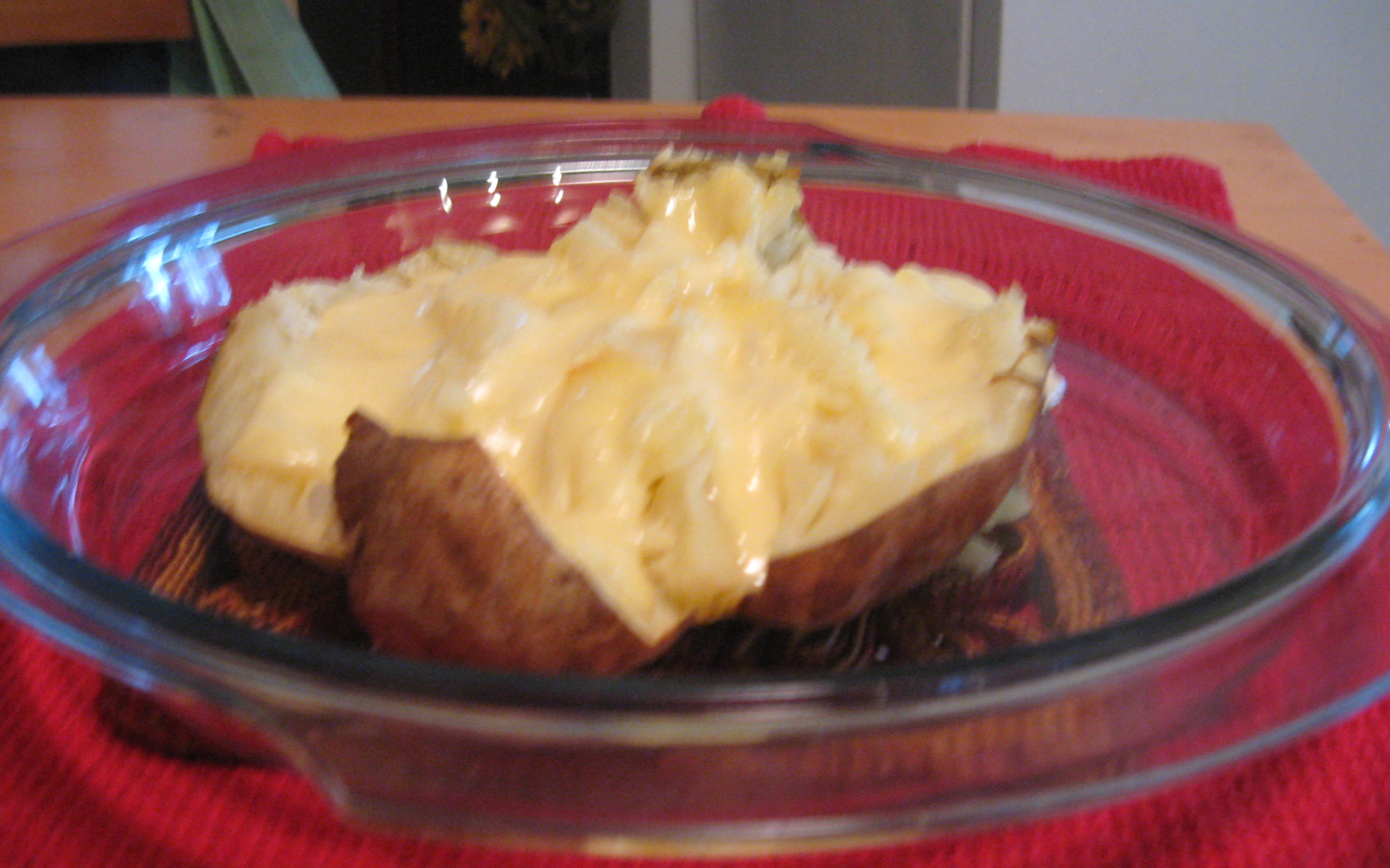
Comfort food for supper
The main course was just that big baked potato and cheese, with a glass of champagne (no cornichons though)! I had really intended to have a first course of roasted baby carrots and baby zucchini with vinaigrette dressing….but that was not just BIG potato–it was a HUGE potato, so it was my evening to have just that–I had fruits and veggies for breakfast and lunch anyway.)
−«◊»–
The Reliable Cheese Company–update
Unfortunately, the Reliable Cheese Company is no longer in business, but I’m leaving this because of the links to cheeses and charcuterie. Very sad to see this close; now for cheeses in this area, there is a Fresh Market, A Southern Season (which has an awesome selection of cheese and charcuterie). Wine Authorities carries some special cheeses, and the Durham Farmers’ Market has cheese vendors who come there. Whole Foods also carries cheese. My local Harris Teeter has a rather good selection of pre-cut cheeses–e.g. I can find Etorki there frequently.
After going to the Wine Authorities tasting on Saturday and coming home with raclette, I just had to go check out the Reliable Cheese Company this afternoon (not open on Mondays, but are on Sunday afternoons). It’s not exactly on my way home, but I expect that I’ll be following that route more often in the future!
There were some great cheeses in the case–I could cheerfully do one of each. There were other goodies like slab bacon, bresaola, just to mention a few. The Facebook page will keep you up to date on what’s happening at Reliable Cheese Company.
Came home with some lovely, luscious Taleggio cheese–just perfect texture. This is going to get a bottle of Gewürztraminer or Riesling opened to enjoy while nibbling on this cheese–It will need nothing more than some fresh bread and a bit of fruit to make supper.
Then I found the mortadella and had to bring home enough for one decent sandwich (that’s lunch tomorrow).
After perusing the sandwich menu, I could not walk out without my supper. I came away with the country ham, blue cheese, and fig jam sandwich.

Risotto: making a single serving
An earlier post dealt with one way to have single servings of risotto, but in case you’ve eaten all of that and want a quick batch, here is a recipe adapted from Barbara Kafka’s Microwave Gourmet (pp.114-115) to serve one as a first course or two as a side dish.
Basic Risotto
- 2 teaspoons butter
- 2 teaspoons olive oil
- 1 tablespoon minced yellow onion
- 1/4 cup arborio rice
- 1-1/4 cups chicken broth
- salt and fresh-ground black pepper to taste
- freshly grated Parmesan cheese (optional)
- Make this is a large soup plate or pie plate.
- Heat butter and oil at 100% for 2 minutes.
- Add onions and rice, stirring to coat with the oil and butter and cook for 2 minutes.
- Stir in broth and cook uncovered at full power for 6 minutes; stir well and cook for an additional 6 minutes (12 minutes total).
- Remove from oven and let stand 3 minutes, stirring several times allowing rice to absorb remaining liquid.
- Stir in salt, pepper, and Parmesan cheese.
(I don’t think that this is quite as creamy and luscious as risotto made the traditional way, but it’s certainly very good when you need a quick main or first course–or just some comfort food.)
Another ham & bean soup….
In this kind of weather (drizzly, gray, windy, leaves almost gone) you can never have too many soup recipes. Not long ago I posted about ham and bean soup. While perusing one of my favorite blogs (The Kitchen), I found another ham and bean soup recipe that looks great: Ham Bone, Greens, and Bean Soup. Though I haven’t made this one yet, I do frequently add greens to my winter bean soups. It’s a great way to have a hearty meal out of one bowl. All you need add is some freshly baked bread!
Cornish hen braised in milk

I had an earlier post about braising chicken in milk, when I tried the recipe using chicken pieces since that gave me something more like a single serving. Flavor was great, but I thought that for something a bit scaled down, but more in keeping with the original recipe, I would try this with a Cornish hen and see how that worked. One of the advantages of these little birds is that they are more in keeping with Jamie Oliver’s recipe, rather than the chicken parts that I tried originally. This might be a way to keep with the spirit of the original recipe, but scale it down to something closer to single-serving size. While this is a recipe that might do well on second runs, I really don’t want as much as whole chicken would make.
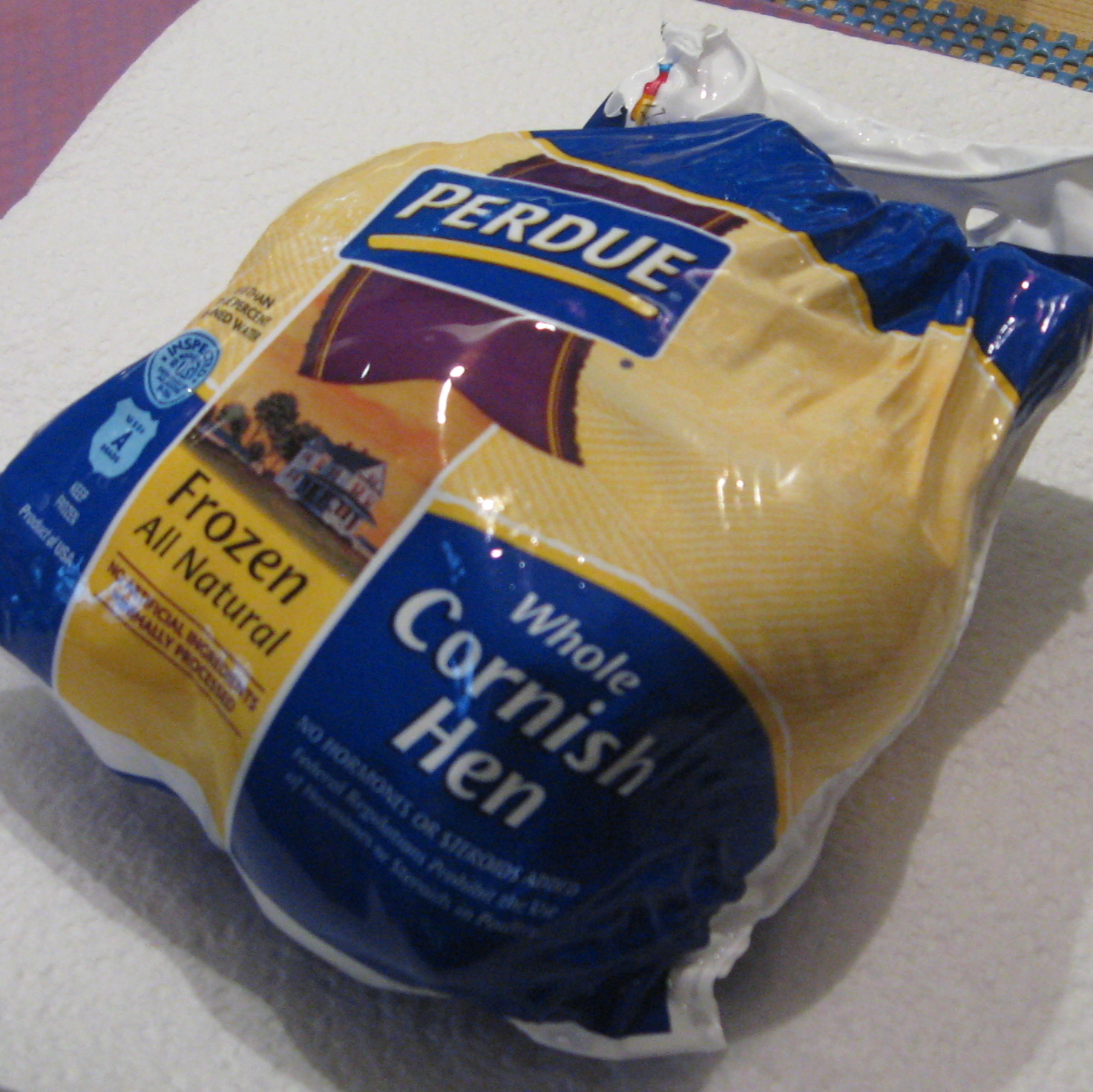 Well, the weather has turned to fall with blowing leaves, and chilly temperatures so this seems an excellent time to try this again…and my grocery shopping provided me with a lovely price on a pair of (frozen) Cornish hens–about 1 to 1-1/4 pounds each.
A Cornish hen–either male or female regardless of calling it a “hen”–is a special breed of chicken (in the USA sometimes also called a poussin, though that is  really French for a very young, small chicken that is usually about a pound in weight). Since my supermarket does not offer poussins, but does have the Cornish hen (which is a young, hybrid chicken–of Rock Cornish with some other breed–not over 2 pounds by USDA specifications) that’s what I’ll use; I was fortunate enough to find some hens that were just about a pound or a pound and a quarter each.
While browsing some of my favorite blogs, I found a discussion of Jamie Oliver’s recipe–where an oversight of lid on instead of off for part of the time was compared to the bird braised in an open pot. This made me think of the French chicken in a pot that I had cook recently–one of the things that was impressive about that was how the flavors seemed to permeate the meat itself. I decided to try this with the lid on for part of the time just for that reason. (I do have two Cornish hens–so maybe I need to do the same here–one each way!
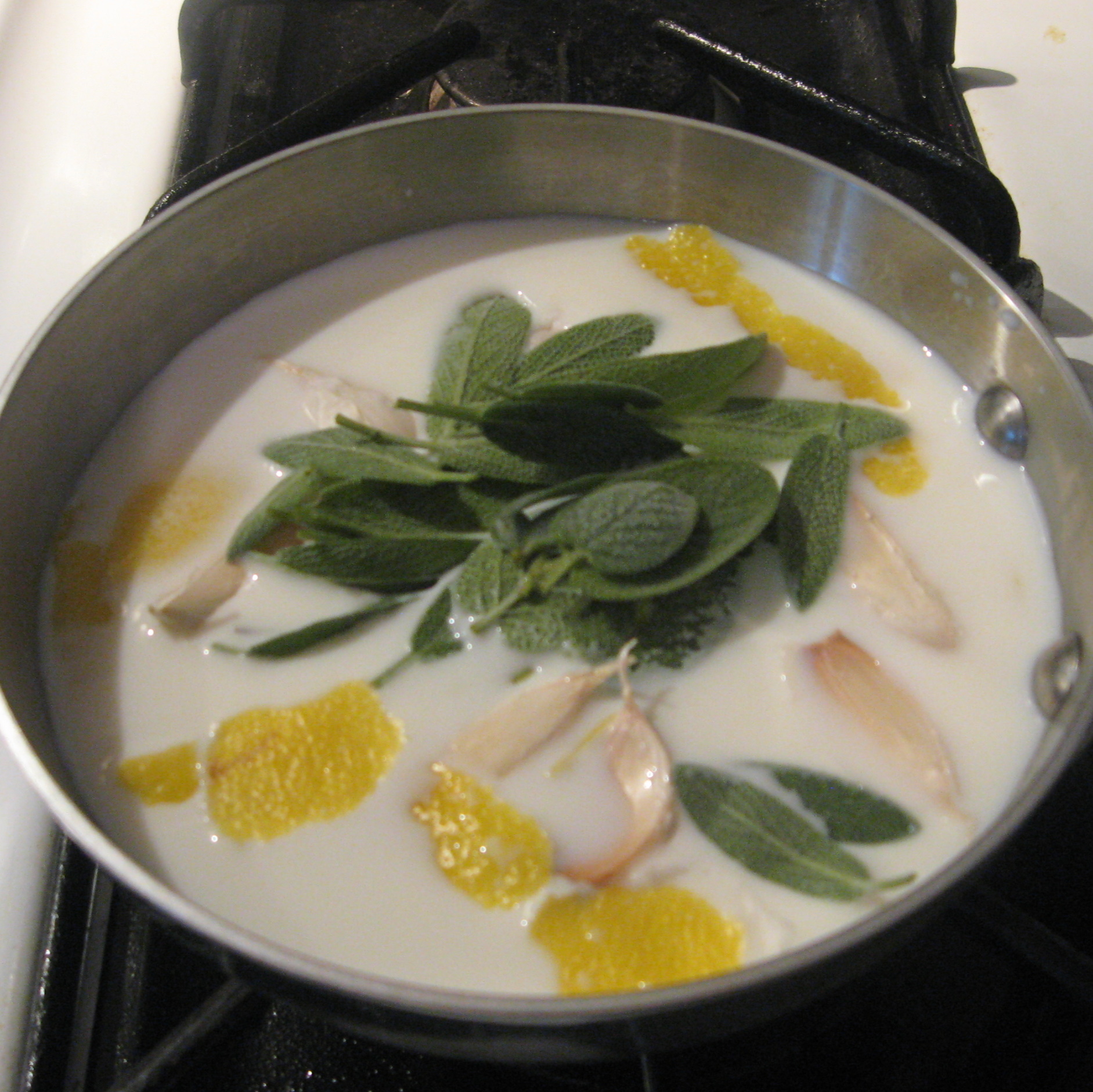 One of the things I discovered when doing the chicken parts was that just because you are using 1 pound of chicken instead of 4 pounds, you might not want to just take a quarter of the seasoning ingredients–the flavor was good, but perhaps a bit on the wimpy side; so I have to find a way to optimize that when cutting the recipe to single-serving size. I decided that this time, I will make up the seasonings and milk as if I were doing the large chicken (in the 2 cups of milk). I thought I’d simmer the seasonings in the milk and taste to see what that was like, cool it and add what seemed appropriate for the size of my bird and my pot.

The petit brasier was a no go–too big around–so I used my 4-quart All-Clad pot as being the closest thing to a “small” dutch oven. The whole stick of butter was obviously not necessary so I used just enough (about 2 tablespoons) with the olive oil (about 2 tablespoons as well) to brown the hen. (One thing I did discover is that the skin on a Cornish hen is much more fragile and has much less fat under it than does a more mature chicken.) Just the smell of the hen browning in the butter and the olive oil is fabulous!
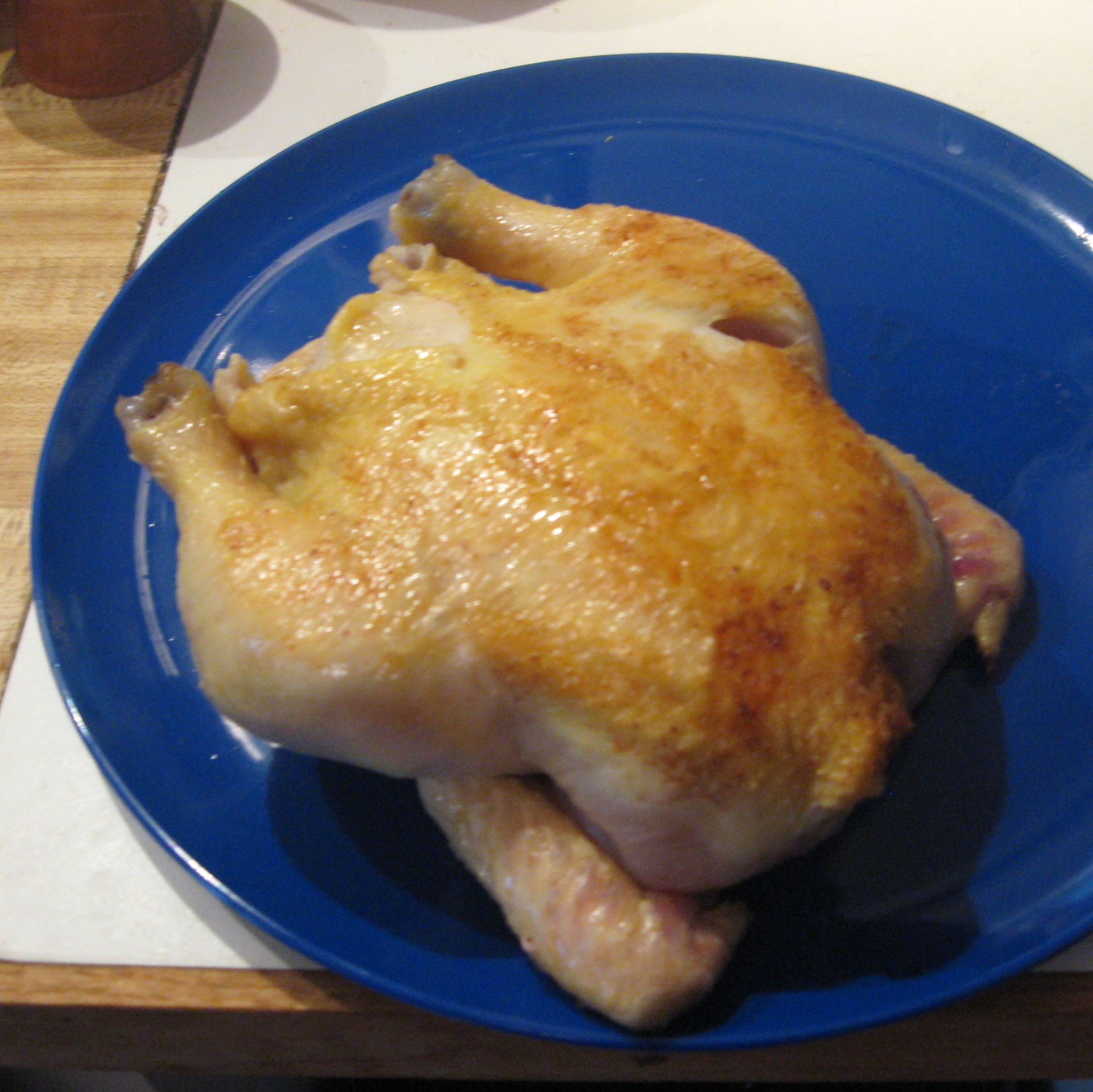
There was not much fat in the cavity either so I returned about half of the butter/olive oil mixture to the pot with the chicken. Giblets were mostly not included–just the neck, but I browned that and included it in the braising pot for extra flavor.
So here’s my bird, browned, and ready to go back into the pot to braise with the seasoned milk. (Next time I’m doing a Cornish hen or poussin, I think that I’ll try using just half the milk with half to three-quarters of seasonings even though these birds are only about a quarter the weight of the chicken called for in the original recipe.)

After steeping the other seasonings in the warm milk, and then letting it cool a bit, I tasted it–very lemony and sage-y, but not much garlic or cinnamon yet; (that came out later in the braising process). I divided the milk and the other seasonings in about half since that looked like about the right amount of liquid (the eyeball test!!). It took about 1 cup of milk (and I added half the solids) so the rest went into the freezer for a repeat, or perhaps just to braise some chicken thighs or poach some breasts. ( I did put the cinnamon into the braising pot with this bird).
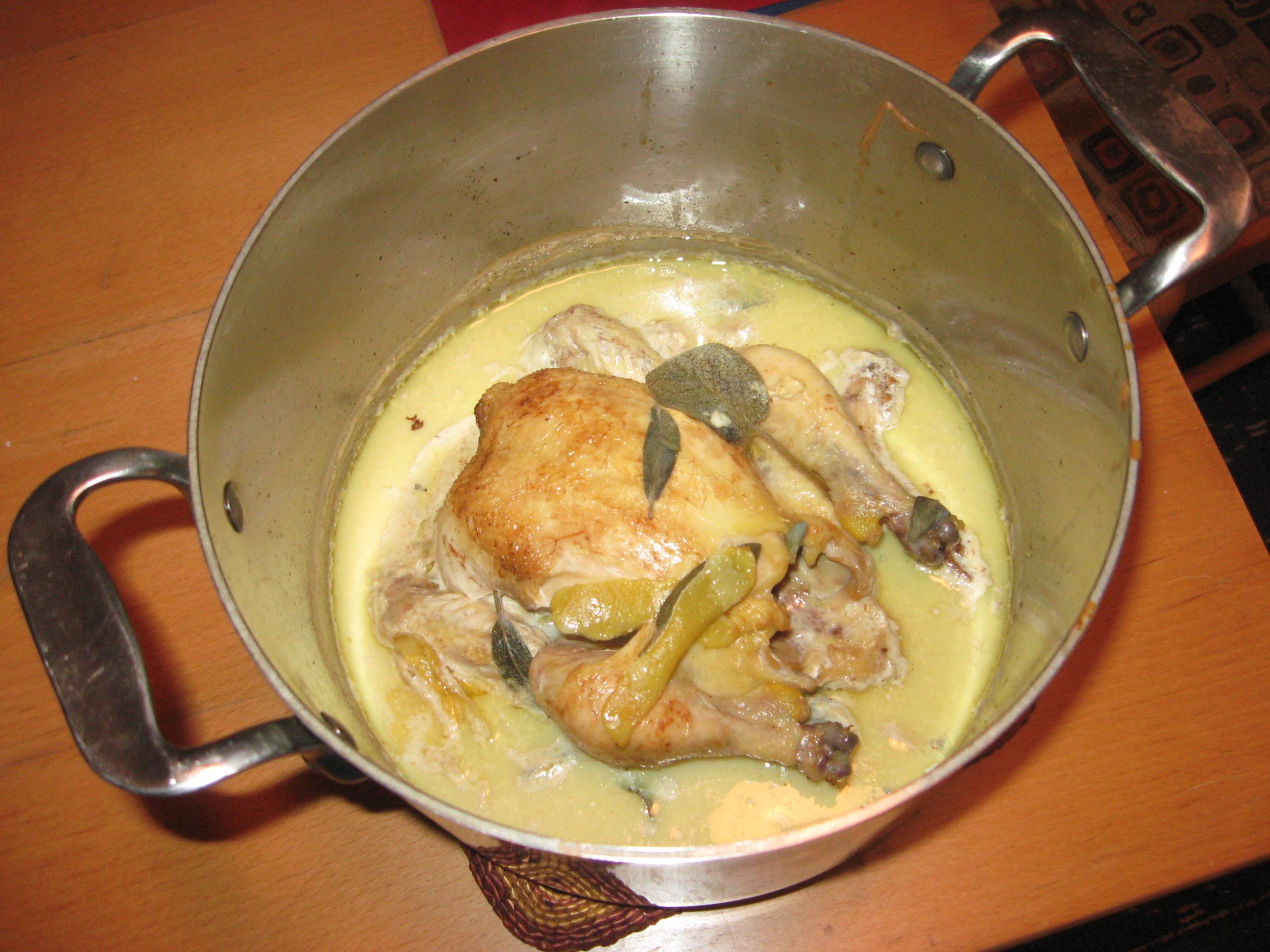
Since it was a smaller bird and the braising liquid was already warm, I reduced the oven temperature to 325 ° F since I wanted enough braising time to let the flavors actually get into the meat (as it did in the French chicken in a pot). I decided to go with lid-on for about 30 or 35 minutes and see how it looked then, and finish the braising with the lid off so that the liquids reduced more.

lid off for about 30 minutes
After another 30 minutes in the oven with the lid off, the sauce has reduced some and it looks falling-off-the-bone tender.
Somewhere along the way, all those unlikely, highly individual, and potent seasonings have turned into a complex, earthy taste and aroma.
I’m ready to eat!
Admittedly this does not look like it’s going to be a dish that lends itself to elegant presentation, but it’s certainly a keeper for comfort food. Braised in a container that could go directly to the table it would make a nice casual presentation as the skin does brown more after the lid comes off.

•♦•«»•♦•
The pot that I used was just a bit deeper than I might have liked, but better too deep than too wide since that would need too much liquid to reduce by the time the hen was done. Unfortunately, the bird was just a bit too tall to fit into my small chef’s pan–but this was close enough. The sauce does look “curdled” but tastes wonderful! Just the thing for a damp, drizzly, autumn or winter evening!
 The original recipe for a whole chicken would be great for causal company–this is definitely a keeper! I had this with basmati rice, roasted baby carrots and baby zucchini. Sautéed spinach, or maybe broccoli raab would be good too. I think that the slight bitterness of the broccoli raab would be a great contrast to the way that these seasonings meld into a very earthy background to the chicken.
A son goût!
Egg basics
In my kitchen, being out of eggs is right up there with being out of onions, garlic, and chocolate!
The egg is packaged by nature to have a long shelf-life–as long as they are treated properly between hen and home. I want the hen to be treated properly as well so I buy my eggs from the farmers’ market where I know the farmers. That gives me better eggs–yellower yolks and more omega-3 fatty acids nutritionally, and better flavor. (Cook’s Illustrated had a blind tasting of eggs with differing levels of omega-3 fatty acids and guess who won? High omega-e fatty acids did give yolks a richer taste.) Color of the shell has nothing to do with quality of the egg–that has to do with the breed of chicken and how its diet.
The down side of eggs? Well, there’s Salmonella but a little care is purchasing, storage, and cooking really takes care of that–buying fresh eggs from someone you know is a good start. Your vendor should have the eggs refrigerated and you should keep them cool until you get to your refrigerator.
Once home, store eggs in the refrigerator, either in the carton or in a closed container. If your refrigerator has those little plastic dents on the door to hold a dozen eggs, ignore it. That’s not the place to store eggs for several reasons: it’s not cold and there are frequent temperature changes as you open the door. Eggs need some protection to avoid moisture loss, and agitation of opening and closing the door can affect texture/consistency of the whites particularly. You can also store eggs in a closed container to further retard moisture loss, but can accentuate
The expected “shelf-life” of eggs is really several weeks past the sell-by date (for supermarket eggs). Eggs seldom spoil, although some moisture loss will occur, nutritional value remains good for a long time–after all, think of the purpose of the egg. Eggs can pick up odors in the refrigerator since the shells are porous.
Because of the potential for Salmonella food poisoning, eggs do need to be cooked carefully, but from one or two eggs anyone with a normal immune system is very unlikely to get Salmonella enteritis from a sunny-side, over-easy or soft-cooked egg if handled properly. For one thing, egg dishes should be served promptly and not left sitting out.
For soft-cooked eggs, it is possible to “pasteurize” them by holding them at a temperature of 140 ° F for 30 minutes–this is a temperature that does not continue to harden the yolks, but will kill bacteria. Eggs which reach a cooking temperature of 160 ° F are safe.
Sometimes you need to know egg sizes since they are not interchangeable. Harold McGee, in Keys to Good Cooking gives the following weights for egg sizes:
- jumbo = 2.5 ounces or 70 grams
- extra-large = 2.25 ounces or 63 grams
- large = 2 ounces or 56 grams
- medium = 1.75 ounces or 49 grams
These equivalents will let you correct for the size eggs that you have and what is called for in a recipe, since eggs purchased at the farmers’ market are not likely to be of uniform sizes.
For more detailed discussion of eggs, see Keys to Good Cooking and Kitchen Science by Harold McGee. There are also lots of fun and useful egg facts in these two books.
Roasted figs
Figs are one of my favorite fresh fruits; unfortunately, the figs here aren’t ripe yet, so when I saw some at Costco (a two-pound carton) that looked as if they were at least reasonably ripe, I had to try them. Thing is, figs are perishable–so after eating some fresh (these were much better than what you usually find in the supermarket (but not perfectly ripe to the point of splitting and having that lovely drop of sap oozing from the blossom end as they should for eating out of hand), I searched through some of my favorite food blogs and something to do with the rest of them.
Here’s what I found that looked really good to me! Every recipe that I’ve tried from this source has been a resounding success, so I’m going to try this one.
Roasted Figs (From David Lebovitz living the sweet live in paris)
Six to eight servings
Use a baking dish or pan that will allow you to bake the figs in a single layer. One that is 2 quarts (2l) should do it. Depending on where you live, fresh fig season is near the end of summer and mid-autumn and the best place to find fresh figs is at a farmers market.
1 pound (450g) fresh figs
4-6 branches fresh thyme
2 tablespoons red wine or liquor, such as Chartreuse, Pernod, Grand Marnier or Cointreau
1 tablespoon dark or light brown sugar
2 tablespoons honey
three 1-inch (3cm) strips of fresh lemon zest
1. Preheat the oven to 400ºF (200ºC).
2. Slice the tough stem end off the figs and slice each in half lengthwise.
3. Toss the figs in a large baking dish with the thyme, red wine or liquor, brown sugar, honey, and lemon zest. Turn the figs so that they are all cut side down in the baking dish, in a single layer.
4. For figs that are softer and juicier, cover the baking dish snugly with foil and bake for 15 to 20 minutes, or until the figs are softened and cooked through.
For figs that are firmer, with less liquid, roast them in the oven, uncovered, for 30 minutes, or until cooked through.
5. When done, remove the baking dish from oven, lift off the foil, and let the figs cool completely.
Variation: For more savory figs, replace the liquor with one or two tablespoons balsamic or sherry vinegar.
Storage: Roasted figs can be stored in the refrigerator for up to one week.
♦♥♦
The figs are out of the oven and I’ve tasted them–wonderful! Some of these are going to be dessert after the French chicken in a pot, with just a dollop of sour cream, and the rest will get used with breakfast Greek yogurt or, perhaps, with oatmeal.
A gift for the cook
 You don’t need a lot of equipment to cook for one or for many, but good knives are necessary if you are going to cook efficiently and pleasurably. Whether you’re purchasing for yourself or looking for a gift for the cook in your life, knives make a gift that keeps on giving over and over and over. Many times, especially for small quantities, a knife is better than the food processor–especially since it’s so much easier and faster to clean. (But remember that knives are very personal in terms of how they feel to the user, so keep that receipt even if you’re giving the knives as a gift so that they can be exchanged if necessary).
When you’re buying knives, you should know that the “set” of knives in a storage block may not be the best way to go. As with pots and pans, the sets are most likely devised by the vendor to get the most money out of your pocket and into theirs, without serious consideration of actual utility in the kitchen. Just as with your basic pots and pans, I would advocate purchasing knives à la carte rather than in a set since most sets do not have the most useful selection of knives and can be expensive.
The knives that you see here are ones that I’ve collected over many years of cooking, both at home and in restaurants. As you can see, it’s not a matched set!
The latest issue of Cook’s Illustrated (November & December 2011, pp. 25-27) evaluated knife sets for quality and usefulness. If you’re thinking of buying knives (for yourself or as a gift) I’d recommend taking a look at this article. You shouldn’t just shop the “celebrity” knives since (just like celebrity cookware) many of those just aren’t really the best knives you can get. This article covers the basic knives that make up a functional set for most kitchen jobs. I’ve collected mine independently but I find that my selections are very close to those in this article.
 Chef’s knives are the workhorses of the kitchen–the knife that you’ll reach for most often. I have two: an 8-inch and a 6-inch. The 8-inch is large enough to handle that butternut squash or head of cabbage, and the six-inch handles smaller jobs. The eight-inch is a Wüsthof classic model. I like this for tougher jobs as it’s a heavy knife. The 6-inch is a Zwilling J.A. Henckels knife. It’s lighter than the Wüsthof and works well for lighter chopping jobs. I don’t use these (even the heavier Wüsthof for dismembering poultry or attacking bones as that’s hard on the edges and I want these to stay sharp–I use heavy duty scissors or a cleaver.

Paring knives
Another real necessity for the kitchen is a good paring (peeling) knife with a 3-1/2- to 4-inch blade. I’ve also added a Wüsthof bird’s beak paring knife that I find very comfortable for peeling jobs where an Oxo vegetable peeler won’t do the job. The bird’s beak is light and very comfortable to use for shaping, or peeling small curvy things.

Slicing knife
A slicing knife has a thinner blade that is more flexible for carving that bird or roast, or smoked salmon or salami. This is a carbon steel one that has been with me for many years. I use it for tomatoes and bread as well. Were I to replace it now, I would get a 10- or 12-inch blade as this is just a bit too short to easily use on a free-form boule.

Bread knife
If you buy unsliced bread (or bake your own) you might want a bread knife–I do have one, although the slicing knife is often the one that gets used even for artisan style breads. While the Cook’s Illustrated tests recommended the Wüsthof classic 10-inch bread knife, I have an Oxo bread knife that I’m satisfied with–not that I wouldn’t love to have the Wüsthof bread knife, but my budget doesn’t stretch that far for a bread knife (but did for the chef’s knives and paring knives since they get used so much).
 With almost all knife sets you find something called a “utility” knife–sometimes serrated, sometimes not. These are not the kitchen workhorses that the chef’s and paring knives are. Over the years, I’ve acquired two–one Victorinox/Forschner and one Henckels Friodur cutlery. They don’t get used very often though they are nice to have around, but by no means essentials. I’ll sometimes reach for these when I’m slicing smaller tomatoes, or meats since they also have thin blades similar to the slicing knife.
 The other knives that I’ve added are a boning and fillet knives. The 6-inch and the 4-inch boning knives, with the sturdy blade, and pointed tip let you work around joints and bones easily. The 4-inch one gets a lot of use for boning chicken thighs (a staple in my chicken use). The fillet knife (Sabatier) with the slender, flexible blade makes taking the skin off a piece of fish a breeze.
A steel is good to have, so long as you learn to use it properly, and realize that it does not sharpen your knives…it merely hones or realigns the edges. For sharpening you can use a stone if you’re comfortable with that, or a knife sharpener if you want to do it yourself…or have your knives sharpened by a professional. You do need to keep knives sharp–otherwise they are frustrating, and dangerous.
With proper care, your knives will last a lifetime: they should NOT be put in the dishwasher, but hand washed, rinsed with very hot water, and dried immediately after use. You should store them in a block or on a magnetic holder to protect the blades (and fingers).

Cook’s Illustrated testing recommendation was an à la carte set, including a storage block, which resembles what I’ve described above (without the fillet and second boning knife) which can ring in at about $334. If you want to do less searching and pick up a set, then the Victorinox 7-piece set is a good bet–for around $189. I’ve used the Victorinox knives and given price and functionality, they would be my choice for a set or as “best buy” in terms of the most bang for the buck. Whether it’s a gift for yourself or someone else, I’d recommend checking that review keeping in mind that Cook’s Illustrated does not accept advertising, and they do not accept products for review from manufacturers, nor do manufacturers get any notice that their products are being tested until the results are published.
 a-single-serving.com
