Growing your own herbs

Whether you have a huge garden, or just a deck with some pots, you can grow herbs.  For me having fresh herbs makes cooking for one easy and exciting.  Just having the herbs around where you smell them when you brush against them can be inspirational.
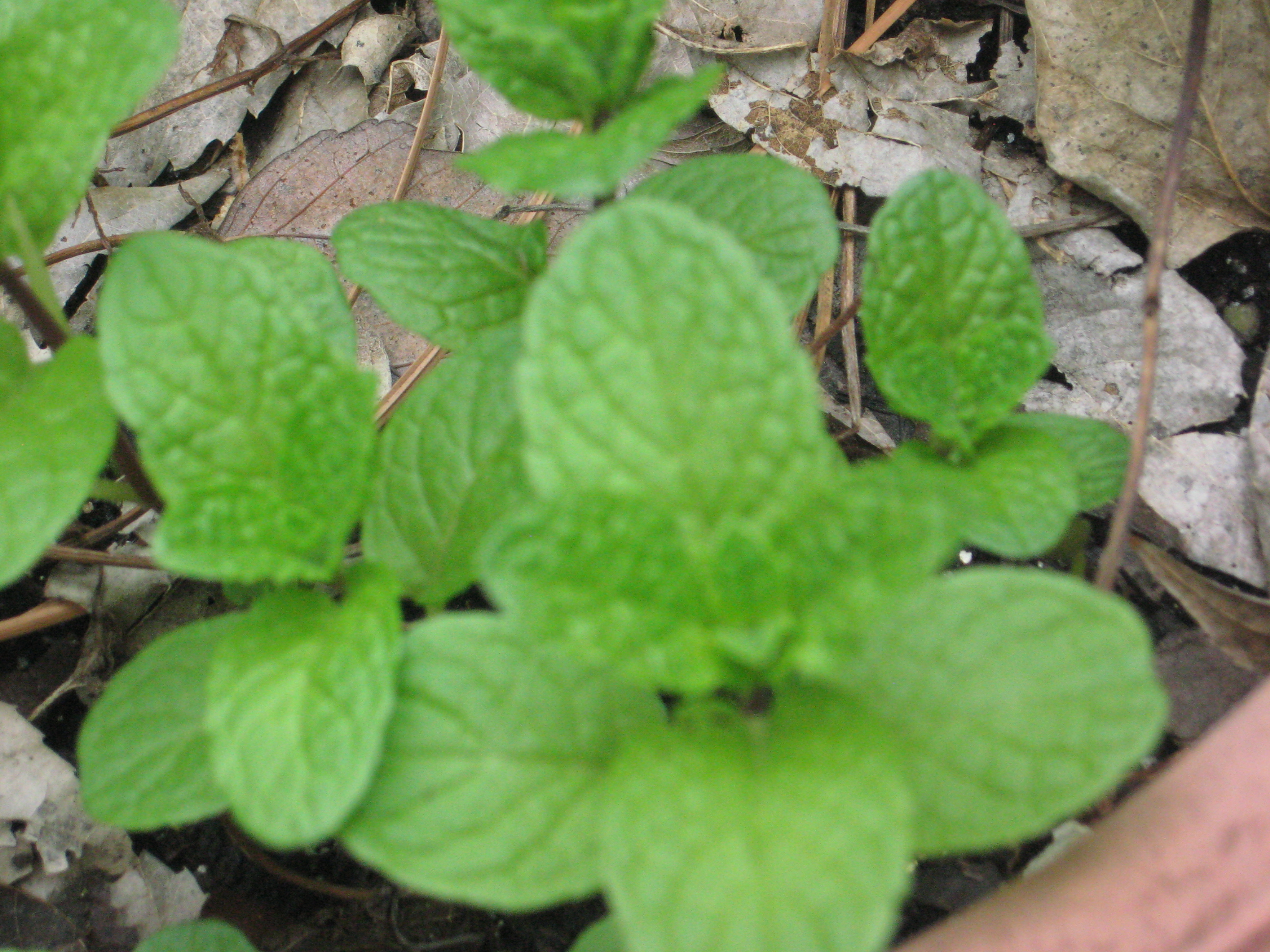
Mentha spicata 'Kentucky Colonel'

Mentha spicata 'Kentucky Colonel'

Herbs pretty unfussy plants to grow–generally they like sun, and want the soil to be well drained.  Some are more drought-tolerant than others and some are more sun-tolerant than other; a few even like a bit of shade.

You can use a wide variety of containers–plastic, ceramic, wood…just be sure that there are holes in the bottom for good drainage.  Herbs really do not like wet feet.  I prefer to put my herbs in fairly large plastic containers since it reduces the need for watering in hot weather–a six-inch pot is about the smallest that I will use. Smaller than that and you’ll spend a lot of time watering in hot weather.

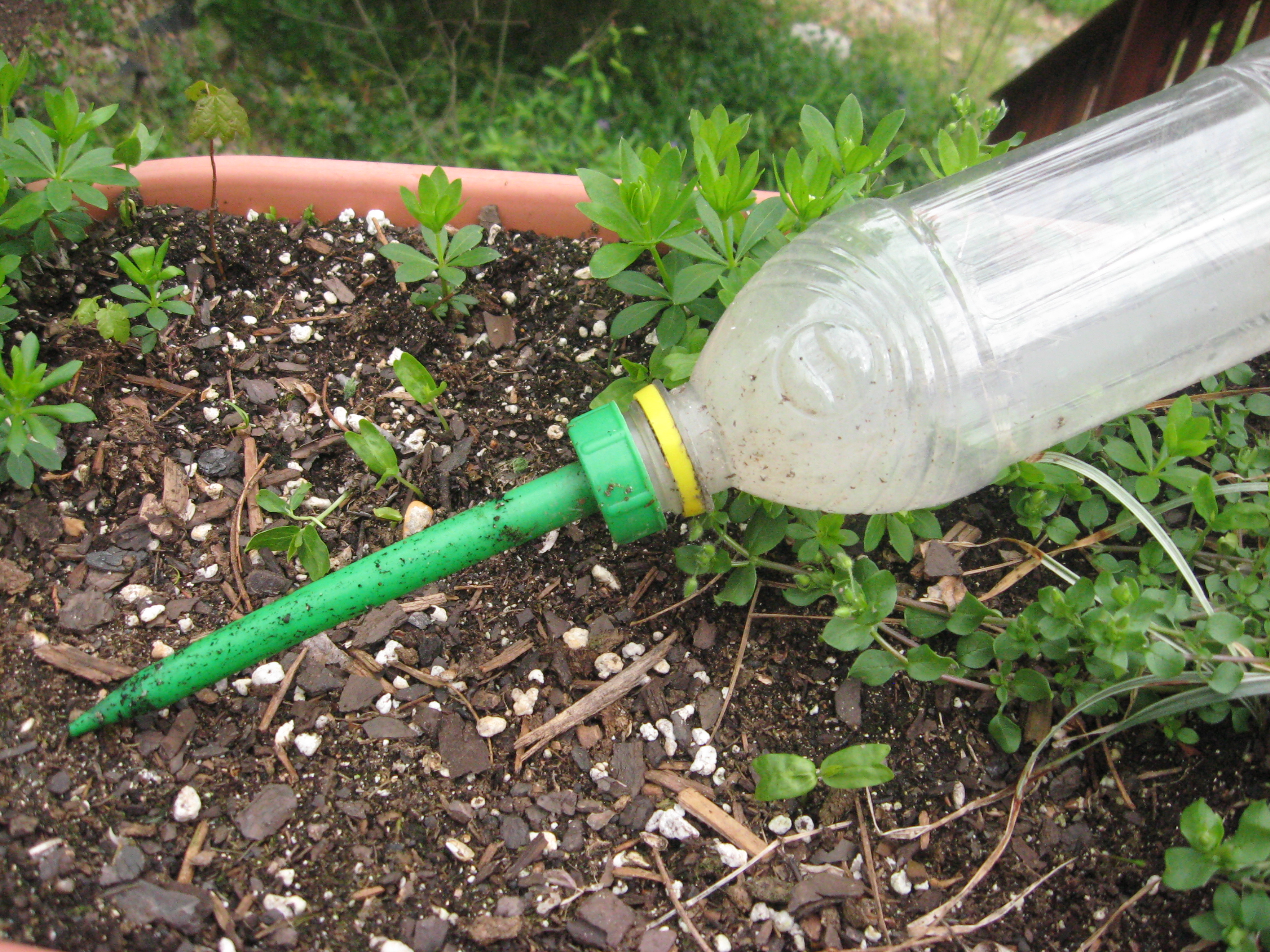
Though not glamorous, my favorite device for keeping herbs happy in hot weather is a spike that screws onto a one-liter (or two-liter) soft-drink bottle which is then stuck into the pot.  It delivers water slowly to the roots where it’s needed.   I catch rainwater in a five-gallon bucket to fill the bottles rather than using tap water.  You’ll see these in use in some of the pictures.  Locally, I can find these at Stone Bros. & Byrd.  They are also available in garden supply catalogs and seed catalogs.
We usually hear herbs characterized as “full sun” plants–that really means that most of them need at least six hours of sun a day; many are happy sitting around in the sun all day–but you have to take your climate into account.  An herb that might be wonderfully happy in all-day sun in the Pacific Northwest might not survive all-day sun in the southern U.S.  As you grow herbs you will learn to look at them and know if they are happy or not.
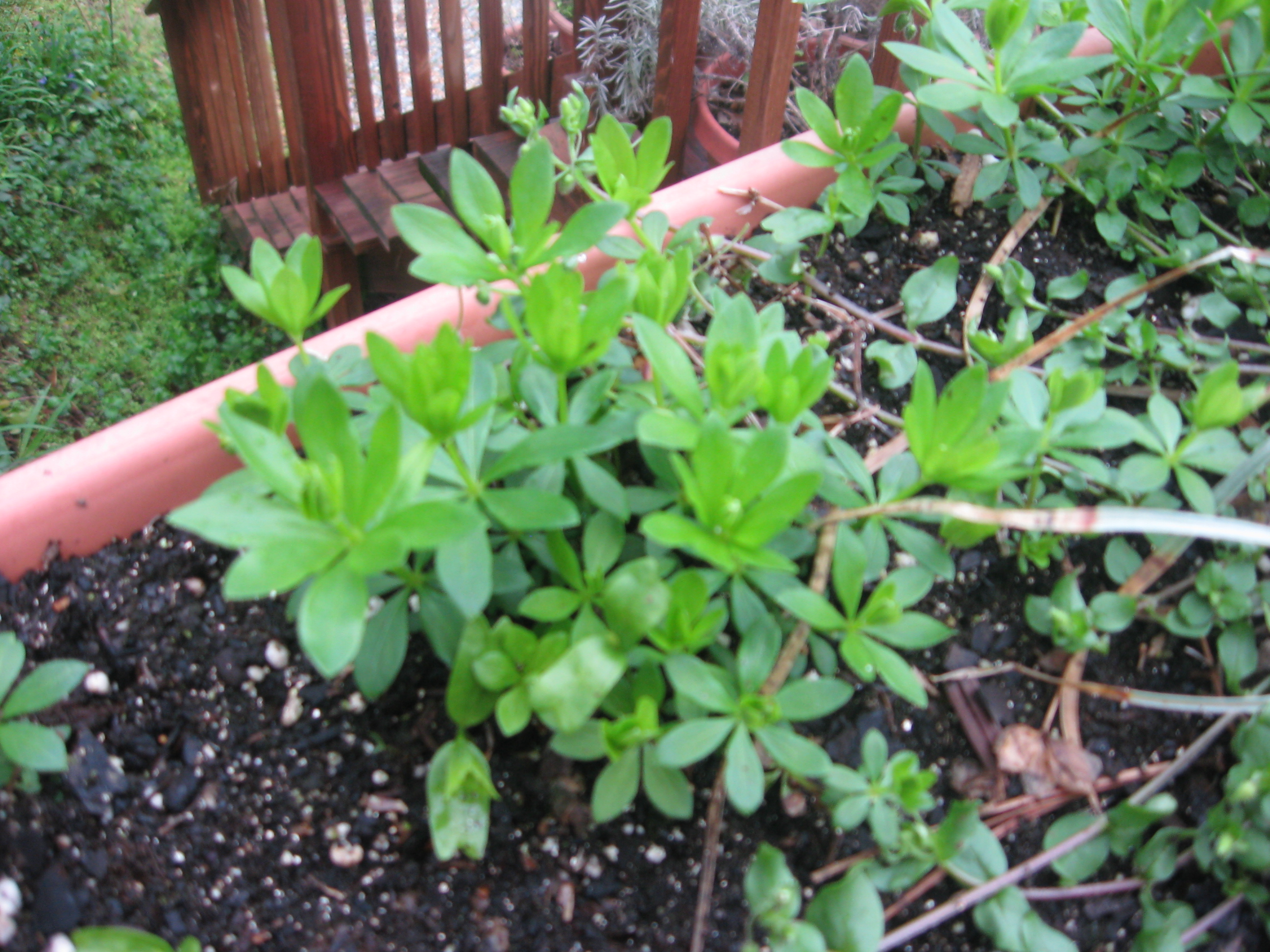
Herb-Gallium Odorata IMG_3834-1

Sweet Woodruff (Gallium odorata)

Some herbs such as sorrel, chervil, sweet cecily, sweet woodruff, and lemon balm would rather have some shade.  If you are planting them in the garden, you need to consider the position of the sun in all seasons of the year, and the presence (or absence) of trees that will leaf out in the summer.  One of the advantages of growing herbs in containers is that you can move them around to give them optimal sun and shade. No matter what the soil you use, if the sun is not there you’ll have spindly, leggy herbs without much flavor and  they will be prone to disease.

Soil is next in importance to sun for growing herbs.  An additional advantage of growing herbs in containers is that you control the soil. Herbs must have good drainage whether in the garden or in containers. (I suspect that many of us who cook for one will be growing them in containers, so that will be my focus.) I use potting soil from a reputable garden supply center.  I know that it’s not going to have diseases carried in it, and I know that it’s formulated to drain well as long as I put it in a  pot with appropriate drain holes, and that it will also hold water in an appropriate manner as well.  It’s a happy medium that I don’t have to fuss with–I can just plant herbs and cook with them.

Many of the herbs that we grow are perennials, so they won’t be moved and may not even be repotted every year, so it’s important to have good soil.  If they are planted in a large pot they may need only top dressing between times when they become root-bound and need to be divided or repotted.  I may fertilize more in the second year that they are in the same pot if it looks as if it is needed.

For many herbs I plant several in a much bigger pot–12 to 14 inches.  It looks great and watering frequency is reduced.  You do need to consider what herbs to plant together because of the differences in their likes for soil moisture and feeding.  Many of the Mediterranean  herbs (oregano, marjoram, thyme, rosemary, lavender) are very drought tolerant once established and need less water. Not so with basils:  basil likes sun, but likes evenly moist soil; I might plant several varieties of basil together in a large pot, or even have a basil plant share a large pot with a tomato plant, but I’d not mix basil with oregano and marjoram because of the differences in watering needs.

Basil (a fast-growing annual herb) is, in contrast to perennials (sage, oregano) is a heavy feeder as well; it will need to be “fed” more often–perhaps a dilute (quarter-strength) solution of all-purpose plant food or fish emulsion monthly. You need to consider the appetites of your herbs, as well as their proclivity for sitting in the sun, before you put them all together in a big pot.  Once you get perennials established they will provide much enjoyment with very little effort.

Some herbs which can be very invasive should be kept in separate pots: lemon balm (Melissa officinalis) and mints, for example.  Other herbs simply do not do well in pots because they develop deep taproots, e.g. dill–and you cannot provide depth enough in a reasonable sized pot for them to do  well.  Others are simply too big for planting in containers (e.g.  angelica and borage) that we’d use here.  More varieties are being developed that are “dwarf” and are suited to containers.  While many dills (such as Anethum graveolens ‘Mammoth’)  do not do well in containers, there are some dwarf varieties (Delikat and Fernleaf) that are suitable for containers.

You’ve got containers, and soil.  Do you start with seeds or with plants?  Many garden centers will have herb plants, but they may not have a large selection of different varieties–you may only be able to get a generic “sage” or “thyme”.  One of the joys of herbs is seeking out different flavors and those that are especially  aromatic, with high levels of essential oils.  The “tarragon” that you find in the big-box garden center may not be French tarragon (Artemesia dracunculus, var. sativa) which is what you want.  The oregano that you find there may not be Greek oregano, but Italian oregano, which is really sweet marjoram (Origanum marjorana).  You’ll want to find a good garden center, or try farmers’ markets in the spring.  Those growers will likely know more about the varieties of herbs that they have.

Buying plants is probably the best way to start growing herbs.  Starting from seeds gives you more possibilities, but you have extra seeds, the difficulties of getting them to germinate; some are slow growing, so you won’t be able to use them as quickly.  It can literally take weeks for some to germinate, the germination rate may be poor (e.g. Stevia), and then many more weeks before you can harvest for use in cooking, and that is really the point of growing your own herbs.  You want to smell and taste them, and season your food with them.

I’m addicted to having fresh herbs at my doorstep…I’m also picky about what varieties I have, so I usually start with seeds.  It also means that I wait impatiently to see if the seeds are going to germinate, and for the tiny  plants to get big enough to transplant, and then to harvest.  It’s always fun to try new varieties.  You do find out that all plants labeled “sage” are not the same.  Starting from seeds, there is always variability in the plants so some may be more aromatic than others.  When you are purchasing a plant, you should crush a leaf and smell it to be sure that it’s what you want–fragrant and potent.  Only plants taken from cuttings will be exactly the same.  Some herbs can only be propagated by cuttings (French tarragon, for example) so you want to be sure that is what you get. (That’s why I’m giving you the botanical names with the common names of the herbs.)

If you get to the point where you hanker to try a new variety of mint, or basil, there are suppliers from whom you can order plants that you cannot find locally.   Just for fun you might want to browse Richters Herbs , Johnny’s Selected Seeds, or Mountain Valley Growers just to get an idea of the wonderful variety that is available.  (Mountain Valley Growers has some wonderful recipes on their website for herbs too.)

There will be more on selecting plants and growing specific herbs coming soon.

Herbal joys of spring

Chives with blossom

Chives (Allium schoenoprasum)

Even though we’ve had the occasional chilly day, it does feel as if spring is close.  I felt that especially going out on my deck and seeing that green was showing amongst my pots of herbs.   For some herbs, I take their hardiness for granted–sage, rosemary, lavender, mint, oregano, marjoram, chives.

There are others that make me breathe a sigh of relief when I see the green shoots coming up in the spring.  Even for the hardy ones, it is such a pleasure to see them return each spring: it means more freedom to improvise with seasonings.  I don’t try to winter-over in the house.  There is not enough room, or light to have really flavorful herbs.  During the coldest parts of the year, I depend on good quality dried herbs, or purchase fresh ones from the grocers.  The problem with having to depend on buying fresh ones is that it really dampens spontaneity in the seasoning process.  So the green shoots of spring are especially welcome.

Several weeks ago I was able to pick a few sorrel (Rumex acetosa) leaves to make sorrel butter to add some sparkle to my griddled salmon.  I had to be careful not to get greedy as there were so few leaves there at the time.  Now it’s  a lovely

Sorrel

Garden sorrel (Rumex acetosa)

clump of bright green foliage.  Sorrel sauce for salmon is in the offing.  While discussing herbs with a customer at the Durham Farmers’ market last week, it was mentioned as something to be added to white bean soup.  I’d not thought of that, but my mouth says that might be really interesting, given the bright, tart,  somewhat citrus-like  flavor of sorrel.  That got me to thinking that I might try it in the lentil soup that I like so much (instead of the lemon–definitely not with the lemon juice).   Sorrel leaves are very delicate and will cook down and almost literally melt into a sauce.

Greek oregano

Greek oregano (Origanium vulgare hirtum)

Another herb that I’m always happy to see showing new green in the spring is oregano–it’s one of my favorites.  I grow the Greek, and usually the Italian (or marjoram), and Syrian as well.  In addition to all the things like pizza and pasta sauces, I like to toss haricots verts (grown in a pot on my deck) with just a little extra-virgin olive oil that has been carefully infused with some fresh oregano (Greek or Italian, depending on my mood at the time I’m cooking them).  While oregano and marjoram do well as dried herbs, there is nothing like the flavor of the fresh herb to wake up your taste buds and say that the season has changed.  Spring is on the way!

Addendum to the Clever Coffee Dripper post

Just a quick over-coffee addendum about the Clever Coffee Dripper.

I’ve had the third run of coffee from this gadget! I just had to know if the stirring at 1-1/2 (or so) minutes made a difference so I made one cup without doing that.  It does, indeed, make a  difference.  Definitely a more complex flavor if you do the stirring.

On the third batch, I did make the grind just a bit finer and like that better too.  I may try just one “click” finer on the grinding and see what that does.

The Clever Coffee Dripper

I’m a coffee lover–as long as it’s good coffee and it’s brewed properly.  That leaves out a lot of brewing methods, including the automatic drip coffee maker.  I’ve tried different ways of brewing coffee (other than the standard drip coffee maker):  Bodum vacuum coffee maker which I do like a lot but is not functional for work days; the Filtron cold-water brewing which makes great iced coffee in the summer, Chemex, Melitta, and, of course, a French press.  I like the flavor of coffee from the French press, but the sediment just sets my teeth on edge for some reason–otherwise, the French press is my favorite coffee maker for flavor.

When I got my last issue of Cooks Illustrated (first of this month) I noticed that they had good things to say about something called a Clever Coffee Dripper.  I’ve seen a lot of coffee brewing systems reviewed in Cook’s Illustrated; it usually comes down to them recommending the French press.  I was surprised to read that The Clever Coffee Dripper was labeled “a success”.  Curiosity and my dislike of the sediment in French press coffee finally got the better of me and on Friday I ordered a Clever Coffee Dripper.

I found it most inexpensively from Amazon.com; the price that Cook’s Illustrated quoted from that supplier plus the shipping was higher than I wanted to pay, so I googled the Clever Coffee Dripper.  Amazon’s price was a bit higher, but the shipping was less, so I ordered it from there.

Over the weekend I had an e-mail saying that it had been shipped.  I’ve been waiting rather impatiently for it to arrive.  On my way home from work today I stopped at Harris Teeter and got some #4 cone filters, in hopes that it would arrive today.

On this wet, gray, rainy day I was thinking  hot chocolate, but I found a package outside my door–the Clever Coffee Dripper had arrived.  For an instant or two I contemplated waiting until morning to try it out–but that was really only a quickly passing thought.  I knew I had to try it now!

It’s a very simple apparatus: a funnel-shaped top that looks like a Melitta or filter-cone coffee brewer, but with a few extra parts:  a coaster for it to rest on, and a lid and a stopper/valve that is opened when it is set on a cup or carafe.

I filled it with water and checked to see if it leaked (it did not) and how quickly it drained without a filter or coffee grounds in it (it drained much more rapidly than the Melitta filter-cone).

I plugged in the kettle and ground some coffee while that was heating.  I used a medium drip grind as the instructions said that too fine and it will drain too slowly; too course and  it would drain too fast.  I’m not sure how much of an issue that is since the water and the grounds stay together in the cone.  According to the instructions on the box it will fit on anything with a diameter between 1-1/2 inches and 3-3/4 inches.  That means it will fit on my thermal carafe.  I got out my widest coffee cup  to test that–also means my biggest coffee cup.

The instructions said to put in the filter and rinse to minimize the paper taste–which is something that I did even with the Melitta.  I filled my coffee cup with hot water to warm it.  The brewing time is essentially the same as the French press–but the instructions say to stir it after 1-1/2 minutes, then continue to brew for 4 minutes.  After the proper amount of time, I set the thing on my coffee cup and watched it drain.  I did follow the instructions, and I got a good cup of coffee!  I haven’t done a side-by-side test with the French press, but to me this tasted like French press coffee without the sediment.   No sediment, and easy to clean up.  Definitely a keeper!

This is not going to make a lot of coffee at one time–unless you want to brew into a carafe–and brew several times. As Cook’s Illustrated indicated–it’s for small amounts of coffee.  The heat loss during the standing time is about what you’d expect from a French press (unless you have the double-walled one).  Overall, it seems to be a good prospect for my morning coffee–easy and tasty!

Baking dishes

I think that many of us who do single-serving cooking are likely to live in smaller places, and have less drawer and counter space in the kitchen.  With storage space at a premium, we need to consider that when tempted by gadgets and single use items.  Before I buy it, or even bring home a freebie, I try to ask myself if I will really use it, and if so, how often.  Many times that item gets left right were I originally saw it, I probably don’t even miss it.

I  have a lot of cookware of various sorts, but some things are much more useful than others; some things I should give away or send to the Habitat ReStore, or even have a yard sale, since I’ve not used them in ever so long.

I was looking through a drawer the other day and found a couple of yellow plastic thingies that I may never have used–I may have gotten these for attending a Tupperware party in the (very) distant past.  I do know that the one on the left is supposed to be an egg separator.  The one on the right (especially since it’s a matching color) looks to me like a thingy that could be used to do something with an egg–scoop it out of hot water, or hold eggs when you are dying them (not likely–too broad on the arms), perhaps? (Why use that when I have a slotted spoon?)  I think that I may have tried the egg separator once, but usually I  either use the shell halves or my hand–why wash a gadget when it’s just not necessary?  (I’m a firm believer that hands are meant to do more than hold implements in the kitchen.)  I try not to have similar kinds of dishes around, because that really takes up storage space.

Just as I’m supposed to be able to multitask these days, I like multiple use things in my kitchen.  I try to stay away from “disposable” items, too.  I’ve already mentioned that I use Ball/Mason jars for storage containers for both pantry and refrigerator, and I’ve mentioned the cast-iron grill/griddle (which can double as a broiler pan); there are some basics that see a lot of use in the kitchen almost every day.

My most frequently used baking dishes are not fancy–most were obtained from the hardware store or the grocery store–while doing the every-day activities of keeping house and cooking for one; I did not have to go look for them in specialty stores. I’m sure a kitchen/cooking website like Cooking.com would have these basics as well.  I like glass so that I can use them in the gas oven or in the microwave oven–again, space savers.

One of my favorites is a Pyrex rectangular baking dish with lid that I’ve had for ages and ages.  Should I ever break it, it will take more to replace it than just a dish and a lid.  It’s a small covered baking dish just the right size for about four chicken thighs to roast (on top of the right amount  potatoes and/or other root veggies) with a lid which has ridges and a lip on one side (raised and smooth on the other) which works so well for cooking bacon in the microwave because it allows the fat to drain away (no, I don’t cook it on paper towels, though I do use a paper towel to cover it with). The glass lid fits well enough that it can also be used for storing  in the refrigerator.

Another favorite is (also Pyrex) narrower baking dish (also with lid) that is just about the right width for single lasagna noodles so that I can have two servings.  This one has silicone seal with vents in it so that you don’t have glass-on-glass contact.

Both these are a great size for cooking for one, allowing for some  “leftovers” that can be used in other recipes, but not so large that there is too much space for baking or roasting.

I do have a larger and smaller oven-safe dishes (mostly Pyrex) that have plastic covers for storage.  Of course, any kitchen must have the usual rectangular and square baking dishes and pans (the “usual” 9×9-inch and the 9×13-inch, but those get used much less frequently.

Another favorite of mine is a large round covered dish  (yes, Pyrex) with a multipurpose lid.  It has good wide handles on both the base and the lid.  The lid has done duty as a pie plate for me several times.  It’s a bit bigger than you average pie plate, but it’s got the right slant and approximately the right depth.  The lid can also serve as a shallow baking dish.

I do have some Emile Henry bowls and oval baking dishes that see a fair amount of use, but some colored glazes cannot be used in the microwave; the plain glass or the white seem to be the real workhorses in the kitchen: oven, freezer, microwave, and refrigerator for storage.

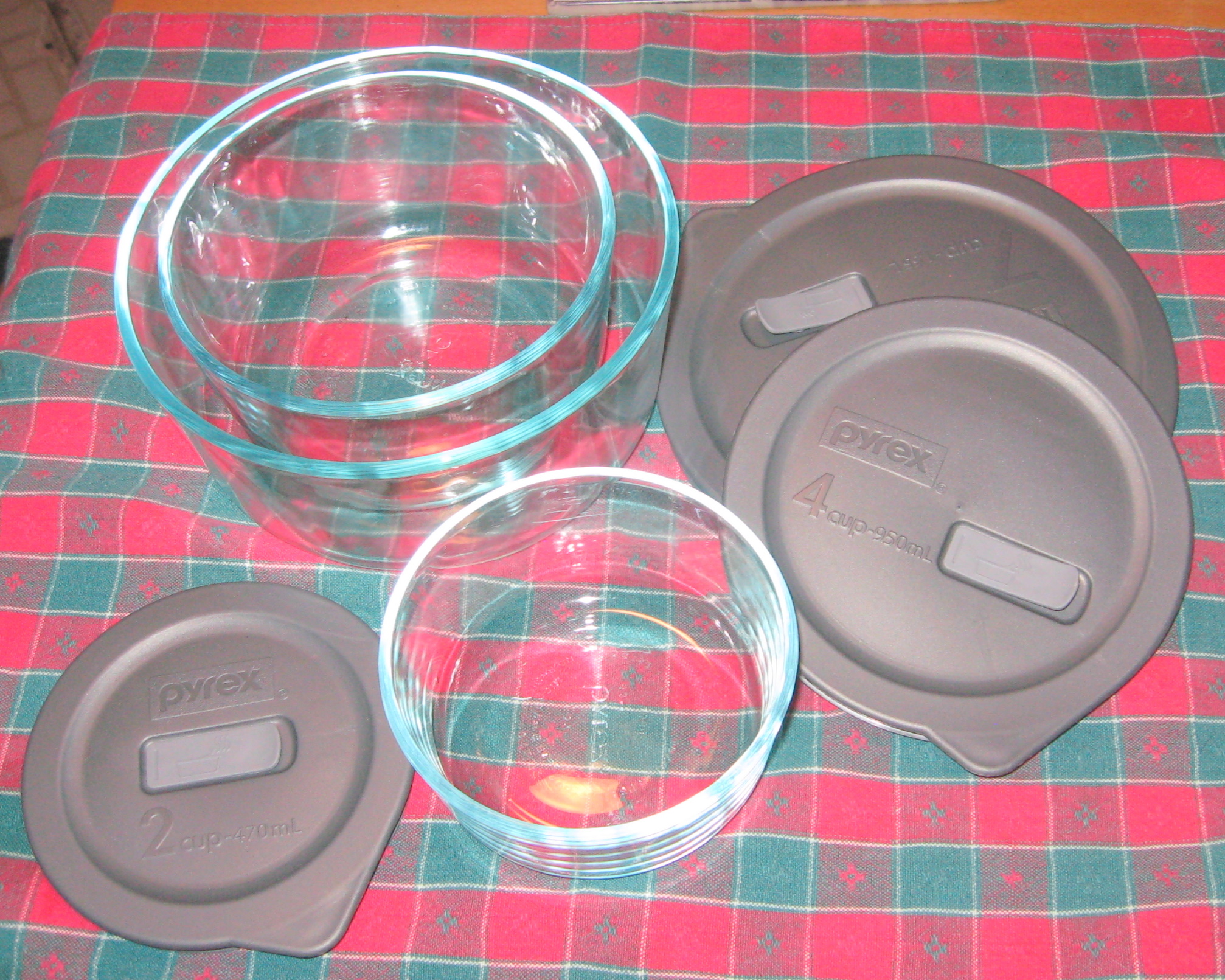
I also have bowls that have vented plastic lids for use in the microwave so that I don’t have to reach for the plastic film every time I want to nuke something.   The vents can be opened for microwave use, and then closed for storage.  The plain bowl can do cooking and serving duty which is a real space saver, and a real cleanup help. The white bowl (below left) is also one with a vented lid for microwaving, baking, or refrigerator.

One of the most-used for my single-serving cooking at breakfast time and when soup is on the lunch menu is another with a vented plastic lid that is microwave safe. The cup (right) is just right for cooking single servings of hot cereal in the microwave.  The vented lid means no plastic film wrap is needed.  Admittedly some mornings I feel like I should use that cup for coffee because it bigger than the average coffee mug.

No matter what you’re cooking, it’s important to have the right size container. In baking or roasting, just as in stove-top cooking, too large and food will dry out; too small, and there’s an oven mess to clean up, or food is too confined and steams rather than roasts. In the microwave the right size and arrangement of food is also important.  Cooking that breakfast cereal in a container that is too shallow can leave you with a really nasty mess to clean up–not a good way to start the day.

One of the things that is so important about food is good flavor, no matter if it’s for a crowd, or just a single serving.  It always should be a son goût!

Cold beet soup

I’m back from the Durham Farmers’ Market–it was a great day, even though the market is not in full summer swing yet.  The Piedmont BioFarm’s booth, which was right next to mine, had absolutely gorgeous beets. Unfortunately, they  sold quickly so  I didn’t get any today, but I’m told that there will be more next week, so I’m planning to bring some home with me then.

beets with tops from Johnny's Select Seeds.The sunshine and warm weather made me think about beet soup.  This recipe was given to me years ago by a good friend, and it’s become one of my favorite summer things to have in the refrigerator for hot weather.  It’s cool and refreshing, yet very satisfying.

I first experienced this soup when Casey brought me some, just when it was most needed:  I was moving–in extremely hot, humid weather–from one apartment to another in the same building, so it was mostly carrying boxes and lugging furniture, all very hot sweaty work.  Air conditioning was out of the question with the constant coming and going, with the doors open.

Cooking was also out of the question–mostly for reasons of fatigue, sore muscles, disruption of the kitchen, and the heat, and maybe even a dollop of laziness thrown into the mix.   That soup was the most wonderful treat, particularly under those circumstances; I’ve made it many times since and it’s at least as good, if not even better, when had in much less dire straits.

It’s not a small recipe, but it holds very well in the refrigerator;  a “left-over” taste is not a problem–and I think that the flavors actually blend and grow with standing.  I suppose you could always halve the recipe, but it’s so good that I’ve never done that–I can easily enjoy  it several days in a row!

Šaltibaršciai (Casey’s Cold Beet Soup)

Ingredients

  • 1/2 medium-size onion, finely chopped (preferably Vidalia or Walla Walla sweet onions)
  • 1 tablespoon salt
  • 6-10 (depending on size) boiled, peeled, and grated beetroot
  • 2 cups water in which the beets were boiled.
  • Chopped stems and greens from the beets, steamed 3-5 minutes
  • 2 large cucumbers peeled, seeded, and chopped
  • 2 handfuls of fresh dill, finely chopped
  • 1 bunch of green onions, sliced thinly
  • 5-6 hard-boiled eggs, chopped
  • 1 cup of sour cream
  • 1/2 gallon buttermilk
  • 2 cups water from cooking the beets (cooled)
  • red wine vinegar (0 -4 tablespoons) to taste.

Assembly

  1. In a large bowl, place the 1/2 medium onion and about 1 salt. With the back of a wooden spoon, grind together the onion and the salt to draw out the onion juice. (You really need to do this “muddling” process–you don’t get the same “blend” of the onion flavor if you simply add minced onions.)
  2. Add the remainder of the ingredients to onion in the bowl and stir well.  Adjust the flavor balance with additional salt if needed, and a wine vinegar to taste.  Add more liquid if needed for the consistency you prefer.
  3. Chill thoroughly.  Serve with boiled or steamed potatoes, chilled.  (You want boiling potatoes, not baking potatoes for this; red or Yukon gold work well.)

Wine suggestions, courtesy of Casey, were as follows:

  • Sauvignon Blanc is excellent.  The soup needs a wine with more fruit and not too herbal or grassy.
  • A white Corbières was too herbal–it accentuated the dill in the soup until it was just overwhelming.

I did not try the Corbières; overwhelming dill did not strike my fancy and I trust this recommendation.  I can attest that Sauvignon Blanc is excellent with the soup.  I’ve probably eaten this for breakfast, lunch, and supper, with wine, and without.  It’s well worth the effort of making and it may well improve with standing a few days.

I have to confess that is a spate of utter laziness, I have replaced the potatoes with cubed extra-firm tofu with a very satisfying result.  I have always thought that it’s the eggs and the potatoes that make this such a satisfying, but cool, meal.  And, it a marvelous color, too–definitely shocking pink.  I’ve not tried it with the orange beets, but that might be interesting, too.

Think it looks like a lot? Well, invite a friend. Friends are usually glad to help in cases of an excess food crisis!

A son goût!

Risotto–even for one

Risotto is a favorite food–sometimes it’s comfort food and sometimes it’s a treat for a special occasion.  I am addicted to that luscious, sensual, creamy texture.  Depending on the additions it’s an all-season dish–veggies or shellfish in warm weather, or sausage and meat for cold-weather, stick-to-the-ribs comfort food.

There was a time when risotto was a special-occasion, dinner-with-friends dish for me. I’d invite friends for a meal and make risotto.   One day while making spinach risotto to go with pan-seared tuna, supervised by the cat, stirring and adding liquid, stirring…and thinking…I decided that there must be a way to have risotto in single-serving quantities.  Thinking of restaurants, I was sure that there was some “trick” that would allow finishing off one serving at a time;  I needed to figure out what that was.

I’ve tried the recipe given by Barbara Kafka in Microwave Gourmet (p.  114)  and that’s good for quick risotto but, to me, not quite as luxurious as the long slow kind.  The advantage there is that she does give quantities for serving one or two.  I kept going back to restaurant line cooking, and wondering how I would do risotto in that situation–I certainly would not be making it totally “to order”–I’d be finishing it off as ordered.  As much as I like risotto, it seemed worthwhile to try to find a way to have it more often.

I was using one of the recipes from Marcella Hazan’s Essentials of Classic Italian Cooking (pp. 242-245) as usual–still stirring, thinking, and stirring….   Maybe I could take some of the risotto out while slightly undercooked, before adding the cheese and butter and any final ingredients and freeze it for later use. (Can you see the light bulb appear above my head with this though?)

Judging that there was  more than enough for two of us in the batch that I was working on, I grabbed a small container and took out a single serving (fairly large single-serving), sealed it carefully so that there was no air space, and put it in the freezer.

A couple of weeks later, I pulled it out of the freezer and let it thaw in the refrigerator.  Now to see if I had something edible.  I’d taken it out of the original batch when I though I had about ten minutes of cooking time left.  Now, back into a pan, add some broth, and more stirring.  It took a bit of effort to get it mixed with the liquid as it was stiff, but after that it seemed to be a good consistency.   As soon as the rice had that bit of “bite” –tender outside, but still firm at the center, I added the parmigiano-reggiano, and a bit of butter and it was ready to eat.

I have not done a side-by-side tasting with this method and the microwave risotto or with risotto freshly made with the classic technique, but I felt that this was a bit creamier than the microwave method, and it took about the same amount of time.

Rice for risotto needs to do two things:  to have soluble starch to dissolve in the liquid to give the creamy texture of risotto, and to have enough insoluble starch to have that “tooth” or “bite” at the center of the grain that makes risotto such a sensual (and sensuous) delight.  I’ve most often used Arborio rice for risotto, and that’s what I used for this, and for the microwave trial, and from the same batch of rice.   Two other varieties of rice used for risotto are Vialone Nano, and Carnaroli.   These three varieties offer a bit of difference in the consistency of the risotto due to differences in the kinds of starch that predominate.   The Vialone Nano has enough e “bite” while having enough soluble starch to have the creamy texture of risotto, albeit looser, and maybe a bit less creamy.  The Carnaroli  has an even firmer “bite” with the creaminess, with the Arborio being sort of in between, and the most readily available (and the least expensive) of the three.  I have not tried this technique with either the Vialone Nano or with the Carnaroli–maybe that’s a future experiment, but with the Arborio I was pleased with the result.

There are so many variations that make risotto a meal in itself:  you can add meat, vegetables, fish, or shellfish easily as you finish the thawed risotto and vary the seasoning easily.   Quick-cooking vegetables could be added as you start the finishing step; harder vegetables can be sautéed  or partially cooked before you add the risotto to finish it.

One surprisingly good addition to risotto (from Marcella Hazan’s recipes) is celery!  I’m always looking for things to do with the celery that’s left after I use the one or two ribs called for in recipes; when I saw her recipe for “Risotto with Celery” I just had to try that variation on risotto. Her recipe (p. 249 in Essentials of Classic Italian Cooking) calls for 2 cups finely diced celery for six serving of risotto.  It’s added in two different stages (if you’re making risotto in the classic way):  half at the beginning  when the rice is added, and the remainder  when the rice is about half-cooked  so there is some texture variation.  This is a great side for grilled meat or fish.  I really liked it to accompany a grilled lamb shoulder chop.   (I’m starting to feel that celery may be an under-appreciated vegetable and not just an aromatic seasoning.)

For finishing liquid, if the original batch of risotto was made using broth, you could finish it with water, though I find I usually have some broth in the refrigerator.   I’ll concede that you may not have the melding of flavors that you would have were the veggies or meats cooked with the risotto for the entire cooking time, but the result is good enough when you consider the shorter time, and the fact that you can have this in single-serving quantities.

Another lovely “comfort” food with Arborio rice that is a favorite of mine is “Boiled Rice with Parmesan, Mozzarella, and Basil” (again from Marcella Hazan’s Essentials of Classic Italian Cooking (pp. 258-259).  Here is a summary of the recipe:

Boiled Rice with Parmesan, Mozzarella, and Basil

Servings: 4, but halving the recipe works well.

Ingredients:

  • 4 tablespoons or butter
  • 6 ounces of mozzarella (fresh)
  • 1-1/2 cups Arborio rice
  • 2/3 cup freshly grated parmigiano-reggiano cheese
  • 4-6 fresh basil leaves (shredded)
  • salt

Preparation:

  1. Cut room-temperature butter into small pieces and cut the mozzarella in  small pieces (grate on the largest holes of a box grater if it’s not too soft–mine usually is too soft). You want small pieces so that the heat of the rice will melt it.
  2. Bring 3 quarts of water to a boil, add 1 tablespoon salt, and bring back to a boil.
  3. Add rice, stir immediately for a few seconds so that it doesn’t stick together. Cover the pan. Keep at a constant, but moderate boil, until the rice is tender but still has the central “bite”.  Stir occasionally while cooking, about 15-20 minutes.
  4. When tender but al dente, drain the rice and add the mozzarella, then the Parmesan cheese, then the butter; stir well after each is added.  Finally, add the shredded basil leaves and stir in and serve immediately.

It’s not risotto, but then you don’t have the constant stirring that goes with classic risotto,  while you do get a great texture given the soluble starch of the Arborio and the cheese melted into the hot rice.

I’ve yet to try the Cook’s Illustrated baked risotto, but that looks like another possible alternative and perhaps adaptable to smaller quantities.  As well as I like rice and risotto, I have a lot of exploring to do to find out what works best for single-serving cooking.

A son goût!

Griddled dinner, addendum

End of the work week for me; I’m home from teaching my last class (ended at 4 o’clock).  I made a stop at the local Harris Teeter store to try to find some “Opal” apples without success, and came home with only some milk and chocolate  (Chuao with chile pepper and some other spices).

I think that I probably set a record for the least time to get a meal for myself (and a good one, at that)–short of just dipping into the peanut butter jar.  Of course, it helps to start with great ingredients that really don’t need much done to them.

I got some beautiful wild-caught Alaskan salmon yesterday, so that was dinner this
evening, from the griddle.  The filet was beautiful–skin on,  not a single bone that I had to pluck out with tweezers, and it was cut to just the size that I needed for a single serving.  It was griddle-ready.

I heated the griddle so that I had a good “spit” when I flicked a drop of water on it.  I rubbed a bit of olive oil on both sides, sprinkled a little salt, put the salmon on the griddle skin-side up to start.  At the same time I tossed a handful of partially cooked haricots verts on with it.  It took about five minutes for it to brown nicely.  I flipped it over, skin-side down,  turned the heat down on that end of the griddle, and finished cooking it until there was just a nice darker streak  visible on the ends and took it off the griddle to rest for a few minutes, flipped the beans, and topped the salmon with some sorrel butter.  Great meal in about 15 minutes, start to sit-down.   Definitely minimal ingredients, but not minimal flavor–and it was a healthy dinner too. (Keiko preferred it without the sorrel butter, though.)

I wish there had been enough sorrel to make a sauce, but as it’s just coming up, I could not pick many leaves; what I could pick were minced and mixed with room-temperature butter (unsalted) to be plopped on top of the salmon.  The sorrel butter added a little richness, with some tartness that went well with the salmon.  Fast, easy, and a great way to cook for one person.

Aguas Frescas

I just wanted to add this link for some refreshing summer drinks.  I know the heat is coming, and as I mentioned in and earlier summer-time post, I always in search of healthy, refreshing drinks that are really thirst quenching.  I came across this post of Aguas Frescas this evening and thought that, despite the chilly weather outside tonight, I’d pass it along as some of you might enjoy some of the ones given here.  I know I plan to try some of them during the hot weather.

Evolution of comfort food.

A few days ago it was gray, rainy, chilly and no matter what there thermostat said, I could not feel warm.   Peering into the refrigerator, I could not find anything that I wanted to eat and I did not want to cook.  Comfort food was in order, something basic: grilled cheese and tomato soup.

That got me thinking about why grilled cheese and tomato soup was so appealing.  I realized that it was likely because that was comfort food when I was a child–home from school with a cold, or sometimes, just a treat.

I did fix myself a grilled cheese sandwich and tomato soup, and it was wonderful–just what I needed.  Munching away, I started considering, even though this was grilled cheese and tomato soup (our of a can), how different it was from what I had as a child.

Growing up on a farm in the country we were pretty self-sufficient: raised and butchered our own meat, curing our own ham and bacon, canning vegetables, raising chickens for our own eggs, and milking cows so that we had our own butter, milk and cream.  I grew up with home-made bread, cakes, pies as a routine thing.   From that vantage point, “store-boughten” was a treat.

One of those treats was a grilled cheese sandwich made with American cheese and something like Wonder bread–so it all squished down flat under the bacon press.  Heaven was to have that accompanied by a can of Campbell’s cream of tomato soup–yes, the condensed stuff.

Given the home-cured country ham, bacon, and good meats (beef, pork, and maybe even lamb, with some rabbit and maybe venison) a treat was a bologna sandwich!  Extra special if fried.  Probably almost anything that came out of a tin can that required a can opener, and did not come out of a Ball/Mason jar would have been considered a real treat.

The things that came out of the Ball/Mason jars were luscious halves of peaches, whole tomatoes,  pears, apple butter…and I did not appreciate them then–they were just food, nothing special.  Well, how things do change.

Now, even though I admit to really liking mortadella, and having just had a grilled cheese sandwich with cream of tomato soup for comfort food–my idea of quality of comfort food has changed a lot.

My grilled cheese sandwich was made with excellent imported, firm, nutty Swiss cheese, with bread sliced from a whole loaf of Italian bread.   That bread was lightly brushed with extra-virgin olive oil, almost like was done in my childhood, put onto a cast iron griddle and carefully browned on both sides.  Lovely, crunchy on the outside, melted cheese oozing with every bit, and delicious.

My tomato soup, admittedly, did come from a can but what a difference from condensed soup.  It was Progresso chunky tomato with basil, not cream of tomato, but really pretty good for soup out of a can.  I did, however, want cream of tomato soup.  I put half the soup into the refrigerator to be used another time, and after heating the other half in the microwave, I added two teaspoons of heavy cream, and some fresh (frozen) basil to it.

I was quite happy with my comfort food–but I did have to reflect on how my taste has evolved.  The original American-cheese, Wonder-bread sandwich never even occurred to me; no did Campbell’s condensed cream of tomato soup–yet my choice was cream of tomato soup and a grilled cheese sandwich, but such a difference now.

This made me think of other differences then and now.  When I first left the farm and went to the city, I was amazed at “city” or deli ham…thought I liked  that better than “country ham”.  Living alone and cooking for one, I even used mac ‘n’ cheese from a box–very different from what I had grown up with.  I was so thankful to be away from the farm, to not have to milk cows, churn butter, and make cheese.  Now, I seem to  have come back to where I started–I want to grow things, buy from the farmers’ market, and will search out those things that I took so much for granted as a child.