Unknown's avatar

About sa.fifer

Lover of good, wholesome food and wine. Cooks for one and the cat. Likes to paint-- a frustrated botanical illustrator and amateur (photographer) and fledgling birdwatcher, beekeeper, and Kindle addict. Works as a freelance indexer.

From hive to apiary?

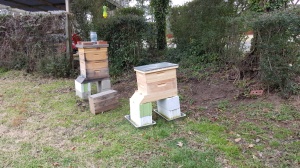
hive added The bees are sending signals–they think it’s spring, no matter what the calendar says, or what the infamous groundhog says. (Happy groundhog day, all.) In reading about beekeeping you often find mentions of the varied opinions of different beekeepers–as 5 beekeepers and you will get at least 5 opinions. Well, in describing my hive situation to three master beekeepers I’ve gotten only one opinion: prepare for swarming.

Not being one to ignore what seems good advice, especially with the consensus.  I’ve set up another hive in preparation for  (but hoping to prevent)  the swarming. One hive is soon going to become two.  The bees may dictate that I’m going to do this split sooner rather than later! I won’t know until it’s warm enough to get a good look inside the hive to see if there are swarm cells, or not.

Right now I don’t know if there is another queen in the making in the main hive (I guess that’s hive #1–but I need to think of something more poetic). From some quick searching on the internet, it looks as if I may have not choice but to allow the girls to “make” their own queen for those that stay behind in the main hive.

Ò¿Ó

I keep mentioning candyboard (or candy board) but I don’t think I ever explained what it is and why I put one on the hive for winter.
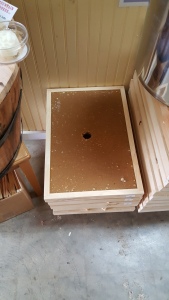
sugar in mould for bees

candyboard

Bee candy is just about what you would make for yourself–sugar and water–cooked to a hardball stage then poured into a mould that fits on top of the hive so the bees can get to it for emergency food in cold weather. The bee candy likely has some additions that you’d not like–essentially vitamins, and pollen or pollen substitutes. The is a picture of a candyboard taken in Bailey Bee Supply store while I was there purchasing hive components for the second hive. This is hard candy.  (There’s a photograph of the candyboard that I put on my have after the bees had worked eaten some of it.)  They ate the whole thing! Much sooner than I expected. Now depending on the weather the bees will need more “emergency” food.

Another option for feeding during times when there is not an adequate nectar flow is fondant (soft candy). Since I’ve displayed absolutely no talent for making candy–ever–I chose to buy both the hard and the soft from bee suppliers. I’m going to try the fondant for feeding now until the nectar flow starts. I’ll have to make some other decisions about feeding when the split is made–all rather weather dependent, and bee dictated.

It is possible to feed bees table sugar in other ways. In warm weather, a 1:1 sugar and water syrup works well, or dry sugar in an emergency. (There’s more about my adventures with that in other posts.)

Now, off to the books to learn more about doing splits! These girls obviously didn’t read the book or look at the weather forecast.

Ô¿Ô

.
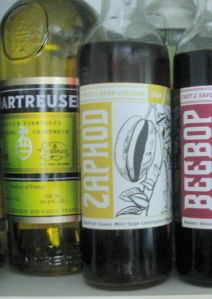
Zaphod

First, let me tell you that I’m not generally a fan of liqueurs, especially to be sipped on their own because most are syrupy and my first impression is simply of sweet. Now let me tell you that I’ve found some exceptions, starting with Krupnikas and then Zaphod liqueur bottleBeatnik–it really amazes I’ve now found five that I truly like on their own. Even sweetened with raw cane sugar, my first gustatory experience is not of sweet.

From the Brothers Vilgalys another great liqueur: Zaphod.  It’s a light liqueur (for sipping even in the summer) that is very complex–but not overwhelmingly any particular spice or botanical.  One of the things that I love about Krupnikas and these liqueurs is the complexity and the blending of all the flavors.

Sniffing the Zaphod suggests something clean, and bright. Taking a sip and holding it in your mouth the flavors begin to unfold. There is the brightness of lemon (lemon grass), the coolness of mint and sweetness of fruit. As the liqueur warms in your mouth you begin to sense the earthiness of sage, and finally a spicy, peppery feel.

The balance of Krupnikas and each of these liqueurs is impressive: they give a whole sequence of tastes–and have a very long finish. I can see this one with soda (seltzer water) or a very light sparkling wine for a summer beverage.  Another awesome liqueur.


Ò¿Ó

Because the scale never lies: Farro and Legumes Soup

I share those after-holiday feelings. I only discovered farro but considering how much I love legumes this looks just wonderful.

Francesca's avatarFlora's Table

Farro and legume soup Farro and legume soup

4 Servings

Hello everyone!

The Holiday season is behind us but our Christmas tree is still up and some of Santa’s presents (unwrapped) are still laying under the tree – mostly because they are so ugly I’m not quite sure what to do with them! 😜

Anyway, this year Santa decided to surprise me with something totally unexpected. Something you cannot really unwrap but you can see, feel and touch, something that makes your clothes feel tighter and tighter as the day goes by.

A magical gift? Not really! I’m rather talking about 5 pounds of sneaky and vicious fat spread out all over my body!

With my parents over for Christmas, I wholeheartedly embraced the holiday spirit by practically eating non-stop and using any excuse that came to mind to ask Stefano to pop a bottle of bubbly. Considering that my body is not exactly in its twenties and my metabolism gets slower as we speak…

View original post 838 more words

Hive check 01 Feb 2016

IMG_8902Feb hiveThe uncertainties of the new beekeeper. . . .
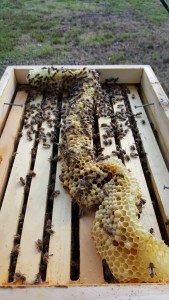
Since it’s warm, sunny today, I went out to check the hive. Bees are buzzing–including drones. There is pollen somewhere that the girls are bringing in. After seeing the traffic in and out of the hive, I decided to attack the burr comb problem after the temperature went up a bit more.

While waiting for the temperature to rise, I went to Honey Bee Suite to read about a camouflage bee suit, and spent most of the time reading about the experiences (from all over the country) of  unexpectedly large bee populations in the hives, considering the time of the year. That’s what my hive looks like as well–wall to wall bees with no sign of a cluster. Watching the traffic in and out showed pollen coming in and drones flying today.

Checking NOAA and Weather.com seems to suggest cooler than average temperatures in the southeast this spring, and wetter than normal–that suggests some time when foraging might be late or be sporadic. As I 20160116_134032gathered from Honey Bee Suite, since the girls have already wiped out the candyboard, the question now is to feed more sugar, or not to feed and hope the honey supplies are adequate for the rest of the winter. (As a new beekeeper, I’m not great at judging honey supply just from lifting the boxes–experience should change that.)

If I’m going to feed, I have to open the hive and remove all that extra burr comb that the bees in the space where my candyboard was, so that I can put in some emergency sugar for the rest of this winter.

(I have a plastic queen excluder to put on the bottom of this candyboard frame so that I can add more sugar or fondant (over waxed paper) where the candyboard was before. Next year’s candyboard will have more support underneath–like the queen excluder–than this one did so that it won’t collapse onto the frames.)

Ò¿Ó

This afternoon after the temperature had gone up,  I thought I’d be able to open the hive and remove this big batch of burr comb; however, it is windy today. At my hive location, I estimated the wind at about 15 mph (local weather showed up to 18 mph). My thoughts on opening the hive in that much wind were first, there is brood in the frames just under this burr comb, and second, that there is too much wind to use the smoker effectively (have tried that).

I discovered with a quick peek at one corner of the quilt box that there are bees all over that burr comb. My bit of experience with the smoker tells me that there’s no way I’m going to be able to smoke them down into the hive with the wind. Even when trying to puff smoke when lifting the quilt box a bit wasn’t successful–it just blew away. Even though I don’t smoke heavily for my inspections, I don’t think I could remove that comb without smoking. (The girls that were flying were paying a lot more attention to me than they usually do on a beautiful calm day though they were not aggressive, but then I was just looking and not doing anything like taking the roof off of their home.) I’d suspect that scraping that much burr comb is likely to attract their attention.

From my last inspection, I know that there is brood on the frames just under that big batch of burr comb, so I am concerned about heat loss and chilling that brood.   I’m going to have to scrape away that comb–and that means having the hive open longer than I’d think would be good for brood right under it.

The bottom line is that I wussed out and did not open the hive today and as the temperature drops I’m wondering (regretfully) if I should have done that little chore anyway. I did another “lift” and the hive feels heavy enough so that I think there’s likely enough honey for this next cool spell that’s coming. This uncertainty does mean that I’m going to have to attend to this problem soon!

#LovePulses and take the pledge

Another informative post on an underutilized and versatile food source. Even if you don’t wish to take the pledge, please read! Look at the nutrition data. If you cook your own, the preparation  may take planning and time but it’s not labor intensive. Canned beans are an option to help use this food group.

Gremolata

A simple, quick way to add some kick and freshness to lots of dishes: gremolata.  It’s an Italian classic served with osso buco, but can be used with almost any grilled, roasted, or even boiled meats, fish, or with vegetables. It’s especially delightful in the winter when food is a bit heavier and lacks that spring and summer freshness. Great taste, and it is so simple and quick.

It’s one of those things you don’t really need a recipe for. It’s just lemon zest, parsley, and garlic. Here is a nice post from The Kitchn that should give you all the information you need to whip up this condiment.

Once you’ve got this basic condiment down, you’ll find lots of uses for it, and here are some variations for different dishes.

So many variations!

A son goût.

Crystallized Honey

Since I’ve been posting about my bees, I want to share/reblog this post for all the honey fans out there.

zeebeeman's avatarZeebeeman's Blog

2 Honey

My friend Jannine brought me a jar of her crystallized honey for the holidays. It is so good!  It got me to do a bit of research on why some honey crystallizes and some doesn’t.  First of all, it does not mean that it has “gone bad”. Honey has a very low moisture content which deters bacteria and yeast, so it rarely if ever spoils. It turns out that the main reason honey will crystallize is due to the proportion of fructose and glucose, the two main sugars in honey. And this comes from the source of the honey. Honey that is high in glucose  ( and lower in fructose ) will have a tendency to crystallize sooner than the honey that is lower in glucose ( and higher in fructose).  Honey that comes from nectar from apple, goldenrod, sunflower, alfalfa, dandelion, mesquite and chamisa is high in glucose and will…

View original post 100 more words

Snow day. . .

Well, not really a snow day (I wish!), but an ice and wind day, the second in a row here. It’s a grey day with a few snowflakes fluttering around. It’s not so far been a productive day. I’ve been wandering from room to room, fighting the urge to take a lesson from the cat. Neither did he go with me to make morning coffee nor did he get out of bed when I started rattling around in the kitchen. He simply got under the duvet instead of on top.

Cat looking into refrigeratorSo I’ve resisted the lure of book and duvet to try to accomplish something, even if not useful or productive, just something I can say that I did. The motif today seems to be opening, peering inside, and closing doors, figuratively and literally, including internet browsing–opening a site and then just passing on to another. I’ve peered into the cabinet where all the plastic storage containers live and close the door tightly and firmly, then opened the internet door (Google search) on organizational ideas for empty containers.
Peering into the refrigerator led to the conclusion that I didn’t want to eat anything that was already in there. The threat of power outage led me to follow a link on what foods were safe after a power outage, but that didn’t catch my interest either (no new information, and no power outage here yet). My list of blogs that I follow l did provide something that held my attention: posts on one taste at a time caught my interest–food waste and eating mindfully. After reading (and reblogging those) my meandering led me back to the kitchen with thoughts of something warm and cozy to eat this afternoon.

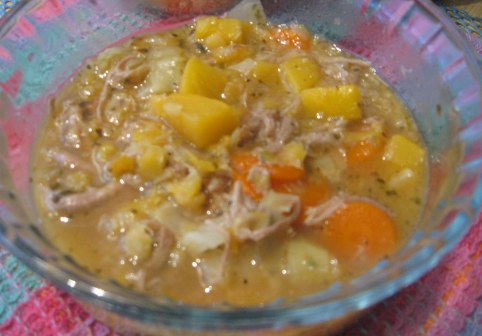
This recurring theme eventually led to the freezer compartment of the refrigerator which has been needing organization and sorting for a while. Gazing at a container of stock finally got my interest. What better way to start sorting and organizing that to make something from what I found in the freezer that was approaching its end-of-life-even-if-frozen state.  Thus: mostly freezer soup happened–with additions from the crisper drawer.

Ingredients

  • pulled pork (from a large pork butt, slow-roasted in the Schlemmertopf)
  • two packages of stock (one pork, one chicken)
  • the last package of sofrito (a staple, but needing to be used and replaced)
  • carrots (the last of a bag that had been vacuum packed for later use)
  • 1/2 small rutabaga, diced
  • two handsful of cabbage, in bite-size pieces (a crisper staple)
  • about 1 cup yellow split peas
  • about two teaspoons Hatch red chili powder
  • a dash of dried oregano
  • (a retained bay leaf from the pulled pork)

Preparation

  • thaw and sauté the sofrito to brown lightly (frozen with olive oil)
  • add chili powder and oregano to bloom in olive oil
  • add frozen stock
  • add pork
  • add rutabaga, cabbage, and split peas
  • simmer until rutabaga and split peas are tender (about 40 minutes)

Supper is on! IMG_8880

As is typical of all soup making, there is more than I’m going to eat, but some will go back into the freezer for a quick meal on another grey day–carefully labeled, and dated.

Ò¿Ó

.

eating. . .

I’ve just now reblogged two posts from one taste at a time that are really thought-provoking on what and how we eat:  eating mindfully (which is certainly a contrast to what many of us do) and another on addressing food waste (something we all need to give our attention–not just those of us doing single-serving cooking). If we eat, we need to think about our food.