The Clever Coffee Dripper

I’m a coffee lover–as long as it’s good coffee and it’s brewed properly.  That leaves out a lot of brewing methods, including the automatic drip coffee maker.  I’ve tried different ways of brewing coffee (other than the standard drip coffee maker):  Bodum vacuum coffee maker which I do like a lot but is not functional for work days; the Filtron cold-water brewing which makes great iced coffee in the summer, Chemex, Melitta, and, of course, a French press.  I like the flavor of coffee from the French press, but the sediment just sets my teeth on edge for some reason–otherwise, the French press is my favorite coffee maker for flavor.

When I got my last issue of Cooks Illustrated (first of this month) I noticed that they had good things to say about something called a Clever Coffee Dripper.  I’ve seen a lot of coffee brewing systems reviewed in Cook’s Illustrated; it usually comes down to them recommending the French press.  I was surprised to read that The Clever Coffee Dripper was labeled “a success”.  Curiosity and my dislike of the sediment in French press coffee finally got the better of me and on Friday I ordered a Clever Coffee Dripper.

I found it most inexpensively from Amazon.com; the price that Cook’s Illustrated quoted from that supplier plus the shipping was higher than I wanted to pay, so I googled the Clever Coffee Dripper.  Amazon’s price was a bit higher, but the shipping was less, so I ordered it from there.

Over the weekend I had an e-mail saying that it had been shipped.  I’ve been waiting rather impatiently for it to arrive.  On my way home from work today I stopped at Harris Teeter and got some #4 cone filters, in hopes that it would arrive today.

On this wet, gray, rainy day I was thinking  hot chocolate, but I found a package outside my door–the Clever Coffee Dripper had arrived.  For an instant or two I contemplated waiting until morning to try it out–but that was really only a quickly passing thought.  I knew I had to try it now!

It’s a very simple apparatus: a funnel-shaped top that looks like a Melitta or filter-cone coffee brewer, but with a few extra parts:  a coaster for it to rest on, and a lid and a stopper/valve that is opened when it is set on a cup or carafe.

I filled it with water and checked to see if it leaked (it did not) and how quickly it drained without a filter or coffee grounds in it (it drained much more rapidly than the Melitta filter-cone).

I plugged in the kettle and ground some coffee while that was heating.  I used a medium drip grind as the instructions said that too fine and it will drain too slowly; too course and  it would drain too fast.  I’m not sure how much of an issue that is since the water and the grounds stay together in the cone.  According to the instructions on the box it will fit on anything with a diameter between 1-1/2 inches and 3-3/4 inches.  That means it will fit on my thermal carafe.  I got out my widest coffee cup  to test that–also means my biggest coffee cup.

The instructions said to put in the filter and rinse to minimize the paper taste–which is something that I did even with the Melitta.  I filled my coffee cup with hot water to warm it.  The brewing time is essentially the same as the French press–but the instructions say to stir it after 1-1/2 minutes, then continue to brew for 4 minutes.  After the proper amount of time, I set the thing on my coffee cup and watched it drain.  I did follow the instructions, and I got a good cup of coffee!  I haven’t done a side-by-side test with the French press, but to me this tasted like French press coffee without the sediment.   No sediment, and easy to clean up.  Definitely a keeper!

This is not going to make a lot of coffee at one time–unless you want to brew into a carafe–and brew several times. As Cook’s Illustrated indicated–it’s for small amounts of coffee.  The heat loss during the standing time is about what you’d expect from a French press (unless you have the double-walled one).  Overall, it seems to be a good prospect for my morning coffee–easy and tasty!

Baking dishes

I think that many of us who do single-serving cooking are likely to live in smaller places, and have less drawer and counter space in the kitchen.  With storage space at a premium, we need to consider that when tempted by gadgets and single use items.  Before I buy it, or even bring home a freebie, I try to ask myself if I will really use it, and if so, how often.  Many times that item gets left right were I originally saw it, I probably don’t even miss it.

I  have a lot of cookware of various sorts, but some things are much more useful than others; some things I should give away or send to the Habitat ReStore, or even have a yard sale, since I’ve not used them in ever so long.

I was looking through a drawer the other day and found a couple of yellow plastic thingies that I may never have used–I may have gotten these for attending a Tupperware party in the (very) distant past.  I do know that the one on the left is supposed to be an egg separator.  The one on the right (especially since it’s a matching color) looks to me like a thingy that could be used to do something with an egg–scoop it out of hot water, or hold eggs when you are dying them (not likely–too broad on the arms), perhaps? (Why use that when I have a slotted spoon?)  I think that I may have tried the egg separator once, but usually I  either use the shell halves or my hand–why wash a gadget when it’s just not necessary?  (I’m a firm believer that hands are meant to do more than hold implements in the kitchen.)  I try not to have similar kinds of dishes around, because that really takes up storage space.

Just as I’m supposed to be able to multitask these days, I like multiple use things in my kitchen.  I try to stay away from “disposable” items, too.  I’ve already mentioned that I use Ball/Mason jars for storage containers for both pantry and refrigerator, and I’ve mentioned the cast-iron grill/griddle (which can double as a broiler pan); there are some basics that see a lot of use in the kitchen almost every day.

My most frequently used baking dishes are not fancy–most were obtained from the hardware store or the grocery store–while doing the every-day activities of keeping house and cooking for one; I did not have to go look for them in specialty stores. I’m sure a kitchen/cooking website like Cooking.com would have these basics as well.  I like glass so that I can use them in the gas oven or in the microwave oven–again, space savers.

One of my favorites is a Pyrex rectangular baking dish with lid that I’ve had for ages and ages.  Should I ever break it, it will take more to replace it than just a dish and a lid.  It’s a small covered baking dish just the right size for about four chicken thighs to roast (on top of the right amount  potatoes and/or other root veggies) with a lid which has ridges and a lip on one side (raised and smooth on the other) which works so well for cooking bacon in the microwave because it allows the fat to drain away (no, I don’t cook it on paper towels, though I do use a paper towel to cover it with). The glass lid fits well enough that it can also be used for storing  in the refrigerator.

Another favorite is (also Pyrex) narrower baking dish (also with lid) that is just about the right width for single lasagna noodles so that I can have two servings.  This one has silicone seal with vents in it so that you don’t have glass-on-glass contact.

Both these are a great size for cooking for one, allowing for some  “leftovers” that can be used in other recipes, but not so large that there is too much space for baking or roasting.

I do have a larger and smaller oven-safe dishes (mostly Pyrex) that have plastic covers for storage.  Of course, any kitchen must have the usual rectangular and square baking dishes and pans (the “usual” 9×9-inch and the 9×13-inch, but those get used much less frequently.

Another favorite of mine is a large round covered dish  (yes, Pyrex) with a multipurpose lid.  It has good wide handles on both the base and the lid.  The lid has done duty as a pie plate for me several times.  It’s a bit bigger than you average pie plate, but it’s got the right slant and approximately the right depth.  The lid can also serve as a shallow baking dish.

I do have some Emile Henry bowls and oval baking dishes that see a fair amount of use, but some colored glazes cannot be used in the microwave; the plain glass or the white seem to be the real workhorses in the kitchen: oven, freezer, microwave, and refrigerator for storage.

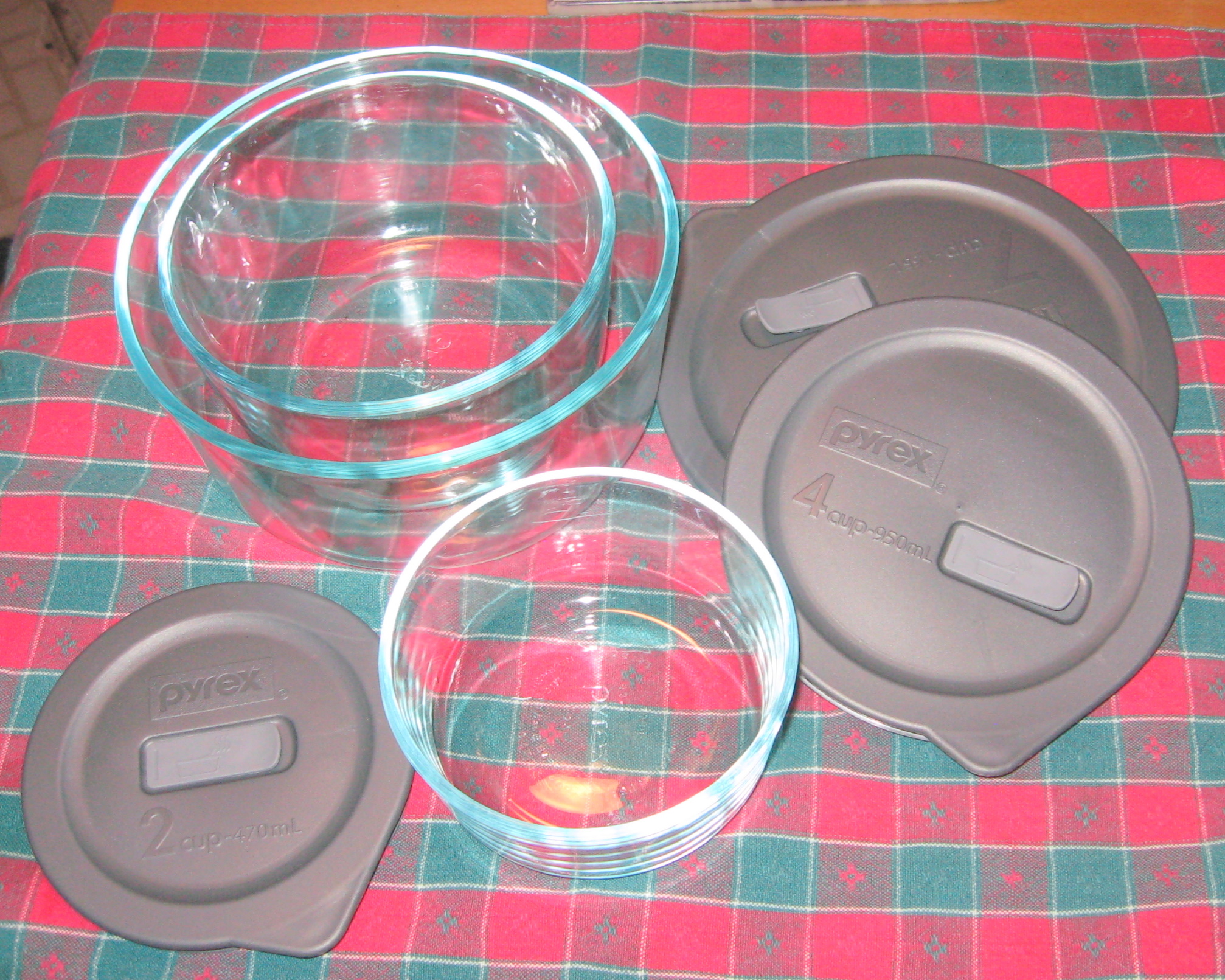
I also have bowls that have vented plastic lids for use in the microwave so that I don’t have to reach for the plastic film every time I want to nuke something.   The vents can be opened for microwave use, and then closed for storage.  The plain bowl can do cooking and serving duty which is a real space saver, and a real cleanup help. The white bowl (below left) is also one with a vented lid for microwaving, baking, or refrigerator.

One of the most-used for my single-serving cooking at breakfast time and when soup is on the lunch menu is another with a vented plastic lid that is microwave safe. The cup (right) is just right for cooking single servings of hot cereal in the microwave.  The vented lid means no plastic film wrap is needed.  Admittedly some mornings I feel like I should use that cup for coffee because it bigger than the average coffee mug.

No matter what you’re cooking, it’s important to have the right size container. In baking or roasting, just as in stove-top cooking, too large and food will dry out; too small, and there’s an oven mess to clean up, or food is too confined and steams rather than roasts. In the microwave the right size and arrangement of food is also important.  Cooking that breakfast cereal in a container that is too shallow can leave you with a really nasty mess to clean up–not a good way to start the day.

One of the things that is so important about food is good flavor, no matter if it’s for a crowd, or just a single serving.  It always should be a son goût!

Griddled dinner

I was recently scanning through my e-mail update from CliffordAWright.com and I saw “Griddled Broccoli”.  It was one of those keep-scanning moments, and then (when the brain caught up with the eyes)–back up and look again, and read carefully.  This looked like something that would be great for single-serving cooking .  I set out to cook my whole meal as a griddled dinner.  The house supervisor was on duty, approved  and was waiting anxiously to see how this was going to turn out.

A favorite cooking tool in my kitchen is my cast iron griddle which goes across two burners of my gas stove.  It’s not a pre-seasoned one–but that’s really easy to do.  I got it from mycast -iron griddle
local garden store which also carries Lodge cast iron.  Sometimes I contemplate getting a grill-pan, but I, despite needing two burners, I really like the flexibility of being able to have the grill/griddle combination.  It’s certainly not a glamorous piece of cookware, but it’s functional and not all that expensive either.

I have found that trying to use it with only one burner lit really does not let it heat well.  It does not have a non-stick finish since I’m concerned about the effects of high heat on that, but it’s well seasoned and non-stick in effect.  Besides I also has doubled as a broiler pan too, and I certainly could not do that with non-stick coatings.

I’ve got a lovely rib-eye steak for a red-meat splurge.  I could do on my Weber Kettle Grill, but given the uncertainty of the weather now and finding the griddled broccoli recipe, I decided I’d try my whole meal on the griddle.

The griddled broccoli recipe calls for parboiling the broccoli for a few minutes before the actual griddling, but that seems simple enough, even for a quick meal.   I want some other vegetables as well as the broccoli with my steak, so I though I’d add some mushrooms, some sweet potato slices, and maybe some red bell pepper to my griddling.

I started by salting the steak as recommended in Cook’s Illustrated; it’s really worth the time to do this.  While the steak was Rib-eye steakresting with the salt, I prepared broccoli almost according to Wright’s instructions,  sliced the mushrooms, part of  a yellow bell pepper (the red ones at the market just didn’t look or feel really good), peeled and sliced the sweet potato into 1/2-inch thick cross-sections.  Because I wanted a variety of vegetables, with two of them that needed a bit of pre-cooking, I opted for steaming instead of blanching for the par-cooking. I steamed the broccoli for only about two minutes since it was cut in fairly small pieces.  I steamed the sweet potato slices for about three minutes and then set these aside for griddling a bit later.  Because I wanted to cook the whole sweet potato and the more of other vegetables for some planned leftovers, I started on the vegetable a bit before I put the steak on the griddle. I preheated the griddle until I got a good “bounce and sizzle” when a drop of water was flicked on the surface; we were good to go.

I thought that the mushroom and peppers could be easily reheated while my steak was resting and the broccoli was finishing, so I started with those and the sweet potato slices which were still firm.  I patted the sweet potatoes dry, since they had been put into cold water to stop the cooking after steaming.  I tossed the vegetables with a bit of  olive oil, and put them on the hot griddle.

Once the mushrooms and peppers were nice and brown, I removed them from the griddle, moved the sweet potatoes to the front since they would require more attention than the steak.

I patted the steak dry (a little moisture accumulates while it is stand with the salt, and I put the steak on the griddle to start cooking.  Since the broccoli has been steamed and put into cold water, I drained it and let it rest on paper towels to dry a bit.  While the steak was browning on the first side, I attended to the sweet potatoes and sliced some zucchini which I had decided to add as last-minute addition while looking in the refrigerator for something else.   After about  seven minutes, I peeked at the underside of the steak.  It was a lovely brown, so I turned it over and continued cooking it.  Since I like my steaks on the rare side of medium rare, I thought it would take about another five or six minutes, so I put the now-drained broccoli into a bowl and tossed it with a little olive oil.  I wanted the steak to rest for about five minutes after coming off the griddle to let all those lovely juices redistribute–evenchecking temperature that short of a rest does make a difference.

Now for the broccoli.  I put that on the griddle to finish the cooking, and I used an instant-read
thermometer to check the temperature of the steak since it was a very thick one.  It showed 115 ° F  on the thermometer, so I turned the heat down under the griddle and  put all the vegetables back on to rewarm.  I took the steak off and set it aside on my plate to rest.  After a five-minute rest the vegetables were reheated, and it was time to eat.

Even allowing for the salting time for the steak, I was sitting down to eat in about an hour and twenty minutes.  I spent some extra  time cooking veggies while the steak was “salting”, but I have plans for those–some can be reheated, and some can go into a salad for another meal.   And…yes, there is left-over steak–that thing was huge! That will be good in a sandwich for lunch with some horseradish, or perhaps in a salad; but I won’t try to reheat that.

Had I not wanted the extra vegetables for planned leftovers, all this could easily have been prepared on the griddle at the same time and easily tailored to provide even a mix of vegetables in a single-serving quantity.

The clean-up was really minimal–the steamer, two small bowls, and the plate!  The griddle, when cooled just needs a quick rinse under hot water, and drying over  flame for a few minutes.  It really is non-stick, and it’s easy to keep it properly cured.  It does get a lot of use: grilled cheese sandwiches, grilled chicken or pork chops.  The red meat aside (and that is a rare splurge) it was a pretty healthy meal: lots of veggies, and very little oil involved in the cooking…but it was really good.  I’m definitely a fan of griddled broccoli.

Empty plate

Pot roast with brown gravy

You’ll notice that I said “gravy”–this is too much of a comfort food to use “sauce” because what you’re getting is plain, down-home gravy that needs bread or potatoes to complement it.

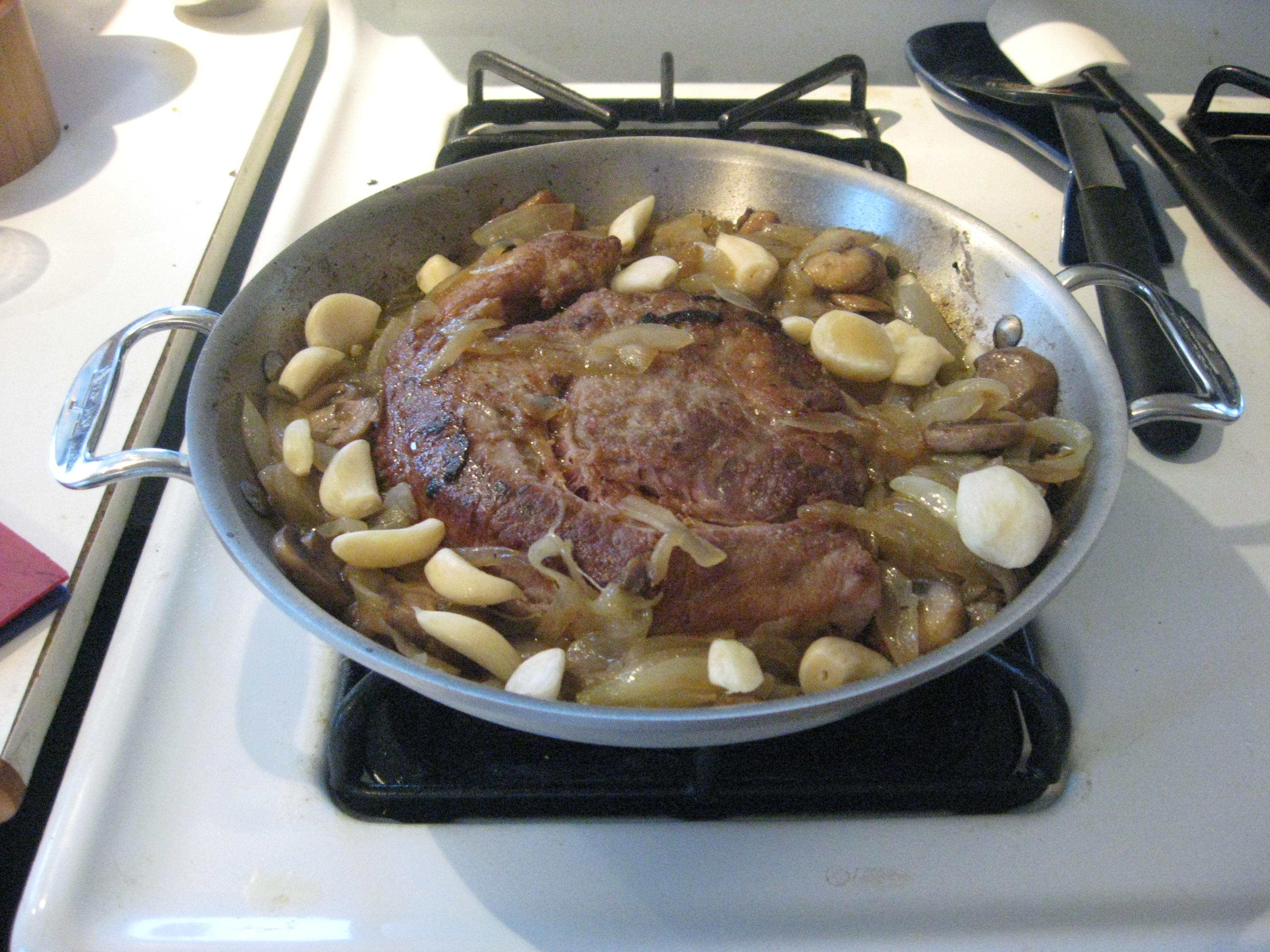
After I got my Christmas present (See The Petit Brasier) I had to give it an immediate test run.  What better to test than a favorite braised dish:  pot roast.  This was nothing fancy at all.  You’ll note that I’m not even saying it had a sauce–I really did mean good, old-fashioned, down-home, satisfying brown gravy, lots of onions, and good tender beef.

Even though I say I dislike leftovers, there are some exceptions and pot roast is one of the exceptions.  Sometimes I get the great big chuck roast and make a lot of it and put it in the freezer in single-serving packages, right with the chili, the stock, and some soups so that I can have an “instant” meal–the microwave is great for defrosting and individual portion.  I don’t always want to have to pack and freeze leftovers, so with the small braiser, and a cooperative butcher or meat department at the supermarket, I can make a small pot roast that’s good for two, or maybe three meals since there are some very easy ways to kind of spiff it up for the reruns.

This is really not a recipe–it’s a happening–quantities are approximate as the amount of oil you need will vary with the size of you pan, the amount of mushrooms and onions you are going to sauté–just use what you need.  (Improvise! Wing it!  Just do it–it will work.)

Ingredients

  • 1-1/2 to 1-3/4 pound piece of chuck roast
  • 4 or 5 small onions (or 3 medium to large ones) sliced moderately thinly
  • 2 teaspoons flour, plus flour for dredging the beef
  • about 3 tablespoons olive oil (divided as needed for  sautéing mushrooms and onions.
  • 8 ounces of mushrooms, sliced (more if you really like mushrooms)
  • 1 to 1-1/2 cups of water or stock
  • salt and fresh-ground black pepper to taste
  • about 8-10 medium garlic cloves.

Preparation

  1. Pat the pot roast dry with paper towels and dredge in a flour seasoned with salt and pepper.  Let it stand while you cook the onions and mushrooms.
  2. Slice the mushrooms and sauté in a little of the olive oil until they release their liquid and brown.  When brown and liquid has evaporated, remove to a bowl.
  3. Add a bit more olive oil, and sauté the sliced onions until they start to brown and caramelize.  When partly browned, remove to a bowl with the mushrooms.
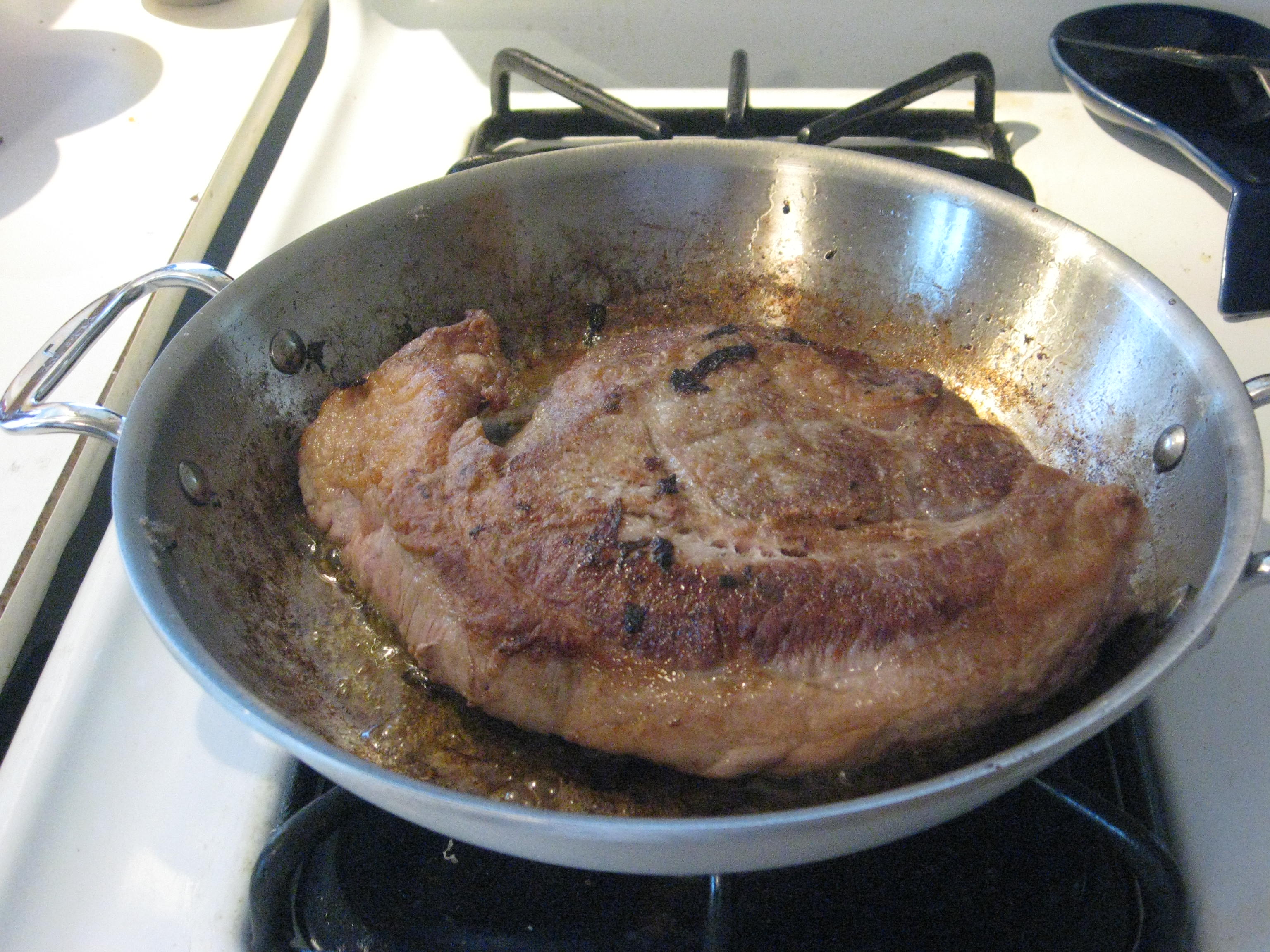
  4. Add the additional olive oil, as needed, and brown the beef well on both sides. Put it to the side for final assembly.
  5. Take the rest of the olive oil, and the 2 teaspoons of flour, and brown the flour in the oil until it turns a nice golden brown and smells toasty.  Turn the heat down, add the stock or water to the browned flour.
  6. Add the sautéd onions and mushrooms, and return the browned roast to the pan, with the onion/mushroom mixture around the sides, sprinkle the garlic cloves over the top.
  7. Bring to a simmer on the stove top, cover and place in a 295-300 ° F oven and cook until fork tender–about 2-3 hours (unattended).  Check periodically to see if you need to add more liquid.  You need just enough to make nice thick gravy, and the onions are going to cook down to help thicken the gravy.

For that first meal, all you really need is a salad, maybe a baked potato….or some noodles.For the second serving, stir a tiny dollop of sour cream into the portion of brown gravy for this serving to add some tang and be a bit “stroganoff-ish”, add some steam-sautéd (See Cooking Vegetables Quickly) carrots, or spinach as a side.   What about the third?  As you reheat, add some tomato paste, or some tomato sauce to the last bit for a different taste.

It’s pure unadulterated comfort food.  Even if it’s not a single serving, it’s an appropriate quantity for small-time cooking, but it sure has big-time taste.  It’s great what having the right size pan does for cooking for one.

A son goût!

The Petit Brasier

I do get excited about kitchen things.  One that you’ve already heard me rave about is the All-Clad saucier pan. While I was browsing the Cooking.com website shortly before Christmas, I found what was listed as a 2-quart “petit brasier” by All-Clad.  Since one of the cooking methods that I employ frequently is braising, I thought that sounded like something very useful for small-time cooking.

I have had a Calphalon “everyday pan” for some time, that gets frequent use; it a similar shape–but it’s really too big when I’m doing single-serving cooking.  This had all the advantages of that bigger pan: two short handles that make getting it in and out of the oven easy; sloped sides that make it useful as a skillet, and it goes easily from stove-top to oven since the handles are metal, plus one more:  it’s size–small!

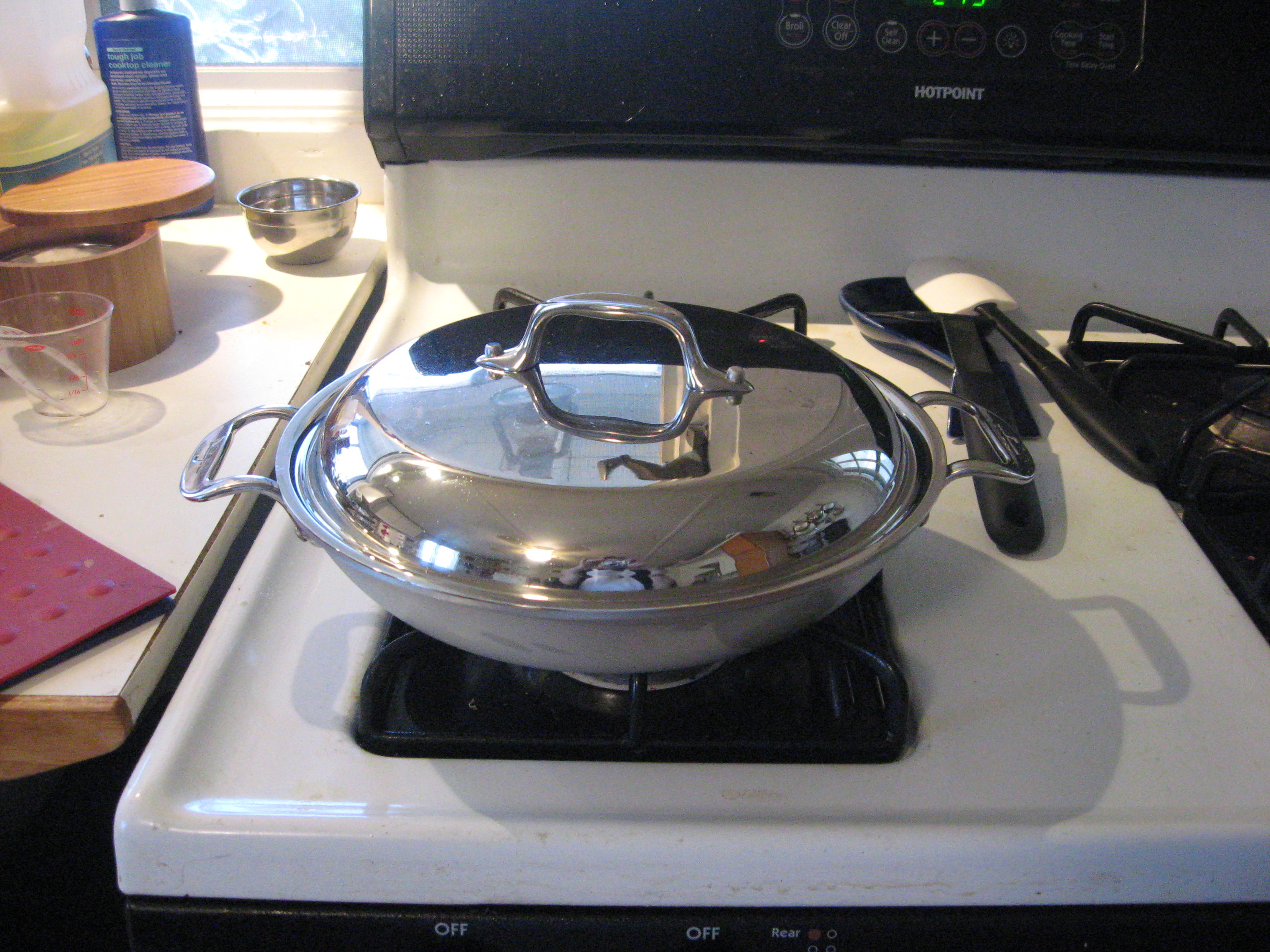
the petit brasier

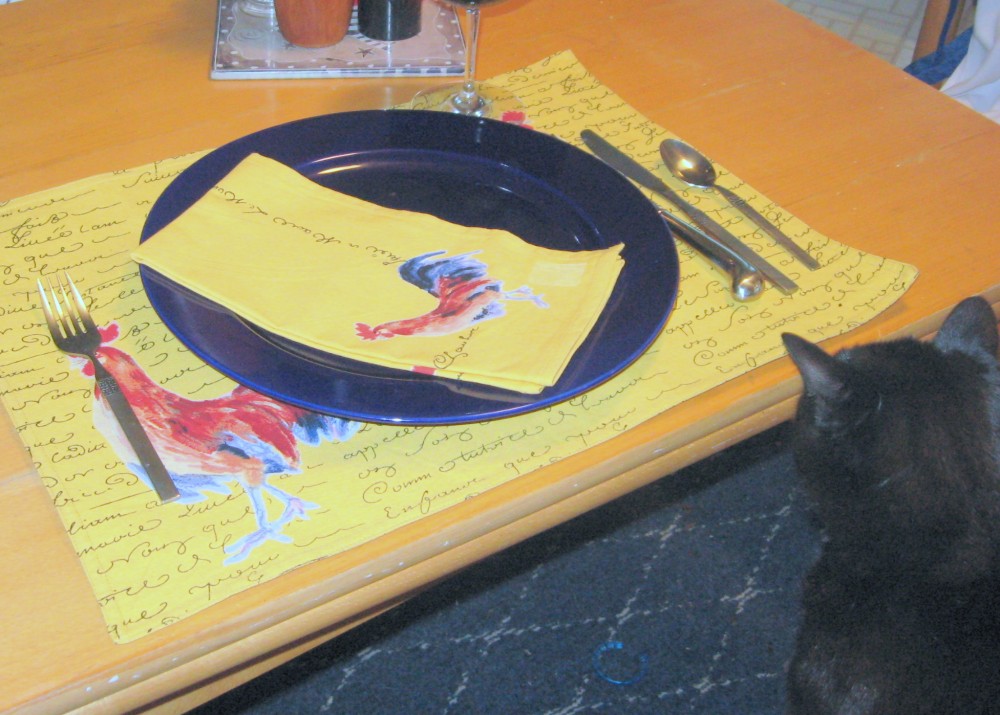
I just could not resist, so by way of rationalization, it was considered a gift from my housemate, Keiko the cat. It arrived and looked just as fine as it had on the Cooking.com website.   Here it is–fresh out of the box, just waiting for me to cook something.  It had a good heft when I picked it up–just like all my other All-Clad cookware.  It has had a thorough inspection by Keiko, so it’s now ready to used.

Needless to say, I’m like a kid with a new toy.  I spent a good deal of time mulling over what would be the most appropriate “test drive” for this new pan.  I thought of the most traditional braised dish–pot roast, and not a fancy dish either.  This will be just plain, down-home, country-style pot roast, with brown gravy.  The recipe will be posted next week.   I’m sure there will be something else braised on the menu soon.  I’m sure this will be the usual All-Clad quality; it may turn out to be one of the most used pans in my kitchen, given how often I used the “every day” pan, even thought it was not the right size for solo cooking.  You’ll get a further report in a short time, as well as recipes for braising for one.

This is Keiko, the “fur person” to whom this gift is attributed; that was necessary as I had already decided what I was giving myself for Christmas–and it was not food-related.  I’m sure she will be happy to check out what gets cooked in “her” pan. 

She’s only been with me since April, but she is turning into a very attentive kitchen cat–she comes and miaows at me immediately when a timer goes off  and I’m slow to attend to it.  So, thanks, Keiko, for a petit brasier for some small-time cooking while enjoying big-time taste!

Storage containers

One of the perennial problems with liking to improvise, and wanting to have a well-stocked pantry is that one person uses things more slowly than you would cooking for a family of four.  I think that it’s important to store supplies carefully in closed containers rather than bags or boxes which can let some interesting beasties into your staple supplies.  For years, I carefully cleaned and saved glass jars and their lids.  Great solution?  Well–until the lid loses its seal.

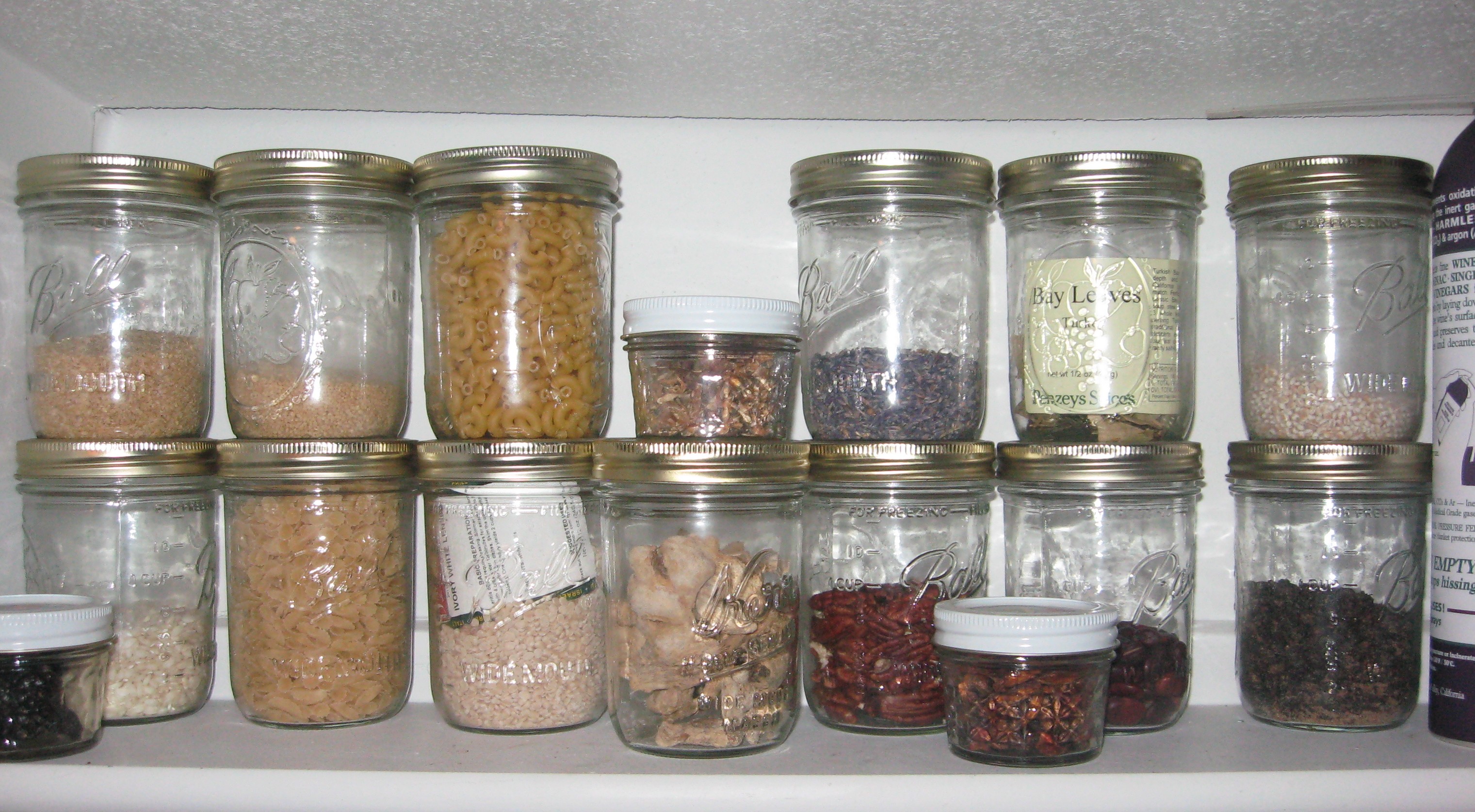
Then what do you do?  My solution was to buy some Mason  canning jars (Ball or Kerr) with wide mouths, in the pint and quart sizes.  They are inexpensive, and lids are  no longer a problem.  The same lids fit all the jars, so I’m not standing around with a jar full of something and trying to find a lid to fit.  The rings last, and last–a bit like the Energizer bunny–and you can replace the seals as needed!  I think that my kitchen shelves even look rather nice…but then I kind of like a homey look.

If your pantry space is cramped,  the wide-mouth jars stack well!  Another advantage of the wide-mouth jars is that a 1/4-cup dry measuring cup will fit through the mouth of the jar easily–so you can dip and measure from the easily. Got to store that 10-pounds of rice that was such a great price?  Well the same lids will fit the half-gallon jars.

With some minimal additional equipment you can even put food by in these same jars–just be sure that you have new lids  if you’re going to use them for long-term preserving of foods.

Cookware for small-time cooking

One of the important things in cooking for one is to have the right size pan for the quantity you are cooking.  Small-time cooking with big-time flavor doesn’t happen when you have  one chop in as 12-inch skillet!  This may mean that you don’t buy that prepackaged set that is more appropriate in size for a family of four, but buy smaller pans as your needs are likely to be different.  Cook’s Illustrated has a great article on “à la carte” selection of cookware.  When cooking for one, you won’t need the sizes, but pans with the same functionality will give you a lot of flexibility and room for you cooking to evolve.   To  stretch you dollars, you want to look for multifunctional cookware.  If you are really going to enjoy cooking for one, you do need the best pans that you can afford and it is better to have a few good ones than many not-so-good ones, or even good ones in the wrong sizes.  It’s worth saving for good pans (or you drop all sorts of hints to friends and relatives, if not to give you the pans you want, at least to give you the means to purchase them).

At the time I needed to make the decision about cookware, I was fortunate to be working in a gourmet food store with an excellent kitchen ware department, and I was able to have hands-on experience with top-line cookware (All-Clad, Calphalon, Le Creuset, Emile Henry, and others).  I was able take advantage of employee discounts so I started with All-Clad cookware.  I cook for one (and a cat) most of the time;  but do like to have friends come for meals when I cook something special (like roast goose and stuffing) that is not just for one.  I bought standard starter set of All-Clad stainless steel cookware that had nothing huge in it, but did cover even making stock (for one).  That set consisted of a 10-inch fry pan, a 2-quart saucepan, a 6-quart sauté pan, a 6-quart stockpot, and a  4-quart casserole with lid.  I got a bonus of an 8-inch nonstick fry pan with the set.  That was so many years ago–but I’m still hooked on the All-Clad cookware.

Over the years, I’ve added various other pieces to fit my cooking needs–from the steamer insert, and double-boiler insert (with rounded bottom corners that make it easy to stir with a whisk) that fit the 8-inch saucepans or the casserole, a smaller sauté pan (2-quart), a larger, tall stockpot with pasta/colander insert.  Even cooking for one, I use all these–the smaller ones more frequently than the larger.  I’ve been using this cookware now for more years that I am going to admit to publicly–but it has performed well, so that I’ve never questioned where to go for additional pieces.

The latest piece that I have added is the 1-quart open saucier pan.  I added that because I frequently do reductions of stock or sauces and make custards over direct heat–which means that the rounded bottom edges of this pan don’t let custards stick and curdle in the squared off corners as they would in a sauce pan.  I had to make a decision on whether to add a Windsor pan or the saucier–difficult because the both have their uses, but I opted for the saucier.  (I was given a saucier pan as a gift–from another manufacturer–and it is languishing in the back of a cabinet somewhere because it did not heat evenly, and it was easy to see why just by the heft of the two pans.

My very first high-end cookware was a great set of Le Creuset, enameled cast iron (a gift).  Looked great, cooked great–I really liked it, but it was heavy.  After I had used All-Clad, so much easier to lift, and found out how well it did, I decided that I’d rather have the advantage of lighter weight, easier care, and great performance.  I passed on my Le Creuset saucepans and fry-pans to a friend, and got the All-Clad.  I confess that I kept the Le Creuset dutch oven for a number of years even though I always reached for the equivalent All-Clad since it was so much easier for me to lift into and out of the oven when filled with stew or stock.  When I was convinced that the All-Clad performed as well as that, that particular piece also went to join its mates with the same friend.

So where do you start if you’re going  to purchase cookware?  I’d start with Cook’s Illustrated website (unless you’re a subscriber to the Cook’s Illustrated magazine) since they do some pretty stringent and objective tests of cookware (Note that there is no advertising in the magazine).  Then, I would go to a brick-and-mortar store that carries different brands, e.g. All-Clad, Calphalon, Le Creuset, and look, lift and see how the pieces look and feel.  I think that it’s important, just like I advised with knives, that you actually handle the different pieces and brands.  But, don’t commit to buying yet!    Think about it, sleep on it.  It’s not quite like buying a car, but it is an investment.  After you’ve thought about it, I’d go online to Cooking.com. They have customer reviews which are helpful to read; look at the pieces you think would make sense for you, check prices and compare.

Think about your favorite foods–what you’d like to cook for yourself.  I like to do soups and stews in the winter, but don’t always want huge quantities, so the small covered casserole (4-quart) which can function like a small stockpot,  or dutch oven (oven or  stove-top) is a necessity for me.  It’s the workhorse in my kitchen.  Another that I reach for a lot is the small sauté pan–just the right size for one or two chops.

There are other things to consider in your choice of cookware:  What is the manufacturer’s recommendation about putting it in the dishwasher?  Can the pans (with lids) go from stove-top to oven cooking?  This last is the much more important consideration (at least for me) since in order to cook with minimal attention I use the oven a lot for finishing stews, making stocks–anything that requires long, slow cooking.

Dishwasher safe if less important when cooking for one. The All-Clad stainless steel is dishwasher safe, but other finishes are not.  Stainless steel is my preference for appearance–and for the fact that it can be used with induction cooking.  Copper clad is beautiful–if you don’t mind the maintenance–I ogle a friend’s copper All-Clad enviously, but know that mine would never look like that!   For other information you can go to the manufacturer’s FAQs.

As you cook more, it’s likely you’ll want to add other pots and pans.  I’ve got a couple of All-Clad pans on my wish list:  Right at the top of my wish list is the petit braisier. I have (as a gift) a Calphalon 12-inch “everyday” pan.  It performs very well, but it’s too big for many of the things that I cook as single servings.  It can function is so many ways–skillet, brasier, omelet pan, and the short handles make it ideal for things that go from stove-top to oven. Another on my wish list is the round dutch oven for one.  I  use my pans directly from oven/stove-top to table–and not because I’m cooking only for myself (and the cat).  I think that the rounded bottom corners and the domed lid would be great–and besides, aesthetics do count, too; it’s a great looking pan.

I’d love a domed lid to fit my sauté pan (if possible), rather than buying another pan.  The flat lids that I have fit so well and have handles that can go in the oven, but every once in a while, that domed lid would be great since it give you a bit of extra capacity. Then there is the French brasier…another to the wish list!  There are times when the stainless steel rack would be wonderful….

You might be wondering why I’ve not mentioned nonstick cookware.  I do have two nonstick pans–which are very infrequently used.  For dishes that may go stove-top to broiler, I’d be concerned about the temperature effect on the nonstick coating.  For frying, I often want to use high heat, so for me, nonstick is out.  The two places where it is useful are an omelet pan and a pan in which you sauté delicate fish.  Generally, I think that if you have good cookware that distributes  heat well, you warm the pan before adding oil, and let your oil heat before you put anything in, any pan is nonstick!  Nonstick cookware has the disadvantage of not forming fond as well–which can keep pan sauces from being as flavorful as when it develops well.  If you like to do quick sautés and make pan sauces, then you might not want nonstick; however, you cookware needs to fit you style of achieving big-time taste with small-time cooking.  To help you make that decision, I’d recommend the Cook’s Illustrated article on nonstick cookware.

Shop carefully, compare prices.  It’s possible to find even some of the high-end cookware at special prices, so check prices.  Have to love the Internet.  Just to give you an example, I did price comparisons for that petit braisier that tops my wish list:  I found it ranging from $99.99 to $179.95.  The lowest price (excluding shipping–don’t forget that) was from Cooking.com (and that was with free shipping and a coupon code given)! I think I just found the Christmas present that Keiko, the cat, is going to give me!

Kitchen equipment for small-time cooking

One of the most important things in doing “small-time” cooking is to have the right equipment.  You don’t need a lot, just the best that you can afford.  Good equipment makes cooking easier and thus, more enjoyable.

It’s interesting what other serious cooks feel are the basics for cooking.  When so many kitchen gadgets are promoted, it’s easy to pick up things that sound great but really are not necessary, and may not even work well.  I had not really though about the bare essentials until I read what Michael Ruhlman gave as his five basic items: “my truly minimalist kitchen would have a chef’s knife, cutting board, large sauté pan, flat-edged wood spoon and a large Pyrex bowl”.  For the purposes of cooking for one, I might suggest that a smaller sauté pan might be in order, but otherwise those things would give you basic cooking tools.  You can certainly start minimalist and add as you find your cooking style.

One of the most important things in you kitchen is your knives.  Have knives that are comfortable to use–go to a store where you can actually pick them up and feel the weight and the balance.  I like heavy knives; I have a mix of brands chosen because I like the feel, the heft and balance of a particular knife.  You frequently see Wüsthoff, Henkles and, more recently, a number of Japanese knives, in the “gourmet” stores and catalogs, but there are good serviceable knives available that are less  expensive.    You need to buy the best knives you can afford that are comfortable in your hand and fit your cutting style.   If you feel clueless about knives, Consumersearch offers a report on various brands of knives that may be useful. You don’t need a lot of knives; buy the knives that do the things that you do in the kitchen.  You can always add specialty knives as your cooking repertoire expands.  For basic kitchen tasks, a chef’s knife, a slicer and a utility paring knife are good starters.  If you use lots of bread, then you might also want a bread knife but a good, sharp slicer can handle bread.  If you filet fish, then you may well want a specific knife for that–buy only what you need.  There is no point in having a huge set of knives, but using only a couple.  Your money would be better spent in other ways.

A French (chef’s) knife is the real workhorse of the kitchen:  it cuts vegetables, chops, minces; it’s broad tapered blade lets you perform a “rocking” motion for chopping.   A slicer  or slicing knife, with its long, thin blade can slice meats, breads, and tomatoes.  A utility paring knife of 3-1/2 to 4 inches–looking a bit like a small chef’s knife, is good for coring, taking eyes out of potatoes, peeling, et cetera.  These form a sound base of kitchen work.  I also like a “bird’s beak” paring knife that has a short, thin, curved blade makes quick work of shaping and peeling.

I’d consider a cutting board as a necessity even for a minimalist kitchen since I want to treat my knives well.  Cutting boards can be made of so many different things and in such different prices that it can be hard to make a decision.  I would recommend looking at some product reviews, such as Cook’s Illustrated where the testing done is unbiased, and where they are not selling a product.  One of the things that’s important to me is the feel of the board while chopping–it’s hard to beat wood for chopping comfort.  The down side of wood is the necessity of hand washing, and conditioning them; but it takes only seconds, so that’s not the deciding factor for me.  I also have plastic cutting boards in my kitchen; the feel is different from wood, but I still find it comfortable.  I like my cutting boards to be light enough that I can pick them up to move ingredients, rather than having to scrape them up in order to transfer them to their destination.

Another important item for your “small-time” cooking are pots and pans of the appropriate size for the quantity of food that you are cooking.  Quality of these in important too: heavy enough for good even heat transfer.   A 12-inch skillet is just not going to work the same when cooking one chop as when cooking four chops.  The appropriate size pan controls evaporation.  Cooking that single chop in a large skillet will get you burned fond.  Cooking that same chop in a smaller pan will give you that wonderful, browned base for a pan sauce.  Don’t be tempted to buy that set of pots and pans that is suitable for cooking for four or more; if that’s what you have now, your cooking for one will improve when you invest in some smaller pans suited to the size of servings that you are cooking.  Almost all of my cookware is All-Clad, with the occasional piece of Calphalon mixed in.

A food processor is nice, but not by any means a necessity; I have a Krups blender/food processor–the same base works for blender and for the food processor as well.  It’s a very basic food processor–it does not shred, or really do much but chop things.  For a lot of things I won’t use it because I need such a small quantity that it is easier to use a knife which is much quicker to clean than the food processor.  There are times when I would not want to be without the food processor though: when I want to make up mirepoix or soffrito (sofrito) to put in the freezer, or when I want to make a huge pot of chili and need bunches of onions chopped.  Mostly for cooking for one, I use knives or a mortar and pestle for chopping or mincing.

There is one kitchen gadget that I’m in love with:  my immersion blender which comes with a small “processor”, a whisk, and tall container that lets you make mayonnaise or vinaigrette quickly and easily in small quantities, with much less cleanup than the standard food processor.

If you’re serious about cooking for one, get some good knives that fit your hand, and some good pots and pans that are small enough for a single serving–or maybe two servings!