Super-foods & supplements

Okay–this is a rant (rather like my one on “baby” vegetables  so you might want to quit reading right here. Not a problem–you can have my share of the superfoods, too.)

mustard & kale IMG_6023

mustard greens, curly kale, and dandelion greens

I’m really tired of hearing about “superfoods”! I don’t care if it’s açaí berries, green tea, kale, turmeric–I don’t really think there is such a thing–It’s media hyperbole. I don’t mean that I don’t like some of the things that are called superfoods. Kale and acai berries are good, nutritious, and even tasty.

The term superfood somehow suggests that many of the fruits and vegetables we eat are not adequate nutrition. If a superfood is one which is supposed be rich in compounds good for health, it seems more of our fruits and vegetables should be on that list, for example, dandelion greens. (It’s not a new word–according to Merriam-Webster Unabridged Dictionary (online) it was first used in 1915. It’s true that fruits and vegetables do vary in nutritional value–iceberg lettuce and cucumbers are not exactly powerhouses of nutrition but they do have things like fiber that are good for us.

Kale is undoubtedly more nutritious than iceberg lettuce. I like kale, but the other day I wanted a takeaway from the grocery store–a vegetable salad (something other than mesclun, romaine, or other “lettuce”. I was really frustrated because almost everything had raw kale in it. Frankly, I don’t like raw kale even if it’s been massaged, and I’m sure none of this had been.  Raw kale of the kind that is so frequently used (the curly stuff) puts me into the existential world of a ruminant–and I’m lacking the extra stomach that they have for digesting completely uncooked greenery. So, I want my kale cooked and I want different varieties–e.g. Toscano or Russian which are more suited how I want to eat kale.  (I feel the same about completely raw broccoli; give it to me as a cruditè but lightly blanched, please,  and I love it.)

While skulking about the internet to learn more about the legislative process in the EU, I found the European Food Information Council and an article on The science behind superfoods: are they really super? that suggested we need to look carefully at the science behind these claims–with the bottom line being that we do need to eat more fruits and vegetables–and a variety of them. Just a variety of real foods and not look for “superfoods”.

Thinking about all the hype of super-foods lead me to think about all the supplements marketed and consumed in this country and the idea that “more is better” is applied to so many things. On my own recognizance and the recommendation of my physician I take a single multivitamin (age appropriate), and because of age, calcium and vitamin D supplements. That’s all! (As much dairy as I consume I sometimes wonder if the calcium supplement is really even necessary.) Then I think of some acquaintances who take supplements as if life depended on it–rather than focusing on good daily nutrition.

All this rumination leads me to thoughts about our more-is-better attitudes which gets me on my soapbox just about as much as superfood and baby vegetables. It seems bigger-is-better is the theme in the produce department. I don’t want huge apples; I want a serving-size apple so I don’t have “leftovers” when I eat apples. My produce does not need to be picture-perfect to taste good, either.

Give me variety, give me lots of veggies and fruits, give me “real” (unprocessed) food, but spare me the superfoods!

—Ô¿Ô—

What shall I eat?

9780465020416[1]I seem to be on a bit of a binge lately–not eating, but reading about real food, fake food and the quality of food and the effects on health.

This whole thing seems to have started with Richard Wrangham‘s Catching Fire: How Cooking Made Us Human which lead to questions about how we arrived at what we are currently eating–our trip from “traditional” foods to the current state where we seem to have given up the true pleasure of food–treating it almost as “medicine”. It must be low carb, or low fat, or…

I’ll be the last to disagree that our diet determines our health, but why have we given up the true hedonistic pleasures of eating good food to spending more time thinking of all the things our current “diet” doesn’t let us eat?

All these books were well worth reading if you like to eat. The bottom line of all this leaves me feeling that our food needs to include raw, cooked, vegetables, meats, dairy, eggs, and fish–all real foods–but not processed foods. Shop around the edges of the grocery store, except for the side excursions to find the grains, and legumes which are underused by most of us.

Real Food/Fake Food is enlightening in terms of how to shop for foods that are not adulterated–which is so common today. It’s unfortunate that we have to shop for our food using the caveat emptor mindset, but that’s what we have allowed to happen by not exercising selectivity in what we will purchase–in looking for “cheap” as opposed to high quality.  We need to not buy adulterated foods–it’s worth the bit of extra effort to find out what we are buying and find shops where we know that quality is foremost even if the price is just a bit higher.

—Ô¿Ô—


More lentil soups

Most likely you’ve gathered that I’m a big fan of legumes–beans, peas, and lentils–as side dishes, in soups, comfort food, summer salads, and in one-pot meals. Winter weather (or even just a chilly, grey, damp, rainy day that kind of settles into your bones) beg for soup. Even chilly summer days are suitable for a good lentil soup–always quick since they don’t require soaking, and given the Instant Pot addition to my batterie de cuisine, well, almost “instant”.

pantry-de puy lentils cropped IMG_1115My idea of soup is a whole meal in a bowl–not quite a stew, but a whole meal that needs only the addition of some good bread. Wintertime means heartier soups, what Pam Anderson in How to Cook without a Book calls “supper soups.”  Tomato soup is often found on my table in the summer but for me, it is not a winter thing. Most of my winter soups will include legumes–frequently lentils. While the recipe that I posted for lentil soup is used year-round (it’s even suitable for a sunny-day soup), sometimes winter soups need to be more robust–more stick-to-the-ribs.

One of the great things about soups is that they don’t require recipes–improvisation works well here though I find it impossible to make a single-serving soup. (I don’t mind “leftovers” since having a serving of soup in the freezer good when you want a perfect duvet day.

If you’re looking for guidelines here is the suggestion from How to Cook without a Book (p. 35)–kind of a master recipe: Sauté an onion, then add vegetables, starch, and meat. Cook in a quart of broth for a meal that can’t be beat.

The basic formula for four servings is 1 pound of meat, 1 pound of vegetables, and a starch (potatoes, rice, pasta), 1 onion, 1 cup of tomatoes (if you wish), and herbs and spices to fit your culinary mood.

Another “without a recipe” lentil soup is from Food52

If you want more specific guidance Alton Brown’s lentil soup recipe is a good place to start. This one includes a rather esoteric spice–grains of paradise, here or here for a description of flavor, and here for substitution. (I’m always up for trying a new spice or herb though–even harder to find ones.)

Since I’m such a lentil soup fan, I’m always looking for variations, so I plugged lentil soup into Google just to see what I could find. Lots of “hits”–and many so similar that there’s no point in mentioning them but a few have been noteworthy:


Kitchen gloves

I hadn’t really thought much about “dish” gloves even though I don’t have a dishwasher until I saw this article from thekitchn.com on “5 Surprising Things I Learned from Using Dish Gloves”.  I do have gloves in my kitchen–True Blues. Since I’m washing dishes only for myself most of the time I don’t usually put them on–I either get my hands wet or use a brush: however, I do have some “rubber” (actually probably neoprene), lined, heavy gloves that offer heat protection and that I use in place of “hot pads” for a lot of things. They have textured “hands” so it’s easy to get a good grip. 71NNQBEEKxL._SL1500_[1]

These gloves are not really “dish” gloves–they are closer to safety gloves and were likely intended for a restaurant dishwasher. I can wash dishes in them, but they have a lot of other uses, too. They are great for handling very hot dishes or pans. Since I can put them on and wash them just like I would wash my hands before handling food, they are great for flipping that chicken or turkey easily or get hot dishes out of the Instant Pot.

These are kitchen gloves–though they would be suitable for cleaning anywhere and even with harsh chemicals,–these are cooking gloves. These are machine washable and heat safe up to 185°F.  You can get small, medium, or large–and they are latex free. Though not cheap–probably $12-$16, they are a bit like the energizer bunny.  Found in high-end kitchen stores like Williams-Sonoma or Vermont Country Store.

Perennial alliums

The “lilies of the kitchen”–yes, I borrowed the title from a book by Barbara Batcheller (See Bibliography–Vegetable Cookbooks)” are onions, leeks, garlic, shallots, and scallions!  They are often hidden away in the sofrito/soffrito or the mirepoix, but they can make fantastic dishes on their own.  I can’t imagine a kitchen without these “lilies”.  In my kitchen, being without onions and garlic is just about as big a catastrophe as being out of chocolate or coffee!

Can you really cook without all the Allium family? Caramelized onions, roasted garlic, scallions or green onions to add to salads and chives to top the baked potato.  Then there are leeks…another under-used, and perhaps, under-appreciated vegetable as an ingredient as a vegetable on their own.

While most of this family are now readily available in the supermarket, there are some that it’s worthwhile growing in your own garden.  Others, unless you have a huge garden and want to be self-sufficient, it’s much easier to buy.  The regular “yellow” or storage onions that we cook with–they’re inexpensive.  Most of us don’t have space or the humidity/temperatures required to store the quantity that we use in a season so buying those makes good sense.

Others like leeks, shallots, and garlic I use in such quantities that I don’t have space or time to tend. Since they are also readily available from the supermarket or the farmer’s market I’ll opt to buy as well. Some that we use “green”–like scallions might be worth growing but still demand space and time.

When we speak of “fresh” onions, we often use the terms green onion, scallion, and spring onion interchangeably but there really are some differences. The green onion and scallion differences are mostly marketing semantics. Spring onions are just regular onions (that would eventually form a bulb) harvested while immature–as when you have to thin the onion you planted too close together. Scallions, on the other hand, are species of allium that do not form a fully developed bulb. If you’re a huge fan of alliums of all sorts there are some perennial perennials that can be good substitutes for those fresh ones that we normally buy, and they can be grown in small spaces–or even large containers.

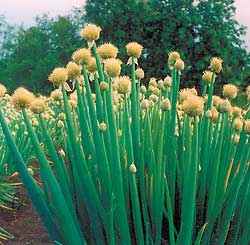
batun

A. fistulosum

Allium fistulosumor bunching onion is a possible stand-in for those green onions from the grocery store if you want to grow your own. While the “Welsh” is a misnomer since these came from China originally, the taste is still “green onion”, sometimes grown as an ornamental. You can find bunching onions from Johnny’s Selected Seeds.


The Egyptian (this may also be a misnomer) –my favorite–is just plain fun with its unusual appearance that will definitely be a topic of conversation.

allium_fistulosum_bulbifera0

A. cepa x proliferu

Other common names include tree onion, top onion, walking onion, Canada onion, and Catawissa onion which may all refer to various cultivars. The Egyptian Walking Onion,  Egyption Onions , Biodiverseed and Mother Earth News websites provide some glimpses into the rather mysterious history of these (and other) onions.

Genetically it has been shown to be a cross between the common allium (Allium cepa) and the “Welsh” onion (above). Botanically speaking, it is Allium cepa x proliferum. These form bulbs, but also have top-sets which can be shared with friends. These plants multiply from the bulb in the ground as well as by producing top-sets, and sometimes topsets on topsets, rather than seeds. These onions are most often found from growers or seed catalogs specializing in heirloom vegetables such as Territorial Seeds, although a Google search shows them available from eBay and Amazon.

Potato onions (multiplier onions, shallots)  or Allium cepa var. aggregatum are also perennial alliums. These do not produce topsets, but rather “multiply” from bulbs left in the ground over the winter.

Multiplier (Allium porrum), perennial, multiplying or “Musselburgh” leeks (Allium ampeloprasum), though smaller than annuals,  can provide the taste of leeks without the amount of effort involved with annual leeks. These are also called garden leeks.

More information on sites like Edible Gardening, Hope Seeds, Southern Exposure Seed Exchange, FoodForestFarm.com , inhabitat.com, and icultivate.net.  Grow some “lilies of the kitchen” and don’t ignore others like chives. Then there’s garlic: for a method of growing without yearly planting check out The One Straw Revolution.

—Ô¿Ô—

_

Eggplant bacon?!

I like breakfast–but not at the crack of dawn. I am trying to get food on the inside me earlier in the morning and I know I need to eat more vegetables–they are good for you. Eggplant IMG_4285The more nutrition and “diet” reading I do the more I realize how important fiber (and thus vegetables) is in diet, and that it would be good to have vegetables included in all my meals. As much as I like omelets and frittatas, I need more ways to get more veggies at breakfast and at other times, too.

Eggplant is a vegetable of which I’m not particularly fond. Nutritionally, I suppose it is good for me–or at least a filler. According to  USDA nutrient information, eggplant is right about with iceberg lettuce and cucumbers–which is certainly not saying much. But it does have fiber!

So you’re wondering where did the breakfast thing come from?  Well, I don’t often find an eggplant recipe that puts me in gotta-try-that mode but the “bacon” got my attention as I was browsing through my email notifications from  Kitchn. (I suspect it was really the “bacon”, not the eggplant that did it, since bacon will always get my attention.) A post on how to make eggplant into bacon caught my eye. The pictures looked really good and it made me think “breakfast vegetable” other than tomatoes, spinach, kale, mushrooms…

After I finished reading about bacon, I noticed that there were recipes for eggplant bolognese, eggplant jerky, and eggplant burgers–which I doubt that I will ever try–eggplant bacon, maybe! 


Crudités

After my last visit to my physician for my 100,000-mile maintenance check, I was appalled at the numbers I read on the scales when I weighed in. Arrrggghhhhh! So it time to do something about those numbers. Obviously, more exercise–and I’ve actually Radish Varietiessuccumbed to a fitness device that will make me (horribly) aware of how inactive I can be, especially during working days.

Along with trying to get my butt out of my office chair even on work days, I’m trying to get more veggies and fruits into me. As the weather gets hotter, I want cool things so crudités are appearing often. Most often served with a dip of some sort but I was looking for something to add a bit of zip and zing to raw (or lightly blanched) vegetables: celery, radishes, zucchini, jicama, kohlrabi, etc.

As you all know by now, Bull City Olive Oil is one of my favorite places to find tasty stuff (like truffle salt for popcorn). In addition to olive oil and salts, there is a grand array of balsamic vinegars. I’ve discovered that some of these make a marvelous “dip” for all these veggies–without adding any oil–so that it keeps my cruditès low calorie but still never boring.  Some of the ones I use are honey-ginger, blackberry, blackberry-ginger, black mission fig, and lemongrass-mint.

And–the dark chocolate! Just a few drops with berries or fruit makes a wonderful treat–as does the passionfruit, or the lavender.  All very low cal, but so tasty! I suspect that the coconut white balsamic would be pretty darn good with fruits and berries too. So many possibilities for good taste–and there are always new ones to try–and healthy eating, too.

A son gôut!

—Ô¿Ô—

Comb honey vs. extracted honey

From one of my very favorite (and useful) beekeeping blogs (HoneyBeeSuite) I wanted to share a post that so well describes the grocery-store honey and the wonders of honey in the comb: How to make value-subtracted honey.  I couldn’t agree more, nor could I say it better so I’ll just pass on this link.

—Ô¿Ô—

Hive report: swarm season

440px-bee_swarmThis is the season for swarming.  There are some things you should know about swarms and what to do if you happen upon one.
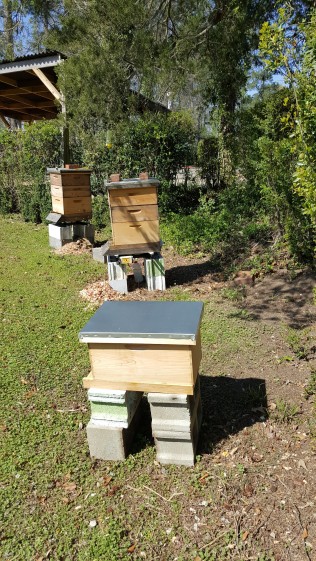
Swarming is a natural thing that honey bees do. It’s reproduction on a colony level.  Only a healthy, strong colony can swarm. While we as beekeepers do everything we can to prevent swarming because it decreases the size of the colony and, thus, honey production, it does happen. One of my colonies just swarmed. I was fortunate enough to retrieve the swarm and they are now inhabiting the third hive in my apiary. So, my apiary has grown because the bees swarmed.  This is also good.

A swarm happens when the bees think that they need more room for the queen to lay eggs and to store honey. There is preparation within the colony for the swarm–after all, this is splitting the colony into two.

Each colony must have a queen–i.e. in bee-speak, be queenright. The queen who was with the colony is going to fly away with the swarm.  That would leave the colony remaining in the hive without a queen–and that would spell the death of the colony but before the swarm leaves, the worker bees have started rearing a new queen for themselves: they will build special “queen cups” into which the queen will lay eggs before she starts getting ready to lead the swarm out of the hive.  The workers remaining in the hive will feed those larvae in the queen cells appropriately so that they grow up to be queens.

Honeybee Democracy Cover ImageOnce these preparations are in progress, the queen will lead the swarm out of the hive, Once out of the hive, the bees will make a temporary stop somewhere not too far away while the process of selecting a new home goes on.  That’s when you see the bunches of bees in some truly strange places. There’s a complicated process going on with the swarm: scout bees are going out and looking for potential new homes. Scouts return and report, other scouts check out the possibilities, and finally, there is agreement on a suitable site.  At that point, the swarm leaves their temporary resting place and moves to the new home–with their queen, to establish a new colony and begin drawing comb for the queen to lay eggs in, and in which to store honey.  It’s a fascinating and complicated process, wonderfully described by Thomas Seeley in Honeybee Democracy. It’s a collective, democratic process by this swarm bees.

Things that you should know about swarms: first and most importantly, they are not dangerous. The honey bees making up the swarm are very docile. They have gorged on honey before leaving the hive so that they can survive the search for a new home. They don’t have a home to protect–they out looking for a new home. They are not going to attack. Extermination is not necessary (except in very rare circumstances). What you want to do is to contact your local beekeepers’ association–or a local beekeeper. Someone will come with appropriate gear and take the swarm away to a new home; they are highly prized as a way to get started in beekeeping or to increase the size of an apiary.

Should the swarm not be collected by a beekeeper who will provide a hive, or find a suitable cavity you will occasionally see comb built in the open air–not the best in terms of long-term survival.
Meanwhile, back in the hive of origin, the workers are busily raising new queens. Yes, the plural is intentional. Having a queen is necessary for the survival of the hive so the workers will raise several queens to be sure of success. However, a colony will have only a single queen–it’s not a shared job. The first of the queens to emerge from the queen cell is going to wipe out the other rivals–it can be brutal in the hive at times.  This hive will now have a virgin queen, who will leave the hive to mate (with multiple drones) in a drone congregation area, return to the hive, and begin her egg-laying duties.

—Ô¿Ô—

My second hive (the GA girls) and now in the process of requeening the colony. I can only hope that the workers rear a good queen to replace the one that left with the swarm, and hope that she will be well-mated.  There are a lot of things that can interfere with this process–cold, rainy weather, a predator needing a meal while this virgin queen is on her mating flight, or getting splatted by a huge raindrop on her way home.

With fingers crossed, I’m hoping for a good, new queen for replacement. If the normal sequence of events doesn’t work, then it is possible to purchase a new queen from professional breeders but since this was a successfully overwintered, productive colony, I  would like to keep these genetics going by allowing them to produce their own new queen.

Now it’s more anxious, not likely patient, waiting for the new queen.

—Ô¿Ô—


Hive report: Swarm!

Yesterday (28 March) it was finally warm enough for me to do a hive inspection at the same time that I could take off work. So I inspected Hive A (affectionately knows as Dave’s Bees). The population was very heavy, there was brood in the deep, and in two medium supers.  I didn’t see much nectar in the hive, but there was pollen.  Unfortunately, the girls got really PO’d part way through and I had to let them calm down. I think that was partly nectar dearth and the fact that it was cloudy and fairly windy. So that inspection was not one where I pulled every single frame. But I didn’t see swarm or supersedure cells, but I did add another medium super to give them some more room.

Then I went to Hive B (the GA girls) but they had been affected by the alarm pheromone from Hive A, and were PO’d from the first contact. So, being a wuss, I thought that since the weather forecast was for another warm day to follow (29 March) that I’d simply let the yard calm down a bit and do that inspection on the 29th.

The 29th turned out to be a lovely day except it was just bit windier than I like for an inspection but it was warm and sunny. So I toted another medium super out to the hive, along with my toolbox, and then went back to get the smoker. As I walked to within about 10 feet of the hive the Georgia girls (Hive B), I heard them–bees came pouring out of the hive. Swarm in progress, right before my eyes.

The last time one of my hives swarmed I was lucky–the queen landed on my shoulder so I got that swarm easily.  Luck was with me again today–the queen didn’t land on me, but in a short, squatty, multi-trunked bush that was infiltrated by a very thorny climbing rosebush, very close to the hive, and practically on the ground.

Bee brush and a dishpan in hand, I started the process of capturing my errant bees. With 20180316_114851.jpgthe aid of pruning shears, I got down to the cluster but they had picked a spot where the trunk had multiple branches and was sturdy enough not to shake very well, and of course, that’s where the bees settled down.

(Nope, no photos–I was way too busy working out my plan to get these creatures into their new home.)

It was obviously time for the bee-brushing technique: hold the pan under bees, and brush downward.  That got me a pretty good batch of bees so I carted them back to their new home that I had prepared for an occasion like this. Dump them in, look for queen; no queen seen. Back to the bush: a lot of the bees settled back in another cluster although a fair number were on the ground. So the routine became to shake and brush the bush, dump into the hive, shake, brush, dump, several more times. Finally, I was down to only a very small cluster of bees right on the main trunk of the bush and it seemed that the girls I had carted back to the new hive were staying there although some were still flying around the bush.

I decided to let them settle and try one more shake-and-brush, but first, I needed water. I gave it long enough for me to slake my thirst (it’s damn hot in a bee suit) and went back to the bush. There were no bees there–that little cluster had dispersed, but there were some still in the air between the bush and what was now Hive C and I saw some bees going into the hive! Maybe, just maybe, that means that I’ve got the queen in that hive.

I still haven’t looked into Hive B–got distracted by the swarm—but maybe tomorrow.

Now I have to decide if I purchase a queen or let them raise one of their own. Decisions, decisions, decisions….and the bees will do what they damn well please!  Just like cats, we only think we are in charge.

—Ô¿Ô—