Oysters Hot and Cold

As you know I’m an oyster fan–both these look just too good not to reblog the recipes for other oyster lovers!

Linda Duffin's avatarMrs Portly's Kitchen

Standing in a battered boat on a cold creek in the middle of winter might not be most people’s idea of fun, but I loved it. I was with Bill Pinney (that’s him, at the top), whose family has been farming oysters in Suffolk since just after World War Two. Bill is a mine of information, not just on oysters but on marine life in general and the art of smoking.

View original post 104 more words

Overnight-baked garbanzo beans from Sifnos

With this last cold weather where we seemed to be trying to set records for low temperatures it seemed like a good time to do some oven cooking that could help keep things warm.

This recipe comes to me from my good friend David; it’s from Vefa’s Kitchen. That’s  one of the great things about FaceBook–sharing “food porn”  with friends.

Ingredients

2-1/4 cups of garbanzos, soaked overnight
1 tablespoon all-purpose flour
2 large onions, sliced thinly
1 teaspoon black peppercorns
2 garlic cloves, finely chopped (optional–but not to me!)
2/3 cup extra virgin olive oil (I use a nice Greek one)
course sea salt
freshly squeezed lemon juice, to serve

Preparation

  • Drain and rinse the garbanzos and put them into an ovenproof casserole dish ( David uses a large Spanish cazuela with lid; I use a Romertopf).
  • Sprinkle with the flour and stir.
  • Put the onions into a bowl, pour water to cover, and let soak for one hour, then drain (this makes them sweeter and remove their “bite”).
  • Preheat oven to 300˚F (150˚C/Gas Mark 2).
  • Stir the onions into the garbanzos together with the peppercorns, garlic, and oil.
  • Season with salt.
  • Pour in water to cover.
  • Cover the casserole dish tightly.
  • Bake for 7 to 10 hours, until all of the liquid is evaporated. (David says in his oven that takes about 9 hours.)
  • Serve hot or at room temperature, sprinkled with a generous amount of fresh lemon juice.

It’s a main with a salad, but these are SO good with the Portuguese lamb stew that I made. This also freezes well if you want to make a big batch to have on hand.

Ò¿Ó

…..

Basics: Chicken Stock

Some wise advice for making chicken stock.

Linda Duffin's avatarMrs Portly's Kitchen

When I first launched this ‘basics’ series I asked for suggestions from readers. Quite a few people asked how to make stock. I must admit I’ve been postponing a response as it’s a thorny subject.

If you’d like to know how to make a restaurant-standard demi-glace, or a bone broth that’s simmered for 24 hours, you’ve come to the wrong place. I don’t have the patience for the first or the inclination for the second.

View original post 426 more words

Slow-cooker mashed potatoes

This was, obviously written at Thanksgiving time! I was going to share it then but somehow it just didn’t get done. Better late than never because it is an easy way to do mashed potatoes for a group.

For the group of us who celebrate Thanksgiving together, it just wouldn’t be completewithout mashed potatoes. Of course, it wouldn’t be complete without the Brussels sprouts, or the dressing, the cranberry relish, or the turkey and gravy either. pots_9hrs_crop_20161124_133134Since we all bring the side dishes, mine has gotten to be the mashed potatoes–with garlic. It’s not a new thing that I admit to being fond of cooking things the easy way (okay, so read lazy). This year I found a recipe from The Kitchn for making mashed potatoes in the slow cooker.

Since I needed mashed potatoes for nine people (who all seem to eats lots of mashed potatoes) I decided to try this as easier than my usual. I have to say that I’ve never seen the point in cooking potatoes in water when you want your mash to be really decadently rich with butter and cream. So that wasn’t new to me, but the slow-cooker part really intrigued me. I could keep the potatoes warm and take them to dinner in the slow-cooker–bypassing the necessity of reheating a huge batch of potatoes in the microwave.

So with my 8-pound bag of Russet/Idaho potatoes–where the recipe called for only 5 pounds, I started peeling potatoes–many potatoes. I’ve always wondered every time I decide to by “bakers” they are SO huge that it’s more than I want as a side to other food. I found the size potatoes I want for baking–yes, they were in that 8-pound bag, so there were lots, and lots of potatoes to peel. (Obviously when you’re trying to do single-serving cooking you don’t buy your potatoes in 5- or 8-pound bags.)  I peeled and stashed the potatoes in a large bowl of water until time came to cut them up.

According to the recipe the potatoes to be cut in 1-inch pieces, but looking at my 8 pounds of potatoes, the size of the slow-cooker, I decided that I’d cut them a bit smaller–1/2- to 3/4-inch. Good move on my part as even so a few didn’t fit and had to be left for cooking later. The recipe also said that you should cook the potatoes on high for four to five hours–or until very tender–since the Krups multi-function pot doesn’t “do” high in slow-cook mode it was to be until very tender. I added milk, half-and-half, lots of garlic cloves, some salt, closed the cooker, set the time to 9 hours and went to sleep.

While I was waiting for my espresso to brew next morning I opened the cooker, and found20161124_120800 that my potatoes were not yet really tender. Closed lid, added a few more hours and had a very leisurely morning (as opposed to my usual T-day morning of peeling and cooking potatoes.)  Just about an hour before I was ready to go to dinner, I mashed the really tender potatoes, added the necessary butter, white pepper, and more cream (butter melted and cream warmed). Then with the cooker on “warm” the potatoes were ready to be carried off to dinner–plugged in once I arrived, and ready to serve. How easy is that!

Unfortunately, my Krups multi-function pot has a metal container with a nonstick coating, so I didn’t feel I could actually mash the potatoes in the cooker so I transferred them to a bowl to mash and season. If you did this in a cooker with a ceramic or crockery liner, you wouldn’t even have to use that extra bowl. The only additional dishes to clean would be the pan to melt the butter and warm the cream. Even using the extra bowl for mashing, these were the easiest mashed potatoes I’ve ever done. Very tasty too.

Ò¿Ó

Instead of the usual supermarket butter (sweet cream) I used some Amish Country Roll butter that I found at my local Harris Teeter; only disadvantage was that it is salted, but since it was much  cheaper, I thought it was worth trying, but I’ll probably use unsalted next time. Besides, that butter comes in a two-pound roll. That’s a lot of butter for one person to use; portioning it and freezing works, but I don’t think the butter is good enough for that effort.

Ò¿Ó

…..


New Year’s wishes

I just wanted to wish all of you a New Year that is filled with good food, good wine–shared with good friends (or even just with the cat). Happy New Year! Happy cooking, and may it all be perfectly a son gôut!

Christmas dinner

I’m having my usual lazy Christmas day–just me and Frankie (the cat). After having brunch of scrambled eggs with truffle butter, I turned my attention to fixing supper.

It seems that I’ve inadvertently created another Christmas tradition (aside from the oysters): chicken (or at least fowl) in a pot. I guess it has something to do with it being an easy and tasty dish that I really like. This year, though, there was a variation–it’s pheasant in a pot. It’s been awhile since I’ve had pheasant so that’s what came to mind for this Christmas supper. After-holiday sales, and sometimes specials in between, are great for eating higher-on-the-hog with lower prices–so there was a plump McFarlane pheasant, just a bit shy of 2.5 pounds, lurking in the freezer.
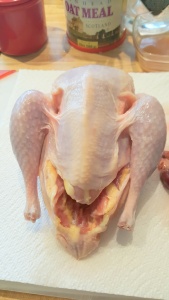
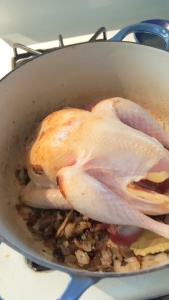
20161225_134929

…giblets removed

I toyed with cooking the pheasant with milk as I had done before with cornish game hen, but somehow I just couldn’t picture the pheasant-milk combination. So, just plain pheasant in a pot.

I couldn’t think of any reason that pheasant wouldn’t work just as well as chicken for this treatment–but since a pheasant isn’t a chicken, I thought there would have to be a little adjustment.I little skulking about (via Google) suggested that my pheasant should cook in less time than the bigger chicken (duh! About an hour or a little more). Cook’s Illustrated has a basic recipe for chicken in a pot; that seemed a good place to start since there’s always a rationale included that should make the recipe easy to modify as needed though it seems that none of that series (Cook’s Illustrated, Cook’s Country, or America’s Test Kitchen) addresses pheasant.

So, next, seasonings for the bird. Pheasant may be considered one of the “other white meats”, but it’s still more like the dark meat of the chicken: bay leaves (certainly), onion (can you cook without onion?), garlic (often used with pheasant), thyme, sage, and juniper berries (good with game) were the final seasonings that went into the pot. I also added some sliced button mushrooms with the onions while they were sautéing. These are eye-ball measurements:

  • one large onion, chopped
  • 2 bay leaves
  • one basket sliced mushrooms
  • 1/2 teaspoon thyme
  • large pinch rubbed sage
  • 1-1/2 tablespoon minced garlic

20161225_140238

After browning the pheasant breast-side with the onions and mushrooms, the pheasant was flipped, seasonings added, and the pot  covered with foil and the tight-fitting lid, and it went into a 250ºF oven. Time to consider what I wanted for sides to this lovely bird.

My peasant side is showing–well, right along with bird-in-a-pot which isn’t exactly haute cuisine unless you are eating in in a US restaurant–I  rummaged through the vegetable bin and decided that something with cabbage and rutabagas would fit with the dark meat.

After some more Google use and letting my imagination run wild for a bit, it seemed something quick and easy would be a sautéed combination of those two vegetables, spruced up with a bit of a sauce of some sort. Something sweet-tart–maybe some dark buckwheat honey and lime juice and zest of one lime). I did a little shredding, julienne work (mandoline), and zesting  I left those veggies sitting in water to await cooking time; the buckwheat honey and lime zest melding; then I was off for some more quality time with the cat for an hour (until time to check the temperature of the meat (one of J.J. Salkeld’s  Lakeland mysteries).

While the bird rested (about 15 minutes or a bit more), I put the drained cabbage and rutabaga in a sauté pan with a dollop of butter (salted) and covered them–sort of a steam-sauté–until almost tender then removed the lid to let moisture evaporate while I tossed this mixture around a bit with my sauce (about 10 or 12 minutes altogether).

After scraping up all the good brown stuff from the pot, the juices from the roasting pot were strained, and enriched with a blob of truffle butter. End of cooking–time to eat!

Just a word about en coquette cooking: the meat is absolutely luscious, but don’t expect the same kind of browning that you’d get with dry-heat roasting. I can attest that it works very well–as well as braising–with farm-raised pheasant. I’ll most likely do it again with the next pheasant I decide to eat.

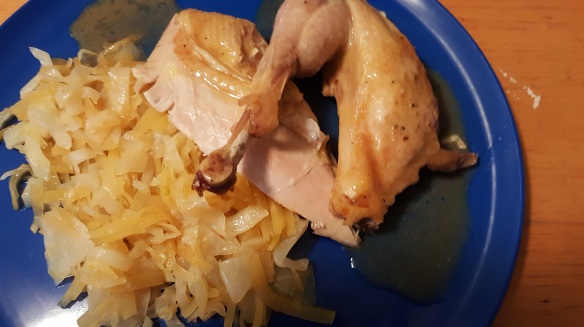
The cabbage/rutabaga combination turned out to be even better than I had expected–always a pleasant surprise–even before the sauce went on. Just with the butter it would have been an admirable side to the pheasant. The mandolin made short work of both the shredding and the julienne work and the cooking time was only about about 10 or 12 minutes. I have to admit that there are leftovers from the 1/2 rutabaga and 1/4 head of cabbage. (I’m thinking that they could be turned into rösti or fritters for a main course since I didn’t add the sauce to the entire batch of cabbage and rutabaga.)

Wine? Of course, but since I had some of the Les Hérétiques left from last night, I decided I’d just go with that–it’s a good all purpose wine–maybe not what I’d have chosen were I giving it a lot of thought, but sometimes it’s a needs-must situation–I love my wine vinegar but there’s a limit to how much good wine I’m going to pour into that jar. So–I finished that bottle this evening. The “leftover” wine was quite good with this combination of food–the blackberry was a nice contrast to the other flavors here.

Ò¿Ó

If I want to sound really fancy, I guess I just ate pheasant en coquette with truffle  au jus–whatever you call it it was a fine meal, even if I can’t get the cat to say so though I’m not that modest. I’m still listening to Christmas music and enjoying a another glass of wine. The other half pheasant has been boned and stashed, and the carcass is in the slow-cooker making pheasant broth. I’m not sure what is going to evolve out of the Christmas Eve and Christmas Day leftovers, but I would guess that there is going to be some pheasant soup, among other things.

The kitchen is tidy–only the roasting pot left to soak with baking soda overnight–and only clean things to put away from the drainer in the morning. Altogether a most pleasant day with the cat, low-intensity, undemanding cooking, music, and reading.

I was contemplating starting to filter my chocolate/cardamom/ancho/golden rod-aster honey liqueur this evening, but I’m just too full and lazy. I decided it would be better to start that in the morning since it is a long process–so now to quality time with the cat and Kindle since I’m happily fed and still enjoying wine.

I hope all of you had as pleasant a day as I did. A final happy holidays to you if you happen to be celebrating something just now.

20161225_162137

20161225_163944

Ò¿Ó

.

Books for the cook

For those of you looking for possible gifts for the cook, here’s a list from The Washington Post  of “The 31 Best Cookbooks of 2016”.

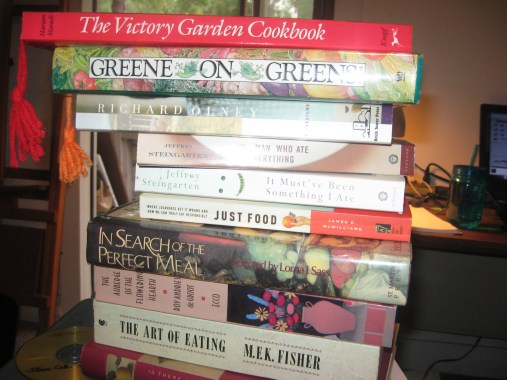
I’d add to the list (even though some weren’t published just this year):

  • Dandelion & Quince: Exploring the Wide World of Unusual Vegetables, Fruits and Herbs, Michelle McKenzie, Roost Books, 2016
  • Bitter: A Taste of the World’s Most Dangerous Flavor, with Recipes, Jennifer McLagan, Ten Speed Press, 2014.

  • The Broad ForkHugh Acheson, Clarkson Potter Publishers, 2015.

If you’re adventurous and believe that we should make better use of the animals that we use for food rather than just the choice bits (like steaks, chops, and roasts) you might also check books by Fergus Henderson  and other books by Jennifer McLagan for more on nose-to-tail approach to food and recipes.

For fun reading (with recipes mostly for one or two) there’s always Nigel Slater (one of my favorites).


Ò¿Ó

img_8265

.

On cooking for one

Cover of Serve YourselfI have a number of favorite food writers–but some special favorites are those who cook for one (or maybe two), e.g. Nigel Slater,. Judith Jones, and Joe Yonan, who have a kind of get-in-there-and-do-it attitude.
I came across an post in The Kitchn with tips from Joe Yonan on “Five Essentials for Solo Cooking” that I thought I’d share.I think there are some good suggestions for those of use who don’t have a loving relationship with “leftovers” for three or four days in the week.

I particularly like his “building block” suggestion, especially since many of us shop where things are packaged for family, not for one. The freezer is a great adjunct to cooking for one, but it’s sometimes easy to plop something into the freezer and it gets forgotten until much, much later when you’re wondering what is this frozen lump of mystery stuff. With the caveat that you remember to date and label it a huge help in dealing with things like chili and soups, especially when the work schedule gets hectic.

Even though I work from home, like to cook (and eat well) sometimes deadlines get in the way of cooking, even something quick like a chop or steak which takes only minutes to cook.Then it’s time to delve into the freezer either for a full meal or some building blocks to put together something suitable for the weather and your mood.

A son gôut!


Dicing onions

Ok, I’m lazy–even about some things in the kitchen–like dicing onions; however, I’m not at all sure that it’s possible to cook without onions.Being out of onions is like–well, my mind simply boggles at the thought.

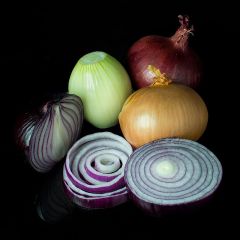
800px-mixed_onionsI use lots of onions, meaning that I cut up a lot of onions, but I’ve never understood the “usual” way that we’re told is “proper” to dice onions. I can understand it if your onions are HUGE, I suppose, or if you have a touch of OCD (I may have, but not about diced or chopped onions). I’ve always thought that onions were essentially self-dicing with little effort on my part–after all they come with layers already there. Another aspect of dicing or chopping onions–I’ve never been one to expose myself to unnecessary risk so why the cuts parallel to the cutting board? (Yes, I know that you’re supposed to have your hand on top so it’s impossible to cut yourself. Be sure to check on that the next time you’re dicing an onion properly. Where’s you hand?)

My lazy approach has always been kind of a two-part thing: First don’t buy huge onions. Secondly, I bypass those horizontal cuts, doing only the vertical cuts. For diced, do the vertical cuts close together; for chopped, farther apart. Easy!

Recently, I stumbled over a video from The New York Times Cooking Techniques on how to dice an onion that omitted those cuts. How refreshing!

Since I’m doing single-serving cooking most of the time, I often use shallots. Then there’s the truly, completely lazy way to deal with the onions. For cooking purposes when I want chopped onions I often reach into the freezer for that bag of frozen chopped onions. If I want lots of onions for something like caramelized onions, then I’ll get out the knife and go to work.