Roasted figs

Figs are one of my favorite fresh fruits; unfortunately, the figs here aren’t ripe yet, so when I saw some at Costco (a two-pound carton) that looked as if they were at least reasonably ripe, I had to try them.  Thing  is, figs are perishable–so after eating some fresh (these were much better than what you usually find in the supermarket (but not perfectly ripe to the point of splitting and having that lovely drop of sap oozing from the blossom end as they should for eating out of hand), I searched through some of my favorite food blogs and something to do with the rest of them.

Here’s what I found that looked really good to me!  Every recipe that I’ve tried from this source has been a resounding success, so I’m going to try this one.

Roasted Figs (From David Lebovitz living the sweet live in paris)

Six to eight servings

Use a baking dish or pan that will allow you to bake the figs in a single layer. One that is 2 quarts (2l) should do it. Depending on where you live, fresh fig season is near the end of summer and mid-autumn and the best place to find fresh figs is at a farmers market.

1 pound (450g) fresh figs
4-6 branches fresh thyme
2 tablespoons red wine or liquor, such as Chartreuse, Pernod, Grand Marnier or Cointreau
1 tablespoon dark or light brown sugar
2 tablespoons honey
three 1-inch (3cm) strips of fresh lemon zest

1. Preheat the oven to 400ºF (200ºC).

2. Slice the tough stem end off the figs and slice each in half lengthwise.

3. Toss the figs in a large baking dish with the thyme, red wine or liquor, brown sugar, honey, and lemon zest. Turn the figs so that they are all cut side down in the baking dish, in a single layer.

4. For figs that are softer and juicier, cover the baking dish snugly with foil and bake for 15 to 20 minutes, or until the figs are softened and cooked through.

For figs that are firmer, with less liquid, roast them in the oven, uncovered, for 30 minutes, or until cooked through.

5. When done, remove the baking dish from oven, lift off the foil, and let the figs cool completely.

Variation: For more savory figs, replace the liquor with one or two tablespoons balsamic or sherry vinegar.

Storage: Roasted figs can be stored in the refrigerator for up to one week.

♦♥♦

The figs are out of the oven and I’ve tasted them–wonderful!  Some of these are going to be dessert after the French chicken in a pot, with just a dollop of sour cream, and the rest will get used with breakfast Greek yogurt or, perhaps, with oatmeal.
Baba ghanoush

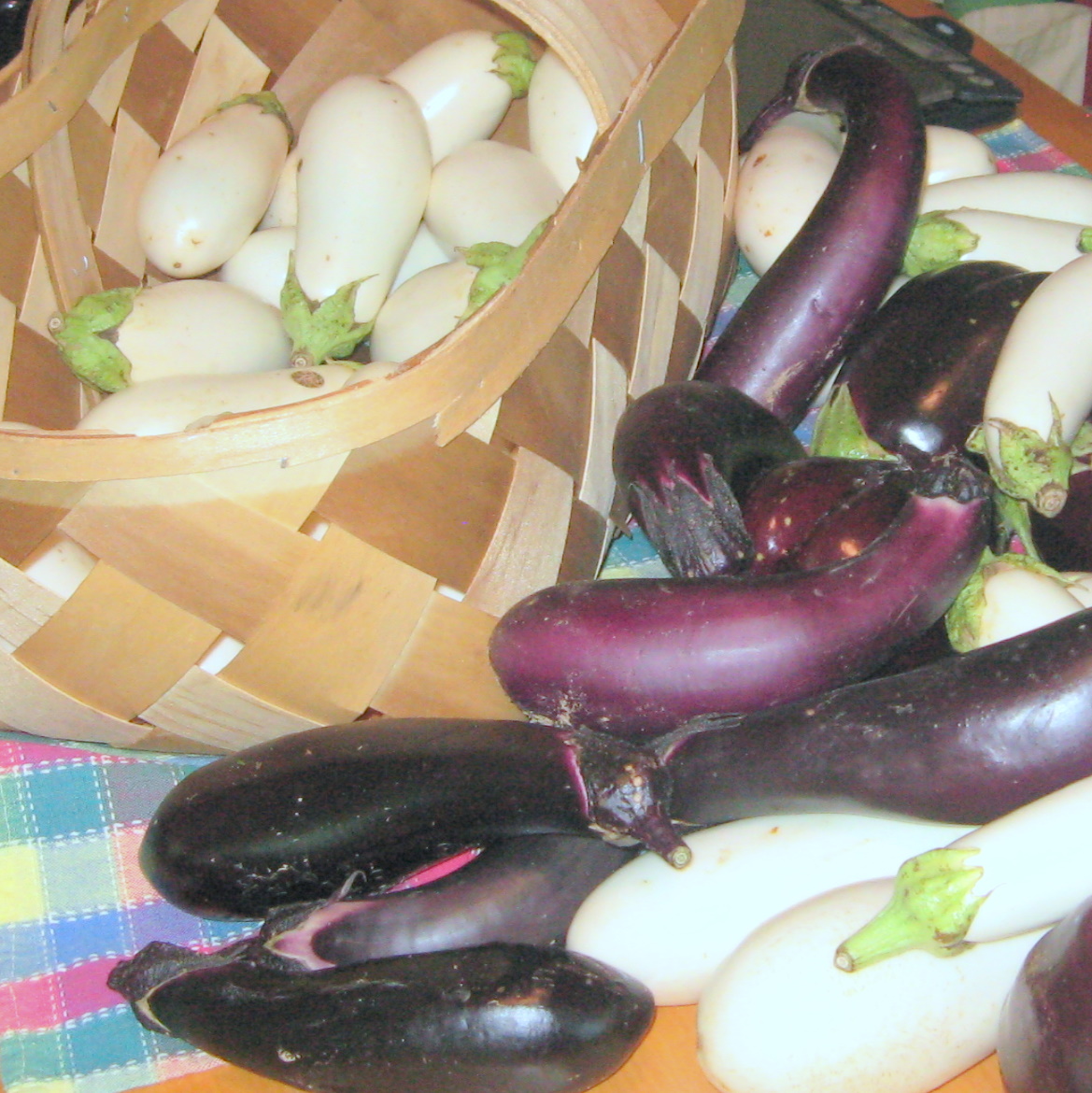
Market was a bit slow this past Saturday with the unrelenting rain most of the morning.  I had  lots of lovelyWhite and purple eggplants white and purple eggplants left so I’m going to make baba ghanoush.  No matter how you spell it, this creamy garlic- and lemon-spiked dip (frequently served as part of a mezze platter in Middle Eastern countries) is a delightful and simple dish to prepare when eggplants are abundant.

I started with my bookshelf on Eat Your Books to survey recipes…most were very similar.  The biggest differences were in the preparation of the eggplant.   Since I have a penchant for those that explain the whys of the recipe, I elected to use one from Perfect Vegetables (from the editors of Cook’s Illustrated magazine.  That recipe noted that  the eggplants must be more than just soft–they needed to be cooked until the insides were “sloshy”.  This can be done on the grill (preferable) or in the oven (acceptable alternative).  Broiling seemed not to be an option as the outsides would be charred too much and the insides not sloshy.

See “Eggplant….” for how to select appropriately mature eggplants of good quality.

This recipe is adapted from Perfect Vegetables, page 105 (Master Recipe for Baba Ghanoush).  I used white eggplant to make this batch of baba ghanoush–they are proported to be sweeter than purple ones.

Ingredients (makes about 2 cups)

  • 2 pounds eggplant
  • 1-2 tablespoons lemon juice  or to taste
  • 1 small clove garlic (minced or pressed)
  • 2 tablespoons tahini paste
  • 1 tablespoon extra-virgin olive oil
  •  1/4 teaspoon salt and  1/4 teaspoon fresh-ground black pepper or to taste
  • 2 teaspoons chopped fresh parsley leaves

Preparation

Prick the eggplants evenly over the surface with the tip of a paring knife (to prevent exploding in the oven) and place on a foil-lined baking sheet.  It’s best not to have them touching each other in order to roast most evenly. (I did spread these out more before they actually went into the oven to roast.)

Eggplant ready to go into the oven to roast

white eggplant ready to roast

Roast on the middle rack of the oven preheated to 500 ° F, turning every15minutes.  (Globe eggplants, about 60 minutes; Italian eggplants, 50 minutes; oriental/Japanese eggplants 40 minutes). Let cool until you can handle them.

Roasted white eggplant just out of the oven

roasted white eggplant just out of the oven

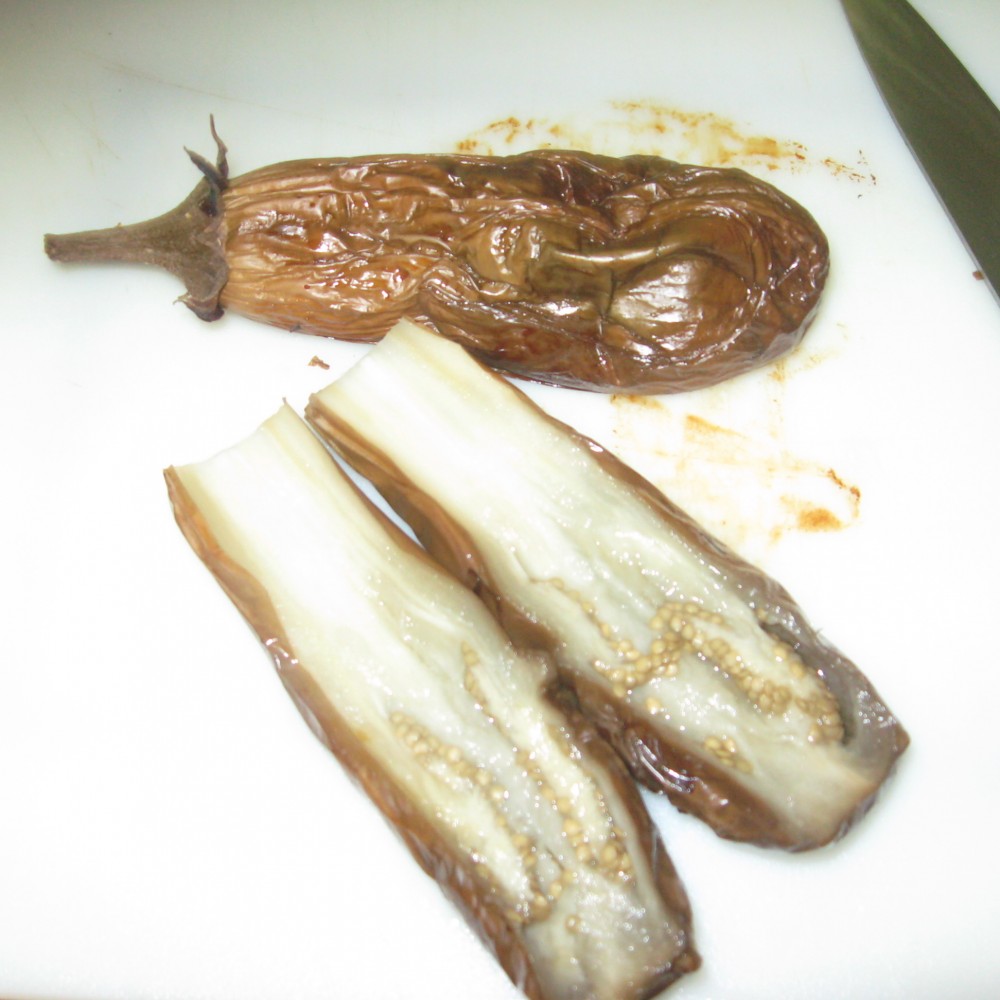
The eggplants should be more than just soft–they should be squishy (or sloshy as described in the recipe) after the roasting.

a very soft roasted eggplant and one cut in half

squishy eggplant

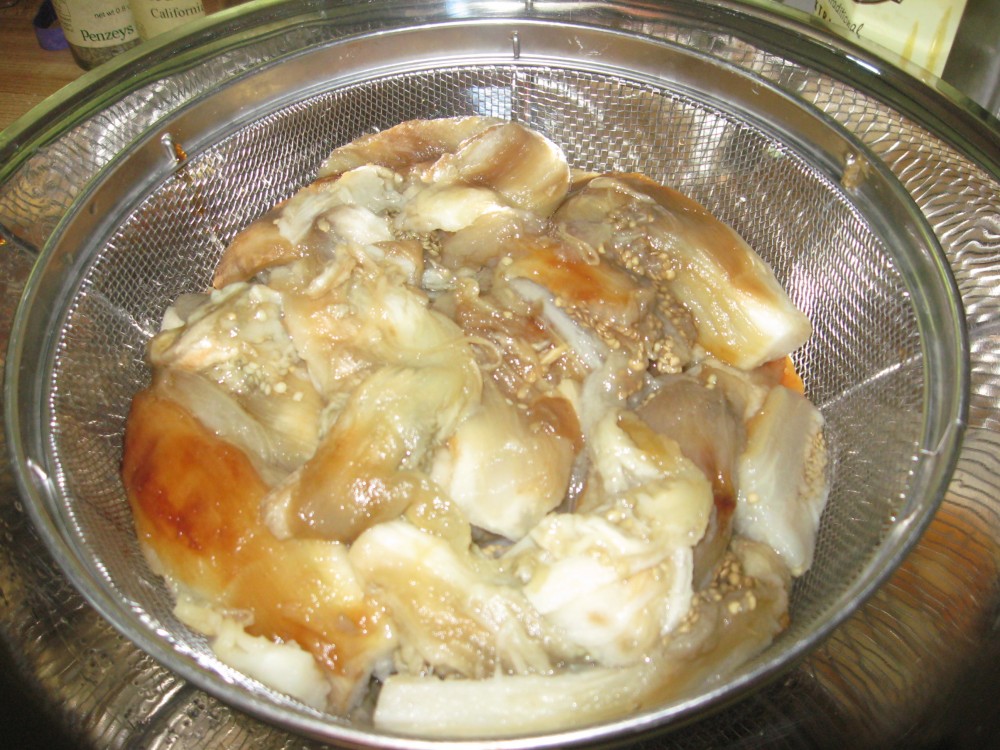
Over a colander set in a bowl, trim off  top and bottom of eggplant and slice lengthwise in half.  Using a spoon, scoop out the hot pulp into the colander.  You should have about 2 cups packed pulp.  Let the pulp drain for 10 to 15  minutes

draining eggplant flesh in colander

eggplant flesh draining in colander

Transfer the pulp to food processor bowl.  Add lemon juice, garlic, tahini, oil, 1/4 teaspoon salt, 1/4 teaspoon pepper. Process using 1-second pulses (about 8 to 10) until the pulp has a coarse, chopped texture.  Adjust seasoning as needed.

Transfer to serving dish or storage container, covering the surface with plastic film and chill lightly (about 45 to 60 minutes) before serving.

To serve

Baba ghanoush is typically served as part of a mezze platter (or like Italian antipasto) with pita bread, but crudities (peppers, cucumbers, small tomatoes, celery, et cetera) can be used as well to dip as well.

If the baba ghanoush has been thoroughly chilled, the flavor will be best if it is allowed to warm slightly before serving.

Sprinkle with chopped/minced parsley. Make a depression in the center and add a bit of extra-virgin olive oil.

Enjoy!

baba ghaoush with Sicilian olive oil and parsley

garnished with Sicilian extra-virgin olive oil and parsley

Cook’s notes

I did find that the white eggplant have more body and take longer to roast than comparable size purple ones.  The flesh is, indeed, sweeter than purple ones, so I added just a bit of extra lemon juice to the baba ghanoush than the recipe called for.  I think that I prefer the white eggplants for slicing or using whole as they do seem sturdier and to have a bit more “tooth” to them.

I  prefer a bit more garlic and lemon than this recipe calls for, as well as a pinch of cayenne pepper–not enough to be hot–just as a flavor enhancer.  If you like really lemony flavor, use a microplane grater or zester  to get some very fine zest and add just a bit to give it a real lemon kick.

Caponata!

The first time I tasted “caponata” it was mostly eggplant, and it was absolutely buried in tomato sauce.  I liked the concept, but it had kind of languished until I was looking around the kitchen at the tomatoes and eggplants that I had there.  This has been such hot, humid, torrid weather that I’m turning into a very picky eater…must be flavorful, room temperature or cold.  Needless to say I’ve eaten a lot of melons and fruits…and raw tomatoes in caprese salad, but I really needed to do something with the tomatoes and eggplants.

I decided to go looking for a recipe for caponata that looked like something I want to eat with grilled or griddled king klip since that was on special in the market today.  I started by going to EatYourBooks.com to search for caponata recipes among the books that I own (that I’ve put on my bookshelf there).  I found that I had 6 recipes for caponata.  I don’t know if it’s the weather, or what, but none looked like something I wanted to tackle this afternoon.  So I went searching online in the blogs that I like to check on.

On All Things Sicilian and more, I found a recipe that “felt” like something to do this afternoon, and it seemed loose enough that I could do it with what I had–oriental-type eggplants and little grape tomatoes.  It involves several steps, but it’s seemed approachable. A slight variation put a little garlic and some red pepper flakes into the mix as the olives that I had were marinated in those things.   Admittedly I did take a few liberties with the recipe but I think it worked well.  I did not improvise with the agro dolce–I kept those proportions.

My only real variation (other than the tomatoes) was that I treated the eggplant as described in my post on how to cook eggplant (as suggested by Cook’s Illustrated: salted very lightly, microwaved it, pressed it) and I was able to sauté all the eggplant in about a tablespoon of olive oil.

Here is the recipe from All Things Sicilian blog–the best I’ve ever tasted.  (You should go to this blog and read for more information about caponata.)

Ingredients

  • extra virgin olive oil, 1½ cups (more or less – depending how much the vegetables will absorb)
  • eggplants, 1-2  large, dark skinned variety,
  • peppers, 3, preferably 1 green, 1 red, 1 yellow (variation of colour is mainly for appearance, but the red and yellow ones taste sweeter)
  • onion, 1, large, sliced thinly
  • red tomatoes, 2 medium size, peeled and chopped, or 2 tablespoons of tomato paste and a little water
  • capers, ½ cup, salted or in brine
  • green olives, ¾ cup, stoned, chopped
  • celery, 2-3 tender stalks and the pale green leaves (both from the centre of the celery)
  • white, wine vinegar, ½ cup
  • sugar, 2 tablespoons
  • salt and freshly ground pepper 

Preparation

For caponata vegetables

  1. Cut the eggplant into cubes (approx 30mm) – do not peel. Place the cubes into abundant water with about 1 tablespoon of salt. Leave for about 30 minutes – this will keep the flesh white and the eggplant is said to absorb less oil if soaked previously.
  2. Prepare the capers – if they are the salted variety, ensure they have been rinsed thoroughly and then soaked for about 30 minutes before use, and then rinsed again.
  3. Cut the peppers into slices (approx 20mm) or into rectangular shapes.
  4. Slice the onion.
  5. Slice the celery sticks and the green leaves finely.
  6. Peel, and coarsely chop the tomatoes (or use tomato paste).
  7. Drain the eggplants and squeeze them to remove as much water as possible – I use a clean tea towel.
  8. Heat a large frypan over medium heat with ¾ cup of the extra virgin olive oil.
  9. Add eggplant cubes and sauté until soft and golden (about 10-12 minutes). Place the drained eggplants into a large bowl and set aside (all of the vegetables will be added to this same bowl). If you want to, drain the oil from the eggplants back into the same frypan and re-use this oil to fry the next ingredients – the peppers.
  10. Add new oil (to the left-over eggplant oil) plus a little salt and sauté the peppers,until wilted and beginning to turn brown (about 10-12 minutes). Remove the peppers from the pan and drain the oil from the peppers back into the same frypan. Place the peppers in the bowl with the eggplants.
  11. Add a little more oil to the pan and sauté the celery gently for 5-7 minutes, so that it retains some of its crispness (in more traditional recipes, the celery is always boiled until soft before being sautéed). Sprinkle the celery with a little salt while it is cooking.
  12. Remove the celery from the pan and add it to the eggplants and peppers.
  13. Sauté the onion having added a little more oil to the frypan. Add a little salt and cook until translucent.
  14. Empty the contents of the frypan into the bowl with the other cooked vegetables.

For the agro dolce sauce

  1. Add the sugar to the frypan (already coated with the caramelised flavours from the vegetables).
  2. Heat it very gently until it begins to melt and bubble. Add the vinegar and evaporate.
  3. Incorporate the cooked vegetables into the frypan with the agro dolce sauce.
  4. Add ground pepper, check for salt and add more if necessary. Gently toss all of the ingredients over low heat for 2-3 minutes to blend the flavours.
  5. Remove the caponata from the pan and cool before placing it into one or more containers.

Ò¿Ó
It should hold well in the refrigerator–and I know it will be even better tomorrow when the flavors have melded  more.  I’m looking forward to this with some griddled king klip tomorrow.

Chilli con carne

I love weather where I can get up want to put on clothes and  warm food like oatmeal for breakfast!  This morning I turned on the space heater in the office for a bit.  This means it’s time to cook things that will give me quick comfort food during the colder weather.

One of my favorites  for winter is chilli con carne–a version that I learned from a cook who spoke no English,  by watching it being made.  I’ve only made one modification to that original “recipe”–and that has been to add some sun-dried tomatoes; otherwise, it’s as I saw it made originally.

This is not a recipe that has fixed amounts–you’re going to have to taste and season it to suit yourself.  It’s a bit time consuming, but since it’s a large quantity and freezes well, it’s well worth the time and effort.

You can manipulate the “heat” by leaving in some seeds from the chile peppers, or by adding cayenne or crushed red pepper flakes to achieve the desired hotness.  I usually leave the seeds in about half the chile peppers–I’d consider it mild to moderate in heat, depending on the particular batch of chile peppers.

Ingredients:

  • 4 slices bacon or fatback minced, browned and reserved
  • 6 to 8 medium yellow onions, chopped
  • 2 tablespoons ground cumin
  • 2 tablespoons ground coriander
  • 3 pounds beef, diced or coarsely ground
  • 3 pounds pork, diced or coarsely ground (shoulder preferred to loin)
  • 4-5 chipotle peppers in adobo (1 small can)
  • 2-3 dried ancho chilli peppers, toasted and crumbled (seeds removed)
  • 2-3 dried guajillo or pasilla  negro chilli peppers, toasted and crumbled (seeds removed)
  • 1/2 cup minced garlic
  • 1/2 to 3/4 cup masa harina, toasted; cornmeal can be substituted if you don’t have masa harina)
  • 32 ounces of beef broth/stock
  • kosher salt to taste (approximately 3 teaspoons)

Assembling the chili:

  1. In a large dutch oven, sauté bacon until brown and crisp; remove and reserve.
  2. Remove all but about 2 tablespoons of fat, reserving excess, and add the chopped onions; cooking slowly until caramelized.
  3. Meanwhile, toast the dried chilli peppers by holding in the flame of a burner until aromatic.  Remove seeds and crumble.
  4. Toast the masa harina in a small skillet and set aside.
  5. Add cumin and coriander to the onions and sauté until aromatic.
  6. Add garlic and sauté for about 1 minute.  Remove to a bowl and set aside.
  7. Add additional bacon fat if needed, and brown meats in small batches, transferring to the bowl with other ingredients.
  8. Remove excess fat from dutch oven, and deglaze by adding beef stock.
  9. Transfer meats and other ingredients from the bowl to dutch oven, add chipotle peppers and adobo sauce, sun-dried tomatoes, and salt.  Stir in the toasted masa harina.
  10. Cover tightly and place the dutch oven in a very low (275 ° to 295 ° F) oven and allow to cook for approximately 4-6 hours, tasting and adjusting seasoning as needed.  Add water or more stock if it becomes too dry, but I prefer this to be a thick chili.

I’ve tried this once in a crock-pot or slow cooker, and just not been happy with the final result.  I think that the oven cooking allows just enough evaporation and concentration to do good things with the flavor that just cannot be gotten with a crock-pot.  It was certainly edible when done in the crock-pot, but just lacked a little something.  Were I doing this in hot weather, I’d certainly use the crock-pot, but since the weather is cooler now, the oven heat is not a problem, and I get to savor the aroma as it cooks.

Roast duck with fresh fig sauce

No–it’s not a single serving, but it’s so good that you just have to make it when there are fresh figs available.  So invite friends and enjoy.

Adapted from In Search of the Perfect Meal, a collection of writing by Roy Andries de Groot, pp 148-150.

  • 2 Long Island ducks (one about 2-1/2 pounds, and one about 4-1/2 to 5 pounds).
  • 1 lemon cut in half
  • 1 medium yellow onion, peeled and chopped
  • 2 medium carrots, chopped
  • 2 ribs of celery, chopped with leaves
  • 3 springs of fresh parsley
  • kosher salt to taste
  • freshly ground white pepper to taste
  • 12 whole fresh figs (I like black mission, but any good ripe fresh fig will work)
  • 2 ounces French Orgeat, almond syrup
  • about 2 cups chicken bouillon
  • 1 cup white wine, preferably Sancerre
  • 2 tablespoons minced shallots
  • 2 tablespoons sweet butter

Ducks: Preheat the oven to 350 ° F.  Rub the ducks inside and outside with the lemon. Prick the underside skin to allow fat to run out.  Place the ducks on a rack in an open roasting pan and roast until the breasts are pink (usually no more than about 45 to 50 minutes).

Stock: While the ducks are roasting, put chopped onion, chopped carrots, chopped celery and parsley springs into  a 2-quart sauce pan. Pour a pint of cold water over these and bring rapidly to a boil.  Stir, and reduce heat to a simmer and continue simmering until the duck carcass is ready to go in.

Figs: Put figs in a 1-quart saucepan.  Dribble the Orgeat over them and pour enough of the chicken stock over them to cover. Heat this to a gentle simmer and continue simmering, covered, until the figs are warm and puffed up (usually 5 to 10 minutes).  The stock should be vaguely sweet with the fig juice.  Remove the figs (carefully) and keep warm in a covered container.

Now boil the fig-chicken stock hard to reduce to about half and concentrate its sweetness.  Hold covered until you need it later.

Back to the roasting ducks: When the breasts are pink, put the larger one in a covered casserole and let stand tightly covered over extremely low heat on top of the stove, gently ripening in its own juices for about an hour.

Carve off the breast, legs, thighs and wings of the smaller duck and put them into the covered casserole with the larger duck.

Chop the carcass of the smaller duck into pieces, about 8 pieces, and put them into the 2-quart saucepan with the vegetables; press the pieces down into the liquid fairly tightly. If necessary add more water to cover.  Continue simmering, covered, until the stock is needed later.

Skim off the fat from the pan in which the ducks were roasted and set the pan over a burner, and deglaze with the cup of white wine, scraping the bottom of the pan with a wooden spoon to loosen the fond.  Pour this deglazing mixture into the simmering duck bouillon.

Completion and assembly: Preheat grill.  Strain the duck bouillon, return to the saucepan and boiling it hard to reduce it and concentrate the flavor.  Reheat the fig bouillon to just bubbling.  While finishing the sauce here, you must taste continually the duck and the fig stocks to get them just right to combine.  If the sauce is too sweet it will overwhelm the duck–you want just a very delicate on sweetness in this sauce so that you still appreciate the “duckiness” of the meat. Defat the duck stock.  Pour the fig bouillon into the duck stock, add the 2 tablespoons of shallots, and continue boiling to further reduce the combined sauce.

Place the figs on a platter and quickly glaze them under the broiler–for just a minute or two.

Now, carve the duck (the whole bird) and the parts from the casserole. Set portions on warmed plates and garnish with the glazed figs.  When the sauce has just the right sweetness, turn the heat down to below simmer, add a fair amount of white pepper–enough to cut across the sweetness of the sauce, but not enough to “prick your throat”.  Do not let the sauce boil after adding the pepper or it will have a bitter taste.

When the sauce is just right, monter au beurre. (Melt the butter on the surface, a small piece at a time, stirring in.  This will give the sauce a luxurious, velvety mouth-feel.  Pour the sauce around (not over) the duck and figs on the plate.  Rush them to the table.

Wine: Because of the sweetness of the sauce, red wine is not  quite right with this dish.  The recommended wine (from the French restaurant where this dish is served) is a white burgundy.  I did this with a Meursault and it was luxurious.   For domestic wine, a California PinotChardonnay from the Alexander Valley was recommended.

Even though this is a fairly complicated preparation and definitely not a single serving it is an exquisite dish.  If you have duck at other times, by all means make stock from the carcasses and freeze it. If you have the stock, you can do this sauce at any time you have the fresh figs available and perhaps serve with pan-seared duck breast without roasting the whole bird.

Vinaigrette

I think that seasoning is SO important when cooking for one–it can take that serving of veggies from sort of humdrum to great so easily. One of the easiest ways to “dress up” leftovers is to use a sauce with them on the second run.

I think that one of the easiest is a vinaigrette.  It’s so simple, holds well in the fridge. If you know a basic ratio (usually 3 parts oil to 1 part acid or if you prefer a less tart dressing 4 parts oil to 1 part acid) you can vary it easily.

A bit of mustard serves to aid the emulsification of the oil and acid.  The acid can be vinegar, or it can be lemon juice, lime juice, orange or grapefruit juice.  You can easily add different herbs, or garlic, onion, shallot, spices, or chives as an aromatic, depending on what you want:  with fish, lemon might be a good choice.

Stored in a small jar, covered, it will keep for approximately a week in the refrigerator, so it’s always handy.  This same vinaigrette is good to make a non-mayonnaise tuna or chicken salad.  Better and less expensive than store-bought salad dressing, and without additives and preservatives.