Cabbage with juniper berries

I’ve always liked cabbage–slaw, steamed, and even boiled if it was not cooked to mush. I’ll even just nuke a wedge with a little olive oil and salt sprinkled over it and call it a vegetable dish. It’s a good keeper that doesn’t get foul if it stays in the crisper for a while–especially if you just peel off the leaves from the outside of the head as you need them, instead of cutting the head in pieces.

Cover of book

Nigel Slater’s “Tender”

I’ve read a lot of Nigel Slater lately (Kitchen Diaries, Ripe, and Tender). I like his style: very descriptive of the garden, and the kitchen–almost makes me feel that I’m right there with him. I’m anticipating the followup volumes for Tender and Kitchen Diaries; his website is also well worth checking out.

Tender is a vegetable cookbook (as well as a gardening book)–not a vegetarian cookbook, though most recipes could be pretty easily adapted if you’re of the vegetarian persuasion.  The discussion of each vegetable includes cooking as well as growing information, and most delightfully, a discussion of seasonings for the vegetable.

His recipes are simple, designed to make the most of excellent fruits and vegetables without being at all fussy.  Quantities are rather loosely given, which makes it ideal for my improvisational style of cooking for myself (and the cat). I’ve found all sorts of thing I want to try, but here is one that particularly caught my fancy–perhaps because it’s fall, or maybe just because I had a head of cabbage in the crisper.

One of the seasoning he mentioned for cabbage was juniper berries. I’ve used juniper berries for other dishes, but can’t honestly say that I’d ever thought of trying them with cabbage.  Here’s what I did to try this out.

Cabbage with juniper berries

Ingredients

  • About 6 leaves from a medium head of cabbage
  • 3 juniper berries
  • dash of red pepper flakes if desired for spice
  • dash of salt to taste
  • small pat of butter

Preparation

  • Flatten the leaves on a cutting board and cut into bite-size pieces
  • Add crushed juniper berries, (see note below.), chili flakes if desired, and salt.
  • Toss the cabbage to distribute seasonings.
  • Add butter and 1 tablespoon of water.
  • Cover and microwave for about 4 to 6 minutes, until cabbage is still bright green, but tender (See NOTE).
  • Serve.

Cook’s notes

  • Though I used white cabbage, I’m sure this would be fine with red or savoy cabbage as well.
  • The juniper berries are very oily, so I did not put them in my spice grinder–I used a mortar and pestle that could be cleaned easily.
  • The microwave really seems to bring out the heat in the chili peppers, so add less than you might were you just going to sauté the cabbage.
  • The amount of water needed will depend on whether the cabbage is just washed and still wet, and/or how tight the cover is. I don’t usually use plastic wrap, but Pyrex bowls with vented covers, so I do lose some steam.
  • Sauté or steam-sauté would work as well–I just didn’t want to wash another pan when I was preparing this after a day of indexing work.

I’ve tried it now–right up there with caraway seeds.The combination is a winner–I’m not sure I can easily describe what the juniper berries do for the cabbage, but it certainly puts it in a different class from “boiled” cabbage that I grew up with and what is typical of “southern” cooking. I think it adds background earthiness and complexity to the flavor. It was no longer “just” cabbage!

It was a side for roast turkey thighs, but I can easily see this as a great side for pork, or most particularly for duck legs or duck confit.  I’ll certainly make it again–probably on many occasions.

I didn’t use extra virgin olive as I normally might with cabbage because I just could not get the flavors of that and the juniper berries together in my head. (Cabbage with a little extra virgin olive oil is excellent, though.) If I were making this to go with duck, I make it with duck fat instead of butter.

bowl of cooked cabbage

cabbage with juniper berries

<>^<>

These links are to The Regulator Bookshop, my local, independent bookstore. I like to use them whenever possible–though I do sometimes go to Amazon.com. I have no connection with The Regulator Bookshop, such as an affiliate status–I just support local independent business when I can.  They are very efficient in processing orders, even if the book you want is not in stock.

$36.00

ISBN-13: 9781607740377
Availability: Usually Ships in 1-5 days
Published: Ten Speed Press, 4/2011

$36.00

ISBN-13: 9780670026418
Availability: Usually Ships in 1-5 days
Published: Studio, 11/2012

$36.00

ISBN-13: 9781607743323
Availability: On Our Shelves Now
Published: Ten Speed Press, 4/2012

$65.50

ISBN-13: 9780007256037
Availability: Special Order – Subject to Availability
Published: Fourth Estate, 9/2012
Serious, easy comfort food….

Surely one of the easiest comfort foods must be a baked potato. I don’t mean just any old baked potato. It has to be one that has never had aluminum foil mentioned in the same room with it, rubbed with oil, popped into the oven at about 325°F until the well-scrubbed skin is almost crisp.

Pulled from the oven, x-ed on top and smushed open, given a minute or two for steam to escape, just a tad of butter added–it’s so good!  Probably, in my estimation, the ultimate comfort food–even more than mac ‘n’ cheese.

Want to make it some seriously “gourmet” comfort food?  Add some fleur de sel, or another fine specialty finishing salt. For a great account of salts of the world, you should check out Salted: A Manifesto on the World’s Most Essential Mineral by Mark Bitterman. Just a pinch of a finishing salt adds a very special touch.

Some truffle oil and/or butter, or shaved truffle over the lovely baked potato is awesome.  If you go so far as the truffle butter (or not) a glass of champagne goes well with it and helps induce an aura of comfort in a serious way.

If it’s a meal you want, rather than just comfort food, add some steamed broccoli, and maybe even some cheese–some pepper jack or Havarti will melt easily over the top–just lay thin slices over the hot potato–never mind making cheese sauce here.

Sumptuous but simple.

A son goût!

…and planting continues

I’ve been working on planting the herbs on my deck this weekend–though it’s been raining off an on so it’s not going as fast as I’d hoped. In the past I’ve tried filling in the bottoms of very deep pots to decrease the amount of potting mix needed, I’m not doing that this time around. Going to go with the advice posted by in “Growing Herbs in Containers.”

As usual, when I’m skulking among little plants at the nursery, I’ve come home with some unplanned ones:  Vietnamese coriander (Persicaria odorata) and Cuban oregano (Plectranthus amboinicus) for the herb garden–and they are looking good, but my summer savory crumped.  Guess I’ll have to get another one…which means I’ll probably come home with more than that….

Growing herbs in containers

From Gardener to Go (Sharyn Caudell) some pointers on growing herbs in containers.  For other gardening information you’ll find “Tip of the Month” at her website.

Herbs are wonderful addition to any garden.  They are beautiful plants and everyone knows that fresh herbs add so much to cooking.   Many of our herbs are Mediterranean in origin.  This means they grow in thin, often rocky soils in a hot summer climate with no rain in the summers.   Central North Carolina has the hot summers and one of the best ways to provide the other conditions is to grow them in containers.   Herbs will languish with ‘wet feet’ so good drainage is essential.

If you have sandy, well-drained soils in your garden, you can probably grow them directly in the ground.   For the rest of us, choose a large container. Some folks use flue tiles which are made of terra cotta. These are available from building supply stores.  Place the tiles upright on the ground and fill with a good soilless mix such as a high-quality potting mix. You want a potting soil that does not compress to a wet mix.   Several good brands are Fafard, MetroMix, Pro-Mix, Sunshine Mix and others (these are professional mixes).  If you can’t find those, look for a potting soil that does not contain moisture-retaining granules; this type is great for hanging baskets that you don’t want to water constantly but not herbs.  Try lifting the bag. It should feel light for its size.  Some potting soils are very heavy in the bag and will be too dense and wet for herbs.   You can mix perlite with the soil to improve the drainage. (Perlite improves aeration and drainage; vermiculite holds water so read the bags carefully!)   Do not add Styrofoam peanuts or pebbles or anything in the bottom of the pot to improve the drainage; it doesn’t work.  Soils drain by capillary action between the small pieces of the soil (think of a very thin straw).   Adding items in the bottom of the pot shortens the capillary ‘straw’ and holds more moisture in the pot.  To keep the soil from washing out of the pot, line with a sheet of newspaper, window screening, landscape fabric or several coffee filters. These will hold the soil in place while the roots form.   It is a good idea to mix in some dolomitic limestone with potting soil.

Herbs need 4 to 6 hours or more of sun per day.  Try to pick a spot that is easily accessible from the kitchen so you will use your herbs.   Herbs require moderate water so you don’t have to tend these daily.    Some good herbs to start with are parsley, chives, basil, thyme,  oregano, rosemary and sage.   Parsley is a biennial  plant—it sets seed its second year and then dies. Basil in an annual that needs replanted every year.   Chives, thyme, oregano and sage are perennials.   Rosemary is a shrub with lovely small blue flowers in the spring.  There are small varieties that will do better in a container.  Dill and cilantro will grow well in the spring and fall but will bolt, flower, set seed and die in our summer heat.   Pruning off the flowers or dead-heading will keep your herbs growing longer.   Herbs require little fertilizing.  It is better to be very sparing of fertilizer than to have lush growth that may be damaged in the winter.  You can always add a bit more fertilizer if you need it.   Most herbs will be fine with no fertilizer for the first year.

IMG_4073You can grow chives and parsley in a vegetable garden easily.    French tarragon is a wonderful herb that doesn’t do well in our summers.  You can substitute Mexican tarragon (Tagetes lucida) instead. This is actually a marigold that grows to 3-plus feet and has yellow flowers. Use the leaves as you would tarragon.   It is an annual.   There is a substitute for celery that is a perennial: cutting celery (Apium graveolens var. secalinum). It grows 12-15 inches and has a wonderful celery flavor but not the long stalks of regular celery.  It is an evergreen and will self seed.

In general, deer don’t like herbs because of their strong flavors or smells but a really hungry white-tail will eat almost anything.  Don’t use pesticides on your herbs.  The black and yellow caterpillars of the pipevine swallowtail butterfly will devour your parsley, dill and fennel plants but the leaves will grow back.

There are many other herbs that have been used medicinally or for dyes that are grown in our gardens for their beauty.   Browse the herb section at your garden center or find a book on the subject. You will enhance your garden and your table by growing herbs.

Renewing the herb garden

Even though perennials return year after year, they are not forever.  Eventually old age or inclement weather takes its toll.  It seems that my on-the-deck herb garden has reached it’s expiration date and is in serious need of refreshing. That’s my project for the weekend.

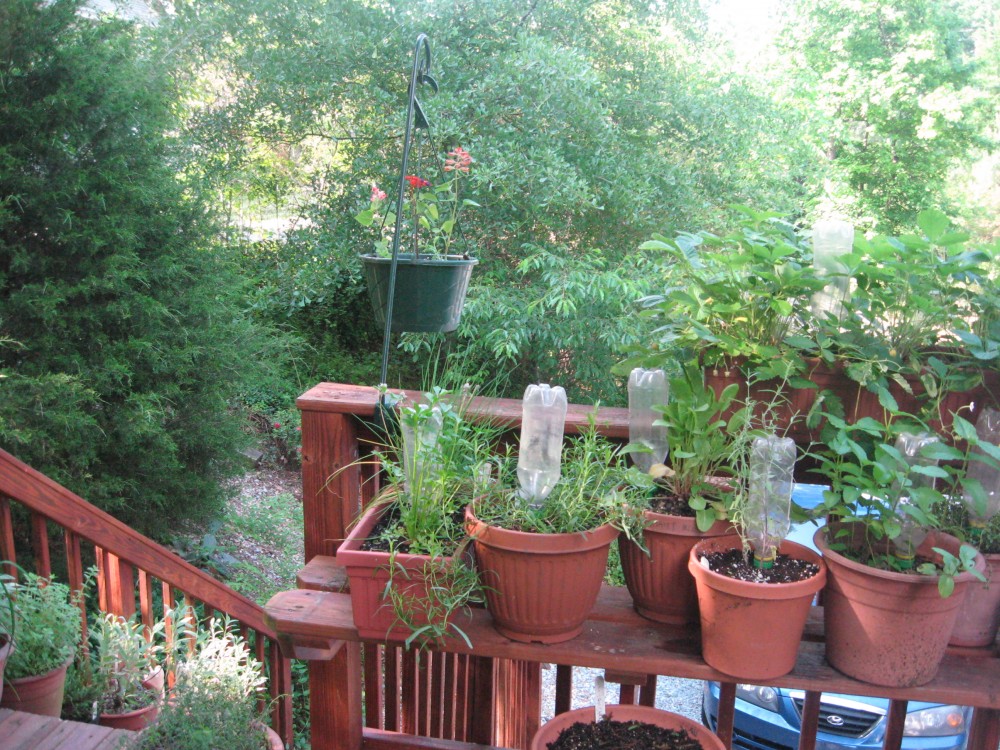
img_3910.jpgSome of the herbs that I’ve grown were plopped into pots in a rather topsy-turvy fashion.  With the summer heat here it takes a lot of watering keep the smaller pots going, and some things just didn’t make it, whether from erratic watering or just plain old age.  This year I’m going to try to be a bit more organized and make the herbs a little easier to care for.

I’m fortunate to have a good friend and neighbor who is a serious plant person, and gardener, with a garden consulting business–Sharyn Caudell at Gardener to Go.  She’ll look over your garden space and give planting advice, show you how to plant, make suggestions about what to plant and where to plant it.  I’m shamelessly taking advantage of her know-how to  improve my herb plantings on the deck.  In exchange for some help on one of her projects she’s made suggestions about how I can improve the container herb garden. She is going to do a post on growing herbs in containers for us.

First thing on the  list was bigger pots with several plants in each so that there will be less watering.  I’m sure that some of my herbs that were in smaller pots bit the dust because of erratic watering during the last summer.  Others were just old plants–even perennials don’t last forever.

For my plants, it’s a trip to Gunter’s Greenhouse and Garden Center since their plants are locally grown.  They will have big bags of soilless mix for potting too.  Then it’s time to get my hands in the dirt–well, the potting mix.

Chilli con carne redux update

I’ve finished the “fast” version of the chilli con carne that I posted about in Chilli Con Carne Redux!  I’ll concede that it’s only sort of faster in terms of the active prep time–it still needs to cook long and slowly, but it is a success.  I don’t think that I can tell the difference (tasted side-by-side with the more laborious version from the freezer) and friends have given it the nod of approval.  So here are the changes and additions to the original chilli con carne that I posted.

  • After the bacon browned, 3 tablespoons of tomato paste was added while the onions were sautéed, and this was browned–again to enhance the umami, not to add tomato flavor.
  •  None of the meat (pork or beef) was browned before adding liquids.
  •  Added bay leaves to increase the earthiness (used five large for this 6 pounds of meat).
  •  Added Mexican oregano–about 2 rounded teaspoons. (You really do want Mexican oregano for this–much different flavor than Turkish or Greek (Mediterranean) oregano–after all it is an unrelated plant, but worth having in the kitchen if you like chili.)
  •  Sun-dried tomatoes (about 1/2 cup chopped) were added for more umami even though this was NOT made in a slow cooker, I was not aiming for tomato-flavored chili.
  • During the cooking time I tasted some in a bowl with a little fish sauce added (yep, I did get up the nerve to try this) and it tasted wonderful; so I added about 4 or 5 tablespoons of fish sauce.  (I suspect that if you don’t have fish sauce a couple of anchovy filets thrown in would have the same effect.)
  • The final thickening was one with a brown roux made with masa harina.  For the fat in this roux I reserved about 1/4 cup of the fat from the de-fatting step.  I heated this and made sure that all liquid was evaporate, then added about 6 tablespoons of masa harina and cooked it until it was a medium brown and toasty smelling.
  • Because of my work schedule, this was cooked in a lower oven (about 195° F) for about 10 hours.

After another run on this I’ll have to post a revised recipe for the “fast” and easier version, but if you feel so inclined you can work with these changes–after all chili con carne is one of those things that really doesn’t need a recipe to be followed strictly.

The passing of the autumnal equinox…

I’m now well-established in the routine of the fall semester teaching. The autumnal equinox has come and now the nights are starting to lengthen, which means it’s time to prepare the herbs growing on the deck for the winter.

pots of sage and oregano on stairs

sage & oregano

Most made it through the summer, though looking a bit ratty now, and even having some strange things growing in the pots as well.  Some will likely remain usable most of the winter in this climate (chives, sage, maybe oregano, and the “walking” onions), or at least come back in the spring:  sorrel, chives, lemon grass, and, if I’m lucky the summer (French) thyme, and French tarragon.  Others will die back if I don’t bring them indoors when it gets cold: ginger, turmeric, and sweet bay (Laurus nobilis).

French thyme and French tarragon in small pots

French thyme & French tarragon

Many of my herbs suffered this summer, and some, even though perennials, are aged enough that they need to be replaced and others repotted.  While that’s going on I’m going to try to make the herbs a bit more manageable–so that I can take a bit better care of them than I managed to do this summer with a bit less effort. During some of the long hot weeks it seemed like I just could not keep up with the watering, especially on those that were growing in smaller pots.

I’ve decided to get some professional advice on my container herb garden.  I’ve a good friend and neighbor for whom I did some garden tending while she was out of town, and in payment, I’m taking advantage of her professional services to advise me on revamping my front-deck herb garden for next summer.  I’d like to keep my French tarragon, since I like it better than Spanish tarragon or Mexican marigold (Tagetes lucida), though that’s good to have too.

large lemon grass

lemon grass

I have to say that one new addition this summer seemed to thrive regardless of heat and my watering or lack of it: lemon grass!  It almost became a bit overwhelming–it started on the steps with the sage, and had to be moved because it was so large.  It was a rather lovely contrast to the turmeric and the culinary ginger plants–overall a very tropical feel to my deck this summer.

I don’t want to give up any herbs that I had growing so conveniently right around my front door–I just want to make it a bit more manageable!  I suspect that I’ll find more that I want to add, but I’ll try to restrain myself and keep it within reason though I may want to trade some of the hostas or other ornamental plants for more edible plants.

hostas and caladium

not herbs!

Fresh rhizomes!

pomegranate tree, culinary ginger, and tumeric in large containers on deck

I’ve had a lovely display of tropical green plants this summer–and the fun (and flavors) of harvesting my own rhizomes from the “garden” on my front deck.  These two plants are worth having for the appearance, as well as the flavors from the leaves, stems, and rhizomes of both these plants.

As autumn progresses towards winter, these both will likely die back, but I can anticipate their reappearance in the spring. I doubt that I have enough light indoors (even with basic grow lights) to keep these plants alive, healthy, and flavorful, so I’ll just protect them from freezing, and wait as patiently as possible for spring! Neither of these seem difficult to grow here in NC: water, occasional fertilizer, and this is what I got to enjoy.

large plant of culinary ginger in pot

culinary ginger

The culinary ginger (Zingiber officinale) has been a pleasure all summer–the rhizome that is most often used in cooking is wonderful when it’s harvested young!  It is not fibrous, and may not even need to be peeled; the flavor is milder than the mature rhizome that we usually retrieve from the market, and can be use fresh to add some spice (but not burn) to salads of both fruit and greens.  Fortunately, the rhizome grows very near the surface so that it’s easy to harvest as needed and allow it to just keep right on growing.  If you have well-established ginger, the young, tender stems are also edible, as well as the rhizome–and since I’m a ginger lover, I sometimes add them to salad greens.

The plants in this picture are from established rhizomes that wintered over undisturbed–I was very restrained in harvesting it last year.  With protection from of the rhizomes from freezing,  it came back this spring.  It’s now on my list of “must have” herbs and spices. I’ll be moving this humongous pot indoors, but I’m afraid that I really can’t provide enough light to have it thrive during the winter indoors, so I’ll be anticipating the reappearance next spring.

Turmeric plant

The other addition this summer (also from second-year rhizomes) was turmeric (Curcuma longa) which I like to use fresh. (The rhizomes can sometimes be found fresh in Latino or Asian food stores.)  This is also a tropical plant so I’ll try it indoors, but I doubt that I can give it enough light either–so I’ll have to wait for spring for more rhizomes.  Turmeric is sometimes called “Indian saffron” because of its flavor and color–and I like to add it to rice just as I would saffron.  (Warning:  It will stain almost anything so handle with care.)  The fresh root can be used in pickles, and I’m sure with some searching I’ll find more ways to use it. The young rhizomes, like those of ginger, and tender and not fibrous like the older, mature rhizomes. Though it seems to grow deeper I harvested it like the ginger, and it did not seem to harm the plants.

As well as the uses for the rhizome, the leaves can be used to wrap food for cooking, and possibly included in other Asian recipes for flavor–I’m looking forward to trying this before these lovely large green leaves are gone for the winter–possibly with some chicken thighs on the grill.  I’ve even found references to use of turmeric leaves and roots in sweet dishes as well as savory ones. I’ve always kept turmeric powder on hand in the spice cabinet just as I do ginger root, but the fresh turmeric has now earned a place in my list of “usual” herbs and spices as well!  Many new flavors to explore.

A son goût! 

Red, white, and blue roasted potatoes

Happy Fourth of July to all!

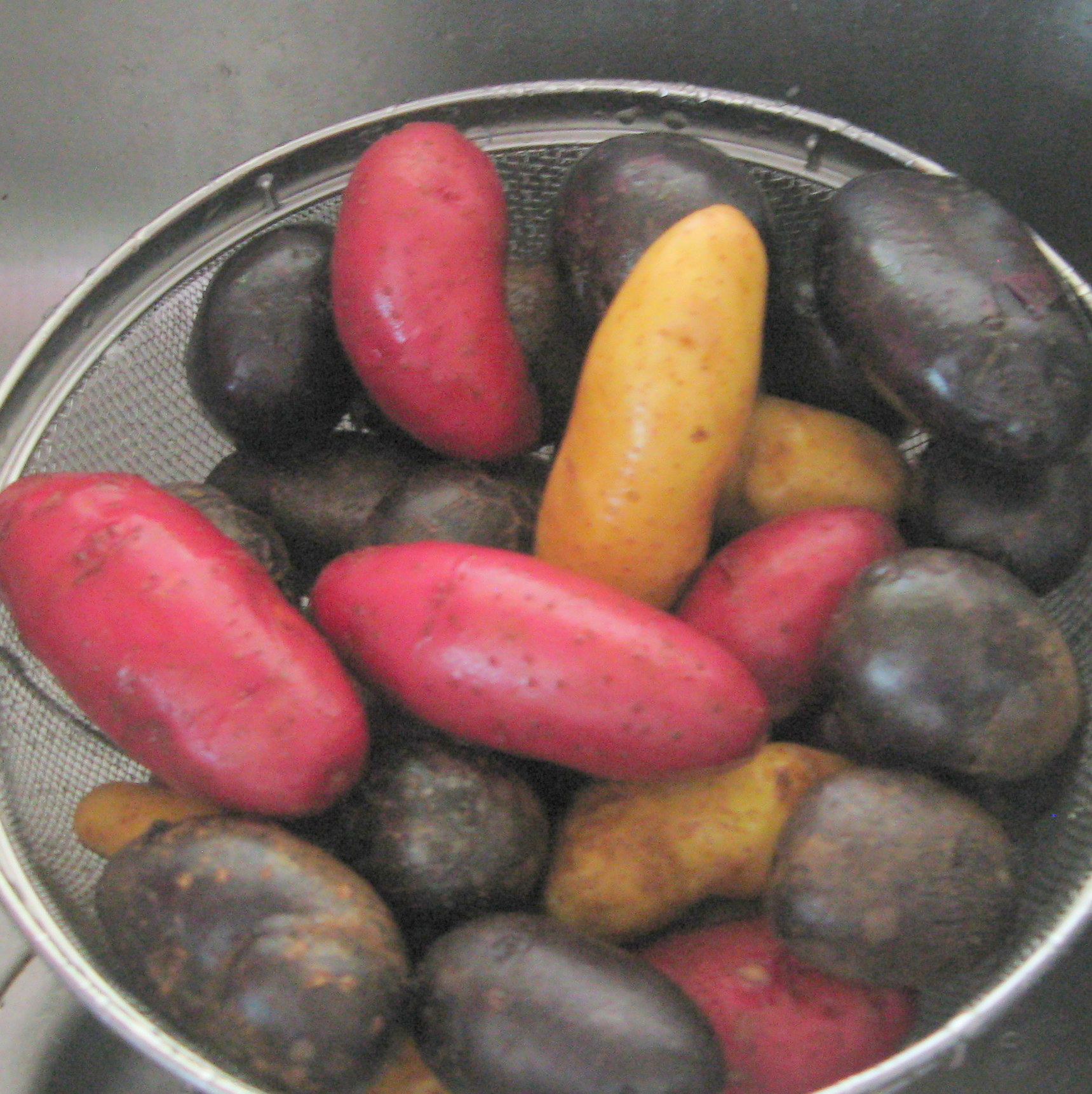
mixed color potatoes in colander

I really was planning to do something special today–more smoked lamb and goat shanks–but I admit to turning to a total wuss, wimping out…as I looked at the weather forecast for the week.  Even though those are easy, it still requires some minding of the grill, and I just could not face it.  I resolved to have a quiet, cool Fourth of July–just me and the cat–indoors with the air conditioning…and I woke up this morning wishing I’d not been such a wuss.

Saved by friends!  An impromptu invitation to join them for grilled chicken this evening.  So–I’m having my quiet Fourth, but with friends and neighbors.

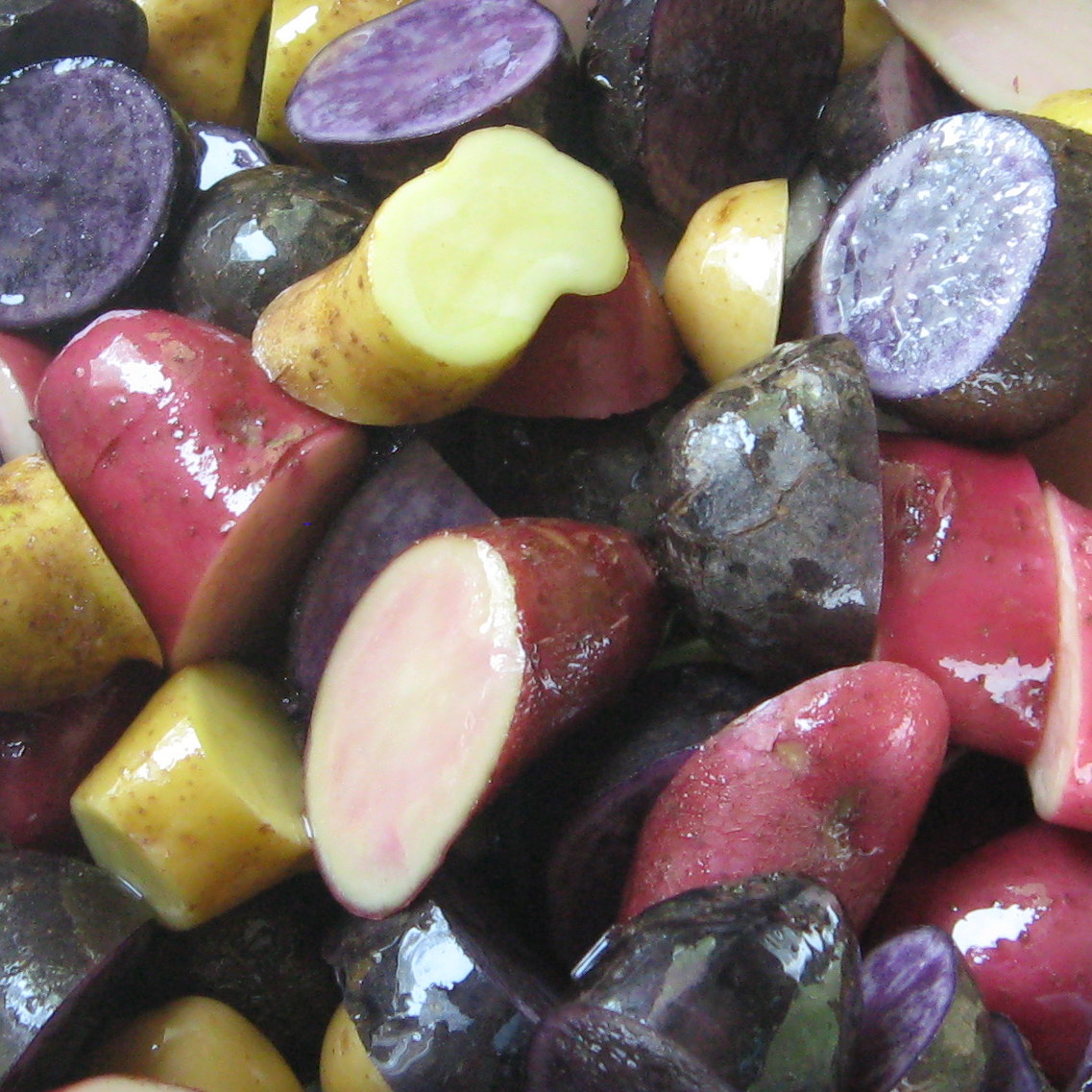
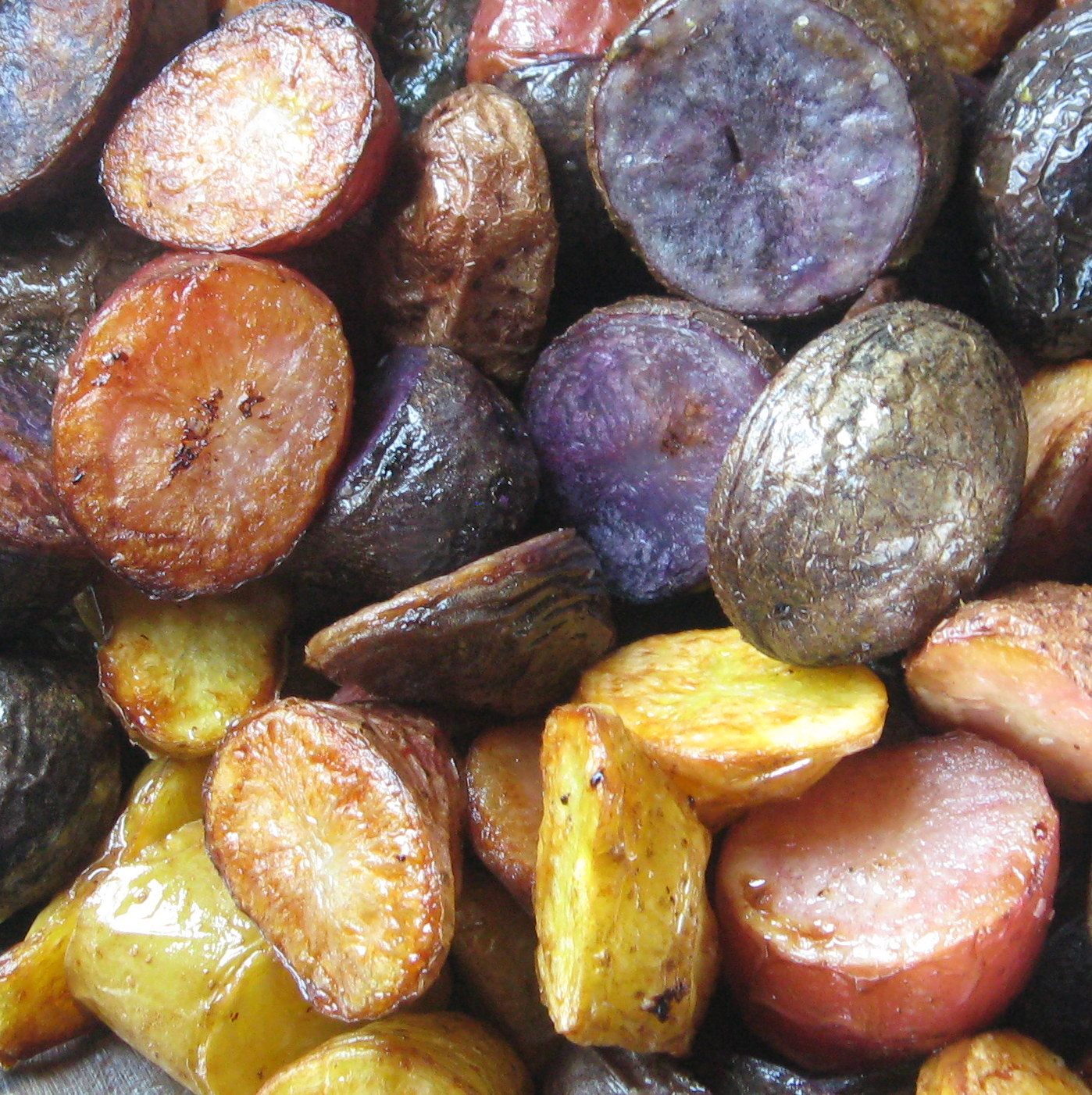
close-up of cut purple, pink/red, and yellow potatoes

Not to go empty-handed, I am making some patriotic roasted potatoes–red, white, and blue–Red Thumb, Russian Banana (okay, bit of fudging here), and Purple Majesty potatoes (new ones from the farm).  Since it’s HOT (my thermometer is reading 98°F now), I’ve decided that those roasted potatoes are going to turn into something that can be eaten at “room temperature”, that will be light and refreshing, and compliment the chicken.

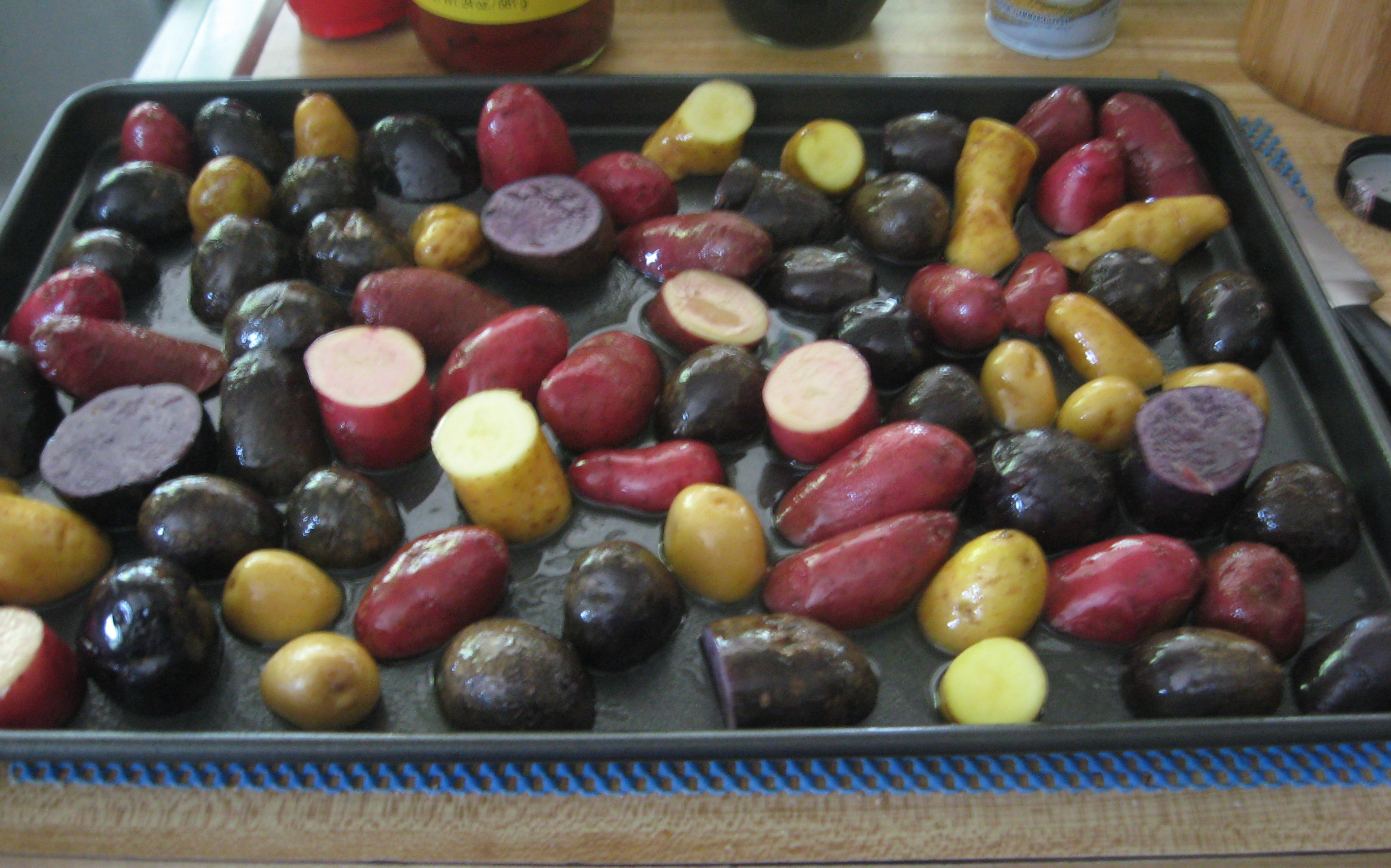
I’m taking  newly dug tri-colored potatoes and scrubbing their delicate skins carefully, cutting as needed to have them equal sizes so that they cook at the same rate, tossing them with a little olive oil; then into a preheated pan and into a 350° F oven until they are tender.

cut and oiled potatoes on baking sheet

I’ve done what America’s Test Kitchen recommends and placed cut sides in contact with the baking sheet so that at least some of the potatoes will brown to give roasted flavor. Now for some complimentary and contrasting flavors to finish these. Since all these do taste a bit different, and for me one of the fun things about this is to be able to taste the individual potatoes and to compare them–think about comparing wines–I want light seasoning–nothing to overwhelm the potatoes themselves. The only seasoning at this point is kosher salt.

Since it’s hot outside (my thermometer is now reading 99.7°F ), I’m thinking light and cool flavors.  I don’t want “potato salad”–so vinegar is out, but I do need something “bright”–and light, and something cool.  Time to check out the herbs on the deck, and the crisper drawer.

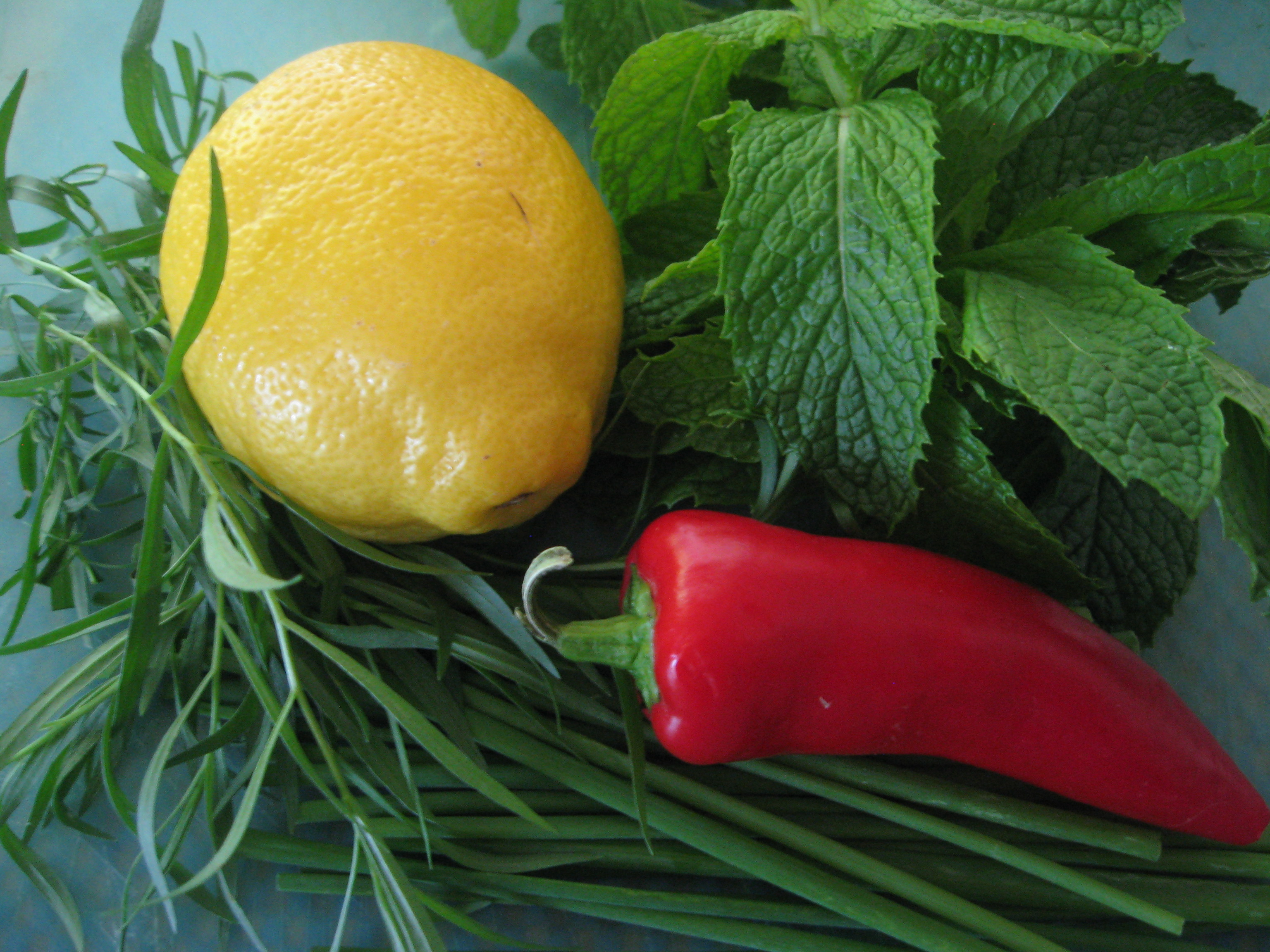
lemon, tarragon, chives, mint, and chili peppers.

Chicken makes me think tarragon.  Cool makes me thing mint–hmm.  Let me smush a couple of leaves together and see how that smells.  Tarragon–warm, mint–cool.  Need some brightness to set off the earthiness of the potatoes–lemon zest, and maybe just a bit of lemon juice over the potatoes while they are still warm.  Seems a good start–but not quite there yet.  Needs a little “spice”–some very finely minced red chili pepper might just do it.

After the potatoes had been in the oven for 30 minutes, I used the tip of a paring knife to check doneness–not quite; and, not quite brown enough.  (I probably should have used the heavier half-pan baking sheet instead of this one–drat.) I kicked the oven temperature to 450°F for another 15 minutes and checked again.  Perfect!  Brown potatoes–so out of the oven, ready for the first seasoning.

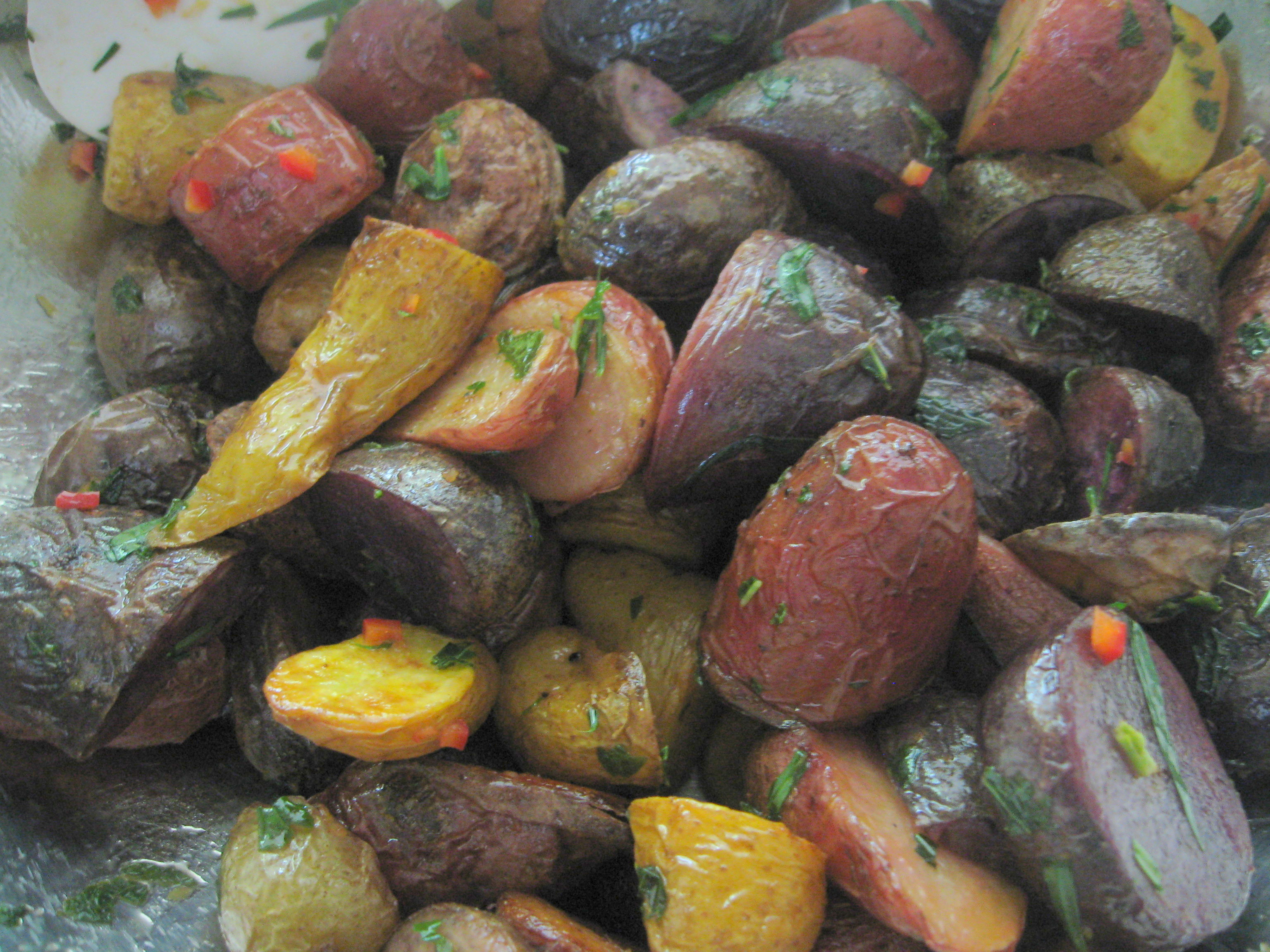
roasted potatoes--browned edges of the red, yellow and purple  ones.While still hot, I tossed them with the zest of one lemon and most of the juice of the lemon–nice bright flavor to contrast with the brown and earthy potatoes.  After cooling a bit, I tossed in about a tablespoon each pretty finely chopped French tarragon and mint. That got the first taste of cool mint, followed by the warm flavor of French tarragon.  So far so good.

I let them stand for a bit and tasted again–the lemon flavor is there but not overwhelming–the juice has added just a bit of tartness, but not enough to taste like a “potato salad”. Now, I’m debating chives and chili pepper.  I taste the chili pepper–it’s not screaming hot–and I think that just an occasional bit of heat as you eat the potatoes would be nice.  I seeded and removed the ribs, and finely minced about 1/5 of the pepper and tossed that with the potatoes. (Still debating about the chives–I really don’t want them to taste like ersatz baked potatoes.)

seasoned IMG_6935After standing for a bit longer, I tasted again, and decided that chives are not what is needed here–I probably should just leave them alone!

So the final seasonings are the zest of one lemon, lemon juice, mint, tarragon, and just a touch of  red Serrano chili pepper, and a very light sprinkle of a good fruity, extra-virgin olive oil.  I hope that after standing a bit more (not to be refrigerated before we eat the at ambient temperature–or maybe a little less–thermometer now at 100.6°F ) there will be flavors of warm and cool herbs, the brightness of lemon (juice and zest), and an occasional burst of heat from the chili pepper.

Using the baking sheet so that the potatoes are spread out and don’t steam, and preheated does really help get browned roasted potatoes.  If they are too crowded, they will only “steam” and not brown–not really roasted.  The browning is, after all, the whole purpose of turning on the oven!

It’s not smoked lamb shanks, but it’s going to be a pleasant evening with friends–and I do think that something similar will return to go with those lamb shanks when they happen later–when the temperature does not turn me into a total wimp!

…and yes, I’ve done that final taste–yum!  No chives though.

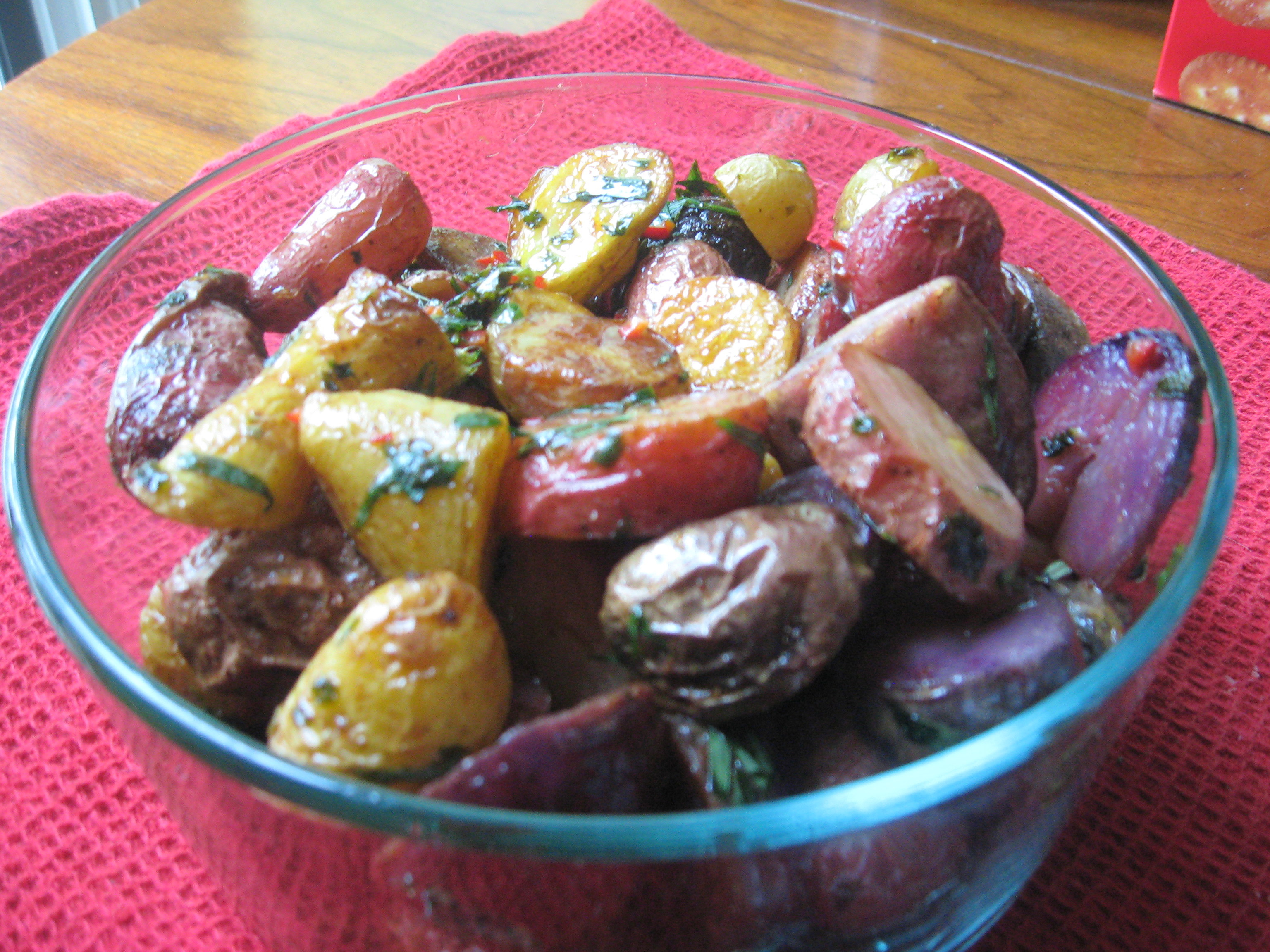
roasted potatoes, with herbs and chili peppers in serving dish.

Leftovers? Possibly–it is a big dish of potatoes for three, but leftovers here are desirable.  Tomorrow they can become a roasted potato salad–perhaps with just a splash of balsamic vinegar, adding some fresh tomato, and cucumber, and, perhaps, some celery, radishes, crisp sweet onion or some freshly snipped chives.

Happy Fourth of July!  A son goût!  

Haricots verts with herb-infused oil

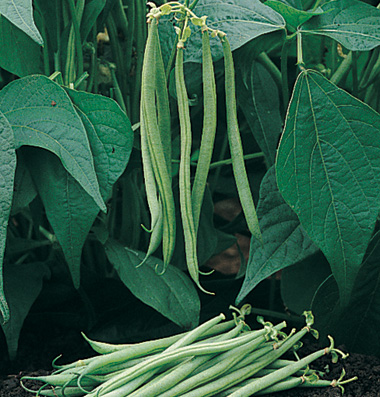
Taverna filet beans

haricots verts (Taverna)

Yes, it is French for green beans–and they are Phaseolus vulgaris, but they are special green beans–not like Kentucky Wonder, or some of the other rather common beans.  To find them in the seed catalogue you need to look for “filet” beans.  They are bush beans, but the pods are small and slender (when harvested appropriately). Not having a large garden, I don’t grow my entire supply of green beans–the usual pole beans or bush beans like Kentucky Wonder–I buy some from the farmers’ market and I even use frozen ones in the wintertime.

These little beans are something that does get space in my garden or in a container on my deck–with successive plantings throughout the summer so that I can dash out and pick a single-serving batch when I want them.

My favorite way to cook them is to steam them very briefly (about 5 minutes) until just tender, shock  them in ice water so that they stay brilliant green, and  toss them with some extra-virgin olive oil infused with fresh herbs, and served at room temperature.  A favorite of mine for those hot summer days when you’re being fussy about what you eat.

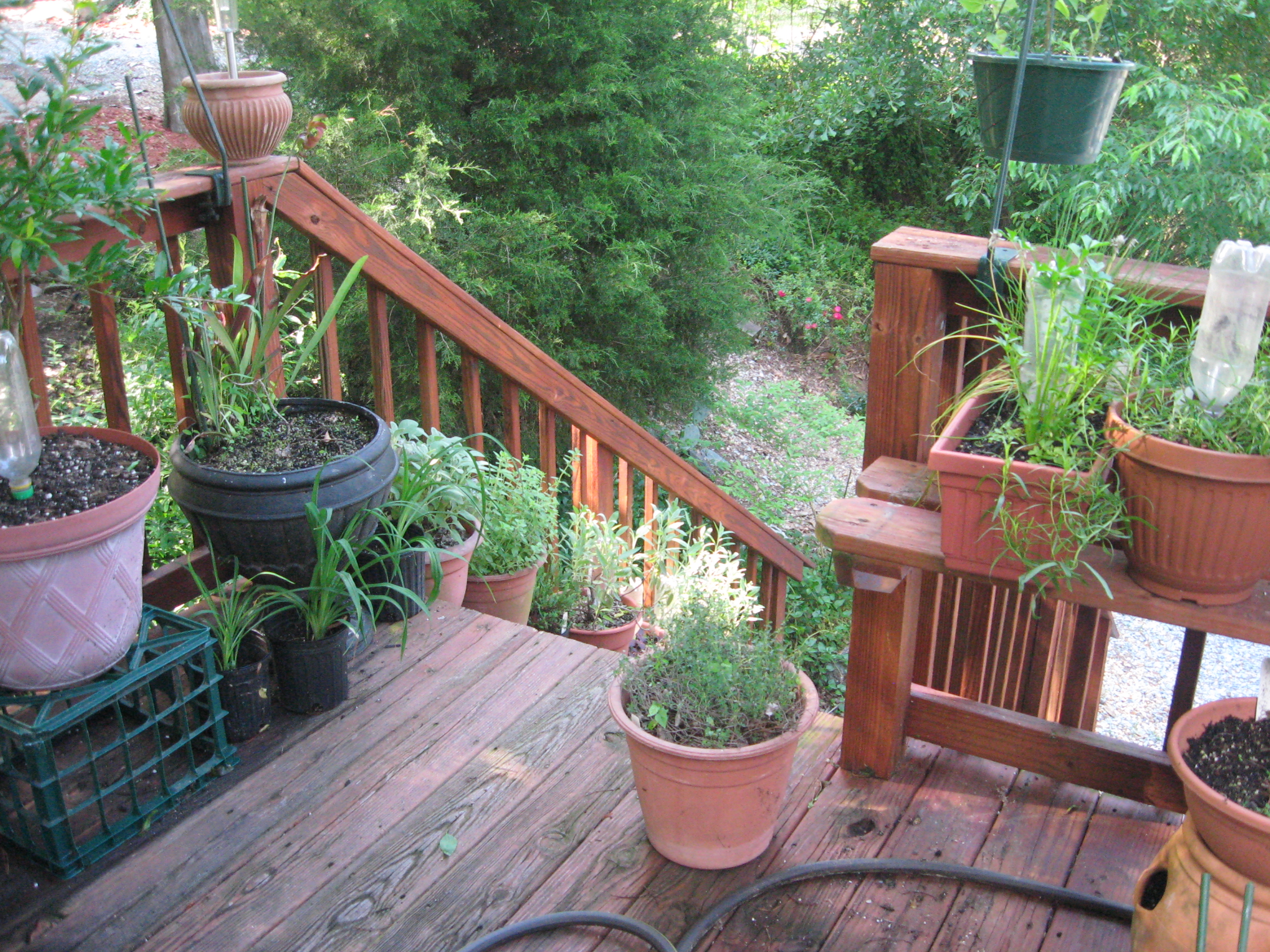
containers of herbs on deck and stairway

herbs

Since I do grow a lot of herbs on my deck with containers arranged on the stairway, and since I prefer not to let them bloom since that affects the flavor of the herb, I keep them cut back to prevent blooming–or grow varieties that do not bloom as readily as the common culinary herbs.  I find that I often need to give the marjoram and the oregano a “butch” cut.  This does not involve a neat trim–it’s taking the hedge shears with the long blades and lopping off the tips.  That leaves me with a handful of fresh herbs to share with my neighbors, or to use to make herb-infused oils to have on hand, and to use during the wintertime.

It’s simple to make herb-infused oils.  For immediate use, you can simply blanch the herbs, then “shock” in ice water, squeeze dry, and purée with enough oil to make a slurry, then add more oil.  Let stand, refrigerated, for 24 hours and strain through coffee filter.  These can keep for about a week, refrigerated.

For longer storage, I prefer to heat the herbs in oil to about 185 to 195° F and then strain.  At that temperature, you should be safe from any bacterial growth.  The last batch of oil that I prepared, I washed, blanched and dried the herbs; then chopped them and popped them into my very small slow cooker overnight, and then strained them.  This oil is probably not as bright green as it would be had I not heated it for that long, but the aroma is really great.

My favorites with the haricots verts is either sweet marjoram, or Syrian oregano (also sometimes known as zaatar).  Both of these herbs seem to intensify the sweetness and the “bean-ness” of the haricots.

Most herbs lend themselves well to making flavored oils:  sage, oregano, thyme–whatever is your favorite–try different ones with the beans, and vary it according to the flavors of other dishes served at the same time.

A son goût!