…and now it’s turkey soup!

Remember those turkey thighs that I roasted a couple days ago? They have really been a bargain.  I spent about $5 on the package of thighs–two small-to-medium ones.

I had my roast turkey with sides of potatoes and cabbage (with juniper berries). Then I had two full-size sandwiches, and a half sandwich for lunches. Now I’m finishing the turkey thighs with a very hearty bowl of soup (and a  glass of good wine).

small Rival Crockette

a crockette

I popped those thigh bones (with what meat wasn’t easy to carve for sandwiches) in to my tiny little single-serving crock-pot to make some stock–I just added a little salt, a bay leaf, the brown stuff that I deglazed from the roasting pan, and enough water to cover the bones. After slow cooking overnight, I removed the thigh bones.  The meat just fell off into the pot.

In the same little crock-pot (don’t want extra dishes to wash), I added a small handful of barley, some dried mushrooms of various sorts–including shiitake, chanterelle, and porcini. The other things that went into this soup were the leftover cabbage (with juniper berries) and a few potatoes that were roasted with the turkey.  (You may be thinking that this is pretty heavy on starch, but to finish the soup, I added some green stuff.)
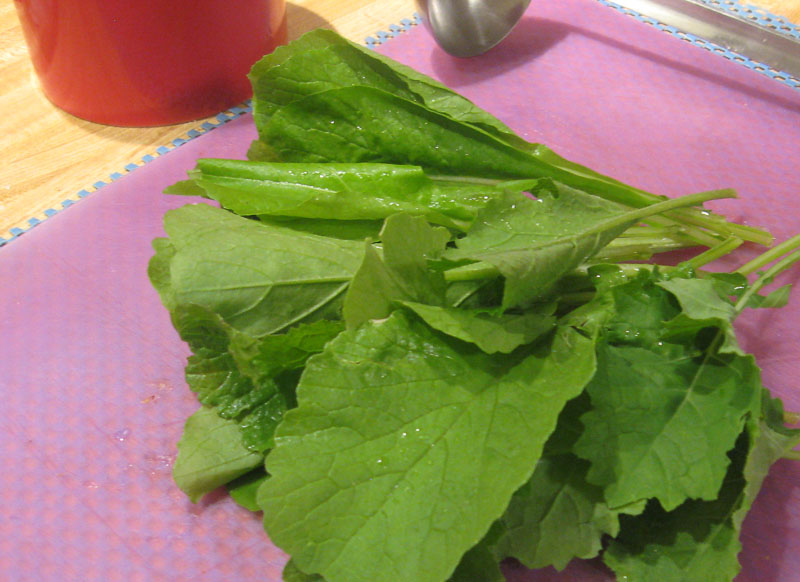
small leaves of greens

mixed greens

About half an hour before I was ready to eat, I went out to the garden (which I share through the good graces of a neighbor) and picked a good size handful of small kale, turnip, and mustard greens.

After washing, I cut these in bite size pieces (though that was almost unnecessary as they were really not as big as my hand). They went into the crock-pot; in about 20 minutes they were still bright green but tender.

I did a final adjustment of salt using French Grey sea salt, and finally added several drops of black truffle oil to finish the soup.

-<>^<>-

I’ve had my bowl of soup for supper this evening–and it looks as if I’ll get one more meal out of those turkey thighs–with the barley, and the amount of meat that was left on the bones, there is easily another serving of this soup for lunch or supper tomorrow. (I’m sure that by the time I reheat it, those greens won’t be quite so bright green, but the flavors may have melded with the other ingredients so it should be good–maybe even better than this evening.

bowl of soup with greens

a warm, hearty supper

-<>^<>-

I opened a bottle of wine this evening that was a completely unknown to me. It was a limited release called “Dark” from Apothic. I was completely beguiled by the description that said that it “blends dark fruit flavors of blueberry and blackberry with opulent notes of coffee and dark chocolate”.  How could I possibly pass that up? (I found it while shopping at Harris Teeter–just after I had bought a case of something called “Besieged”–more about that one later.)

I was surprised how dark it was when I poured it into the glass! (I even tried to take a picture–but it just looks almost black–so forget that.) It is definitely a “big” wine and right out of the bottle it was fruity and mellow–but after breathing for a bit it lives up to its description.

I thought it might overwhelm my bowl of turkey soup, but with the juniper berries, the rather emphatic mushrooms, the flavors of the greens, and the truffle oil, it turned out to be a great combination.  Fortunately there is some of the wine left for tomorrow’s soup! This is one time when I’m looking forward to the “leftovers”.

Cabbage with juniper berries

I’ve always liked cabbage–slaw, steamed, and even boiled if it was not cooked to mush. I’ll even just nuke a wedge with a little olive oil and salt sprinkled over it and call it a vegetable dish. It’s a good keeper that doesn’t get foul if it stays in the crisper for a while–especially if you just peel off the leaves from the outside of the head as you need them, instead of cutting the head in pieces.

Cover of book

Nigel Slater’s “Tender”

I’ve read a lot of Nigel Slater lately (Kitchen Diaries, Ripe, and Tender). I like his style: very descriptive of the garden, and the kitchen–almost makes me feel that I’m right there with him. I’m anticipating the followup volumes for Tender and Kitchen Diaries; his website is also well worth checking out.

Tender is a vegetable cookbook (as well as a gardening book)–not a vegetarian cookbook, though most recipes could be pretty easily adapted if you’re of the vegetarian persuasion.  The discussion of each vegetable includes cooking as well as growing information, and most delightfully, a discussion of seasonings for the vegetable.

His recipes are simple, designed to make the most of excellent fruits and vegetables without being at all fussy.  Quantities are rather loosely given, which makes it ideal for my improvisational style of cooking for myself (and the cat). I’ve found all sorts of thing I want to try, but here is one that particularly caught my fancy–perhaps because it’s fall, or maybe just because I had a head of cabbage in the crisper.

One of the seasoning he mentioned for cabbage was juniper berries. I’ve used juniper berries for other dishes, but can’t honestly say that I’d ever thought of trying them with cabbage.  Here’s what I did to try this out.

Cabbage with juniper berries

Ingredients

  • About 6 leaves from a medium head of cabbage
  • 3 juniper berries
  • dash of red pepper flakes if desired for spice
  • dash of salt to taste
  • small pat of butter

Preparation

  • Flatten the leaves on a cutting board and cut into bite-size pieces
  • Add crushed juniper berries, (see note below.), chili flakes if desired, and salt.
  • Toss the cabbage to distribute seasonings.
  • Add butter and 1 tablespoon of water.
  • Cover and microwave for about 4 to 6 minutes, until cabbage is still bright green, but tender (See NOTE).
  • Serve.

Cook’s notes

  • Though I used white cabbage, I’m sure this would be fine with red or savoy cabbage as well.
  • The juniper berries are very oily, so I did not put them in my spice grinder–I used a mortar and pestle that could be cleaned easily.
  • The microwave really seems to bring out the heat in the chili peppers, so add less than you might were you just going to sauté the cabbage.
  • The amount of water needed will depend on whether the cabbage is just washed and still wet, and/or how tight the cover is. I don’t usually use plastic wrap, but Pyrex bowls with vented covers, so I do lose some steam.
  • Sauté or steam-sauté would work as well–I just didn’t want to wash another pan when I was preparing this after a day of indexing work.

I’ve tried it now–right up there with caraway seeds.The combination is a winner–I’m not sure I can easily describe what the juniper berries do for the cabbage, but it certainly puts it in a different class from “boiled” cabbage that I grew up with and what is typical of “southern” cooking. I think it adds background earthiness and complexity to the flavor. It was no longer “just” cabbage!

It was a side for roast turkey thighs, but I can easily see this as a great side for pork, or most particularly for duck legs or duck confit.  I’ll certainly make it again–probably on many occasions.

I didn’t use extra virgin olive as I normally might with cabbage because I just could not get the flavors of that and the juniper berries together in my head. (Cabbage with a little extra virgin olive oil is excellent, though.) If I were making this to go with duck, I make it with duck fat instead of butter.

bowl of cooked cabbage

cabbage with juniper berries

<>^<>

These links are to The Regulator Bookshop, my local, independent bookstore. I like to use them whenever possible–though I do sometimes go to Amazon.com. I have no connection with The Regulator Bookshop, such as an affiliate status–I just support local independent business when I can.  They are very efficient in processing orders, even if the book you want is not in stock.

$36.00

ISBN-13: 9781607740377
Availability: Usually Ships in 1-5 days
Published: Ten Speed Press, 4/2011

$36.00

ISBN-13: 9780670026418
Availability: Usually Ships in 1-5 days
Published: Studio, 11/2012

$36.00

ISBN-13: 9781607743323
Availability: On Our Shelves Now
Published: Ten Speed Press, 4/2012

$65.50

ISBN-13: 9780007256037
Availability: Special Order – Subject to Availability
Published: Fourth Estate, 9/2012

Some good eating ahead…

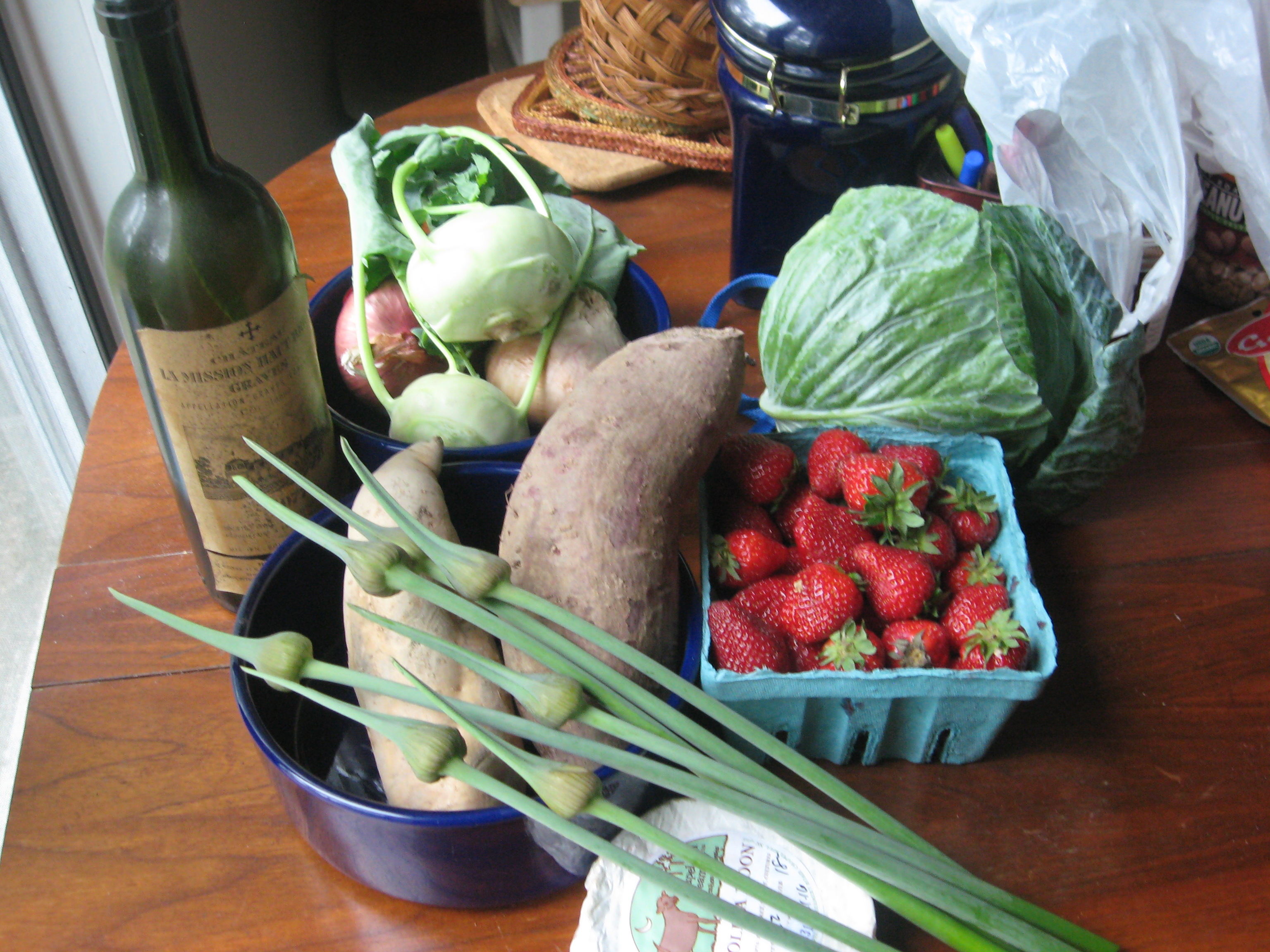
I’m back from the farmers’ market ready to settle in for the afternoon with some hot chocolate, book, and cat.  It was a chilly market this morning with the wind blowing a lot of the time–it was more than just breezy–so it feels so good to be indoors.

brought home from the farmers' market.

treasures from the farmers' market

I came home with lots of “finds” from the market:  strawberries, kohlrabi, both white and blue sweet potatoes, cabbage, garlic scapes, and one of my favorite cheeses (Carolina Moon) from Chapel Hill Creamery.  Now for some meal planning!

The weather is still cool enough that I think that the cabbage is going to be joined by some country-style pork ribs in one of my favorite “comfort foods”–braised pork and cabbage. A fair number of the strawberries have already disappeared while I was at the market–breakfast.  I’m still contemplating the fate of the garlic scapes, the sweet potatoes, and the kohlrabi, though some of the kohlrabi may just be eaten as a salad, just dressed with a vinaigrette.  Perhaps the other will find its way into the sauté pan.

I’m still contemplating the garlic scapes–a quick search has turned up a number of possibilities from blogs that I like to read.

I was so pleased to see white sweet potatoes at the market–they’re not as moist as the yellow/orange ones–that’s likely to end up as a baked potato.  I’ve read about blue ones, but this is my first time to try one, so that will be an experiment.  The grower tells me that the blue keeps it color when cooked and that the texture is similar to the white–but that may call for some research and recipe hunting although I might just roast a mix of the white and the blue so that I can taste them  side by side.

The cheese?  Well, that’s likely to be paired with some good bread and a nice robust red wine as my evening snack!

Under-appreciated veggies: Brussels sprouts

bagged Brussels sprouts at Harris Teeter supermarket

Brussels sprouts

Obviously I’m writing this because I have Brussels sprouts in hand now!  They are a favorite winter veggie in my kitchen but I think they are sometimes under-appreciated and under-used by those of us doing single-serving cooking, possibly because the come in packages that contain too many.  Some of these may be underused because we’ve had them prepared in ways that did not really let them make their best impression.  I thought I’d address some of these, especially the cool weather crops–starting with one that seems to be a love-it-or-hate-it vegetable: Brussels sprouts.  Until I started cooking for myself, I was in the hate-it camp.  Most of the Brussels sprouts that I had were over-cooked, mushy, and bitter; in a word, nasty!

Fortunately, I’ve discovered ways to make Brussels sprouts a desirable vegetable because they have some excellent qualities: they are  inexpensive and readily available in the wintertime.  They are nutritious–I’ll not give you all the details here, but you can find all that sort of information from the Nutrient Database Laboratory.  They are versatile–you can use them as a substitute for cabbage in some recipes, and (a concern if you’re cooking for one), they store well in the fridge.

First, storage:  Brussels sprouts often come prepackaged in a mesh bag that’s about a pound or so.  That’s a lot of Brussels sprouts if you’re cooking for one and had to use them all at one time.  Fortunately that’s not the case–they’re small, separate units so you are not trying to preserve a cut vegetable (always more difficult)–big bonus for those cooking for one.  I store mine with a paper towel that has been dampened and then squeezed mostly dry, in a partly open zipper-lock bag in the vegetable drawer.   I’ve seen suggestions (The Victory Garden Cookbook–see bibliography) that the flavor gets stronger with storage.  I’ve not found that to be a problem, but that may be because I do keep my fridge really cold, and the damp paper towel helps even out moisture. However, if you do find that you don’t like the taste after they’ve been stored for a few days, the other option of something to do with the rest of the bag would be to blanch and freeze part of them.  Blanching is simple:  bring a large pot of water to a boil, salt it heavily (after it’s come to a boil), and put in the Brussels sprouts for about 2 minutes; then “shock” in an ice bath, drain, and freeze.  (The purpose of the blanching is to stop enzyme action, and it keeps the color bright and green.)

Now for cooking them. Personally I’m not a fan of boiling veggies as a method of cooking them (other than blanching before freezing)–there are so many nutrients that are water soluble!  So my preference is for some cooking method that does not involve putting them into huge quantities of water to cook completely.  So that leaves steaming, stir-frying, roasting, and  microwaving.  The best way to avoid having “nasty” sprouts is NOT to overcook them.

I’ve added them to soups, used them instead of cabbage with braised pork, and added them to one-dish meals like roasted potatoes with sausages, and lots of other things.  They lend themselves well to improvisation and substitution.

Recipes for steaming, blanching, roasting and microwaving can be found in a number of cookbooks so I’ll not post here, except for the recipe that I just made to go along with my baked sweet potato.

For more information on how to cook and specific recipes, I suggest you might want to check The Victory Garden Cookbook by Marian Morash (see bibliography).  As I was sitting here at the computer writing this, my e-mail notification popped up and said it had received a notification of a new post from domestic diva M.D., a blog that I think is worth following for anyone who cooks.  I was surprised to see that the subject was  roasted Brussels sprouts.  

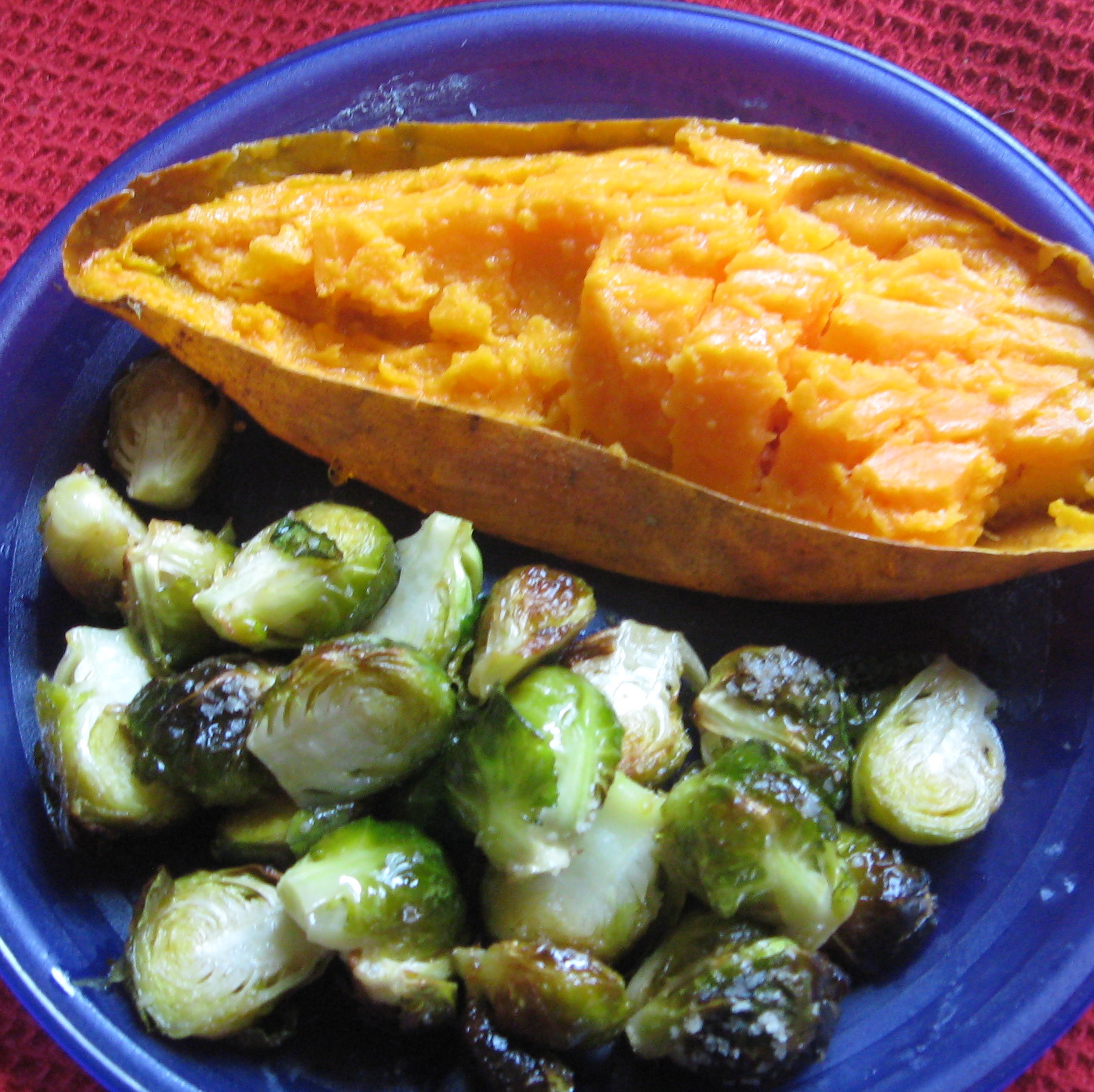
Since it was about lunch time, I was preheating the oven to bake a sweet potato (a very large sweet potato so that I’ll have some for another use as well).  I read the recipe and grabbed the last of the Brussels sprouts from the fridge.  I didn’t have the full amount, but this is a recipe that does not depend on the quantity–which is great for us solo cooks.  Since I was baking my potato in a 350 ° F oven, I did alter the cooking time just a bit–I popped the Brussels sprouts prepared as in the recipe into the oven for about 45 minutes right along side my sweet plate with half  a baked sweet potato and roasted Brussels sproutspotato, and there was my colorful, nutritious lunch!  This is the kind of improvisation that can make cooking for one easy–many recipes aren’t dependent on how many you have or how many you want to cook and eat right now.

You should check out this recipe.  I’d not used garlic powder with them before, but it was yummy and much easier to use than minced garlic.  One of the comments on this post suggested adding Parmesan cheese–I did not try that because I’m out of Parmigano-Reggiano (horrors!), but it sounds  like something that would taste great!

Braise-roasted sausages, potatoes, and Brussels sprouts

Another dreary, rainy, winter day…not particularly cold, but as usual on a day like this I’m in need of comfort food.  In trying to keep one of my New Year’s resolutions to be sure and use what’s in my freezer, I was rummaging through the freezer to see what was there.  Interesting package of four plump sausages.  Only problem, I don’t know what they are–except that they are labeled “hot”.   But I’m sure they are due to be used–probably a sample that I got at one of the farmers’ markets this summer.  So we’re going to cook those this evening.  (I usually try to be careful to label things that get put into the freezer–I suspect that these were frozen when I brought them home, so I just tossed them into the freezer and…now I don’t know for sure what I’ve got.  But–they look like the should turn into a luscious meal once cooked.

Looking through the vegetable drawer in the fridge I found Brussels sprouts, potatoes (yes, I do keep my potatoes in the fridge because they aren’t in there long enough to change taste or texture.)

Onions, garlic, chili peppers, potatoes, sausages…and sprouts.  I’m being lazy today so I want easy food, but flavorful and satisfying.  Since there are four sausages I think that I should just do about 4 serving of this dish: one for another day this week, and maybe one for the “ready-to-eat” part of the freezer, along with the soup and the chilli.

I took four medium size Yukon Gold potatoes scrubbed but not peeled, cut into 1-1/2-inch chunks, mixed with about 6 or 8 garlic cloves, one medium onion chopped into 1-inch chunks, about 15 trimmed Brussels sprouts, all sprinkled with a three-finger pinch of salt.  On top of that go the four sausages, skins pierced so that they won’t explode, and some herbs. (Being in truly lazy mode, I used herbs de Provence since that’s got a variety of herbs so likely something will connect with the sausage seasoning.

I added about 1/4 cup of water, covered the baking dish tightly, and popped it into a 350 ° F oven.  I’ll check it in about 45 minutes.  When the potatoes are close to being done,  the cover comes off and  it finish cooking uncovered.  Add one green salad, or maybe just the sprouts, and there’s comfort food, and lazy comfort food at that!

Braised pork and cabbage (Caribbean seasoning)

I’m of the opinion that cabbage is a much under-appreciated vegetable!  It’s good for so many things besides the traditional “coleslaw”.  One of my favorite things is to use it in braises.  Here is one of my favorites:  Braised pork and cabbage.  Again, it’s versatile, freezer-friendly, and the quantities are flexible.

Heads of savoy cabbage

Savoy cabbage

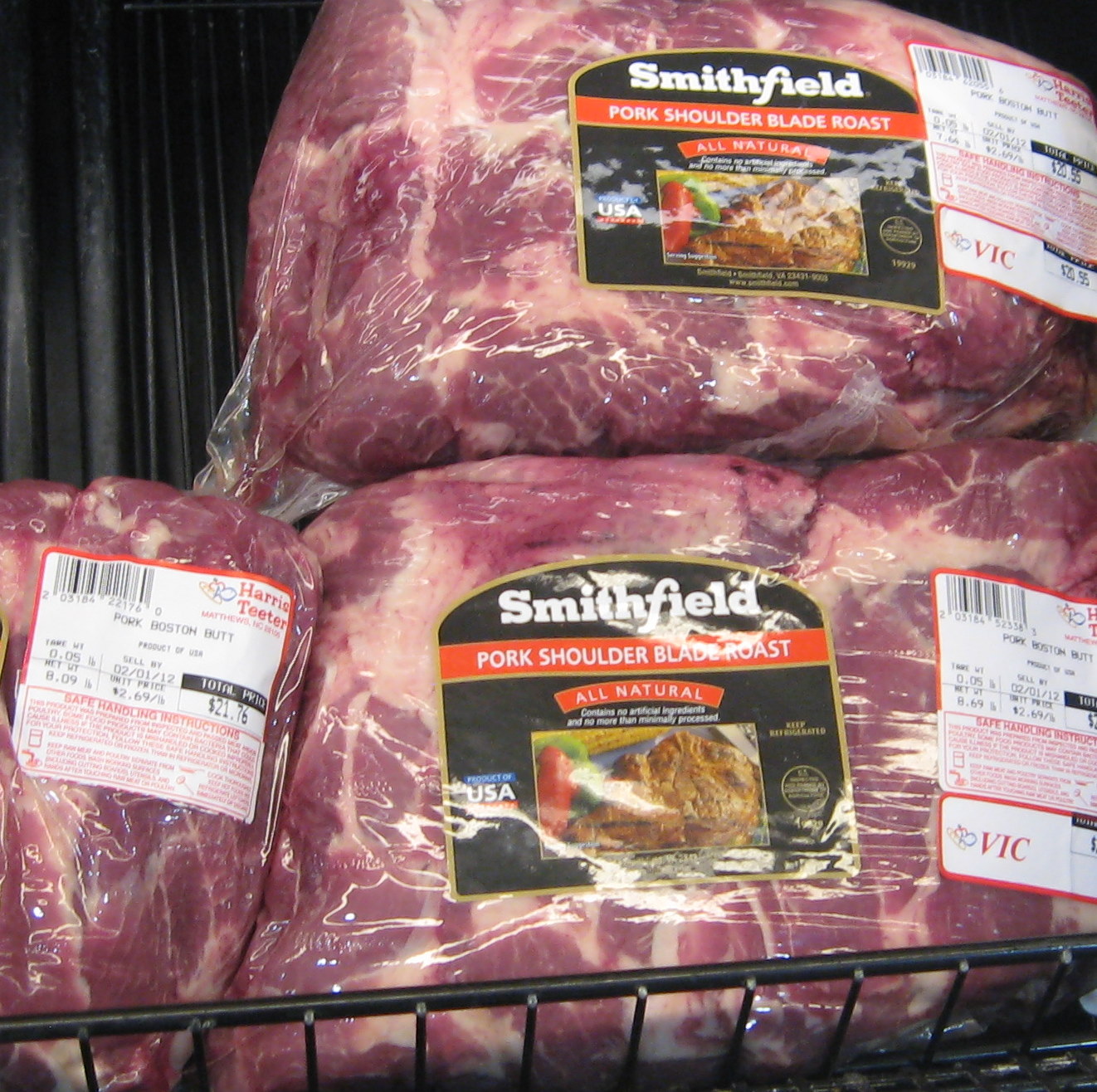
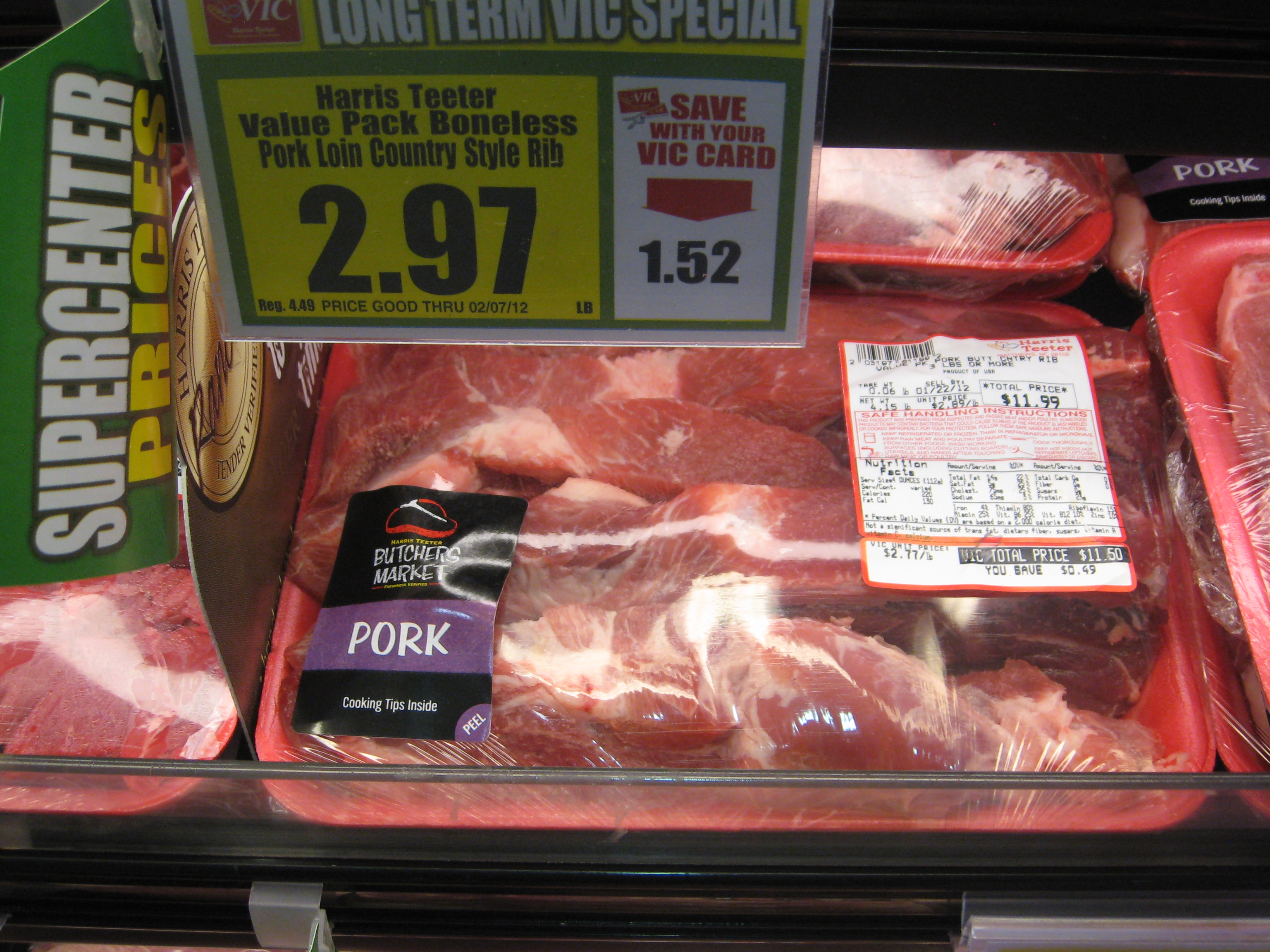
A particular favorite is from Jacques Pepin’s Cuisine Economique.  I’ll give you the basic recipe here ingredients as given in that recipe and summary of the preparation.  If you’re interested in ways to take economical cuts of meat and make them into something really good, this is a book worth looking at (See Bibliography).  The recipe is here not to give you quantities, but to suggest seasoning.  While this recipe suggests a larger cut of pork, I usually get the boneless country ribs to use for this–they are really more like pork butt than are loin chops.

Braised Pork and Cabbage (p. 247)

Ingredients

  • 2 teaspoons salt
  • 2 teaspoons dried oregano
  • 1/2 teaspoon allspice powder
  • 1 teaspoon cumin powder
  • 1/4 teaspoon cayenne pepper
  • a 4-pound pork roast (loin tip, shoulder, or pork butt)
  • 1 tablespoon virgin olive oil
  • 1 large or 2 medium-size heads Savoy cabbage (about 2-1/2 pounds), leaves cut into 2-inch pieces and core cut into 1/2-inch pieces
  • 2 large onions (about 1 pound), peeled and sliced
  • 1 tablespoon of sugar
  • 1/2 cup cider vinegar
  • 1 tablespoon dark soy sauce
packaged pork boston butt

boston butt shoulder roast

Preparation

  • Mix the salt, oregano, cumin, allspice, cayenne, and rub the mixture all over the meat.  (See Notes.)
  • Heat the olive oil in a heavy pot.  When hot, brown the meat over medium-to-high heat for about 30 minutes (See Notes) until well browned on all sides.
  • Cover tightly and place in a preheated 325 ° F oven and cook for 45 minutes to a hour.
  • Remove the meat and transfer to a platter.
  • Combine the cabbage, onions, sugar, vinegar, and soy sauce in the pot.
  • Put the meat on top of the cabbage, cover, and return to the oven for about 2 hours until the roast has released juice and is fork tender.
  • Slice the meat and serve with the cabbage and juices from the pot.

Notes:

  • The cooking times will vary to some degree with the type of meat you use–shoulder, butt and ribs have enough fat and connective tissues to need long slow cooking. A supermarket loin roast, which I would not use, can easily become dry with long cooking unless brined.   I do not usually make this with a roast, but with big, meaty,  country-style spare-ribs, with about  1 to 1-1/2 pounds.  Even using about a quarter of the meat, your cooking time will still be longer than a quarter of these times–you just need to check the doneness)

    country ribs

    butt country ribs

  • You’ll probably want to use the quantities given for the rub ingredients–and I like to put these on the meat for at least several hours (if not a day before) browning it.  There is a lot of surface area to cover with the ribs.
  • This is also a freezer-friendly dish–I love to have a single-serving sized portion to pull out when I need comfort food on a cold day or I’m just in a hurry for food.
  • I like to serve steamed potatoes with it–or add one of those single servings to a  single-serving amount of rice as it cooks (in the rice cooker) for a complete meal.
  • A Riesling or Gewürztraminer wine is excellent with this dish.