Lentil & couscous salad with cherry tomatoes, mint and goat cheese

As you can tell, I like lentils!  And tomatoes.

It’s getting to the kind of weather where I begin to think about “salads” for hot-weather meals.   I know it’s a bit early for this since tomatoes not  ready to pick yet.  While I was writing about lentils, shortly after planting some tomato seeds (Black Krim, Japanese Black Trifle, Black Pearl, Brandywine, Indigo…..) I couldn’t help but think of this salad with some anticipation as I planted the Black Pearl cherry tomato seeds.

Lentil & Couscous Salad with Cherry Tomatoes, Mint and Goat Cheese

This is my adaptation of the recipe from Gourmet 1995, retrieved from Gourmet on Epicurious with a few changes from me.  (This is a great place to browse for salad inspirations.  You don’t need to follow the recipes–just look at the ingredients and make a salad.)

Ingredients

  • 1 cup lentilles du Puy (French green lentils) or brown lentils (or any small lentil that will hold its shape well)
  • 3 tablespoons sherry vinegar  (The original recipe calls for white wine vinegar–but I prefer sherry; use what you have at hand.)
  • 1-1/4 cups water
  • 1 cup couscous
  • 1/2 teaspoons salt
  • 1/4 cup olive oil (preferably extra-virgin)
  • 1 large garlic clove, minced and mashed to a paste with 1/4 teaspoon salt
  • 1/2 cup finely chopped fresh mint leaves (spearmint, rather than peppermint)
  • 1 bunch arugula, stems discarded and leaves washed well, spun dry, and chopped
  • 2 cups vine-ripened cherry tomatoes, halved.
  • 1/4 pound feta, crumbled (about 1 cup)

Preparation

  • Cook the lentils in a small pan, covered by about 2 inches of water until tender but not getting mushy.  The lentilles du Puy cook more slowly than other varieties, so if you substitute, watch them carefully to keep from over-cooking them.  My preference is for the french, Spanish brown, or black lentils instead of the brown.
  • When tender, drain well and transfer to a bowl.  Stir in 1 tablespoon of the vinegar, salt and pepper to taste.
  • Prepare the couscous:  bring water to a boil and couscous and salt (use the package directions).  Remove from heat and let stand until the water is absorbed.  Fluff and transfer to a bowl. Stir in 1 tablespoon of the extra-virgin olive oil and cool.
  • Dressing:  Whisk together the garlic paste, remaining vinegar (to taste), and oil.  Add salt and pepper to taste.
  • Add the lentils and dressing to the couscous and mix well. Chill well–about 2 or 3 hours.
  • Before serving, add the crumbled goat cheese and the mint leaves.

One problem I’ve found is that the cherry tomatoes can give off a lot of liquid and make this salad too juicy.  I like to toss the halved cherry tomatoes with about 1/2 teaspoon kosher salt and let them stand in a colander for about 15 or 20 minutes before I add them  to avoid the excess juice.  This doesn’t make them “salty”–but do taste before you add the last salt to taste.  This will hold well in the fridge for about 24 hours if you’ve  gotten some of the excess liquid from the cherry tomatoes.

My favorite garnish for this is crispy slices of European style cucumbers and crispy, crunchy radishes on the side as well.

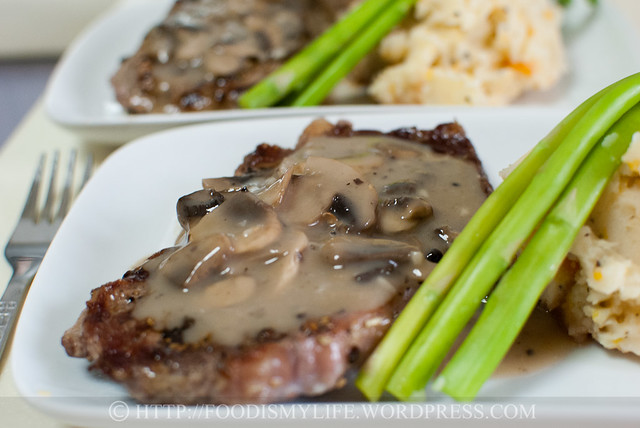
15-Minutes Mushroom Sauce (for Steaks and Mashed Potatoes)

Quick and easy!

Foodie Baker's avatarFood Is My Life

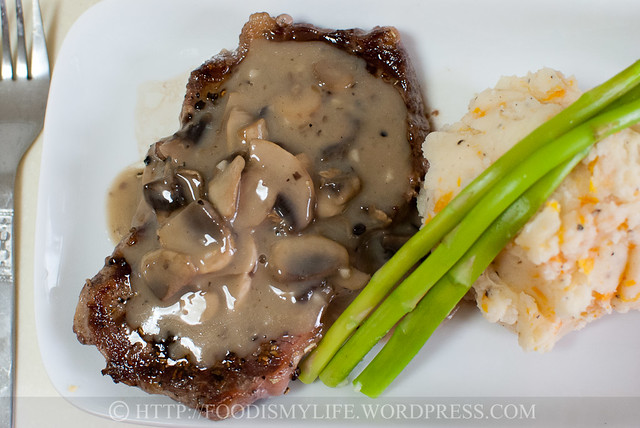
15-Minute Creamy Mushroom Sauce for Steaks

This very easy, very quick and very delicious mushroom sauce changed my life, completely.

Okay that’s a total exaggeration, but well, at least I no longer have to go and buy those pre-made sauces for steaks (God knows what’s in there). I can make this sauce myself, at the comfort of my own home, with pantry ingredients (okay you probably need to grab the mushrooms and milk/cream from the market, but yea you get the idea, right?) And the sauce tastes so good, so spoon-licking good that I can’t stop eating it right out from the pot (even before I started cooking my steaks).

So yea, in a way you can say that this sauce is revolutionary. 😉

15-Minute Creamy Mushroom Sauce for Steaks

View original post 442 more words

Cooking monkfish

TGIEOT—yes, that’s a bit more than TGIF!  It’s end-of-term.  The Spring term was the school term from hell, starting right at the end of Fall term!  Over the winter break I had unexpected course preparation to do for two online classes—switching from Blackboard to Sakai—for content management.  Top that off with an ongoing indexing project, and it’s—well, let’s just say it left very little time for cleaning, cooking, or writing!  Then, add to that a hard-drive failure for my computer….but it’s over now.

I’ve taken some time to work on revising the on-deck herb garden since I had plants that needed to go into their home pots, and a couple of days to do nothing but have quality time with the cat.  All that has left me yearning for some relaxation time and some really good food—cooked by me.

My day was absolutely made when I got my email delivery of the “Fresh Catch” specials from my local Harris Teeter this morning: they had monkfish! In terms of favorite fish, that’s right up there with Chilean sea bass for me.  Needless to say, I scarfed down my morning coffee and headed right off to HT.

fennel, leeks and garlic ready to roast

fennel, leeks and garlic

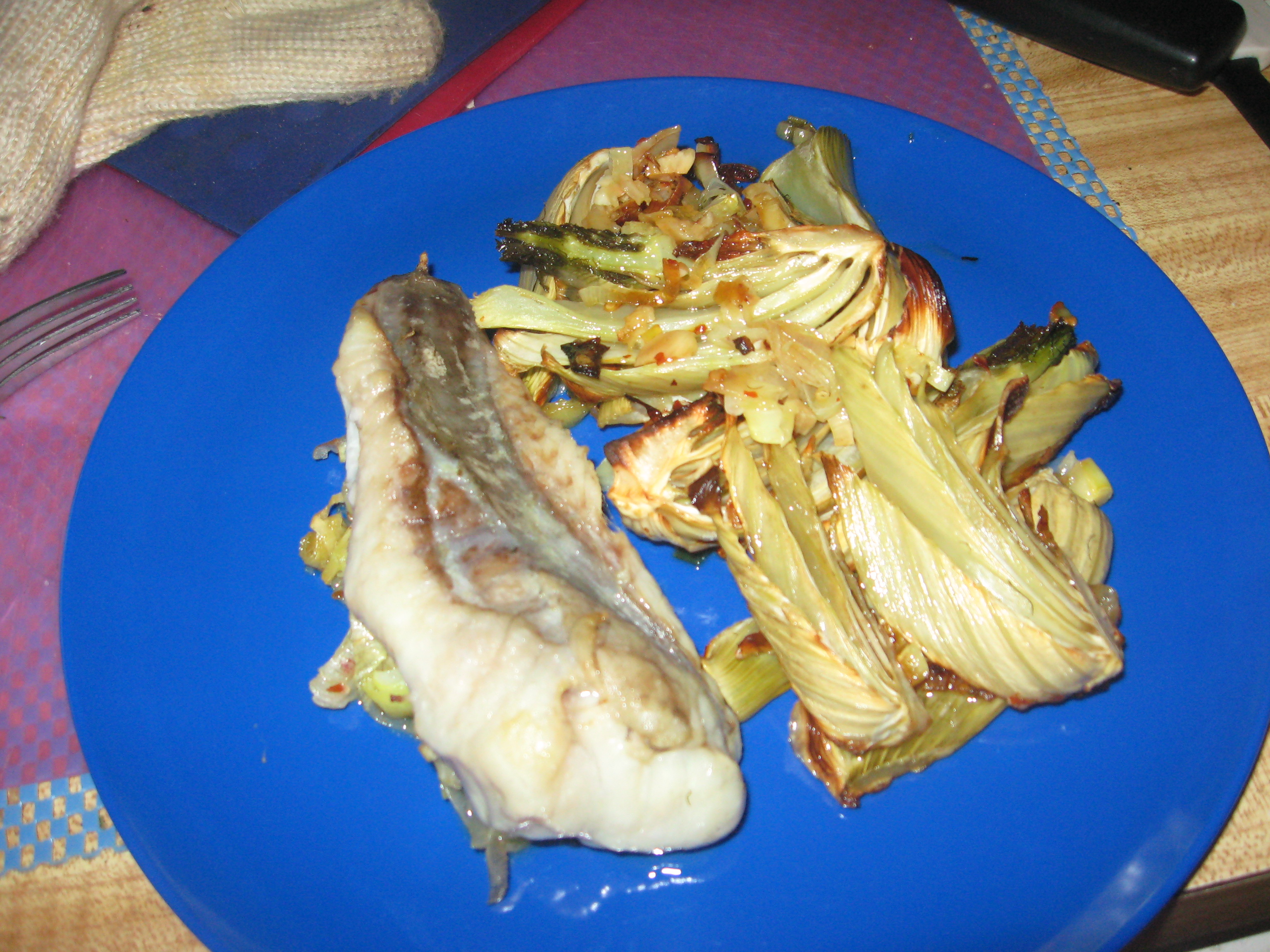
Supper this evening was roasted monkfish, with roasted fennel with leeks, garlic, and a dash of red pepper flakes, with a nice un-oaked chardonnay.  The fennel was an in-store, spur of the moment thing since it looked so gorgeous.

Even though it is warm this afternoon, I opted to cook in the oven because I wanted roasted fennel as well. I’ve done monkfish in hobo-pack style before but I thought I’d try roasting it this time and see if I couldn’t have a one-pot dinner.

monkfish

monkfish

I’d seen a post by Edward Schneider in Mark Bittman’s NY Times column (Diner’s Journal) about roasting monkfish, and the differences in monkfish on both sides of the Atlantic. After reading that I salted my monkfish for about an hour, and then roasted it.  I did manage to make a one-pan meal out of it. Since I had to allow about 40 minutes for the fennel to roast, I started that first.  After about 15 minutes, I laid the monkfish on top of the leeks, pushing the fennel wedges to the side, and popped it back into the oven for about 15 minutes.  I used very simple seasoning on the fish—olive oil and salt before going into the oven, and nothing for than fresh-ground black pepper and a pat of unsalted butter after it came out of the oven. So very simple—so very good, and even healthy.

(The only thing I wish I had done differently would have been to add some sweet red (or orange or yellow) bell pepper with the fennel. A glass of un-oaked chardonnay complemented the meal very nicely.)

IMG_7553

Baked cod fillet with vegetables

The “leftover” cod to which I alluded in a previous post was the result of beginning-of-term course preparation frenzy (always happens no matter how well I think that I’ve planned).  It was an OMG-I’m-starving-what-have-I-got-in-the-fridge, what-can-I-put-into-the-oven-so-I-don’t-have-to-watch-it, panic situation.

cod filet in a baking dish

cod & vegetables ready for oven

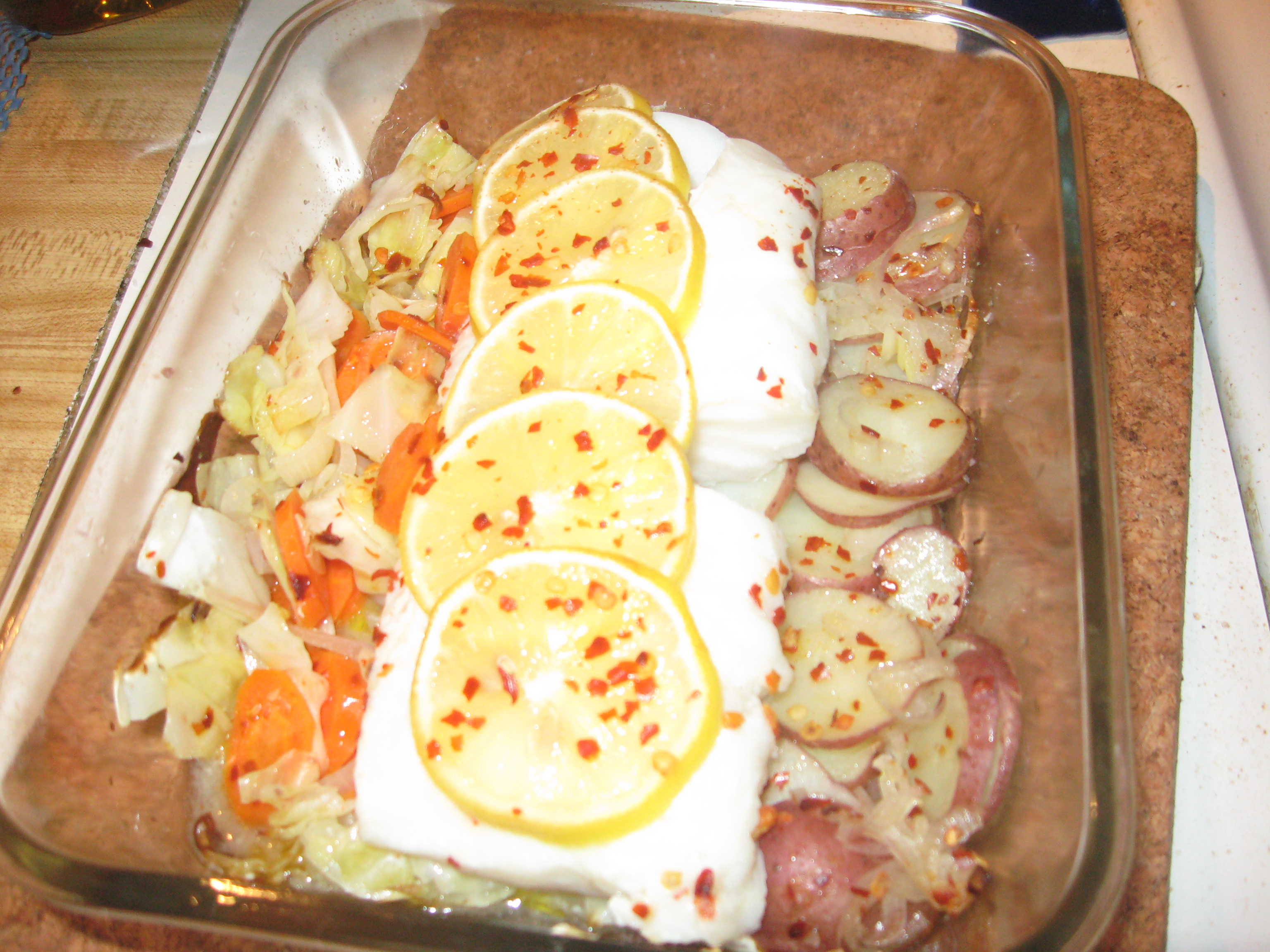
I had the cod fillet, but I was really pressed for time.  After madly rummaging in the vegetable crisper, and came up with cabbage, carrots, potatoes, lemons, and onions.  The cabbage got cut into bite-size pieces, the carrots and potatoes sliced into about 3 mm (1/8-inch) pieces.  I tossed the cabbage and very thinly sliced onions with some extra-virgin olive oil and a pinch of salt.  I gave the carrots and the potatoes the same treatment, threw in one of the few herb mixes that I keep on hand–herbes de Provence (my go-to in panic mode), some red pepper flakes put the fillet on top, plopped some lemon slices in, covered it, and stuck it in the partially preheated 325°F oven for about 45 minutes since it was a very thick cod fillet–and set a timer! (Since there were lemon slices, and the cabbage was still damp from rinsing, the cover for this baking dish fit very well, and I knew there would be a bit of liquid from the fish, I didn’t add any water.)

plated cod fillet with cabbage, carrots and potatoes

one-dish meal

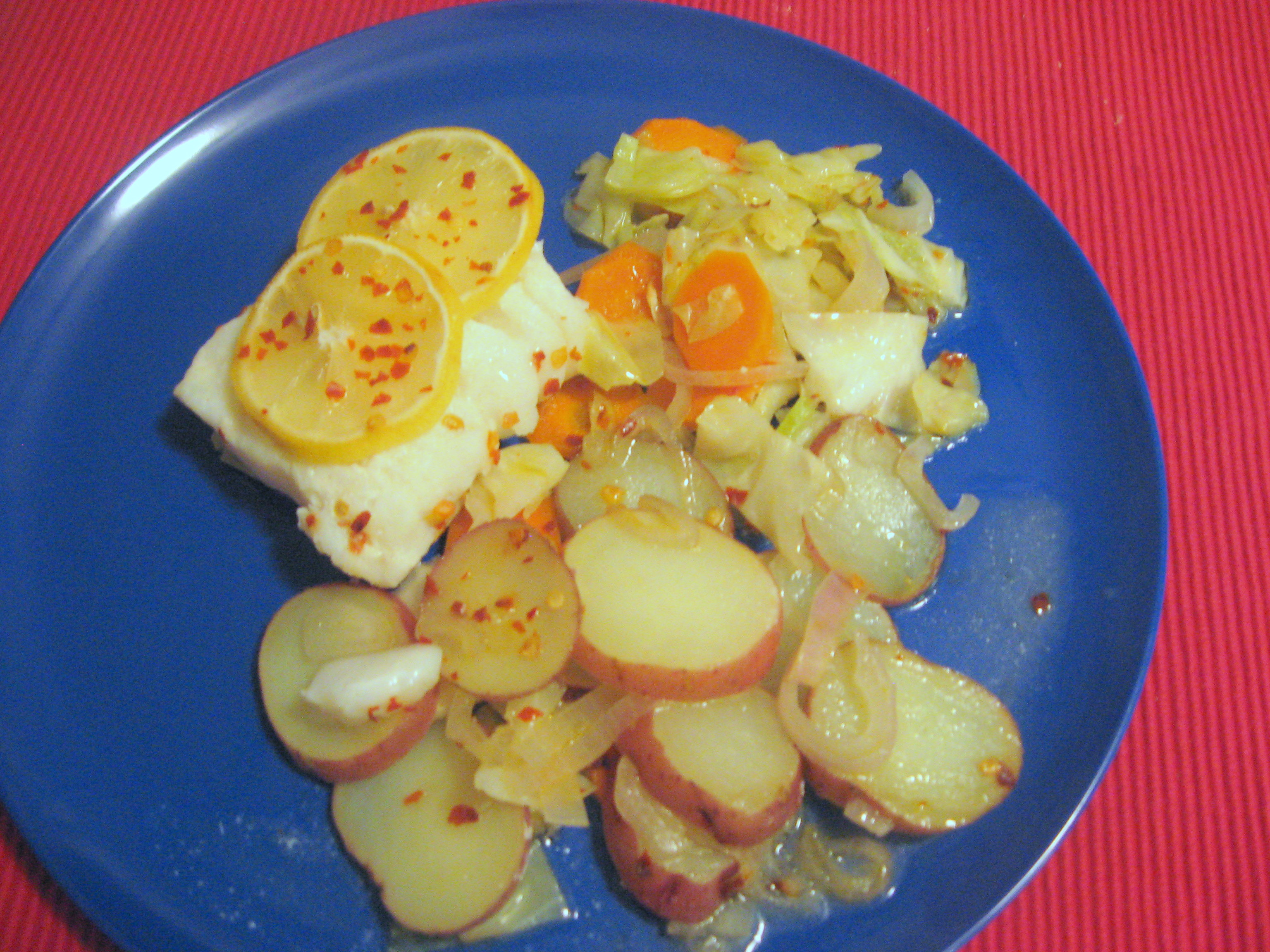
When the timer went off I went back to see what I had–the thinly sliced carrots and small red potatoes were tender, the cabbage was tender but still slightly crisp, and the fish flaked nicely–success on the fly!  If you don’t like a little crunch with your cabbage, you might remove the heavier ribs.

Good results for minimal effort, and a really healthy meal.  The lemon and extra-virgin olive oil complemented all the veggies and the fish.  The red chili pepper flakes spiced things up just a little.  Yes, pretty simple, but tasty.  Good food doesn’t have to be complicated if you have good things to start with.

Cauliflower-black olive gratin (for one)

I started with the recipe from The New York Times that I had mentioned in an earlier post–and adapted it for single-serving cooking.

cauliflower, black-olives, garlic, shallot

just a few ingredients

My first “adaptation” was NOT to buy a whole head of cauliflower–I like it but I usually waste some of it, so I purchased 250 grams from the salad bar at my local Harris Teeter store already cut.  This was about 1/4 of what the original recipe called for (900 to 1000 grams).

My second adaptation was to use the rice cooker to blanch the cauliflower!  Put water in, add salt, close the lid and set the “rice cooker” mode.  In just a few minutes when I opened the lid I had boiling water.  I added the cauliflower, close the lid and blanched for about 5 minutes, then proceeded with the recipe–faster than a pan of water on the stove top!

My third adaptation is one I use often in cooking for one–I used shallot instead of onion since I don’t like bits and pieces of cut onion loitering in the fridge–so one medium to large shallot, prepped as for the onion in the above recipe.

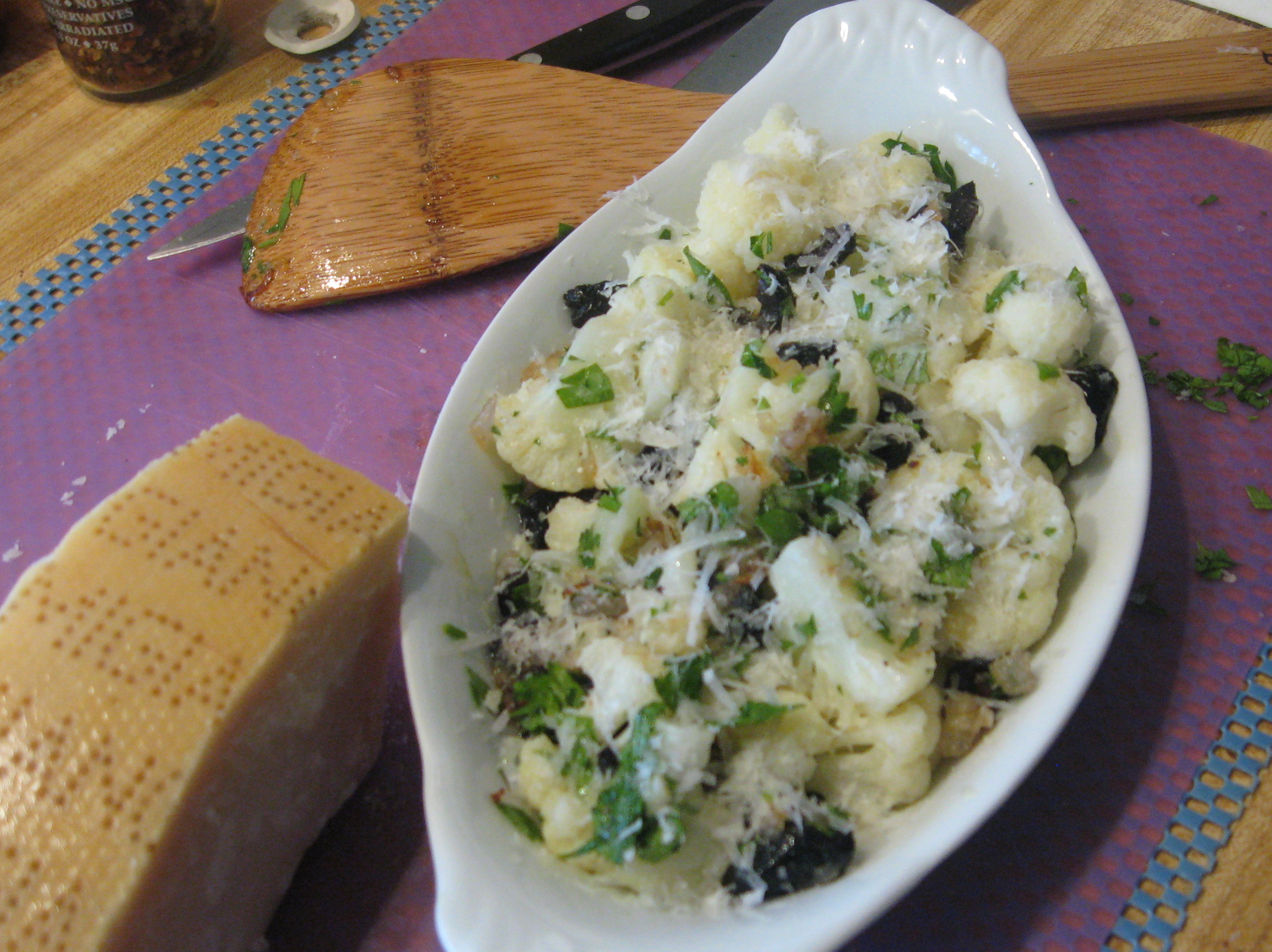
gratin dish with cauliflower

oven ready

That recipe called for 16 olives–well four olives just didn’t look like enough, so I used six. Garlic–well, I used two very small cloves. The rest of the ingredients were “measured” by eye: parsley, the Parmigiano-Reggiano were whatever looked like enough for the amount of cauliflower–maybe my adaptation is a bit cheesier than the original, but  that’s okay with me!

The results were fantastic, maybe even awesome! (Please note past tense–well, there was a tiny bit left, but that’s probably because of the rather large cod fillet–a leftover as I define leftovers–re-warmed in sugo alla puttanesca.)   This was one of the best things that I’ve ever done with cauliflower. It’s a keeper with lots of room to improvise: some red pepper flakes added to the shallot-olive mixture, or maybe some roasted red peppers.

browned gratin of cauliflower

ready to eat

I think that I might step down to 150 grams of cauliflower next time, and bake it in a slightly deeper dish–but it will definitely be made again. I do need to add more garlic, though. I can’t believe how easy it was.  This is my kind of recipe–not at all fussy and open to modification to fit my mood, the weather, and what else is served.

<><o><>

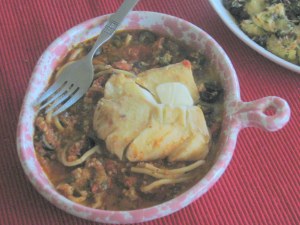
The cod fillet was a “leftover”–meaning planned.  The method of the “rerun” was unplanned.  After several days of intensive course preparation for online courses, I suffered a serious case of cabin fever.  On impulse, I called a friend, and we went out to dinner at one of my favorite causal places, Meelo’s Ristorante, here in Durham, since I had a serious craving for Andre Chabaneix’s spagetti alla puttanesca.  There was a bit of the puttanesca sauce left in the bottom of my plate, so I brought it home with me.  I used it to gently re-warm the cod fillet for supper this evening–now I’m going to have to see if I can match his sauce so that I don’t have to go out every time I want puttanesca sauce.

cod with puttanesca sauce

cod with puttanesca sauce

The Cuban Swet Potato (Boniato))

Today was a particularly stressful Monday–thanks to disappearing content on my computer-assisted course. But one has to eat, stress or no stress.  My quick lunch today was the Cuban sweet potato (Boniato) that I brought home from the grocery store yesterday.

True to my usual idea about checking out something new, I did some skulking on the web, and decided that the best way to get acquainted with this new vegetable would be to prepare it as simply as possible.  Being rushed and needing uninterrupted computer time to recover from technological boo-boo, I just treated it like a baked potato–washed, oiled, couple light stabs with the tip of a paring knife (so it wouldn’t explode), popped into a 350°F oven for about 40 minutes. (That’s when it was soft enough to smush, well, like a baked potato.)

A little sprinkle of fleur de sel, was all it really needed, but I confess to checking it out with a little unsalted butter, too.  It was not as wet as the usual orange sweet potato though more moist than a russet baking potato.  The flesh was pale yellow, and not as sweet as the orange-fleshed  sweet potatoes, nor was it as dry,  as pale, or quite as sweet as the now-available white sweet potatoes.

I enjoyed it for lunch!  More Cuban sweet potatoes will find their way into my kitchen before too long if they are available.  I really should check things like nutritional information and glycemic index on it too.

Now off to the kitchen to pop some veggies and potato into the Römertopf, and then back to the computer to finish the recovery project!

(Hey, I’m also patting myself on the back that this new veggie came into the house yesterday and I ate it today–did not allow it to loiter in the crisper.)

Trying to keep the New Year’s resolutions…

I’m really trying to keep my New Year’s resolutions, though sometimes I think that I should simply resolve each year to try to do better on keeping LAST year’s resolutions.  But it’s a new year, new start, so here goes!

I’ve just gotten back from the grocery store–with only one thing that wasn’t planned–That was a veggie that I’ve never seen in this Harris Teeter before–a Boniato (Cuban sweet potato). While I gripe loudly and constantly about how crowded the grocery store always is on Sundays, it’s what seems to work for me–so I gripe and still shop on Sundays–unless I ran out of milk on Saturday!

The grocery shopping took a bit longer than usual, but I went with the idea of doing some meal planning on the hoof.  (I like to shop by what looks good and what’s on special, so meal planning at home doesn’t necessarily work for me.) I went with a set number of meals in mind–and the meat (at least vaguely) in mind, then walked around looking to see what was on special, and what looked good–in other words,  produce and meat.

Knowing that we can expect some cooler weather over the next week did influence my shopping, and so did the fact that I’m still knee deep in course prep for the medical terminology courses that I’m teaching.  I need cool-weather dishes that I can pop into the oven (Römertopf is out on the counter–and I can scarcely believe that I’ve not posted about cooking something in them before this.)

The result of my meal planning on the fly was this and I’m going to keep you posted on how well I succeed with this–hoping for some peer-pressure here:

  • It’s really too-warm-for-the-season weather here today, so I’m having something light (and “leftover”)–cod re-warmed with the tomato sauce that I brought home from the Italian restaurant, and cauliflower and black olive gratin (had all the ingredients in the fridge except the cauliflower.  I purchased enough for one good-size serving from the salad bar–cheaper than a whole head of cauliflower when I know part will likely go to waste.)
  • Lamb (shoulder chops to be cut up) braised with veggies–in the Römertopf–with an under-appreciated vegetable–turnips.  Personally I love them raw too, and like the sweetness that they add to soups, so they get used a lot.  Doesn’t hurt that they store so well either.
  • Chicken thighs to roast (most likely Römertopf  again) with some root vegetables (have carrots, turnips, parsnips, and some cabbage).  There will be at least two meals from the chicken thighs.
  • Since I have some lovely ham stock (courtesy of a friend sharing ham and the ham bone with me) I’m going to make some bean and kale soup for one warm cozy supper.
  • While I was perusing the New York Times Health section and stumbled onto a recipe for a turnip gratin that is a possible for a side dish with some of the chicken.
  • Then last, but not least, is a fresh black pepper and onion sausage that most likely headed into the Römertopf with some potatoes, to be accompanied by some cabbage that’s been quickly microwaved with a bit of extra-virgin olive oil.

After my meal planning, I’ve got a couple servings of meat (chicken thighs and pepper-onions sausages) that are flexible and should lend themselves to other things if my appetite doesn’t fit my plans.  The sausages could always end up in another “one-pot” dish.  There are also some salad makings in the fridge, and some fruit (Fuyu persimmons, apples, and oranges) for dessert.

One of the things that I like about recipes like those for the cauliflower-black olive gratin and the turnip gratin, is that even though they say “serves 6” they are SO easy to cut down to size for single-serving cooking.

So that’s my plan for this week–regular cooking that is healthy, and doesn’t promote waste from things that just don’t get used.  There are some lunches to be made during the week since most of my courses are online this term–meaning I’m home to fix brunch or lunch for myself.  Maybe that Boniato will fit there.

I’ll be posting more about these meals, but, please, wish me luck with the New Year’s resolution!  Now, off to the kitchen to do the cauliflower-black olive gratin to go with my cod in tomato sauce!

A new take on a Southern tradition…

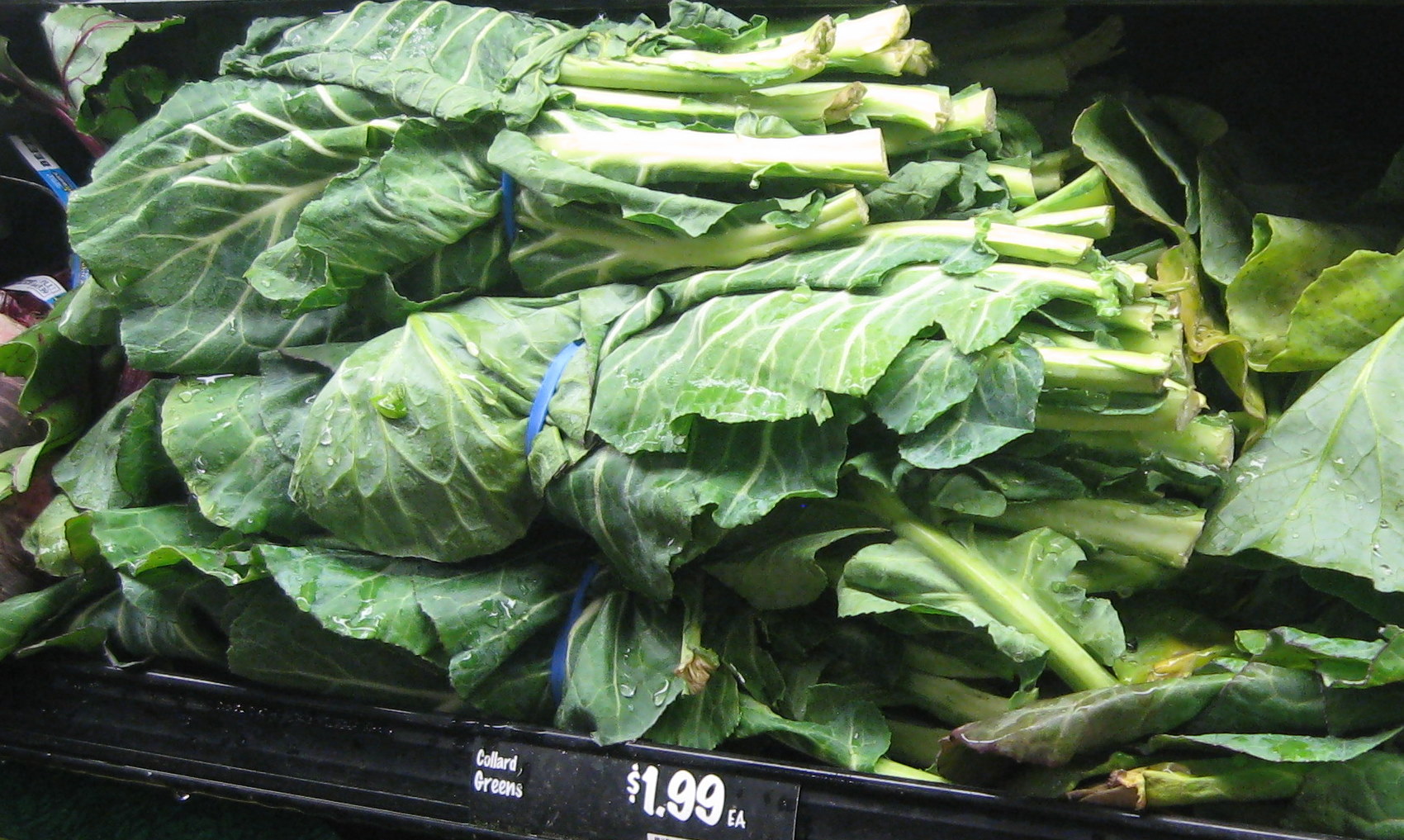
Produce display of bunched collard greens

collard greens

I’m not a native to the “real” South, so I was intrigued to learn about the custom of having collard greens and black-eyed peas as a mandatory part of New Year’s day dinner.  I like greens–so not big thing about the collard greens.  I like pulses, legumes, and all those things too.  Again, no big deal.  Unfortunately, I may be a less finicky eater than some of my friends and acquaintances.

On several occasions I’ve been the delegated to prepare those dishes for New Year’s day meals.  So–dinner for eight or so, I prepare collard greens and black-eyed peas in a traditional Southern style–well, talk about leftovers–everyone had the mandatory dishes–about a teaspoon of each!   Next year, I lucked out again–make collards and black-eyed peas. I made a much smaller quantity of each, but still had mega-leftovers.  Enough of that!

Next time I was delegated to bring collard greens and black-eyed peas to a New Year’s Day gathering, I decided that something had to be done to make those palatable to the kind of guests at the meal–true we’re all foodies, but some of us more than others.  I decided that the problem was not collards and black-eyed peas per se, but rather that they just did not fit with lovely roast duck with a nice fruit sauce.  I decided that I needed to present them differently.

Personally, I’d happily make a one-dish casserole of the collard greens, some sausages, and the black-eyed peas–a variation on one of my favorite recipes from Jacques Pepin’s The Short-cut Cook That still did not fit with New Year’s Day festivities.

My next though was that all these people (in fact, most people  I know) really like risotto.  After perusing a number of recipes, it seemed that as long as you could add most anything to basic risotto, as long as you did the appropriate pre-cooking.

I decided that it was time for collard greens and black-eyed peas to make a début as risotto ingredients.  Thankfully, the frozen vegetable case at my local supermarket came to the rescue: frozen collard greens (chopped), and frozen black-eye peas!  Happiness.

I started the basic risotto recipe with onions, white wine, olive oil, and sautéed  the rice.  I used home-made chicken stock for the liquid.  Frozen collard greens are already blanched, chopped, so all I did was to thaw them,  give them a bit more in the way of a rough chop, and since they are rather “tough” greens, steam-sautéed  them (without adding any more liquid) until close to being done.

The black-eyed peas seemed a bit more problematic since I knew that those can turn to mush easily as they’re fragile; I cooked those separately until almost done (according to the directions on the package).

When the risotto was close to being done, I added the collard greens and the black -eyed peas, and then finished the risotto with the Parmigano-Reggiano as usual.

Taking into account my earlier “luck” with collards and black-eyed peas, I made less than I though eight or so people would eat.  Wrong again–needed more–these foodies wanted seconds!

A son goût!  

Cucumber mango salad

Photograph of 7 mangoes in case with PLU stickers

mangoes

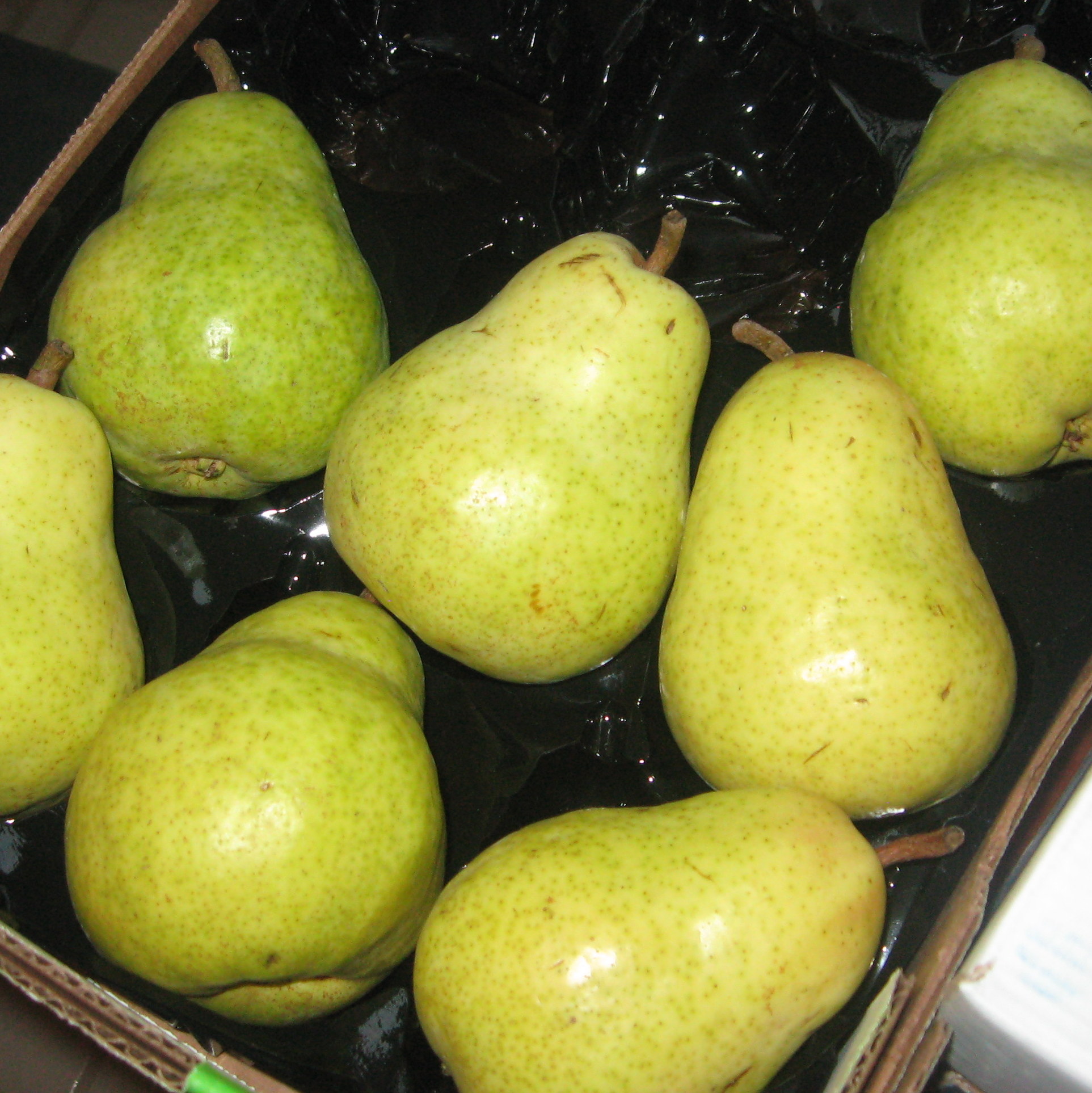
Yesterday I had a minor food crisis–fruit overload.  I went to Costco (for cat food and laundry detergent) but while walking past the huge stacks of produce I smelled first peaches, and then pears–and then there were the mangoes. The difficult decision was pears or peaches, and/or mangoes.  The pears won over peaches though the peaches smelled as good as the pears, but the price was such that I brought both mangoes and pears home with me. Both were much more reasonably priced than in the supermarket. So it was a no-brainer–I eat all the pears and mangoes that I want and share some with friends and I’m still ahead on the cost. (The pears were absolutely luscious–every bit as good as they actually smelled!)

bartlett pears in case (from costco)

Bartlett pears

That quantity of fruit does have you looking for some things to do other than just eat it out-of-hand.  I had some mangoes that needed to be used; I had eaten lots and shared some, but I needed to eat some more! (Not that eating big, juicy, ripe mangoes is really any hardship.) Saved by inspiration that struck when I started smelling my supper cooking.

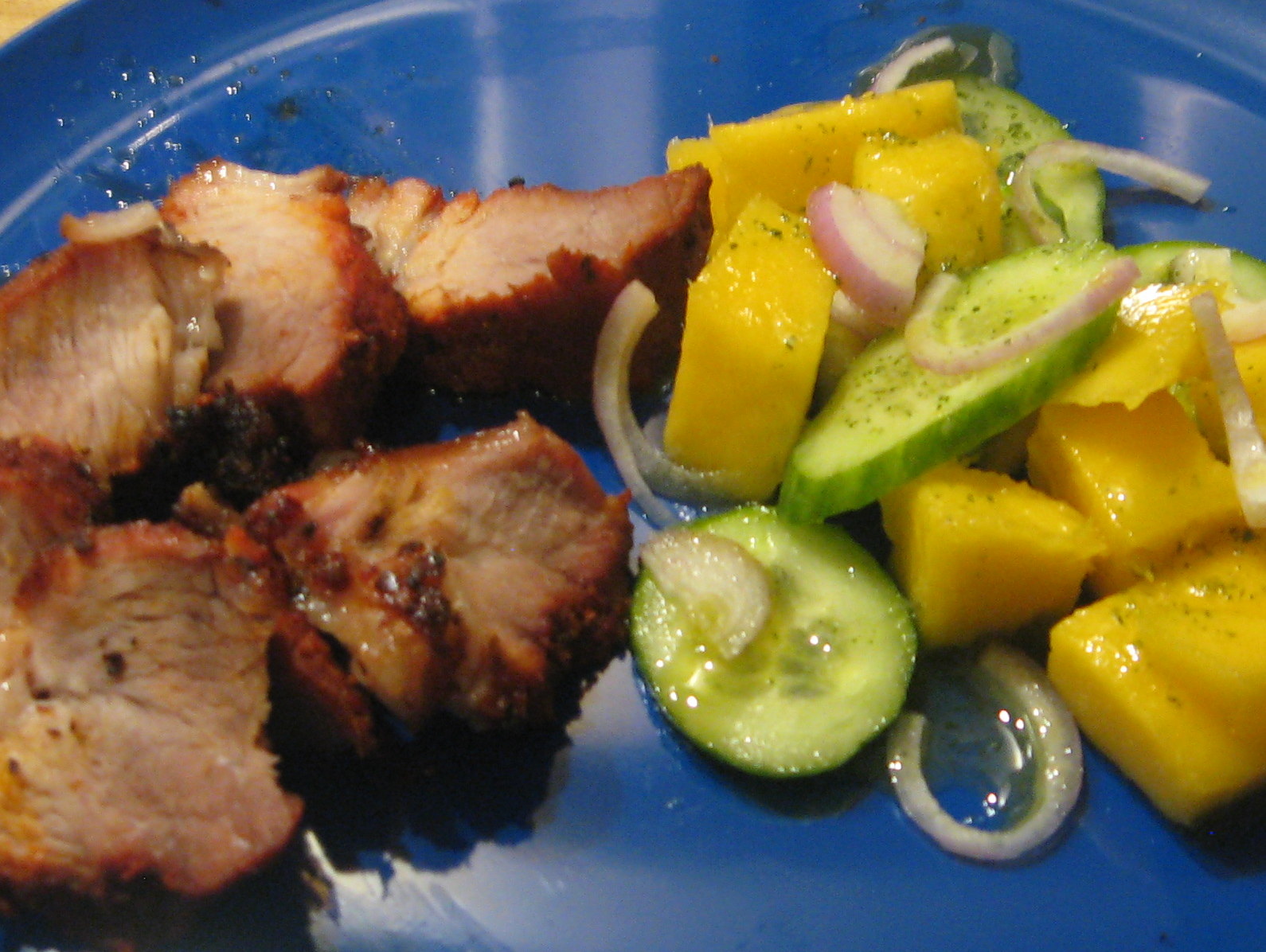
I was roasting some pork (on which I’d used a dry adobo seasoning rub given to me by a friend as a birthday present)–just a single big meaty spare rib for supper. This was one that was extra from making the chili con carne--simply would not fit in the pot so it became a small pork roast for one with just a tad left over.

I couldn’t think what to have with it until I smelled the roasting pork with the spicy adobo seasoning, something said “sweet and cool”–I thought of mangoes and cucumbers (which were sitting right there in the refrigerator just waiting to be used).

Not being particularly inspired about what to do with these two things, I headed for my laptop and Google!  As I was entering the “cucumber and ma….” the instant search which I’ve enabled popped up “cucumber and mango salad”.  That sounded just right with spicy roast pork.

I perused a number of recipe sites and blogs and found several interesting ones for cucumber and mango salads (and somehow I thought I was being very original when I visualized that combination):

  • from Daily Bites blog mango and cucumber, lime, ginger, honey (or coconut nectar–something new to explore), and optional cilantro.
  • from Eating Well which added avocado, brown sugar, rice vinegar, canola oil, and fish sauce as well as red pepper flakes.
  • from Herbivoracious  using Thai sweet chili sauce, rice vinegar, mint and cilantro leaves, and toasted sesame seeds.
  • from My Recipes  the simplest of all–cucumber, mango, lime juice and ground red pepper.
  • from Rookie Cookie with the addition of jacima, red bell pepper, honey, rice vinegar, and chile powder.
  • from The Full Plate Blog those basics but with champagne vinegar in the dressing, and suggestions for optional pea shoots (yum!), and slivered almonds, with romaine lettuce.

Those certainly gave a place to start for concocting for what I needed that night’s supper.  Then I found recipes with suggestions for adding grilled shrimp…seems like these need to be explored  much more carefully next time I’m that flush with mangoes.

rosy-cheeked bartlet pear and mango on blue/purple print towel.

pear and mango

Since my adobo rub had given me quite a spicy seasoning for the pork, I decided that I did not want to add chile powder, or even ginger–anything at all spicy to the salad–I wanted something cool and contrasting with the spicy meat.

I opted for the bare basics: cucumbers (the little baby ones), mango, shallot (no red onion in the house),  and since I didn’t have fresh mint (I’ve now killed my second plant), I used frozen cilantro (from Dorot) in the dressing which was just a simple vinaigrette made with olive oil and sherry vinegar (drat–no lime or champagne vinegar) and I didn’t think that rice wine vinegar would stand up to the adobo seasoning of the pork).

Even one mango and cucumber gave me some extra, so I dressed only what I was going to eat right then.  (What was left became another salad, with very thinly sliced pork right in with the fruit, and I added some of those luscious Bartlett pears to it as well–threw that over some mixed greens and it made an awesome lunch. I dressed with a fig-infused white balsamic vinaigrette since I added the pear.

The combination of mango, or other sweet fruit, and cucumber is definitely one that I’ll be playing with in the future–probably with chicken, shrimp  or maybe even crab, or scallops to “bulk it up” a bit for a complete meal.

(I know, it’s not a beautiful plate, but I was too hungry to go outside in the dark to find garnish–I almost didn’t even take a picture.)

A son goût!

pork, cucumber-mango salad

supper

Greens, with dill and feta cheese

So many greens do well in cold weather–and can be simple to fix.

emmycooks's avatarEmmy Cooks

Welcome to Emmy Cooks!  You can see more of my favorite recent recipes by clicking the “My Favorite Recipes” category on the sidebar (here are July, August, and September).  If you like what you see here, you can sign up on the sidebar to receive a daily recipe by email, add the RSS feed to your blog reader, or follow Emmy Cooks on Facebook, Twitter, or Pinterest.

Some days, maybe most days, simpler is better.

I had a plan to make this week’s greens into a tart of some sort, or maybe spanakopita, or at least green tartines.  But those things take time, and some days I don’t have time.  I piled all my greens into a pan to wilt, then chopped and dressed them with olive oil, lemon juice, dill, and a sprinkle of feta cheese.  It was better than good enough.

View original post 231 more words