Eggplant bacon?!

I like breakfast–but not at the crack of dawn. I am trying to get food on the inside me earlier in the morning and I know I need to eat more vegetables–they are good for you. Eggplant IMG_4285The more nutrition and “diet” reading I do the more I realize how important fiber (and thus vegetables) is in diet, and that it would be good to have vegetables included in all my meals. As much as I like omelets and frittatas, I need more ways to get more veggies at breakfast and at other times, too.

Eggplant is a vegetable of which I’m not particularly fond. Nutritionally, I suppose it is good for me–or at least a filler. According to  USDA nutrient information, eggplant is right about with iceberg lettuce and cucumbers–which is certainly not saying much. But it does have fiber!

So you’re wondering where did the breakfast thing come from?  Well, I don’t often find an eggplant recipe that puts me in gotta-try-that mode but the “bacon” got my attention as I was browsing through my email notifications from  Kitchn. (I suspect it was really the “bacon”, not the eggplant that did it, since bacon will always get my attention.) A post on how to make eggplant into bacon caught my eye. The pictures looked really good and it made me think “breakfast vegetable” other than tomatoes, spinach, kale, mushrooms…

After I finished reading about bacon, I noticed that there were recipes for eggplant bolognese, eggplant jerky, and eggplant burgers–which I doubt that I will ever try–eggplant bacon, maybe! 


For oyster lovers

Here’s an interesting post from Taste magazine: Cooked Oysters for People Who Love Raw Oysters complete with a recipe!

Crudités

After my last visit to my physician for my 100,000-mile maintenance check, I was appalled at the numbers I read on the scales when I weighed in. Arrrggghhhhh! So it time to do something about those numbers. Obviously, more exercise–and I’ve actually Radish Varietiessuccumbed to a fitness device that will make me (horribly) aware of how inactive I can be, especially during working days.

Along with trying to get my butt out of my office chair even on work days, I’m trying to get more veggies and fruits into me. As the weather gets hotter, I want cool things so crudités are appearing often. Most often served with a dip of some sort but I was looking for something to add a bit of zip and zing to raw (or lightly blanched) vegetables: celery, radishes, zucchini, jicama, kohlrabi, etc.

As you all know by now, Bull City Olive Oil is one of my favorite places to find tasty stuff (like truffle salt for popcorn). In addition to olive oil and salts, there is a grand array of balsamic vinegars. I’ve discovered that some of these make a marvelous “dip” for all these veggies–without adding any oil–so that it keeps my cruditès low calorie but still never boring.  Some of the ones I use are honey-ginger, blackberry, blackberry-ginger, black mission fig, and lemongrass-mint.

And–the dark chocolate! Just a few drops with berries or fruit makes a wonderful treat–as does the passionfruit, or the lavender.  All very low cal, but so tasty! I suspect that the coconut white balsamic would be pretty darn good with fruits and berries too. So many possibilities for good taste–and there are always new ones to try–and healthy eating, too.

A son gôut!

—Ô¿Ô—

Comb honey vs. extracted honey

From one of my very favorite (and useful) beekeeping blogs (HoneyBeeSuite) I wanted to share a post that so well describes the grocery-store honey and the wonders of honey in the comb: How to make value-subtracted honey.  I couldn’t agree more, nor could I say it better so I’ll just pass on this link.

—Ô¿Ô—

Hive report: bees and cats!

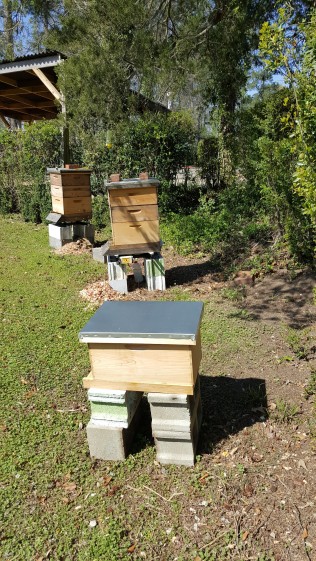
The last week or so has been a bit hectic–indexing work, and beekeeping. The apiary has grown to four hives now–two from swarms cast by the two large (Dave’s bees and the Georgia Girls) hives. Now I have hives C and D. Hive C is from the swarm from the Georgia Girls. Hive D is from a swarm from Dave’s Bees. The purpose of my inspections of three hives today was to check to see that all were queenright even though looming deadlines for indexes have put a limit on the amount of time that I can spend with the bees on this Mother’s Day; so necessarily very quick question-oriented inspections.

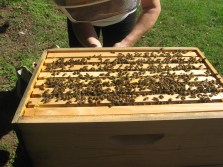
brood box of hiveI had already found that Hive C was queenless. I started the procedure of requeening earlier in the week, but I did need to make sure that the queen had been released from her travel cage. Happily, the queen was out and about in the hive. However, the comb in that brood chamber is so exuberant and higgledy-piggledy that it was (in a reasonable amount of time, with sweat dripping from my eyelashes) impossible to see if there was brood. But, the queen is free so I’ll check again for brood in a while.

[Why did I have sweat dripping from my eyelashes? Well, it happens if you neglect to put on the sweatband under the veil. Needless to say, I went back and added that to my attire before moving on the Hive D.]

Hive D (I know, very unimaginative) was a swarm from Hive A and since I had not captured the queen, I had put a queen cell into the new hive. Today was to check and see if that colony was queenright. Still dripping sweat, I opened this hive to find that there was now capped brood, lots of capped brood in a very good pattern in that hive. Again, I settled for the quick answer without a detailed search to find and mark the queen as I need to move on to Hive A.

In Hive A, my concern for this quick inspection was to see if there was a functioning queen here, too.  The quick answer was a resounding yes! I found lots of capped brood in an excellent pattern–in the medium super above the brood box.  Again, I accepted that, but realize that there is another problem that I need to address immediately. I need to get some new frames for the bees to start for cut-comb honey since they are rapidly filling everything with honey and pollen. I admit that I didn’t even look in the brood box to see what was going on, but I suspect it’s being filled with honey and pollen, so I likely need to reverse the medium with brood and the deep at least for a while.IMG_7769

Ok–you wondering about the “bees and cats”!  Since this was the week that I had to tote Frankie, the cat, to the vet and deal with his foibles about the carrier and the car, cats, and their sometimes strange ways have been blatantly obvious.  After these quick inspections, I thought that bees shared some of the same characteristics: both bees and cats do what they damn well please, no matter what I think, or hope, they will do!

I definitely need some consultation with a very experienced beekeeper to try to sort out what these girls are doing and how I can best deal with it.  But from a beekeepers perspective, all is right with the world.

—Ô¿Ô—

Popcorn!

I am a big fan of popcorn. I’ll take that over potato chips, or any other variety of chips almost any time. It’s just the thing to go with a good book while you’re having a duvet day.

PopCorn MakerYou can probably even make a case that it is at least “healthy-ish”–compared to most other snacks that come in bags from the grocery store–and it’s more fun. You can custom tailor the seasoning to fit your mood. At least I know what’s in it if I’ve popped and seasoned it myself.

I’ve gotten very fond of my Lékué PopCorn Maker for making popcorn in the microwave (and that’s about the only thing I do in the microwave).  I will admit to using oil (usually about 1-1/2  tablespoons of olive oil for about 1/3 cup popcorn) when popping popcorn. For some awesome popcorn, use just a little Baklouti chili pepper (fused) olive oil (about 1 teaspoon) with the regular olive oil. Wow!

Other favorite infused oils (all from Bull City Olive Oil) to touch up my popcorn with are harissa, chipotle, or garlic.

While I don’t often do stove-top popcorn, I did find some interesting suggestions for other flavorings to try from Taste in “Really Good Popcorn“: brewer’s yeast, dulse flakes (I know I like other seaweed seasonings), and Urfa biber (described as in that article as “a dried Turkish chile pepper with a raisin-like sweetness, a subtle spice, and the gentle acidity of a lightly roasted Ethiopian coffee”–that sounds totally great.  Since I’ve used Aleppo pepper on popcorn and that makes this sound very interesting to me.

A son gôut!

—Ô¿Ô—

Hive report: Swarms from Hive A!

Shortly before I had to go out of town for my indexing convention, Hive A (Dave’s bees) decided to swarm (18 April 2018). I really appreciate the consideration–swarming before I’m out of town–and all the swarms have clustered low and close. But, you notice, I didn’t say that they were convenient or locations where they were easy to retrieve–just close and low.

I thought that these bees might just be “thinking” about swarming as they were coming out of the hive at a brisk pace, but not streaming out as with the other swarm. They clustered on the frame of the hive scales and down into the hollow of the cinder blocks on which the hive sat.

No way was I able to do a nice, neat collection. I got as many of the bees as possible–but I didn’t think I had the queen with the swarm although bees that I put into the 4th hive did stay there so I still don’t know if I captured the queen.

When I saw the brisk movement out of the hive I had put a jury-rigged swarm “trap” on the outside (cut from a plastic queen excluder in hopes of keeping the queen in), even knowing that a queen with the swarm would have slimmed down and might get through it. On inspection of the hive after collecting the bees as best as possible,  I could not find a queen so I suspect she was already out since there were some bees still clustered in this inaccessible place (I drew the line at actually moving the entire hive to get them). They stayed clustered in a way that certainly made me think the queen might well be there–out of my reach unless I took real risk of injuring her, even if I did find her.

In going through that split the day after, I did not find a queen and there were certainly many fewer bees to sort through. I decided to treat that swarm as if it did not have a queen and provided them with a closed queen cell from the ones found in the hive from which they swarmed. So–doin’t know what will happen, but it’s soon time to go take a look again.

Today (Tuesday, 01 May 2018) there was another swarm–I suspect a secondary swarm from Hive A. I captured it (another low and close, and almost convenient) but don’t have space to keep it, so I contacted the “swarm team” from our local beekeeper’s club to donate this one to someone who needed bees. (I did find it a good home.)  This swarm behaved like I had gotten the queen in the box–all the stray bees that I couldn’t capture followed the box (but since it was the second swarm I wonder if it had a virgin queen).

In retrospect, I wish I had checked that first swarm from Hive A again to see if there was a queen, or if the queen cell had been opened. If not, I wonder if I could have combined those two swarms for a stronger hive. Ah, hindsight is such a wonderful thing. Thinking about this in the comfort of my desk chair is entirely different from considering it while putting thousands of bees in a box.

—Ô¿Ô—

_

Hive report: swarm season

440px-bee_swarmThis is the season for swarming.  There are some things you should know about swarms and what to do if you happen upon one.

Swarming is a natural thing that honey bees do. It’s reproduction on a colony level.  Only a healthy, strong colony can swarm. While we as beekeepers do everything we can to prevent swarming because it decreases the size of the colony and, thus, honey production, it does happen. One of my colonies just swarmed. I was fortunate enough to retrieve the swarm and they are now inhabiting the third hive in my apiary. So, my apiary has grown because the bees swarmed.  This is also good.

A swarm happens when the bees think that they need more room for the queen to lay eggs and to store honey. There is preparation within the colony for the swarm–after all, this is splitting the colony into two.

Each colony must have a queen–i.e. in bee-speak, be queenright. The queen who was with the colony is going to fly away with the swarm.  That would leave the colony remaining in the hive without a queen–and that would spell the death of the colony but before the swarm leaves, the worker bees have started rearing a new queen for themselves: they will build special “queen cups” into which the queen will lay eggs before she starts getting ready to lead the swarm out of the hive.  The workers remaining in the hive will feed those larvae in the queen cells appropriately so that they grow up to be queens.
Honeybee Democracy Cover ImageOnce these preparations are in progress, the queen will lead the swarm out of the hive, Once out of the hive, the bees will make a temporary stop somewhere not too far away while the process of selecting a new home goes on.  That’s when you see the bunches of bees in some truly strange places. There’s a complicated process going on with the swarm: scout bees are going out and looking for potential new homes. Scouts return and report, other scouts check out the possibilities, and finally, there is agreement on a suitable site.  At that point, the swarm leaves their temporary resting place and moves to the new home–with their queen, to establish a new colony and begin drawing comb for the queen to lay eggs in, and in which to store honey.  It’s a fascinating and complicated process, wonderfully described by Thomas Seeley in Honeybee Democracy. It’s a collective, democratic process by this swarm bees.

Things that you should know about swarms: first and most importantly, they are not dangerous. The honey bees making up the swarm are very docile. They have gorged on honey before leaving the hive so that they can survive the search for a new home. They don’t have a home to protect–they out looking for a new home. They are not going to attack. Extermination is not necessary (except in very rare circumstances). What you want to do is to contact your local beekeepers’ association–or a local beekeeper. Someone will come with appropriate gear and take the swarm away to a new home; they are highly prized as a way to get started in beekeeping or to increase the size of an apiary.

Should the swarm not be collected by a beekeeper who will provide a hive, or find a suitable cavity you will occasionally see comb built in the open air–not the best in terms of long-term survival.

Meanwhile, back in the hive of origin, the workers are busily raising new queens. Yes, the plural is intentional. Having a queen is necessary for the survival of the hive so the workers will raise several queens to be sure of success. However, a colony will have only a single queen–it’s not a shared job. The first of the queens to emerge from the queen cell is going to wipe out the other rivals–it can be brutal in the hive at times.  This hive will now have a virgin queen, who will leave the hive to mate (with multiple drones) in a drone congregation area, return to the hive, and begin her egg-laying duties.

—Ô¿Ô—

My second hive (the GA girls) and now in the process of requeening the colony. I can only hope that the workers rear a good queen to replace the one that left with the swarm, and hope that she will be well-mated.  There are a lot of things that can interfere with this process–cold, rainy weather, a predator needing a meal while this virgin queen is on her mating flight, or getting splatted by a huge raindrop on her way home.

With fingers crossed, I’m hoping for a good, new queen for replacement. If the normal sequence of events doesn’t work, then it is possible to purchase a new queen from professional breeders but since this was a successfully overwintered, productive colony, I  would like to keep these genetics going by allowing them to produce their own new queen.

Now it’s more anxious, not likely patient, waiting for the new queen.

—Ô¿Ô—



Lentil soup from Taste magazine

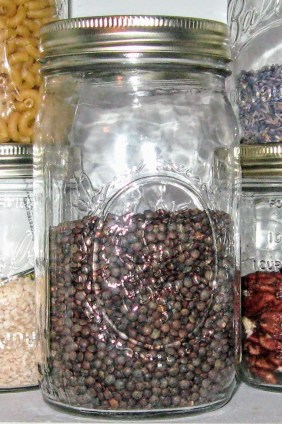
pantry-de puy lentils cropped IMG_1115

We all know that I’ve got a “thing” for lentil soups. Here’s the latest recipe added to my collection:  Lentil Soup with Sausage and Fennel.

(I’ve become a serious fan of Taste magazine, especially the cookbook recommendations and the great deals on ebooks.)

My pantry always contains Le Puy lentils; they are for anything made with lentils. This hearty soup is great in cold weather. But, now it’s starting to get warmer here, so it will soon be time to switch to lentil salads. The sausage doesn’t suggest a salad, but I think the fennel and lentils have possibilities for a salad–add some cheese…

—Ô¿Ô—

Hive report: Swarm!

Yesterday (28 March) it was finally warm enough for me to do a hive inspection at the same time that I could take off work. So I inspected Hive A (affectionately knows as Dave’s Bees). The population was very heavy, there was brood in the deep, and in two medium supers.  I didn’t see much nectar in the hive, but there was pollen.  Unfortunately, the girls got really PO’d part way through and I had to let them calm down. I think that was partly nectar dearth and the fact that it was cloudy and fairly windy. So that inspection was not one where I pulled every single frame. But I didn’t see swarm or supersedure cells, but I did add another medium super to give them some more room.

Then I went to Hive B (the GA girls) but they had been affected by the alarm pheromone from Hive A, and were PO’d from the first contact. So, being a wuss, I thought that since the weather forecast was for another warm day to follow (29 March) that I’d simply let the yard calm down a bit and do that inspection on the 29th.

The 29th turned out to be a lovely day except it was just bit windier than I like for an inspection but it was warm and sunny. So I toted another medium super out to the hive, along with my toolbox, and then went back to get the smoker. As I walked to within about 10 feet of the hive the Georgia girls (Hive B), I heard them–bees came pouring out of the hive. Swarm in progress, right before my eyes.

The last time one of my hives swarmed I was lucky–the queen landed on my shoulder so I got that swarm easily.  Luck was with me again today–the queen didn’t land on me, but in a short, squatty, multi-trunked bush that was infiltrated by a very thorny climbing rosebush, very close to the hive, and practically on the ground.

Bee brush and a dishpan in hand, I started the process of capturing my errant bees. With 20180316_114851.jpgthe aid of pruning shears, I got down to the cluster but they had picked a spot where the trunk had multiple branches and was sturdy enough not to shake very well, and of course, that’s where the bees settled down.

(Nope, no photos–I was way too busy working out my plan to get these creatures into their new home.)

It was obviously time for the bee-brushing technique: hold the pan under bees, and brush downward.  That got me a pretty good batch of bees so I carted them back to their new home that I had prepared for an occasion like this. Dump them in, look for queen; no queen seen. Back to the bush: a lot of the bees settled back in another cluster although a fair number were on the ground. So the routine became to shake and brush the bush, dump into the hive, shake, brush, dump, several more times. Finally, I was down to only a very small cluster of bees right on the main trunk of the bush and it seemed that the girls I had carted back to the new hive were staying there although some were still flying around the bush.

I decided to let them settle and try one more shake-and-brush, but first, I needed water. I gave it long enough for me to slake my thirst (it’s damn hot in a bee suit) and went back to the bush. There were no bees there–that little cluster had dispersed, but there were some still in the air between the bush and what was now Hive C and I saw some bees going into the hive! Maybe, just maybe, that means that I’ve got the queen in that hive.

I still haven’t looked into Hive B–got distracted by the swarm—but maybe tomorrow.

Now I have to decide if I purchase a queen or let them raise one of their own. Decisions, decisions, decisions….and the bees will do what they damn well please!  Just like cats, we only think we are in charge.

—Ô¿Ô—