
May your day be filled with good food, wine (or other spirits), friends and convivial conversations!
Digital Cookbook sale (11/05/17–11/19/17)
The most recent email (today) from Taste is extolling the virtues of digital cookbooks, and along with that, there are some links to so specials from Amazon, Barnes & Noble and iBooks.
I am a fan of ebooks–even cookbooks since a lot of what I do is look at them for inspiration, and maybe just out of curiosity. (Don’t misunderstand, I still love hardcopy, but with newer e-readers (or tablets) you’re still able to enjoy the photographs without buying another bookcase.)
The prices are right if there are some you’d like to check out without paying the usual prices: all of these are between $1.99 and $2.99 so they can be an indulgence.
- Brunch at Bobby’s by Robert Flay
- The Banh Mi Handbook by Andrea Nguyen
- Madhur Jaffrey’s World Vegetarian
- Soframiz by Ana Sortun and Maura Kilpatrick
- The Mac + Cheese Cookbook by Allison Arevalo and Erin Wade
According to Taste, the sale runs from 11/05/17 to 11?19/17 but check before you buy. The links I’ve posted here are Amazon because I’m a Kindle owner but you pick your favorite vendor.
A mortar and pestle
I have a dedicated spice grinder (one of those little “coffee grinders” that doesn’t work on coffee,) but I’ve decided that I need a good mortar and pestle. I gave away the wooden ones and the porcelain ones that just don’t work either.
Why do I want a mortar and pestle? Well, the spice grinder does not work well for small quantities like I often used when doing single-serving cooking–I do mean literally single-serving cooking. When all I want to grind is six allspice berries and 1/8 teaspoon of cumin seeds–the grinder is overkill, and they really just bounce around in there, so it’s not really efficient and then add cleaning time and effort. (This is kind of like my feeling about food processors versus my chef’s knife–give me simple and effective, along with easy clean-up for small quantities of stuff!)
That doesn’t mean I’m giving up my spice grinder–it’s great when I’m making a huge pot of chili con carne and need to grind larger quantities. But when all I want is a few spices to put into two servings of mujadara I’ll opt for manual labor. Not giving up the food processor either–love it for making large quantities of mirepoix for the freezer.
Given how unhappy I’ve been with all the previous mortars and pestles I’ve had, I went in search of a review of them. From Fine Cooking I found “Equipment Review: Mortars and Pestles” with a discussion of materials, pros, and cons, and even some specific recommendations.
The top rated one was made of granite with granite pestle from ImportFoods.com was one tested. Part of the utility of a mortar is how rough or smooth the inside is. I don’t want to buy one sight unseen from “that place” because I won’t be able to look inside it and feel the interior.
–Ò¿Ó–
Rotisserie chicken
Yes, I do mean exactly what you think I mean: one that I tote home from my local Harris Teeter supermarket, not one that I’ve cooked at home. On Sundays, the rotisserie chickens are on special–$4.99. I can’t buy a whole chicken for that price so I’ve learned the times when the freshly roasted ones come out, and I go pick up one that hasn’t been sitting on the heated carousel for hours. That’s one thing to check before you buy. I like to lurk while they are actually being put out.
Even getting one that is freshly packed still has its problems–chickens have both dark and white meat. Unfortunately, the two don’t cook the same, but they are both on the same bird. The first serving of breast meat off that bird is okay–not really my favorite. The second is not so okay if you don’t particularly like white meat. But such a bargain!
I usually don’t buy whole chickens. I buy leg quarters. Occasionally when I’m really busy and don’t want to cook I succumb to the lure of the whole rotisserie chicken. My quandary is always how to make use of the second serving of white meat. Reheated it’s dry and tastes reheated. Made into soup, it is still dry and even less flavorful that it was on the fresh bird.
Inspiration struck the other evening when I was making mujadara in the Instant Pot. When I pulled the bowl out it was steaming hot. I was planning it as a side to the chicken. Instead, I sliced the breast into bite-size pieces and stirred it into the mujadara. That was enough to warm the chicken but not enough heat to overcook it. That turned out to be the best second serving of white meat that I’ve had in a long time.
I’m sure I can do that same thing with other dishes–or with soup–just add right before eating instead of cooking it more.
Mujadara
One of my favorite things is a combination of rice and beans–or lentils. The top of my list of comfort food (even higher than mac ‘n’ cheese) is mujadara–rice and lentils, and onions. (I discovered that if you want to find this in a Lebanese cookbook you should look for m’jadara, but then, I was not even sure what the dish was called so I didn’t even get close.) Now that I know what I’m looking for, it’s much easier to look in the index!
I’ve found lots of recipes online:
I’m sure that this is one of the dishes that every cook has their own recipe, so I was looking at how it was seasoned. There was an amazing range: from salt, pepper, and onions to versions including cumin, allspice, coriander, cinnamon, and cayenne. Some included lemon juice or zest.
Since I’ve become the proud owner of an Instant Pot (IP for short), I have been experimenting with things like dried beans, rice, and all sorts of meat dishes. I’m convinced that the IP is going to be a good replacement for my Krups multifunction pot.
I had been exposed to pressure cooking ages ago, and by a cooking style that produced everything drab olive green, and by first-generation pressure cookers. So I never really bothered. Now I’m convinced that I have been missing a good thing. So, enter the IP.
I started with the simplest version of mujadara that I could find. My perusal of recipes led me to the conclusion that rice and lentils were used in almost equal quantities. Since I’m a single-serving cook, I want smaller quantities than any recipe that I’ve seen.
For my first test, I didn’t do the crispy onions–I just put some chopped onions in with the rice and lentils. Since I’ve been reading The Essential Instant Pot Cookbook by Coco Morante, and everything I’ve followed her instructions for has worked so well, I decided to follow my “gut” about how much water to use to cook this in the IP, and knowing that onions would release a bunch of water, I used just slightly less than the volume of the rice and the lentils.
My Mujadara
For two servings:
Ingredients
- 1/4 cup brown basmati rice
- 1/4 cup lentils de Puy
- a good three-fingered pinch of kosher (Morten) salt.
- black pepper
- a dash of red pepper flakes
- 1 medium yellow onion, chopped
- scant 1/2 cup water
Preparation
- All ingredients into the Instant Pot
- Add water
- Multigrain setting
Yes, all of it all at once into the IP, without rinsing the rice, in a 7-cup Pyrex bowl for the pot-in-pot cooking method.
I should have reduced the time just a bit to leave a bit more “tooth” to the rice and to the lentils–I suspect 30 minutes will work fine. Even though all the recipes I’ve found say NOT to use the French lentils, I like them–and they were what I have in the house for general use. So, that’s my version.
For a first run, I’m was a happy camper. The second time around, the multigrain time set for 30 minutes. I added the seasonings in from the Cook’s Illustrated recipe, except that I was out of coriander. To try to pick up something of the same flavor, I added sumac. However, without any extra seasonings, it was a good side to go with my rotisserie chicken (brought home from the grocery store because I’m eyeball-deep in indexing) and not spending a lot of time cooking.
The second batch, with shorter cook time and more seasonings, was better consistency, but I really like the very plain dish for flavor although I’m sure it will depend on what’s being served with it.
A son gôut!
Ò¿Ó
Game birds
The post Fowl Language: All About Game Birds from D’Artagnan is a good one to read if you want to learn more about them. They are not as hard to find as you might think, and this is a reliable source too. Especially around holidays, you may find them in your supermarket–and on sale afterward.
They are not as hard to find as you might think, and this is a reliable source too. Especially around holidays, you may find them in your supermarket–and on sale afterward. It’s a great time to try them if you have not done so before now.
I look forward to finding goose on sale after Christmas. It not for single-serving cooking, but a great occasion to have friends over for a meal.
Ò¿Ó
.
Salt is salt?…Not!
Salt seems to be an ingredient we take for granted. What kind of salt do you have in your kitchen? A lot of us have forsaken “table” salt for other kinds of salt. A frequent response from cooks is “kosher”. But what brand?
Most of us probably know that table salt and kosher salt, while both sodium chloride, cannot be interchanged when salt is measured by volume. But what about kosher salt?
This article, “The Kosher Salt Question” is a good discussion of the two major brands of kosher salt. Read it before you use a volume measure to salt a recipe.
A son gôut!
It was a good kitchen friend….
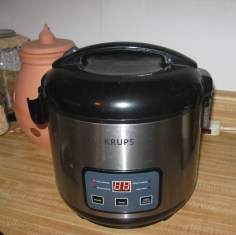 I’m sure that you’ve gathered from my posts that I really like my Krups multifunction pot: rice cooker, steamer, slow cooker, and even a bit of sous vide thrown in. It was a good kitchen friend…and I hope to pass it on to someone who will care for it as much as I did since it’s still in good working condition.
Some time ago a friend loaned me his “extra” pressure cooker, and I like it a lot. I kept thinking that as much as I used beans that it would be useful for me to have a pressure cooker–not just because of the beans, but because it would be a good way to do summer cooking when I don’t want to tax the air conditioning; however, I just never got around to adding another thing to the kitchen. I even decided which I would buy when I did add it. A Fagor that could be used with an induction unit. As a proficient procrastinator, I just never got around to buy the pressure cooker. Now I’m glad that I didn’t.
I did add the DASH yogurt maker (yes, homemade is better) to my batterie de cuisine and I’m glad that I did, but that, too, is going to a new home where it will be appreciated. Are you wondering yet what is going on in my kitchen?
You’ve probably guessed–the Instant Pot has invaded my kitchen. I’ve now had it for eleven days (as of 01 October 2017). It did not linger in the box. It was unpacked and used the day after it arrived. So far it has been used at least once a day every day that it has been here.
This wasn’t a spur of the moment purchase. I did a lot of research before I decided to purchase one, and a lot more before I decided which one I wanted to buy. I read a lot of reviews, perused a lot of recipes, checked out the Facebook Instant Pot Community, and went so far as reading America’s Test Kitchen/Cook’s Illustrated reviews of the multifunction cookers which were pretty damning)–but I bought it anyway because I think that once I “get a feel” for how it works it will be a great kitchen appliance.
I’ve made my lamb and garbanzo bean stew in it, cooked my steel-cut oatmeal in it, made soup, and a number of other things already. Yes, there is a bit of a learning curve in terms of seasonings, but I find it really pretty intuitive (although I did let my OCD show and read the manual). So far I’m pleased with this new addition to my kitchen. It would appear that a few other single-use appliances will need to find new homes–even the egg cooker.
My morning breakfast quandary of food versus functionality has been solved. I think that one of the most pleasurable things since cool weather has finally arrived here is my morning bowl of steel-cut oatmeal. Frankie, the cat, has steadfastly refused to cook it. I’m often working before I’m ready to cook. Now the Instant Pot has taken over that job. Using the “pot-in-pot” technique (which was one idea that helped persuade me that I needed the Instant Pot) I can put breakfast on before I go to bed, and it’s hot and ready to eat when I’ve finished my first round of cafe latte.
Another plus for me was that the Instant Pot has a stainless steel liner (so you can saute right in the pot)’. The Krupps multifunction pot to which I am bidding farewell had a nonstick liner so required some care in using it. (Yes, I’ll give the stainless steel inner pot due respect to that it doesn’t get scratched up, too–because that’s just the way good cookware should be treated.)
So–at this point, despite its yeoman’s service in my kitchen for quite a number of years, this is a requiem for that useful appliance–and hope to find it a good home and I’ll be embarking on more cooking adventures with the Instant Pot.
—Ô¿Ô—
P.S. It remains in my kitchen for the sole purpose of taking the mashed potatoes to our Thanksgiving Day gathering since it does that better than the Instant Pot–it’s a bit lighter and easier to tote around.
Ò¿Ó
…
Bouillabaisse–for one or two.
I’ve decided that one of the things that I should always have in my freezer is some good quality frozen fish.I like it packaged in individual servings so that I’m not trying to figure out what to do with the remains of a meal of fish. True, a bit of “leftover” baked, broiled, or even pan-fried fish can be turned into chowder…or tuna or salmon can be “re-purposed” into a salad. However, as much as I like fish, I’m not really into it as a leftover so it’s either get it from the fishmonger/supermarket, or in individual Cryovac packages. I do like variety in my fish so I usually check out the fish counter at my local Harris Teeter or The Fresh Market anytime I’m there–and if lucky, come home with something special like monkfish, “manager’s special” tuna steaks, or wild-caught salmon. I do bring home the occasional tilapia (though with some thought to the downside of the farm-raised fish).
I love Chilean sea bass but that’s just not in the budget for everyday fish although my freezer does have some that I found at Costco. My favorite standby fish is cod. Firm, tasty white fish that lends itself to cooking in many different ways. Again, my favorite source is Costco.
I’m also fond of reading recipes–if only for inspiration rather than mindless to-the-letter following. Skulking through my inbox today I found an email from Bon Appétit that provided some interesting reading: recipes for cod–an interesting collection that all looked tasty.
One particularly caught my eye was poached cod with tomatoes and saffron–which brought to mind another cool-weather favorite that I don’t make all that often unless I’m making it for friends: bouillabaisse. Looking at this recipe made me wonder why I hadn’t made an effort to make mini-bouillabaisse for myself. It’s really just poached fish in a yummy tomato soup.
Though bouillabaisse typically has lots of different kinds of fish and seafood in it, I could certainly start with a single-serving size piece of cod and add a couple things. My Harris Teeter fishmonger is used to me ordering strange quantities, so probably wouldn’t bat an eye over two shrimp and a scallop–or maybe even a clam or two.
Taking this basic recipe for poached cod, I’d need to add a couple things to recreate the taste of the traditional bouillabaisse: most notably some fennel and pastis (licorice-flavored aperitif).
Mini-bouillabaisse
Ingredients
SERVINGS: 4
- one 4-5 ounce skinless cod fillet
- 2-3 shrimp
- 1-2 scallops, clams, or muscles.
For the poaching liquid (from the Poached Cod with Saffron)
- 2 tablespoons olive oil
- 2 garlic cloves, thinly sliced
- 1 teaspoon Aleppo pepper or ½ teaspoon crushed red pepper flakes
- 1 14.5-ounce can whole peeled tomatoes (with juice instead of adding water)
- ¼ cup dry white wine (keeping this instead of using fish stock)
- 2 bay leaves
- Pinch of saffron threads
- Kosher salt and freshly ground black pepper
Adding for traditional bouillabaisse flavor:
- scant 1/4 cup diced fennel
- 2 to 3 teaspoons pastis/Pernod (season to taste)
- 1/2 medium onion or 1 small leek
Preparation
- Sauté leek and/or onion in olive oil until softened.
- Add garlic and sauté until fragrant but not browned.
- Add tomatoes, wine water, fennel, bay leaves, pepper, and salt and simmer 10 to 15 minutes to let flavors meld. Reduce to a bare simmer.
- Add cod filet and about 3 minutes later add the shrimp, scallop, clams, or mussels and continue to cook for another 3-4 minutes (until the shrimp begin to curl, the scallop is opaque, and clams or mussels open.
If you want to bulk this up for extra hungry people, add cubed potatoes while the soup base is simmering and cook until almost tender; then add fish and continue as above. There is more soup/sauce here than is needed for one serving. Put it in the freezer for the next time you want bouillabaisse for one–you’ll have a quick meal–even if it is only a fish filet without the extra seafood.
A rather traditional accompaniment to bouillabaisse rouille, a garlicky “mayonnaise” to dollop into your bowl but I don’t always make it. Bouillabaisse can be eaten without it. My favorite is the version by Anthony Bourdain with the roasted red peppers, egg yolk, and lemon, and lots of garlic. My most often-used version of rouille uses a mayonnaise base as it’s faster and easier (from Saveur). Traditionally this would be made with soaked breadcrumbs or egg yolk and other ingredients into which olive oil is emulsified–like mayonnaise. The mayonnaise version is easier for single-serving, solo cooking. (If there’s any left over it’s good on a sandwich or with other meat since I don’t use the fish stock in it.)
Rouille (my version)
Ingredients
- 2 cloves garlic mashed to paste with pinch salt
- 1/4 teaspoon sweet paprika
- 1/3 cup mayonnaise
- pinch of saffron threads
- pinch of cayenne pepper
- a squeeze of lemon juice, to taste
Preparation
- Blend garlic, paprika, saffron to a paste with a few drops of water if necessary.
- Add to the mayonnaise
- Add the squeeze of lemon juice to taste, and salt to taste.
- Thin with a few drops of water if necessary.
Hive report: bee attitude!

This is much more subtle. Despite my careful monitoring of the feeding jars, I let them get empty–completely empty–while on the hives. The bees are sucking down syrup at a great rate which does say something about nectar dearth. But they have registered their disapproval of my behavior.
When I removed the jars–quart jars with a lid that has small holes punched in them so that syrup is under a vacuum when the jars are turned upside down–I find that the girls had filled each and every one of the tiny holes in the lids with propolis. Every single little, tiny hole–completely shut!
Propolis has its uses–it’s antimicrobial, and bees seal small cracks in the hive with it and cover things that need to be “sealed”–like a mouse that is too big for them to carry out of the hive if the beekeeper, perhaps, forgot to put the mouse guard on the hive in the fall.
Getting propolis off of anything is not easy–it is very sticky so that dissolving it is really the only option. Rubbing alcohol is the best thing I’ve found–and the 91% rubbing alcohol (isopropyl) is much better than the usual 70% stuff, but it still required an awl to open each little hole individually and then a second scrub with alcohol.
I understood the message while I was out of town for the indexing convention–the jars were probably empty for several days, so I get the propolis. But this time they were only empty for a few hours–I get this message too, but I think I detect a faint bit of attitude here as well, but then I guess I could be feeling that way because I have been getting attitude from the cat as well today.
Anthropomorphize? Who, me?
Õ¡Ö
. . .
 a-single-serving.com