
Take four chicken thighs…

If you are going to cook for one, you need to get away from recipes that specify exact quantities–it’s a step toward learning to improvise as you cook.  I’d urge you to take a look at Kitchen Express by Mark Bittman–you don’t have to buy it, thought it’s a great book to have; go to the library and check it out. (It’s also available for Kindle, too)  Other simple, and simply good recipes can be found at The New York Times, and at Mark Bittman.com.  You will find recipes that are easy to do for one because they are “quantity-less” in the sense of the typical recipes.  They don’t call him “minimalist” without a reason–a very few ingredients can make some wonderful eating.

Now for those four chicken thighs, cooked as described in “The Microwave in my Kitchen”, here’s what has been done with some, and what is intended for that fourth one:

1.  Chicken salad for a sandwich, quickly made by adding some minced red onion, a bit of cutting celery (See Herbs page) leaves and stems, salt, fresh-ground black pepper, a squeeze of lime juice (or lemon juice), and a drizzle of extra-virgin olive oil.

2.  A warm meal of chicken with  part of a can of chickpeas left from a previous use.  Sautéed a handful of onion in olive oil until softened, added a big clove of garlic, the chicken cut into bite-sized pieces, added some halved grape tomatoes, about a tablespoon of chopped sun-dried tomatoes, a dash of Syrian oregano (still growing on my deck); finish with salt and fresh-ground black pepper to taste.   Add a  single-serving salad of mixed greens and had a quick, satisfying meal.

3.   The third piece went to make some quick chicken hash for Sunday breakfast as follows:  In a 12-inch nonstick skillet sauté a handful of diced onion  in olive oil until just starting to brown.  Add two minced garlic cloves (I like lots of garlic),  and cook for two or three minutes.   Meanwhile, open a can of diced potatoes (I told you this was quick–obviously you can start with raw potatoes and sauté them until tender) and brown them lightly. Rinse and drain the potatoes, add to the skillet and sauté until they start to brown.

Remove half the potato mixture–this is destined for another use.  Remove the meat from the chicken thigh if it was bone-in and dice the meat.  Add this to the potato mixture in the skillet, along with some (about 1/2 teaspoon) fresh thyme (again still growing on my deck) and continue to sauté.  When the potatoes and chicken are slightly browned, remove to a plate and keep warm.  Cook one egg (or two if you are really hungry) to medium, and serve over the chicken hash.

The portion of potatoes that you removed from the skillet can be used in different ways: the are likely to become a kind of quick version of a Spanish tortilla by just  warming and adding a couple of eggs and serving with a salad or vegetable.

4.  With the broth obtained from cooking the thighs in the microwave, I plan make a meaty chicken soup using that fourth chicken thigh, using that bit of  rice left  from another meal.  I’ll add more veggies, perhaps a bay leaf, and some of my “lazy” favorite (and only) herb mix, herbs de Provence. I’ll see when the time comes–since I don’t do leftovers, I probably shouldn’t do predictions either.

There will be a follow-up on that fourth piece of chicken to let you know where my improvisation lead me.  I’ll give you another example, using a recipe from Kitchen Express for a lentil soup that just blew my mind (See An Awesome Lentil Soup).  It was such an unexpected combination of flavors, and it is one that I keep using to improvise with other ingredients, as well as coming back to the original.  It’s a recipe where I could also make use of the last piece of chicken.
The microwave in my kitchen

I guess I’m not really fond of many small appliances or kitchen gadgets.  There seem to be a lot that just take up drawer space or counter space and don’t work that well.   In many ways the microwave has mostly been just a “gadget” in my kitchen.  Most of the microwave recipes that I found were just not that good: edible, but that’s about it. Many of the early cookbooks that I looked at seemed to suggest that anything could be cooked well in the microwave.  Admittedly, I’ve not looked at a lot of newer ones because they seemed so uncritical about what does or does not cook well in the microwave.  So for me it was for melting chocolate, making popcorn, heating a cup of water….

I’ve revised my opinion slightly after finding the Microwave Gourmet cookbook by Barbara Kafka.  This author is a traditionally trained chef, and approached the microwave in a very skeptical frame of mind, and that has produced a useful microwave cookbook.  There is no hesitation in saying what NOT to cook in the microwave.

One of the really useful features of this book  is a dictionary where you can look things you might want to know about cooking in the microwave, and find times, suggested container sizes in which to cook it.  I’ve use this more than almost any other part of the book, except possibly the information on how to arrange foods in containers in order to have them cook properly.

I’ve tried the microwave risotto, and it’s not bad for times when you don’t want to spend the time standing by the stove stirring for 25 minutes or so.  (I’m anxious to compare the results of this with the Cook’s Illustrated simplified risotto.)

The most-used recipe in that book for me is the one for quick chicken broth or stock.  I’m mostly a stove-top or oven stock maker, but this is great when you don’t have canned stock or want some really good broth for soup.  Here is the recipe:

Use bones (carcass from the roast chicken, or necks, backs, wings, or giblets (except liver).  You can collect these in the freezer until you have enough, or if you’re lucky, you can buy backs cheaply and make this whenever you need to.

  • 2 pounds chicken
  • 4 cups water

For 4 cups, place the bones and water in a 2-quart dish and cover tightly with microwave plastic wrap.  Cook at 100% for 30 minutes.  (Cook 40 minutes for broth that will jell.)

For 2 cups, use 1 pound bones, and 2 cups water.  Cook for 20 minutes.

This cookbook has directions for making  the classic stocks and broths in the microwave–including vegetable and fish/seafood broths.  Although I’m sure I will not give up the stove-top or oven long, slow preparation of stock I think that I’ll turn to the microwave more frequently, especially in hot weather.  I’ve not done a side-by-side tasting of each method, but this is certainly better than canned!

I’ve also cooked chicken in the microwave according to instructions in this book and been pleased with the results.  I use chicken thighs instead of breasts, but instructions/times can be found in the Dictionary section of this cookbook.  An unexpected benefit of cooking the chicken this way  is some very good strong broth; just enough to make one good  serving of chicken soup.  To me the texture of the chicken is a bit different when done in the microwave– more chewy, but not tough, or disagreeable at all (I actually like that “chew”).  I expect that I’ll be using the microwave more often to cook chicken now.

“Convenience” foods for cooking for one

Time frequently seems to be of the essence when cooking–for one or for many.  There are some things that I discovered that save me lots of time–and that means that I’m much more likely to cook a meal, rather than do carry-in, or reach for the peanut butter jar!

When you see “convenience” food, I dare say your first thought is processed, open-heat-and-eat food.  That’s not what I’m talking about here.  I’m thinking of things you prepare yourself with choice ingredients, and freeze, or otherwise “put by” for later uses that can shave time off of recipes.

How many recipes do you have that start with  a “flavor base” like  sofrito (Spanish), soffrito (Italian), mirepoix or mirepois (French)?    Lots, probably.  How many times have you passed on that recipe because you don’t have those, you did not want to spend the time mincing, dicing, or you pulled that bag of celery out of the crisper, and–yuck–it’s no longer fit to use!   Cooking for one, I find celery a particularly frustrating ingredient.  I like celery–but it always seems to go bad in the crisper.

Many flavor bases to start soups, stews, et cetera begin with carrots, celery, onion, diced or minced and sautéed  in olive oil (or maybe butter).  True it’s only a few minutes work to do this–if you have the ingredients.  My solution to this has been to take celery, carrots, onions, and use the food processor to chop a large batch of this useful mixture, sauté in a mild olive oil with just a touch of salt, and then pack it into small containers in lots of a couple tablespoons (or freeze in ice-cube trays and transfer to zipper-lock bag), and put it in the freezer so that when I need it, I have the basic prepared carrots, celery and onions, to which I can add garlic and herbs as needed for a particular recipe, and I’m off to a running start.

I do keep canned beans around as a “convenience” food, but I much prefer to cook my own dried legumes (pulses).  Since that is a time consuming thing, I have found a way to make those into “convenience” ingredients:  cook a large batch until almost fully cooked, and then freeze with some of the liquid in small quantities–a cup or so, whatever you would most likely use.  I’ve found that they hold well in the freezer, and can finish cooking quickly, so that you have the advantage of home-cooked quality, without the time investment.  I’ve done this with lentils (my favorites being the French LePuy) of all sorts.  True, lentils cook quickly and do not require soaking, but I can still save time with these.   I particularly like to do this “precook” with beans since that means that I can have lots of variety and have the convenience of canned, with specialty beans that are very tasty.

Grains can also be done this way too.  That left-over serving of rice that I’m sure I’m not going to use this week gets labeled, dated, and put into the freezer for a quick serving when I don’t want to take the time of cook rice from scratch.

Risotto is another favorite main dish for me–right in my category of comfort food with mac ‘n’ cheese, and tomato soup; I don’t find cooking it to be difficult–in fact it’s rather relaxing, but time consuming.  I’ve tried some of the “quick” recipes (see Risotto post) and have not been too dissatisfied with them, but I’ve also found that I can make a big batch of risotto to the point where it’s ready for the addition of the Parmigiano-Reggiano, and then freeze it is serving-size batches.   It will thaw quickly, and lets me have risotto fairly frequently.   It’s easy to add vegetables or seafood or other quick-cooking things as you finish this preparation.

Another “convenience” ingredient is homemade broth or stock.  While I will admit to keeping canned/boxed broth/stock on hand, I much prefer to have the real homemade thing, and that is not hard to do:  make a large batch on a cold rainy day when it’s good to be indoors; freeze it in small quantities for future use.   I’ve found a very quick way to make chicken broth too.  More about that later.

All these little conveniences can add up to much better small-time cooking with big-time flavor even when cooking just for one.

I love wine in a box!

I’m definitely an oenophile. I like wine with my meals, but sometimes I hesitate to open a bottle when I know that I’m going to have leftovers, or if I think that it’s a more expensive bottle than I want to have only for one.  I also like to cook with wine, but hate opening a bottle for just a glass and a splash in the sauce.  I think that wine in a box is one of the greatest that for those of us living alone.  It’s now possible to get good wine, inexpensively in a box.  Tuck a box of white in the fridge, and stash a box of red on the pantry shelf.  I can have the luxury of a glass of wine whenever I want, and a splash of white for cooking even when I’m drinking red.  That doesn’t mean that I don’t have some exquisite bottles in my cellar.  They’re the ones to  have with a special meal, and possibly with friends.  But the “house” wine is now in a box.  It’s not cheap wine–just inexpensive and convenient.

There was one advantage of having “leftovers”–bits and pieces of bottles: those make great wine vinegar.  I have a glass container in the cabinet that get “fed” on those to keep the mother alive, so I have a constant supply of good wine vinegar.  It’s unfiltered, unpasteurized, potent, and much more complex in flavor that the stuff out of a bottle.  I’ve had the red wine going since I was given the mother over 10 years ago.  It’s simple to keep–the occasional splash of wine from the box, or occasionally, but a really inexpensive bottle and dump that in.

I recently decided that I wanted white wine vinegar, too.  So, took some of the mother from my red wine and put it into a bottle of white wine.  Not sure yet what is going to happen–now it’s still a bit pink as the mother was a very deep, dark red.  There will be future reports on the progress.

A new cookbook

A few weeks ago, I had a friend visiting (as a house guest) from California.  We were out and about doing some things that I don’t usually do: visited A Southern Season to browse for housewares and foods, and we visited The Regulator Bookshop. Both were having their summer sales.  As usual, I came home with things that I did not expect to buy.

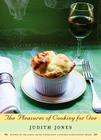
One of my “finds” at the bookstore was The Pleasures of Cooking for One by Judith Jones.  This is an admixture of philosophy of eating alone as well as some recipes, and, best of all, lots of tips for not having left-overs.  While some of the recipes are for things that cannot be bought in small quantities (like pork tenderloin) she provides recipes and suggestions about make several different dishes from the “left-overs” so that they really don’t taste like left-overs. While this does require some meal planning, the emphasis here is on flexibility and improvisation.  I was impressed that the recipes here were real meals for real enjoyment.  I think that this is a worthwhile addition to my cookbook library.

Serves how many?

I love cookbooks.  I love to read cookbooks just to get ideas, but one of the most frustrating things is finding a recipe that I think looks wonderful, but it’s for 6 people.  Sometimes it’s something that will freeze well, so I can make it and not have to eat it for a week.  On the other hand, since I am cooking for one (and the cat) I don’t want to pay for the ingredients to make servings for six or eight people, or have so much in the freezer.  (More on freezer use later.)  The dilemma for the single cook is scale the recipe down, not make it, or eat it for a week.  Personally I don’t do left-overs well; I guess I’m easily bored or they begin to taste like something that’s been in the fridge for five days!

Downsizing recipes can be treacherous, especially in going from six to one–the consistency can come out wrong, the seasonings may not be right.  If you are determined to do THAT recipe, perhaps you need to invite friends.

You’ve gotten ideas from those huge recipes that you can use for one.  The problem now is that you need to get away from depending on a recipe slavishly.  You need to move on to improvisation and perhaps some food science to help understand how some specific ingredients react to the application of heat, i.e. cooking.

First improvisation is a must for cooking for one–and it’s not hard–it’s just taking that first step that seems difficult if you’ve always used recipes. A book that I’ve found immensely useful is How to Cook Without a Book by Pam Anderson. This author has provided a wonderful review of various cooking techniques as well as recipes in ratios that promote improvisation of various types of dishes:  stews, salads, an such.  While the proportions given in this book tend to be for 4 people, you can scale them down to something manageable for one person.

I have to admit to being a Kindle addict.  I admit this because I might not have found this cookbook had I not been browsing the Kindle store.  The book is  Ratio: The simple codes behind the craft of everyday cooking byMichael Ruhlman.

My grandmother taught me to cook and one of the things I remember learning from her was the “four parts cake”–frequently referred to as “pound cake” for equal parts of eggs, flour, sugar, and butter.  I was taught to vary the size of this cake by starting with the eggs.  You want a small cake, you use fewer eggs, and that “egg weight” determined the weight of each the other three ingredients.   It was many year before I discovered that this recipe was actually in something published in a cookbook.  While browsing through La Cuisine, by Raymond Oliver I found a recipe with the title pâtè à quatre-quarts which translated as “four parts cake”.  In the English edition this was translated as pound cake, but it was the French title that caught my eye.

In a manner reminiscent of that cake, Ruhlman gives recipes by proportions so that they are easily sized up or down.  This book gives ratios for batters, doughs, stocks and sauces, roux, and even sausages and many other things in ratios so that you have the base ingredients, and then add things like seasonings or “minor” ingredients (seasonings, et cetera) in order to have a finished dish.  This is the kind of technique that can allow cooking for one.

If you don’t want to contemplate doing the math of the ratios (and have an iPhone), there is an app for that.  The cookbook by Michael Ruhlman is now an iPhone app that will help you do the calculations.  Makes me wish I had an iPhone!