Offal: beef tongue

Offal:  1 : material that is left as waste or by-product of a process of preparation or manufacture: as a : the stalks and dust from tobacco leaves b : less valuable portions (as the belly, head, and shoulders) of a hide c : the by-products of milling (as of wheat or barley) used especially for stock feed d : the parts of a butchered animal that are removed in dressing, that consist largely of the viscera (as brain, heart, sweetbreads, liver) and the trimmings (as tail, hooves, blood, skin, head meat), and that are used as edible products or as raw material in the manufacture of by-products e : small or inferior or unmarketable fish

(Webster’s Third New International Dictionary, Unabridged. Merriam-Webster, 2002. http://unabridged.merriam-webster.com (20 Jun. 2011).

♦♦♦

I am fortunate to have a wonderful supplierof organ meats, such as tongues, hearts, beef cheeks, and other offal at my local farmers’ market.  While it’s not a regular part of my diet it’s certainly a treat to cook some once in a while.  It can be hard to find recipes for organ meats.

Since I now have a ready supply of offal, I’ve recently discovered two delightful cookbooks dealing with offal.  The Whole Beast:  Nose to Tail Eating and Beyond Nose to Tail:  More Omnivorous Recipes for the Adventurous Cook by Fergus Henderson.  The onset of cool weather makes me want to do more serious cooking so I’ve searched for recipes for beef heart and beef cheeks, which reside in my freezer awaiting cooking.   My own cookbook library provided me with some, but wanting to be a bit more adventurous, I decided to see what other recipes I could find.  It would seem that offal is gaining favor, at least with adventurous cooks, judging from the results of my search for blogs and recipes.

Since I grew up on a farm where we butchered our own meat, I’ve never been squeamish about organ meats, either preparing or eating.  Beef tongue is really pretty tame when it comes to offal.  Some of my old stand-by recipes are found in Mastering the Art of French Cooking (Volume 2) by Julia Child, and in Glorious French Food by James Peterson.  Since I’ve been cooking beef tongue for so long, I don’t always do a fancy preparation–love it cold, sliced for sandwiches in the summer time; for that I break out the slow-cooker and just poach it.  I’m fortunate that the tongues I get from my supplier (Meadow Lane Farms) are extremely clean, I don’t have to do a lot of the cleaning and soaking that many recipes call for.  I sometimes salt, but sometimes I don’t and the results either way are excellent.

I usually poach the tongue with bay leaves, juniper berries, brown mustard seeds, or maybe herbs de Provence:  just pop it into the slow cooker and cover with water for really carefree cooking.  If you don’ t have the slow cooker, it can be simmered on the stove-top, but it does need monitoring so that it does not boil. You could also cook this in a slow oven so that you don’t have to do so much monitoring–bring to a simmer on the stove top and then move to the oven.

The tongue is simmered in the slow cooker for two or three hours, and then I check to see if the outer covering peels easily.  If so, I’ll pull it out of the slow cooker and peel it.  If you’re doing this on the stove-top, or even in the oven, it may be ready to peel in about an hour.  Since I want to use some of it for sandwiches or in a salad, I’ll return the peeled tongue to the slow-cooker for another hour or so, until it’s tender; then let it cool in the cooking liquid and chill it, since it’s easier to slice when cold. The cooked tongue is very tender and beefy in flavor.

A great hot meal can be made if you take thicker slices of the tongue and quickly brown them in butter, and then serve with the brown butter over as a sauce.  Great with asparagus, or haricots verts, and some potatoes.  In the summertime, when the tomatoes are really lush, the cold sliced tongue with a good sweet-tart tomato slice, on bread brushed with a bit of olive oil is wonderful.   As with other beef, horseradish complements it nicely, too.

Health-wise, it’s not something I’d have every week, but I doubt seriously that it is any worse for me than some of the things I might find in the local delicatessen, and I know exactly what is in it.  While it may not sound like something to prepare when you’re cooking for one, it’s so versatile that leftovers are never a problem!
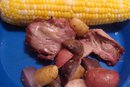
A simple supper

When I did the smoked lamb and goat shanks for the Fourth of July I deliberately added some extras, even after I had allowed for the appetites of my guests.  What was left after our dinner was not “leftover” but was planned (even though I had nothing specific in mind just then) as future food since I thought that these would lend themselves well to improvisation.

I sliced some of the meat very thinly from the cold shanks and used it in a salad.  The goat meat was especially good here, but the lamb made a nice salad addition too.  There was still enough for one all-meat meal, or two meals if supplemented with a grain or beans.

Lamb and beans heating in skilletI had envisioned using the rest of the meat with some cannellini beans  to make a kind of mini-cassoulet that would be topped with bread crumbs and baked briefly to meld the just-added seasonings. That was just not on the program!  It’s been so hot lately that I just did not want to have the oven on even with the air conditioning running, so I opted for a “skillet” meal.

My first step was to sauté some chopped onion (1 medium) until soft and starting to brown, then add  garlic (2 large cloves, minced).  Next I added the chopped meat from the lamb and goat shanks.  I had enough for two servings–and I decided to use it all in this concoction as I though I would like two meals from this as it would only improve with reheating. I added about 1 teaspoon of herbs de Provence(seemed rather cassoulet-like) and a healthy dash of crushed red chili peppers for some spice, and about 2 tablespoons of water.  Finally I drained, rinsed and added one can of cannellini (white) beans to the skillet, which I covered and allowed warm over low heat to hydrate the herbs de Provence and the pepper flakes.

Without further ado it was time to eat. With the last of the bottle of wine that was Lamb with white beans and sliced tomatoesserved with the original meal  it was a very satisfying, and easy, meal. There will be one more serving (and that’s not a “leftover” either–maybe that will make it into the baking dish with the bread crumbs and some rosemary added. This could adapt well to any extra pork, beef or chicken that happened to be hanging about the fridge as a leftover.  All this needed was a salad to complete the  meal.  Dessert was just some fresh fruit.

18 July 2011

Just a quick update here.  I’m glad I made two serving of this.  The improvement on re-heating was fantastic.  The smokey flavor came out more–next time I do something like this, I’ll plan to make it one day and reheat it later.  I’d love to try this with goat!

Vegetable cookbooks….

At the Wake Forest Farmers’ Market today, purple-hull peas made an appearance. There were lots of questions about them.  What are they? They certainly don’t look like what most folks are used to as “peas”.  How do you cook them?  Do you eat the pods? What do they taste like?

One of the joys…or perhaps frustrations, for some…of a trip to the farmers’ market is that you find “new” vegetables–uncommon ones, or simply regional ones–like purple-hull peas which are not necessarily included in a vegetarian cookbook.  So you need general, basic information–not fancy recipes; just the basics for starters.  Where to go?

There are lots of vegetarian cookbooks out there–some very sophisticated with wonderful recipes that make vegetables into worthy main courses or entrées; however, that’s not what you need to begin cooking a vegetable that is completely new to you.  For that what you want is the nitty-gritty information of how to prepare it–do you shell it, peel it–or how best to cook it.  The more sophisticated vegetarian books may just call for the ingredient and not give you the those basics or even just some simple recipes.

One of my favorite vegetable (note that I didn’t say vegetarian) cookbooks (and gardening information too) is The Cover of The Victory Garden CookbookVictory Garden Cookbook by Marian Morash.  It’s organized by veggies in alphabetical order so you can go directly to beets, kohlrabi, cauliflower or whatever, and find information on growing, preparing, buying the vegetable.  There’s a highlighted section of special information that includes yields (how much usable vegetable do you have after preparation/trimming or peeling), how to store and preserve, microwave instructions, and even suggestions for things to do with what is left from your first use (especially useful if you’re doing single-serving cooking).  Now that’s a vegetable cookbook!  The recipes given go from the most basic to more advanced. Terms (e.g. string and snap beans) are explained.  It’s a great place to start with a new vegetable.

The one I have in my library was published in 1982– I guess it’s time for me to go to the Regulator Bookshop and browse through the cookbooks again to see if there’s a new edition and if it has significant additions.  As for pink-eyed purple-hull peas…well, unfortunately, the closest this book came was black-eyed peas. True, they’re a Southern thing…and that’s another post coming up.

Another cookbook for single-serving cooking

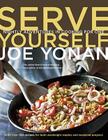
Cover of Serve YourselfI’m always browsing cookbooks–especially those that appear to deal with single-serving cooking.  A friend recently mentioned Serve Yourself: Nightly Adventures in Cooking for One to me. True to form, I immediately went in search of it–and was pleased to find it available in Kindle format.

I really identified with a statement made in this book: “…we solo artists deserve just as varied a diet as anyone.  While I love having some leftovers around that can morph into new dishes, I also appreciate the beauty of starting and finishing a single cooking project on a given night.” (Kindle location 173)

One of the things that I find delightful is that there are suggestions and recipes that are incredibly helpful in allowing morphing leftovers.  These include condiments (to use not only on leftovers) but suggestions on using those extra ingredients that seem to be the bane of single-serving cooking–such as what’s left of that bottle of wine that you opened to go with dinner yesterday evening.  Personally I think that this is a book worth having in your library if you cook for one, but I suggest that, at least, you check the local library and peruse this one.

I’d also recommend his website for fun reading of his “Cooking for One” column for more thoughts on cooking for one, and more recipes.  Even cooking for one it can still be a son goût!  

Healthy eating & living

I’m back from the Wake Forest Farmer’s Market–with blackberries, blueberries, sweet corn and other goodies.  One of the things I enjoy about selling at that market is the people I’m meeting.  In chatting with one of my customers today, a Health Coach, I discovered a website that has some good health and nutrition information.   Recipes here are simple, healthy and focus on good ingredients.

Independence Day smoked lamb shanks

After seeing the photograph and reading about smoked lamb shanks I decided that was what I needed for the Fourth of July.  It took some searching but I did finally find some shanks.  Unfortunately, they were not as large as those shown in that photograph, but I decided to give it a try with the smaller ones.  I also included two goat shanks to see how those tasted smoked. (These were from Two Bridges Farm, Louisburg NC)

I took the basic seasoning  from Rufus’s post:  lots of rosemary, garlic, some chili powder, some cinnamon, and added a healthy dollop of Colman’s mustard powder, salt, and added enough oil to make a very thick paste–heavy on the rosemary.  The shanks were rubbed all over with this, and then allowed to stand (refrigerated) for about 18 hours (overnight until ready to start the smoking process).

The Weber kettle grill was set up with a pan in the middle with water in it; then added hardwood charcoal briquettes (unlit on both sides of the pan.  These were topped with lit briquettes, and the soaked hickory wood chunks.  Vents were adjusted for a nice slow fire.  I opted not to use a mop sauce this time–may well try that on the next round!  But soon there were wonderful smells wafting from the grill–smoke, rosemary and lamb.

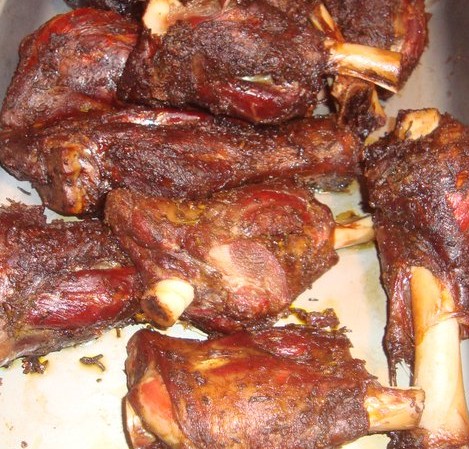
Smoked lamb and goat shanksIn an effort to keep the day as simple as possible (read to avoid dish washing, either by guests or me) there were disposable plates. Although I really did have a platter set out on which to serve the shanks, they never made it into a serving dish since we were being so casual; hence, picture of shanks in the pan that was used to bring them from the grill.  The results were fantastic.  (The goat shanks are the two in the front of the pan–the rest are lamb). The seasoning was there, but not intrusive but complementing the meat– the hot mustard added some “spice” and “zing” without ever seeming “hot”.

Mojitos started us off; then we had a very eclectic meal–one of the guests prepared Padrón peppers for starters–I’d never tasted them before, but I certainly hope that it will not be the last time.  Those wereplate with lamb corn on the cob and potatoes followed by wonderful gazpacho, then by crab cakes, with some melon interspersed.  Then,  the main course:  lamb shanks, corn on the cob, and several kinds of newly dug potatoes steamed and then tossed with extra-virgin olive oil, salt and peppers.  There were Purple Majesty, Red Thumb, and Russian banana potatoes mixed.  (Unfortunately, the Red Thumbs lost their pink color during the steaming, but there were the lovely red skins to make it red, white(ish), and blue!)

For those of us who wanted wine with the meal, we had a 2008 Marcillac Rouge “Lo Sang del Pais” (Domaine du Cros)…this was not the wine that I had bought to serve.  My mistake–it was a bottle from my cellar that I  considered before I decided to go visit the Wine Authorities.  They suggested 2008 Rouge “Cuvee Jericho” Vin de Pays (Mas Montel (Mas Granier), France, that I bought.  When I was setting up the serving area, I put out the Marcillac (my original intention) instead of the Jericho (80% Syrah and 20% Grenache)!  The Marcillac was awesome with the lamb shanks–it’s 100%  from Mansois (Fer Servadou) grape.   So I still have a bottle of the Jericho (and some “leftover” lamb shanks–that may well be supper this evening.

This is something I’ll do again, soon…the smoke flavor was not overwhelming, but very complementary to both the lamb and the goat and it was low-maintenance cooking, thought it took about 3-1/2 hours, that let me visit and relax while preparing it.  Perhaps the next thing to get smoked will be a goat leg.  The vendors from whom the goat shanks were purchased said that they had recently tried smoking a leg and it was excellent.  I’m glad that I discovered the post on smoking lamb shanks–and the associated information on smoking.

If there are “leftovers” after this evening, I think that those might end up in something with white beans for sort of a mini-cassoulet (for a hot dish) or maybe even a white bean salad–we’ll see what evolves.

I think there’s more smoking in  my future–and I’ll be learning to make the gazpacho that we had with this meal too!