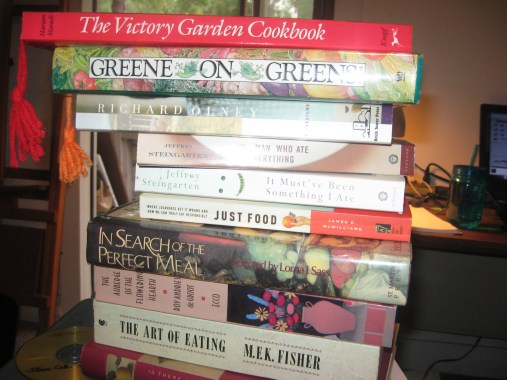
Books for the cook

For those of you looking for possible gifts for the cook, here’s a list from The Washington Post  of “The 31 Best Cookbooks of 2016”.

I’d add to the list (even though some weren’t published just this year):

  • Dandelion & Quince: Exploring the Wide World of Unusual Vegetables, Fruits and Herbs, Michelle McKenzie, Roost Books, 2016
  • Bitter: A Taste of the World’s Most Dangerous Flavor, with Recipes, Jennifer McLagan, Ten Speed Press, 2014.

  • The Broad ForkHugh Acheson, Clarkson Potter Publishers, 2015.

If you’re adventurous and believe that we should make better use of the animals that we use for food rather than just the choice bits (like steaks, chops, and roasts) you might also check books by Fergus Henderson  and other books by Jennifer McLagan for more on nose-to-tail approach to food and recipes.

For fun reading (with recipes mostly for one or two) there’s always Nigel Slater (one of my favorites).


Ò¿Ó

img_8265

.

Holiday gift shopping…2016

That time of year again! I’ve sworn off malls, and almost any shopping until after the holidays. I find I have zero tolerance for the chaos of parking lots and stores. Somehow those places really dampen any holiday excitement that I do manage to have: folks that can’t manage to allow two-lane traffic in a wide lane, bumps in the butt with shopping carts, and the like. Not to mention the choice of music in so many stores. But if you still need to do some holiday shopping….

  • For the cookbook lover who has an incredible library but is constantly cursing about not being able to find a recipe, a membership to Eat Your Books will let them search those books, as well as magazines, and blogs for recipes. (Membership information here.) It is definitely worth the bit of effort it takes to get you books on you searchable bookshelf.
  • Bull City Olive Oil specializes in fine olive oils, vinegars, and other provisions (shipping is available). If you are local (Durham NC) you can taste before buying. I’d not been a particular fan of infused oils until I tasted some there. The combination of herbes de Provence infused oil and lavender infused balsamic vinegar makes an awesome vinaigrette!
  • Cooks always love herbs and spices–if you don’t want to make the decision on what to give Penzeys will provide a great selection from which to choose. Personally  I love the small jars, especially for things you want to try, but may not use in huge quantities. Although I don’t keep many mixes on hand I wouldn’t  want to be without the herbes de Provence–it’s the jar that I reach for when I am rushed or just can’t decide what to use.
  • Spirits are always welcome gifts. My latest “booze” discovery is from The Brothers Vilgalys Spirits. They produce Krupnikas, Jabberwock, Zapod, Beatnik, and Beebop. I know I’ve mentioned these before, but I think they still make an excellent gift.
  • For someone who wants to learn more about cooking, The Science of Good Cooking presents techniques used in the kitchen with some good recipes; eat well while you learn to understand what goes on in the kitchen. In the same understand-what-you’re-doing vein there’s  Cook’s Science Cook’s Illustrated .com, Cook’s Country.com or a subscription to  America’s Test Kitchen membership that can give access to these last three sites.
  • For someone who wants to butter their toast without using cold, hard to spread butter, the Butter Bell crock, or the Emile Henry butter pot, or a plethora of others which work on the principle of using a water seal to keep the butter from air exposure. Caveat: you do have to remember to change the water every couple of days, but it’s a pretty small effort for soft butter. (Unfortunately, I’ll have to mention a solution that doesn’t work although it seems like a nice idea: the Cook’s Innovations Butter Mill. According to reviews some do work–mine didn’t–the fine threads just didn’t catch so the butter moved down to the “grating” surface.)
  • Your toast eater might also appreciate some topping for that buttered toast: varietal honeys from Old Blue Raw Honey–an impressive selection–including poison ivy honey.
  • For the cook who wants to explore using fresh herbs there are seed collections of basic culinary herbs: seed disc collections (complete with pots) from Johnny’s Select Seeds,  or just collections of herb seeds.
  • The potato of the month club from Wood Prairie Family Farm might suit for a “meat and potatoes” person. The variety of potatoes is absolutely amazing–and yes, they do taste different from what we’re used to in the supermarket.
  • For excellent citrus fruits Mixon Fruit Farms can provide luscious fruit shipped right to the door–grapefruit, oranges, lemons, or other. Even the white grapefruit will surprise you.
  • There is always a gift certificate for Kindle books  (or other e-readers) and a Lékué popcorn popper to provide a cozy, relaxing evening. Of all the microwave popcorn poppers I’ve tried this is a hands-down winner.
  • For some exotics like truffle butter, game, kits for making cassoulet, or charcuterie (which you might be invited to share) D’Artagnan can likely provide what you want.
  • Finally, another option for relaxation to go with the book or the Kindle gift certificate, a good cup of tea would add a final touch. Check out what’s available from Harney & Sons provides an incredible variety. One of the things I like so much about getting my tea from them is that for a small charge you can get samples of the teas–enough to brew a pot to really taste the tea. Frankly, I love trying different ones, so I’d be happy with a selection of samples as a gift!

Some other gift suggestions here, here, and here–there may be some redundancy, but some thing appreciated by cooks never change. My redundancy will probably give you an idea of what I’ve had to replace during the year–e.g. Krupnikas!

Disclaimer:  I have neither affiliate connection nor do I receive any consideration from any of the sources suggested above–they’re simply my personal preferences, so you decide. I’m sure that some of the things are available from other sources as well, perhaps less expensively.

Turkey–with truffle butter

Thanksgiving does have its good points–getting together with friends! There’s another positive thing, especially if you are like me, someone whose favorite part of the turkey is the dark meat: you can find turkey thighs in the grocery store. That means dark meat in quantities suitable for cooking for one.

Perusing my food-related emails a few days ago I found one from D’Artganan–my favorite source of foodstuff that can be hard to find (e.g. the cassoulet  ingredients–no, I didn’t say it was inexpensive). There was a link to a delightful video on preparing your Thanksgiving turkey using truffle butter. (Attempting not to drool on my keyboard.)

You’ve seen from some of my previous posts that I really like truffles (not the candy–well, those, too, but…), even in my comfort food. In my attempts to be frugal and still indulge my tastes for the expensive stuff I do skulk through the “manager’s specials” and those carts full of end-of-season bargains. Sometimes I’m lucky and find an indulgence elsewhere. Not long ago I found a small tub of truffle butter at my local supermarket–marked down as it was lingering with the cheese and spreads, but not past it’s sell-by date. Needless to say, it came home with me–some of just have no willpower when it comes to food!

20161119_165833After seeing the turkey with truffle butter video, realizing that I had truffle butter, and turkey thighs to hand, I decided to try  turkey this way. I decided (since I was roasting all dark meat) to use my Schlemmertopf  for this. I carefully loosened the skin over my turkey thighs, and as directed in the video, put bits of truffle butter under the skin. After soaking the clay cooker properly, I patted my turkey thighs in, sprinkled some kosher salt over them, and put the pot into a cold, 300ºF oven for about 2-1/2 hours–until they were nice and brown, and very tender. (Many recipes will suggest oven temperatures of about 450ºF, but I chose to use a lower temperature because dark meat can tolerate longer cooking, and it often tends to be tough. I wanted slower cooking to break down collagen and make my turkey really tender.

The skin did shrink away from the edges of one of the thighs–I would rather have had one big thigh instead of two small ones, but it seems those haven’t hit the stores yet. Size and skin shrinkage aside, I had some lovely dark-meat turkey nicely flavored with black truffle. Turkey my way!

A son gôut!

On cooking for one

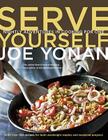
Cover of Serve YourselfI have a number of favorite food writers–but some special favorites are those who cook for one (or maybe two), e.g. Nigel Slater,. Judith Jones, and Joe Yonan, who have a kind of get-in-there-and-do-it attitude.
I came across an post in The Kitchn with tips from Joe Yonan on “Five Essentials for Solo Cooking” that I thought I’d share.I think there are some good suggestions for those of use who don’t have a loving relationship with “leftovers” for three or four days in the week.

I particularly like his “building block” suggestion, especially since many of us shop where things are packaged for family, not for one. The freezer is a great adjunct to cooking for one, but it’s sometimes easy to plop something into the freezer and it gets forgotten until much, much later when you’re wondering what is this frozen lump of mystery stuff. With the caveat that you remember to date and label it a huge help in dealing with things like chili and soups, especially when the work schedule gets hectic.

Even though I work from home, like to cook (and eat well) sometimes deadlines get in the way of cooking, even something quick like a chop or steak which takes only minutes to cook.Then it’s time to delve into the freezer either for a full meal or some building blocks to put together something suitable for the weather and your mood.

A son gôut!


Dicing onions

Ok, I’m lazy–even about some things in the kitchen–like dicing onions; however, I’m not at all sure that it’s possible to cook without onions.Being out of onions is like–well, my mind simply boggles at the thought.

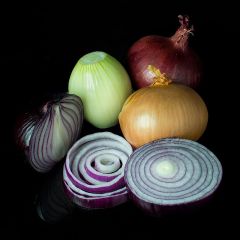
800px-mixed_onionsI use lots of onions, meaning that I cut up a lot of onions, but I’ve never understood the “usual” way that we’re told is “proper” to dice onions. I can understand it if your onions are HUGE, I suppose, or if you have a touch of OCD (I may have, but not about diced or chopped onions). I’ve always thought that onions were essentially self-dicing with little effort on my part–after all they come with layers already there. Another aspect of dicing or chopping onions–I’ve never been one to expose myself to unnecessary risk so why the cuts parallel to the cutting board? (Yes, I know that you’re supposed to have your hand on top so it’s impossible to cut yourself. Be sure to check on that the next time you’re dicing an onion properly. Where’s you hand?)

My lazy approach has always been kind of a two-part thing: First don’t buy huge onions. Secondly, I bypass those horizontal cuts, doing only the vertical cuts. For diced, do the vertical cuts close together; for chopped, farther apart. Easy!

Recently, I stumbled over a video from The New York Times Cooking Techniques on how to dice an onion that omitted those cuts. How refreshing!

Since I’m doing single-serving cooking most of the time, I often use shallots. Then there’s the truly, completely lazy way to deal with the onions. For cooking purposes when I want chopped onions I often reach into the freezer for that bag of frozen chopped onions. If I want lots of onions for something like caramelized onions, then I’ll get out the knife and go to work.

For meat eaters…

I found an interesting series of posts on Stefan’s Gourmet Blog about  Understanding What Happens To Meat When You Cook It.  I really like the experimental approach.

  1. Juciness
  2. Tenderness
  3. Succulence, Flavor, and Appearance

Even if you’re not doing sous vide cooking, I think there is some good information here.

Hive report: Sadness

My beekeeping “career” began 24  July 2015–and it looks as if it’s ending for this year slowly but surely. I’ll not be overwintering bees this year–short of something like a miracle which is almost certainly not going to happen. For a while I had two booming colonies–then found both (apparently) queenless. Even though it was late, I attempted to requeen both colonies.  One didn’t take but on the last inspection of Salvia hive the queen 20161017_124359cage was empty, and we did see some larvae on 16 October and LOTS of bees.

Over the last few days I had noticed that there was not much traffic in and out of the hive, which was rather ominous as the weather was warm enough that I expected to see more.

I opened that hive today and found very few bees, no larvae, eggs, or newly capped brood. That “new” queen was not in the hive. Much to my chagrin, there the “old” queen (blue dot) was trucking around the hive with the few remaining bees–but no eggs, no larvae, and population at a critical level–I’ll be dismantling that hive before long.

I am now a very frustrated beekeeper–I thought I had done a careful, thorough inspection before I introduced the new queen; however, obviously not careful enough. I’m not sure what  should have done to be sure that the “old” queen was really absent from the hive. Had I seen her there with no eggs or brood, I’d (obviously even for my novice state) removed her. Now I can only assume that the new queen that I tried to introduce was killed, though the cage was completely empty of attendants as well as the queen.

It’s definitely been one of those things we call a “learning experience”–but although  I’ll be looking forward to giving it another try in the spring, I’m totally bummed right now! Meanwhile, there is an almost full super of honey on that hive for me to deal with. while I spend the winter considering all the things I’ve learned so far!