Offal–the other tasty bits

When I look at the meat counter in the supermarket I always wonder why we use so few of the parts of the animals that we raise and slaughter for food.  It seems wasteful and disrespectful of life, and  we’re missing a lot of good eating that way. Obviously, I favor of using all of the beast if you’re going to slaughter it to have a steak or a roast (the skeletal muscle, in other words).

Maybe part of the reluctance to use organ meats is that many cooks don’t know how to prepare these other bits–they can be a bit more complicated to cook than a steak. Certainly many popular cookbooks don’t include recipes for them.  It might also be because we are told that these are not good for us–that they are high in fats, and in cholesterol–which is supposed to be so terribly, horribly unhealthy for us. Maybe it’s also related to controversy about whether or not fat, and animal fat in particular, is actually bad for you–government and medical recommendations on what we should–or should not–eat.

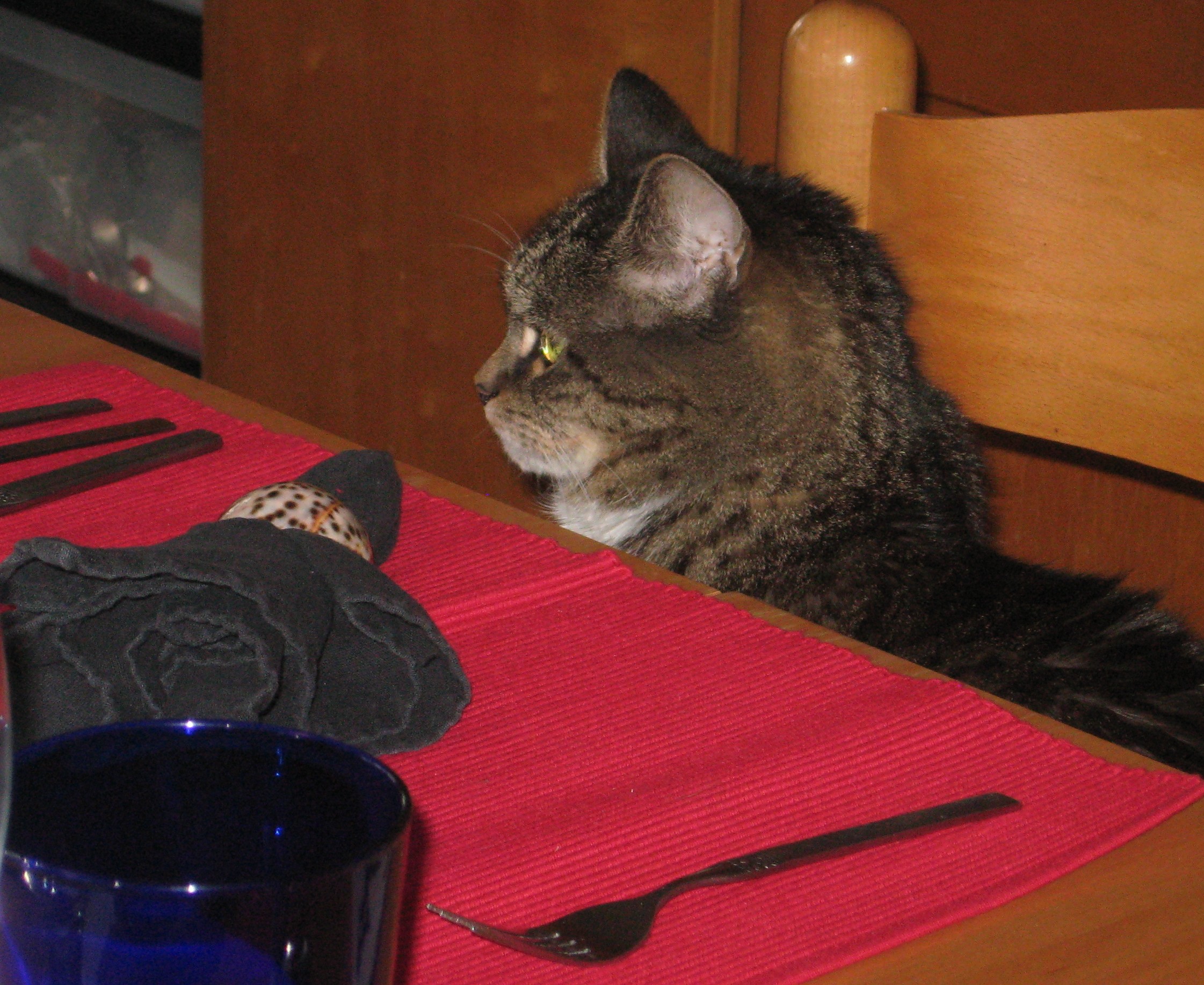
There does seem to be increasing  interest in “variety meats” as something other than pet food. (Yes, I will  share the giblets with the cat when we’re cooking chicken or turkey but I will not give them all away.)  There are some excellent cookbooks available now.  I’ve added some of my favorites to the bibliography. Whatever the reasons, I’m glad to see it (and you can expect more of my opinions on the high-carb, low-fat controversy about how to get rid of the excess weight we tote around with us).

But to get to the thing that got me started on this particular topic. One of my favorite bits of offal is tongue and I found this delightful post on Fae’s Twist & Tango with a recipe for cooking tongue that is a good addition to my collection recipes for that particular bit of the beast.

(It’s really unfortunate that “offal” is pronounced like “awful” so that enunciating that word leaves a lot of people thinking that you’ve said “awful”–which is what many think of organ or “variety” meats. I’m sure there are people who love foie gras and caviar, and maybe even shad roe, who would not consider other organ meat from a cow, or a pig, or a chicken.  But offal is not awful–it’s good stuff.)

Addendum to “Hard copy or Digital”

Aside

Addendum to Hard-copy or Digital?

I’ve admitted being an addict, so I do buy lots of cookbooks. It’s lovely to have the books where you can pull them out anytime and fondle them,  but don’t forget about your public library.

I have an OverDrive app installed on all my electronic stuff so that I can check eBooks out of the library!  It’s a great way to explore lots of book without needing extra shelf space, or spending money!

Hard-copy or digital?

Eat Your Vegetables: Bold Recipes for the Single CookI’m a sucker for cookbooks–especially by an author that I know has great recipes and knows about cooking for one!  I have Joe Yonan’s book Serve Yourself and love it–now I find that he’s got another that I want–Eat Your Vegetables.  Now comes the debate–do I do hard-copy or digital?

I do love books–and I’m sure that I’ll never be without some of the “hard copy” in my possession. But–there are advantages to the digital, especially as e-readers improve. But there are several attractions of digital versions–given my aversion of house cleaning it’s certainly much easier to dust the e-reader than a shelf of books. And, I love being able to have a selection of books no matter where I am.  There’s the price, too–since the e-edition is usually less expensive (though I can’t use the word “cheaper” here). Then there are some of the downsides….

Right now I’ve got reading material in several different e-readers: Kindle (just the third generation, not the Kindle Fire), Google,and  Kobo account.  That is frustrating.  I have the Kindle app installed on laptop, notebook, droid….you should see me trying to figure out where to look for Nigel Slater’s Ripe! Is it in Google, or Kobo–I am sure it’s not the Kindle–since there are color photographs, but….

[Hiatus here…skulking on the internet for availability in various e-readers,  and discovering eBook management and  converter software]

I’m back–just finished reading the introductory material to Eat Your Vegetables, and quickly perusing some of the recipes. It’s another winner for cooking for one–in digital format!

Love digital, but I still do  buy hard-copy when a book that  I want to read is not available electronically!  For example, Nigel Slater’s cookbooks, when they aren’t available on Oyster, either–tough to be an addict!

Cooking for one

I’m on my soapbox! Just need to vent!  Maybe I’m even being a bit paranoid, but….

At times I feel there is an attitude problem about cooking for one–even more than cooking for  just two! Sometimes while perusing recipes I find  myself getting irritated by  comments on the fact that one didn’t want to put (too)  much effort into cooking for two! If not for two, then surely we wouldn’t put much effort into cooking for one?  Duh!?!

Table for six

Occasionally more than one dines here

Why is it that  people think that cooking for one or even two people shouldn’t take much effort?  OK–it takes more effort to cook for thirteen  than for one  or two,  just in terms of quantity and size of pots. Admittedly some dishes do not lend themselves to making for one or two–so invite the neighbors; roast goose is not something that works well for one or two.  But…

No matter how many you’re cooking for there are times when you need quick, easy recipes–any cook who works outside the home knows that. But that doesn’t mean that there are not times when you want something special without having to invite the neighbors, or eating the same thing for umpteen meals.

Waiting for the roast goose....

Waiting for the roast goose….

I’m all for improvisation and cooking as an ongoing process of tasting and seasoning, but sometimes I do want a tested recipe so I’m always on the lookout for cookbooks for one or two. It can be difficult to take a recipe that serves six or eight and cut it down for one or two servings; you have to make allowances especially for the seasoning and you cannot necessarily do that “on the fly”.

I’ve commented on some of my favorite books by Judith JonesJoe Yonan and Nigel Slater where you do find recipes (and not necessarily “quick” ones) for one or two–these are single people who really like their food and are not bound by how much effort it takes to prepare the dish.

From Amazon.com

from Amazon.com

When I saw that the editors from America’s Test Kitchen had put out  “for two” cookbook, I  was excited because I like the way they explain the recipes, and how well they work.  I have tried some of the recipes and am glad to have them.  One bonus of their cooking-for-two approach is a section that cross-references recipes, e.g. all that use cauliflower or bell peppers, so that you can deal with what isn’t used in a single recipe.  Another benefit is that the seasonings are also adjusted. (Personally for my taste, I find many of the recipes a bit under-seasoned–but that’s taste, and no reflection of the worth of the recipes–after all, they have to please many people–and I know that I may need to increase seasonings.)

Many of the recipes involve chops, and/or pre-portioned meats which do play huge role in single-serving-cooking. There are recipes, e.g. for beef stew, where ingredients are modified or cooking methods changed (e.g. beef stew).    Recipes designed for two  are much easier to adapt to cooking for one (without necessarily having extra portions) than recipes for six or so.  If you’re hesitant about improvisation or about how to adjust recipes, then the Cook’s Illustrated  books on cooking for two would be a good investment–as you use the recipes, you learn why they work, and get a feel for how to change or reduce ingredients.

These, as well as books by Jones,  Yonan and Slater (see bibliography), give an excellent jumping-off point for single-serving  cooking.

A son goût.

Just a toss of the dice…

jar of recipe dice image from leafcutter designs

a new kitchen gadget

I recently received a delightful care package from a friend visiting in New Mexico–both blue and white posole, some Hatch chilli powder, and something that made me realize how often I do get on about improvisation being desirable–if not a necessity–when cooking for one.

Along with the edibles, there was a jar that looked like it would contain herbs or spices–that would not have surprised me at all since my friend knows how much I love to try different herbs and spices, and there was posole and chilli powder there. But that little jar was not an herb or a spice. it was…and improvisational device!

Recipe dice for me to play with. Unfortunately, between indexing and teaching, I haven’t had a lot of time to “play”, but I think that this can call forth some serious improvisation. Combine this with a book like Pam Anderson’s How to Cook without a Book which gives you ratios instead of specific amounts and let the fun begin. I really don’t have a problem improvising–more like I have trouble NOT improvising, even with a recipe in front of me, but I think this is going to be fun.

If you’re hesitant about improvisation, this just might provide a nudge toward giving up a recipe.  These dice have whimsical designs of veggies, fruits, herbs…even suggestions on how to use the dice. May be just the trick for a day when I can’t decide what I want to cook or eat.

How important is cooking?

Cover of Catching FireHave you ever wondered about the history of the application of heat to food?  When did it start? What has it done for human  evolution, culturally and physically?

Catching Fire: How Cooking Made us Human (ISBN: 0465013627) by Richard W. Wrangham, a biological anthropologist/primatologist, at Harvard University, discusses the importance of cooking in human evolution. What impact did the shift from raw food to cooked food have?  He suggests that it affected the evolution of the brain and the gastrointestinal system.

This book presents a very different perspective on “humanity”–cooking food, rather than dependence on raw food, allowed social, household, and marriages. It’s an interesting perspective on our development as humans.

(I notice that this author has another book Demonic Males: Apes and the Origins of Human Violence, ISBN-13: 9780395877432. I find the title intriguing and given the author’s style I’d certainly like to read that one too!)

OMG, what’s that smell?

Reading a Facebook post the other morning from a friend who posted about a situation that I’ve experienced–something presumably a mouse, dying in the wall (and the resulting olfactory stimuli that pervade the environs),  brought to mind another olfactory experience….

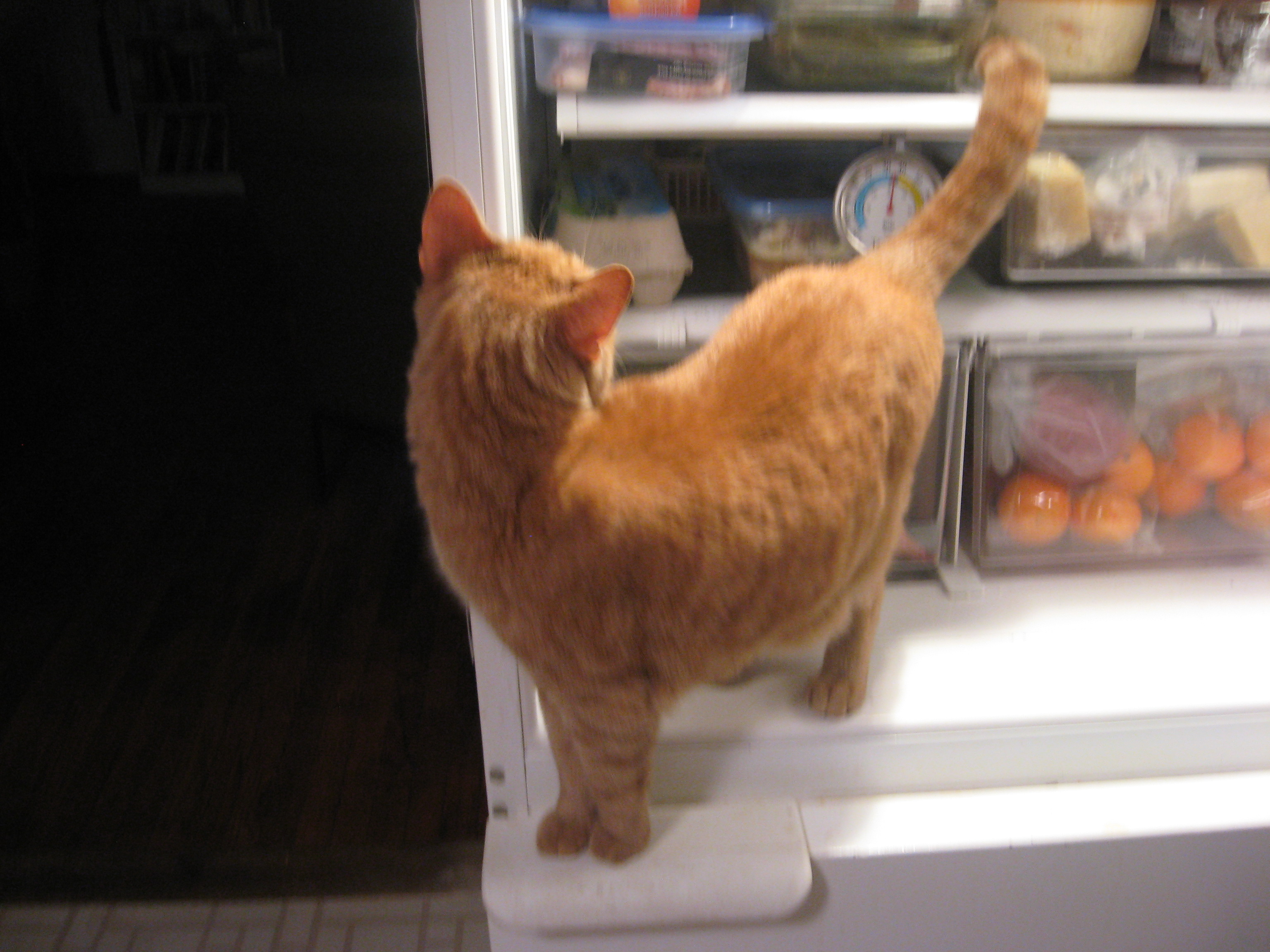
cat checking fridge

just checkin’

Early morning. Open refrigerator door to get milk for morning café au lait. Pour milk.  Open fridge door, put milk back. Something finally filters through to the conscious level even without the coffee yet. OMG! What is that smell? What has died in there? 

Drink coffee, come back for second  round.  Pour milk, put milk back.  Have second cup of coffee.  Recheck fridge.  Drat!  I really did smell something that needs to go away urgently. Something smells weird in there and it’s not  in the league of things handled by baking soda.

One of my least favorite morning events–I’ve just discovered that, even though I’ve thought about it for several days and procrastinated, I now HAVE to clean out the fridge.

It seems that the fridge is the best (most accurate?) reflection of the general state of life in this household. There are areas of my home which are constantly disaster areas, not a big deal–they just are; but I know I’m in trouble when the fridge becomes one.

When I’ve been hassled, harried, beleaguered, and generally frenetic, that’s when the fridge gets out of control. Usually when it’s least convenient to have to pull everything out to find the culprit, but there’s no escaping it–I have to  do it NOW!

The current fridge situation, corresponds to the very noticeable, or notable, hiatus here (sounds better than just saying gap or hole).  For the last several months I’ve dealt with a Clostridium difficile infection that has really turned by life kind of kitty-wampus (not over yet, but improved). Fortunately, since I work at home as a freelance indexer and the one course that I was teaching at a local community college was online, I was able to keep on with those things.

Cooking was another matter altogether since I had absolutely no appetite. At the best of times I can be a pernickety eater (as I’ve said before I don’t deal well with “leftovers”), but add don’t-feel-well-but-must-eat, and that just fills up the fridge with all sorts of odds and ends.

The places in my home that are usually disaster areas, are still, and even more, disastrous, and I’ve added new ones–but most urgently it’s the fridge!  I have to get that sorted so that I can get back to normal cooking since I’m beginning to regain an interest in food (eating and not just reading cookbooks) and actually cooking.

So, into the depths of the fridge….

It’s that time of year again….

Yes, the New Year is almost here.  I’m sure I’ll do like most of you and make some resolutions–but really all I should do is make a resolution to try to keep the ones that I made last year…and the year before that, too.  My big one has to be one that was only partially successful last year–lose weight and exercise more. I guess that’s really two.  Duh!

I’m trying to plan how to be more successful with keeping my well-intentioned resolutions this year–after all, my doctor did tell me (again) that I really need to lost weight (and I know that the exercise really does go with that effort). Just like so many other people needing weight loss, I’ve read, though not just about weight loss, but about responsible eating, too. Recent reading includes:

  • Gary Taubes, Good Calories, Bad Calories (incredible bibliography)
  • Mark Bittman, V6B (another good bibliography and interesting that it’s written by someone who is a serious “foodie”)
  • Eric Westman, The New Atkins for a New You  (Duke University)
  • Richard Wrangham, Catching Fire: How Cooking Made Us Human (fascinating physical anthropology discussion of how cooking changed our evolution)
  • Pierre Desrochers and Hiroko Shimizu, The Locovore’s Dilemma: In Praise of the 10,000-Mile Diet (interesting for the energy analysis that they do regarding the various energy expenditures related to putting food on the table)
  • even some Kindle samples on the “flat belly” diet, and the “Paleo” that never got past the “sample” stage!

I have to confess that I’ve done the high-protein, low-carbohydrate one—it does work, but….true to promises made in the books, I wasn’t hungry. Now here’s the kicker, I wasn’t hungry, but I really, really, really missed some things that were “forbidden”:  milk, fruit, and some of the higher carbohydrate veggies, and legumes.  Even though I like greens and use a fair amount of them, I got SO tired of greens—spinach, lettuce, kale, collards, arugula, and the like. I found that as soon as I tried adding back some carbohydrates, weight loss came to a standstill. Not a sustainable program, especially when you consider the amount of energy it takes to raise meat, particularly in the quantities that we in the US consume. I’m a meat-eater, but my mind boggles at the statistics about how much meat Americans eat. Then we could go on to the “factory farming” issues.

Some of these (Gary Taubes, Eric West (MD) and Mark Bittman) actually do some impressive and almost-scholarly nutritional and metabolic literature reviews. Some have prefaces written by medical people with credentials that are impressive. The studies cited are from reputable journals. The data presented on insulin resistance and metabolic syndrome were convincing though–we really cannot continue to ignore obesity issues and the disease consequences of these.

No matter how scholarly or well documented, or which particular method they tout, it all comes down to cut calories and increase your energy expenditure. One of   the ways to do that is to eat more plant-based foods since many are not as calorie-dense as animal products–more fruits and veggies. I’m not planning to give up meat or animal products, but I will opt for better quality and less to keep the budget in balance and be somewhat “green”. I am an omnivore!

I can’t escape that if I’m going to lose weight I  have to expend more energy than I take in; that’s the physics of the situation–so I’m right back where I started: eat less and exercise more. Seems this is where I started this year….

But all that aside, I wish all of you a healthy, happy, prosperous 2014 with lots of good food, wine, and friends!

Chicken in a pot for Christmas day

It’s brisk and breezy, but sunny outside. I’m wallowing in Christmas music (classical and choral from WCPE). The heirloom chicken that I bought at Rose’s Meat Market and Sweet Shop yesterday is in the oven now.

I decided that I would do the traditional French chicken in a pot rather than just roasting the bird–it seemed so appropriate for the weather. I browned the breast side in a little olive oil, added onions, garlic, and bay leaves. After covering the pot with foil and putting on the lid, I put it into a 250°F oven for an about an hour–the basic technique from America’s Test Kitchen.

The chicken that came out was not photogenic, but tasty. Cooking the closed, steamy pot didn’t let me have the luxury of savoring the aroma of roasting chicken, but when I lifted the lid and took off the foil, the aroma was awesome.  Another bonus of this method is the juice that in the pan–strained and reduced it’s  wonderful to serve the chicken au jus. While not impressive for presentation, it takes the chicken to another level for comfort food.

This was a bird that had serious chicken flavor. Supermarket birds don’t hold a candle to this for richness. Admittedly pricy (but not overpriced for the quality), there will be several more meals off of this bird–and likely some soup too.  It can’t be my “everyday” chicken–that will still have to be the free-range or organic from the supermarket, but for a special treat I would certainly get another of these birds.

Oven-braised lamb and garbanzo beans

It’s another grey day–unseasonably warm, but at least not hot, sticky, and terribly humid today–the kind of day when you need to smell something cooking–long, slow, and tantalizing.   I found lamb shoulder chops on special (2-1/2-pound package) at the grocery store, I decided to try the lamb/garbanzo slow-cooker thing in the oven since it’s not too hot (and I’ll use the oven to prepare a second dish for reheating tomorrow (acorn squash stuffed with Sicilian sausage).
Book coverThe slow cooker version of this concoction was really good, but I thought it could be improved by doing it in the oven. Even after reading the Cook’s Illustrated Slow Cooker Revolution (volume 1), I am still not a wild fan of the slow-cooker.  I use it because it does some things well, and is necessary at times to fit cooking into a working schedule.  The Slow Cooker Revolution has improved my slow-cooker results immensely, mostly because I’ve discovered some unusual ingredients that can improve flavor.

My impression was that many of these recipes required more preparation time than I would be able to put into a slow cooker recipe, given that I use it for utter simplicity.  I’m interested in seeing what comes from volume 2 of the Slow Cooker Revolution.  If I have to do a lot of preparation for the recipe, then I might as well not use the slow cooker.  I still find that I like over-braising when possible; however, I do find I’m using the slow cooker even more since I read the first volume of this book. That said, I still prefer oven braising, especially if I’m working at home.
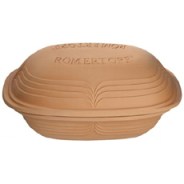
Romertopf clay baker (oval)I had intended to do this in the Romertopf, (one of my favorite things for roasting and baking hearty, peasant-style comfort food in the winter) but by the time I had boned the lamb and added other ingredients, it wouldn’t fit in either of my small ones (great for single-serving cooking), and was not enough to fit in my large Romertopf (for roasting whole chicken, for example)–so it was the Dutch oven for today.

(Shoulder chops are reasonably priced, and the boning doesn’t take long if you use a boning knife rather than trying to do it with a paring knife or chef’s knife.  Those bone went into a saucepan with a tad of salt and some bay leaves to make stock.  After boning out, I had about 2 pounds of lamb, so that’s what I started with.)

Oven-braised lamb and garbanzo beans
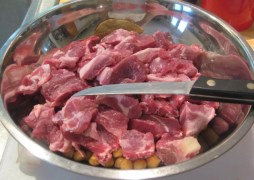
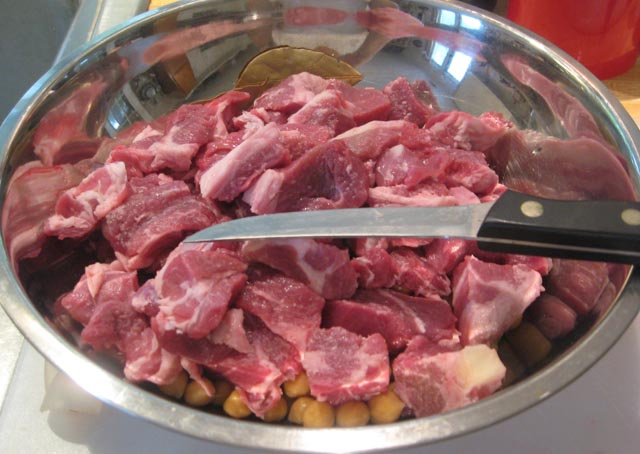
lamb from chopsIngredients

  • 2 pounds lamb (from boned shoulder chops)
  • 2 14.5-ounce cans of garbanzo beans, drained and rinsed
  • 3 large onions, chopped
  • 1 14.5-ounce can of fire-roasted, diced tomatoes with juice
  • 2 tablespoons of Hatch chilli powder (used for the slow cooker), but more added after tasting this halfway through cooking
  • 2 teaspoons of salt, or to taste
  • 1 tablespoon fresh Mexican oregano, minced
  • 1 cup water

PreparationIMG_7667

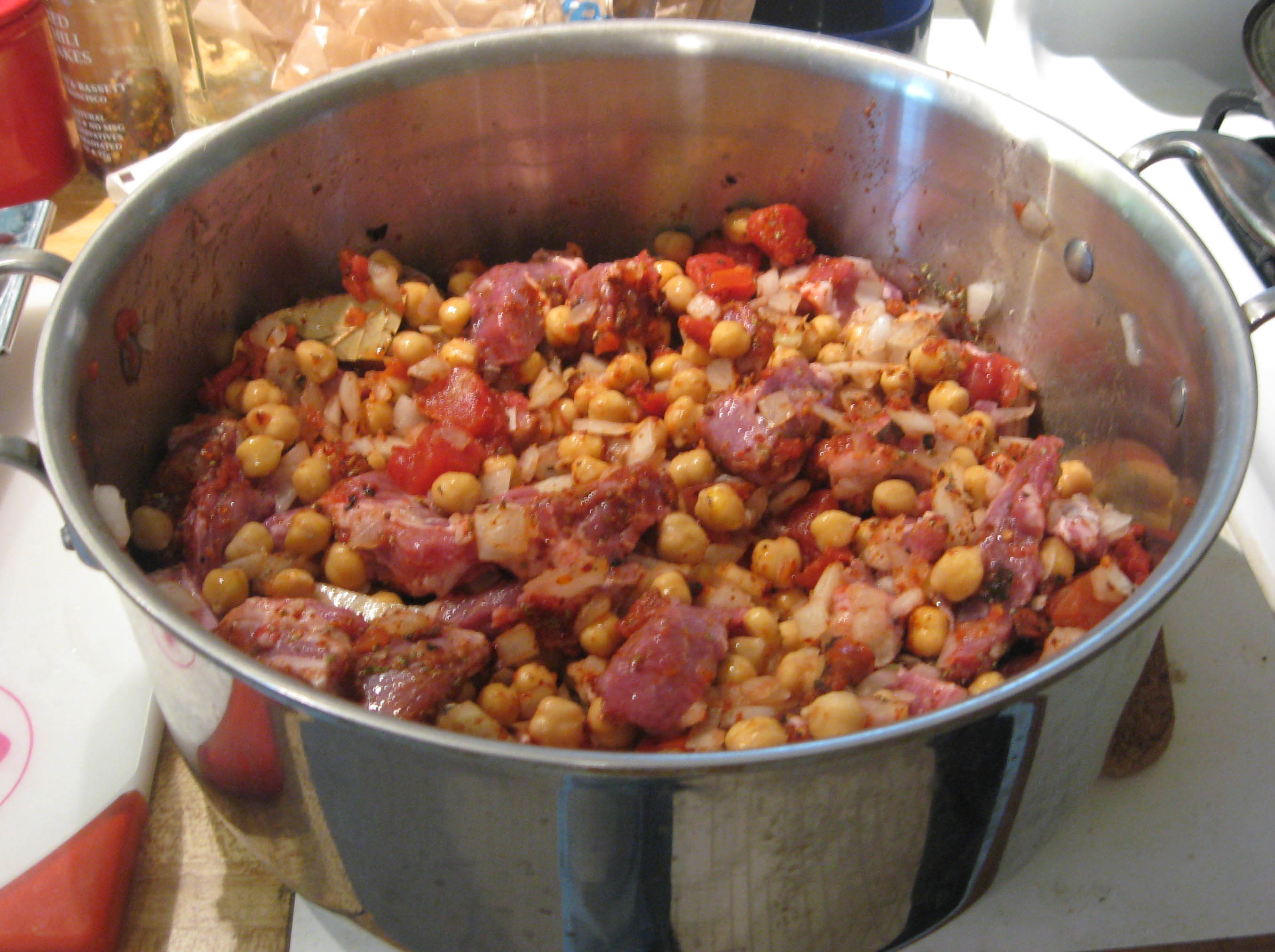
  • Put everything in pot
  • Cover
  • Pop it into the oven, and check for liquid in an hour
  • Go get laundry or whatever, then check liquid again

-<>^<>-

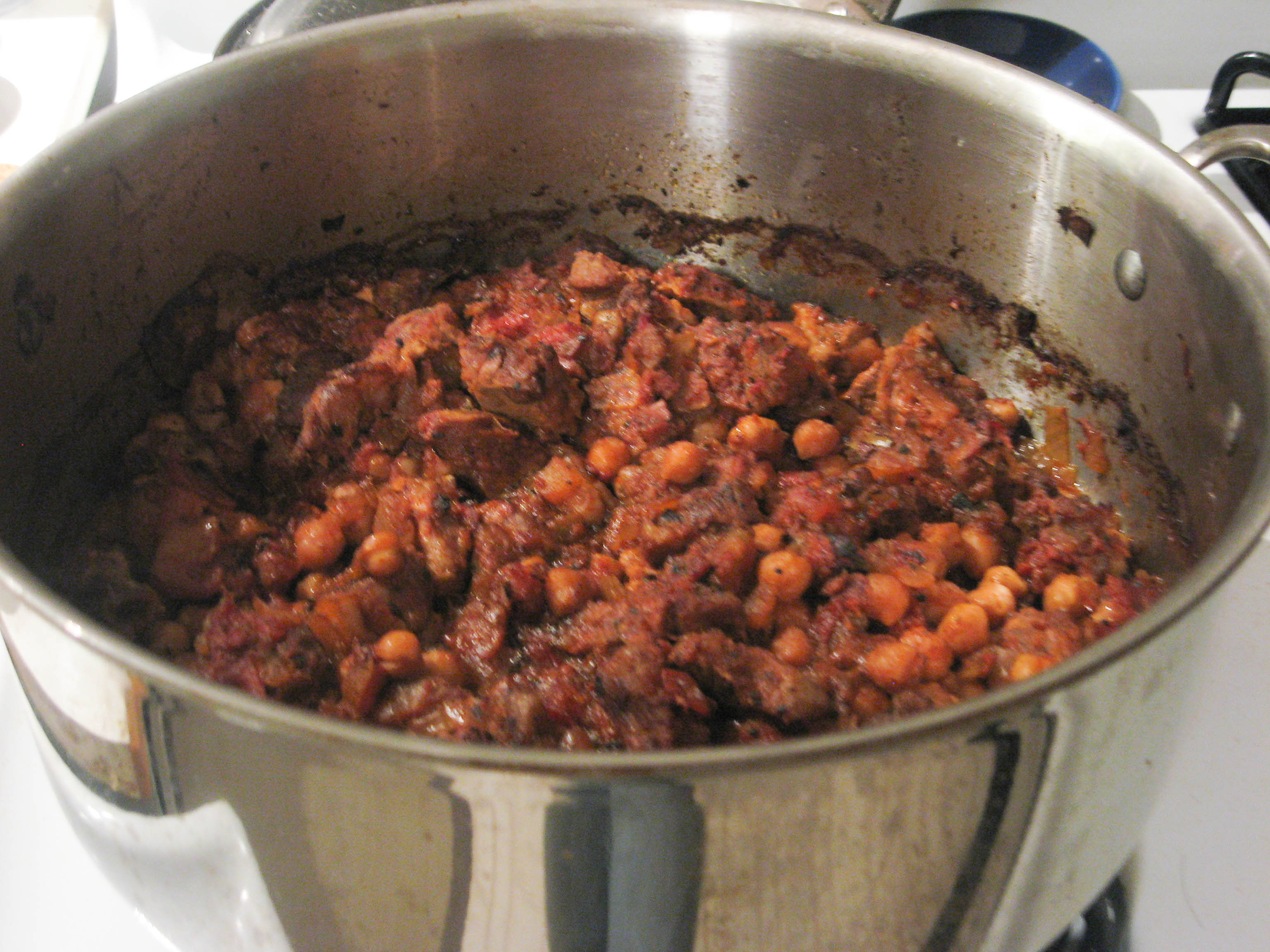
In order to be as much like the slow-cooker, I did not brown the meat or cook the onions separately–just combined everything, covered, and put in a preheated, 300-degree Fahrenheit oven.  I added 1 cup of water to start, and checked in one hour but there was plenty of liquid.

On tasting, I found it needed more than the 2 tablespoons of chili powder so I added about 1 tablespoon more, stirred, covered, and let it continue to cook. There was plenty of liquid, so next time, I’ll not add any water–just rely on the juice from the tomatoes, onions, and meat.

-<>^<>-

The stock made with the bones smelled really good–if more liquid had been needed during baking, I would use some of the stock.  There was some meat from the bones in the stock, but I not enough to spend time picking off, although I’m not compulsive about trying to get every bit off when I bone meat like these chops. Since I started the stock in cold water, the meat that was left was pretty flavorless, but the stock was good.

-<>^<>-

There will be a next time for this–and unless I’m really pushed for time, or can’t leave the oven while I’m out, I’ll opt for the oven method to cook this–a much more complex flavor with the same ingredients, likely attributable to the bit of evaporation that takes place in the oven but not in the closed slow-cooker.

Getting this added flavor lead me to consider the energy used in the various cooking methods–the energy required for cooking is certainly part of the energy required to make that food edible–the energy  of production and transportation, and the cooking is all part of the picture: the footprint of feeding me. We cannot ignore the energy used for cooking when we talk about other energy costs associated with our food so I spent some time browsing to find information on different cooking methods.

In trying to research this issue, I’ve perused many different sources–and the gas/slow cooker comparison is difficult, and I get the feeling that the answer to which is more efficient is an “it depends” situation.

Interestingly, an article on slow cookers versus electric ovens from the University of Connecticut Sustainable Living suggests that there may not be a significant difference in energy use.  SFGate discusses gas versus electric energy use, which gets more complicated, but I’m not sure that there difference is significant enough to make me give up oven braising, even though I’d like to minimize my “carbon footprint” as much as possible. If my slow cooker requires eight or so hours of cooking, and my oven braise requires only two or three hours on low to medium heat, then it may be a toss-up, since the slow cooker doesn’t cycle, and the oven (gas or electric) does.

Oven braising in the wintertime helps warm the house so probably cuts my heating use some, but I’m certainly NOT going to oven braise in the summer and increase the use of air-conditioning.  There is lots of conflicting information out there on the ‘net.  The “best” I found was from the Consumer Energy Center (California Energy Commission)–from that information, I’m not going to give up oven braising for the slow cooker anytime soon, but I’ll still use the slow cooker for some things.
Cover, pressure cooker perfectionOne comparison that I’d really be interested in is slow cooker versus pressure cooker energy use, and taste of the same dish prepared in both. Most data that I found suggested that the slow cooker wins on convenience, and the pressure cooker on energy saving. A taste comparison would certainly be interesting.  I’m almost certain that a pressure cooker can’t replace a good old-fashioned slow braise in the over.

I’ve recently started playing with a pressure cooker–it’s a lot different than what my mother used. The recipes in Pressure Cooker Perfection have been a good starting point. I suspect that I’ll be using a pressure cooker more  in the future, as well as the slow-cooker. Climate, air conditioning, and heating, are all things that will enter into my decisions. I’m also trying out an portable induction unit which is supposed to be ore energy efficient.

So many options for energy efficiency–but what about taste?  I doubt that any other method is going to come out tasting like an oven braise, no matter how many umami-enhancing ingredients you add.

A son goût!
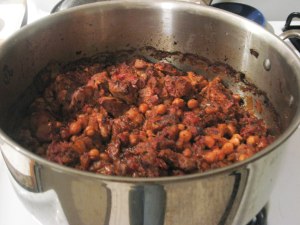
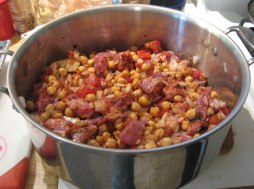
Dutch oven with lamb and garbanzos

very simple, very tasty