Pheasant soup

Immediately after Christmas dinner, while I was still sipping my wine, I took care of the leftover pheasant. Since there was a carcass, there just had to be soup!

  • remove meat from the carcass when the meal is over,  refrigerate for later use
  • break up the carcass as much as possible
  • put in slow-cooker and flatten out as much as possible
  • add water to barely cover
  • add healthy pinch of salt
  • set for 6 hours–in other words, until morning
  • strain stock and put back in slow-cooker
  • add any leftover truffled au jus 
  • add a generous handful of barley and  generous handful of lentils
  • taste for salt and seasonings; add a dash of soy sauce and nam pla
  • add one pasilla chilli pepper, whole
  • add generous dash of herbs de Provence and/orle any other seasonings you wish
  • set slow-cooker for about 4 hours
  • when lentils and barley are tender, refrigerate or use immediately.
  • add pheasant meat to hot broth and reheat.

Now if you have leftover soup (from your first round of soup) and leftover cabbage and rutabaga from the side, and any remaining pheasant meat, add those and you have soup that’s a bit different for the final day of soup.

A son gôut!

Christmas dinner

I’m having my usual lazy Christmas day–just me and Frankie (the cat). After having brunch of scrambled eggs with truffle butter, I turned my attention to fixing supper.

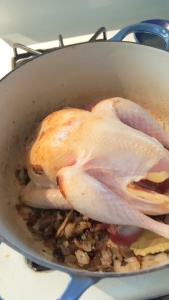
It seems that I’ve inadvertently created another Christmas tradition (aside from the oysters): chicken (or at least fowl) in a pot. I guess it has something to do with it being an easy and tasty dish that I really like. This year, though, there was a variation–it’s pheasant in a pot. It’s been awhile since I’ve had pheasant so that’s what came to mind for this Christmas supper. After-holiday sales, and sometimes specials in between, are great for eating higher-on-the-hog with lower prices–so there was a plump McFarlane pheasant, just a bit shy of 2.5 pounds, lurking in the freezer.
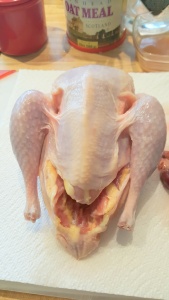
20161225_134929

…giblets removed

I toyed with cooking the pheasant with milk as I had done before with cornish game hen, but somehow I just couldn’t picture the pheasant-milk combination. So, just plain pheasant in a pot.

I couldn’t think of any reason that pheasant wouldn’t work just as well as chicken for this treatment–but since a pheasant isn’t a chicken, I thought there would have to be a little adjustment.I little skulking about (via Google) suggested that my pheasant should cook in less time than the bigger chicken (duh! About an hour or a little more). Cook’s Illustrated has a basic recipe for chicken in a pot; that seemed a good place to start since there’s always a rationale included that should make the recipe easy to modify as needed though it seems that none of that series (Cook’s Illustrated, Cook’s Country, or America’s Test Kitchen) addresses pheasant.

So, next, seasonings for the bird. Pheasant may be considered one of the “other white meats”, but it’s still more like the dark meat of the chicken: bay leaves (certainly), onion (can you cook without onion?), garlic (often used with pheasant), thyme, sage, and juniper berries (good with game) were the final seasonings that went into the pot. I also added some sliced button mushrooms with the onions while they were sautéing. These are eye-ball measurements:

  • one large onion, chopped
  • 2 bay leaves
  • one basket sliced mushrooms
  • 1/2 teaspoon thyme
  • large pinch rubbed sage
  • 1-1/2 tablespoon minced garlic

20161225_140238

After browning the pheasant breast-side with the onions and mushrooms, the pheasant was flipped, seasonings added, and the pot  covered with foil and the tight-fitting lid, and it went into a 250ºF oven. Time to consider what I wanted for sides to this lovely bird.

My peasant side is showing–well, right along with bird-in-a-pot which isn’t exactly haute cuisine unless you are eating in in a US restaurant–I  rummaged through the vegetable bin and decided that something with cabbage and rutabagas would fit with the dark meat.

After some more Google use and letting my imagination run wild for a bit, it seemed something quick and easy would be a sautéed combination of those two vegetables, spruced up with a bit of a sauce of some sort. Something sweet-tart–maybe some dark buckwheat honey and lime juice and zest of one lime). I did a little shredding, julienne work (mandoline), and zesting  I left those veggies sitting in water to await cooking time; the buckwheat honey and lime zest melding; then I was off for some more quality time with the cat for an hour (until time to check the temperature of the meat (one of J.J. Salkeld’s  Lakeland mysteries).

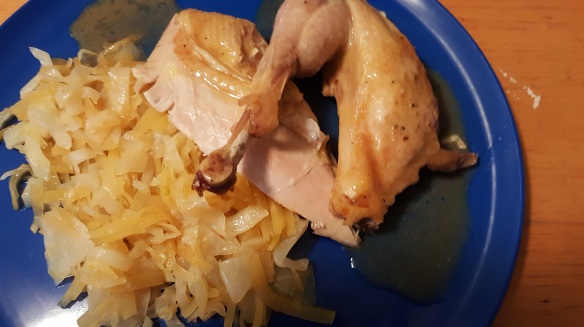
While the bird rested (about 15 minutes or a bit more), I put the drained cabbage and rutabaga in a sauté pan with a dollop of butter (salted) and covered them–sort of a steam-sauté–until almost tender then removed the lid to let moisture evaporate while I tossed this mixture around a bit with my sauce (about 10 or 12 minutes altogether).

After scraping up all the good brown stuff from the pot, the juices from the roasting pot were strained, and enriched with a blob of truffle butter. End of cooking–time to eat!

Just a word about en coquette cooking: the meat is absolutely luscious, but don’t expect the same kind of browning that you’d get with dry-heat roasting. I can attest that it works very well–as well as braising–with farm-raised pheasant. I’ll most likely do it again with the next pheasant I decide to eat.

The cabbage/rutabaga combination turned out to be even better than I had expected–always a pleasant surprise–even before the sauce went on. Just with the butter it would have been an admirable side to the pheasant. The mandolin made short work of both the shredding and the julienne work and the cooking time was only about about 10 or 12 minutes. I have to admit that there are leftovers from the 1/2 rutabaga and 1/4 head of cabbage. (I’m thinking that they could be turned into rösti or fritters for a main course since I didn’t add the sauce to the entire batch of cabbage and rutabaga.)

Wine? Of course, but since I had some of the Les Hérétiques left from last night, I decided I’d just go with that–it’s a good all purpose wine–maybe not what I’d have chosen were I giving it a lot of thought, but sometimes it’s a needs-must situation–I love my wine vinegar but there’s a limit to how much good wine I’m going to pour into that jar. So–I finished that bottle this evening. The “leftover” wine was quite good with this combination of food–the blackberry was a nice contrast to the other flavors here.

Ò¿Ó

If I want to sound really fancy, I guess I just ate pheasant en coquette with truffle  au jus–whatever you call it it was a fine meal, even if I can’t get the cat to say so though I’m not that modest. I’m still listening to Christmas music and enjoying a another glass of wine. The other half pheasant has been boned and stashed, and the carcass is in the slow-cooker making pheasant broth. I’m not sure what is going to evolve out of the Christmas Eve and Christmas Day leftovers, but I would guess that there is going to be some pheasant soup, among other things.

The kitchen is tidy–only the roasting pot left to soak with baking soda overnight–and only clean things to put away from the drainer in the morning. Altogether a most pleasant day with the cat, low-intensity, undemanding cooking, music, and reading.

I was contemplating starting to filter my chocolate/cardamom/ancho/golden rod-aster honey liqueur this evening, but I’m just too full and lazy. I decided it would be better to start that in the morning since it is a long process–so now to quality time with the cat and Kindle since I’m happily fed and still enjoying wine.

I hope all of you had as pleasant a day as I did. A final happy holidays to you if you happen to be celebrating something just now.

20161225_162137

20161225_163944

Ò¿Ó

.

Christmas evening supper

Christmas eve–what’s for supper? Your basic duck breast, pan-seared and dressed with some of the spoils of my visit to Bull City Olive Oil. Just a take-off on a vinaigrette, but what fun. A nice fatty duck breast pan-seared so that the skin is cracklin’ crispy–with a very simple sauce–fruity.

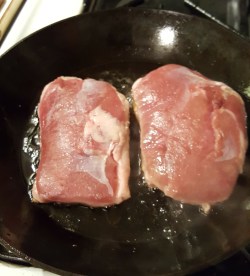
Turn off the smoke alarm so you won’t be interrupted while cooking. You need to start with a skillet that will tolerate high heat–it needs to be almost smoking hot to begin–and no worries about sticking given the fat in the duck skin. I used my favorite carbon steel skillet–very well cured (now black and nonstick), and has the advantages of cast iron, without the weight. Just the right size for two duck breasts.

20161224_173256I had thought that perhaps just a drizzle of one of the infused vinegars would be good, but after tasting the vinegars with a piece of breast that was loose in the package, I decided it needed  more complexity, so I started with  extra-virgin olive oil infused with mushroom and sage–awesome as a condiment in its own right, but for nice fatty duck it needs to be brightened a bit with one of the infused balsamic vinegars. Decisions, decisions!
I had black mission fig, black cherry, and blackberry with ginger. After tasting I decided that blackberry-ginger was what I wanted this evening, though any of these would have been good with duck. I didn’t use typical vinaigrette proportions but I did emulsify the oil and the vinegar (1:1). The mushroom-sage oil is very earthy and a great contrast to the fruitiness of the blackberry with that little spark of ginger.

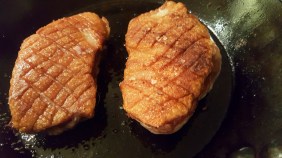
20161224_174026To prep the breasts I patted them dry and scored the skin side, careful not to cut into the meat–just to help the fat render while pan-searing. You need a very sharp knife so that just the weight of the knife pulled across the skin will cut into it. Then I salted the meat side of the breasts and let them sit for about 20 minutes to season.

After patting them dry I put them into a  very hot skillet, skin side down, and cooked until most of the fat rendered and the skin side was brown and crispy (about 5 to 8 minutes), reducing the heat a bit to keep them from getting too brown before a sufficient amount of fat had rendered. Then turned them and continued to cook until the temperature was 135ºF by instant read thermometer (about 5 minutes).

While the breasts were searing, I whisked the oil and vinegar together, and got the roasted potatoes out of the oven. While the breasts rested (and continued with carry-over cooking), I poured off the excess fat from the pan, left just enough to  sauté a mix of  baby arugula and radicchio for a side. Very quick. Very tasty!

The bitterness of the arugula and radicchio was a great contrast to the richness of the duck, and the blackberry-ginger/mushroom-sage sauce. (Blackberry and sage are awesome together–makes me want to try a sorbet with that combination.)  The Les Hérétiques wine (old vine Carignane grapes) has lots of berry fruit (blackberry  with some earthiness, and minerals) all in all a great wine for this meal even though it’s just my “house” wine.

All together a very flavorful supper for no more time than it took.  So many possible flavor variations possible with this simple sauce. A son gôut!

Ò¿Ó

.

Turkey–with truffle butter

Thanksgiving does have its good points–getting together with friends! There’s another positive thing, especially if you are like me, someone whose favorite part of the turkey is the dark meat: you can find turkey thighs in the grocery store. That means dark meat in quantities suitable for cooking for one.

Perusing my food-related emails a few days ago I found one from D’Artganan–my favorite source of foodstuff that can be hard to find (e.g. the cassoulet  ingredients–no, I didn’t say it was inexpensive). There was a link to a delightful video on preparing your Thanksgiving turkey using truffle butter. (Attempting not to drool on my keyboard.)

You’ve seen from some of my previous posts that I really like truffles (not the candy–well, those, too, but…), even in my comfort food. In my attempts to be frugal and still indulge my tastes for the expensive stuff I do skulk through the “manager’s specials” and those carts full of end-of-season bargains. Sometimes I’m lucky and find an indulgence elsewhere. Not long ago I found a small tub of truffle butter at my local supermarket–marked down as it was lingering with the cheese and spreads, but not past it’s sell-by date. Needless to say, it came home with me–some of just have no willpower when it comes to food!

20161119_165833After seeing the turkey with truffle butter video, realizing that I had truffle butter, and turkey thighs to hand, I decided to try  turkey this way. I decided (since I was roasting all dark meat) to use my Schlemmertopf  for this. I carefully loosened the skin over my turkey thighs, and as directed in the video, put bits of truffle butter under the skin. After soaking the clay cooker properly, I patted my turkey thighs in, sprinkled some kosher salt over them, and put the pot into a cold, 300ºF oven for about 2-1/2 hours–until they were nice and brown, and very tender. (Many recipes will suggest oven temperatures of about 450ºF, but I chose to use a lower temperature because dark meat can tolerate longer cooking, and it often tends to be tough. I wanted slower cooking to break down collagen and make my turkey really tender.

The skin did shrink away from the edges of one of the thighs–I would rather have had one big thigh instead of two small ones, but it seems those haven’t hit the stores yet. Size and skin shrinkage aside, I had some lovely dark-meat turkey nicely flavored with black truffle. Turkey my way!

A son gôut!

Always Hungry? Mediterranean Chicken

And the weight loss is back on track, and meals still really tasty. From the Always Hungry? today I picked the Mediterranean Chicken recipe to try. The recipe struck me as  lacking oomph that I needed today, but a meal plan is a meal plan. This was, at least, a one-pot meal, and easy.

Refrigerator tidying was in progress at the same time as I started preparing the chicken. Some of the things that I found lurking in the back of the fridge ended up in the  Mediterranean chicken–though I played with it a bit, the final dish contained all the ingredients called for in the recipe–well, except one. That recipe called for putting green beans in near the end of the cooking time. I didn’t do that. Just didn’t trip my trigger, and since I made the whole four servings I’ll need to reheat and that wouldn’t work well with the green beans. (The haricots verts that I had in the fridge turned into a side that has always been a favorite: room temperature with sweet marjoram infused olive oil, and a sprinkle of Maldon salt–keeping with the spirit of the meal plan.)

The basic recipe is simple: chicken thighs cut into bite-sized pieces, sautéed with onion, then simmered with canned tomatoes with garlic, olives–salt and pepper, of course. The recipe called for kalamata olives–not what I had so I used a mix of green (that had been marinated in garlic and red pepper flakes), and oil-cured black olives to make up the 3/4 cup called for in the recipe. I was surprised that there were no herbs called for here–but I remedied that!

Ingredients

NOTE: The pickled garlic cloves were from tidying the fridge and I thought the bit of tartness would be nice since the tomatoes were very sweet smelling. The garlic cloves and the green olives both had hot red pepper flakes, so I didn’t need to add. If I were doing this without these, I’d likely add about 5 or 6 cloves of garlic sliced thin, a dash of red pepper flakes, and a splash of vinegar–likely white wine.

  • 1 pound of skinless, boneless  chicken thighs, cut into 1-inch pieces
  • 3/4 cup of pitted oil-cured black olives and green olives, halved
  • 1-1/2 cups of chopped onions (I cheated and used frozen ones)
  • a 28-ounce can of whole San Marzano tomatoes, hand-crushed into the pan,  the thick juice added as well
  • 1/2 cup of pickled garlic cloves, sliced
  • one 14-ounce can of garbanzo beans
  • 1/2 teaspoon of dried Turkish oregano
  • 1/4 teaspoon salt (olives were salty)
  • 1/3 teaspoon fresh ground black pepper
  • 3  tablespoons olive oil
  • feta cheese for garnish

Preparation

  • In a large skillet or brasier  heat the olive oil
  • Sauté the onion until translucent, add the sliced garlic a continue to sauté until fragrant
  • Add the chicken, salt, and olives a sauté until the chicken is opaque
  • Add the tomatoes, black pepper, and garbanzo beans
  • Simmer uncovered for about 35 minutes until the sauce thickens nicely
  • Garnish with feta cheese and serve with vegetable or salad

Ò¿Ó

In my tidying of kitchen and fridge, there were a small handful of cherry and grape tomatoes on the counter, so I pitched those in as well. I think that my modifications were in keeping with the spirit of the meal plan–even though the green beans migrated to a side dish. Those were a nice contrast to the dish–and now I can put part of it into the freezer for later use. This nice spicy, garlicky combination of chicken, tomatoes, and garbanzos would have been lovely accompanied by a glass of red wine, but–that will come later; meanwhile, I’m eating healthy, tasty food and losing weight.

Ò¿Ó

.

Gremolata

A simple, quick way to add some kick and freshness to lots of dishes: gremolata.  It’s an Italian classic served with osso buco, but can be used with almost any grilled, roasted, or even boiled meats, fish, or with vegetables. It’s especially delightful in the winter when food is a bit heavier and lacks that spring and summer freshness. Great taste, and it is so simple and quick.

It’s one of those things you don’t really need a recipe for. It’s just lemon zest, parsley, and garlic. Here is a nice post from The Kitchn that should give you all the information you need to whip up this condiment.

Once you’ve got this basic condiment down, you’ll find lots of uses for it, and here are some variations for different dishes.

So many variations!

A son goût.

Confit taste without the labor

From The Deluxe Food Lovers Companion, you’ll find that the term “confit” is the from the method of cooking meat slowly, at low temperature. This (in South-West France) is frequently duck or goose.Yes–you read that correctly: it’s cooked in fat after being salted and seasoned, and is stored in fat. Before refrigeration it was a method of preserving meat–duck or goose, or pork in their own fat.  Cooking killed microbes and sealing in fat and sealing in the fat (similar to putting paraffin over jam or jelly) prevented exposure to additional microbes. The temperatures usually given for traditional confit are below boiling (212°F or 100°C) but high enough that the internal temperature of the meat will be over 140°F (60°C)–usually around  160 °F to 180°F (60 °C to 80°C) leave the confit more tender (McGee).

If you’re thinking g “Ewww, fat”, not to worry. Fat does not penetrate into the meat. I’ve seen suggestions in several blogs that you can get the same effect by braising in liquid very slowly, and then rubbing fat onto the meat afterwards. I’ve not tested this; I know that the texture and flavor of confit (e.g. tuna) is very special, so I’m not likely to change my method anytime soon. Either way, we are not taking fast food here, at least until after we get the confit made). We are talking long, very slow cooking.

If you’re adding the traditional salting/seasoning, then we’re talking even longer–requires planning several days ahead. Then there’s the aging of the confit–the flavor does mature as it stands, and I, personally, would hate to lose that really great flavor and the lush texture of the traditional method. Time well spent, in my opinion.

Note that the image here is thanks to NPR, the salt website.

A friend recently emailed me a link for Counterfeit Duck Confit (NPR) since she knows that I like that sort of thing–in other words, I like a peasant cooking. I’ve not tried this recipe yet–weather is just too damn hot to even think of turning on the over or even having a burner on for very long (induction cooking is a help) but my appetite isn’t set for duck yet–later when the weather is cool. Despite my lack of appetite for duck confit right now, this is a recipe that I do want to share and that I’ll be making when the weather is cooler.

You’re asking why I’m sharing this if I haven’t tried it?  Well looks like an excellent recipe to me, and it’s from David Lebovitz–I pay attention to his recipes, since I’ve never made on that was anything but excellent. My reservation is that although the duck legs are going to taste very good, that I will not measure up to traditional duck confit.  It’s my excuse to get a bunch of duck legs (which I almost always have to special order so it’s a lot of duck legs) and taste this side-by-side with my traditional confit. The caption is a link to the NPR site and the full recipe and the commentary.  You’ll note that this is still not fast food, though is easier than the traditional method.

One of the important things for the texture of confit is “slow and low” cooking. While this is slow (3 hours probably begins to qualify for “slow”), I don’t think it qualifies for the “low” as the temperatures used are 300 °F for 2-1/2 hours of the baking, and 375 °F for 15 minutes.  I have no doubt at all that these duck legs will taste wonderful–but as Lebovitz stated–it’s not true confit. Some serious comparisons are in order here–but pleasurable since I love duck!

. . . .a son goût

Fig season

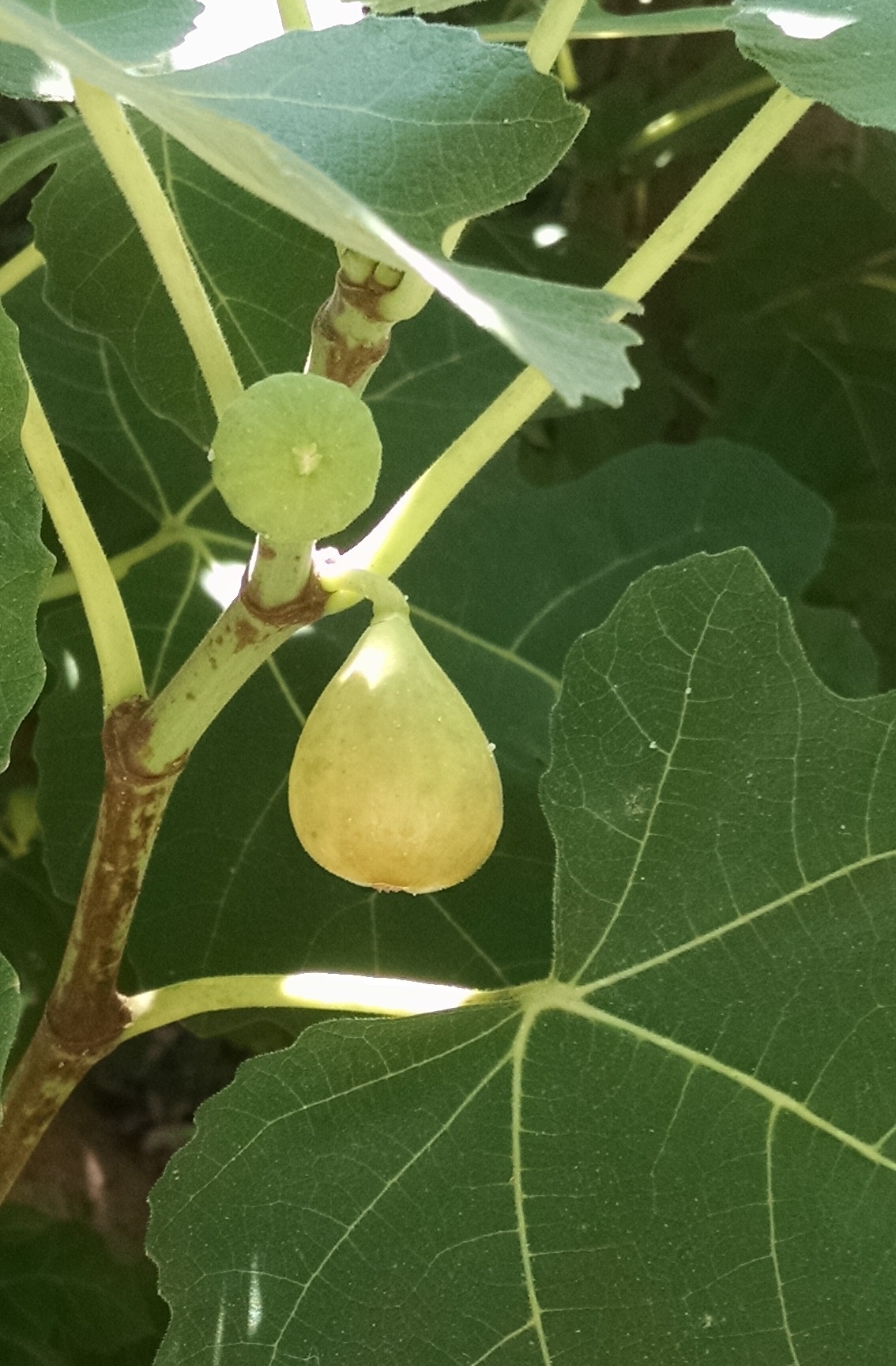
ripening fig

Excitement. . . .

Anticipation is one of the good things about seasonal foods. I know some have already had fresh figs this season, but not here yet. I’m anticipating that day when I see that luscious, brownish-reddish fruit, the little drop of nectar at the bottom telling me its ready to eat. It’s like the anticipation of the first asparagus in the spring, or the first home-grown tomato in the heat of the summer. The very first of a seasonal food–even if it’s only a single fig found ready to eat, need to be appreciated without adornment so that the appreciate the season, not the sauce or other accompaniments. Those come later when the figs, asparagus, or tomatoes are more abundant–maybe even a little overwhelming.

The first of the brown turkey figs are starting to ripen now–they are straggling in–the figs are ranging from very tiny to several that have been mostly devoured by birds, to one that was ready for me to eat–but lots of tiny ones that I can look forward to.

Mornings may find me with my latte visiting the fig tree in hopes of a fresh-off-the-tree, warm from the sunshine, figs for breakfast.

There are so many easy things to do with figs:

The anticipation of watching them ripen, hoping that you’ll get them before the birds. . .so many easy and delightful ways to enjoy this luscious fruit during its season.


A strange coincidence this afternoon

I truly love technology, especially when it lets me find marvelous things. If you’ve been here before, you’ll note the change of format. Well, it’s entailed a LOT of editing, link checking, replacing photographs that somehow disappeared in the switch.  So, I’m likely a little squirrely side. (Frankie would probably flat-out bitchy since the last time he walked across the keyboard.) I was just editing a blog post on Roast Duck with Fresh Fig Sauce, thinking that since it’s summertime, there will be figs. . . .

My email popped up notification of a  “like”  from a blog that I just discovered and started following.   From Alfred’s with Love.  WordPress put this one up on my list of recommended blogs yesterday, and I went to check it out.  I liked, I followed.Thank you, WordPress!

I’m seriously addicted to good writing about food, eating, dining, or even just the occasional graze, or an excellent sandwich (See Bibliography page).  As usual, the WordPress email included some links–Sea Bass and eat it caught my eye, and I was just roaming around. Perhaps because I had just been looking at duck on my blog I pulled down the recipe index and clicked on duck.

What I found first was Duck à l’epoisses. Epoisses is one of my two favorite cheeses (the other being Brin d’Amour or Fleur de Maquis).  I’d never thought of combining it with duck until I saw this recipe, and it’s left me drooling on my keyboard, even if it is so hot right now that I’d not want duck for dinner. This is a keeper of a recipe–come some cooler days and I’ll be looking for Epoisses cheese to try this (unfortunately it’s not one that I can just walk into the cheese shop and get here in Durham).

You’ve got the links here; you really should go check out this blog because there delightful reading, and some great anticipation with the recipes.

A chicken casserole

As it’s getting warmer, we do tend to change the way we cook and eat.  Generally I turn away from things with the label “casserole”, but from Frugal Feeding  blog here is a keeper for summer, even though it’s called a casserole. I’m also sure that you’ve noticed that I do like to use chicken thighs, so this is right my my alley.

If you’re cooking for one, the “leftovers” are awesome–just cold/room temperature, added to a green salad.  (I want to try this in my Schlemmertopf–I suspect that I won’t need to brown the chicken first.)