Christmas eve–oysters!

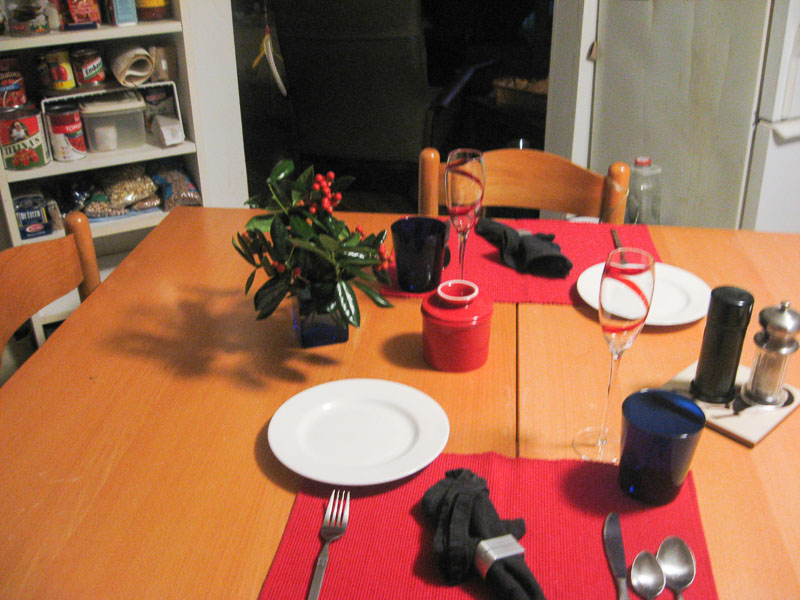
Christmas eve tableI think my Christmas spirit has finally arrived!

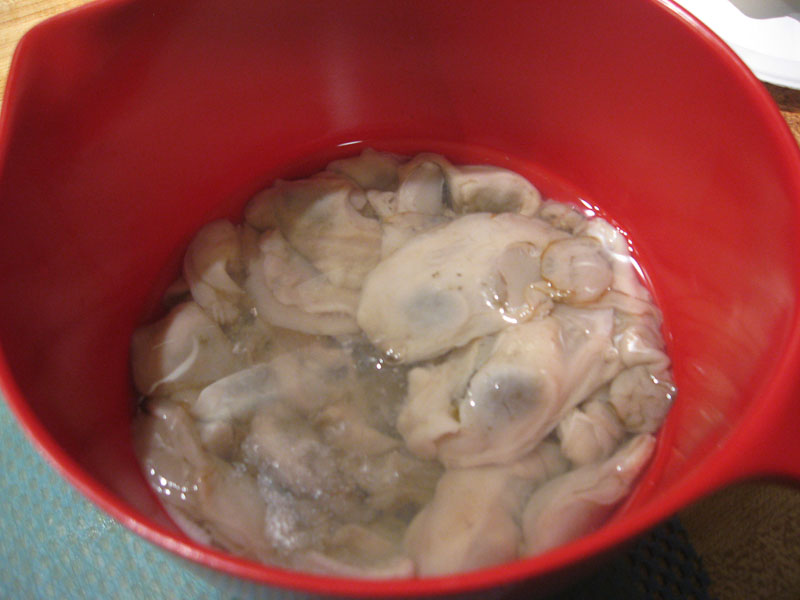
I have the Messiah playing on WCPE, the oyster liquor is working its way through the coffee filter.  The sliced black truffles have steeped in warmed heavy cream  for several hours.  The half-and-half is warming. The cava (recommended by Randy at the Wine Authorities for this particular dish) is chilled and waiting to have the cork popped. There is a nice ripe sedge of Chaumes coming to room temperature.  A neighbor is coming to share the meal with me. The serving bowls are in a very low oven so that they will be warm for serving.

Note that this is intended to be a serious meal of oysters–not appetizer, or a light bowl of soup.

Poached Oysters with Black Truffle Cream

Ingredients

For the black truffle cream:

  • 1 cup of heavy cream
  • 0.7 ounce jar of sliced black truffles, drained and oil reserved
  • grey sea salt, a pinch

For the poached oysters

  • 1-1/2 or 2  pints of select oysters with liquor (strained)
  • 2 cups half-and-half
  • grey sea salt to taste

AssemblyOysters

  1. A couple of hours before you want to serve this, warm the heavy cream (to about body temperature or just a hair above that). Drain the truffles, add to the warm cream and let stand and steep until ready to poach the oysters–or make the oyster stew if you prefer. (Reserve the oil for another use
  2. After the cava is open, and you’re nibbling on the cheese, warm the half-and-half to a brisk simmer or a very gentle boil, add the oysters and the liquor, remove from the heat and stir very gently. (People must wait on the oysters, not the other way about, so you can really be the center of attention with this one.)
  3. Watch the oysters carefully and as soon as the edges begin to curl very slightly add the reheated truffle cream and stir gently.
  4. Serve immediately with more bubbly, and lots of good bread. (Be sure that your serving bowl are warm when you serve the oysters.

Sorry–no pictures–this dish needs to be eaten immediately!

><<o>><

I love oysters, and truffles.  The inspiration to combine them for my Christmas Eve tradition came from Le Chef’s Kitchen. I wanted  the flavors to contrast: the earthiness of the truffles and the briny flavor of the oysters so I didn’t think that poaching the oysters in the truffle cream would give me that. As it turned out, adding the truffle cream just as we were ready to eat worked perfectly.  Plump tender briny oysters and the contrast of the truffle cream was fantastic–kind of a “surf and turf” effect.

We had   	Cava, Brut Nature Gran Reserva Cava, Brut Nature Gran Reserva “Coquet” (Mestres, Heretat, Spain) with this.  The cava was excellent–bold enough to stand up to the oysters and truffle flavors, but not quite the perfect combination that I’d hoped for. Both of us though the wine needed–well, we’re not sure just how to say it–I though maybe something a little “darker”, not quite so sharp and “bright”. Maybe I need a still wine with this rather than bubbly, though it’s a classic with oysters.

(We liked the cava;  I’ll certainly buy it again to drink with something else–but obviously I have to continue the search for the perfect wine to accompany this dish. (You do realize that I was very pleased with this combination–and it will definitely be repeated as it’s now on my list of favorites.)

A son goût!

Garlic mashed potatoes

My assigned dish for the Thanksgiving dinner that I always have with friends is garlic mashed potatoes…I love them, but don’t make mashed potatoes for one.  One of the reasons is that I want my mashed potatoes to be unctuous, with lots of butter and (at least) half-and-half–not something I should be adding to my diet often.

This year, I made my Thanksgiving garlic mashed potatoes as described inCook’s Country recipe for garlic mashed potatoes–it’s a one-pot method that produced a lovely result–with less effort that the way I had done them.  It’s always been my contention that I don’t want to cook potatoes for mashing in the jackets–I hate having to peel them while still hot, and I certainly don’t want to boil peeled potatoes in water–I want all that lovely starch to be available to absorb cream and butter–so I’ve always steamed them and then let them dry out just a bit before I start mashing.

This recipe took a different approach:  the potatoes were cooked with the minced garlic (after it was sautéed in butter) and then cooked in the half-and-half with a bit of water added.  Once tender the potatoes were mashed right in the pot, adding some more butter, and half-and-half.

I’ve looked at this recipe and wondering if this approach could be adapted to making mashed potatoes (decent ones) for one, or maybe two.  It would certainly be faster than baking a potato and then making mashed potatoes, since the potatoes are cut into 1/2-inch cubes before cooking and you do the mashing right in the same pot that you cooked them in–less clean-up to do, as well.

Adapting this recipe for one seemingly would involve just a ratio adjustment–but that will take a test run to see if it is so simple.  Since the original recipe called for four pounds of potatoes (designed to serve about 6 or so), it might take some tinkering, but sometimes mashed potatoes (like risotto) are necessary even when doing single-serving cooking.

…and now it’s turkey soup!

Remember those turkey thighs that I roasted a couple days ago? They have really been a bargain.  I spent about $5 on the package of thighs–two small-to-medium ones.

I had my roast turkey with sides of potatoes and cabbage (with juniper berries). Then I had two full-size sandwiches, and a half sandwich for lunches. Now I’m finishing the turkey thighs with a very hearty bowl of soup (and a  glass of good wine).

small Rival Crockette

a crockette

I popped those thigh bones (with what meat wasn’t easy to carve for sandwiches) in to my tiny little single-serving crock-pot to make some stock–I just added a little salt, a bay leaf, the brown stuff that I deglazed from the roasting pan, and enough water to cover the bones. After slow cooking overnight, I removed the thigh bones.  The meat just fell off into the pot.

In the same little crock-pot (don’t want extra dishes to wash), I added a small handful of barley, some dried mushrooms of various sorts–including shiitake, chanterelle, and porcini. The other things that went into this soup were the leftover cabbage (with juniper berries) and a few potatoes that were roasted with the turkey.  (You may be thinking that this is pretty heavy on starch, but to finish the soup, I added some green stuff.)

small leaves of greens

mixed greens

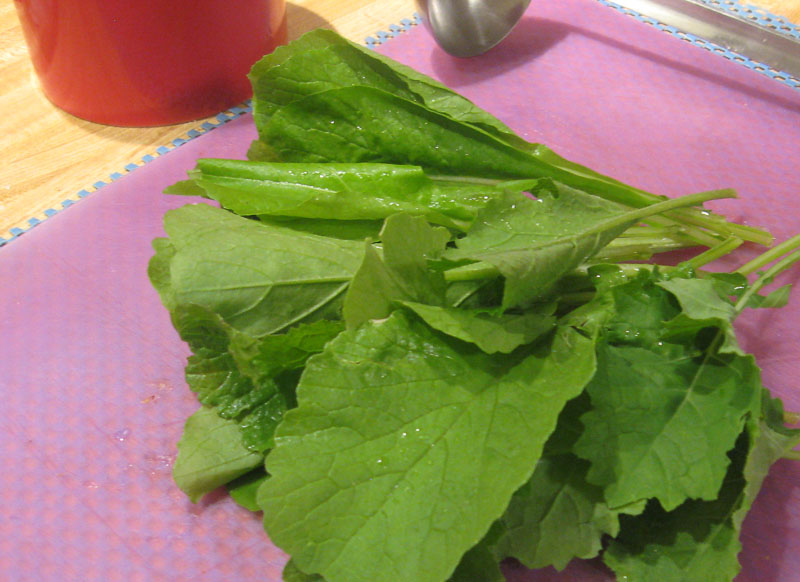
About half an hour before I was ready to eat, I went out to the garden (which I share through the good graces of a neighbor) and picked a good size handful of small kale, turnip, and mustard greens.

After washing, I cut these in bite size pieces (though that was almost unnecessary as they were really not as big as my hand). They went into the crock-pot; in about 20 minutes they were still bright green but tender.

I did a final adjustment of salt using French Grey sea salt, and finally added several drops of black truffle oil to finish the soup.

-<>^<>-

I’ve had my bowl of soup for supper this evening–and it looks as if I’ll get one more meal out of those turkey thighs–with the barley, and the amount of meat that was left on the bones, there is easily another serving of this soup for lunch or supper tomorrow. (I’m sure that by the time I reheat it, those greens won’t be quite so bright green, but the flavors may have melded with the other ingredients so it should be good–maybe even better than this evening.

bowl of soup with greens

a warm, hearty supper

-<>^<>-

I opened a bottle of wine this evening that was a completely unknown to me. It was a limited release called “Dark” from Apothic. I was completely beguiled by the description that said that it “blends dark fruit flavors of blueberry and blackberry with opulent notes of coffee and dark chocolate”.  How could I possibly pass that up? (I found it while shopping at Harris Teeter–just after I had bought a case of something called “Besieged”–more about that one later.)

I was surprised how dark it was when I poured it into the glass! (I even tried to take a picture–but it just looks almost black–so forget that.) It is definitely a “big” wine and right out of the bottle it was fruity and mellow–but after breathing for a bit it lives up to its description.

I thought it might overwhelm my bowl of turkey soup, but with the juniper berries, the rather emphatic mushrooms, the flavors of the greens, and the truffle oil, it turned out to be a great combination.  Fortunately there is some of the wine left for tomorrow’s soup! This is one time when I’m looking forward to the “leftovers”.

Serious, easy comfort food….

Surely one of the easiest comfort foods must be a baked potato. I don’t mean just any old baked potato. It has to be one that has never had aluminum foil mentioned in the same room with it, rubbed with oil, popped into the oven at about 325°F until the well-scrubbed skin is almost crisp.

Pulled from the oven, x-ed on top and smushed open, given a minute or two for steam to escape, just a tad of butter added–it’s so good!  Probably, in my estimation, the ultimate comfort food–even more than mac ‘n’ cheese.

Want to make it some seriously “gourmet” comfort food?  Add some fleur de sel, or another fine specialty finishing salt. For a great account of salts of the world, you should check out Salted: A Manifesto on the World’s Most Essential Mineral by Mark Bitterman. Just a pinch of a finishing salt adds a very special touch.

Some truffle oil and/or butter, or shaved truffle over the lovely baked potato is awesome.  If you go so far as the truffle butter (or not) a glass of champagne goes well with it and helps induce an aura of comfort in a serious way.

If it’s a meal you want, rather than just comfort food, add some steamed broccoli, and maybe even some cheese–some pepper jack or Havarti will melt easily over the top–just lay thin slices over the hot potato–never mind making cheese sauce here.

Sumptuous but simple.

A son goût!

Oven-braised lamb and garbanzo beans

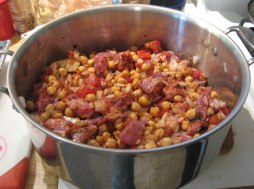
It’s another grey day–unseasonably warm, but at least not hot, sticky, and terribly humid today–the kind of day when you need to smell something cooking–long, slow, and tantalizing.   I found lamb shoulder chops on special (2-1/2-pound package) at the grocery store, I decided to try the lamb/garbanzo slow-cooker thing in the oven since it’s not too hot (and I’ll use the oven to prepare a second dish for reheating tomorrow (acorn squash stuffed with Sicilian sausage).

Book coverThe slow cooker version of this concoction was really good, but I thought it could be improved by doing it in the oven. Even after reading the Cook’s Illustrated Slow Cooker Revolution (volume 1), I am still not a wild fan of the slow-cooker.  I use it because it does some things well, and is necessary at times to fit cooking into a working schedule.  The Slow Cooker Revolution has improved my slow-cooker results immensely, mostly because I’ve discovered some unusual ingredients that can improve flavor.

My impression was that many of these recipes required more preparation time than I would be able to put into a slow cooker recipe, given that I use it for utter simplicity.  I’m interested in seeing what comes from volume 2 of the Slow Cooker Revolution.  If I have to do a lot of preparation for the recipe, then I might as well not use the slow cooker.  I still find that I like over-braising when possible; however, I do find I’m using the slow cooker even more since I read the first volume of this book. That said, I still prefer oven braising, especially if I’m working at home.
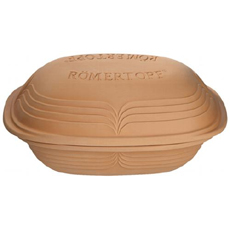
Romertopf clay baker (oval)I had intended to do this in the Romertopf, (one of my favorite things for roasting and baking hearty, peasant-style comfort food in the winter) but by the time I had boned the lamb and added other ingredients, it wouldn’t fit in either of my small ones (great for single-serving cooking), and was not enough to fit in my large Romertopf (for roasting whole chicken, for example)–so it was the Dutch oven for today.

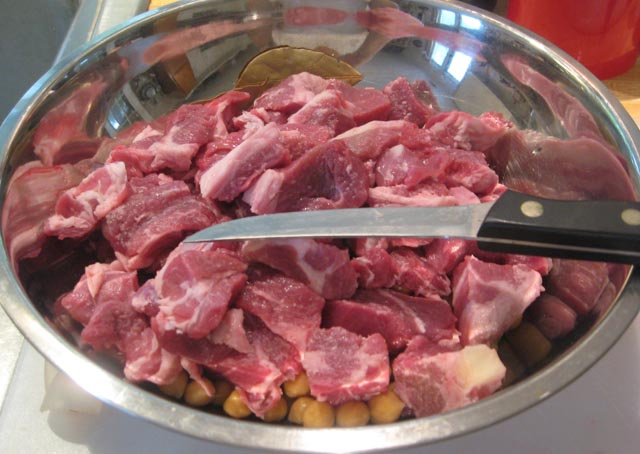
(Shoulder chops are reasonably priced, and the boning doesn’t take long if you use a boning knife rather than trying to do it with a paring knife or chef’s knife.  Those bone went into a saucepan with a tad of salt and some bay leaves to make stock.  After boning out, I had about 2 pounds of lamb, so that’s what I started with.)

Oven-braised lamb and garbanzo beans
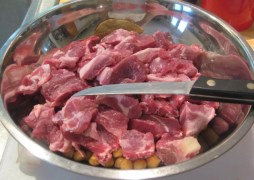
lamb from chopsIngredients

  • 2 pounds lamb (from boned shoulder chops)
  • 2 14.5-ounce cans of garbanzo beans, drained and rinsed
  • 3 large onions, chopped
  • 1 14.5-ounce can of fire-roasted, diced tomatoes with juice
  • 2 tablespoons of Hatch chilli powder (used for the slow cooker), but more added after tasting this halfway through cooking
  • 2 teaspoons of salt, or to taste
  • 1 tablespoon fresh Mexican oregano, minced
  • 1 cup water

PreparationIMG_7667

  • Put everything in pot
  • Cover
  • Pop it into the oven, and check for liquid in an hour
  • Go get laundry or whatever, then check liquid again

-<>^<>-

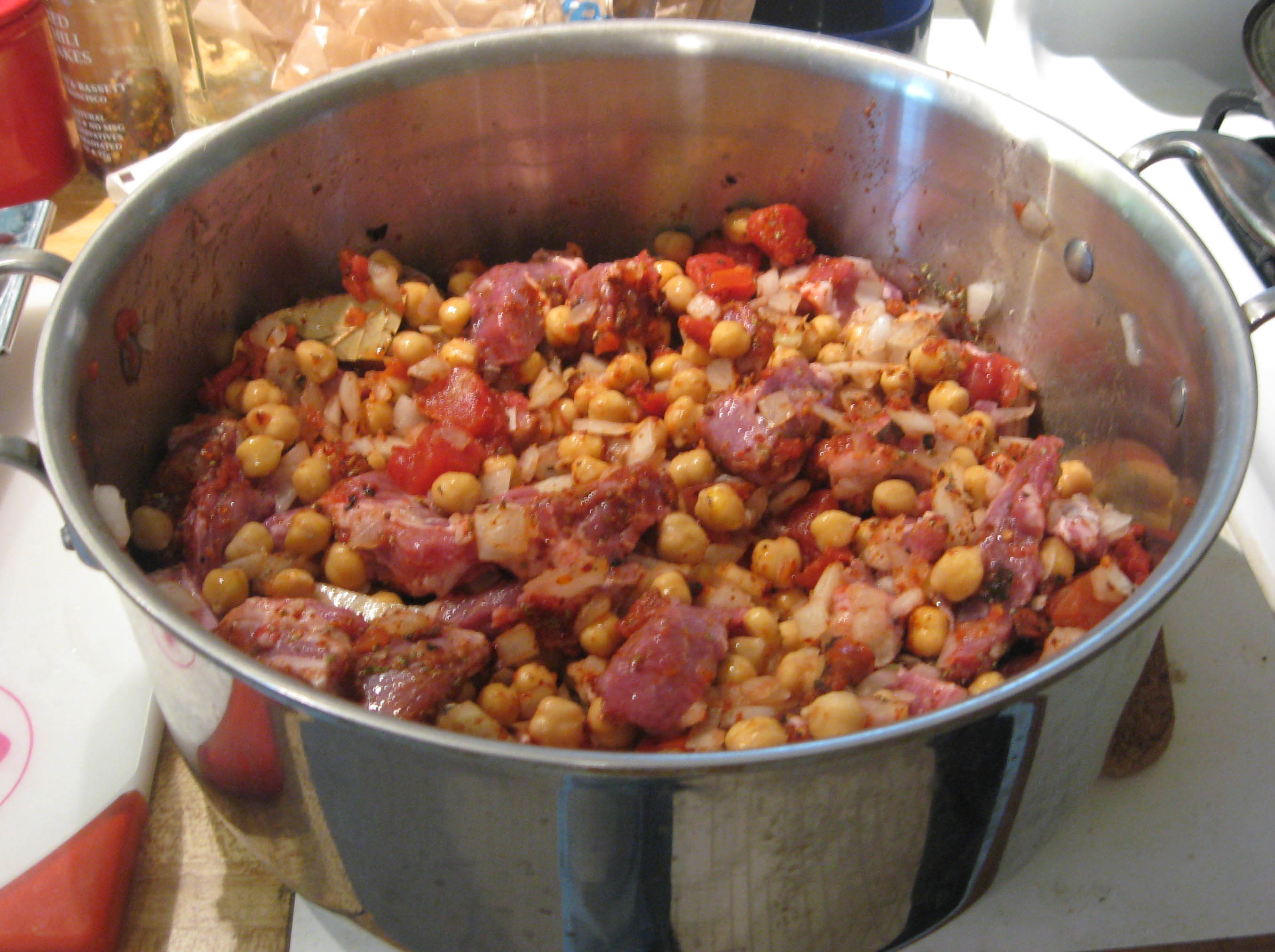
In order to be as much like the slow-cooker, I did not brown the meat or cook the onions separately–just combined everything, covered, and put in a preheated, 300-degree Fahrenheit oven.  I added 1 cup of water to start, and checked in one hour but there was plenty of liquid.

On tasting, I found it needed more than the 2 tablespoons of chili powder so I added about 1 tablespoon more, stirred, covered, and let it continue to cook. There was plenty of liquid, so next time, I’ll not add any water–just rely on the juice from the tomatoes, onions, and meat.

-<>^<>-

The stock made with the bones smelled really good–if more liquid had been needed during baking, I would use some of the stock.  There was some meat from the bones in the stock, but I not enough to spend time picking off, although I’m not compulsive about trying to get every bit off when I bone meat like these chops. Since I started the stock in cold water, the meat that was left was pretty flavorless, but the stock was good.

-<>^<>-

There will be a next time for this–and unless I’m really pushed for time, or can’t leave the oven while I’m out, I’ll opt for the oven method to cook this–a much more complex flavor with the same ingredients, likely attributable to the bit of evaporation that takes place in the oven but not in the closed slow-cooker.

Getting this added flavor lead me to consider the energy used in the various cooking methods–the energy required for cooking is certainly part of the energy required to make that food edible–the energy  of production and transportation, and the cooking is all part of the picture: the footprint of feeding me. We cannot ignore the energy used for cooking when we talk about other energy costs associated with our food so I spent some time browsing to find information on different cooking methods.

In trying to research this issue, I’ve perused many different sources–and the gas/slow cooker comparison is difficult, and I get the feeling that the answer to which is more efficient is an “it depends” situation.

Interestingly, an article on slow cookers versus electric ovens from the University of Connecticut Sustainable Living suggests that there may not be a significant difference in energy use.  SFGate discusses gas versus electric energy use, which gets more complicated, but I’m not sure that there difference is significant enough to make me give up oven braising, even though I’d like to minimize my “carbon footprint” as much as possible. If my slow cooker requires eight or so hours of cooking, and my oven braise requires only two or three hours on low to medium heat, then it may be a toss-up, since the slow cooker doesn’t cycle, and the oven (gas or electric) does.

Oven braising in the wintertime helps warm the house so probably cuts my heating use some, but I’m certainly NOT going to oven braise in the summer and increase the use of air-conditioning.  There is lots of conflicting information out there on the ‘net.  The “best” I found was from the Consumer Energy Center (California Energy Commission)–from that information, I’m not going to give up oven braising for the slow cooker anytime soon, but I’ll still use the slow cooker for some things.

Cover, pressure cooker perfectionOne comparison that I’d really be interested in is slow cooker versus pressure cooker energy use, and taste of the same dish prepared in both. Most data that I found suggested that the slow cooker wins on convenience, and the pressure cooker on energy saving. A taste comparison would certainly be interesting.  I’m almost certain that a pressure cooker can’t replace a good old-fashioned slow braise in the over.

I’ve recently started playing with a pressure cooker–it’s a lot different than what my mother used. The recipes in Pressure Cooker Perfection have been a good starting point. I suspect that I’ll be using a pressure cooker more  in the future, as well as the slow-cooker. Climate, air conditioning, and heating, are all things that will enter into my decisions. I’m also trying out an portable induction unit which is supposed to be ore energy efficient.

So many options for energy efficiency–but what about taste?  I doubt that any other method is going to come out tasting like an oven braise, no matter how many umami-enhancing ingredients you add.

A son goût!
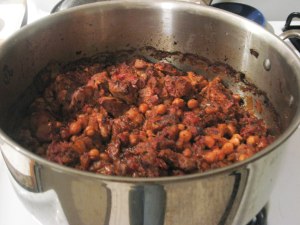
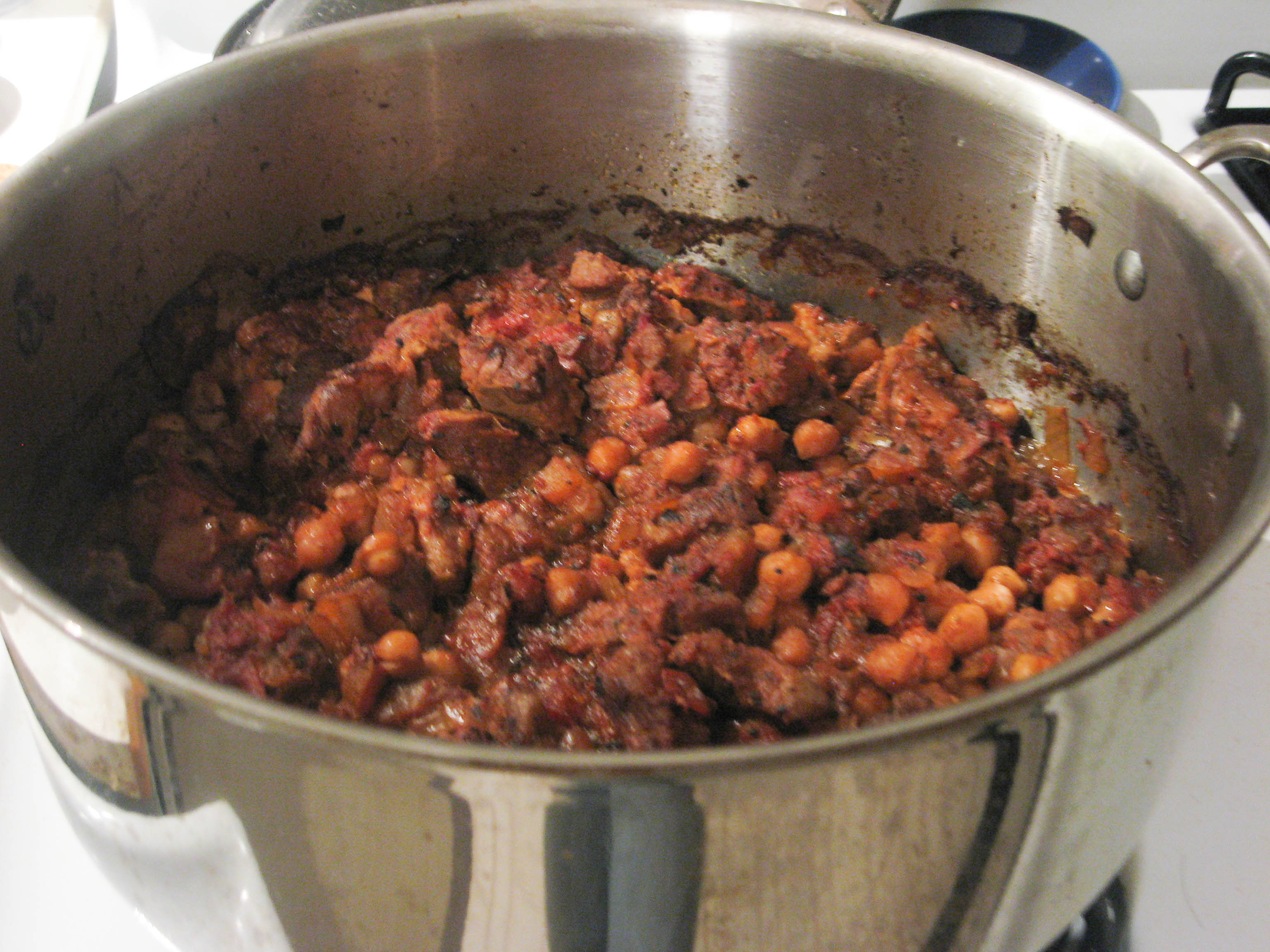
Dutch oven with lamb and garbanzos

very simple, very tasty

A pork and kale braise

It’s been chilly, cloudy, and grey–just the kind of weather for soups, stews, and braises. It’s also time to get the freezer stocked with some quick, easy food as I’ve got indexing projects coming in–some while I’m still teaching this Fall term.  With lots of grading to do as well, I wanted something that would take care of itself while I worked–so out comes the all-purpose “rice” cooker for some slow-cooked food.

I’m a great fan of pork almost any way you fix it so when I found a package of boneless pork ribs–just the ticket for the slow-cooker–while I was doing my grocery shopping on Thursday it obviously went into the cart. Big package, but on special, so it came home with me to make a lazy meal, and some to go into the freezer for quick meals when I’m really busy, or when I need comforting, peasant-style food. Can’t pass up inexpensive on something I really like.

Braised pork and kale from the slow-cooker

Ingredients

  • boneless pork spare ribs, about 2 pounds
  • 1 packaged of frozen, chopped onions
  • chopped kale, one frozen “family” pack
  • 6 large garlic cloves
  • 1 14.5-ounce can of fire-roasted tomatoes
  • 2 tablespoons of Hatch chili powder
  • 2 teaspoons of kosher salt, adjust to taste as needed when cooking is finished

Preparation and cooking

  • cut pork into about 2-inch pieces
  • add half package of kale and onions, mixing
  • layer in pork, sprinkle with salt, chili powder
  • add remaining kale and onions
  • add fire-roasted tomatoes with juice
  • close the lid and set for 8 hours
  • shred pork using two forks (if desired)
  • check seasoning and adjust as necessary.

No, no pictures as  this is NOT a photogenic dish, but it sure is tasty! And there’s certainly nothing like complicated technique involved here.

Great served with a side of spicy black beans, or garbanzo beans, or just a big bowl on its own. This particular time I had a roasted winter squash as a side with it. (Now, to turn the rest of the winter squash into another meal–maybe stuffed with some Sicilian sausage that also went into the grocery cart.)

There was more liquid than I had anticipated when this was finished cooking, so after packing some in zipper-lock bags to go into the freezer (with SOME juice), the extra juice with some kale and some shredded pork is going to turn into soup–details will evolve when it’s used–but that’s an additional meal out of that pack of spare ribs!

Celebrating the autumnal equinox.

I woke up to a lovely fall morning–sunny, breezy, cool–absolutely lovely day, some leisurely time over coffee in the sunny kitchen, and realized that I’ve gradually been shifting into autumn cooking mode–cooking urges that are very different from the hot, humid weather of summer.

I’ve been making meals in the multitasking rice cooker lately: whipped up a great spicy lamb and garbanzo bean stew and another of braised pork and collard greens.  Some of immediate use today, and some of each of those to stash in the freezer for quick meals on a cold winter day when I need serious comfort food.

The lamb and garbanzo “stew” was one that I literally threw together in about 15 minutes while I was finishing an index to send to a client. A good friend who knows how much I like to use chili peppers gave me a wonderful chile powder from Made in New Mexico.  I used lamb shoulder chops, a healthy batch of chile powder, some Mexican oregano,  Goya garbanzo beans, and a can of diced tomatoes. The lamb chops came out of the slow-cooking melt-in-your-mouth tender, with just enough spice to accumulate a bit of burn by the time you’ve eaten a bowl of it, but not enough to rip you taste buds out by the roots.  This chili powder is the best I’ve ever used–I’ll be ordering more of that one.

Another job that just could not be put off any longer was cleaning the gas stove. It is one of my very least favorite things to do so I do tend to procrastinate about it; that does not make the task any easier and I know that but I still procrastinate about it. (I think that a house elf would be a wonderful thing to have around!)

Now the stove has at least had a  lick and a promise as my grandmother would have said. Well, at least the lick, but still needs the promise though that is going to happen today. (Definitely no pictures here!)  So happy that the oven is self-cleaning since it gets lots of use in cool weather for carefree braising while I’m working at home.

Now I’m ready for a plate of braised pork and collard greens!

Fig and fennel caponata!

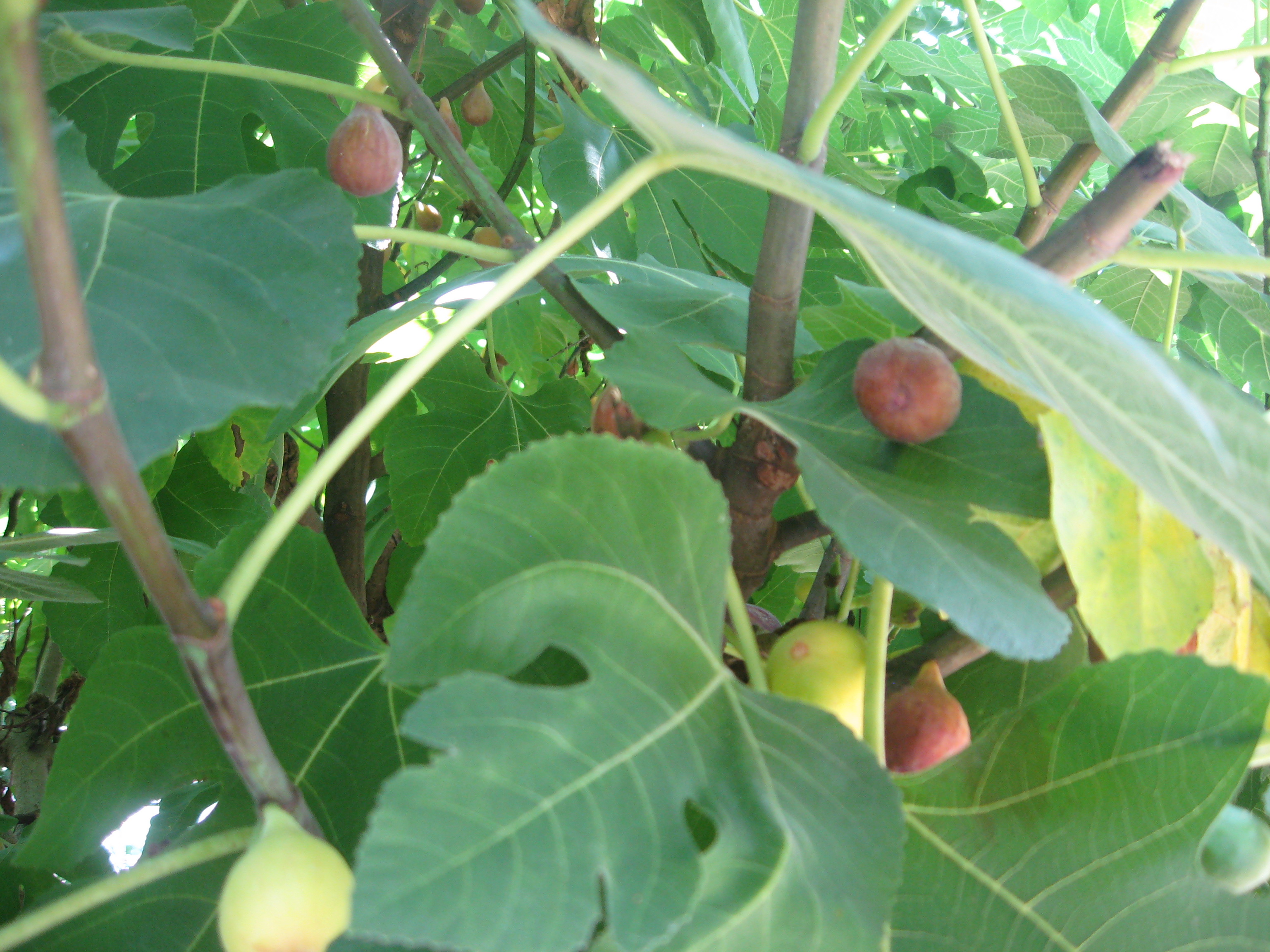
figs on tree

ripe and unripe figs on tree

My kitchen smells SO good right now–fennel, oranges, garlic…tartness of balsamic vinegar….

I’ve finished the most recent BIG indexing project, and I’m supposed to be deep in course preparation for my medical terminology courses that start a bit after mid-August.

I’m playing hooky from that for a bit.  I found a recipe for fig and fennel caponata that wouldn’t wait.  You’ll find the recipe at jjbegonia.com.

Caponata of any sort is one of my favorite summer things, no matter how served, and this was a combination I just had to try. Though mostly we think of caponata as a dish made with eggplant, tomatoes, etc., it is really a cooked vegetable salad–and as much as I love fennel and figs, I just had to try this one NOW.

I took a few liberties with the recipe, but I think that I kept to the spirit–the flavor was certainly good.  The only real modification I made was to substitute diced (drained) fire-roasted tomatoes for the crushed in purée since that’s what I had in the pantry, and after tasting, I added more figs. Whether my figs were less sweet, or my balsamic was more acidic, I’m not sure, but it seemed to need a bit more of the figgy-ness.  I held back most of the parsley since I’m not serving immediately.

Despite my liberties, it’s a fantastic recipe–obviously great on toasted bread just as a nibble (maybe with a glass of cava or prosecco), but I’m looking forward to it as a side for a grilled lamb (shoulder or leg) chop, though I’ll have some left to try on sandwiches as well, and maybe with pasta…and probably to share with neighbors and friends.

(Given that both the recipe from jjbegonia.com and mine were changes from the Barefoot Contessa, here is the link to that recipe for fig and fennel caponata as well. I’ll probably try this when fresh figs are not available, but I do like the freshness of this recipe.)

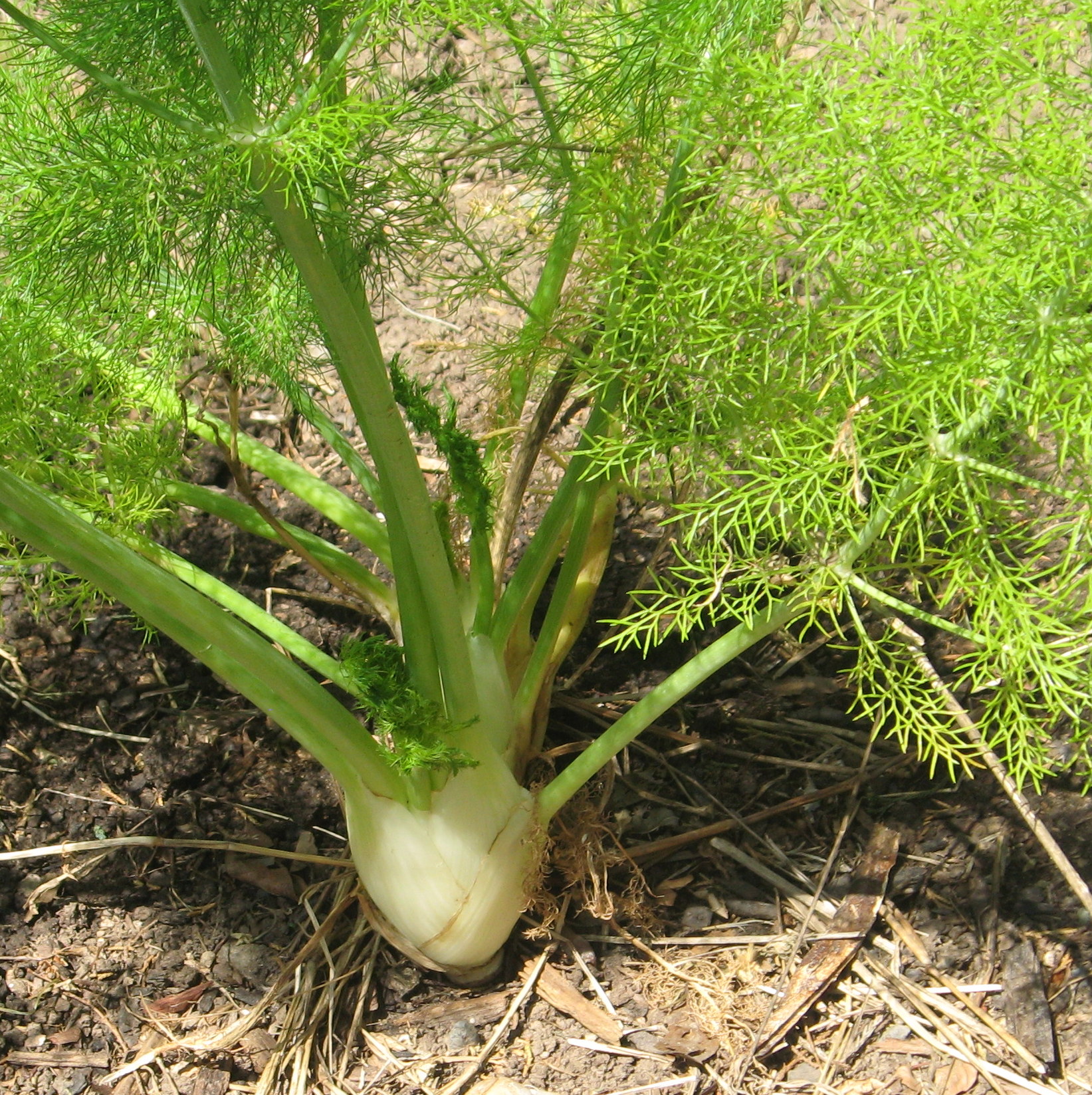
fennel (Foeniculum vulgare)

Foeniculum vulgare

Turnip greens…

Loose mustard greens

While having leisurely Sunday morning coffee I was browsing through the Huffington Post and discovered a presentation on rediscovering mustard greens (though I didn’t realize that they were lost or misplaced). If mustard greens need rediscovery, then perhaps turnip greens need rediscovery (or just discovery) too. One of my favorite things to do with heartier greens (those that need longer cooking, unlike spinach) like collards, mustard, kale, dandelion, or chard is to braise them with sausages for a one-pot meal that is easy to make in any quantity–and reheats and freezes well.

Just recently I was the happy recipient of a LOT of turnip greens from a gardener who likes the bottoms–the turnips and not the green tops. Some of these were older–so a bit spicier, with some of the “horseradish” tang that you find in mustard greens as well.

Even though it was warm weather, I had just started an intense indexing project and wanted some easy food–braised greens with sausage.  No need for a recipe and certainly not labor-intensive or needing a lot of attention while it cooked. (I thought about using the pressure cooker, or the slow cooker but just did this on the stove-top this time)

hot italian sausage IMG_6092I started by dicing and sautéing a large onion, then added a mix of sweet and hot Italian sausage, removed from the casings, to brown lightly.  Of course it needed garlic–about half a dozen large cloves, minced. (The garlic mellows a lot during cooking.)  Since the greens had their own “heat” and I had used hot Italian sausage, I didn’t add the hot red pepper flakes that I would have used with other sausages, or other greens–e.g. kale or collards.

Once the garlic had sautéed enough to become aromatic, I added the washed and cut up greens (still wet from washing) and a can of diced tomatoes. In a tightly lidded pot, I left this over low heat until the greens were almost tender–about 45 minutes. (Since these were older turnip greens, I did remove the stems before cooking.)

In went one can (rinsed) of pinto beans (not on the low-carb diet, but…) and continued to cook about 30 minutes more to let the beans pick up some of the flavor of the greens and the sausage. Home-cooked dried beans would have been better, but since I didn’t have any of those in the freezer, and hadn’t planned ahead–canned ones had to do for now.

And there you have it, a quick supper, and a couple of servings for the freezer for several more quick, comforting meals.  Since the greens were spicy, the sweet Italian sausage added a nice counterpoint. I’m glad to have some tucked away in the freezer since I suspect that will be the last of the turnip greens for the summer–as the weather gets hotter the greens get a bit more assertive. If I’m lucky and there are more, I’ll probably do this again, but omit the hot Italian sausage. Or think about doing this with lamb sausage…so many possibilities, and so easy–and reasonably healthy as well.

All you need to add is a glass of a nice sassy, robust red wine, and maybe some good crusty bread (if you’re not on a low-card diet). A son goût!

Spiced Strawberry Sorbet

It’s summer time–I know that you don’t want to hear me complain about heat and humidity, so I won’t.  There are some things that are good about it–and one of them is strawberry season.  I’ve enjoyed some of the local ones that I’ve gotten at Harris Teeter (so happy to see them carrying local produce). When strawberries are perfectly ripe I just want to eat them completely unadorned. But the hot weather makes me think about cool things like sorbet, ices, and ice cream.

bowl of washed strawberriesHere’s a recipe that I’ve had for literally years.  It’s so good that I wanted to share it with you as one more way to enjoy the season’s strawberries. (Thanks to Google, I can tell you that I got this recipe from Epicurious.com). Just as in making the sour cream strawberry ice cream, you don’t want berries that are just “okay” or “fine for ice cream”, you want them to be absolutely luscious–the kind where they are so fragrant that they make you feel like you’re right in the strawberry field feeling the sun shining down on your back and smelling the ripe, fragrant berries.

I’ve made one slight change to this recipe–I like to toast the black peppercorns in a dry skillet until they start to smell aromatic and peppery, then crush and add to the sorbet. I think it makes a more complex, spicier accent from the pepper.

Spiced Strawberry Sorbet

Ingredients

  • 2/3 cup sugar
  • 2/3 cup water
  • 3 tablespoons black peppercorns, coarsely crushed
  • 1 quart strawberries, hulled
  • 2 tablespoons balsamic vinegar, or to taste

Preparation

  • In a saucepan combine sugar and water and bring to a boil, stirring until sugar is dissolved.
  • Stir in peppercorns and remove pan from heat.
  • Cover pan and let syrup stand 1 hour.
  • Strain syrup through a fine sieve into a food processor or blender and discard peppercorns.
  • Puree hulled strawberries with syrup until very smooth and force though sieve into a bowl, discarding seeds and other solids.
  • Stir in vinegar and chill, covered, until cold.
  • Freeze mixture in an ice-cream maker, following manufacturer’s instructions.
  • Serve sorbet with sliced strawberries.

The Epicurious recipe suggests an accompaniment of toasted almond Phylo crisps; that recipe is given at the link above.  The balsamic vinegar does not need to be absolute top of the line–but it should be authentic–not a cheap imitation.  To be frank, I’ve never gotten around to making the phyllo crisps to go with the sorbet, though I can attest that a good traditional pound cake, tuiles, or madeleines are excellent with it.

After tasting strawberry with green peppercorns in a Hachez Cocoa d’Arriba chocolate bar, I want to try this using green peppercorns, probably bloomed with heat before putting them into the sorbet.

Another taste combination that occurred to me was to add cilantro (tiny, newly sprouted plants).  If you’re questioning my sanity on that one, there is a reason it occurred to me.  When I was in San Antonio for the national American Society for Indexing convention, I had dinner at Los Ramblas (Spanish cuisine), and I had a strawberry gazpacho with tiny cilantro “microgreens”–those with just the cotyledons–not even the first true leaves; it was an awesome flavor combination that I think might adapt nicely to sorbet. (The microgreens are not nearly so strongly flavored as fully grown cilantro.)

small alpine strawberry

alpine strawberry