Spanish potato omelette (Tortilla Española)

Another favorite egg dish (though I don’t make this as often as the basic omelette) is tortilla Española or Spanish potato omelette–this takes a bit more time than basic omelette, but it is serious comfort food.  Though most recipes that I’ve seen recommend serving it at room temperature (and I love it that way too), I like the first serving still warm.  I don’t mind having some of this around to eat as recommended, at room temperature, especially in hot weather.  I usually make the entire 4 servings of this.

This recipe is adapted from The food of Spain and Portugal: The Complete Iberian Cuisine by Elisabeth Lambert Ortiz (p. 231) and allioli (p. 239).

Tortilla Española

Ingredients

  • 500 gm/1 pound potatoes, peeled and diced or thinly sliced (preferably waxy potato–red or Yukon gold).
  • 250 gm/8 ounces (about 3 medium) onions, finely chopped or sliced thin
  • salt and fresh-ground black pepper
  • 250 ml/8 fluid ounces (1 cup) olive oil
  • 5 large eggs, lightly beaten

Preparation

  • season the potatoes and onions with salt and pepper.
  • heat the oil in a large, heavy frying pan (skillet), preferably nonstick.
  • cook the potatoes and onions covered over low heat until soft, but not browned; stir gently from time to time.
  • drain the potatoes and onions through a sieve, reserving the oil.
  • stir the eggs with a little salt and pepper
  • add the potato and onion mixture, mix gently and allow to stand for 10 to 15 minutes.
  • wipe out the frying pan/skillet and add 4 tablespoons of the oil, and heat
  • add the egg, potato, and onion mixture and spread it evenly
  • cook over moderate heat shaking the pan occasionally to keep it from sticking.
  • when the omelette begins to brown underneath, put a plate over the skillet and invert the pan and slide the omelette onto the plate.
  • heat a little more oil and return the omelette to the pan with the browned side up.
  • cook it just long enough to brown the underside.
  • transfer to a warmed plate and serve hot or at room temperature.
As a garlic lover, I love to accompany the with allioli (garlic mayonnaise) so here is a recipe for that accompaniment:   
 

Allioli à la Catalana  (Garlic mayonnaise, Catalan-style)

Ingredients

Makes about 1 cup; will keep in the fridge for several days.  This is for serious garlic lovers–there is a less potent variation given in the book, as well as variations using egg yolks.

  • 1/2 large head of garlic, peeled and crushed.
  • 1 teaspoon (5 mL) lemon juice (or white wine vinegar)
  • 250 ml (1 cup) olive oil at room temperature
  • 1/2 teaspoon salt.

Preparation

  • put the crushed garlic into a small bowl (or a large mortar).
  • add the lemon juice or vinegar
  • stir to mix
  • gradually add the oil, stirring in the same direction until the oil is absorbed and the mixture has a mayonnaise-like consistency.
  • stir in salt to taste.

You don’t need to use expensive oil–the garlic flavor is very strong.  This can be made in a food processor or blender, but I think that it’s more trouble to clean either of those than to make it by hand.

If you don’t care to make the allioli from scratch, you can add crushed garlic to a good commercial mayonnaise, and adjust seasoning to taste with lemon juice (or vinegar).  When I do it this way I use Hellmann’s® mayonnaise–it is quicker, but not quite as good as making it from scratch.

More potato basics

For those of you wanting more information on potato varieties,  you might also want to check the article on “Potato Varieties”  from Cook’s Illustrated.

Potato basics

Potatoes Solanum tuberosum) come in a myriad shapes, sizes and colors, with different starch and moisture content that makes different kinds suitable for different cooking methods.  There are red potatoes, white potatoes, purple potatoes, yellow potatoes, fingerling potatoes…. (I’ve put in the botanical name because these are different from sweet potatoes (even though we call both potatoes).

They are a wonderful vegetable–nutritious with lots of minerals and vitamins.  I think  they sometimes get a bad rap for all of the things we pile on–for example–a baked potato.  With “the works” added it’s certainly not low calorie…but we’re responsible for all that extra stuff that adds calories and “bad” fat.  There are lots of good things to do with potatoes that are quite healthy and then at times, potatoes turn into luxurious comfort food.

Potato blossom

potato blossom

All potatoes are created delicious, but not necessarily equal when it comes to performance.  You need to pick the right potato for what you want to do:  russet potatoes will be mushy in a potato salad.  Red potatoes (frequently called “new” potatoes–even though they are not) may not make the most luscious, decadent mashed potatoes.


rows of potato plants

potato plants

First, about what should and should not be called a “new potato“:  only a potato that is  harvested while immature is “new”–you can tell by looking at the skin.  On real “new” potatoes (all sizes) the skin is very thin and can be rubbed off the tuber;  you will likely see places where it has been abraded. Size does not tell you if a potato is new or not!  Even some very reputable and otherwise knowledgeable authors use “new potato” to mean red potatoes or boiling potatoes.  Newly harvested potatoes differ in moisture, starch and sugar content from potatoes that are fully mature.  They are wonderful in their own right if you can get them–it’s one of the joys of growing potatoes.  You can go out and get some really new potatoes.

—«°»—

Baking potato or russet potato

baking potato

The russet potato is the potato usually recommended for baking and for mashed potatoes.  They have lots of starch and less moisture than either red potatoes or Yukon gold potatoes.  They will make fluffier mashed potatoes and baked potatoes. They’re my preference for baked and mashed potatoes because I want “fluff” in my baked potato and I want to be able to add lots of butter and cream to my mashed potatoes.

—«°»—

Yukon gold potatoes

Yukon gold potatoes

The Yukon gold and Yellow Finn are rather middle-of-the-road potato, with medium starch and medium moisture.  If in doubt, and for an all purpose potato, these are my choice.  The flesh is pale yellow and I think a bit more “buttery” flavor than bakers or the red potato or even the round white potato (not pictured here).

—«°»—

red-skinned potatoes

red potatoes

The red-skinned, or red potato (sometimes called “new potatoes” or boiling potatoes) are usually described as “waxy”–that is low starch, higher moisture.  These, or round white potatoes,  would be my choice for potato salad, roasting, because they hold their shape well.


—«°»—

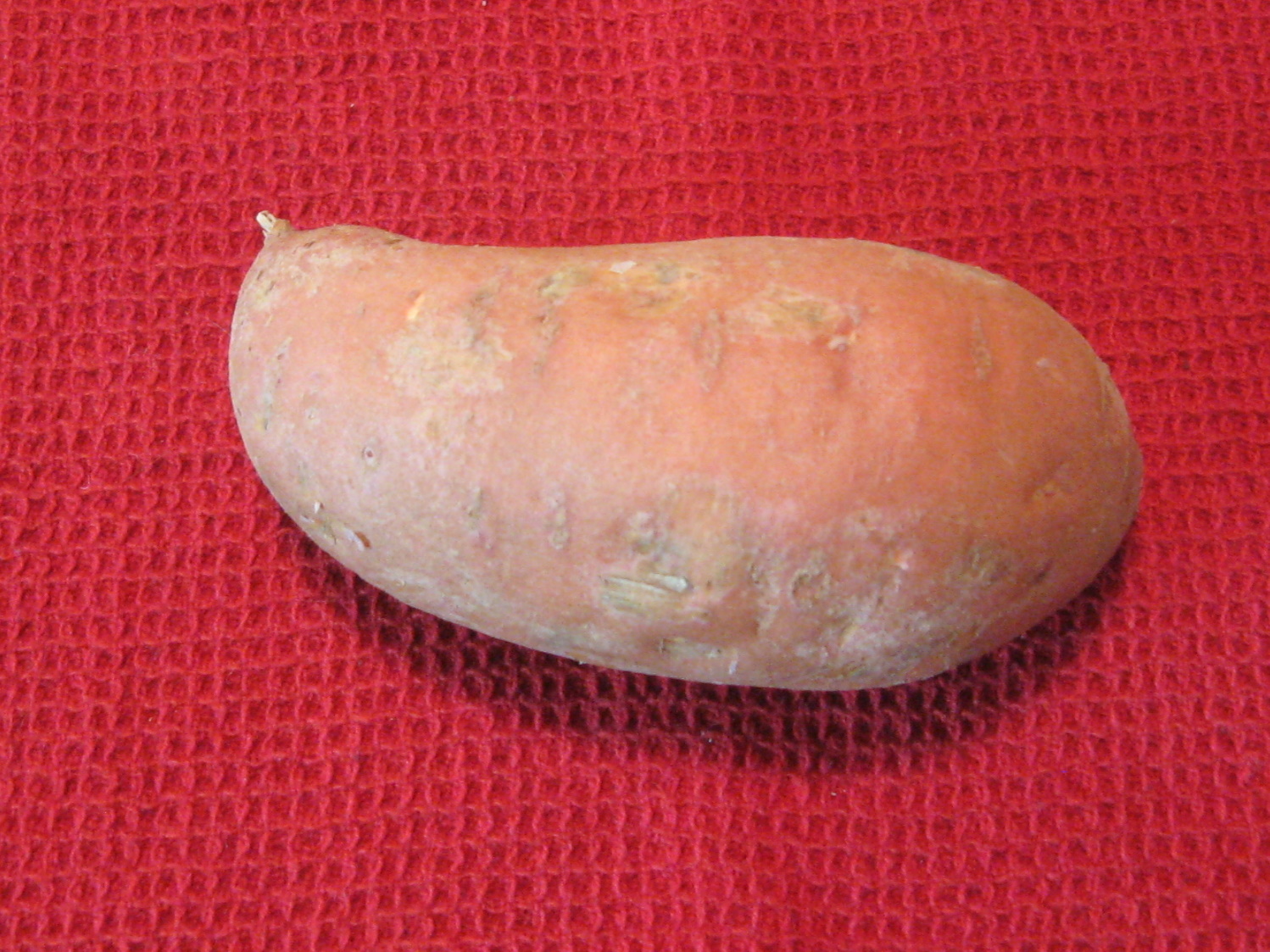
orange fleshed sweet potato

sweet potato

Then there are sweet potatoes (Ipomoea batatas),  which are commonly (and incorrectly) called yams.  Yams are a totally different biological entity.  These are only distantly related to the potatoes  discussed above.

Sweet potatoes likewise come in a variety of moisture content and colors.   The orange-fleshed ones are very moist, and as the name indicates, sweeter than the “real”  potatoes described above.  They are good baked and as french fries.  The white-fleshed ones are drier and those are my favorites for baking and making fries, but they are hard to find as a rule so when I see them, I bring some home.  There are purple sweet potatoes, too–again sometimes called yams, which they are not.  I’m going to be looking for these–I really like the purple potatoes, so I need to try these–they will certainly give a new look to sweet potato pie!

—«°»—

No matter what kind of potato you are buying, there should be not cuts, abrasions, or  soft spots.  For potatoes (Solanum tuberosum) you should check to see that there is no greenish discoloration.  This comes from exposure to light which produces solanine, a natural toxin.  The green is actually  chlorophyll, but it’s presence indicates the possible presence of a toxin, so green potatoes should be discarded.

When you get you potatoes home, they are best stored in a cool, dry, dark place.  Best is a temperature of about 40 to 50 ° F.   That’s certainly not the temperature of living quarters.  When stored at lower temperatures this can cause conversion of the starch in the potato to sugar and that will affect the flavor and cooking characteristics.  Lacking a suitably cool, dry and dark place I pass on the five-pound bag of bakers no matter how good the price, and bring home only what I’ll use in a short time (a week or ten days) and store them in the refrigerator (even though I keep my refrigerator really cold) otherwise they sprout before I use them all.

For lots more varieties and more suggestions for use see The Cook’s Thesaurus and the Potato and the sweet potato entries in Wikipedia for lots more great information on potatoes.

This is by no means a complete discussion of potatoes–I hope it gives you some basic information on  different characteristics of potatoes and which are most suitable for what use.   In the end, it’s your choice–want fluffy mashed potatoes, go russet; more rustic mashed potatoes–use red or try Yukon golds.  After all, you’re the one eating them  A son goût!

And here’s a bit of trivia for you for you next occasion for small talk:  2008 was the International Year of the Potato.  There is nutrition information and other fun stuff.

Comfort food: baked potatoes

It’s another chilly day here, but at least the rain has stopped and the sun is out off and on now, but the thermometer is still reading only 51 ° F .  Despite the chill, a neighbor and I ventured out to go to the wine tasting at the Wine Authorities.  as well as the usual great wines, there was cheese from the Reliable Cheese Company (with samples).  The Tomme de Savoie was very tempting, but when I saw the raclette, I passed on the Tomme since it’s only for me (and the cat). I got the raclette instead so that I could  make one of my favorite special comfort foods:  baked potato with raclette cheese melted over it.

Just plain baked potatoes are one of my favorite comfort foods!  I don’t mean anything fancy like “twice-baked” potatoes  (love those too)—just a really good baked potato that has seen neither the inside of a microwave oven, nor the inside of a foil package.

Russet (baking potato)

a baking potato

When you select your potato for baking, you want one that is as evenly shaped as possible, in addition to being a good potato in general.  (See potatoes.)

Here are three basic recipes for baked potatoes (adapted from Cook’s Illustrated).  Easy…and worth the time.  Cheaper than eating out too–you’d have to go to a really expensive restaurant to get as good a baked potato as any of these recipes will give you.

Basic oven-baked potato

This method will give you a baked potato with a really great  skin to munch on along with that lovely interior.

  • Preheat oven to 350 ° F
  • Scrub a russet potato thoroughly and dry well.
  • Place potato in the middle rack of the oven and bake for 1 hour and 15 minutes.
  • Remove and open immediately (to let steam escape) and serve.

Salt-baked potato

This method can give the potato a flavor boost, especially if you include herbs and/or garlic in the covered dish while the potato is baking.  It will give you the fluffiest inside and a tender but lightly crisped skin on the top.

  • Preheat oven to 450 ° F
  • Scrub a russet potato thoroughly and dry well.
  • In a small baking dish, place a layer of kosher salt about 1/2-inch thick (about 1 cup for this particular dish).
  • Place the potato on the salt, broad side down.
  • Cover with foil or place in a covered baking dish and bake in the middle position of oven for 1 hour and 15 minutes
  • Remove foil, brush the potato with 1 teaspoon olive oil and return to the oven until tender when pierced with the tip of a paring knife.
  • Remove, brush off excess salt, open immediately, and serve.

Oven-baked sweet potato

This is for the orange-fleshed, wetter varieties.  If you have a white sweet potato (yum) it has much drier flesh, and I typically treat it as a russet potato.

  •  Scrub thoroughly. Prick lightly with a fork in three places, or multiple times with the tip of a paring knife.
  • Preheat oven to 400 ° F
  • Rub the potato with olive oil and place on a foil-covered pan, on the middle rack of the oven.
  • Bake 40 to 50 minutes until it’s tender when pierced with the tip of a knife.
  • Open immediately, season to taste, and serve.
«◊♦◊»
Wedge of raclette cheese

Raclette cheese

When you want to be a little extra special with even the most comfy of foods–just add more comfort food.  One of my favorite extra comfy foods is baked potato with cheese; and my all time favorite for baked potato with cheese is baked potato with raclette.  Never mind the butter, sour cream and all that stuff (admittedly wonderful), but in this case it’s totally unnecessary.

Raclette is a semi-hard cow’s milk cheese that is mellow, nutty and earthy.  A dish by that name is typically served with the cheese melted over potatoes (usually

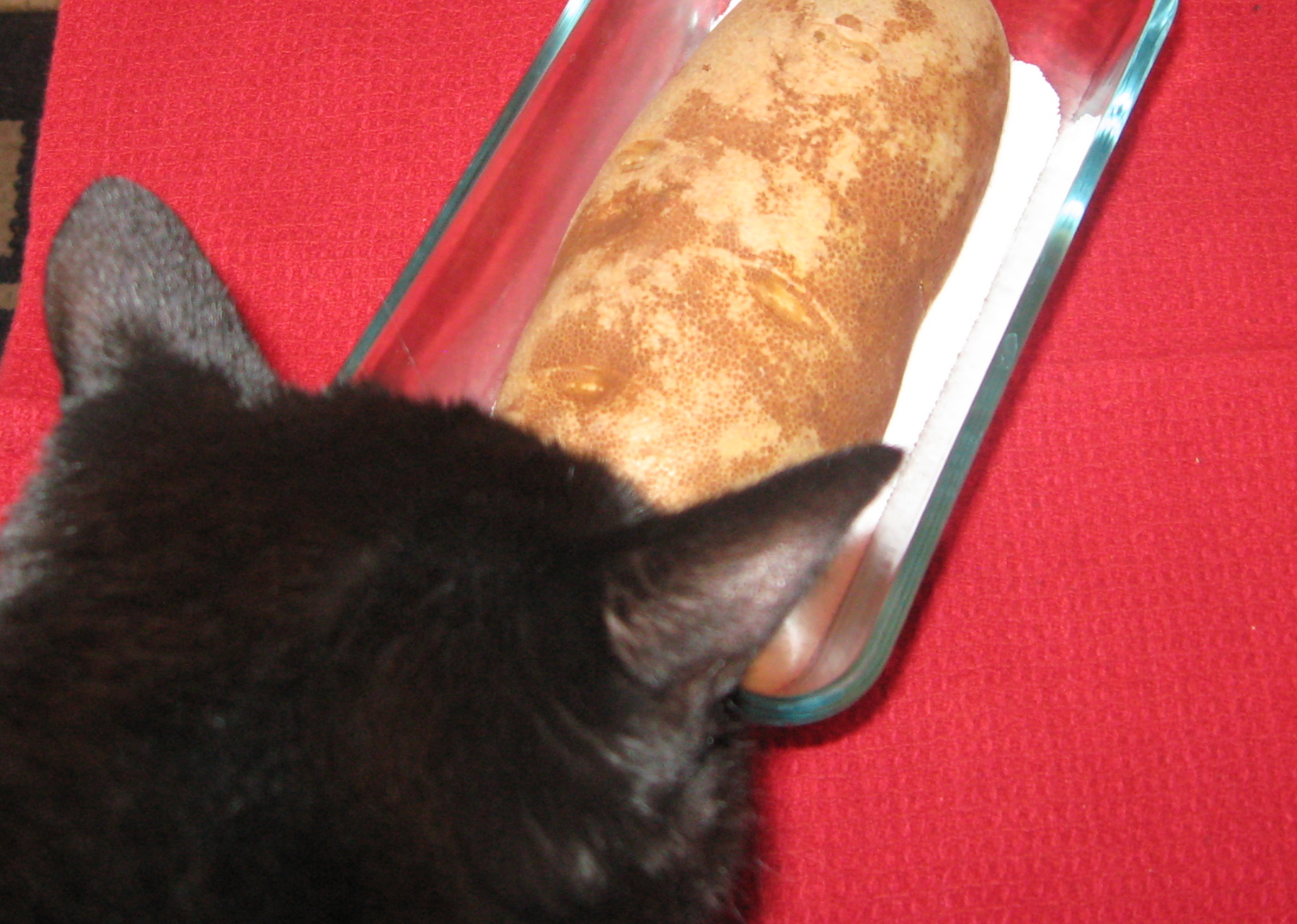
black cat looking at potato

Is it mine?

boiled) and gherkins (pickles made from specially grown small cucumbers). While what I’m having here is not traditional raclette, it is a real treat.  (All cooking and recipes are tested and approved (or not) by Keiko, the cat.)

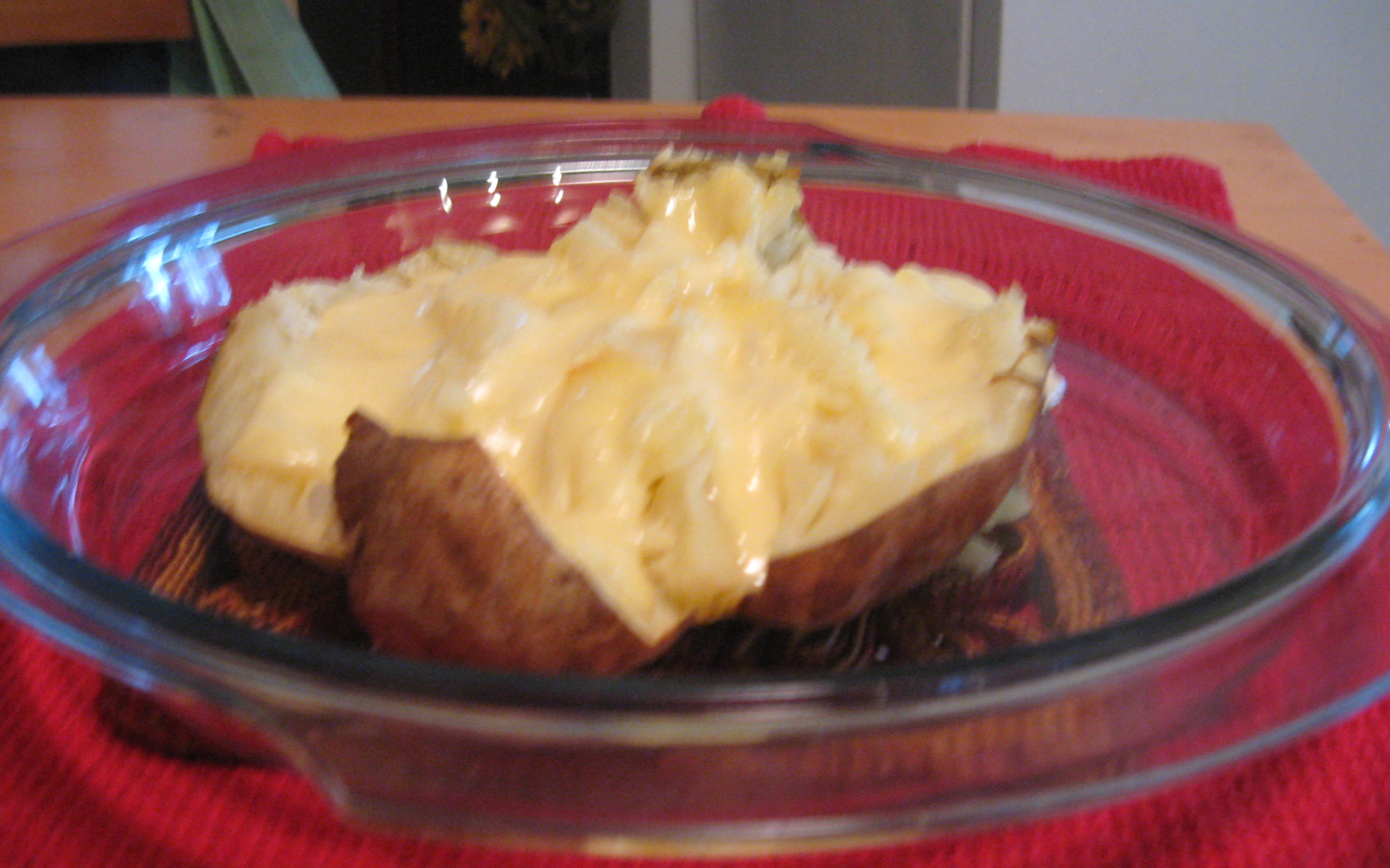
I made a salt-baked potato and finished it as directed in the recipe, and after opening it, laid slices of raclette over the top, and put it back into the oven to let the cheese melt (not under the broiler).

baked potato topped with raclette cheese

Comfort food for supper

The  main course was just that big baked potato and cheese, with a glass of champagne (no cornichons though)!  I had really intended to have a first course of roasted baby carrots and baby zucchini with vinaigrette dressing….but that was not just BIG potato–it was a HUGE potato, so it was my evening to have just that–I had fruits and veggies for breakfast and lunch anyway.)

 −«◊»–

Another ham & bean soup….

In this kind of weather (drizzly, gray, windy, leaves almost gone) you can never have too many soup recipes.  Not long ago I posted about ham and bean soup.  While perusing one of my favorite blogs (The Kitchen), I found another ham and bean soup recipe that looks great:  Ham Bone, Greens, and Bean Soup.  Though I haven’t made this one yet, I do frequently add greens to my winter bean soups.  It’s a great way to have a hearty meal out of one bowl.  All you need add is some freshly baked bread!

Baba ghanoush

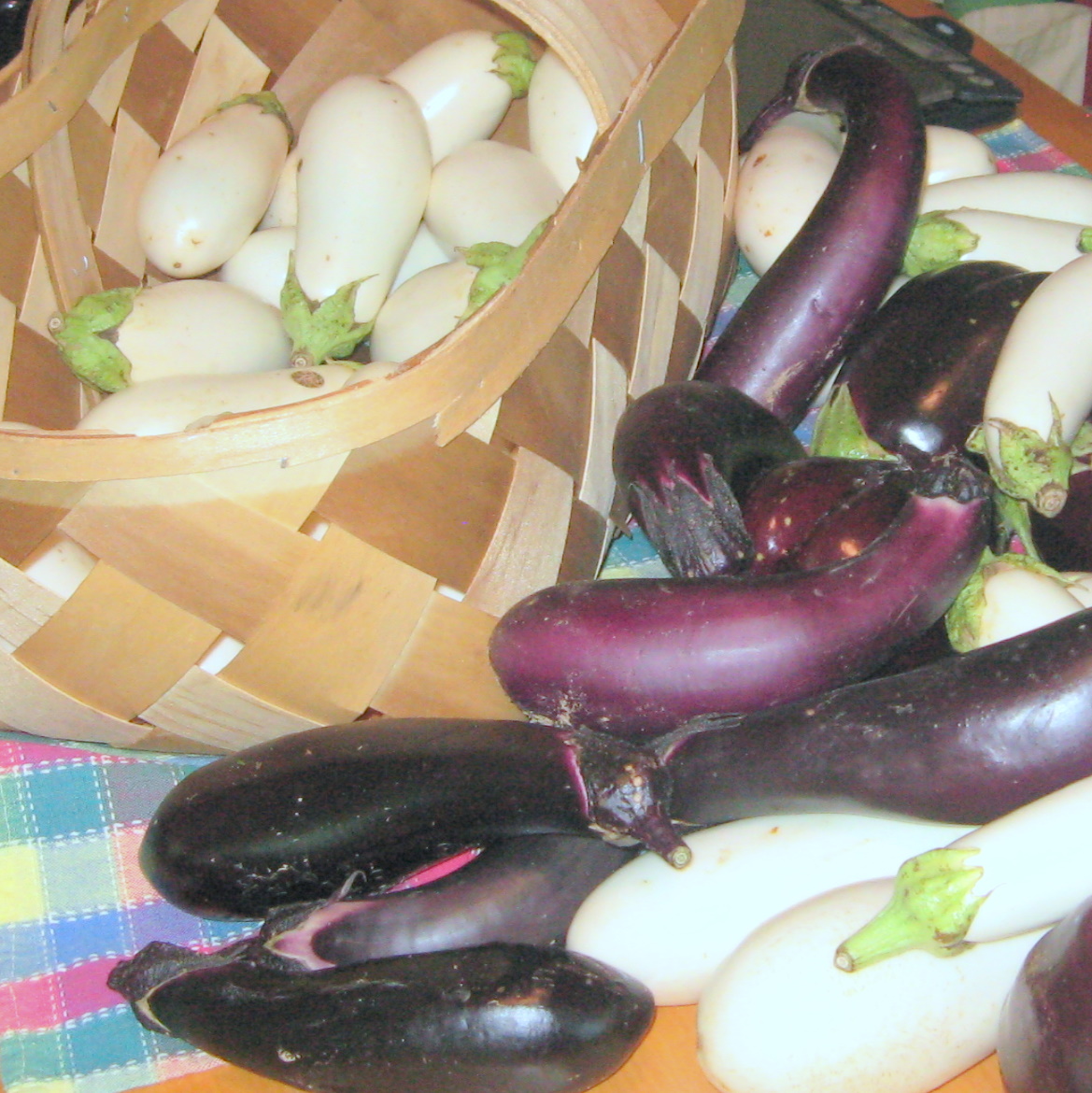
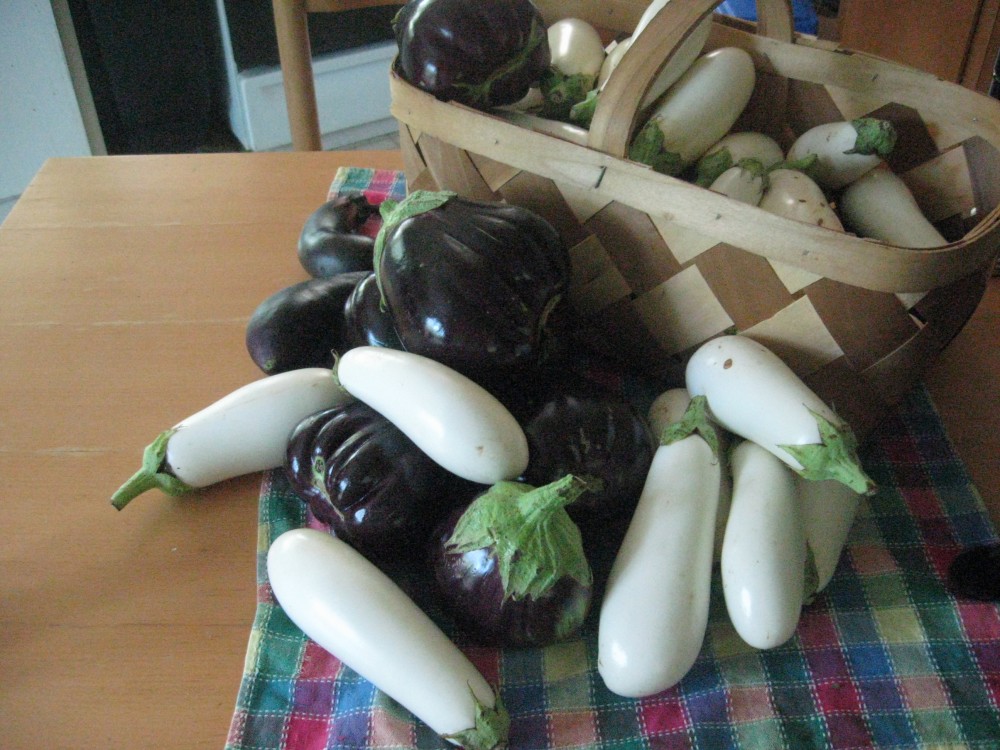
Market was a bit slow this past Saturday with the unrelenting rain most of the morning.  I had  lots of lovelyWhite and purple eggplants white and purple eggplants left so I’m going to make baba ghanoush.  No matter how you spell it, this creamy garlic- and lemon-spiked dip (frequently served as part of a mezze platter in Middle Eastern countries) is a delightful and simple dish to prepare when eggplants are abundant.

I started with my bookshelf on Eat Your Books to survey recipes…most were very similar.  The biggest differences were in the preparation of the eggplant.   Since I have a penchant for those that explain the whys of the recipe, I elected to use one from Perfect Vegetables (from the editors of Cook’s Illustrated magazine.  That recipe noted that  the eggplants must be more than just soft–they needed to be cooked until the insides were “sloshy”.  This can be done on the grill (preferable) or in the oven (acceptable alternative).  Broiling seemed not to be an option as the outsides would be charred too much and the insides not sloshy.

See “Eggplant….” for how to select appropriately mature eggplants of good quality.

This recipe is adapted from Perfect Vegetables, page 105 (Master Recipe for Baba Ghanoush).  I used white eggplant to make this batch of baba ghanoush–they are proported to be sweeter than purple ones.

Ingredients (makes about 2 cups)

  • 2 pounds eggplant
  • 1-2 tablespoons lemon juice  or to taste
  • 1 small clove garlic (minced or pressed)
  • 2 tablespoons tahini paste
  • 1 tablespoon extra-virgin olive oil
  •  1/4 teaspoon salt and  1/4 teaspoon fresh-ground black pepper or to taste
  • 2 teaspoons chopped fresh parsley leaves

Preparation

Prick the eggplants evenly over the surface with the tip of a paring knife (to prevent exploding in the oven) and place on a foil-lined baking sheet.  It’s best not to have them touching each other in order to roast most evenly. (I did spread these out more before they actually went into the oven to roast.)

Eggplant ready to go into the oven to roast

white eggplant ready to roast

Roast on the middle rack of the oven preheated to 500 ° F, turning every15minutes.  (Globe eggplants, about 60 minutes; Italian eggplants, 50 minutes; oriental/Japanese eggplants 40 minutes). Let cool until you can handle them.

Roasted white eggplant just out of the oven

roasted white eggplant just out of the oven

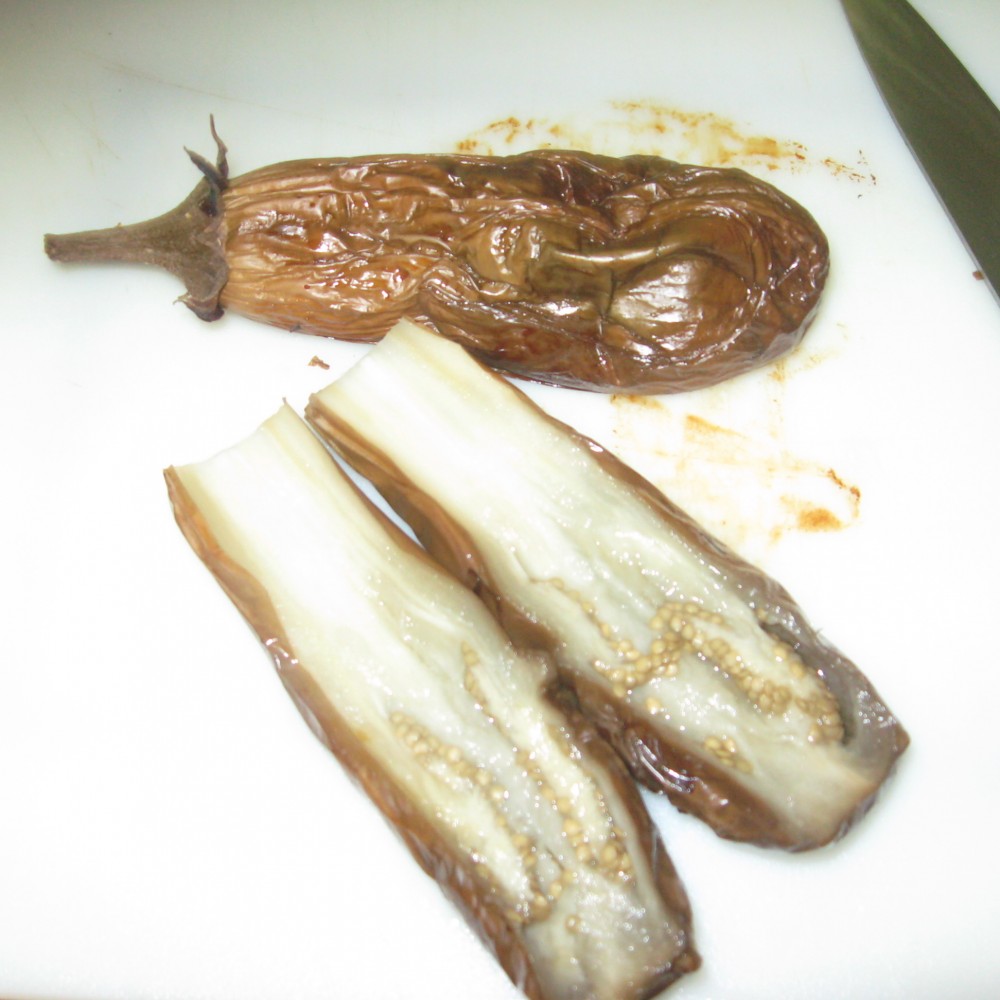
The eggplants should be more than just soft–they should be squishy (or sloshy as described in the recipe) after the roasting.

a very soft roasted eggplant and one cut in half

squishy eggplant

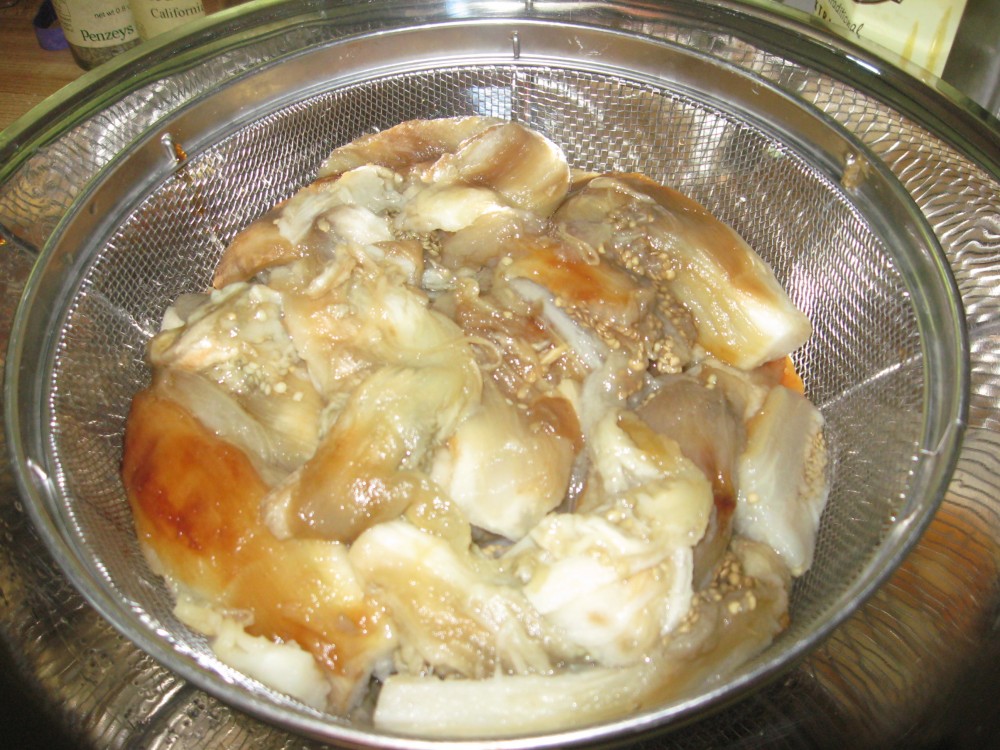
Over a colander set in a bowl, trim off  top and bottom of eggplant and slice lengthwise in half.  Using a spoon, scoop out the hot pulp into the colander.  You should have about 2 cups packed pulp.  Let the pulp drain for 10 to 15  minutes

draining eggplant flesh in colander

eggplant flesh draining in colander

Transfer the pulp to food processor bowl.  Add lemon juice, garlic, tahini, oil, 1/4 teaspoon salt, 1/4 teaspoon pepper. Process using 1-second pulses (about 8 to 10) until the pulp has a coarse, chopped texture.  Adjust seasoning as needed.

Transfer to serving dish or storage container, covering the surface with plastic film and chill lightly (about 45 to 60 minutes) before serving.

To serve

Baba ghanoush is typically served as part of a mezze platter (or like Italian antipasto) with pita bread, but crudities (peppers, cucumbers, small tomatoes, celery, et cetera) can be used as well to dip as well.

If the baba ghanoush has been thoroughly chilled, the flavor will be best if it is allowed to warm slightly before serving.

Sprinkle with chopped/minced parsley. Make a depression in the center and add a bit of extra-virgin olive oil.

Enjoy!

baba ghaoush with Sicilian olive oil and parsley

garnished with Sicilian extra-virgin olive oil and parsley

Cook’s notes

I did find that the white eggplant have more body and take longer to roast than comparable size purple ones.  The flesh is, indeed, sweeter than purple ones, so I added just a bit of extra lemon juice to the baba ghanoush than the recipe called for.  I think that I prefer the white eggplants for slicing or using whole as they do seem sturdier and to have a bit more “tooth” to them.

I  prefer a bit more garlic and lemon than this recipe calls for, as well as a pinch of cayenne pepper–not enough to be hot–just as a flavor enhancer.  If you like really lemony flavor, use a microplane grater or zester  to get some very fine zest and add just a bit to give it a real lemon kick.

Caponata!

The first time I tasted “caponata” it was mostly eggplant, and it was absolutely buried in tomato sauce.  I liked the concept, but it had kind of languished until I was looking around the kitchen at the tomatoes and eggplants that I had there.  This has been such hot, humid, torrid weather that I’m turning into a very picky eater…must be flavorful, room temperature or cold.  Needless to say I’ve eaten a lot of melons and fruits…and raw tomatoes in caprese salad, but I really needed to do something with the tomatoes and eggplants.

I decided to go looking for a recipe for caponata that looked like something I want to eat with grilled or griddled king klip since that was on special in the market today.  I started by going to EatYourBooks.com to search for caponata recipes among the books that I own (that I’ve put on my bookshelf there).  I found that I had 6 recipes for caponata.  I don’t know if it’s the weather, or what, but none looked like something I wanted to tackle this afternoon.  So I went searching online in the blogs that I like to check on.

On All Things Sicilian and more, I found a recipe that “felt” like something to do this afternoon, and it seemed loose enough that I could do it with what I had–oriental-type eggplants and little grape tomatoes.  It involves several steps, but it’s seemed approachable. A slight variation put a little garlic and some red pepper flakes into the mix as the olives that I had were marinated in those things.   Admittedly I did take a few liberties with the recipe but I think it worked well.  I did not improvise with the agro dolce–I kept those proportions.

My only real variation (other than the tomatoes) was that I treated the eggplant as described in my post on how to cook eggplant (as suggested by Cook’s Illustrated: salted very lightly, microwaved it, pressed it) and I was able to sauté all the eggplant in about a tablespoon of olive oil.

Here is the recipe from All Things Sicilian blog–the best I’ve ever tasted.  (You should go to this blog and read for more information about caponata.)

Ingredients

  • extra virgin olive oil, 1½ cups (more or less – depending how much the vegetables will absorb)
  • eggplants, 1-2  large, dark skinned variety,
  • peppers, 3, preferably 1 green, 1 red, 1 yellow (variation of colour is mainly for appearance, but the red and yellow ones taste sweeter)
  • onion, 1, large, sliced thinly
  • red tomatoes, 2 medium size, peeled and chopped, or 2 tablespoons of tomato paste and a little water
  • capers, ½ cup, salted or in brine
  • green olives, ¾ cup, stoned, chopped
  • celery, 2-3 tender stalks and the pale green leaves (both from the centre of the celery)
  • white, wine vinegar, ½ cup
  • sugar, 2 tablespoons
  • salt and freshly ground pepper 

Preparation

For caponata vegetables

  1. Cut the eggplant into cubes (approx 30mm) – do not peel. Place the cubes into abundant water with about 1 tablespoon of salt. Leave for about 30 minutes – this will keep the flesh white and the eggplant is said to absorb less oil if soaked previously.
  2. Prepare the capers – if they are the salted variety, ensure they have been rinsed thoroughly and then soaked for about 30 minutes before use, and then rinsed again.
  3. Cut the peppers into slices (approx 20mm) or into rectangular shapes.
  4. Slice the onion.
  5. Slice the celery sticks and the green leaves finely.
  6. Peel, and coarsely chop the tomatoes (or use tomato paste).
  7. Drain the eggplants and squeeze them to remove as much water as possible – I use a clean tea towel.
  8. Heat a large frypan over medium heat with ¾ cup of the extra virgin olive oil.
  9. Add eggplant cubes and sauté until soft and golden (about 10-12 minutes). Place the drained eggplants into a large bowl and set aside (all of the vegetables will be added to this same bowl). If you want to, drain the oil from the eggplants back into the same frypan and re-use this oil to fry the next ingredients – the peppers.
  10. Add new oil (to the left-over eggplant oil) plus a little salt and sauté the peppers,until wilted and beginning to turn brown (about 10-12 minutes). Remove the peppers from the pan and drain the oil from the peppers back into the same frypan. Place the peppers in the bowl with the eggplants.
  11. Add a little more oil to the pan and sauté the celery gently for 5-7 minutes, so that it retains some of its crispness (in more traditional recipes, the celery is always boiled until soft before being sautéed). Sprinkle the celery with a little salt while it is cooking.
  12. Remove the celery from the pan and add it to the eggplants and peppers.
  13. Sauté the onion having added a little more oil to the frypan. Add a little salt and cook until translucent.
  14. Empty the contents of the frypan into the bowl with the other cooked vegetables.

For the agro dolce sauce

  1. Add the sugar to the frypan (already coated with the caramelised flavours from the vegetables).
  2. Heat it very gently until it begins to melt and bubble. Add the vinegar and evaporate.
  3. Incorporate the cooked vegetables into the frypan with the agro dolce sauce.
  4. Add ground pepper, check for salt and add more if necessary. Gently toss all of the ingredients over low heat for 2-3 minutes to blend the flavours.
  5. Remove the caponata from the pan and cool before placing it into one or more containers.

Ò¿Ó
It should hold well in the refrigerator–and I know it will be even better tomorrow when the flavors have melded  more.  I’m looking forward to this with some griddled king klip tomorrow.

Eggplant….

Eggplant is a lovely vegetable from the blooms to the fruit.  What’s not to love about this glossy purple vegetable, especially from an artistic point of view?  Beautiful color, highlights and shadows….

From a cook’s standpoint, at the farmers’ market I hear lots of “What do I do with eggplant?” questions. This seems to be another vegetable that needs to be looked up in a vegetable cookbook to get some basic information.   I’d recommend checking out The Victory Garden Cookbook at the library if you don’t want to own it.  The author is Marian Morash.

I’m going to try to condense some information from various sources here to give you a bit better idea about what eggplant is and what you can do with eggplant.

For any of you who might want to think about growing your own next summer, keep in mind that it’s a hot-weather plant.  The nighttime temperatures need to be about 55 ° F before you put the plants out in the garden; otherwise they just kind of sit there and never do anything–even after the temperatures warm up.  So don’t rush it–wait until it’s warm enough.  Then you’ll have a plant that is very productive (if you keep harvesting the fruits).  Come peak season, you’ll find eggplant a bit like zucchini…you will have an abundant (maybe even excessive) supply of this lovely stuff. Maybe you neighbors would like some…especially if you can tell them some things to do with it when you give it to them.

It’s a widely used vegetable in Middle East and Mediterranean cultures.  It seems to be less familiar to the average American cook shopping at the farmers’ market.  So here is some basic information on yields (from The Victory Garden Cookbook, page 102-103):

  • one pound of cubed, peeled eggplant is about 4 cups.
  • for 1 cup of cooked, cubed eggplant you’ll need about 6 cups of raw, cubed eggplant.
  • for 2 cups of puréed eggplant, you’ll need about 6 cups of raw, cubed eggplant
  • for 4 servings, you’ll need about 1-1/2 pounds of eggplant.

Now for choosing your eggplant:  If you’re harvesting your own, size is not a good indicator of maturity–big is not necessarily better.  Older eggplants can become bitter, with many seeds, and skins will be tough.   First, look for glossy skin.  Then lightly press on the fruit.  If it’s hard, the eggplant is not ready.  If the flesh presses down, and bounces back–it’s ready.  Flesh of a too-old eggplant will press down very easily and will keep the depression from your pressure.   Eggplants that you buy should have the “cap” and part of the stem on them.

Eggplants are easily bruised so handle with care–when checking for maturity be gentle.

Eggplants also are not “fond” of refrigeration; best storage temperature is about 50 ° F.  Stored colder than that, the eggplant will rapidly develop soft brown spots (rotting) and will become bitter.   Plan to cook your eggplant as soon as possible after purchase or harvest and store in a plastic bag with a damp paper towel, at room temperature.

One of the down sides of cooking eggplant is that it’s a bit like a sponge–it can absorb large quantities of oil–which most of us don’t want in our diet because of the calories (at least).  A properly harvested eggplant does not need salting in order to remove bitterness.  Salting and draining, however, removes moisture from the eggplant.

Traditional salting uses about 1-1/2 to 2 teaspoons salt per pound of eggplant.  Let stand for 30 to 60 minutes.  Then press between paper towels to get more moisture out and compress the eggplant so that it’s not so porous or “spongy”.

You can also get help from the microwave:  add the salt 1/2 teaspoon per pound, place on paper towels sprayed with nonstick spray, and cook on high power for about 10 minutes until it feels dry and is slightly shriveled.  Press to compress the eggplant so that it’s dense, and doesn’t absorb oil.  Proceed with sautéing, and it will not absorb  nearly so much oil; you should be able to sauté a pound of eggplant with about 1 tablespoon of oil.  (I love this method–I have been able to sauté a pound of eggplant in less than a tablespoon of oil.)  See post on Caponata!  This will work with sliced eggplant as well as cubed.  I’d recommend doing this instead of the traditional salting, but the pressure compressing the eggplant is important.

There are other things to do with eggplant than make eggplant parmesan but that seems to be a dish that everyone has heard of.  Even if you’re going to make eggplant parmesan, I recommend using one of the procedures for removing moisture and compressing this vegetable.

If you’re going to broil or grill (a favorite of mine) you won’t need to do the salting or compressing–just brush the slices, of halves of the oriental-type eggplant with olive oil, sprinkle on some salt and pepper and grill/griddle/broil until tender.

There’s a wonderful Middle Eastern dip to make using eggplant too: baba ghanoush (many alternative spellings which I’m not going to include here).   This usually starts with a whole globe eggplant baked or grilled whole before being mashed with extra-virgin olive oil and seasonings.

Another popular eggplant dish which you may encounter in restaurants is Iman Bayidi–eggplant sautéed  and braised with onions, garlic, and tomatoes.  Ratatouille is a popular Provençal dish which uses eggplants.

Baking or sautéing is often a preliminary step in eggplant dishes, but you can serve it just like that with a squeeze of lemon juice, or one of many toppings.

When you’re searching for eggplant recipes, try looking at Mediterranean (Italian, Greek, southern France), Chinese, Japanese, Middle Eastern  cuisines as this vegetable is frequently used in these.    Just some thoughts on where to go to find things to do with eggplant now that you know how to buy it and some of the basic techniques for cooking it.

Vegetable cookbooks….

At the Wake Forest Farmers’ Market today, purple-hull peas made an appearance. There were lots of questions about them.  What are they? They certainly don’t look like what most folks are used to as “peas”.  How do you cook them?  Do you eat the pods? What do they taste like?

One of the joys…or perhaps frustrations, for some…of a trip to the farmers’ market is that you find “new” vegetables–uncommon ones, or simply regional ones–like purple-hull peas which are not necessarily included in a vegetarian cookbook.  So you need general, basic information–not fancy recipes; just the basics for starters.  Where to go?

There are lots of vegetarian cookbooks out there–some very sophisticated with wonderful recipes that make vegetables into worthy main courses or entrées; however, that’s not what you need to begin cooking a vegetable that is completely new to you.  For that what you want is the nitty-gritty information of how to prepare it–do you shell it, peel it–or how best to cook it.  The more sophisticated vegetarian books may just call for the ingredient and not give you the those basics or even just some simple recipes.

One of my favorite vegetable (note that I didn’t say vegetarian) cookbooks (and gardening information too) is The Cover of The Victory Garden CookbookVictory Garden Cookbook by Marian Morash.  It’s organized by veggies in alphabetical order so you can go directly to beets, kohlrabi, cauliflower or whatever, and find information on growing, preparing, buying the vegetable.  There’s a highlighted section of special information that includes yields (how much usable vegetable do you have after preparation/trimming or peeling), how to store and preserve, microwave instructions, and even suggestions for things to do with what is left from your first use (especially useful if you’re doing single-serving cooking).  Now that’s a vegetable cookbook!  The recipes given go from the most basic to more advanced. Terms (e.g. string and snap beans) are explained.  It’s a great place to start with a new vegetable.

The one I have in my library was published in 1982– I guess it’s time for me to go to the Regulator Bookshop and browse through the cookbooks again to see if there’s a new edition and if it has significant additions.  As for pink-eyed purple-hull peas…well, unfortunately, the closest this book came was black-eyed peas. True, they’re a Southern thing…and that’s another post coming up.

King klip

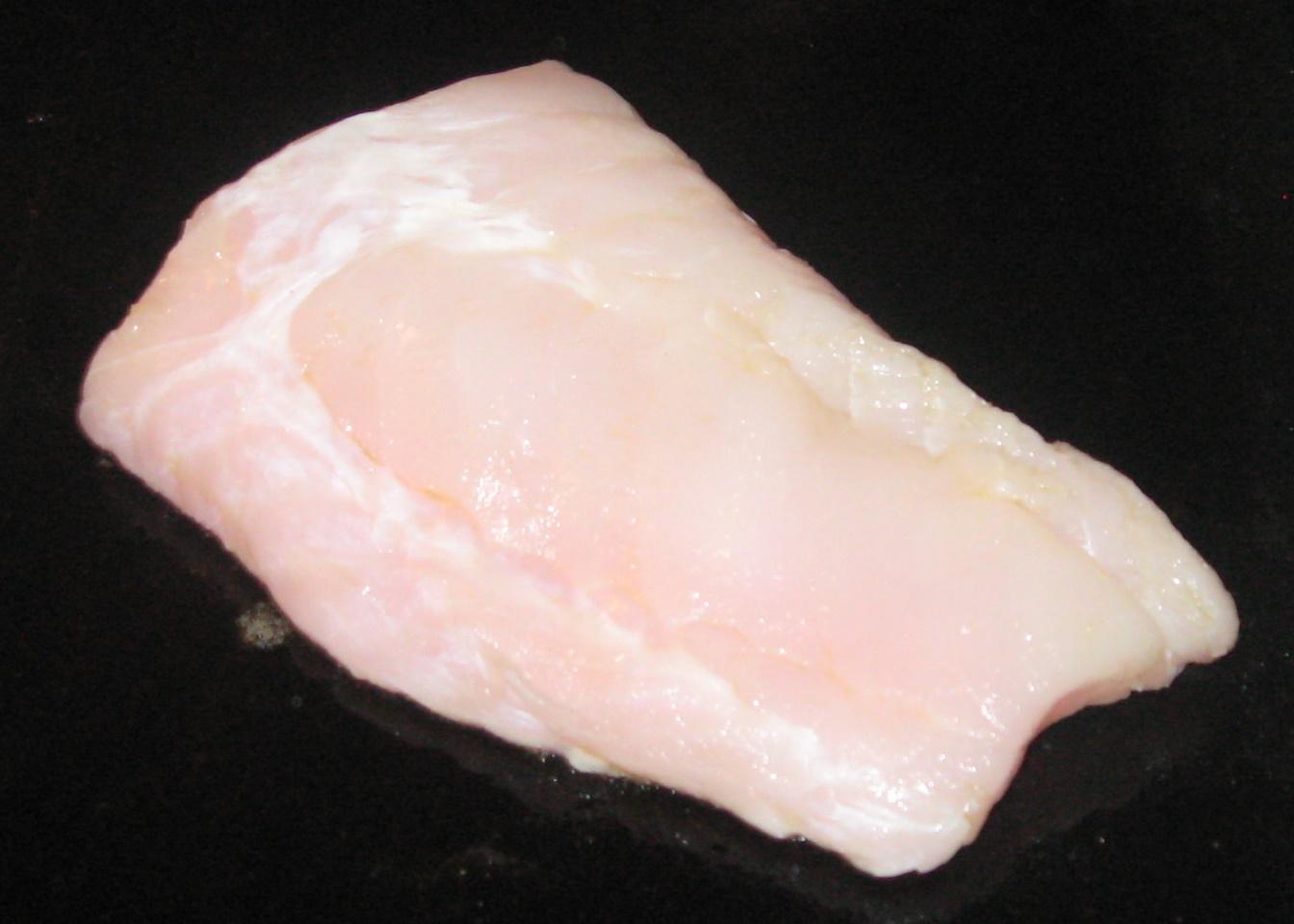
I went to Harris Teeter (affectionately known as the Teeter or HT) this morning looking for something to cook for  dinner (or supper if you prefer).  I was scoping out the fish contemplating salmon, tuna, or one of the standbys when  saw something that I was not familiar with, but look great.  The sign said it was  King klip.  My cooking curiosity being what it is, I had to bring some home with me, particularly as it  was inexpensive.

The fishmonger told me it was sort of like grouper and would do well grilled.  The heat being what it was this afternoon (my thermometer in the shade said 97 ° F ), I thought that grilling was out of the question so I opted for the cast-iron griddle –my standby.

I portioned my fish (I was a little overzealous when I said how much to cut so I have King klip filet portionedanother portion to try cooking a different way tomorrow), patted it dry, and rubbed itwith a tiny bit of olive oil.   Then I started wondering what I was going to have with this lovely fish…looking around the kitchen I saw the kaboka squash that I’d brought home from the Compare market the other day and decided that was going to be part of dinner tonight.  (I now have to figure out what to do with the rest of this thing as well, since I used only about a quarter of it.)  I attacked it with my chef’s knife, halved it, seeded half, and then took off several slices to use this evening.

I decided that I needed some green stuff with this as well, so I make a trip to a neighbor’s garden(yes, she had previously offered)  for some of  the last of the snow peas–it’s really the last–the heat has gotten to them for sure.

I decided that I’d steam sauté the squash, extravagantly with a bit of butter since the rest of the meal would be “lean”.  I used a paring knife to remove the skin and cut it into chunks so it would cook fairly quickly.

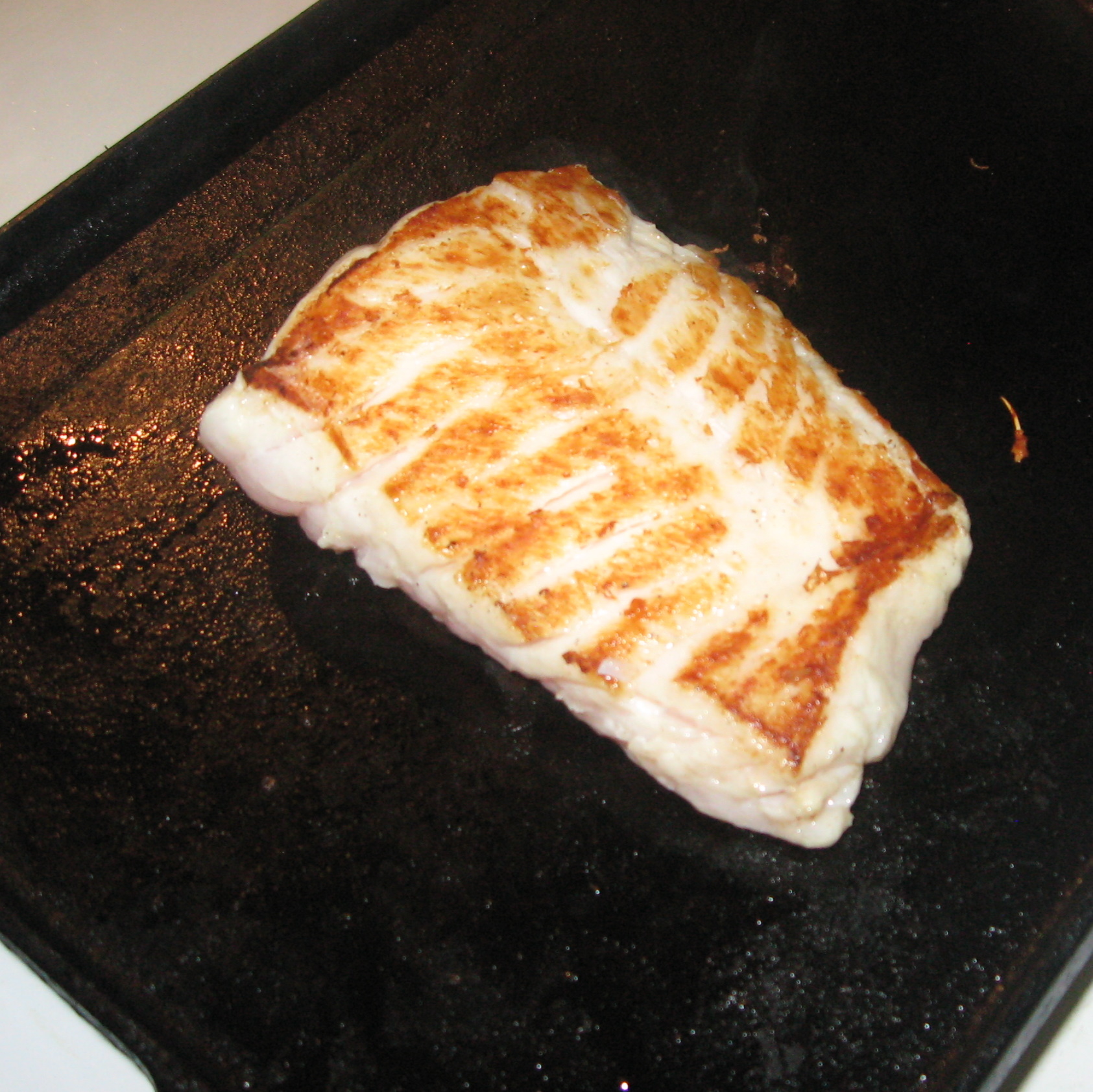
I topped and tailed my snow peas and since they were feeling the heat I put them into some cold water until I was ready to cook them.  I started the  squash in my small sauté pan with a bit of butter and about a tablespoon of water, covered tightly.  It was time to heat up the griddle.  Once it was hot, I rubbed just a light coat of oil onto the surface and put my filet on to start cooking.

Meanwhile, a quick check on the squash–not quite ready to let the water evaporate yet, but close.  Back to the fish–not quite ready to turn yet–still resisted my sliding the spatula under the edge, so it needed a bit more browning to “release” by itself.   It was smelling really good by now.  About the time it was ready to turn, the squash should be read to be uncovered to finish cooking while the water evaporated, and then to start sautéing to finish.

   The fish released and turned easily on the griddle.  I removed the lid from the squash and let the water evaporate from the pan; turned the heat down to hold while the fish was finishing.  I could see the opaque line moving toward the middle.

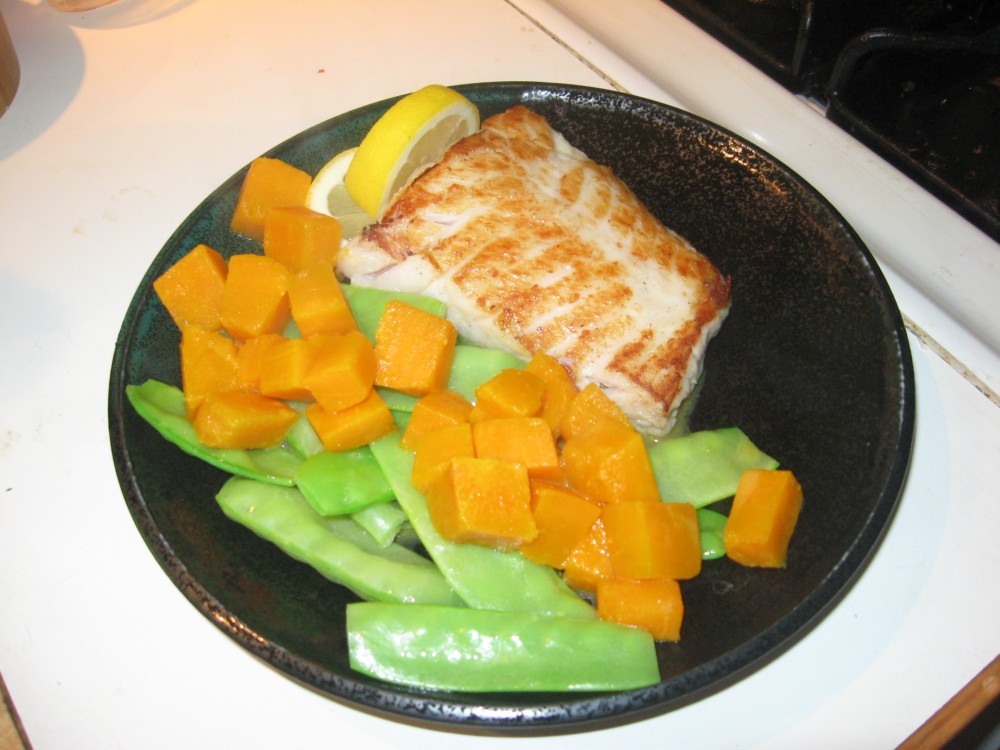
I put the snow peas into the pan on top of the squash and put the lid back on so that they would get just a bit of steaming .  By the time this thick filet was opaque to the center, the squash and peas were ready to eat as well.

I warmed my plate under hot water and dried it, and put my dinner on it!  Simple, and really pretty healthy–I did put just a small pat of butter on top of the fish to finish it off with the lemon.  That was about 30 to 40 minutes start to finish.  Since this was my first time with this fish, I wanted to cook it as simply as possible to get to know its basic taste.  It was a very mild fish, but it held together well during the grilling.  It’s going in my “standby” category with tilapia for a good all-purpose white fish.  (It’s line-caught, by the way; I was pleased to see that HT signs indicated how all of the fish in the case had been caught)!   It was a simple, but good, quick, healthy meal!

I think that I’ll try baking the other half of that filet in foil with some veggies.  As for the rest of that kaboka, I have a neighbor  who I’m sure will be able to make use of at least part of the other half.  (If you’re doing single-serving cooking, it’s always good to find out what your neighbors like to eat–so you can share when you get really big things like winter squash or watermelons.)  I’ll share, and still have a bit more of the squash for me.  The second portion of fish will probably be a hobo pack with some fresh tomatoes and herbs–maybe tarragon. The rest of the kaboka squash is likely going to get a “classic” treatment:  baked with some butter and brown sugar.

One of the good principles of single-serving cooking is to share the big stuff.  Most of my single (or cooking for two) neighbors always seem really please to be able to get a portion of something like the kaboka–especially if you give cooking instructions if it’s unfamiliar to them.)