The honey bee calendar: seasonal honey.

The bees’ calendar and the beekeeper’s calendar are not the same as the one in Outlook or Google that displays all the holidays for you and the “year” by which we proceed through our daily routines. They are more responsive to temperatures, and hours of daylight–what’s really going on in nature.  They are awaiting the spring nectar flow to increase the population of the hive and to store honey.  Or the fall nectar flow to store food for the winter months.

In summer when we are enjoying a surfeit of fruits and vegetables (because of the bees’ pollen and nectar gathering in the spring) we have to realize that about that time there is a declining flow of nectar–fewer things are blooming. Life can be hard for bees in July. A nectar dearth means less food for them, so depending on forage region, we may be feeding bees while enjoying plenty of fruits and vegetables.  The bees will be waiting for the fall nectar flow–in my forage region (Appalachian-Ozark Upland) that’s primarily asters and goldenrod.

This seasonal variation is one of the delights of honey and beekeeping. The photograph at the top of the page shows the difference between spring/summer honey (left) and autumn honey (right). It’s seasonal flavor when honey is not blended. In this forage region, as an urban beekeeper, I have “wildflower” honey since my bees don’t have access to a large monofloral flow. I can’t produce varietal honey such as sourwood or alfalfa honey, or even clover honey, but I do have seasonal honey.

Ò¿Ó

Hive report: an interim update

brood box of hiveThe bees have been getting attention–I’ve just not had time to tend bees and to write given work and travel.

I thoroughly enjoyed my almost-a-week stay in Portland ME.  I wish I could have brought the weather back with me, or figured out a way to get the bees and Frankie (the cat) to Maine. Since neither was feasible, I’m back home, tending the bees.

On 11 June 2017, I installed a nuc (small colony with laying queen) in my second hive. These are truly local honey bees–from an established beekeeper right here in town. It looks as if they have taken well to their new home. The “package” bees that I installed in the other hive on 14 April 2017 (from Georgia) seem to be doing well, too.

On 24 June 2017, I add a “super” to each hive–expecting it to be brood and honey. With a very quick look under the inner cover while I was putting my bucket feeders on this morning, I saw that there were bees working on all the frames on the super. This means that I need to plan a serious look into the hive when the weather is suitable in the next week to see if I need to add another super.

Ò¿Ó

Chrome browser issues…

I’ve discovered that there is a display issue with Google Chrome. I’m working on resolving this, but if you load the site and it appears blank except for the sidebar, please just scroll down until you get to the content. That is not happening in Edge or Firefox. Sorry for the inconvenience.

What “raw” honey means…

…or doesn’t mean.

In many places, the spring nectar flow is over and some beekeepers may be harvesting honey. When you look at the label you may see “raw” honey. Here is a good discussion of that may mean from HoneybeeSuite. 

It’s a lot like the word “natural” used on labels. Your best bet is to ask the beekeeper who is selling the honey. They will be glad to explain the harvesting and extraction process to you so you know exactly what you’re getting.

Water source for the honey bees

Every since I started the first colony I’ve been trying hard to see that the bees have a constant supply of water when needed. I’ve put water at numerous locations around the hives but never seen any bees using any of them. I know that with the heat here they must be getting water somewhere–and I’d much prefer that it NOT be someplace where it inconveniences neighbors who might just view them as stinging insects.

Yesterday as I was going through the procedure of lighting my smoker (on my deck) to do my inspection of the hives I noticed bees coming and going right on the deck. There was rainwater standing on the lid of a five-gallon bucket and the bees were getting water from that. It was water that certainly didn’t look potable to me–leaves, and other funky stuff, but there were  lots of them drinking.

I’d read about providing water sources for my bees in a number of places but, apparently, I missed the post from Honey Bee Suite on bees and dirty water. All the water sources that I’ve put out have had gravel or marbles for lots of edges for bees to land on so that they don’t get into deep water and drown–nothing much more depressing to me (well, maybe the RNC) than seeing drowned bees. In spite of my efforts, I’ve not seen bees coming to any of those locations.

I did notice some aggression going on several times while the bees were drinking even though this was a fair distance from the hive. I did note that my ladies of the hive were a bit testier than usual when I did my hive inspection on 19 July 2016, but I was surprised to see it here at the watering hole.

From reading through other posts on Honey Bee Suite, it seems that “dirty” might not be the operative thing here since there are reports of bees frequenting clean water sources but mention was made of bees liking salt pools. Since they were coming to that location I’ve put an additional watering place there as well and added just a bit of salt to see if that pleases them.

I’m not sure what the ladies are telling me–they don’t like city water,  they like rainwater better than city water, or that they like this particular location or something else that I’ve not figured out yet. Although we’re apparently going to have slightly cooler weather (merely in the low 90s) for a few days I’ll be watching as the temperature climbs into the upper 90s to see if the ladies use this water source.


Green salad with tuna

It’s been a day when I feel like I’ve accomplished nothing–but I really ran a lot of errands and went computer shopping (yes, the “old” laptop that is my main indexing computer seems to have given up the ghost).  After a day like this, and when the temperature is getting to summer levels here, I wanted something easy, and light, for supper.  After perusing the refrigerator and the pantry, I settled on a leafy green salad with tuna.  (No, not tuna salad–salad with tuna.)

The contents of the fridge included some lettuce foraged from the garden of a friend who gardens seriously.  I had some green oakleaf and some red lettuce–a good start towards my veggies for this evening.

I’ll admit to a fondness for tuna–even the canned–so long as it’s good canned tuna, and packed in olive oil.  I simply don’t “do” water-packed tuna! Preferably the kind that isn’t cooked twice and all mashed and smushed into a paste. Of course, I’d rather have my own tuna confit, but I’m waiting for a manager’s special on the fresh tuna to replenish my supply of that for the summer.  Good canned tuna is a pantry staple for me–winter or summer–yes, I like tuna melts, and tuna noodle casserole, too.

I took my lovely fresh lettuce, added fresh herb leaves: French tarragon, epazote, spearmint (leave out chocolate mint), shiso, oregano, cutting celery, dill, and some parsley leaves.  (Just as good as the packaged stuff from the grocery that has the herbs in it), added some cherry tomatoes, a Persian cucumber, and the drained tuna (that was packed in olive oil). Add two walking onions (didn’t have green onions in the veggie bin in the fridge), and it’s a salad.

For a dressing I used lemon juice, freshly ground black pepper, a tad of salt, and some Sicilian olive oil to make a vinaigrette.  I used my favorite “gadget” to make the vinaigrette quickly–a Ball/Mason jelly jar, and some vigorous shaking does it–no need to clean even the the immersion blender.

One large, fresh green salad with tuna and fresh herbs–enjoyed sitting on the deck watching the hummingbirds, with a glass of white wine.

Hive report: 14 May 2017

Honey B HealthyFinally! A warm, sunny day when I can open up the hive and see what’s going on inside. The bees have been in their new home for a month now. The weather has, overall, been more like March than May lately so I’ve not been able to check inside the hive, and I’ve had to give them sugar syrup with Honey B Healthy  (that’s the bee version of a one-a-day vitamin) and feeding stimulant since they don’t forage in cloudy weather or chilly, rainy, or very windy weather.
These girls went into a completely new hive on 14 April 2017 so I was really anxious to see how they are settling in. There was no comb already drawn for them to start storing honey–lots of work for them to do before storing nectar and pollen.

Go girls!

On inspection today I found that they have drawn (built) comb on almost all the frames (only one with no comb on either side, and another comb only on one side) in the brood box–so they have built comb on 6-1/2 frames of the eight so it looks like they are off to a good start. The queen has been doing her queenly stuff–there was lots of brood in the hive.

Since the weather forecast is looking much more like May for the next ten days, I didn’t replace the feeder after the inspection since there should be nectar available now that the weather has improved and they girls can go out to forage instead of staying home and slurping up sugar syrup. (When there is nectar available the bees don’t take sugar syrup even with the Honey B Healthy in it). They like the real stuff when they can get it.

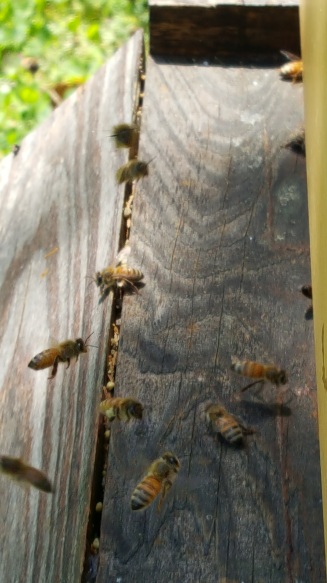
About two hours after I finished the inspection I noticed that there was a lot of activity outside the hive: bees flying around the hive, but not going very away. I suspect I was seeing “new” foragers or field bees coming out for a first flight and getting oriented to hive location

When I finished the inspection–laid eyes on the queen–I added a medium super to give the girls room to start stashing honey and pollen. It looked as if the bees thought they were getting a bit crowded as they were putting pollen into some of the brood areas and building lots of burr comb. Now they don’t have to do that. I’ve given them more room for storing nectar and pollen.

First honey super of the season on the hive!

Ò¿Ó

Recipe for a dreary day

There are pros and cons of working freelance; however, one of the good things about it is that you can declare a “mental health” day when needed (within reason). Since I’m having a hiatus (but expecting incoming work so I know that I can’t do it again for a while, I’ve declared today a “duvet day: a mental health day in advance.

It’s not actually raining–merely drizzling so the patter of rain on the roof is missing, but it’s a duvet day!

Duvet Day

Ingredients

Take one chilly, dreary, drizzly, or rainy day and add as needed

  • One duvet
  • One cat (or more) or dog (or more)
  • Several good books of various genres  (hardcopy or digital, or both)*
  • PocketJuice for uninterrupted reader or tablet use**
  • Music to taste

Add sporadically throughout the day as required:

  • Tea (Harney & Sons) and toast***
  • More tea or herbal tea
  • Grilled cheese sandwich with soup of choice–chicken or tomato perhaps…. (sorry, not Campbell’s)****
  • Additional warm beverage as needed
  • Popcorn  (with truffle salt)*****
  • More books, as needed
  • Good bread, cheese, fruit, and wine for supper
  • Hot chocolate  (with a dollop of Jabberwock or Krupnikas), repeat as needed

Preparation

Combine as needed in desired quantities. A son gôut!

0¿0

*J. J. Salkeld is good–Lake country, non-bloody mysteries.

** external battery pack if you’re going digital. Large, heavy (as these devices go, usually used only for travel) but supplies a day’s worth of reading and keeping up with Facebook on a tablet,

***Coffee not applicable; get-up-and-go beverage not useful; favorite tea or herbal infusion

**** Progresso Hearty Tomato is easily turned into cream of tomato with just a dollop of heavy cream as you heat, but don’t let it boil

*****from Bull City Olive Oil (yummy, especially if a little olive oil is used to pop the corn)

O¿O

Chilean sea bass (sous vide)

Supper this evening was Chilean sea bass (Patagonian toothfish. or Dissostichus eleginoides if you prefer). I’ve been skulking through cookbooks again–especially those that have sous vide recipes. (No, I haven’t bought anything special for sous vide cooking–yet, though I will confess to looking at immersion circulators and thinking a birthday present to self.)

In The Food Lab: Better Home Cooking Through Science by J. Kenji López-Alt I foud a lot of recipes for sous vide cooking–and a method of doing it without any special equipment (at least for foods requiring only a short cooking time). It’s done with a beer cooler.  I do have a beer cooler so this seems like a method to try, as an alternative to the multifunction pot that I used before because I was too lazy to try the beer cooler method.

First I decided to check out the beer cooler to see how well it held temperature. I put about 2-1/2 gallons of hot tap water into it (118ºF) and checked the temperature over several hours.  Two hours later, the water temperature was 113ºF, and at four hours, 110ºF. I decided that would certainly do for “short” cooking times. Seems most fish recipes call for cooking times under one hour.

The recommended temperature that I found for Chilean sea bass ranged from 122ºF to 140ºF so I decided to go with 130ºF. Since my sea bass was frozen (individually packaged filets from Costco), I thawed it in cold water, seasoned it lightly with salt and black pepper, a tiny splash of fennel fused olive oil (olives and fennel are crushed together), popped it into a zipper-lock freezer bag, and after squeezing out the air, plopped it into my beer cooler for 45 minutes. (Water temperature was 131ºF when I put the fish into the water and 129ºF one hour later.)

Results? Well, satisfactory. Obviously, the temperature in the cooler held well for the necessary time. The sea bass wasn’t quite as done as I’d prefer–though perfectly evenly cooked (even though this piece had one end that was definitely thinner than the rest). I think for my next–there’s more in the freezer–I’ll go with the 134ºF temperature or maybe just a tad higher.

I’ve also read lots of warnings about over-seasoning for sous vide cooking (and I came close to over-seasoning with the monkfish) this was bordering on under-seasoned. Next time, a bigger pinch of salt, and a bit more fennel oil, and a little lemon zest.

Ò¿Ó