Beet Chips

An interesting option for beets when there are more than you can use fresh.

emmycooks's avatarEmmy Cooks

Welcome to Emmy Cooks!  You can see some of my favorite recent recipes by clicking the “My Favorite Recipes” category on the sidebar (here are April, May, and June).  If you like what you see here, you can sign up on the sidebar to receive a daily recipe by email and to follow Emmy Cooks on Facebook or Twitter.

During my first pregnancy, I had an occasional craving for citrus.  Grapefruit, oranges, pomelos, lemons, limes, anything.  During my second pregnancy, nothing.  And during my third pregnancy, I had no cravings, but one aversion: beets.

Other vegetables were okay: I would happily have eaten butternut squash tacos with chipotle and feta or a pound-of-greens frittata.  Those risotto-stuffed chard leaves were popular in my kitchen that year, and a simple arugula salad was just my speed (the arugula comes up in the garden by itself on years…

View original post 314 more words

Red, white, and blue roasted potatoes

Happy Fourth of July to all!
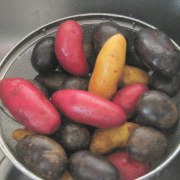
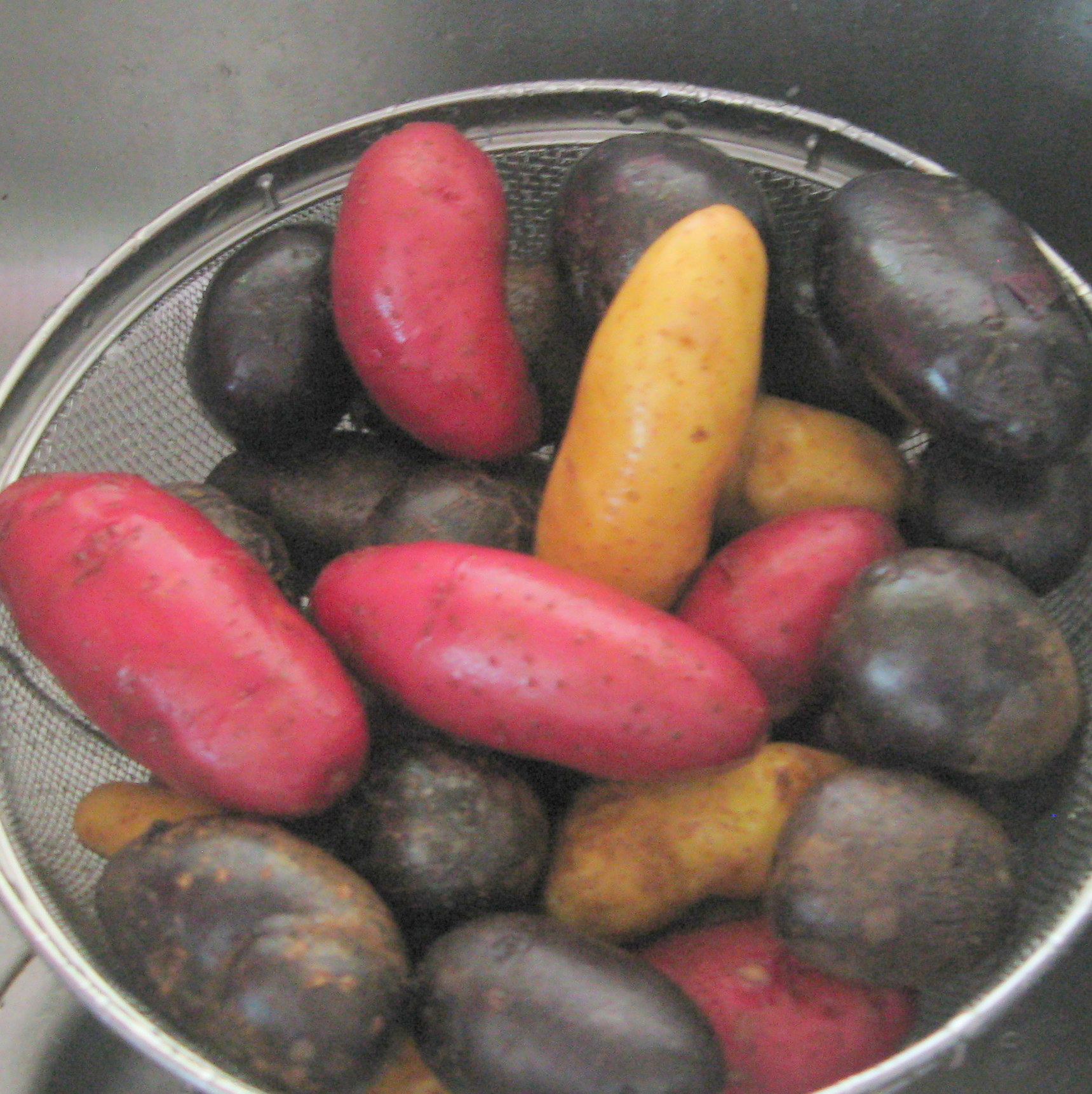
mixed color potatoes in colander

I really was planning to do something special today–more smoked lamb and goat shanks–but I admit to turning to a total wuss, wimping out…as I looked at the weather forecast for the week.  Even though those are easy, it still requires some minding of the grill, and I just could not face it.  I resolved to have a quiet, cool Fourth of July–just me and the cat–indoors with the air conditioning…and I woke up this morning wishing I’d not been such a wuss.

Saved by friends!  An impromptu invitation to join them for grilled chicken this evening.  So–I’m having my quiet Fourth, but with friends and neighbors.
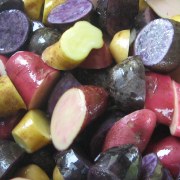
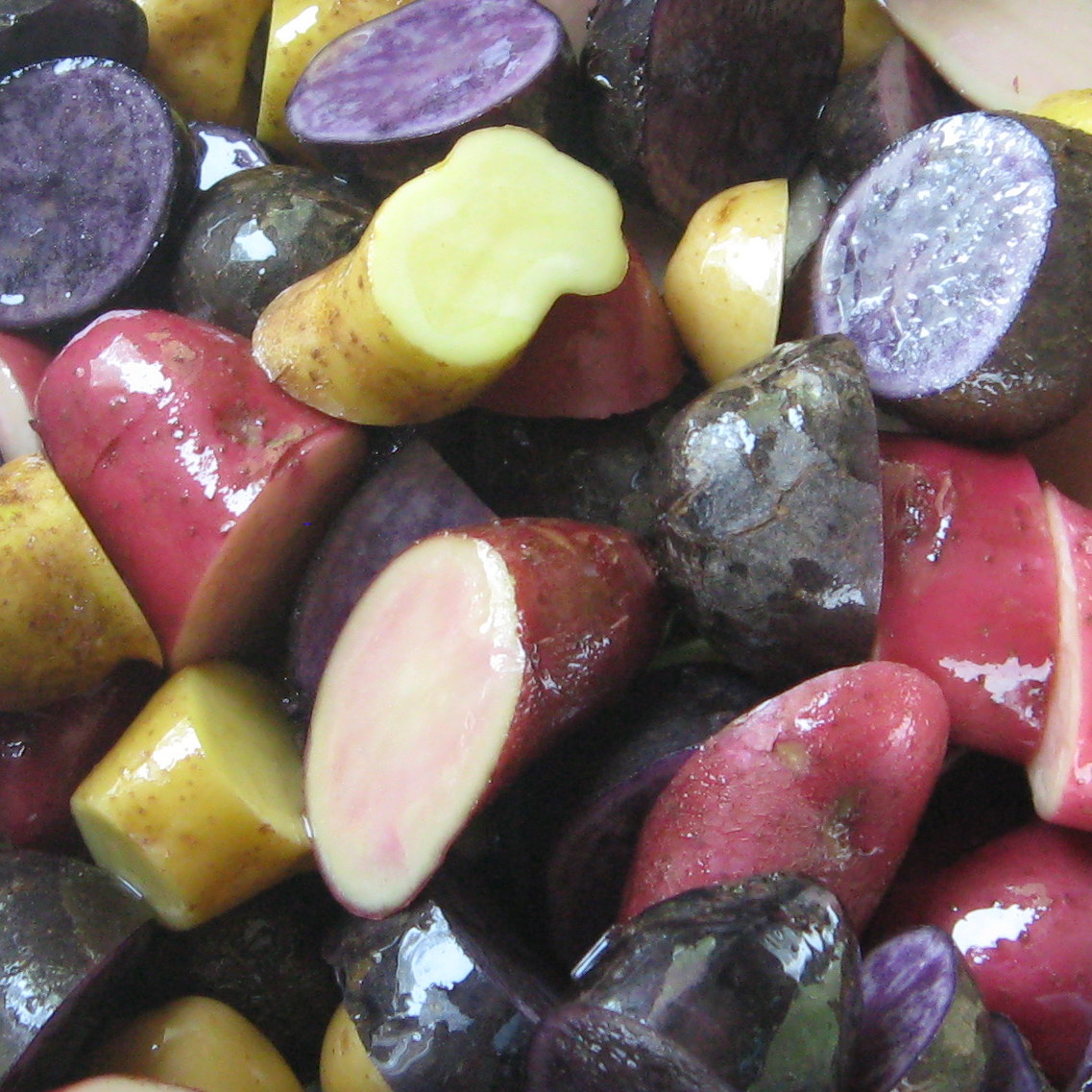
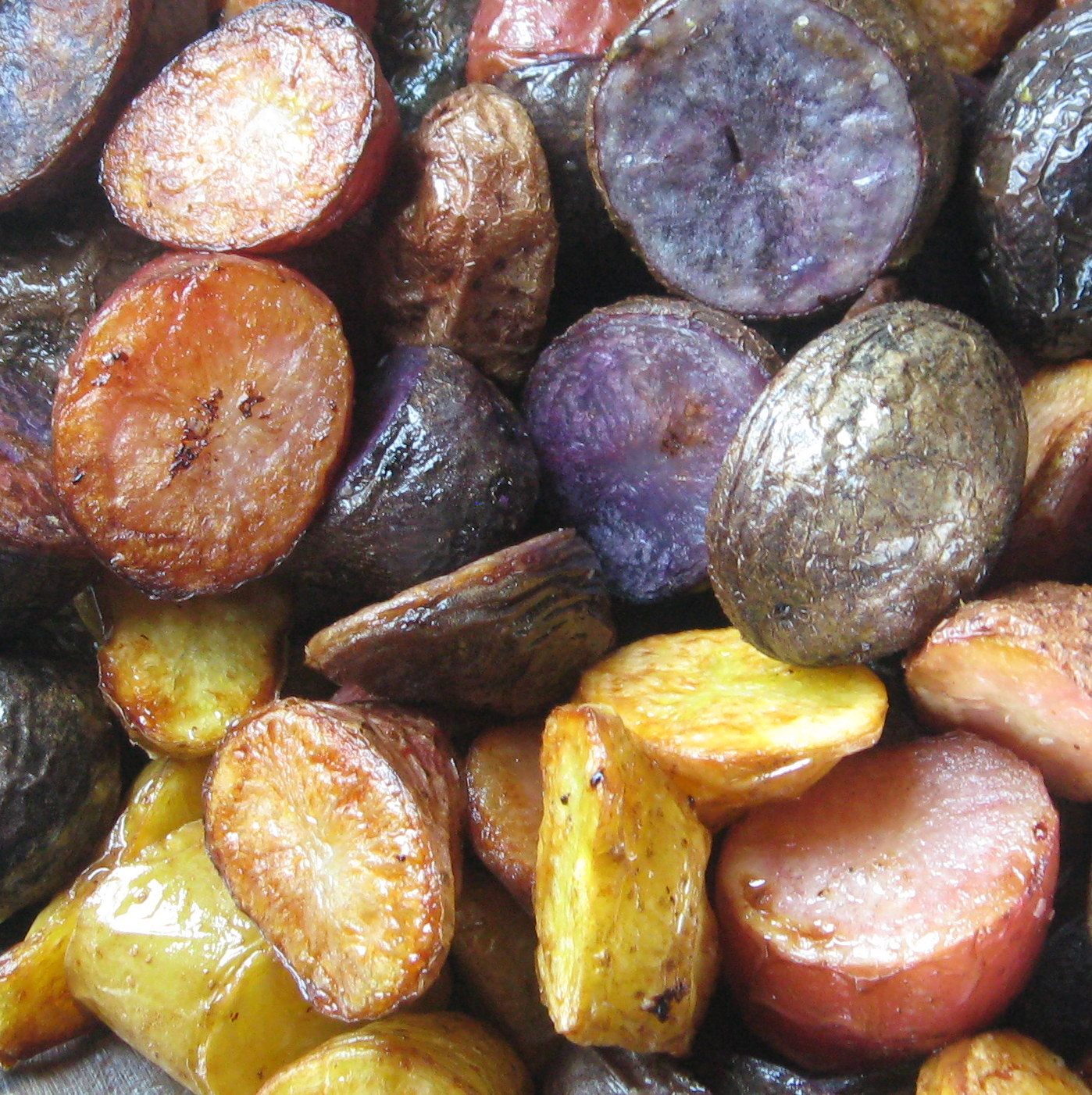
close-up of cut purple, pink/red, and yellow potatoes

Not to go empty-handed, I am making some patriotic roasted potatoes–red, white, and blue–Red Thumb, Russian Banana (okay, bit of fudging here), and Purple Majesty potatoes (new ones from the farm).  Since it’s HOT (my thermometer is reading 98°F now), I’ve decided that those roasted potatoes are going to turn into something that can be eaten at “room temperature”, that will be light and refreshing, and compliment the chicken.

I’m taking  newly dug tri-colored potatoes and scrubbing their delicate skins carefully, cutting as needed to have them equal sizes so that they cook at the same rate, tossing them with a little olive oil; then into a preheated pan and into a 350° F oven until they are tender.
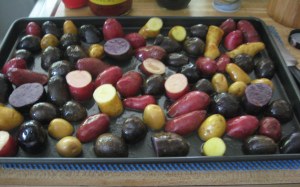
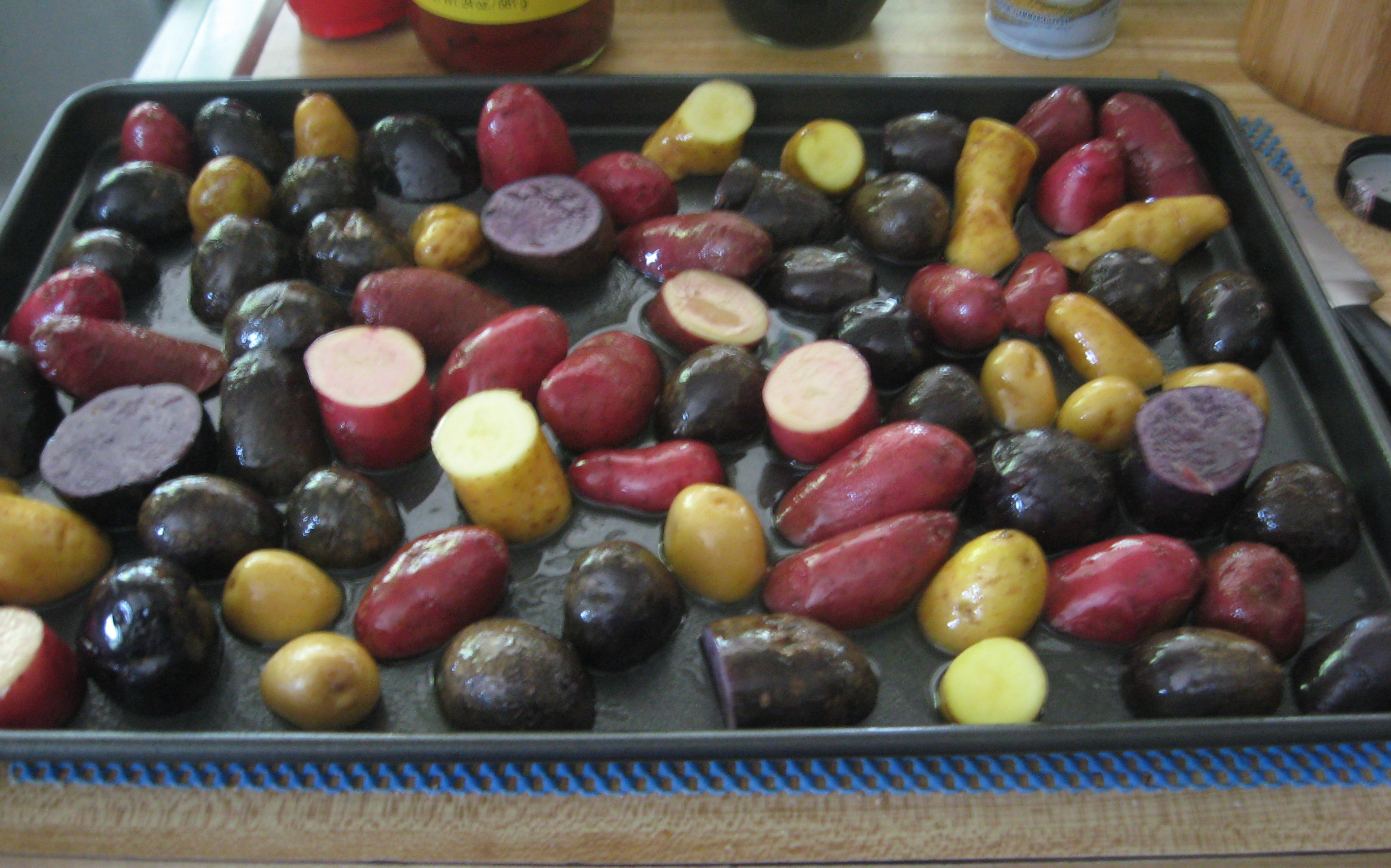
cut and oiled potatoes on baking sheet

I’ve done what America’s Test Kitchen recommends and placed cut sides in contact with the baking sheet so that at least some of the potatoes will brown to give roasted flavor. Now for some complimentary and contrasting flavors to finish these. Since all these do taste a bit different, and for me one of the fun things about this is to be able to taste the individual potatoes and to compare them–think about comparing wines–I want light seasoning–nothing to overwhelm the potatoes themselves. The only seasoning at this point is kosher salt.

Since it’s hot outside (my thermometer is now reading 99.7°F ), I’m thinking light and cool flavors.  I don’t want “potato salad”–so vinegar is out, but I do need something “bright”–and light, and something cool.  Time to check out the herbs on the deck, and the crisper drawer.

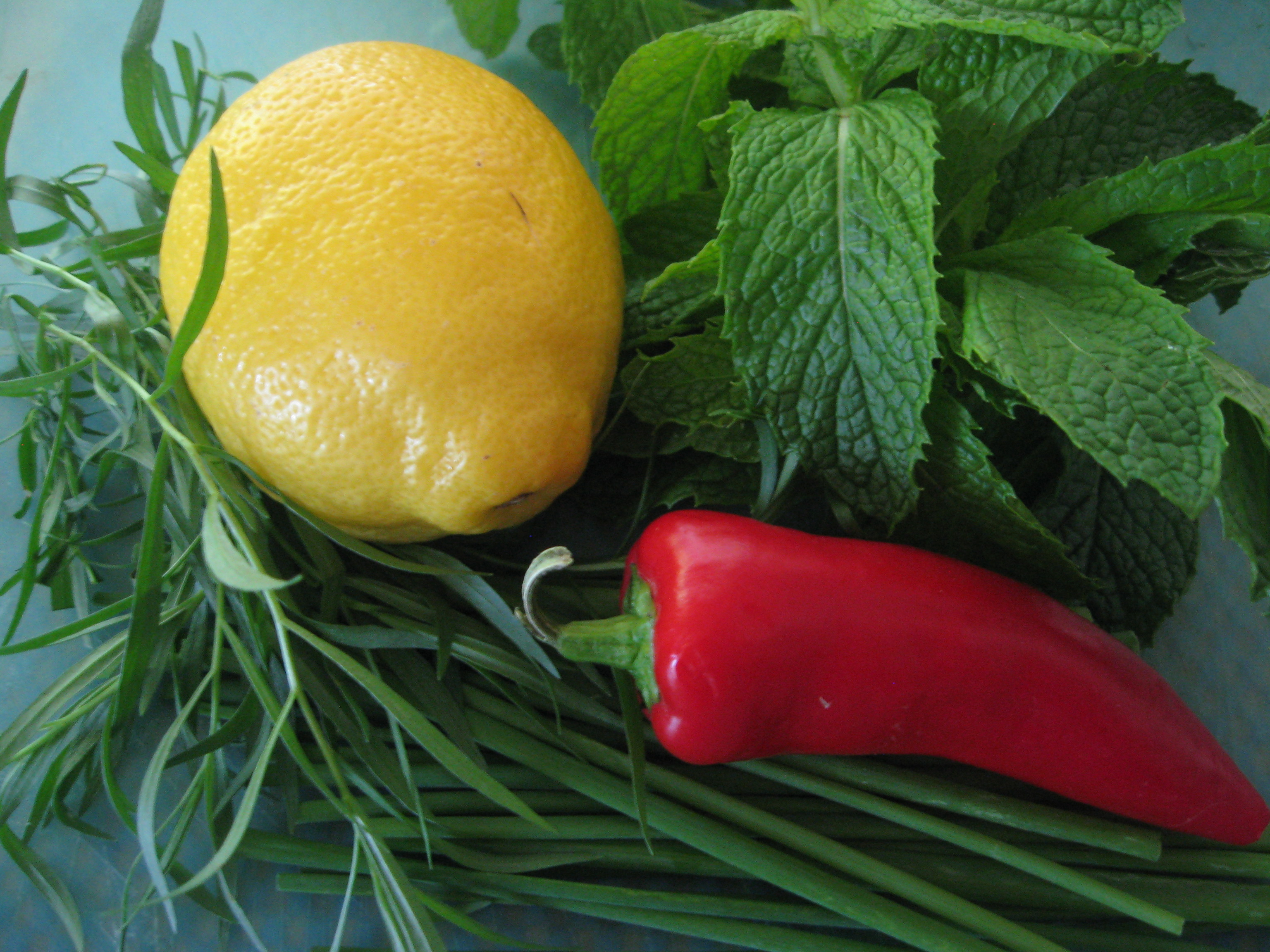
lemon, tarragon, chives, mint, and chili peppers.

Chicken makes me think tarragon.  Cool makes me thing mint–hmm.  Let me smush a couple of leaves together and see how that smells.  Tarragon–warm, mint–cool.  Need some brightness to set off the earthiness of the potatoes–lemon zest, and maybe just a bit of lemon juice over the potatoes while they are still warm.  Seems a good start–but not quite there yet.  Needs a little “spice”–some very finely minced red chili pepper might just do it.

After the potatoes had been in the oven for 30 minutes, I used the tip of a paring knife to check doneness–not quite; and, not quite brown enough.  (I probably should have used the heavier half-pan baking sheet instead of this one–drat.) I kicked the oven temperature to 450°F for another 15 minutes and checked again.  Perfect!  Brown potatoes–so out of the oven, ready for the first seasoning.
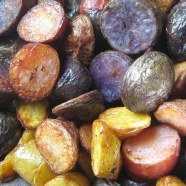
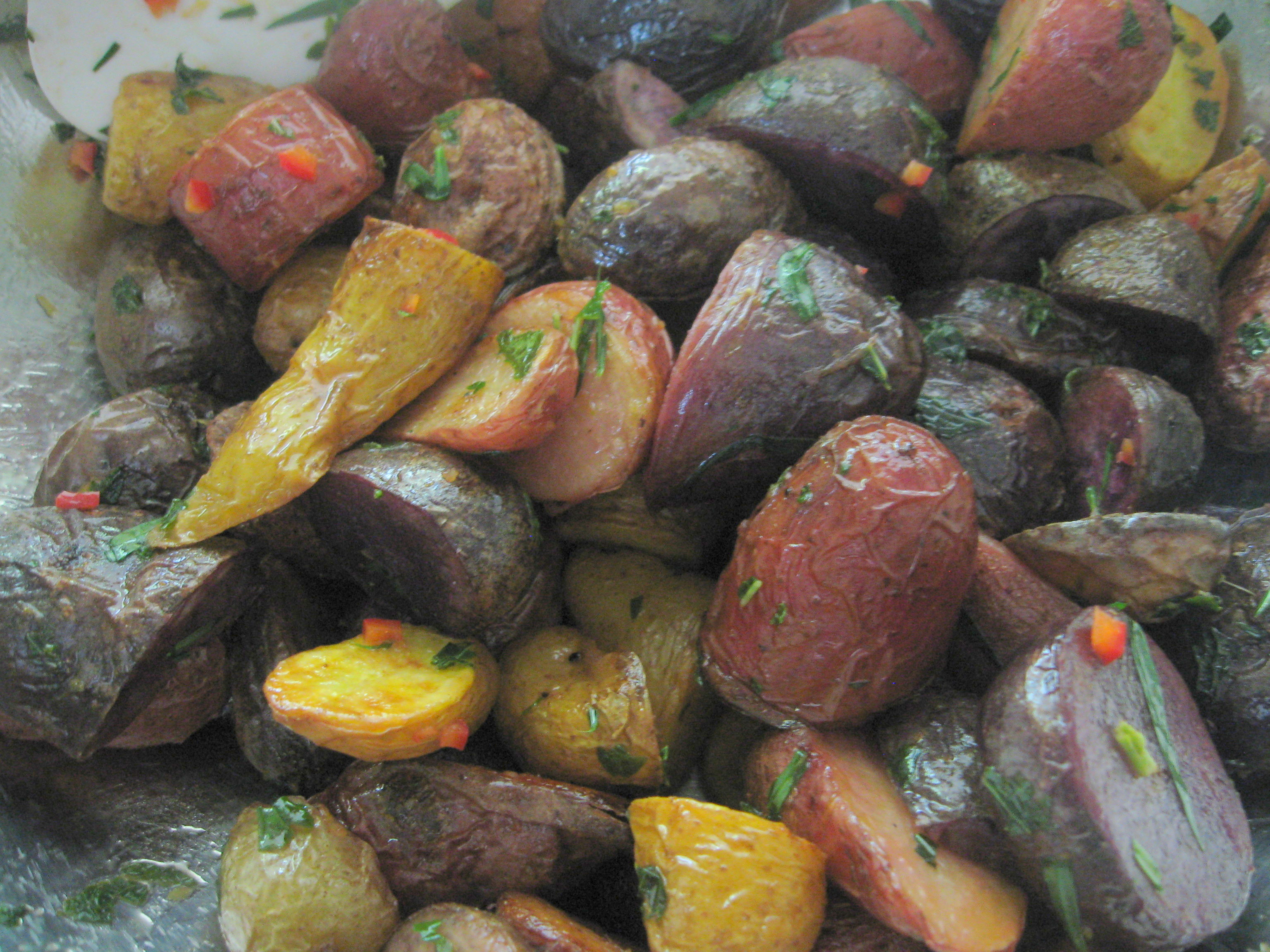
roasted potatoes--browned edges of the red, yellow and purple  ones.While still hot, I tossed them with the zest of one lemon and most of the juice of the lemon–nice bright flavor to contrast with the brown and earthy potatoes.  After cooling a bit, I tossed in about a tablespoon each pretty finely chopped French tarragon and mint. That got the first taste of cool mint, followed by the warm flavor of French tarragon.  So far so good.

I let them stand for a bit and tasted again–the lemon flavor is there but not overwhelming–the juice has added just a bit of tartness, but not enough to taste like a “potato salad”. Now, I’m debating chives and chili pepper.  I taste the chili pepper–it’s not screaming hot–and I think that just an occasional bit of heat as you eat the potatoes would be nice.  I seeded and removed the ribs, and finely minced about 1/5 of the pepper and tossed that with the potatoes. (Still debating about the chives–I really don’t want them to taste like ersatz baked potatoes.)
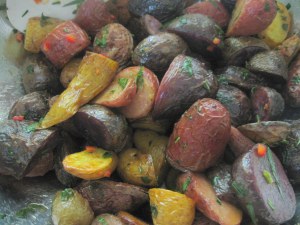
seasoned IMG_6935After standing for a bit longer, I tasted again, and decided that chives are not what is needed here–I probably should just leave them alone!

So the final seasonings are the zest of one lemon, lemon juice, mint, tarragon, and just a touch of  red Serrano chili pepper, and a very light sprinkle of a good fruity, extra-virgin olive oil.  I hope that after standing a bit more (not to be refrigerated before we eat the at ambient temperature–or maybe a little less–thermometer now at 100.6°F ) there will be flavors of warm and cool herbs, the brightness of lemon (juice and zest), and an occasional burst of heat from the chili pepper.

Using the baking sheet so that the potatoes are spread out and don’t steam, and preheated does really help get browned roasted potatoes.  If they are too crowded, they will only “steam” and not brown–not really roasted.  The browning is, after all, the whole purpose of turning on the oven!

It’s not smoked lamb shanks, but it’s going to be a pleasant evening with friends–and I do think that something similar will return to go with those lamb shanks when they happen later–when the temperature does not turn me into a total wimp!

…and yes, I’ve done that final taste–yum!  No chives though.
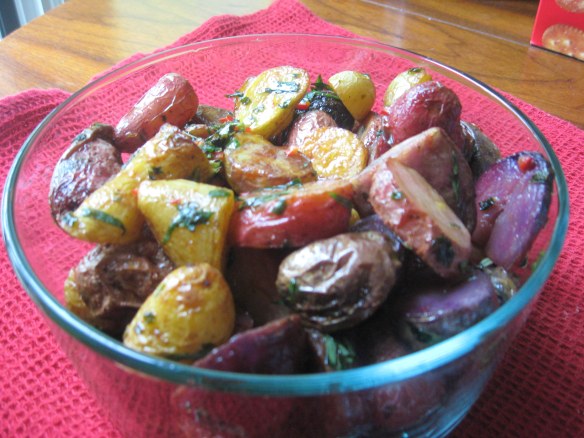
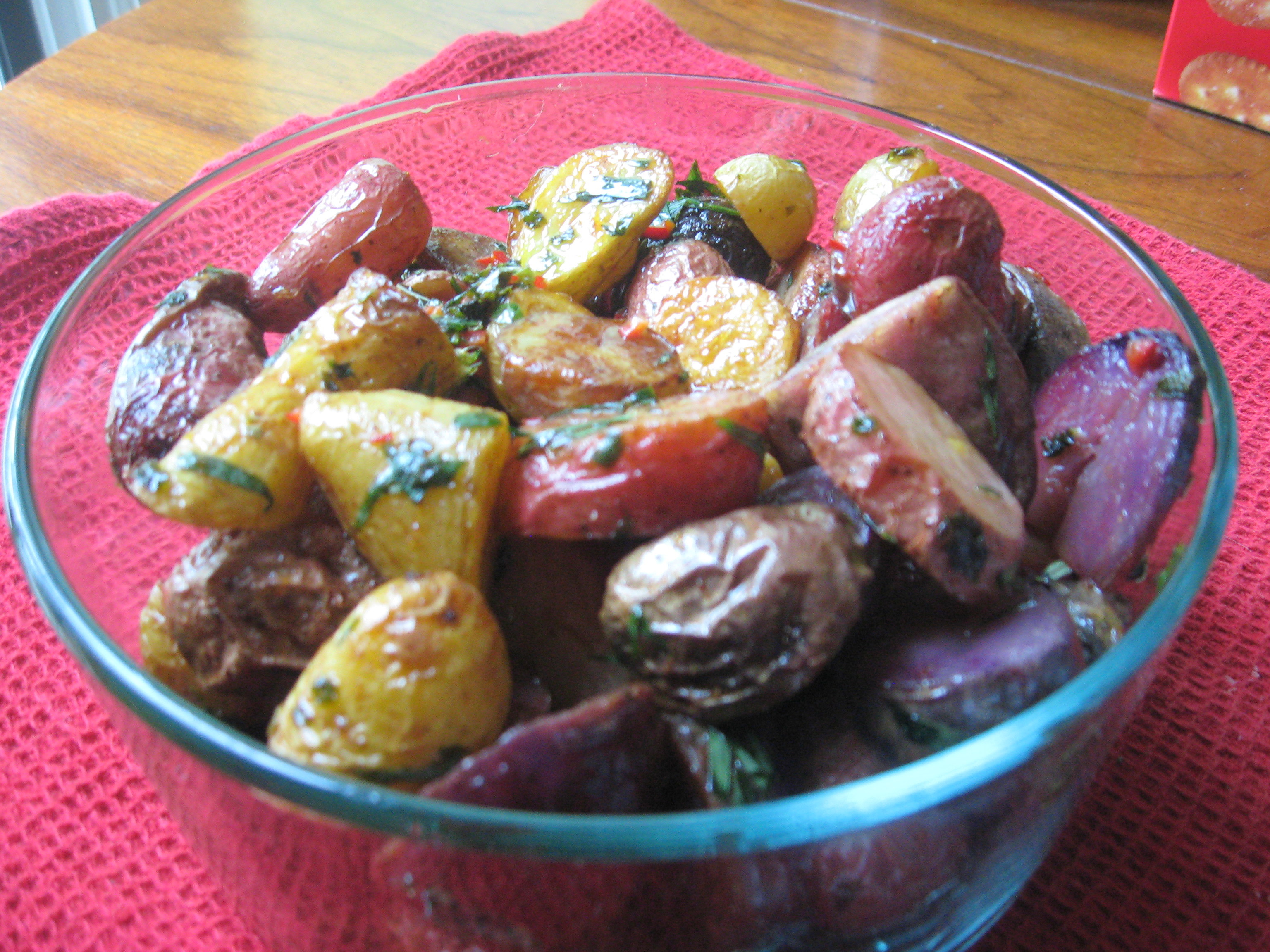
roasted potatoes, with herbs and chili peppers in serving dish.

Leftovers? Possibly–it is a big dish of potatoes for three, but leftovers here are desirable.  Tomorrow they can become a roasted potato salad–perhaps with just a splash of balsamic vinegar, adding some fresh tomato, and cucumber, and, perhaps, some celery, radishes, crisp sweet onion or some freshly snipped chives.

Happy Fourth of July!  A son goût!  

Haricots verts with herb-infused oil

Taverna filet beans

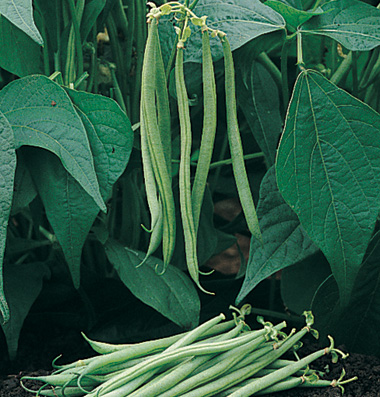
haricots verts (Taverna)

Yes, it is French for green beans–and they are Phaseolus vulgaris, but they are special green beans–not like Kentucky Wonder, or some of the other rather common beans.  To find them in the seed catalogue you need to look for “filet” beans.  They are bush beans, but the pods are small and slender (when harvested appropriately). Not having a large garden, I don’t grow my entire supply of green beans–the usual pole beans or bush beans like Kentucky Wonder–I buy some from the farmers’ market and I even use frozen ones in the wintertime.

These little beans are something that does get space in my garden or in a container on my deck–with successive plantings throughout the summer so that I can dash out and pick a single-serving batch when I want them.

My favorite way to cook them is to steam them very briefly (about 5 minutes) until just tender, shock  them in ice water so that they stay brilliant green, and  toss them with some extra-virgin olive oil infused with fresh herbs, and served at room temperature.  A favorite of mine for those hot summer days when you’re being fussy about what you eat.

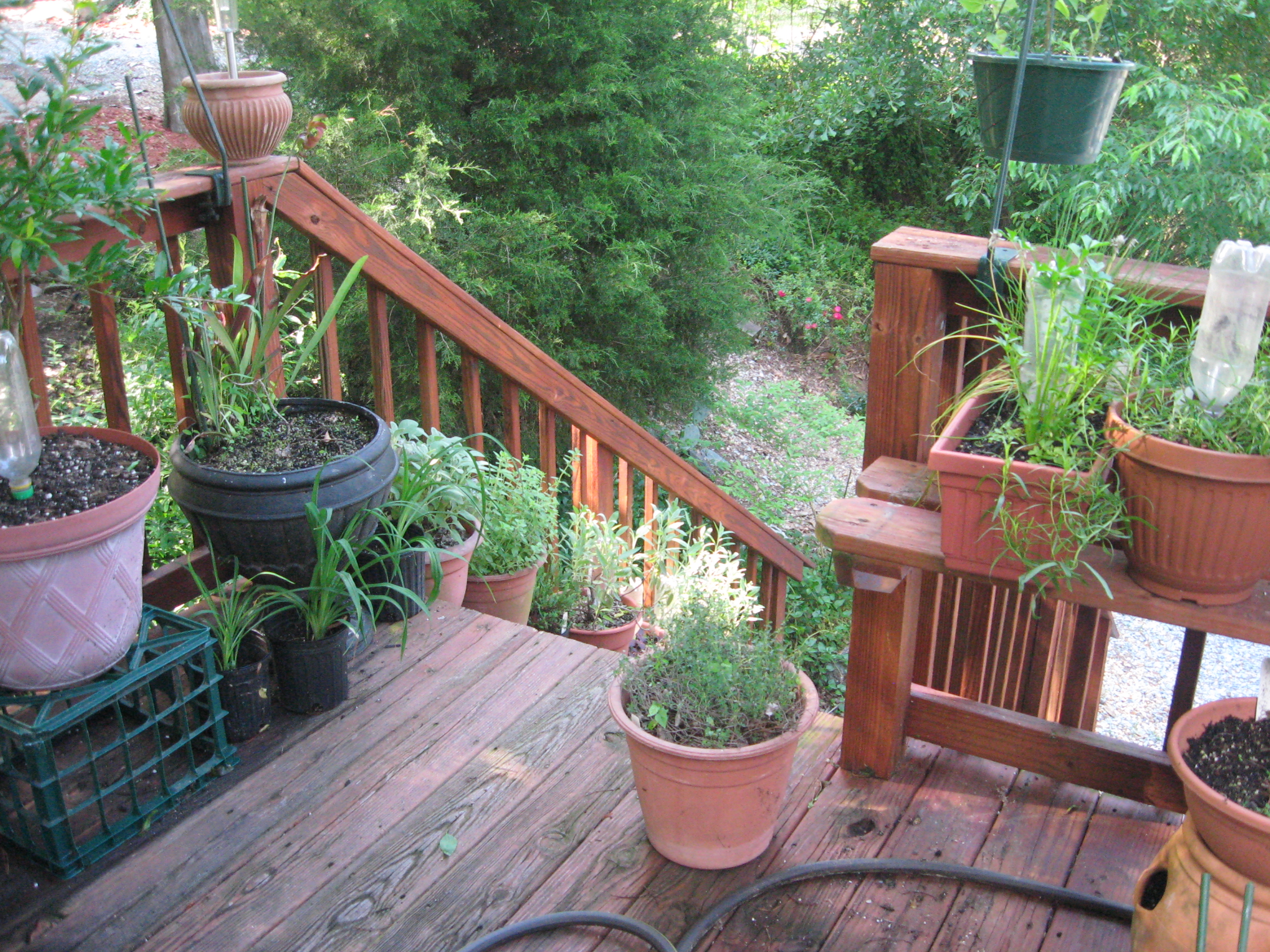
containers of herbs on deck and stairway

herbs

Since I do grow a lot of herbs on my deck with containers arranged on the stairway, and since I prefer not to let them bloom since that affects the flavor of the herb, I keep them cut back to prevent blooming–or grow varieties that do not bloom as readily as the common culinary herbs.  I find that I often need to give the marjoram and the oregano a “butch” cut.  This does not involve a neat trim–it’s taking the hedge shears with the long blades and lopping off the tips.  That leaves me with a handful of fresh herbs to share with my neighbors, or to use to make herb-infused oils to have on hand, and to use during the wintertime.

It’s simple to make herb-infused oils.  For immediate use, you can simply blanch the herbs, then “shock” in ice water, squeeze dry, and purée with enough oil to make a slurry, then add more oil.  Let stand, refrigerated, for 24 hours and strain through coffee filter.  These can keep for about a week, refrigerated.

For longer storage, I prefer to heat the herbs in oil to about 185 to 195° F and then strain.  At that temperature, you should be safe from any bacterial growth.  The last batch of oil that I prepared, I washed, blanched and dried the herbs; then chopped them and popped them into my very small slow cooker overnight, and then strained them.  This oil is probably not as bright green as it would be had I not heated it for that long, but the aroma is really great.

My favorites with the haricots verts is either sweet marjoram, or Syrian oregano (also sometimes known as zaatar).  Both of these herbs seem to intensify the sweetness and the “bean-ness” of the haricots.

Most herbs lend themselves well to making flavored oils:  sage, oregano, thyme–whatever is your favorite–try different ones with the beans, and vary it according to the flavors of other dishes served at the same time.

A son goût!  

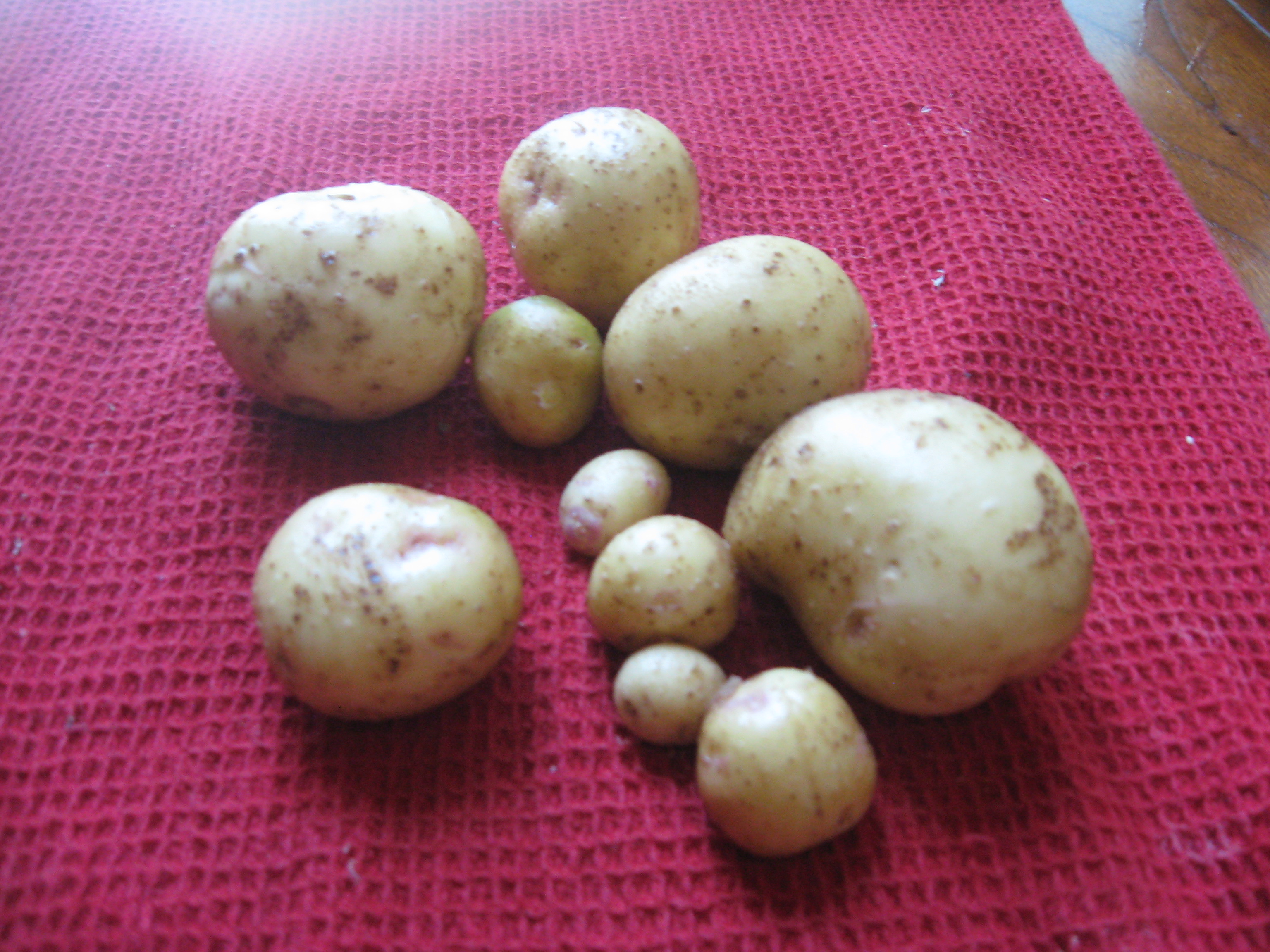
New potatoes

Yukon Gold potatoes still with soil on them

newly dug

There are lots of benefits from growing your own food!  You know how it was grown, when it was harvested, and that it’s going to taste better than supermarket produce.  Aside from these obvious benefits, there  is the very sensual, and sensuous, experience of harvesting your own food–tactile, olfactory as well as the anticipated gustatory experience.

I harvested my first  potatoes today.  The smell of  the earth as you dig them–newly turned, feeling cool to the touch, and the smell of  the potatoes (yes, you can smell them), and anticipation of the taste are things you’re not going to experience when you buy them in the grocery store–not to mention that you can’t get new potatoes unless you go to the farmers’ market.  The other advantage of growing potatoes is that you can skulk out to the potato patch and gently unearth some of the marble-sized ones whenever you want–you can do that without uprooting the entire plant and treat yourself to something that you’re not even likely to find at the farmers’ market.

Now, I’m not advocating that you should try to grow enough potatoes–or any other vegetables–to meet all your needs since that’s not feasible for most of us urban gardeners; however, it’s worth growing a few just for the total experience of having new potatoes.  I’m certainly not going to grow things that are readily available at the farmers’ market inexpensively–like summer squash, eggplants, or other basics.  I’m going to reserve my gardening efforts for the special treats–like a hill of potatoes, or radishes, or haricots verts.

I recently purchased The food lover’s garden: amazing edibles you will love to grow and eat by Mark Diacono (See Bibliography).  It’s worth a trip to the library to check this one out and read it–especially if you’re contemplating a foray into gardening. It will make you think about what you really want to expend time and effort on for your garden.  The philosophy is that of a true food lover!  It’s full of information on somewhat esoteric veggies that you’re certainly NOT going to find in the supermarket, and may not even find at your local farmers’ market.  The philosophy is that you should grow the things that YOU really love to eat.  There are a lot of really wonderful vegetables and fruits that aren’t readily available–salsify, scorzonera, kohlrabi and the like, as well as some that are just much better harvested as you’re ready to use them (brussels sprouts, broccoli for example) that will make you feel like it’s a different vegetable than what you brought home from the supermarket! These are the ones that deserve space in a small garden, and the time and effort required to grow them.

newly dug Yukon Gold potatoes after washing the soil away.

washed and ready to cook

In my case that includes at least a hill or two of potatoes (you can grow the in a large container) so that I can have the total experience–from planting, sneaking a few very small potatoes early to go with the fresh garden (English) peas in a luscious cream sauce, or larger new potatoes in some other simple fashion.  That means that I’m going to continue buying my yellow storage/cooking onions from other people–though I do have my little clump of “walking” onions, and some tiny carrots to give me a special treat when I want carrots featured; but the carrots for sofrito or mirepoix will continue to come from other people’s efforts. The baking potatoes that I use will also come from somewhere other than my garden–they’re basic, inexpensive, and readily available at the farmers’ market or supermarket with the organic produce.  I will grow some that are unavailable commercially because they’re something I love to eat.

mashed new potatoes

mashed new potatoes

Something as unusual as new potatoes doesn’t need fancy preparation.  Steamed, boiled (in their skins), or even cooked in the microwave oven, need only a tiny bit of good butter (preferably unsalted, sweet butter) or fruity extra virgin olive oil, some sea salt and fresh-ground black pepper for a luscious meal.  Since these were quite variable in size, I cut them into chunks that would cook quickly and evenly, and nuked them, then added a pat of butter, and roughly mashed them with a fork, added sea salt and fresh-ground black pepper–there’s the main course.  (The potatoes were accompanied by a slice of garden-fresh, vine-ripened tomato, and some haricots verts–also from the garden.)

A son goût!  

GMO or not?

I’ve seen posts on Facebook saying that the PLU codes indicate whether produce is genetically modified or not–wanting more information I did a little searching, including reading some FB posts.  I thought I’d share this commentary on the PLU codes from Snopes.com and the Huffington Post.  It would be nice if it were as simple as looking the PLU code for reliable information!

Buying avocados

Just a quick note on a blog post that I read today.

I love avocados, but how many times have I gotten home and found the inside gross, icky brown, and had to pitch the avocado?  Well, too many.

I was interested to see this post on Northwest Edible Life (via Facebook): Never buy a rotten avocado again. This is a method of checking out the interior of an avocado in the store–I’ve not heard it before, so I’m anxious to try it out.

Another thing to try with beets….

Since I’ve written about beets, I thought I’d share this link to a recipe for a pâté.  I came across this while perusing the food blogs that I try to follow.

I’ve not made it (yet), but in my mental image and tasting, this is an appealing combination that I’d like to try.

Beet (and other) Röstis

One of the things that we often want in cooking for one (just as in cooking for four or six) is fast and easy, and a technique that can be applied to a number of dishes. I’ve mentioned steam-sauté as a great way to cook vegetables quickly–but here are some other ideas for quick cooking.

Beets image from Swallowtail Garden seeds

beets

Beets can normally take quite some time to cook since they are dense and hard.  One of the ways to speed up cooking is by grating or shredding a dense vegetable–think about hash browns!  You can use a similar technique with beets (or carrots, parsnips, cabbage)–cut them into small pieces so that they will cook more quickly.  Here is an example adapted from Marion Morash’s Victory Garden Cookbook: 

Grated Sautéed  Beets

Ingredients

  • 4 medium beets
  • 4 tablespoons butter, or olive oil
  • Fresh lemon juice
  • Salt and fresh-ground black pepper
  • Chopped fresh dill weed or parsley

Preparation

  • Wash, peel, and coarsely grate beets (If small and tender, peeling is not necessary)
  • Melt butter in a covered frying pan.
  • Add beets, and stir to cover with butter or oil.
  • Cover and cook for about 10 minutes, until just tender.  (You could add a bit of water or stock–like steam-sauté technique if needed to keep from burning.)
  • Season with lemon, salt and pepper and serve.

Although this will serve four, it’s easy to cut this down to a single-serving size–there’s really nothing to measure or adjust–it’s easy to eyeball the amount of butter and quantity of beets needed.  What could be simpler!

If you want to get just a bit fancier with your veggies, you could make röstis.  This gives you different flavor and texture for very little extra effort.

 You’ve probably heard of rösti–maybe just as “potato pancakes”.  A potato rösti at its simplest is just grated (shredded) potato, mixed with a little flour to help hold the potatoes together (and maybe some Parmigiano-Reggiano), which is sautéed  in a little butter until tender, brown, and crispy.  It’s simple, quick, and yummy–and even better, it’s easily made for one or two people as it’s really not a fussy recipe:  small for a side dish, or a bit larger for a main course.

Here is a basic potato rösti recipe from Mark Bittman’s Food Matters cookbook Kindle location 1464).  This recipe makes four substantial servings, or 12 snack size röstis. Röstis are typically shaped into a cake, but can also be baked in muffin tins or on a cookie sheet

Potato-Parmesan Rösti

Ingredients

  • 1/4 cup olive oil, plus extra for greasing pan and your hands.
  • 1-1/2 pounds waxy potatoes (new potatoes, or red potatoes)
  • 1 onion
  • 1 tablespoon coarsely chopped fresh rosemary or thyme
  • 1/2 cup grated Parmesan cheese
  • 1 tablespoon whole wheat flour
  • salt and fresh-ground black pepper

Preparation

  • Heat oven to 350° F and grease nonstick muffin tins or backing sheet.
  • Grate the potatoes and onion (food processor, or by hand).
  • Squeeze dry with paper towels.
  • Put in bowl, add Parmesan, flour, and oil (if baking–omit if sautéing).
  • Sprinkle with salt and pepper.
  • Divide between muffin tins and press down, or press into cakes.
  • Bake or sauté until crisp and golden–about 30 minutes.
  • Let cool for 10 minutes before removing from pan.
  • Serve warm or at room temperature.

Obviously, this technique will work well with other vegetables–such as beets, carrots, squash, cabbage.  You can see that this is easily cut down for a single serving: you’ll want about one-fourth this amount:  1 tablespoon oil, 6 ounces potato, 1/4 onion, a healthy pinch of rosemary, 2 tablespoons Parmesan, and a scant teaspoon of flour for one large cake, and the cooking time should be about the same since the recipe calls for dividing into cakes. Making these in single serving sizes, I opt to sauté them rather than bake them.  I omit the oil from the mixture and add a little to the skillet.

This technique can be used with lots of other vegetables–one of the advantages being that the shredded vegetables will cook more quickly than whole veggies.

Another recipe from Mark Bittman is for beet rösti from his column in the New York Times:

Beet rösti

Ingredients

  • 2 pounds beets (3 very large or 4 to 6 medium)
  • 2 teaspoons coarsely chopped fresh rosemary
  • Salt and freshly ground pepper to taste
  • 1/2 cup flour
  • 2 tablespoons butter
  • Minced parsley or a few rosemary leaves for garnish.

Preparation

  • Trim and peel beets as you would potatoes.
  •  Grate them in food processor or by hand (For a single serving, I’d use a box grater.)
  • Begin preheating 12-inch nonstick skillet over medium heat.
  •  Toss grated beets in bowl with rosemary, salt and pepper.
  • Add about half the flour; toss well, add rest of flour, and toss again.
  •  Put butter in skillet; heat until it begins to turn nut-brown.
  • Scrape beet mixture into skillet, and press with spatula to form a round.
  • With medium to medium-high heat–the pancake should gently sizzle–cook, shaking pan occasionally, until bottom of cake is nicely crisp, 8 to 10 minutes.
  • Slide cake onto a plate, top with another plate, invert the two plates, and return cake to pan.
  • Keep cooking, adjusting heat if necessary, until other side is browned, another 10 minutes or so.
  •  Garnish, cut into wedges, and serve hot or at room temperature.

 This can be readily adapted to other vegetables–carrots, parsnips, rutabagas, turnips–which have about the same texture and density as beets. Once you’re familiar with the technique, you can use vegetables with different textures:  summer squash–just squeeze them thoroughly to remove moisture, and remember that they will cook more quickly than beets.

Cooking beets…

The indexing project for The Polar Times has really taken over my life right now–which is not unexpected–but it does have its problems. I think any work where there is a deadline does that, but I need to get something for quick meals around here, and it has to meet my “hot weather” requirements!

Beets image from Swallowtail Garden seedsLooking over the Durham Farmers’ market this last week I was seeing lots of lovely beets–and with the weather warming up (from my point of view getting hot!) the cold beet soup came to mind as something that would be pretty easy, keep well, and is great in hot weather.

To prepare the beets for cooking, I cut off the tops (greens) a bit above where they attach to the root; some of the greens will go into the soup, but if there are extras, they are good as a vegetable, or an omelette filling.

Cutting the tops and leaving about an inch of the stems will keep the beets from bleeding and losing flavor.  If there is a slender root tip attached, I leave that on too.  Just scrub the beets with a fairly soft vegetable brush so that the skin is not broken–again, prevents bleeding.

No matter how you cook them, you can tell  they are done when they pierce easily with the tip of a small paring knife.   When done, the skins will slip off easily.  You can cook them a number of ways–One of my favorite ways is to roast them: well and good if it is a cool day but if it is not and you don’t want the oven on for an hour or so, then consider steaming (I use my rice cooker) or microwaving them (see below).  Test for doneness as above.

Roasting:  For four medium-large (about 6 ounce) beets, rub them with oil, place them in a covered casserole or wrap in foil and bake at 400° for about 1-1 ½ hours..  Cool them and then trim off the stems, roots and peel.

Steaming: Place the beets over simmering water and steam for about 1 hour, or until done. Cool, trim and peel. Baby beets will take about 20 minutes.  I sometimes do this using my rice cooker.

Microwave:  For the size beets mentioned above, put the unpeeled beets in a microwave-safe dish with a lid or cover tightly with plastic wrap.  Cook on high for 8 minutes and let rest for 5 minutes without uncovering.  Turn the beets microwave for 3 minutes on high and let stand again without removing the cover for 10 minutes.  Test for doneness with a small paring knife.  If they still offer some resistance to the knife, cover them again and microwave for an additional 3 minutes.  Cool, peel and go ahead with the recipe.

Grilling:  After peeling, slice medium raw beets about 1/4 to 1/2 inch thick, brush with oil and grill until tender. Very intense flavor. (I’ve not used grilled beets in the cold soup; I might if I ever have any “leftover” grilled beets, or manage to cook extras.)

Beet greens: Don’t forget the greens that you trimmed off before you cooked the roots! Some will go into the soup, but there might be more than you need or that.  Stem them like you would spinach–they are edible too.  If the stems are very large, cook them a bit before you put in the leaves.  They are excellent eating too. All they need is a quick braising, boiling, or steaming.  You can substitute beet greens in any recipe calling for chard.

Umami in the slow cooker…

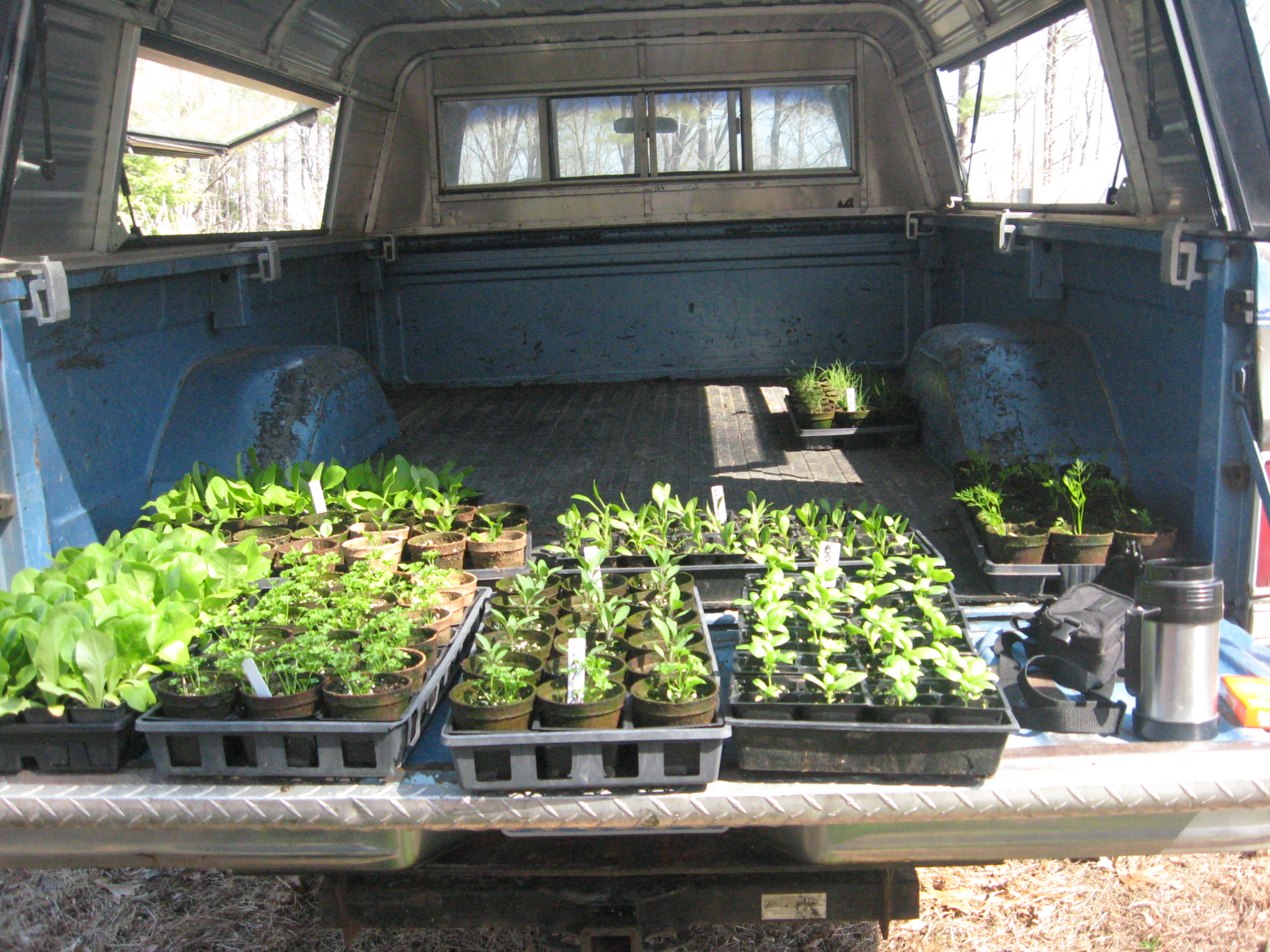
flats of plants on tailgate of truck to be loaded for the farmers' market.

for market

Obviously I’ve not been giving a lot of thought to cooking  things lately–it’s been end-of-term grading, indexing and proofreading, or getting  ready for the farmers’ market, or actually being at the farmers’ market, with more energy going to planting things, both for later harvest and for selling at the market than into cooking.

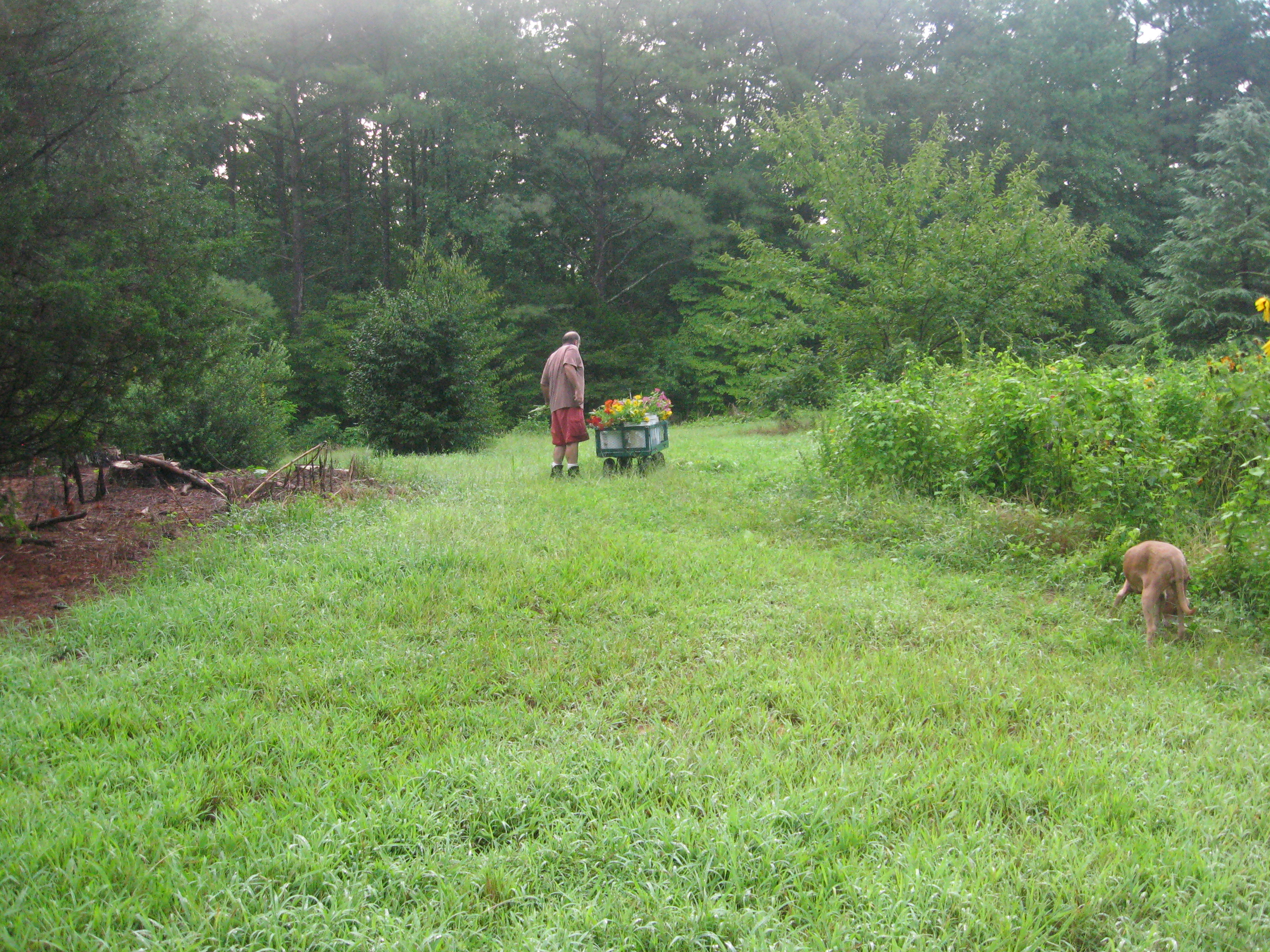
One of the down sides of working the farmers’ market is that I’m one of those people who wake up like a compact fluorescent bulb–pretty dim at first–so getting to the farmers’ market on time on Saturdays involves getting up before the birds just to give me time to be awake and functional. Even Fridays demand early rising, especially as the weather gets hotter–flowers to cut early in the morning and produce to be harvested before the heat of the day sets in and thing wilt…and just to avoid being out in the worst of the heat.

wagon of flowers in buckets

cutting flowers

I’m getting into the swing of that now but it still takes time for my lights to come on, though less painful now.  That early rising on Friday and Saturday makes me into a really lazy slob on Sunday.  Now that the Spring term is over, I’m not meeting classes during the week so I’m enjoying the summer hiatus from lecturing, but still working at freelance indexing so the absolute laziness has to be confined to Sundays and Mondays through Thursdays are still busy.

All this means that for Friday, Saturday, and Sunday cooking is likely to be focused on one-dish meals, and dishes that are good (or even better) when reheated.  Sometimes Saturday meal is not even something reheated–it’s my treat-yourself day–OnlyBurger for after-market meal before I devote the rest of the day to quality time with the cat!  (This past Saturday the treat was a Texan (burger with braised brisket on it) and a peach ice cream sandwich (handmade at OnlyBurger) after the market.  The evening meal was Carolina Moon cheese and strawberries–both from the farmers’ market.)

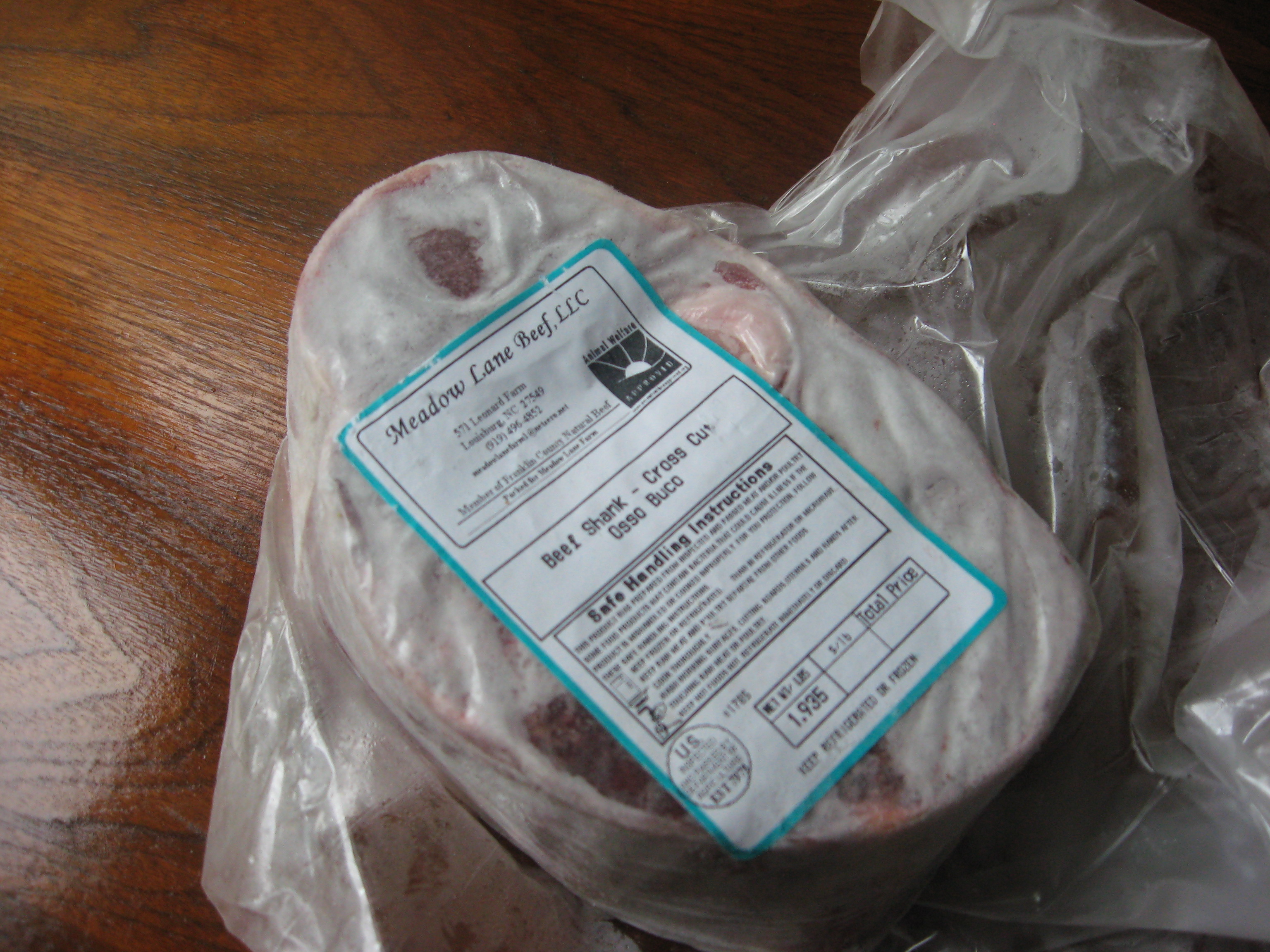
packaged cross-cut beef shank

beef shank

This weekend schedule means that I try to do some planning and cooking on Thursday to have reheatable food on Friday and Sunday.

This weekend’s meals are going to feature an absolutely lovely cross-cut beef shank from Meadow Lane Farms (also from the Durham farmers’ market)  in an easy dish that can cook mostly unattended: osso bucco, but with beef shank rather than veal shank. (The osso bucco really just means “bone with a hole” or marrow bone.)

It’s a dish that’s easily adapted for one person–there’s nothing fussy about it–no need to be exact or tedious in measuring ingredients, and to make even more “unattended”, it will go into the slow cooker (also serving as rice cooker and steamer) while I’m out working on the farm.

Krups rice cooker/slow cooker and steamer

Krups rice cooker

I have to admit that I’ve not been a fan of the slow cooker until recently, at least for anything much more than cooking dried beans, or poaching a beef tongue. The flavors and textures just aren’t the same as when the slow cooking was done in the oven where some evaporation, browning and concentration takes place even in a covered dutch oven.

My attitude about slow cookers has changed since I found the Cook’s Illustrated Slow Cooker Revolution (See Bibliography) and learned some techniques for making food out of the slow cooker more flavorful.  I’m not ready to quit slow-cooking in the oven despite that, but in hot weather I’ll certainly use the slow cooker more often with some of the “tricks” I learned from that cookbook.

What I missed most in slow-cooker dishes was that savoriness that comes from browning (Maillard reaction)  when you slow-cook in a traditional oven or brown/sear on the stove-top.  In the slow  cooker, you can make this absence less noticeable by adding ingredients that contribute “umami“.

Some of the most useful things I learned from that Slow Cooker Revolution are ways to use the microwave oven to facilitate the slow cooker, and using some “unusual” ingredients  in recipes–not esoteric ingredients, just pantry staples that boost  the umami flavor:

  • precooking aromatics like onions in the microwave so that they don’t stay crispy-crunchy in the slow cooker,
  • using tomato paste (for umami) by browning it with the aromatics either in a skillet or in the microwave before adding it to the slow cooker,
  • using dried mushrooms to boost flavor (again, umami),
  • using foil packets in the slow cooker to keep some ingredients from over cooking.
  • using soy sauce or fish sauce to add more of that umami that many slow-cooker dishes don’t get without the evaporation and browning as in the traditional oven.
  • using the microwave to precook some ingredients to get rid of excess moisture that would otherwise dilute the dish in the slow cooker.

These are all easy to do–they really don’t add significant extra prep time or effort, and do really make a difference in the flavor.  I expect an easy, flavorful meal (or two) from the braised beef shank that is going to emerge from my slow cooker on Friday evening, thanks to some added umami!