Christmas Spiced Biscuits

Sounds like real holiday treat. Good discussion on biscuits (English and American), and scones, too.

frugalfeeding's avatarFrugalFeeding

Frugal Christmas Spiced Biscuits

If there’s one time of the year at which biscuits should be made and eaten in prodigious quantity, it is at Christmas. There’s something clean and joyful about a proper English biscuit that makes them a smidge more festive than, to give one example, a cookie. It’s far easier to pick out individual flavours in biscuits than in food that is excessively sugary – a cookie, for instance, is something of a devilish experience.

Not only are biscuits rather light on one’s stomach, they are also one of the more frugal bakes one can embark upon. Of course, this is largely due to the dearth of expensive superlatives, such as chocolate, that are often added to cookies or cake. Instead, biscuits are often left plain or flavoured with spices or citrus fruits – as is the case in this recipe. Indeed, if the spiciness of these biscuits doesn’t appeal…

View original post 420 more words

Spicy Peach Chicken Wings Two Ways!

Image

What’s the best way to say this? I. LOVE. TO. GRILL! Now that you know this little secret about me, let me share one of my favorite sauces that I like to make while cooking. First I want to acknowledge that a lot of people are intimidated when it comes to dealing with MEAT and FIRE. This type of cooking has been going on way before Man realized that wearing white after Labor Day was unacceptable. Besides eating sushi or raw fruits/veggies I can’t imagine a more natural way to enjoy food. Regardless of your belief of how and when we got here once Man found fire he also found his love for a Medium T-Bone steak. I’m just saying.

In this article I’m going to share with you TWO different ways to prepare chicken wings. One will be for you go-getters out there who love to put meat on fire, and the other will be for the less adventurous group who likes to play it safe.

If you are ready to receive your fire badge in scouting then you will take the road I love to travel by and go fire up that grill! Even with grilling you still have options on how you actually want to achieve AWESOMENESS. You can use “Propane, and Propane accessories”-Hank Hill or you can use Charcoal. I personally prefer using gas since you can control the heat and when you’re done, you’re done! With charcoal you will have to move up to the advance cooking class since this will require a lot more concentration and skill set to master this form of cooking. Charcoal will definitely give you that authentic home cooked flavor, however it will also give your wings 5th degree burns really quickly if you don’t pay attention!

Ok so enough about that. Let’s cook!

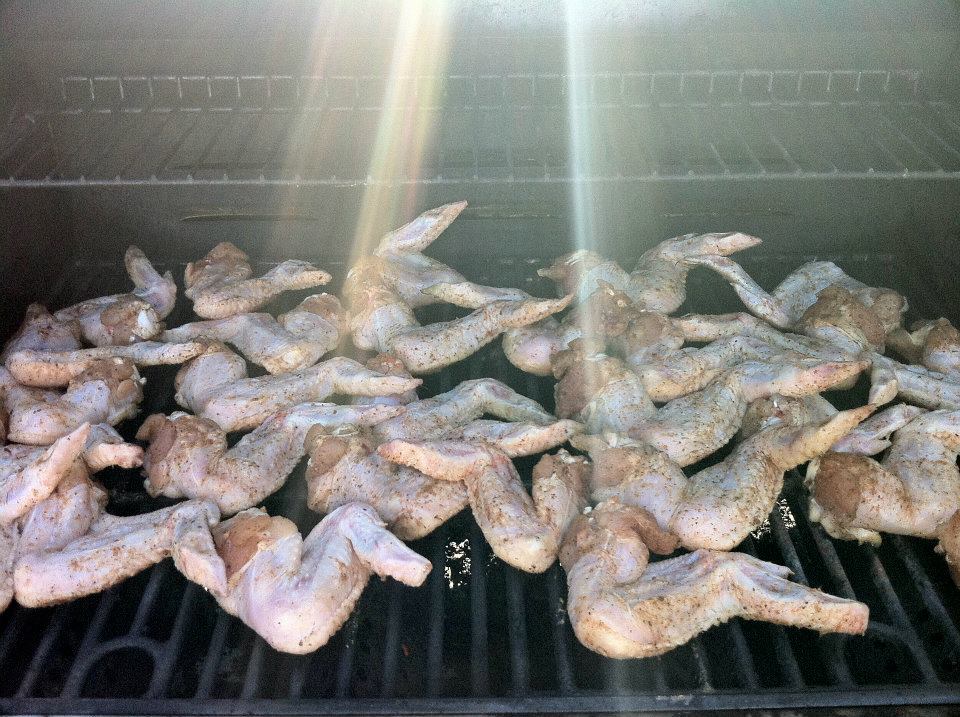
Propane: Cut your grill up to medium-high heat to get the grates nice and hot for the initial sear when you lay the wing down. After placing the wings on the grill for a couple of minutes, lower the heat and flip those bad boys over. At this point there should be a little color as well as grill marks on outside so that you can keep up with when to turn your wings. Keep rotating so that each sides gets crispy brown skin. Don’t wait to long to add the sauce, the last 10-15 minutes of cooking should give you enough time to let the flavors marinate all the way through.

Charcoal:  After you have your nice and red hot you will have to work a lot harder than your gas friend up there because now it’s all about the Indirect Heat method. Ten out of 10 times your grill is going to be extremely hot in the center where you have nonchalantly piled all the charcoal and set it on fire with half a can of lighter fluid. Once you have brought the level 3 fire down to burning red coals you will need to place the wings on the outer perimeter so that you can control how quickly your wings will cook. 

There is no way I’m going to say it will take approximately (fill in the blank) minutes and your wings will be perfect. I can’t sell myself out like that. But I can tell you that the food will let you know when it’s done. Chicken wings start of pale, soft and flabby-just like a newborn baby! Then in the toddler years they will make a lot of noise by hissing and spitting juices everywhere (terrible two’s phase). This is when you have to constantly watch them and move them around to make sure they don’t burn up. Once they become teenagers they have more color to them, stay to themselves and become firmer. They think that they are grown however on the inside they still haven’t developed yet. (I’m 15 and I know everything and my parents are lame phase) And then we come to the adult phase. Now it’s time to sauce em’ up. They have graduated college and ready for the real world. CONGRATULATIONS! You raised your wings right. They have earned the privilege to become a part of the meal.

Now for those of you who choose to bake/broil the wings instead of grilling not only do I give you a serious side eye but I will give you what you need to attempt to duplicate that outdoor flavor without actually going OUTDOORS!!

After seasoning your wings with the dry ingredients (salt, pepper, paprika and garlic powder) your oven should already be on and ready for action at 400 degrees. You are going to lay the wings out in the pan and leave them uncovered. The point is to get that skin crispy as if it had been lying out in the sun all Summer. That crunch is what you are looking for, we want savory crispy wings not soggy chicken pieces. So after 50 minutes (half a Lifetime movie) you want to check and see if those wings have plumped up
and start turning brown like this.

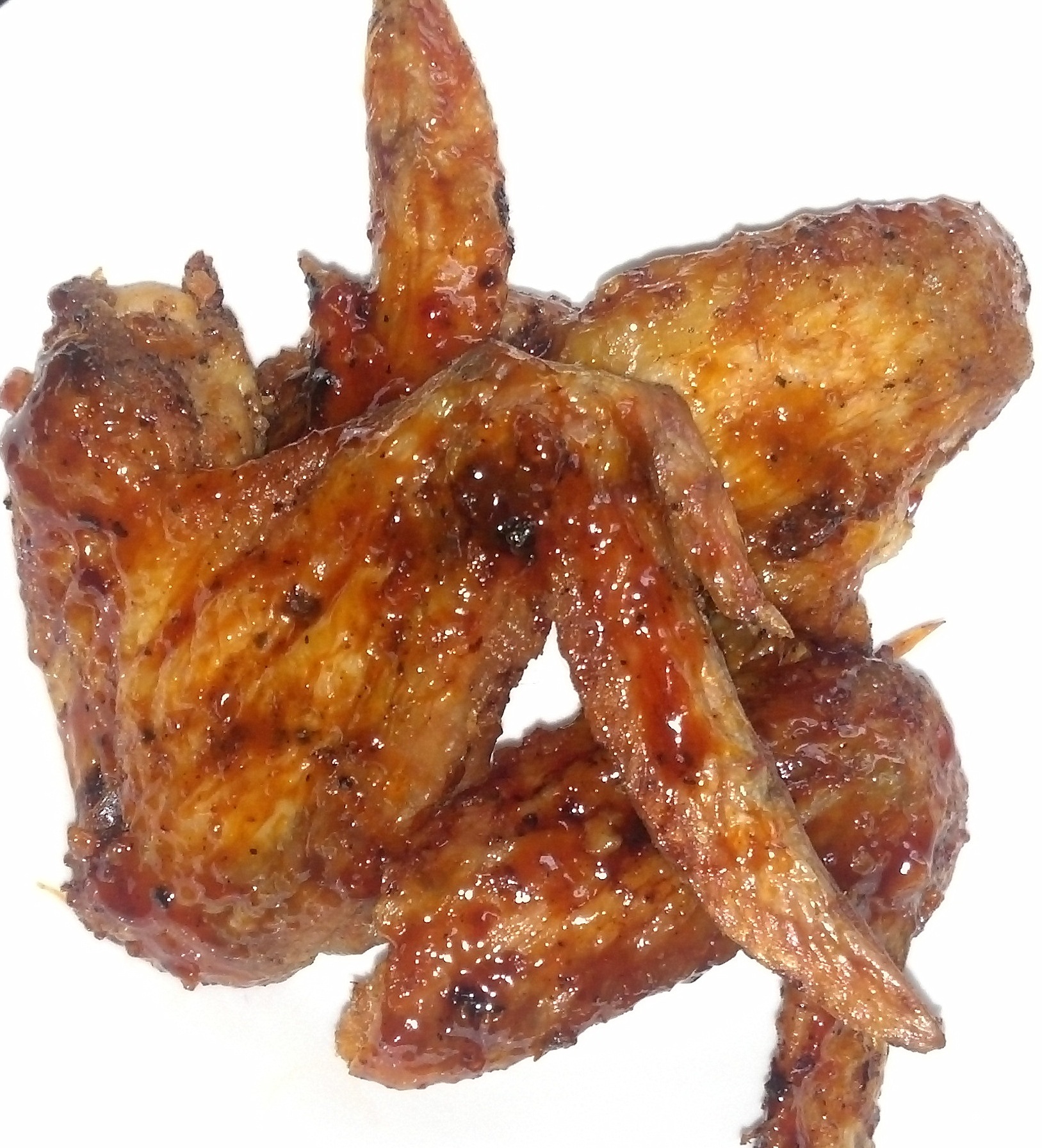
Alrighty then, your wings are ready to be sauced up! At this point you want to add all that finger licking goodness to the chicken so that they can be joined for eternity in flavor heaven. I actually would add the sauce probably around the 40 min mark just so that it gets in there all the way to the bone! Once you have the wings sauced and crispy now it’s time to crank up the heat and cut the broiler on. This will allow the wings to get more color and tighten up the skin just as if you had grilled them. Now is the time to pay attention to what’s going on in the oven instead of pouring that next glass of wine. Things can go from happy-go-lucky cooking time to OH GOD WHERE’S THE FIRE EXTINGUISHER?! Please check on your wings every 5 minutes until they are at the level that you prefer. The sugar in the peach preserves will heat up and become sticky, this will also cause the wings to “burn” more on the outside so unless you want wings that look like tar I suggest you watch them carefully.

This is what I have come up with after cooking in the oven and plating.

So below you will find the recipe for the Spicy Peach Sauce that I have talked about this whole time. The great part about this is the fact that almost any sauce can be substituted based on whatever flavor your palate is looking for at the time. I love complex sauces that make you think about what you are actually tasting. If you are going to eat something good, you might as well do it right!

Ingredients

  • 2 tablespoons table salt
  • 1  teaspoon black pepper
  • 1 teaspoon smoked paprika
  • ½ teaspoon garlic powder
  • ½ stick butter
  • 2 ounces of minced garlic
  • ½ cup peach preserves
  • ¼ cup hot sauce
  • 1 tablespoon soy sauce
  • Sesame seeds (optional)

Preparation & cooking

  • Prepare wing mixture in advance to let them marinate.  Mix salt, black pepper, paprika and garlic powder in a small bowl.
  • Add chicken wings and toss to coat.
  • Grill the wings.
  • Melt the butter in medium saucepan with the garlic.
  • Stir in the peach preserves, hot sauce, and soy sauce. Cook until syrupy and thick (stir so it doesn’t clump) about  5 minutes.
  • Transfer sauce to a large bowl.
  • Add the wings to the sauce and toss.

Enjoy!!!!

Pumpernickel with seeds

sunrising through trees

morning through the kitchen window

I’m sitting here this evening, writing and waiting for the first loaves of the pumpernickel from the Healthy Bread in Five Minutes a Day (p. 115) to come out of the oven.  I’ve peeked in and they look good and smell wonderful!

(Why does it seem that it takes so much longer for bread to bake once it smells so good that your practically drooling on the keyboard? I just know that one of these loaves is not going to get to cool as it should even though I know cutting it immediately will not help–that’s one of the reasons I like baking two smaller loaves–I can treat myself, and still have good bread for sandwiches.)

Waiting, and not very patiently….

Just because of the way that I use bread, I’ve baked these in the perforated Italian bread pan.  The crust is probably not quite what it would be directly on the baking stone, but it quite good and I have the longer, slightly skinnier loaf, and it’s easier if I want to bake a second loaf to share with friends.

This healthy bread has whole wheat flour, rye flour, and flaxseed meal in it…and I did put in the caraway seeds this time too.  I did tamper with the recipe that was given in Healthy Bread in Five Minutes a Day.  I really do make an effort NOT to play with the recipe until after I’ve made it as given once, but I did not make it this time.

Since I had white whole wheat flour which gives a milder flavor instead of regular whole wheat, my dough wasn’t very dark, and it just lacked something in the kind of “bitter” smell that I’ve liked about that last batch of pumpernickel.  The “missing ingredient was the unsweetened cocoa powder, so I got carried away and put in cocoa powder.

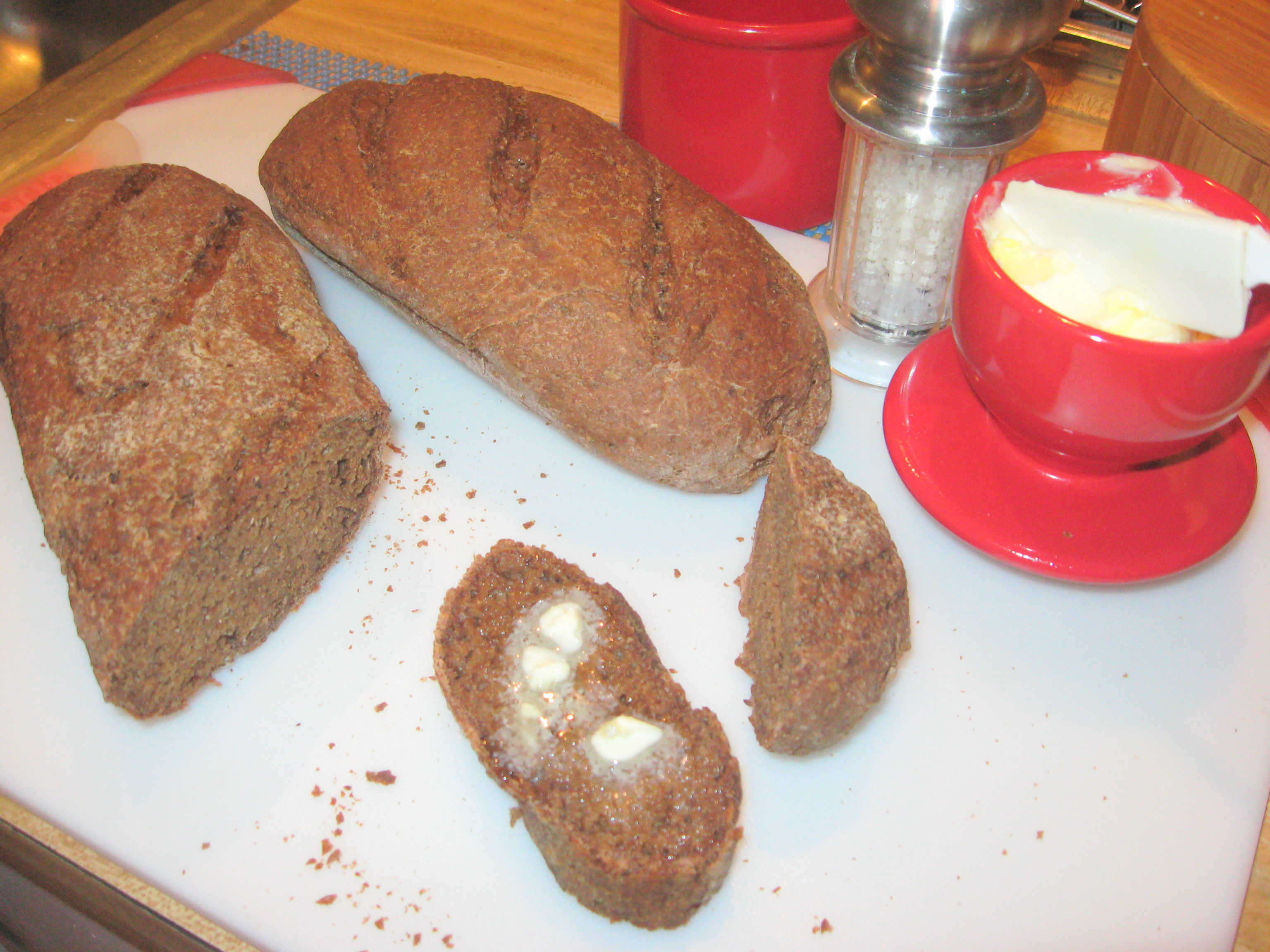
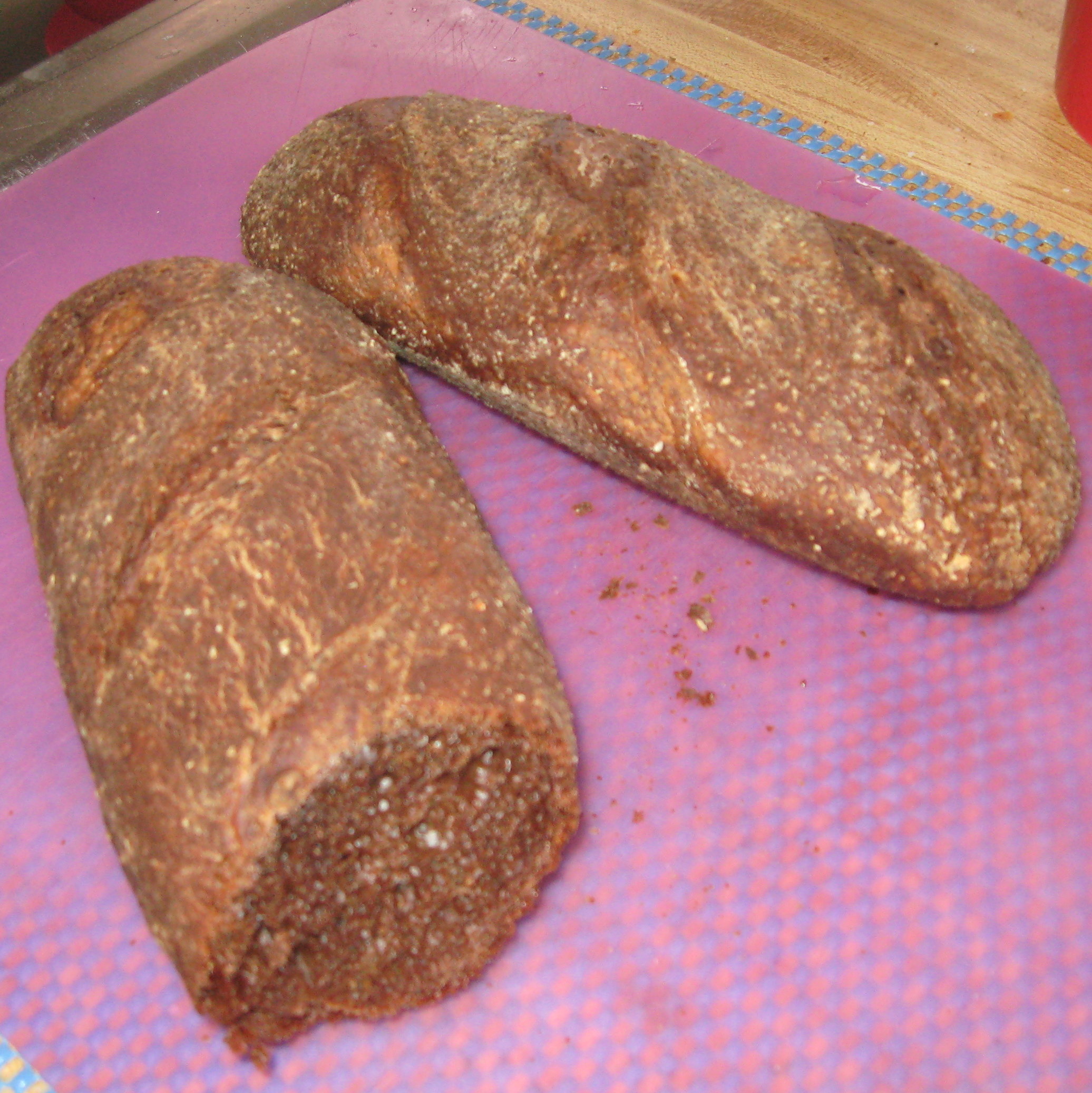
One loaf of pumpernickel bread on cutting board with butter-bellIt’s out of the oven now, and cooled just enough so I can ravage one of the loaves–I’m cutting the one that didn’t rise quite as well, but it’s a keeper.  As you would expect with more whole grain flour, it’s more dense than the first batch, but a good crumb–which I’m sure would have been better had I not cut it so soon.  The flavor is great–the cocoa powder did the trick to take up for the white whole wheat flour, and I think that the flaxseed meal is really undetectable.  The amount of caraway seed called for in this recipe was only 2 tablespoon for four loaves–so it stays as a kind of “dark” background flavor.

This will get made again–with the modifications.  I think that I can work with this (without caraway) to try to get the Russian black bread recipe (the Smitten Kitchen) adapted for the no-knead technique. (It’s not just that it’s no-knead–I have a KitchenAid® mixer.  The real attraction is that I can have this dough in the fridge for a long time–10 to 14 days–and have freshly baked bread quickly and often, too.)

I’m now enjoying my warm (actually, hot) freshly baked bread with some unsalted butter and a light sprinkle of sea salt since the butter has no salt.  I do have some radishes in the fridge to have a radish sandwich tomorrow after the bread has really cooled!  That will be time to break out the bubbly!

one whole loaf and one cut loaf with slice of bread with butter.

…A son goût!  

Under-appreciated veggies: Brussels sprouts

bagged Brussels sprouts at Harris Teeter supermarket

Brussels sprouts

Obviously I’m writing this because I have Brussels sprouts in hand now!  They are a favorite winter veggie in my kitchen but I think they are sometimes under-appreciated and under-used by those of us doing single-serving cooking, possibly because the come in packages that contain too many.  Some of these may be underused because we’ve had them prepared in ways that did not really let them make their best impression.  I thought I’d address some of these, especially the cool weather crops–starting with one that seems to be a love-it-or-hate-it vegetable: Brussels sprouts.  Until I started cooking for myself, I was in the hate-it camp.  Most of the Brussels sprouts that I had were over-cooked, mushy, and bitter; in a word, nasty!

Fortunately, I’ve discovered ways to make Brussels sprouts a desirable vegetable because they have some excellent qualities: they are  inexpensive and readily available in the wintertime.  They are nutritious–I’ll not give you all the details here, but you can find all that sort of information from the Nutrient Database Laboratory.  They are versatile–you can use them as a substitute for cabbage in some recipes, and (a concern if you’re cooking for one), they store well in the fridge.

First, storage:  Brussels sprouts often come prepackaged in a mesh bag that’s about a pound or so.  That’s a lot of Brussels sprouts if you’re cooking for one and had to use them all at one time.  Fortunately that’s not the case–they’re small, separate units so you are not trying to preserve a cut vegetable (always more difficult)–big bonus for those cooking for one.  I store mine with a paper towel that has been dampened and then squeezed mostly dry, in a partly open zipper-lock bag in the vegetable drawer.   I’ve seen suggestions (The Victory Garden Cookbook–see bibliography) that the flavor gets stronger with storage.  I’ve not found that to be a problem, but that may be because I do keep my fridge really cold, and the damp paper towel helps even out moisture. However, if you do find that you don’t like the taste after they’ve been stored for a few days, the other option of something to do with the rest of the bag would be to blanch and freeze part of them.  Blanching is simple:  bring a large pot of water to a boil, salt it heavily (after it’s come to a boil), and put in the Brussels sprouts for about 2 minutes; then “shock” in an ice bath, drain, and freeze.  (The purpose of the blanching is to stop enzyme action, and it keeps the color bright and green.)

Now for cooking them. Personally I’m not a fan of boiling veggies as a method of cooking them (other than blanching before freezing)–there are so many nutrients that are water soluble!  So my preference is for some cooking method that does not involve putting them into huge quantities of water to cook completely.  So that leaves steaming, stir-frying, roasting, and  microwaving.  The best way to avoid having “nasty” sprouts is NOT to overcook them.

I’ve added them to soups, used them instead of cabbage with braised pork, and added them to one-dish meals like roasted potatoes with sausages, and lots of other things.  They lend themselves well to improvisation and substitution.

Recipes for steaming, blanching, roasting and microwaving can be found in a number of cookbooks so I’ll not post here, except for the recipe that I just made to go along with my baked sweet potato.

For more information on how to cook and specific recipes, I suggest you might want to check The Victory Garden Cookbook by Marian Morash (see bibliography).  As I was sitting here at the computer writing this, my e-mail notification popped up and said it had received a notification of a new post from domestic diva M.D., a blog that I think is worth following for anyone who cooks.  I was surprised to see that the subject was  roasted Brussels sprouts.  

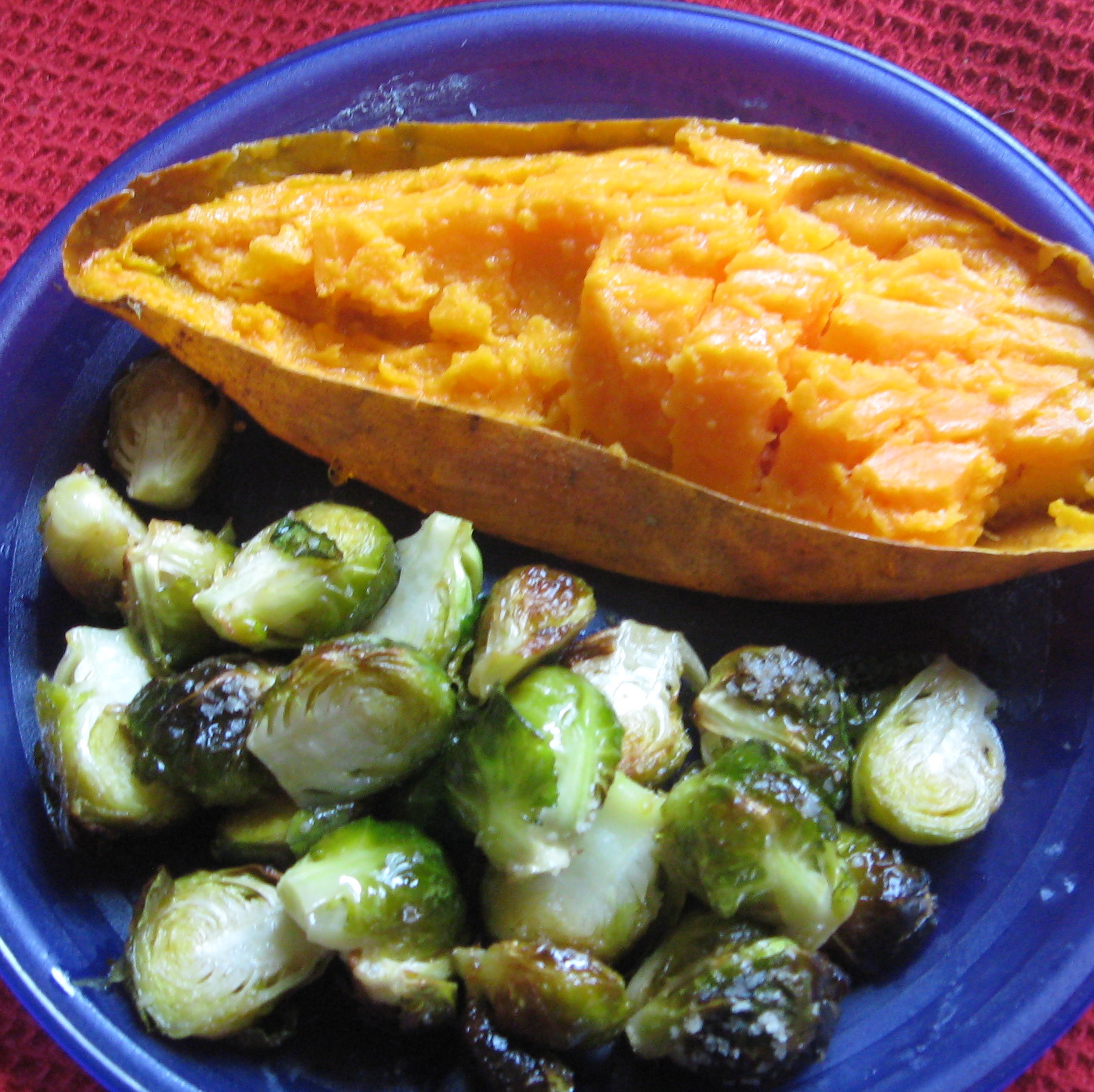
Since it was about lunch time, I was preheating the oven to bake a sweet potato (a very large sweet potato so that I’ll have some for another use as well).  I read the recipe and grabbed the last of the Brussels sprouts from the fridge.  I didn’t have the full amount, but this is a recipe that does not depend on the quantity–which is great for us solo cooks.  Since I was baking my potato in a 350 ° F oven, I did alter the cooking time just a bit–I popped the Brussels sprouts prepared as in the recipe into the oven for about 45 minutes right along side my sweet plate with half  a baked sweet potato and roasted Brussels sproutspotato, and there was my colorful, nutritious lunch!  This is the kind of improvisation that can make cooking for one easy–many recipes aren’t dependent on how many you have or how many you want to cook and eat right now.

You should check out this recipe.  I’d not used garlic powder with them before, but it was yummy and much easier to use than minced garlic.  One of the comments on this post suggested adding Parmesan cheese–I did not try that because I’m out of Parmigano-Reggiano (horrors!), but it sounds  like something that would taste great!

Oops–Pumpernickel bread without the caraway seeds

What better to do while we had our brief taste (so far) of winter than to bake some bread–the oven adding warmth to the kitchen and the smell of rising and baking bread adding some warmth for the soul as well.

My encounters with pumpernickel bread have been with deli sandwiches–and I cannot recall ever having had pumpernickel without the caraway seeds.  Rationally, I knew that a large part of what I tasted as “pumpernickel” was the caraway which, although I like it, is a pretty strong, defining flavor.

Loaves of pumpernickel

freshly baked

I’ve never had freshly baked pumpernickel bread so that seemed like a good thing to do.  I have always associated pumpernickel and rye breads with caraway seeds, so I wasn’t surprised to see caraway seeds in the list of ingredients.  Since I’ve been so pleased with the results of the “no knead” technique, I went to the recipe from Artisan Bread in Five Minutes a Day (p. 67) for my pumpernickel bread. I knew that I had all the unusual ingredients necessary for the recipe since I’ve been planning to try it for some time now and just hadn’t gotten around to it.  I had the unsweetened cocoa powder, caramel coloring, espresso powder, molasses, and caraway seeds.

After my bread had risen nicely I slashed the top, popped it into the oven and generated some steam by spraying water into the oven several times for the first couple minutes, and sat back to await the aroma of baking bread.  Wonderful!  About the time that I really began to smell it was when I realized that I had not sprinkled it with the caraway seeds–but, too late now.

It’s a very happy “oops” from my point of view.  When I tasted the warm bread  with some unsalted butter and a sprinkling of sea salt, it was an absolutely wonderful surprise–without the caraway seeds I was tasting this wonderful dark, slightly sweetish, slightly bitter (pleasantly, mind you) bread.  I loved it.  I’ve been making sandwiches with it for the last several days.  I’ll be making more of it without adding the seeds.

But I couldn’t get away from the fact that I’d never tasted it without caraway seeds before.  I started looking at recipes for pumpernickel bread in all my cookbooks, and online as well.  I wasn’t really surprised when I found that almost all of them included caraway seeds as part of the recipe.  I looked at the recipe for pumpernickel bread in Healthy Bread in Five Minutes a Day (“Bavarian-Style Whole Grain Pumpernickel Bread”, p. 115) and found that caraway seeds were called for in that recipe too.

Further searching lead me to a recipe for the “traditional” Westphalian pumpernickel–the unleavened version, and to other dark/black breads like peasant  black bread, Russian black bread.  Some had caraway seeds, some had fennel or anise seeds, and some had none.  While I used supermarket medium  rye flour rather than darker rye or pumpernickel flour (rye with bran left in), this sample has left me wanting to sample other “black” breads for which I found recipes while browsing through Bernard Clayton’s New Complete Book of Breads–like onion rye, sour cream rye, Russian black bread….

My online browsing lead me to the Smitten Kitchen for a recipe for black bread that sounds so intriguing–reading the list of ingredients trying to imagine the overall taste of this bread.  I’m so “addicted” to the no-knead technique, but I may have to give this one a try just to get a gestalt for the taste–and then maybe I can have a no-knead version.  This recipe calls for seeds–caraway, and fennel, as well as shallots, cider vinegar,  molasses and the chocolate/cocoa of the recipe that I just made.

I think that my next attempt at pumpernickel will be the recipe from Healthy Bread in Five Minutes a Day since that is a whole-grain bread, quite possibly without the seeds!  That may well be one to try to modify it to approximate the Russian black bread recipe from the Smitten Kitchen.

Though I want to try other recipes with other ingredients, I will certainly make pumpernickel again, both with and without the seeds.  I have visions of a wonderful hors d’oeuvre of crispy French radishes, unsalted butter, a sprinkle of sea salt, on unseeded pumpernickel or black bread of some sort, with a glass of champagne!

It’s good that I’ve remedied my cultural deprivation and discovered black breads to bake at home…Still have enough dough for 2 more loaves in the fridge.

Oat flour bread

Freshly baked oat flour bread

oat flour bread fresh from the oven

Bread is one of my favorite things–from the yeasty smell while it’s doing that last rise before going into the oven, while it’s baking, or just out of the oven while I’m waiting for it to cool a bit–to the crusty crunch of biting into a slice  fresh from the oven.

I’m addicted to having fresh bread when I want it, using the no-knead approach from Artisan Bread in Five Minutes a Day.   I’ve had great luck with every recipe that I’ve tried from this book–from the basic white bread to the brioche, including pita bread, rye bread, and now the oat flour sandwich loaf.

The stated intent of the oat flour recipe was to sneak more fiber and whole grain into the kids diet.  Since I don’t have to worry about the kid’s diet, only my own, I decided that I wanted more oat flavor and a different consistency–more like free-form boule or a loaf baked in an Italian pan.

I started with the “Oat Flour Bread” (pp.104-105) recipe in Artisan Bread in Five Minutes a Day” ,  then added the information gleaned from reading Healthy Bread in Five Minutes a Day on gluten requirements and characteristics of flours, I’ve been working on modifying the recipe to meet my particular desires:  first, more oat flavor, and second, a dough that can be baked free-form, or in an Italian perforated pan rather than a loaf pan.
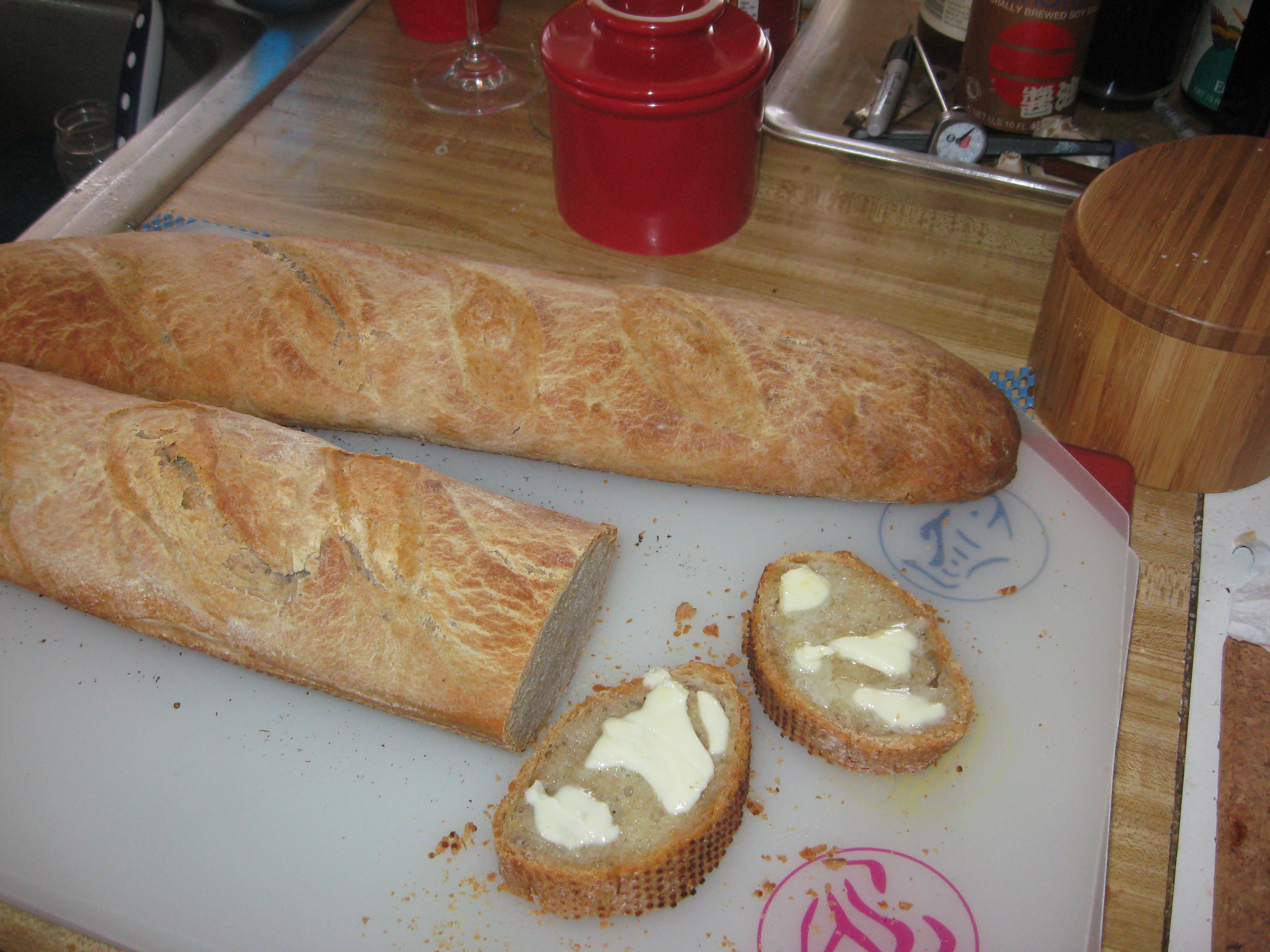
Oat flour bread dough for free-form loaf

Ingredients (3 one-pound loaves)

  • 3-1/4 cups lukewarm water
  • 2-1/2 cups oat flour (275 grams)
  • 1-1/2 tablespoons vital gluten (about 1-2 teaspoons per cup of whole grain flour)
  • 4 cups unbleached, all-purpose flour (King Arthur is my preference)
  • 1-1/2 tablespoon salt
  • 1-1/2 tablespoon granulated yeast

Preparation

  • Measure out and whisk together the dry ingredients (except for salt and yeast). When you’re adding vital gluten you need to be sure it’s well mixed with the flour before you add liquid or it can form lumps.
  • Combine lukewarm water, salt and yeast in the mixing bowl and gradually add the dry ingredients.  If you’re using a stand mixer, use the paddle instead of the dough hook.
  • Place in a covered, but not air-tight container, and allow to rise until doubled in volume; then refrigerate.
  • Pull of the amount of dough needed and shape as directed, and bake in an oven preheated to 400 ° F for about 45 minutes to 1 hour.
◊♦◊
perforated italian loaf pan

Italian loaf pan (perforated

I like to bake my bread in an Italian loaf  pan (bigger than a baguette pan), since it’s just the right diameter to slice the bread on a diagonal and have a good size for a small sandwich. For me this is an effort at mindful eating and  portion control–rather than “dieting”.   This would do well in a baguette pan for good crusty bread if you don’t want to use it for sandwiches.  The Italian pan gives with some of the good parts of a baguette when it’s fresh out of the oven, but the flexibility to have sandwiches later as well.

loaves fresh from the oven, one cut, one whole

yum!

Whole wheat pita bread

Baba ghanoush with olive oil and parsleyNow that you have baba ghanoush, you need something to dip in it.  Crudities are always good—and healthy, especially in the summer when there are grape tomatoes, cucumbers, celery, or even blanched green beans.  The traditional thing to have with baba ghanoush, however, is pita bread.  I’m sure that you can find pita at your market but it’s very easy to make and tastes so good freshly baked.

I’ve posted about the no-knead bread dough that can be kept in the refrigerator for about two weeks.  You can use that same dough to make flat breads (pita included), crackers, pizza crust, and the like as well.  It’s just a matter of how you treat the dough.

The same authors who did Artisan Bread in Five Minutes a Day now have another book out:  Healthy Bread in Five Minutes a Day.  This no-knead method is SO easy, and works so well for single-serving cooking that I had to try this one too.

The master recipe in this is for a whole-wheat bread.  That basic dough can be used for pita bread as well.   That master recipe can be found on one of my favorite food-related blogs, Former Chef–so I’ll not reproduce it here.   I’ve made this recipe using white whole wheat flour.  I’ll admit that I’m partial to King Arthur flours; it’s available in my supermarket–so that is what I’ve used.

Pita bread

just out of the oven…

To make pita bread you don’t need to let the dough rise before baking so it’s very quick.  Just develop the gluten cloak  in the usual way. Since I wanted to do smaller pitas, I used about 75 to 100 grams of dough for each portion, “cloaking” each small portion and flattening it, rolling it out to about 1/8 inch thickness.

Since I did four at a time, I baked them on parchment paper on a baking sheet rather than directly on the stone.  With the 450 to 500 ° F oven it takes only about

Remove from the oven and wrap in a towel on a cooling rack.  They may “deflate”,

but the “pocket” is still there.   Pitas made from whole-grain flours may not puff as much as if made from unbleached all-purpose  white flour.

Since these are not crusty, you can store in a plastic bag.

A must-try dessert

Since I’ve gotten Trillian installed I get all these quick updates from Twitter and Facebook zipping across my desktop. This one, given that it’s berry season,  looked like something I should pass on.

I’m not usually “into” cakes particularly, but I do have a weakness for good pound cake, especially with fresh berries, figs, and good ice cream.  (Good pound cake means one that does not shy away from the good stuff like butter.)

It’s from David Lebovitz. If this recipe is anywhere near as tasty as the recipes in The Perfect Scoop, it will be a real keeper! Take a look at this Bay-leaf-infused Pound Cake!

Lemon cake

Seems that a lot of thing lately have been absolutely screaming summertime to me.  I was browsing some of my favorite websites this afternoon and came across a recipe that looked just fabulous.  As you can tell from most of my posts, I’ve not said much about sweets…but this was one that really made me salivate: Meyer Lemon Lavender Cake.

That link will take you to the recipe on one of my favorite blogs, Former Chef.  That’s a great website to look for recipes.

A sweet treat

Holiday time is coming up so I want to introduce you to something special that you can do, even for one:  brioche filled with chocolate ganache.  While it’s baking, you home will smell like a bit of heaven.  I’m going to share with you a recipe that I will abridge and paraphrase from Artisan Bread in Five Minutes a Day by Jeff Hertzberg and Zoë Francois to demonstrate the range of recipes available in their books, and how adaptable they are to cooking for one. The full recipe (well worth having) is found on page 189 of the book. It’s a recipe that is easily doubled or halved.

Brioche (unfilled)

Ingredients: Makes four 1-pound loaves.

  • 1-1/2 cups lukewarm water
  • 1-1/2 tablespoons granulated yeast
  • 1-1/2 tablespoons (kosher) salt
  • 8 eggs lightly beaten
  • 1/2 cup honey
  • 1-1/2 cups (3 sticks) unsalted butter, melted
  • additional butter for greasing the pan
  • 7-1/2 cups unbleached all-purpose flour
  • egg wash (1 egg beaten with 1 tablespoon of water)

Assembling the dough:

  1. Mix the yeast, salt, eggs, honey, and melted butter with the water in a 5-quart bowl (or lidded, but not air-tight) food-grade container. (You will store the dough in the refrigerator in this.)
  2. Mix in the flour without kneading, using a wooden spoon. You may need to use wet hands to fully incorporate the last bit of flour.  The dough is loose but will become firm when chilled.  You should not try to work with it until it has chilled for 24 hours.  There may be lumps in the dough, but they will (mine did though I was uneasy about this on the first batch).
  3. Cover (not airtight) and allow to rest at room temperature until the dough rises and collapses or at least flattens on top.  This takes about 2 hours.
  4. Refrigerate in the container; it can be used over the next 5 days; for longer, you should portion and freeze the dough.

Baking the brioche:

  1. Grease a 9 x 4 x 3-inch nonstick loaf pan.
  2. Dust the surface of the dough with flour and cut off a 1-pound (grapefruit-size) piece of dough.  Dust this piece with more flour and quickly shape (see link to videos demonstrating this in my post “Smell the fresh bread”.)
  3. Elongate into an oval and place in the prepared pan and allow it to rest for 1 hour and 20 minutes, covered lightly with a cloth or plastic wrap if it is dry in your home.
  4. About 5 to 10 minutes before baking time preheat the oven to 350 ° F.  If you are using a stone in the oven then you will need to preheat the oven for about 20 minutes.
  5. Using a pastry brush, brush the top of the loaf with the egg wash.
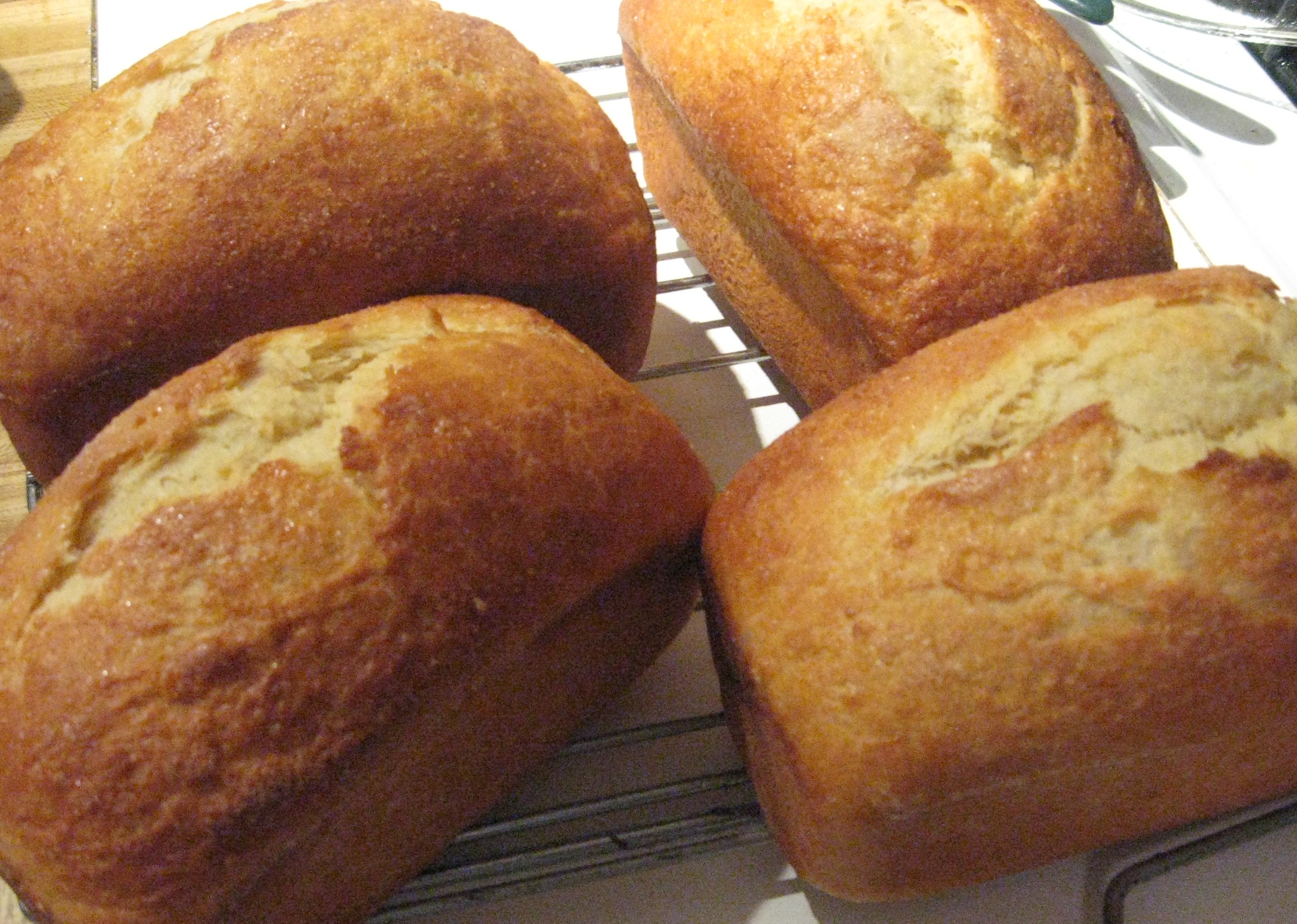
  6. Place the bread near the center of the oven and bake for 35-40 minutes.  It should be a lovely medium golden brown.  It does not form a hard crust because of the fat in the dough.
  7. Allow to cool before slicing and eating.  (I can tell you this part is really hard!)

Brioche

Brioche Filled with Chocolate Ganache (page 195)

This calls for good quality chocolate.  I have always used Valrhona chocolate for this.  It’s worth the splurge to have very good chocolate–after all, you are not likely to be eating this every day.

Note:  This dough can become very soft in hot weather or in a very warm room.  To keep the dough cool while rolling it out, fill two or three zipper lock bags with water and lay them flat in the freezer until frozen solid; use these under an upside-down lipped baking sheet to roll out the dough.  This will keep it cool and easier to work with, but you still need to work quickly.

Ingredients:

  • A 1-pound portion of the brioche dough above.
  • 1/4 pound bittersweet chocolate (Valrhona or equivalent)finely chopped.
  • 2 tablespoons unsalted butter (plus more for greasing the pan)
  • 4 teaspoons unsweetened cocoa powder (Valrhona or equivalent here too).
  • 1 tablespoon of rum or Chambord (optional).
  • 5 tablespoons corn syrup
  • 1 egg white, lightly beaten with 1 tablespoon water
  • Granulated sugar for sprinkling on top.

Making the ganache:

  1. Melt the chocolate in a double boiler or in the microwave until smooth; be careful not to burn it.
  2. Remove the chocolate from the heat and stir in the butter thoroughly.
  3. Stir in the cocoa powder into the rum or liqueur if using.  Otherwise, stir in the corn syrup and mix until smooth.
  4. Add to the chocolate.

Assembling the brioche:

  1. Lightly butter a nonstick 9 x 4 x 3-inch pan.  Take a 1-pound piece of dough as described above, and shape it into a ball, as above.
  2. Using a rolling-pin, roll out the dough into a 1/4-inch thick rectangle; dust with flour as needed.
  3. Spread 1/2 cup of ganache evenly over the dough, keeping a 1-inch border all around the edge.
  4. Starting at the short end, roll up the dough, sealing the bare edges.  Tuck loose ends underneath and place in the prepared pan.
  5. Allow it to rest for 1 hour and 40 minutes.

Baking the brioche:

  1. Preheat the oven to 350 ° F at least 5-10 minutes.
  2. Using a pastry brush, apply the egg white wash to the top of the loaf.  Sprinkle lightly with granulated sugar.
  3. Bake for about 45 minutes, or until golden brown and the sugar on top has caramelized.  (The loaf will likely split in places during baking and some of the ganache will show through, but it just looks so good with the chocolate peeking out!)
  4. Remove it from the pan and let the brioche cool slightly.
  5. Drizzle the rest of the ganache (1/4 cup) over the top crust.  Cool completely and slice.  (This really does need to cool completely before slicing–don’t be tempted to cut it while warm.

There you have it–a serious treat.  It’s very easy to make smaller filled brioches in small “mini” pans, but I’ve found you need to roll out the brioche dough more thinly for the “mini” loaves–otherwise the filling and the brioche are out of balance.  Of course this will take a smaller amount of ganache per loaf.  I have to confess to making more of the smaller loaves, and NOT drizzling the ganache on top, but just letting the sugar and the ganache peeking out from inside  be the finish on the top.

Now you want to know, what else can you do with this dough?  There are recipes in the book for filled breads, pastry, rolls, and other treats that you can make so easily.   You can vary the filling–I’ve done it with good ginger preserves, and orange marmalade too.  Lots of room to please your palate.

The basic brioche is wonderful toasted, makes a great grilled ham and  cheese sandwich (croque monsieur, if you wish, to be in keeping with the brioche).

Think what a great gift a loaf of plain brioche or the filled brioche would make.  Though I don’t make it often (diet!) I like to have friends in for a mid-morning slice of the filled brioche and hot chocolate to give us a wonderful chocolate fix!

Remember that you can halve the recipe easily so it’s very adaptable for almost single-serving cooking, but there really is some big-time taste here.  If you appreciate  breads, this book gives recipes for a huge variety that are all easy to portion  as appropriate for one person.