Smoked salmon salad

It was  just hot enough this evening that I didn’t really want to cook–not all that hungry, but wanted something easy and light.  Rummaging in the pantry, I found that I had Chicken of the Sea wild-caught, smoked Pacific (Alaskan) salmon in the pouches, so I made a salad to have with some good crisp flatbread and fruit (melon and cherries) on the side.

Quantities are approximations–precise measurement is certainly not necessary to make something like this–use your judgement.

Ingredients: 

  • approximately 1/3 to 1/2 cup sweet onion, diced
  • approximately 1/3 to 1/2 cup cucumber (seeded if needed), diced
  • two packages (6 ounces) smoked salmon slightly broken up into chunks
  • lemon juice to taste
  • lemon zest to taste (about 1/8 to 1/4 teaspoon
  • drizzle of extra-virgin olive oil sufficient to moisten
  • fresh-ground black pepper to taste
  • salt to taste  (taste before adding any
Assembly:  combine all ingredients and mix gently.  Taste and adjust seasoning.
Variations:
  • replace extra-virgin olive oil with a dollop of sour cream and add chopped fresh dill
  • if you have leftover grilled or griddled salmon steak or fillet this is even better
  • if you are not using smoked salmon, a dash of chipotle chile powder gives a bit of smoky taste and zip
  • add minced green or red chile pepper (jalapeño, poblano or serrano) to taste.
There are all sorts of possible variations here…fix it to suit yourself.
A son goût!  

Growing your own herbs

Whether you have a huge garden, or just a deck with some pots, you can grow herbs.  For me having fresh herbs makes cooking for one easy and exciting.  Just having the herbs around where you smell them when you brush against them can be inspirational.

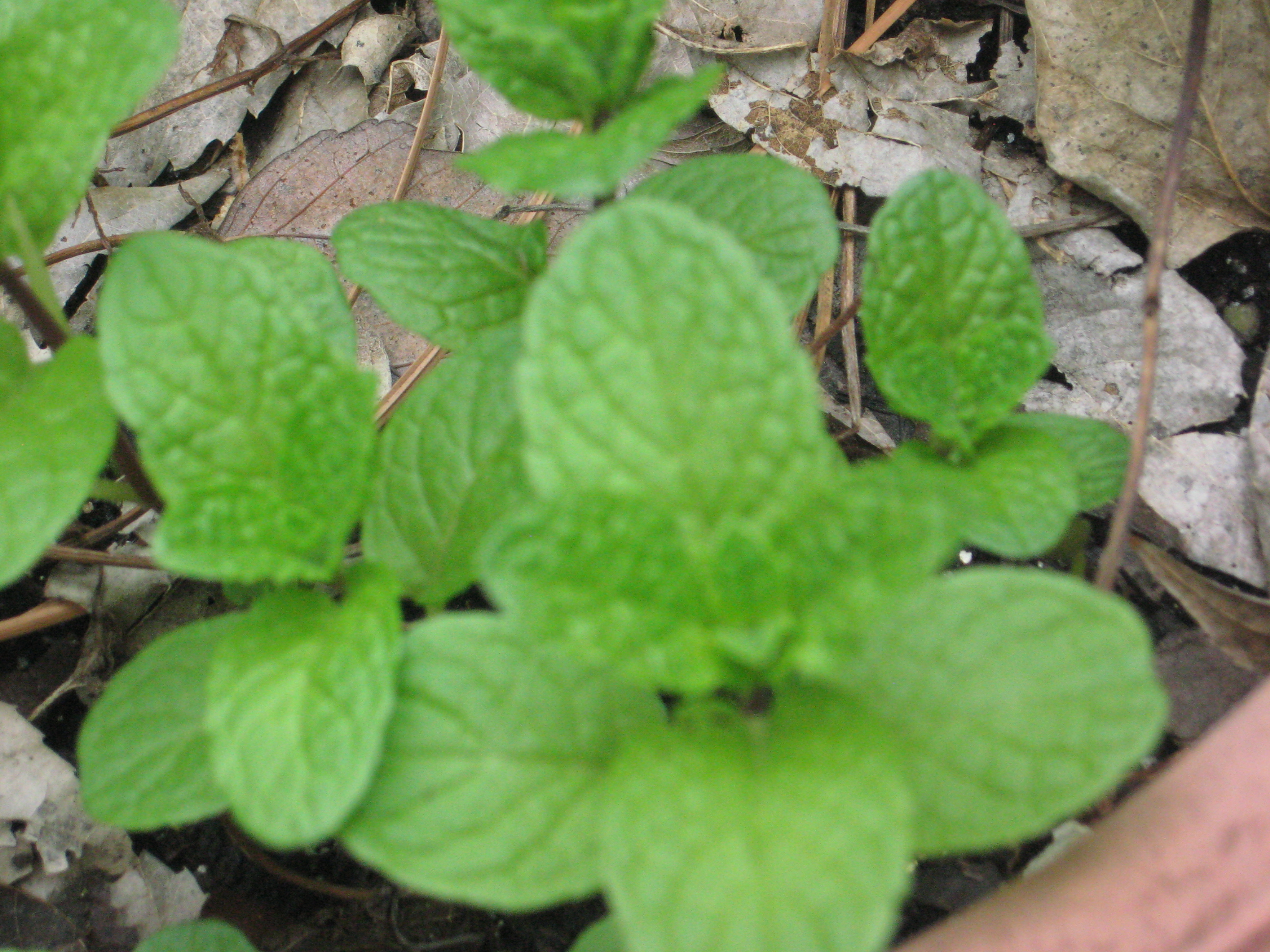
Mentha spicata 'Kentucky Colonel'

Mentha spicata 'Kentucky Colonel'

Herbs pretty unfussy plants to grow–generally they like sun, and want the soil to be well drained.  Some are more drought-tolerant than others and some are more sun-tolerant than other; a few even like a bit of shade.

You can use a wide variety of containers–plastic, ceramic, wood…just be sure that there are holes in the bottom for good drainage.  Herbs really do not like wet feet.  I prefer to put my herbs in fairly large plastic containers since it reduces the need for watering in hot weather–a six-inch pot is about the smallest that I will use. Smaller than that and you’ll spend a lot of time watering in hot weather.

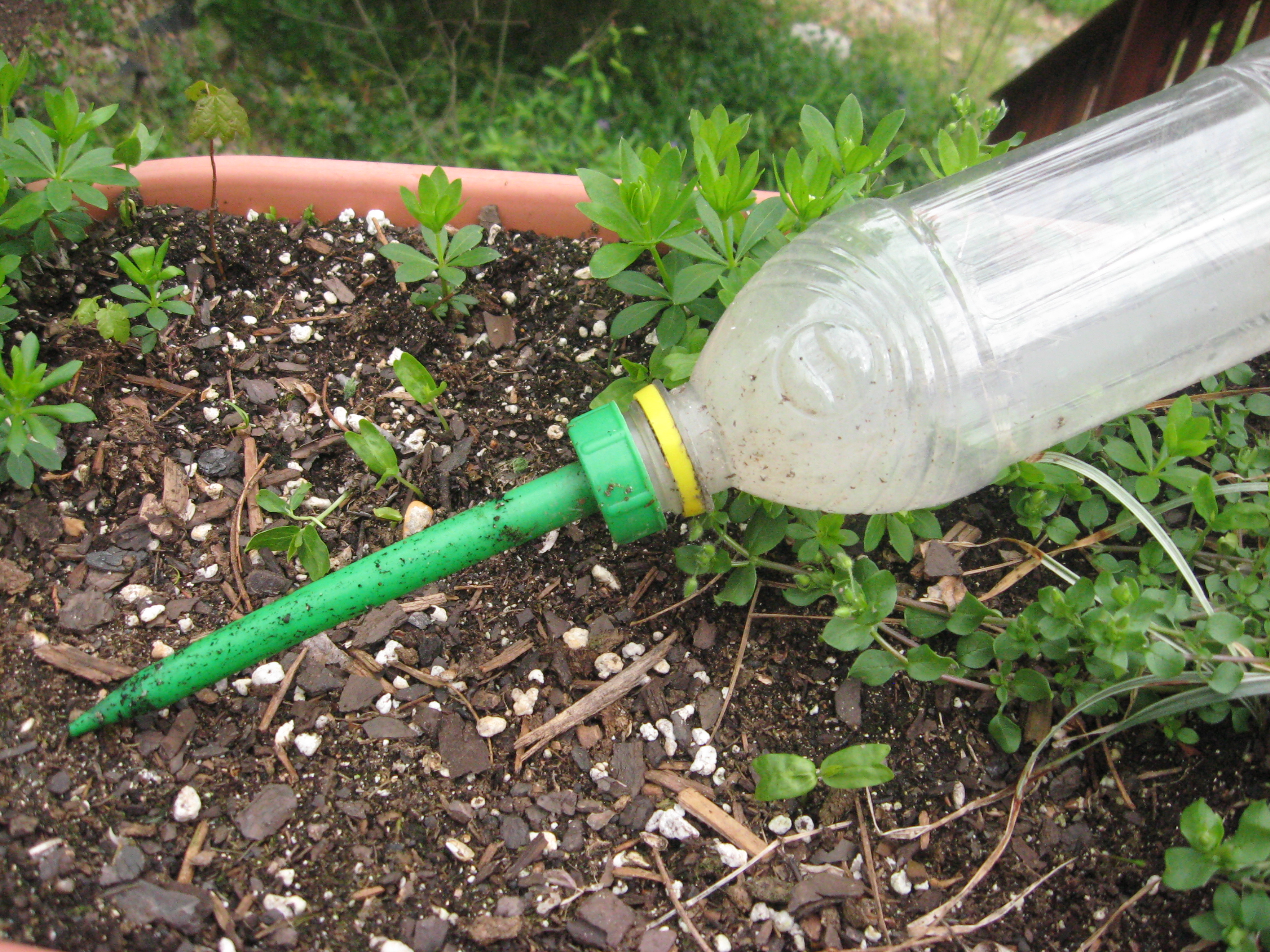
Though not glamorous, my favorite device for keeping herbs happy in hot weather is a spike that screws onto a one-liter (or two-liter) soft-drink bottle which is then stuck into the pot.  It delivers water slowly to the roots where it’s needed.   I catch rainwater in a five-gallon bucket to fill the bottles rather than using tap water.  You’ll see these in use in some of the pictures.  Locally, I can find these at Stone Bros. & Byrd.  They are also available in garden supply catalogs and seed catalogs.

We usually hear herbs characterized as “full sun” plants–that really means that most of them need at least six hours of sun a day; many are happy sitting around in the sun all day–but you have to take your climate into account.  An herb that might be wonderfully happy in all-day sun in the Pacific Northwest might not survive all-day sun in the southern U.S.  As you grow herbs you will learn to look at them and know if they are happy or not.
Herb-Gallium Odorata IMG_3834-1

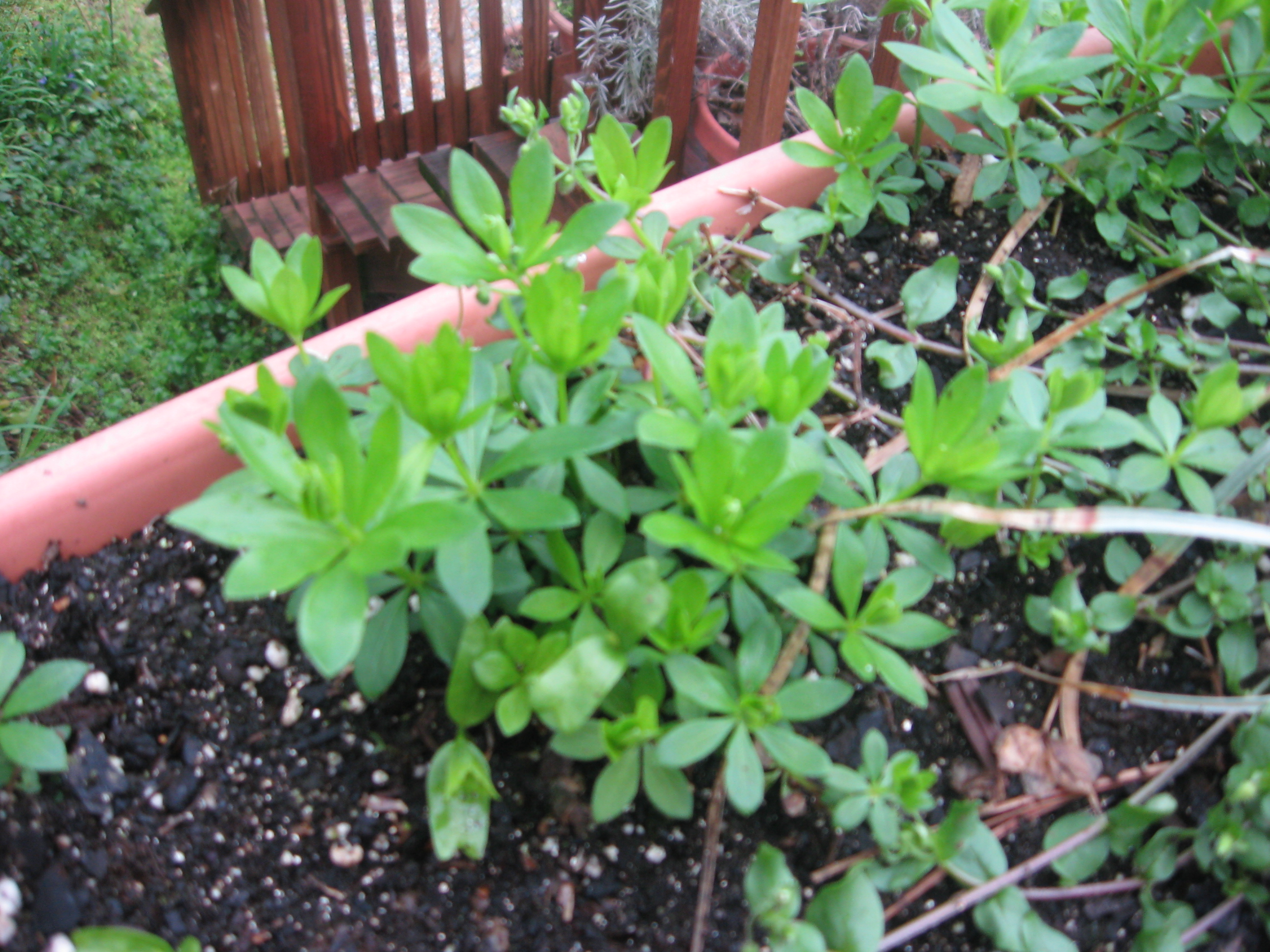
Sweet Woodruff (Gallium odorata)

Some herbs such as sorrel, chervil, sweet cecily, sweet woodruff, and lemon balm would rather have some shade.  If you are planting them in the garden, you need to consider the position of the sun in all seasons of the year, and the presence (or absence) of trees that will leaf out in the summer.  One of the advantages of growing herbs in containers is that you can move them around to give them optimal sun and shade. No matter what the soil you use, if the sun is not there you’ll have spindly, leggy herbs without much flavor and  they will be prone to disease.

Soil is next in importance to sun for growing herbs.  An additional advantage of growing herbs in containers is that you control the soil. Herbs must have good drainage whether in the garden or in containers. (I suspect that many of us who cook for one will be growing them in containers, so that will be my focus.) I use potting soil from a reputable garden supply center.  I know that it’s not going to have diseases carried in it, and I know that it’s formulated to drain well as long as I put it in a  pot with appropriate drain holes, and that it will also hold water in an appropriate manner as well.  It’s a happy medium that I don’t have to fuss with–I can just plant herbs and cook with them.

Many of the herbs that we grow are perennials, so they won’t be moved and may not even be repotted every year, so it’s important to have good soil.  If they are planted in a large pot they may need only top dressing between times when they become root-bound and need to be divided or repotted.  I may fertilize more in the second year that they are in the same pot if it looks as if it is needed.

For many herbs I plant several in a much bigger pot–12 to 14 inches.  It looks great and watering frequency is reduced.  You do need to consider what herbs to plant together because of the differences in their likes for soil moisture and feeding.  Many of the Mediterranean  herbs (oregano, marjoram, thyme, rosemary, lavender) are very drought tolerant once established and need less water. Not so with basils:  basil likes sun, but likes evenly moist soil; I might plant several varieties of basil together in a large pot, or even have a basil plant share a large pot with a tomato plant, but I’d not mix basil with oregano and marjoram because of the differences in watering needs.

Basil (a fast-growing annual herb) is, in contrast to perennials (sage, oregano) is a heavy feeder as well; it will need to be “fed” more often–perhaps a dilute (quarter-strength) solution of all-purpose plant food or fish emulsion monthly. You need to consider the appetites of your herbs, as well as their proclivity for sitting in the sun, before you put them all together in a big pot.  Once you get perennials established they will provide much enjoyment with very little effort.

Some herbs which can be very invasive should be kept in separate pots: lemon balm (Melissa officinalis) and mints, for example.  Other herbs simply do not do well in pots because they develop deep taproots, e.g. dill–and you cannot provide depth enough in a reasonable sized pot for them to do  well.  Others are simply too big for planting in containers (e.g.  angelica and borage) that we’d use here.  More varieties are being developed that are “dwarf” and are suited to containers.  While many dills (such as Anethum graveolens ‘Mammoth’)  do not do well in containers, there are some dwarf varieties (Delikat and Fernleaf) that are suitable for containers.

You’ve got containers, and soil.  Do you start with seeds or with plants?  Many garden centers will have herb plants, but they may not have a large selection of different varieties–you may only be able to get a generic “sage” or “thyme”.  One of the joys of herbs is seeking out different flavors and those that are especially  aromatic, with high levels of essential oils.  The “tarragon” that you find in the big-box garden center may not be French tarragon (Artemesia dracunculus, var. sativa) which is what you want.  The oregano that you find there may not be Greek oregano, but Italian oregano, which is really sweet marjoram (Origanum marjorana).  You’ll want to find a good garden center, or try farmers’ markets in the spring.  Those growers will likely know more about the varieties of herbs that they have.

Buying plants is probably the best way to start growing herbs.  Starting from seeds gives you more possibilities, but you have extra seeds, the difficulties of getting them to germinate; some are slow growing, so you won’t be able to use them as quickly.  It can literally take weeks for some to germinate, the germination rate may be poor (e.g. Stevia), and then many more weeks before you can harvest for use in cooking, and that is really the point of growing your own herbs.  You want to smell and taste them, and season your food with them.

I’m addicted to having fresh herbs at my doorstep…I’m also picky about what varieties I have, so I usually start with seeds.  It also means that I wait impatiently to see if the seeds are going to germinate, and for the tiny  plants to get big enough to transplant, and then to harvest.  It’s always fun to try new varieties.  You do find out that all plants labeled “sage” are not the same.  Starting from seeds, there is always variability in the plants so some may be more aromatic than others.  When you are purchasing a plant, you should crush a leaf and smell it to be sure that it’s what you want–fragrant and potent.  Only plants taken from cuttings will be exactly the same.  Some herbs can only be propagated by cuttings (French tarragon, for example) so you want to be sure that is what you get. (That’s why I’m giving you the botanical names with the common names of the herbs.)

If you get to the point where you hanker to try a new variety of mint, or basil, there are suppliers from whom you can order plants that you cannot find locally.   Just for fun you might want to browse Richters Herbs , Johnny’s Selected Seeds, or Mountain Valley Growers just to get an idea of the wonderful variety that is available.  (Mountain Valley Growers has some wonderful recipes on their website for herbs too.)

There will be more on selecting plants and growing specific herbs coming soon.

Pot roast with brown gravy

You’ll notice that I said “gravy”–this is too much of a comfort food to use “sauce” because what you’re getting is plain, down-home gravy that needs bread or potatoes to complement it.

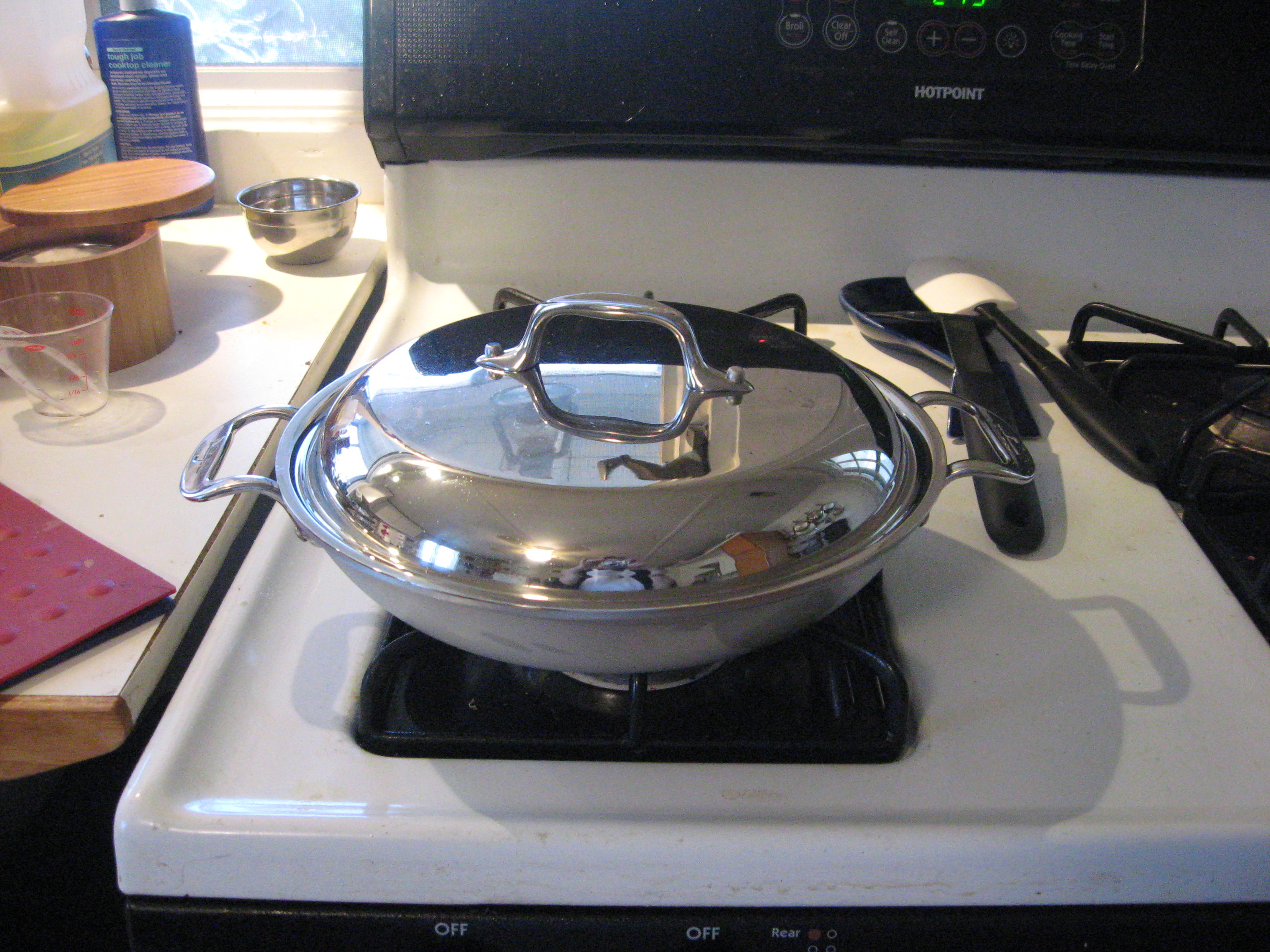
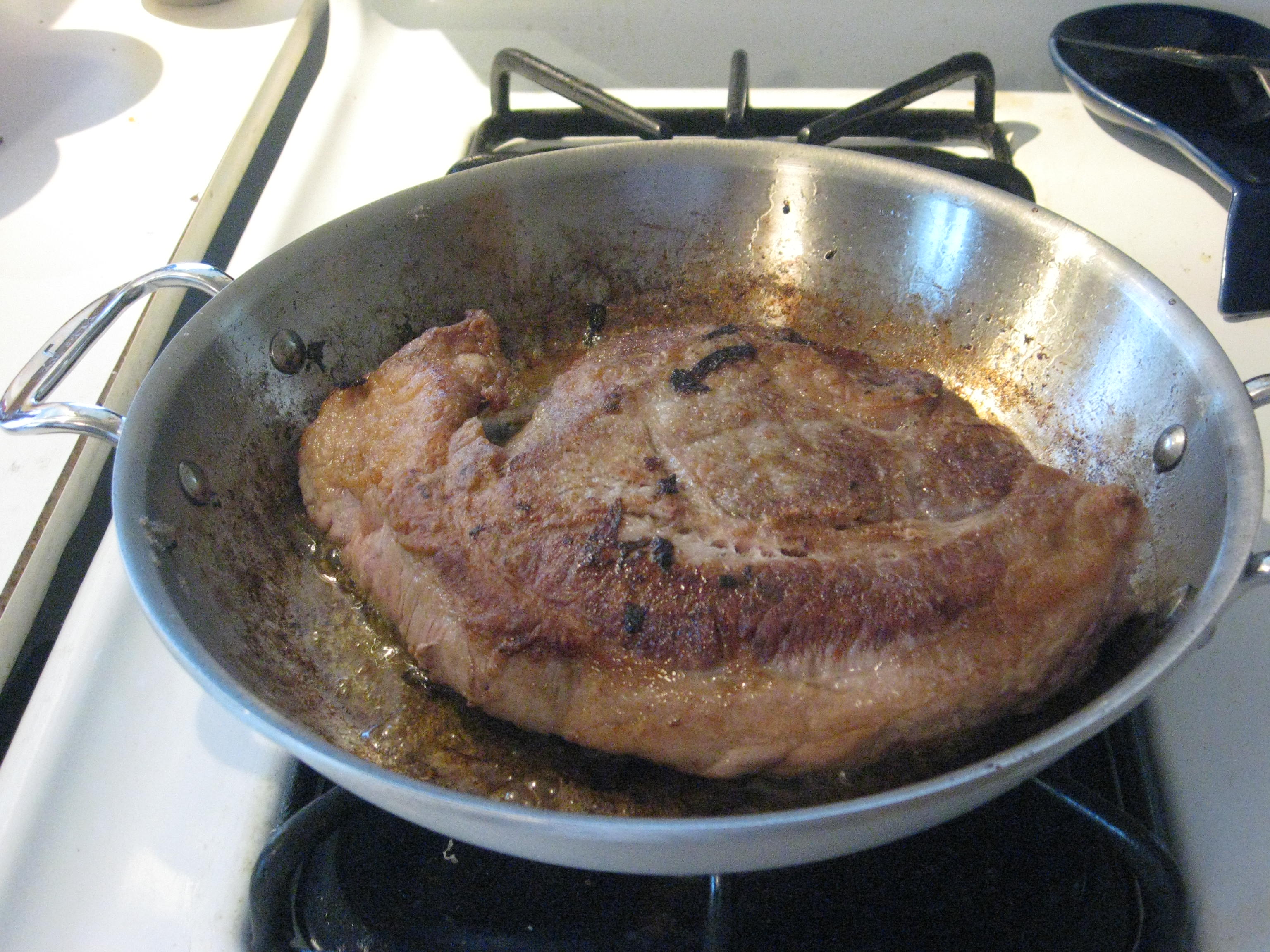
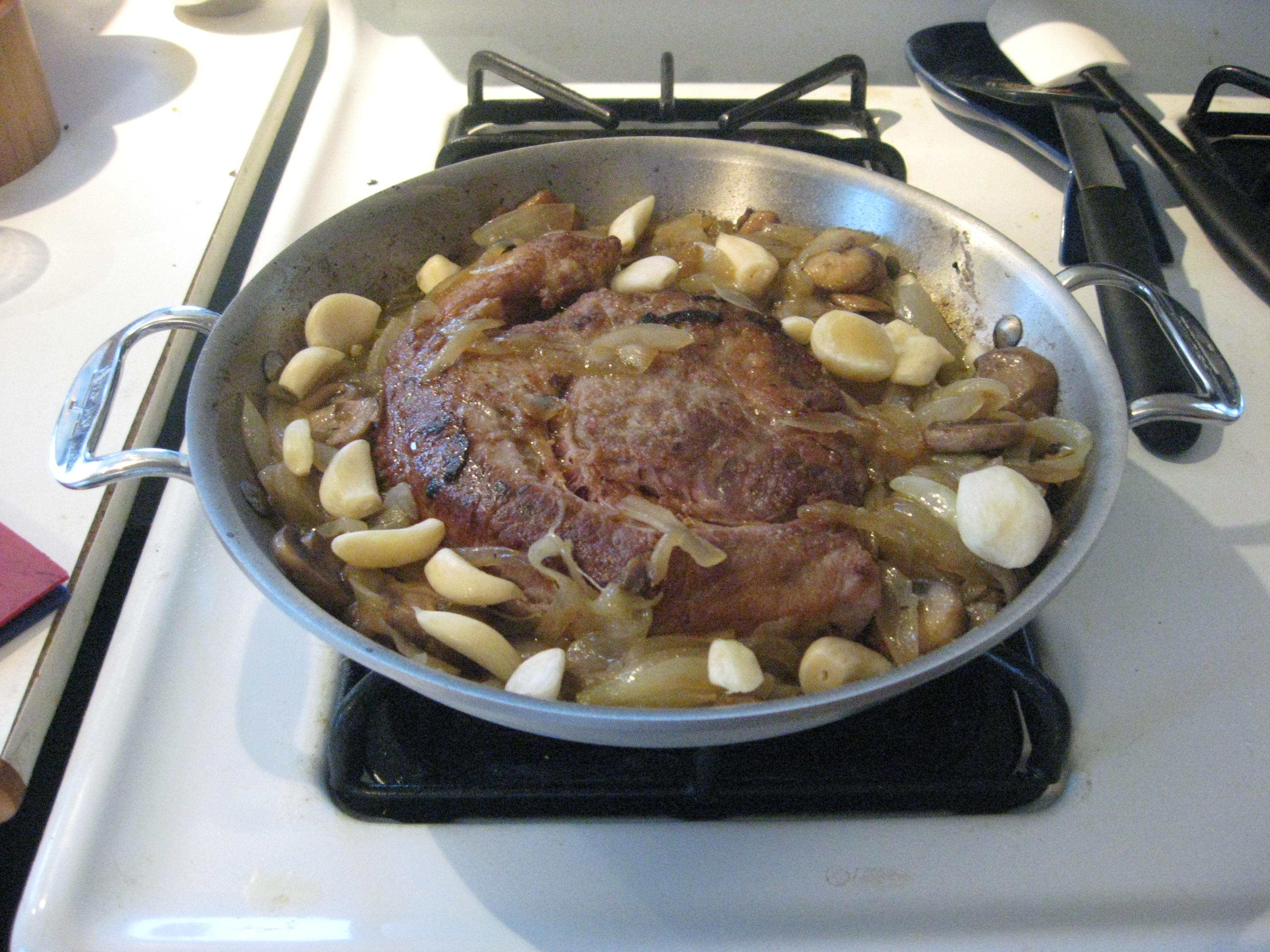
After I got my Christmas present (See The Petit Brasier) I had to give it an immediate test run.  What better to test than a favorite braised dish:  pot roast.  This was nothing fancy at all.  You’ll note that I’m not even saying it had a sauce–I really did mean good, old-fashioned, down-home, satisfying brown gravy, lots of onions, and good tender beef.

Even though I say I dislike leftovers, there are some exceptions and pot roast is one of the exceptions.  Sometimes I get the great big chuck roast and make a lot of it and put it in the freezer in single-serving packages, right with the chili, the stock, and some soups so that I can have an “instant” meal–the microwave is great for defrosting and individual portion.  I don’t always want to have to pack and freeze leftovers, so with the small braiser, and a cooperative butcher or meat department at the supermarket, I can make a small pot roast that’s good for two, or maybe three meals since there are some very easy ways to kind of spiff it up for the reruns.

This is really not a recipe–it’s a happening–quantities are approximate as the amount of oil you need will vary with the size of you pan, the amount of mushrooms and onions you are going to sauté–just use what you need.  (Improvise! Wing it!  Just do it–it will work.)

Ingredients

  • 1-1/2 to 1-3/4 pound piece of chuck roast
  • 4 or 5 small onions (or 3 medium to large ones) sliced moderately thinly
  • 2 teaspoons flour, plus flour for dredging the beef
  • about 3 tablespoons olive oil (divided as needed for  sautéing mushrooms and onions.
  • 8 ounces of mushrooms, sliced (more if you really like mushrooms)
  • 1 to 1-1/2 cups of water or stock
  • salt and fresh-ground black pepper to taste
  • about 8-10 medium garlic cloves.

Preparation

  1. Pat the pot roast dry with paper towels and dredge in a flour seasoned with salt and pepper.  Let it stand while you cook the onions and mushrooms.
  2. Slice the mushrooms and sauté in a little of the olive oil until they release their liquid and brown.  When brown and liquid has evaporated, remove to a bowl.
  3. Add a bit more olive oil, and sauté the sliced onions until they start to brown and caramelize.  When partly browned, remove to a bowl with the mushrooms.
  4. Add the additional olive oil, as needed, and brown the beef well on both sides. Put it to the side for final assembly.
  5. Take the rest of the olive oil, and the 2 teaspoons of flour, and brown the flour in the oil until it turns a nice golden brown and smells toasty.  Turn the heat down, add the stock or water to the browned flour.
  6. Add the sautéd onions and mushrooms, and return the browned roast to the pan, with the onion/mushroom mixture around the sides, sprinkle the garlic cloves over the top.
  7. Bring to a simmer on the stove top, cover and place in a 295-300 ° F oven and cook until fork tender–about 2-3 hours (unattended).  Check periodically to see if you need to add more liquid.  You need just enough to make nice thick gravy, and the onions are going to cook down to help thicken the gravy.

For that first meal, all you really need is a salad, maybe a baked potato….or some noodles.For the second serving, stir a tiny dollop of sour cream into the portion of brown gravy for this serving to add some tang and be a bit “stroganoff-ish”, add some steam-sautéd (See Cooking Vegetables Quickly) carrots, or spinach as a side.   What about the third?  As you reheat, add some tomato paste, or some tomato sauce to the last bit for a different taste.

It’s pure unadulterated comfort food.  Even if it’s not a single serving, it’s an appropriate quantity for small-time cooking, but it sure has big-time taste.  It’s great what having the right size pan does for cooking for one.

A son goût!

Where do I find recipes?

While one of the secrets of cooking for one easily is learning to improvise, I can understand some hesitancy to throw thing into the pot without some guidance–it is a learned skill.  If you are not one of us who avidly reads cookbooks, and owns a few dozen or more, and you are not up to just improvising, where do you find recipes to start with?  I’ve mentioned a few cookbooks that I think are good to get you started on improvising dishes and meals, but I can understand that you might not want to go out and buy cookbooks, so I’m going to suggest some places where you can find recipes.

First, check some of  the blogs that I have listed on my blog roll: Former Chef and Closet Cooking both have some delightful recipes.  Another source that I recommend is Mark Bittman’s column The Minimalist in the New York Times.  The author stresses a few good ingredients for great flavor rather than complicated dishes, so that makes it particularly good if you are trying to work into improvisations of your own.

A neighbor and friend just introduced me to another website that might well be worth exploring:  All Recipes.com.  A neighbor (who also cooks for one) has shared some of the dishes that she has made following recipes from this site, and they have been excellent:  a braised cabbage with keilbasa, and a chicken soup using adzuki beans and kale. This website does require registration, but it is free.  A feature of this website that might be most useful to you if you are just starting with improvisations and changing recipe sizes is a calculator that will do this for you–you do not even have to do the math.  This should help you get a feel for doing this with other recipes.  There are lots of recipes here, ranging from some that use canned ingredients (for example, condensed soup and mixed vegetables) to those using fresh ingredients–you get to choose.

Since I’m a soup lover, and soup usually keeps well, and lends itself to “re-seasoning” and adding additional ingredients to change it, I have found the Swanson Broth website to be useful.  Obviously, I prefer homemade stocks and broths, but there are times when it just isn’t possible; you need some “convenience” ingredients like canned broth in the pantry.  I’ve found Swanson broth to be acceptable.  They have some great, quick recipes which, while they tout Swanson broth and stocks, are very usually use no other processed/prepared ingredients, and can be flexible in quantity.  One of my favorites is the corn and red pepper chowder.  This is quick, easy, and very easy to “refresh” for a different taste from the leftovers.  You might want to change the seasoning:  add one of those chipotle peppers that you froze after you opened the last can.  I particularly like to drop in a few shrimp to poach while I gently reheat the left over soup.  A really quick make-over can be done with a favorite seasoning such as Penzeys Southwest Seasoning.

Other places to look for recipes are purveyors of specialty foods (doesn’t mean you have to buy anything) or cookware.  Cooking.com, Williams-Sonoma, and Penzeys Spices all have recipes on their websites.  Sure, they are touting their wares, but the recipes are good and reliable.

Other sources of recipes are from websites of cooking magazines (and the magazines, too) like Cook’s Illustrated, Cook’s Country, Fine Cooking, and America’s Test Kitchen. Another worthwhile site for those of use looking for single-serving meals is Judith Jones’ Meals for One (at Ophra.com). Her cookbook, The Joys of Cooking for One, is one that’s great for promoting improvisation while cooking for one and eating well.  You’ll find recipes for one on that website.

As you cook more, you’ll find that there are particular chefs whose recipes just seem to click with your style and flavors that you like.  Always check for blogs by these chefs.  One of the latest that I’ve added is Jamie Oliver’s website.  His recipes just “click” for me.  Many websites and/or blogs allow you to register (free) for newsletters or e-mail updates.  If you really like the style of that particular chef, that is a good thing to do.    If there are several, you might consider Google Alerts, or other tools like that.

There are lots of recipes out there–they may not be single-serving recipes, but they will give you ideas for things to try as you learn to improvise.

An awesome lentil soup!

Being both a cookbook/food addict and a Kindle addict, it’s probably no big surprise that I’d have to have a cookbook on my Kindle.  My first one was the Cook’s Illustrated, special Kindle edition (only for Kindle, I believe) which is a great book to have available.  But you can’t expect a cookbook addict to stop at one can you?  Certainly not!

The second one that I downloaded was Kitchen Express. Having the instant gratification of looking, trying a sample, and viola, there it is,  just naturally leads to an I-must-cook-something-out-of-it-now frenzy in the kitchen.  Now I have to say that I love the way that book is organized (aside from the thrill of being able to search using the Kindle).

The weather probably contributed to my choice of a first recipe to try–rainy, but certainly not cold–but the kind of weather to make you want something like comfort food.  I’ve always liked lentils–the cook quickly, freeze well, and all sorts of things.  Given the rain, I searched for lentils and found a recipe for which I had all the ingredients except one: a lemon!  I looked at the description of the recipe, and decided that I had to have a lemon.  Not wanting to go to the grocery store in the rain, I called my closest neighbor to see if she had a lemon I could borrow.  Luck was with me–she had several.

Now having all the ingredients, I made lentil soup (and returned the lemon in a large bowl of soup). Both of us have subsequently done a lot of improvisation around this basic recipe, so I’d like to share it with you, and hope it will inspire you to do some variations.  Here is the recipe reproduced from Mark Bittman’s Kitchen Express. *

Lemony Red Lentil Soup with Cilantro

Red lentils cook very quickly, but allow more time if you substitute and other type.

Cook a copped onion in olive oil in a saucepan until soft; add one cup of red lentils and four cups of chicken broth and bring to a boil; continue simmering until the lentils are soft.  Puree a handful of cilantro with a few tablespoons of olive oil and a pinch of salt; set aside. If you like, puree half the lentils until almost smooth; return them to the pan. Add about two tablespoons of lemon juice or more to taste.  Stir in the cilantro puree, adjust the seasonings, and serve with crusty bread or a mound of rice in the center.”

I’ve done lots of variations on this one: used lime instead of lemon, added some rice, pureed it or not; there are so many ways to improvise with a recipe like this.  I’ve had the same basic soup with garbonzo beans.  There’s something about the combination of the citrus and the cilantro that just makes this kind of sparkle.  I like to add a bit of the citrus zest to brighten this even more that just the juice.  The pureed cilantro keeps very well in the fridge if the surface is covered with oil (and it’s a great addition to chili con carne to add some fresh contrast).

Well, it’s a few months later, and now we have cold weather, real serious soup weather!  I just finished making another half recipe of this with the chicken broth from cooking some chicken thighs.  Now that it’s colder I wanted to “hearty” the soup up a bit, so I used some French (green) DePuy lentils (which I prefer to red, even though they take a bit longer to cook) and added the chicken meat from one of the thighs that I cooked in the microwave to get both meat and broth.

The only complication that I’ve found with this recipe for one is that bunches of cilantro from the grocery store are huge.  As much as I like cilantro I can never use it all.  In the summer I plant successive pots of cilantro so that there is always some to pick.  In the winter, it’s a different story: want to make this but don’t have cilantro.  I’ve found a great stand-in for the fresh cilantro in the frozen foods department at the grocery store: Dorot Chopped Cilantro (www.dorotfoods.com).  It’s frozen, fresh cilantro in cubes equivalent to 1 teaspoon each.  Nothing is quite like the fresh, but I’ve been rather pleased with this as a stand-in, so it has become a freezer staple for my kitchen.

I’ve just finished a supper of a first course of steam-sautéed vegetables–a medley of carrots, broccoli, and red bell pepper, followed by a hearty bowl of the lentil soup with the chicken meat added.   Since I made a half recipe, I’ll have enough for another bowl in a day or two.  I’ll add another splash of lemon and a bit of cilantro to perk it up, and perhaps have it with (as the recipe suggested) a mound of rice–another satisfying, healthy, and easy meal.

This recipe lends itself so easily to improvisation.  Try it–you’ll find something to please your palate.

A son goût!

* I’ve been searching on how to cite a Kindle reference properly since I don’t have the hard copy.  According to Amazon discussions, the font size does NOT affect the location: so here that is: 1187-98.  Since I’ve given you the exact recipe title, I’m sure you’ll have no difficulty locating it in the book.


Cooking vegetables quickly

No matter how much you like to cook, sometimes you just want to prepare veggies quickly, but still want them to taste good.  One of my favorite ways to quick-cook vegetables is a technique that I learned from How to Cook without a Book by Pam Anderson, who really stresses improvisation and good food.

One of her techniques that I’ve found useful for vegetables is the “steam/sautéed” method.  It’s a very simple technique, using both “wet” and “dry” cooking in a single pan, without boiling or blanching and draining.  You can facilitate speed by how you cut the vegetables–smaller pieces cook more quickly than larger chunks.  This book is an excellent resource to help you learn to improvise and adjust quantities for single servings, doing away with leftovers. Recipes are simple, and presented in a manner that makes them very easy to adjust serving sizes, giving the necessary ingredients and there are variations given so that you get the feel of improvising.

To cook vegetables this way, you need vegetable, some fat, and flavorings.  The recipes in the book are presented starting with one pound of vegetables, but are easily down-sized to a single serving.  The basic ratio of these recipes is (p. 204):

  • 1/3 cup water
  • 1 tablespoon fat
  • 1/2 teaspoon salt
  • 1 pound prepared vegetable
  • optional aromatics (1/2 small onion, sliced thin, or 2 medium garlic cloves, minced)
  • optional spices (dried or fresh herbs and or flavorings)
  1. Bring the water, fat, salt, and vegetable, along with the optional aromatics, spices, dried herbs and/or other flavorings to a boil in a Dutch oven or a large deep skillet. Cover and steam over medium-high heat until the vegetable is brightly colored and must tender, 5 to 10 minutes, depending on the vegetable size.
  2. Remove the lid and continue to cook until the liquid evaporates, 1-2 minutes longer, adding optional fresh herbs and/or other flavoring at this point. Sauté to intensify flavors, 1-2 minutes longer.  Adjust seasonings, including pepper to taste and serve.

The cooking instructions are simple. I’ll give you an example of a recipe from this book, and of the technique (above):

Steam/Sautéed Carrots with Cumin (p.209)

  • 1 pound carrots, peeled and cut into 1/2-inch coins
  • 1 tablespoon butter
  • 1/2 teaspoon ground cumin
  • 1 tablespoon minced fresh parsley or cilantro leaves

Follow the Steam/Sautéed Vegetables recipe (p. 204), adding the cumin with the carrots and the parsley once the carrots start to sauté.

One pound of carrots is approximately 5-6 medium or 4 large, so it’s easy to adjust the proportions here for two medium carrots.  For me, 1 large carrot is about the right amount for a serving of vegetable.  The amounts of fat, spices, and water are easily adjusted (see Measurement Conversions), and they do not have to be exact–you can add a bit more water if the vegetable is not quite tender enough, and a bit extra will evaporate once the pan is uncovered.  You’ll adjust the seasonings to taste, as well.

You will need to consider whether your vegetable is “soft” (vegetables which normally give off water as they cook) may not need the steaming before the sauté step), but  vegetables that do not give off moisture as they cook, like the carrots, green beans, cabbage or broccoli, do need this step.  The amount of water will vary with the density of the vegetable–you will learn to judge that, always remembering that you can add more water a tablespoon or so at a time as needed.

Dried herbs and spices (except black pepper) should be added with the vegetable in order to have the flavors develop.  Because fresh herbs can lose volatile oils with heat exposure, these need to be added at the end so that the freshness is retained.  With this technique is easy to prepare vegetables for small-time cooking, keeping the big-time taste.

Cannellini & Italian sausage supper

One Italian sausage provides seasoning and a bit of meat for two meals.  The starting point gives enough for two servings.  When I’m using the Italian sausage for two separate meals like this, I usually buy sweet instead of hot, since I can readily add the heat I’d like with crushed red pepper flakes at the time I’m preparing the meal.

  • 1 medium onion, halved lengthwise and thinly sliced
  • 1 sweet Italian sausage, meat removed from the casing and crumbled
  • 4 cloves garlic, minced
  • 1 tablespoon olive oil
  • 2 cups cooked, drained white beans (cannellini or great northern) or 15-ounce can rinsed and drained
  • 2 tablespoon water

In a 12 inch skillet with a tight-fitting cover, add the olive oil; when the skillet is heated add the sliced onion, and cook until it is beginning to brown. Add the sausage and brown.  Add minced garlic and cook about 2 minutes.  Add the rinsed beans, and cook covered about 5 minutes.

Remove half the bean/onion/sausage mixture to be used for a second meal.  Cool and refrigerate.

Meal 1:

  • Half the bean/onion/sausage mixture
  • about 15 grape/cherry tomatoes, halved
  • 1/4 cup antipasto salad mix (pitted olives, peppers, carrots) from the salad bar, chopped finely.
  • several sprinkles of crushed red pepper flakes
  • 2-3 teaspoons chopped fresh sweet marjoram or Turkish/Greek oregano, or 1/2 teaspoon dried herbs.
  • a single-serving size handful of haricots verts
  • 1 teaspoon water
  • salt and fresh-ground black pepper to taste (the antipasto salad is salty so taste before you add additional salt.

Add the herbs, the chopped antipasto salad, crushed red pepper flakes and mix well.  Over medium low heat, add the tomatoes, lay the haricots verts on top of the cannellini beans, add the water, cover tightly and continue to cook until  the haricots verts are tender.  Serve with shavings of Pecorino Romano over the canellinni beans, and the haricots verts on the side, drizzled with a few drops of extra-virgin olive oil.

Meal 2:

  • the reserved cannellini bean/onion/sausage mixture
  • about 15 grape/cherry tomatoes, halved
  • 3 generous handfuls baby spinach
  • 1 tablespoon water
  • salt and fresh-ground black pepper to taste

Place the cannellini bean/onion/sausage in sauté pan, add the water, halved tomatoes, and cover.  Heat gently for about 5 minutes (until starts to steam).  Add the spinach, cover, and allow spinach to wilt.  Toss to combine with the bean mixture.

I had this with some steam-sautéed carrots as an additional vegetable.  Add a glass of good friendly red wine and its a very satisfying meal that’s easy and economical.

Take four chicken thighs…

If you are going to cook for one, you need to get away from recipes that specify exact quantities–it’s a step toward learning to improvise as you cook.  I’d urge you to take a look at Kitchen Express by Mark Bittman–you don’t have to buy it, thought it’s a great book to have; go to the library and check it out. (It’s also available for Kindle, too)  Other simple, and simply good recipes can be found at The New York Times, and at Mark Bittman.com.  You will find recipes that are easy to do for one because they are “quantity-less” in the sense of the typical recipes.  They don’t call him “minimalist” without a reason–a very few ingredients can make some wonderful eating.

Now for those four chicken thighs, cooked as described in “The Microwave in my Kitchen”, here’s what has been done with some, and what is intended for that fourth one:

1.  Chicken salad for a sandwich, quickly made by adding some minced red onion, a bit of cutting celery (See Herbs page) leaves and stems, salt, fresh-ground black pepper, a squeeze of lime juice (or lemon juice), and a drizzle of extra-virgin olive oil.

2.  A warm meal of chicken with  part of a can of chickpeas left from a previous use.  Sautéed a handful of onion in olive oil until softened, added a big clove of garlic, the chicken cut into bite-sized pieces, added some halved grape tomatoes, about a tablespoon of chopped sun-dried tomatoes, a dash of Syrian oregano (still growing on my deck); finish with salt and fresh-ground black pepper to taste.   Add a  single-serving salad of mixed greens and had a quick, satisfying meal.

3.   The third piece went to make some quick chicken hash for Sunday breakfast as follows:  In a 12-inch nonstick skillet sauté a handful of diced onion  in olive oil until just starting to brown.  Add two minced garlic cloves (I like lots of garlic),  and cook for two or three minutes.   Meanwhile, open a can of diced potatoes (I told you this was quick–obviously you can start with raw potatoes and sauté them until tender) and brown them lightly. Rinse and drain the potatoes, add to the skillet and sauté until they start to brown.

Remove half the potato mixture–this is destined for another use.  Remove the meat from the chicken thigh if it was bone-in and dice the meat.  Add this to the potato mixture in the skillet, along with some (about 1/2 teaspoon) fresh thyme (again still growing on my deck) and continue to sauté.  When the potatoes and chicken are slightly browned, remove to a plate and keep warm.  Cook one egg (or two if you are really hungry) to medium, and serve over the chicken hash.

The portion of potatoes that you removed from the skillet can be used in different ways: the are likely to become a kind of quick version of a Spanish tortilla by just  warming and adding a couple of eggs and serving with a salad or vegetable.

4.  With the broth obtained from cooking the thighs in the microwave, I plan make a meaty chicken soup using that fourth chicken thigh, using that bit of  rice left  from another meal.  I’ll add more veggies, perhaps a bay leaf, and some of my “lazy” favorite (and only) herb mix, herbs de Provence. I’ll see when the time comes–since I don’t do leftovers, I probably shouldn’t do predictions either.

There will be a follow-up on that fourth piece of chicken to let you know where my improvisation lead me.  I’ll give you another example, using a recipe from Kitchen Express for a lentil soup that just blew my mind (See An Awesome Lentil Soup).  It was such an unexpected combination of flavors, and it is one that I keep using to improvise with other ingredients, as well as coming back to the original.  It’s a recipe where I could also make use of the last piece of chicken.

A favorite herb or spice?

I was recently faced with answering a question on an application for employment that really made me think about herbs and spices.  The question:  What is your favorite spice or seasoning, on what do you use it?  My first inclination was  herbs and spices, and I use them on everything, but I decided that was inappropriate, and gave some thought to the matter.

Well, I’ve decided that I cannot say that I have a favorite herb or spice!  My difficulty in answering this question is that I  love most herbs and spices (not really sure about asafoetida yet), and that my preferences change seasonally, and even with the weather within any particular season.   I likely will not season haricots verts in the middle of the winter as I might with the first fresh ones off the bush in the spring. Crisp autumn weather leads me to use “warmer” herbs and spices than during the heavy, humid summer heat, when I want cool and refreshing seasoning.

As a person who cooks for one and sometimes has several servings of the same vegetable, fruit or meat in a relatively short period of time, I find that one of the best ways not to get that “leftover” flavor is to use different herbs and spices with the same vegetable or meat at different times.  When I come home from the farmers’ market with a huge bunch of greens, I may prep them so that I can use them in multiple ways: first, I may sauté some simply seasoned with good extra-virgin olive oil salt and fresh-ground black pepper.  The second time I use them,  I may add onion, or sweet peppers, and if there is a third use, maybe more robust seasonings like garlic, crushed red pepper flakes.  Sometimes I open up the drawer where my herbs and spices live and just open jars and sniff to determine what I’ll use.  I suppose that I have to admit that even mood affects how I season things!  (I have the same difficulty answering the similar question about what is my favorite color, and to me herbs and spices are very much like painting with a palette of colors.)

There are classic pairings, such as basil with tomatoes, which are wonderful, but fresh sweet marjoram is also wonderful with those luscious summer tomatoes; so is Greek oregano and Syrian oregano, though I suppose I tend to use those even more in the winter or at least cooler weather. Classic combinations not withstanding, I love the process of seasoning my food–of smelling the individual components and blending, and tasting the results, and that is a large part of  cooking for me to fit my taste for a particular ingredient, or season, or mood.  Seasoning can make cooking for one a delight–a son goût!

I’m left without an answer to the question that started all this!  In looking at my selection of herbs (dried in the drawer, or fresh in the pots on my deck) I simply cannot say that there is a favorite.  I have very few prepared mixes of herbs or spices, usually choosing to do my own blends.

I’m not intending to denigrate pre-mixed seasonings, at all, if they are made with quality ingredients and are not mostly salt or sugar.  There is one  mixture of herbs that I do purchase blended, and that I do use when I find myself unable to make up my mind or am really in a rush:  herbs de Provence.   But I’m not willing to say that is my favorite–it’s a regular potpourri of herbs that is useful for meats, vegetables, soups, and stews.  My favorite herbs de Provence I order, as I do almost all of my herbs and spices, from Penzeys Spices. It reflects an admixture of French and Italian herbs that must hark back to Roman influences:  rosemary, fennel, thyme, savory, basil, tarragon, dill weed, Turkish oregano, lavender, chervil, and marjoram.    What’s not to love in that mixture!

I’m sure that good seasoning mixes do fill a niche for many home cooks who don’t love the seasoning process as much as I do, and have a definite place in their kitchens.  I just love the sniffing and tasting part of food preparation.  Penzeys Spices has a great selection to browse if you are finding your way and learning about herbs and spices outside the basics.  You will find lots of salt-free seasoning mixes to try.  That’s one of the good things about cooking for one, it’s definitely a son goût!

Shallots

Shallots (Allium ascalonicum), a member of the onion family, is formed somewhat like garlic with several “cloves” per head.  The individual “cloves” are more onion-like with layers within each bulb.  The outer skin can range from grayish tan to a rosy brown.  The flesh may have a pale greenish to purple tint.  The flavor is mild–somewhat between onion and garlic–not hot like onion.  When buying, look for bulbs that are firm, with shiny skins, and without sprouts.  Shallots should be stored like onions or garlic: in a dry place, out of direct light, and with good ventilation.

Shallots

Shallots can be used like onions–very versatile.  They have a mild onion flavor.  They are classic ingredients in beurre blanc, vinaigrette, and béarnaise sauces.  They are expensive in the grocery stores, so it’s a really treat to find them at the farmers’ market somewhat less expensively.

One of the things that I did with them was to sauté  some and add to scrambled eggs.  Another wonderful thing to do when you are fortunate enough to have lots of shallots is to roast them either alone (and then add just a drizzle of balsamic vinegar before serving), or to include them with other roasted vegetables.  They can add wonderful flavor to other vegetables like green beans–so many things to do with this member of the allium family.

The add a marvelous touch to a simple vinaigrette.  The recipe for shallot vinaigrette below is taken from Lilies of the Kitchen, by Barbara Batcheller, p. 211:

  • 1/2 cup fresh parsley springs
  • 2 large shallots
  • 2 tablespoons red wine vinegar
  • 4 teaspoons Dijon mustard
  • 1 teaspoon sugar
  • 1/2 teaspoon salt
  • freshly ground black pepper
  • 2/3 cup peanut oil
  • 3 tablespoons olive oil

Place the parsley, shallots, and vinegar in a blender and given them a few whirls to mince the parsley and shallots.  Add the mustard, sugar, salt, and pepper and spin again.

With the motor running, add the oils in a thin stream.  Store in a covered container in the refrigerator.

Many dishes, such as vegetables, or meats are excellent with a touch of vinaigrette–and easy way to dress up some leftover veggies or meat.  Once you experience the flavor of shallots, I think that you’ll find many uses for them.